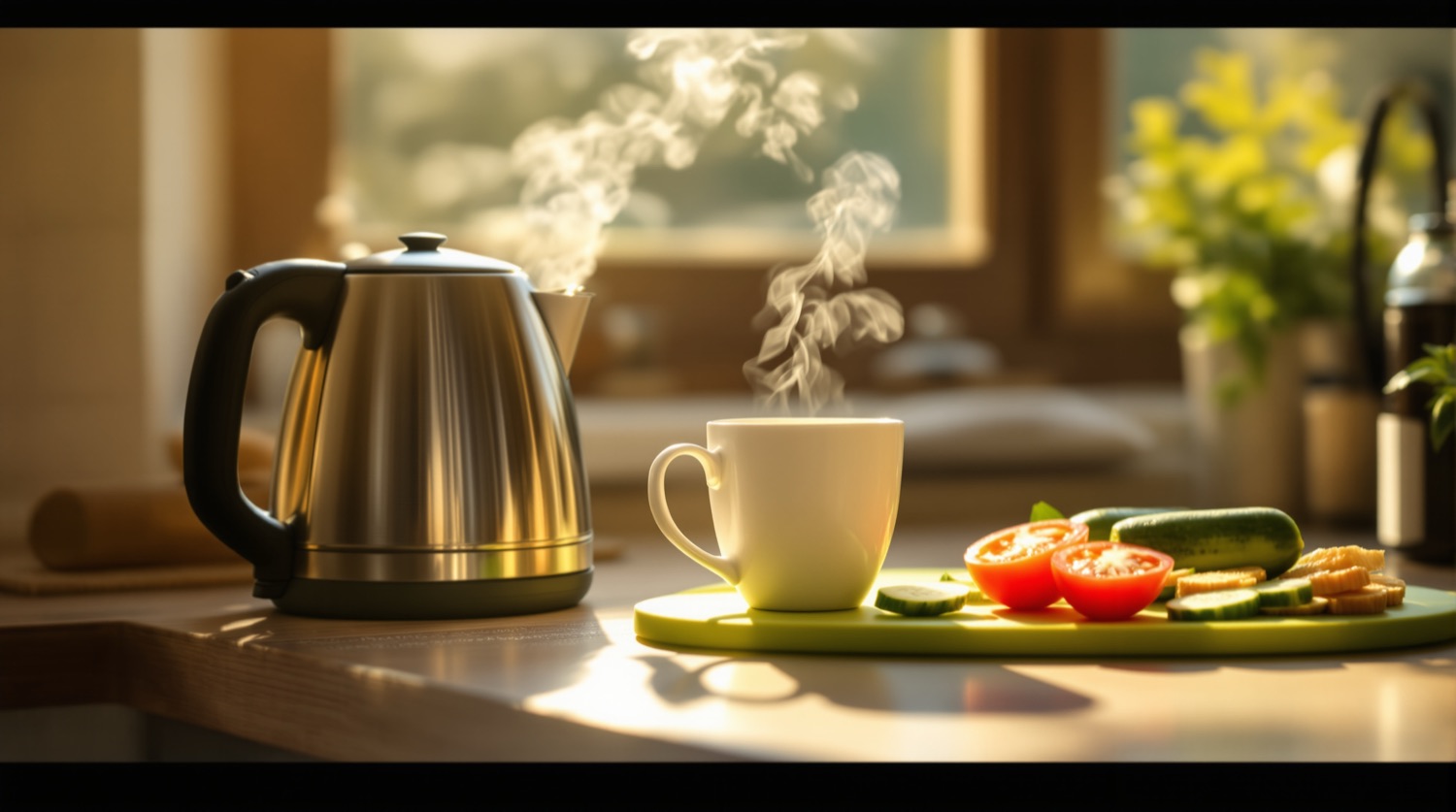
Most of the plastic you eat comes from the kitchen around the food, not the food itself. Peer-reviewed labs have measured the seven habits that shed the most: hot water in a polypropylene container releases up to 16.2 million microplastic particles per liter (Trinity College Dublin, 2020); a single plastic pyramid tea bag releases 11.6 billion microplastics and 3.1 billion nanoplastics per cup (McGill University, 2019); microwaving a plastic container for 3 minutes sheds up to 4.22 million microplastics per square centimeter (University of Nebraska-Lincoln, 2023); and a liter of bottled water carries roughly 240,000 nanoplastic particles (Columbia University, 2024). Each mistake has a swap that costs little and removes most of the exposure.
The kitchen is the single hardest room to keep plastic-free, because every meal you cook, reheat, serve, or drink from touches it in some way. And the specific habits that shed the most microplastics are almost always the ones no one thinks about: not the plastic-wrapped groceries, but the black plastic spatula stirring the sauce, the pyramid tea bag steeping in the mug, the pitcher of water sitting on the counter. Since about 2019 the peer-reviewed literature has quietly filled in real numbers for each one, and the picture is now specific enough to act on.
This guide walks through the seven kitchen habits that measurably move the most microplastic into food, with the study behind each number and the swap that removes it. None of these swaps require a renovation, an appliance upgrade, or a lifestyle overhaul — most cost less than a week of groceries and pay back in a decade of use.
The bottom line up front: if you can only change one thing, take plastic out of the step where it meets hot water — a glass or stainless non-toxic kettle and a certified water filter pitcher together remove the two highest-shedding habits on the list. Then work through the rest at grocery-run pace, one habit at a time — starting with the container you reheat lunch in, covered in our guide to the best non-toxic lunch containers for adults.
The seven kitchen mistakes, in one table
Each row below is one everyday habit, the peer-reviewed study that put a number on it, and what that number actually means for the food. Every study cited here is an independent peer-reviewed paper, linked in the sources list at the bottom; the microplastic numbers are the values the labs published, not our estimates.
| Kitchen mistake | Peer-reviewed measurement | The swap |
|---|---|---|
| Boiling water in a plastic-bodied electric kettle | Up to 16.2 million particles/L from hot water on polypropylene (Li et al., Nature Food, 2020) | Glass or stainless steel kettle |
| Steeping tea in a plastic pyramid bag | 11.6 billion microplastics and 3.1 billion nanoplastics per cup (Hernandez et al., Environ. Sci. & Technol., 2019) | Loose-leaf with a stainless infuser |
| Chopping on a plastic cutting board | 14.5–71.9 million polyethylene particles/year per person (Yadav et al., Environ. Sci. & Technol., 2023) | Hardwood or bamboo board |
| Microwaving food in a plastic container | Up to 4.22 million microplastics + 2.11 billion nanoplastics per cm² in 3 min (Hussain & Balakrishnan, Environ. Sci. & Technol., 2023) | Glass or ceramic in the microwave |
| Drinking hot coffee or tea from a lined paper cup | ~25,000 particles per 100 mL serving in 15 minutes (Ranjan et al., J. Hazardous Materials, 2021) | Reusable ceramic or stainless mug |
| Drinking single-use bottled water | ~240,000 nano- and microplastic particles/L (Qian et al., PNAS, 2024) | Certified pitcher or RO filter on tap water |
| Cooking on scratched or overheated nonstick pans | Cracked PTFE coating releases millions of particles per meal (Luo et al., Sci. Total Environ., 2022) | Cast iron, stainless steel, or carbon steel |
Mistake #1: Boiling water in a plastic-bodied electric kettle
The single most-repeated microplastic release finding in the peer-reviewed literature is this: put hot water in polypropylene, count the particles that come out. In 2020 a Trinity College Dublin team publishing in Nature Food measured up to 16.2 million microplastic particles per liter shedding from polypropylene into hot water, and both increasing the temperature and sterilizing the container made the release worse. The study was framed around baby bottles because they are polypropylene, but the physics does not care what the container is called. A plastic-bodied electric kettle boiling water for tea, coffee, oatmeal, or a French press is the exact same experiment run a hundred times a week in a normal kitchen.
The swap: a stainless steel or glass electric kettle where nothing plastic touches the hot water. It costs about the same as the plastic ones and lasts longer. Our vetted picks are in the best non-toxic electric kettle guide, and if you want to see the shedding data laid out in full, we walk through it in do electric kettles have microplastics.
Mistake #2: Steeping tea in a plastic pyramid bag
The premium-feeling nylon and PET pyramid tea bags are the most extreme point source in this whole list, gram for gram. In 2019, chemists at McGill University led by Nathalie Tufenkji published a study in the American Chemical Society journal Environmental Science & Technology, cutting the ends off four premium tea bags, rinsing them to remove any residual tea leaves, and steeping the empty bags at 95°C. A single bag released about 11.6 billion microplastic particles and 3.1 billion nanoplastic particles into a single cup. Standard paper bags do not have that plastic mesh, but many are still sealed with a small dot of polypropylene or PLA to hold the bag shut.
The swap: loose-leaf tea with a stainless steel infuser, or a brand that uses genuine unbleached paper bags sealed with a metal staple rather than plastic. The best non-toxic tea bags guide ranks the brands that pass this test and names five that fail it.
Mistake #3: Chopping vegetables on a plastic cutting board
Cutting boards seemed like a strange addition to microplastics research until 2023, when a team at North Dakota State University weighed the plastic shavings knives strip off boards during normal chopping and published the results in Environmental Science & Technology. Depending on the material (polypropylene versus polyethylene), the sharpness of the knife, and how the cook chopped, a single person could be swallowing between 14.5 million and 71.9 million polyethylene microplastic particles per year from the board alone. And every one of them ends up in whatever you were chopping.
The swap: a hardwood or bamboo cutting board. Wood is antimicrobial by nature (a 2015 UC Davis study is the classic reference), sheds nothing plastic, and outlasts a plastic board by years. We cover the full comparison in the best non-toxic cutting boards guide, and if you want to see how the raw shedding number breaks down, in do plastic cutting boards have microplastics.
Mistake #4: Microwaving food in a plastic container
Reheating leftovers straight from the Tupperware is the habit almost every household defaults to, and the one that has the ugliest peer-reviewed number attached. In 2023, Kazi Albab Hussain and Gorka Balakrishnan at the University of Nebraska-Lincoln published a study in Environmental Science & Technology that ran commercial polypropylene and polyethylene food containers, plus reusable baby food pouches, through the microwave for 3 minutes with water and dilute acetic acid inside. The containers released as much as 4.22 million microplastic particles and 2.11 billion nanoplastic particles per square centimeter of container surface. Multiply by the surface area of a real Tupperware and you are eating billions of particles from a single reheat. Single-serve microwave rice cups and pouches are the same trap in a smaller package: a University of Queensland study found instant rice carries about four times the microplastic of plain dry rice you rinse and boil yourself. The pot you boil it in matters too: a nonstick inner pot adds particles back after the rinse, which is why the best non-toxic rice cookers use an uncoated stainless steel pot.
The swap: transfer leftovers to a glass or ceramic plate or bowl before the microwave. Never microwave anything — even "microwave-safe" plastic — and never let hot food touch a plastic container while it is still steaming. The deeper walk-through is in is it safe to microwave Tupperware, and if you want to replace your storage set entirely, the best glass food storage containers guide ranks the options.
The "microwave-safe" label on plastic Tupperware is a food-safety mark, not a microplastic mark. It certifies the container will not melt or leach certain regulated chemicals; it says nothing about how many micro- or nanoplastic particles the plastic sheds into your food under the same heat. In the Nebraska-Lincoln study, the containers that shed the most were all labeled microwave-safe. If you are deciding what to store and reheat food in, it helps to know how silicone and plastic food containers compare on measured leaching rather than trusting the label alone.
Mistake #5: Drinking hot coffee or tea from a lined paper cup
Almost every disposable "paper" cup is lined on the inside with a thin polyethylene film, because unlined paper would leak. When hot liquid sits against that film, the film sheds. A 2021 study in the Journal of Hazardous Materials by researchers at the Indian Institute of Technology Kharagpur poured 85–90°C water into standard paper cups and measured what came out after 15 minutes: about 25,000 microplastic particles per 100 milliliters of drink, plus ions of lead, chromium, and other trace metals from the ink and adhesive. We break that research down in full — and the reusable cups that avoid it — in do paper cups have microplastics.
The swap: a reusable ceramic mug at the desk and a stainless steel or glass travel mug on the road. A commuter who does one takeaway coffee a day saves roughly 3 million particles a month by carrying their own cup. It is also usually free — most coffee shops discount your drink for bringing one.
Mistake #6: Drinking single-use bottled water instead of filtered tap
Until 2024, most microplastic-in-bottled-water numbers you saw quoted came from a 2018 study that counted only what large enough to see under a normal microscope — particles larger than about 100 microns. Then Naixin Qian and colleagues at Columbia University and Rutgers ran three top-selling U.S. bottled water brands through a stimulated Raman scattering microscope that can identify individual nanoplastic particles, and published in the Proceedings of the National Academy of Sciences. Average count: about 240,000 plastic particles per liter, 90% of them nanoplastic. That is 10 to 100 times higher than earlier estimates that were blind to the small fraction.
The swap: a certified filter on your tap water. A pitcher-style hollow-fiber or activated-carbon filter costs about the same per gallon as bottled water for a week, and can be third-party tested against microplastics. The full comparison for the leading brands is in the best water filter pitcher for microplastics guide, and the deep dive into filter technology is in the best water filter for microplastics 2026. If you cannot avoid single-use bottles entirely, the best filtered water bottles rank the reusable options with built-in filters.
“The pattern across every study on this page is the same thing said a different way: plastic sheds when it is hot, when it is wet for a long time, when it is cut, and when it is worn out. The fix is always to move the food off the plastic during those moments.”
Mistake #7: Cooking with scratched or overheated nonstick pans
A brand-new nonstick pan used at reasonable temperatures is not the highest-shedding item in a kitchen. A scratched, chipped, or repeatedly overheated one is a different object. In 2022, researchers at Flinders University in Australia (Cheng Fang and colleagues) published a Raman-spectroscopy study in Science of the Total Environment that showed a single crack in a Teflon (PTFE) nonstick coating can release millions of microplastic particles from the pan into food during a normal cook. Overheating an empty pan past ~260°C also breaks the coating down and shortens the pan's shedding-free life dramatically. Many shoppers reach for a ceramic-coated pan to sidestep PTFE altogether; how ceramic and non-stick cookware compare covers whether that swap actually holds up.
The swap: a well-seasoned cast iron pan, a stainless steel pan, or a carbon steel pan. All three are traditional cookware that has fed people for a century longer than PTFE has existed. The best non-toxic cookware guide covers the full comparison, and the is nonstick cookware safe explainer walks through the specific PFAS and PTFE questions in more depth.
What is the single biggest source of microplastics in a kitchen?
Hot water in polypropylene. It is the same underlying mechanism behind mistakes 1, 4, and 6 above, and it is the number that comes up largest in every study that has ever measured it. If you can only change one thing, take plastic out of the step where it meets heat — a glass or stainless non-toxic electric kettle, glass storage for the microwave, and filtered tap water in a glass carafe or steel bottle. That single move cuts the biggest measured source in one weekend and costs roughly the same as a nice dinner out.
Do these swaps actually cut how much plastic you eat?
Yes, and the arithmetic is not close. The seven mistakes above, done at ordinary frequencies (two cups of tea a day, one microwaved lunch, one takeaway coffee, one bottle of water, chopping every evening on a plastic board) add up to billions of measured particles a week entering your food. Swapping just the top four — kettle, tea bag, cutting board, microwave — removes the majority. None of these swaps require you to buy anything more than once, and most of them cost less than a single grocery shop.
What none of these studies show, in fairness, is direct harm from those particles inside a healthy adult. They count particles, not outcomes, and the health science is genuinely unsettled. The reason to act anyway is that the swaps are cheap, the alternatives are already what most kitchens used before plastic became the default, and the direction of every new study since 2019 has been "there is more plastic here than we thought." The dish sponge is the newest example: a 2024 study in Environmental Science & Technology found that as an ordinary plastic foam or melamine sponge wears down it sheds millions of microplastic fibers into your wastewater and onto your dishes — a routine kitchen habit nobody had measured until recently.
How to rank the swaps if you can only do a few
Ranked by how much measured exposure each one removes, based on the studies above:
- Take plastic out of hot water. Replace a plastic-bodied electric kettle and any plastic cup used for hot drinks with glass or stainless steel. This removes the up-to-16.2-million-particles-per-liter source (Nature Food, 2020). Start with the non-toxic kettle.
- Ditch plastic tea bags. One switch to loose-leaf or genuine paper removes billions of particles from every cup (McGill, 2019). See the best non-toxic tea bags.
- Never microwave in plastic. Transfer to glass or ceramic first. Removes the highest per-square-centimeter release in the literature (Nebraska-Lincoln, 2023). See the best glass food storage containers.
- Filter your tap water and skip bottled. A certified pitcher removes the 240,000-particles-per-liter load in single-use bottles (Columbia/Rutgers, PNAS, 2024). See the best water filter pitcher for microplastics.
- Chop on wood or bamboo. A hardwood board eliminates the 14.5–71.9-million-particles-per-year source (North Dakota State, 2023). See the best non-toxic cutting boards.
- Carry a reusable coffee cup. Removes the ~25,000-per-drink source in lined paper cups (IIT Kharagpur, 2021), and coffee shops usually give you a discount for it. Brewing at home? Our picks for non-toxic coffee makers keep the hot water off plastic upstream of the cup.
- Retire scratched or overheated nonstick pans. A single crack in the coating starts shedding millions of particles per cook (Flinders University, 2022). See the best non-toxic cookware.
Cut the biggest source in one afternoon
The two swaps that remove the most measured microplastic exposure in a normal kitchen: a non-toxic kettle and a certified water filter. Both together cost less than a month of takeout coffee. And if you brew that coffee in a pod machine, it is worth knowing whether K-Cups shed microplastics before your next cup.
Is it worth it if you can only change one thing?
Yes — and the honest answer to which one is different depending on your kitchen. If you make hot drinks at home most days, the plastic-bodied kettle is doing the most damage and switching it costs about $60. If you eat mostly reheated leftovers, the microwaved plastic container is worse, and the fix costs the price of a set of glass storage — the same heat-plus-plastic trade-off decides whether you can microwave a Ziploc bag, which is rated for gentle reheating only, never to cook. If you buy bottled water for the family, that is 240,000 particles per liter you can zero out with a $40 pitcher.
None of these are moral judgements about the food, or the pace of a busy life, or the parents who used the plastic kettle for the last decade because that is what they were sold. The peer-reviewed measurements simply were not published until recently, and now that they are, the swap is cheaper than the doubt.
The Complete Plasticproof Home Guide
These seven kitchen swaps are the highest-impact ones, but the kitchen is one room of the whole house. The Complete Plasticproof Guide walks you through 50+ swaps room by room, backed by every study we cite.
Frequently Asked Questions
Hot water in contact with polypropylene. In 2020 Trinity College Dublin researchers measured polypropylene baby bottles releasing up to 16.2 million microplastic particles per liter when hot water was used to make formula in them. The same physics applies to a plastic-bodied electric kettle and to reheating food in a plastic container: heat plus polypropylene produces the largest measured release of any kitchen habit. If you can only change one thing, take plastic out of the step where it meets hot water.
Yes, and the numbers are extreme. In 2019 a team at McGill University tested premium nylon and PET pyramid tea bags in the journal Environmental Science & Technology and measured 11.6 billion microplastic particles and 3.1 billion nanoplastic particles released into a single cup of hot water. Standard paper tea bags are usually sealed with a small amount of plastic (polypropylene or PLA), but the pyramid style is by far the worst offender because the whole bag is plastic.
In terms of microplastics, it is the highest-shedding habit measured for reheated food. A 2023 University of Nebraska-Lincoln study in Environmental Science & Technology microwaved commercial plastic containers and reusable food pouches and measured releases as high as 4.22 million microplastic particles and 2.11 billion nanoplastic particles per square centimeter of container surface in three minutes. Reheat in glass or ceramic instead. If you must use plastic, do not microwave it — warm the food in a pot or transfer it to a plate first.
About a quarter of a million particles per liter, most of them nanoplastic. A 2024 Columbia University and Rutgers study in the Proceedings of the National Academy of Sciences used stimulated Raman scattering microscopy to count plastic particles in three top-selling U.S. bottled water brands and found an average of roughly 240,000 particles per liter — 10 to 100 times higher than earlier estimates that missed the nanoplastic fraction. A good pitcher filter on tap water costs pennies per gallon and delivers water without that load.
Yes. A 2023 study by researchers at North Dakota State University, published in Environmental Science & Technology, weighed and analyzed the shavings produced during normal chopping on polypropylene and polyethylene cutting boards. Depending on the material, board wear, and how the cook chopped, an individual could ingest between 14.5 million and 71.9 million polyethylene microplastics per year from cutting board wear alone. A hardwood or bamboo board eliminates that source.
No. Almost every disposable paper cup is lined with a thin polyethylene film to keep the paper from leaking, and hot liquid strips microplastics off that film. A 2021 study in the Journal of Hazardous Materials by researchers at the Indian Institute of Technology Kharagpur measured about 25,000 microplastic particles released into a 100-milliliter serving of hot water held in a paper cup for 15 minutes. A ceramic mug or a stainless travel cup avoids the whole problem.
Sources
- Li D, Shi Y, Yang L, et al. “Microplastic release from the degradation of polypropylene feeding bottles during infant formula preparation.” Nature Food, 2020;1(11):746–754. (10 polypropylene bottles through WHO-protocol prep; up to 16.2 million particles per liter; both sterilization and hotter water increased release. The largest measured microplastic release from any single kitchen habit.)
- Hernandez LM, Xu EG, Larsson HCE, Tahara R, Maisuria VB, Tufenkji N. “Plastic Teabags Release Billions of Microparticles and Nanoparticles into Tea.” Environmental Science & Technology, 2019;53(21):12300–12310. (Nylon and PET pyramid tea bags released 11.6 billion microplastic and 3.1 billion nanoplastic particles per cup steeped at 95°C.)
- Yadav H, Khan MRH, Quadir M, et al. “Cutting Boards: An Overlooked Source of Microplastics in Human Food?” Environmental Science & Technology, 2023;57(22):8225–8235. (Between 14.5 million and 71.9 million polyethylene microplastic particles per person per year from routine chopping on plastic cutting boards.)
- Hussain KA, Romanova S, Okur I, et al. “Assessing the Release of Microplastics and Nanoplastics from Plastic Containers and Reusable Food Pouches: Implications for Human Health.” Environmental Science & Technology, 2023;57(26):9782–9792. (Microwaving commercial plastic containers for 3 minutes released as much as 4.22 million microplastic and 2.11 billion nanoplastic particles per cm² of container surface.)
- Ranjan VP, Joseph A, Goel S. “Microplastics and other harmful substances released from disposable paper cups into hot water.” Journal of Hazardous Materials, 2021;404:126218. (About 25,000 microplastic particles released into a 100 mL serving of hot water held for 15 minutes in a standard lined paper cup, along with detectable ions of lead, chromium, and cadmium.)
- Qian N, Gao X, Lang X, et al. “Rapid single-particle chemical imaging of nanoplastics by SRS microscopy.” Proceedings of the National Academy of Sciences, 2024;121(3):e2300582121. (Bottled water from three top-selling U.S. brands averaged approximately 240,000 plastic particles per liter, roughly 90% of them nanoplastic — 10–100× earlier estimates.)
- Luo Y, Gibson CT, Chuah C, Tang Y, Naidu R, Fang C. “Raman imaging for the identification of Teflon microplastics and nanoplastics released from non-stick cookware.” Science of the Total Environment, 2022;851:158293. (A single crack in a PTFE nonstick coating released millions of Teflon microplastic particles from the pan surface into food during normal cooking.)