Affiliate disclosure: This article contains affiliate links. If you purchase through these links, Plasticproof may earn a small commission at no extra cost to you. We only recommend products we believe genuinely reduce plastic exposure.
A cellulose sponge cloth that soaks like a sponge and wipes like a rag — plant-based, home-compostable, and the closest one-for-one replacement for the plastic dish sponge in most kitchens.
Check Today’s Price on Amazon →See how all 6 picks compare below.
What is the best plastic-free kitchen sponge?
For most kitchens, a cellulose sponge cloth (like our top pick, the Full Circle Squeeze) is the closest one-for-one swap for the yellow-and-green dish sponge: it absorbs like a sponge, wipes like a rag, and composts at end of life. If you want fewer paper towels alongside it, a Swedish dishcloth is a step up — one 8×7 in cloth soaks up about 15 times its weight in water and replaces roughly 17 rolls of paper towels over its 6-9 month life. And for the jobs a soft sponge cannot do — cast iron, sheet pans, baked-on grease — a natural coconut-coir or bamboo brush is the right tool.
What matters is what the tool is made of. Every pick below is wood-pulp cellulose, cotton, or a natural plant fiber — nothing petroleum-based, nothing that fractures into microplastic fibers, nothing that leaves plastic in your sink or in the meal you eat after.
Compare all 6 picks
Every pick side by side — tap a name to jump to the full review, or check today's price.
| Pick | Material | Best For | Lifespan |
|---|---|---|---|
| Full Circle Squeeze Cellulose Sponge Cloths Best Overall | Cellulose + cotton | Everyday dishes & counters | 2-4 months |
| Augine Swedish Dishcloths (5-pack) Best Reusable Cloth | Cellulose + cotton | Wiping, spills, counters | 6-9 months |
| EcoCoconut Kitchen Dish Brush Best for Cast Iron | Coconut coir + rubberwood | Baked-on grease, cast iron | 3-4 months |
| SUBEKYU Bamboo Palm Brush Best Budget Scrubber | Sisal + bamboo | Pots & vegetables | 4-6 months |
| BONUMVITA Bamboo Kitchen Kit Best All-in-One | Bamboo + natural bristles | Dishes, pots, bottles, sinks | 3-4 months per brush |
| Vove Bamboo Brush + 3 Refill Heads Best Refillable | Bamboo + natural fiber | Long-term daily scrubbing | Up to 12 months (with refills) |
The problem with a plastic dish sponge
The everyday sponge is engineered from the same family of plastics as memory foam and carpet backing. The soft yellow body is polyurethane foam — a petroleum-derived open-cell plastic. The green scrub pad on top is polyester or nylon, glued to the foam with a synthetic adhesive. As you scrub, all three layers abrade at the microscopic level and release fibers that flow down the drain or stay stuck to whatever plate you just cleaned.
Melamine "magic eraser" sponges are worse. They look like white foam but are made of poly(melamine-formaldehyde), a brittle plastic engineered to crumble on contact — that crumbling is exactly the abrasive action that removes marks. A 2024 study in Environmental Science & Technology measured what that crumbling actually releases: roughly 6.5 million microplastic fibers per gram of worn-down sponge material, with worldwide use estimated to emit ~4.9 trillion of these fibers every month.
Because these fibers are 10-400 micrometers long, wastewater treatment plants let a large fraction through into rivers and lakes. The U.S. Environmental Protection Agency's microplastics program lists laundry, cosmetics, and cleaning products (including sponge foam) as documented indoor sources of the plastic fibers now found in tap water, seafood, and human tissue samples.
The dish is the second problem. Some of what the sponge sheds sticks to plates and glasses and gets ingested at the next meal. A 2020 Nature Food paper by Boland's group at Trinity College Dublin is the most-cited kitchen exposure study — it measured polypropylene infant bottles releasing up to 16.2 million particles per liter of formula during hot-water prep. The mechanism is the same one at your sink: plastic in contact with hot water and mechanical stress sheds particles at scale.
Many sponges marketed as "natural" or "eco" still bond a plastic scrub pad to a cellulose core — you get partial credit and full microplastic shedding. A genuinely plastic-free sponge names only cellulose, wood pulp, cotton, loofah, coconut coir, sisal, tampico, or a similar plant fiber on its ingredient list. If the label says "with abrasive scrubber" and does not specify a natural material, assume the scrubber is polyester.
What to look for in a plastic-free kitchen sponge
Not all natural sponges are equal. Here are the four features that separate a genuine plastic-free swap from a decorative product that falls apart in a week.
100% plant fiber — every layer
The main options are cellulose (wood pulp, the closest texture to a conventional sponge — absorbent, soft, compostable), cotton (usually paired with cellulose in a Swedish dishcloth), loofah (dried gourd fiber, tough and mildly abrasive — great for produce and pans), coconut coir (the stiffest natural fiber — ideal for cast iron and baked-on food), and sisal or tampico (agave fibers, medium-stiff, safe for glassware). Any of these is fine. What is not fine is a "natural" product that hides a polyester or nylon scrub pad on the back.
A drying-friendly shape
Natural fibers hold food particles and last longer when they dry fully between uses. Cellulose sponge cloths dry in about an hour when hung; solid sponge blocks stay damp for hours and start to smell. Swedish dishcloths are the winner here — the flat shape and cotton content mean they air-dry stiff, then rewet completely on the next use. If you buy a solid sponge, buy a small drainage rack or hang it on a hook.
Machine-washable or vinegar-safe
A plastic sponge is thrown away because you cannot clean it. A cellulose sponge or Swedish dishcloth goes on the top rack of the dishwasher or into the washing machine, and comes out effectively sterilized — which is the whole reason it lasts 6-9 months instead of two weeks. Confirm this on the label before you buy.
Metal or plant-fiber fastenings only
On brushes, look for bristles secured with stainless steel wire or metal staples — not plastic plugs or synthetic adhesives. Metal fasteners are more durable, fully recyclable, and let the brush compost cleanly at end of life once the wire is pulled out.
Quick Picks — Best Plastic-Free Kitchen Sponges 2026
- Best Overall: Full Circle Squeeze Cellulose Sponge Cloths
- Best Reusable Cloth: Augine Swedish Dishcloths (5-pack)
- Best for Cast Iron: EcoCoconut Kitchen Dish Brush
- Best Budget Scrubber: SUBEKYU Bamboo Palm Brush
- Best All-in-One Kit: BONUMVITA Bamboo Kitchen Kit
- Best Refillable: Vove Bamboo Brush + 3 Refill Heads
Our Top 6 Plastic-Free Kitchen Sponge Swaps
 Best Overall
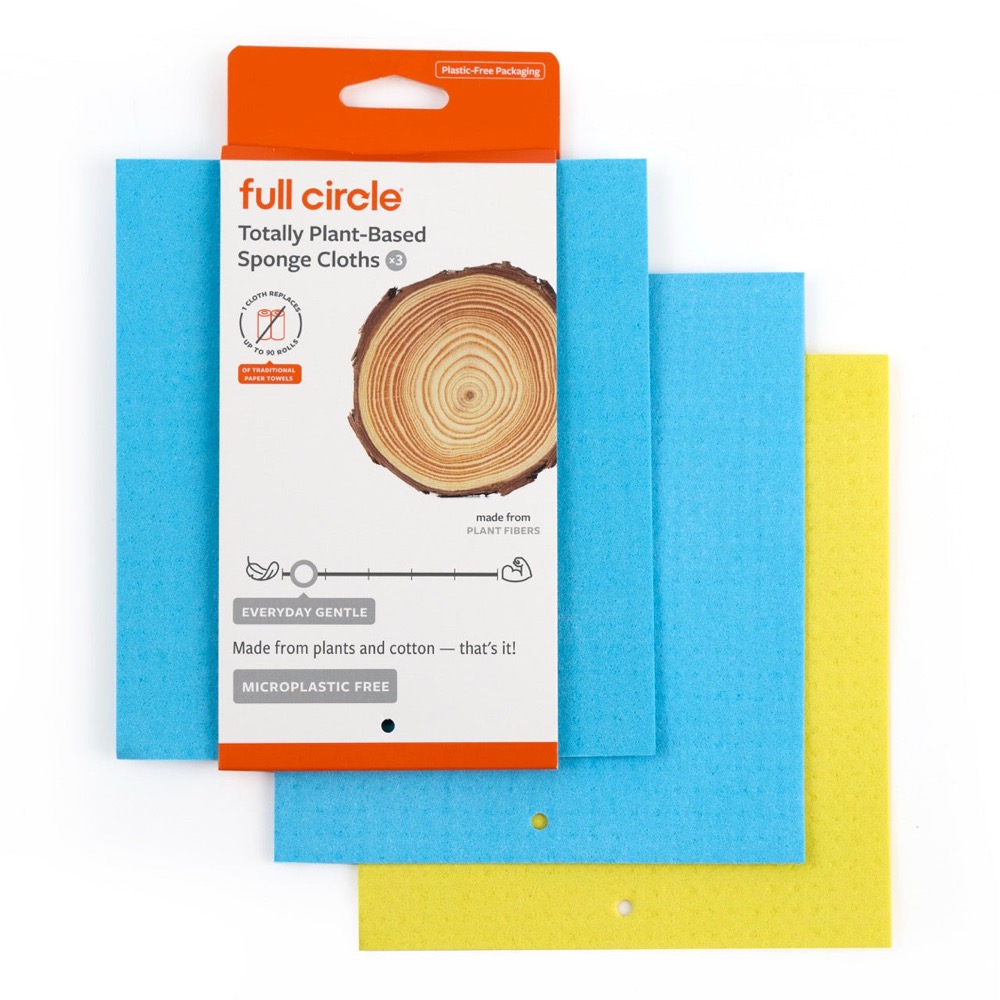
Full Circle's Squeeze is a plant-based sponge cloth — cellulose pulp with a cotton reinforcement layer — that behaves like a firm, squishy sponge when wet. It soaks up spills the way a plastic sponge does, but the material is compostable wood fiber, so nothing petroleum-based can shed into your sink. It comes in a 3-pack.
Between uses, hang it or set it on a drainage tray so it dries stiff instead of staying damp. When it starts to smell, run it through the top rack of the dishwasher or a hot laundry cycle to reset it. At end of life — usually 2 to 4 months of daily use — it goes into the compost bin.
Long-time buyers say the Squeeze cloths hold up to daily dishwashing and machine-washing, stiffen up crisp when dry, and rehydrate soft on the next use. The honest gripes: they take a wet-then-squeeze routine to "wake up" and the pastel colors fade with hot washes; a few reviewers say they thin out faster than the older version. Handling them like a dish rag (rather than a heavy scouring pad) is the trick.
A three-pack of plant-based sponge cloths that feel like a real sponge in your hand — no polyurethane foam to shed microplastics.
Why it's safe: Cellulose and cotton, both plant fibers — no polyurethane foam and no polyester scrub layer, so there is nothing petroleum-based to fracture into microplastic fibers as you scrub.
Check Today’s Price on Amazon →Amazon prices change daily — tap to see today's price and any active discount.
- Free delivery & returns for Prime members
- Sold & shipped by Amazon
- Home-compostable at end of life
 Best Reusable Cloth
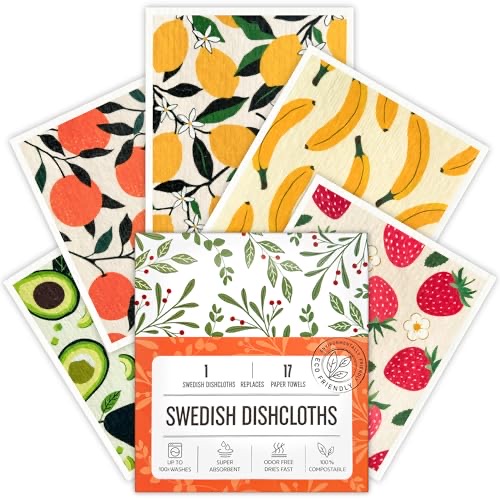
Swedish dishcloths originated in Sweden in the 1940s and this Augine 5-pack is the entry-level way to try them. The cloths are 70% cellulose wood pulp and 30% cotton — both plant fibers, both compostable — and they absorb liquid like a sponge while cleaning surfaces like a rag. Because they dry stiff and flat, they do not hold bacteria and odor the way a solid sponge does.
The economics are the strongest argument. The Swedish-dishcloth industry commonly cites one cloth replacing about 17 rolls of paper towels over its 6-9 month working life — not a lab-measured number, but consistent with the volume of daily wiping one cloth handles. Sanitize weekly on the top rack of the dishwasher or a hot laundry cycle; compost at the end.
Buyers report using these for months without any smell, drying quickly on the sink edge, and washing well in the dishwasher; several call them a "paper towel replacement that actually works." The honest gripes: they arrive rock-hard and dusty (rinse before first use); the printed colors fade after many washes; and they are not the tool for aggressive scrubbing — more of a wipe-up cloth than a scouring pad.
Five reusable Swedish dishcloths in one pack — enough to cover the sink, counters, and stovetop, with a spare drying at all times.
Why it's safe: Cellulose wood pulp and cotton, nothing else — no plastic core and no synthetic scrub layer, so it composts cleanly at end of life instead of shedding microplastic fibers.
Check Today’s Price on Amazon →Amazon prices change daily — tap to see today's price and any active discount.
- Free delivery & returns for Prime members
- Machine washable and top-rack dishwasher safe
- Compostable at end of life
 Best for Cast Iron
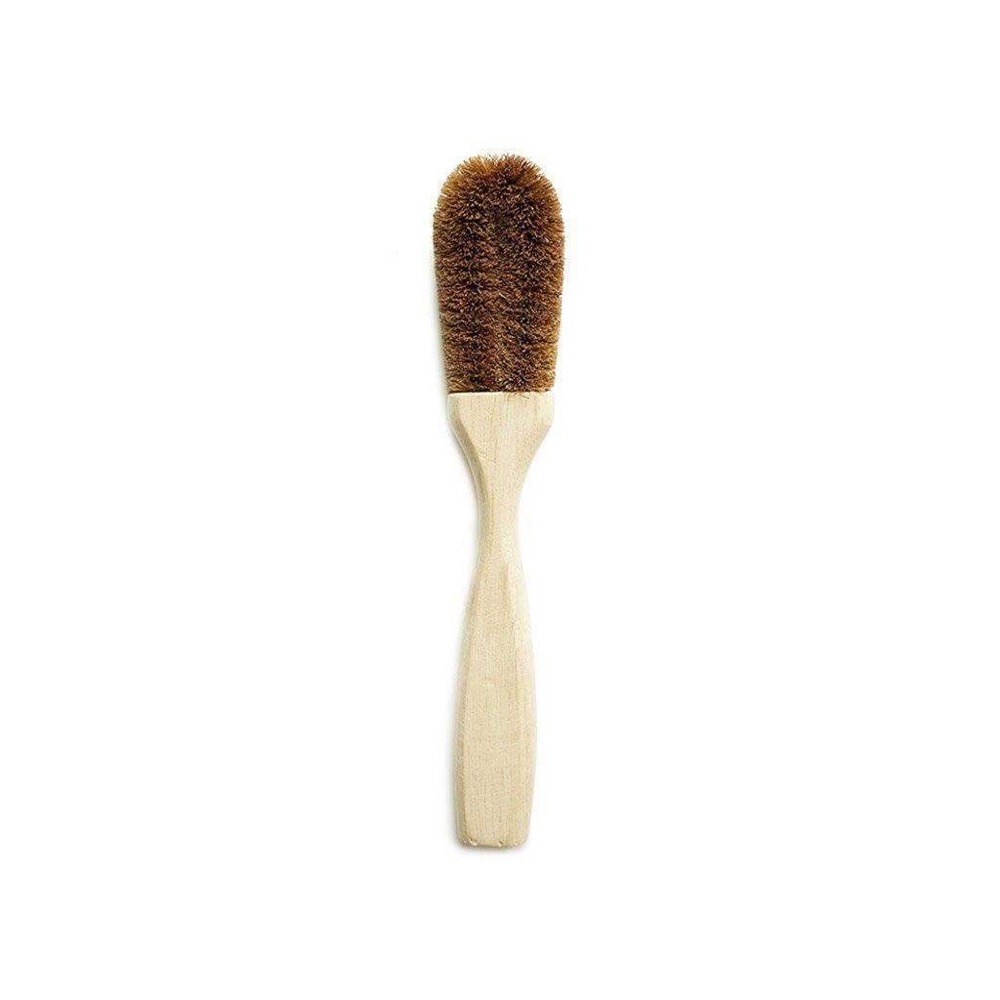
Coconut coir is one of the toughest natural fibers on Earth — naturally resistant to salt water and mold, quick to dry, and stiff enough to move stuck-on food that would flatten a softer bristle. The EcoCoconut pairs those bristles with a rubberwood handle for the jobs where a cellulose sponge cloth is the wrong tool: cast iron seasoning maintenance, sheet-pan grease, and the burnt-on residue at the bottom of a roasting tray.
The whole brush is compostable. When the coir eventually softens (about 3-4 months of heavy use), the wire holding the head can be pulled out and the wood and fiber composted, or the head can be replaced by soaking off the wire and rewinding a new bundle.
Fans of the coir bristles say they are tough on grime without scratching, and that the fibers do not shed the way a cheap brush does. The honest gripes: expect some loose fiber the first few uses; as it wears, the wire underneath can start to poke out and scratch soft plastics; and sticky food like scrambled egg lodges in the bristles and needs rinsing out.
The tool that handles the jobs a sponge cannot — cast iron, sheet pans, and crusted pots — without shredding into your sink.
Why it's safe: Rubberwood handle and 100% coconut-coir bristles — fully plastic-free and biodegradable, so it never sheds microplastics while it scrubs.
Check Today’s Price on Amazon →Amazon prices change daily — tap to see today's price and any active discount.
- Free delivery & returns for Prime members
- Sold & shipped by Amazon
- Plastic-free, biodegradable build
 Best Budget Scrubber
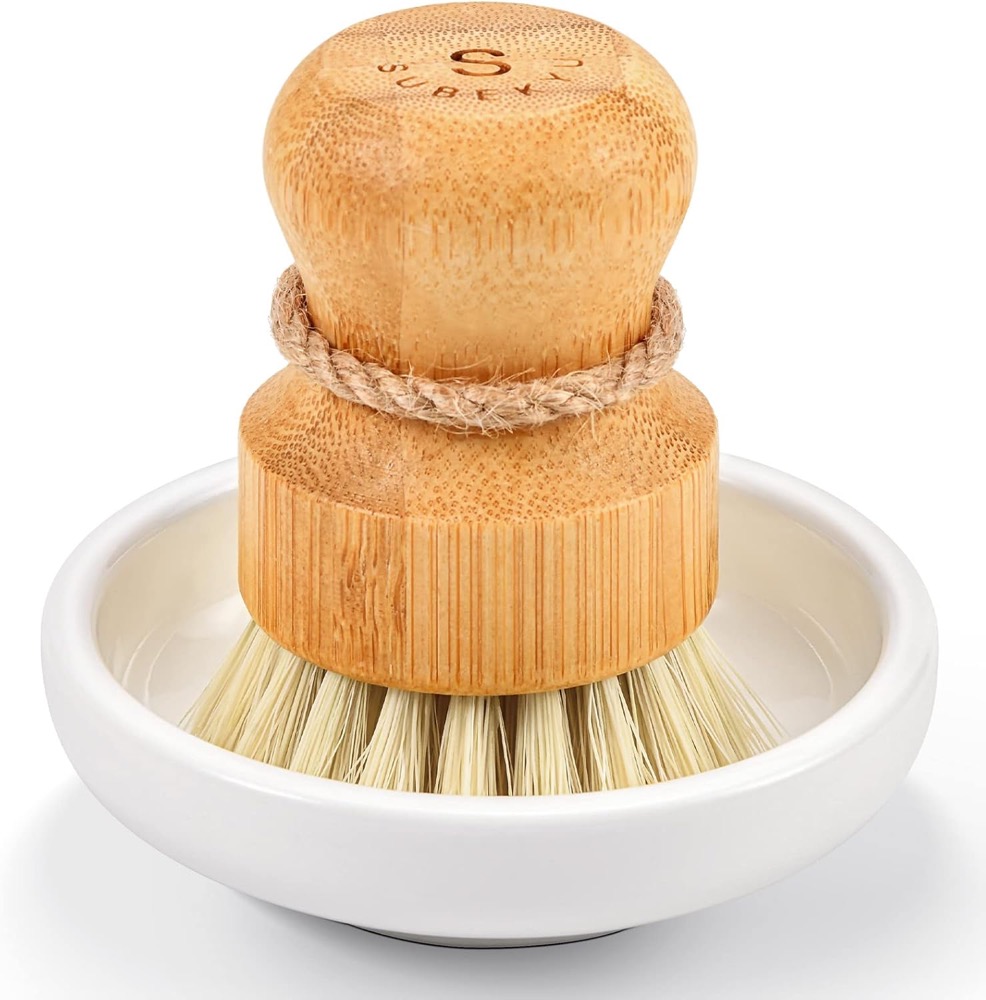
The SUBEKYU is a compact, mushroom-shaped bamboo palm brush with firm sisal bristles — the natural-fiber version of the little handheld scrub sponges most kitchens keep by the sink. You hold it in your palm rather than by a long handle, which gives real downward pressure on pots, vegetables, and stubborn bowls. It ships with a small ceramic drainage dish.
With well over a thousand verified ratings, it is the most road-tested pick here — and by a significant margin the cheapest. The sisal bristles are agave plant fiber, not nylon, so nothing petroleum-based flakes into the water; the head composts at end of life while the bamboo body keeps going.
Owners use this daily and several report it lasting about six months, calling it good value with a comfortable palm grip. The honest gripes: the most common durability complaint is the brush head loosening from the handle after a couple of months (only a short length of the bristle wire is glued into the handle); food bits can be hard to rinse out; and the included ceramic tray sometimes arrives chipped. Hanging it to dry rather than soaking helps it last.
Maximum scrubbing leverage in the palm of your hand — the lowest price of any real plastic-free kitchen scrubber on this list.
Why it's safe: Bamboo handle and natural sisal plant-fiber bristles — no petroleum-based plastic and no microplastic shedding, unlike the nylon-scrubbed sponges it replaces.
Check Today’s Price on Amazon →Amazon prices change daily — tap to see today's price and any active discount.
- Free delivery & returns for Prime members
- Sold & shipped by Amazon
- 1,200+ verified reviews
 Best All-in-One
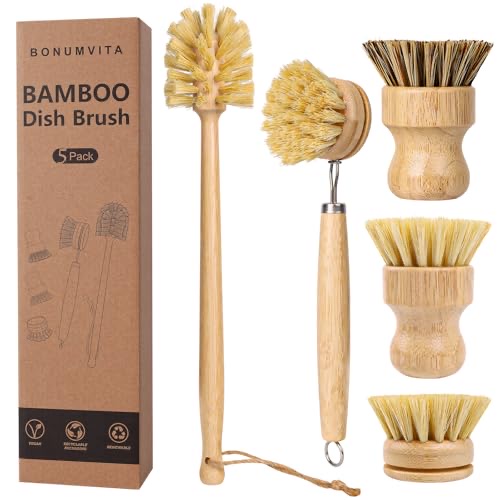
Instead of buying one plastic-free brush at a time, this BONUMVITA set includes five bamboo scrub brushes plus a 14-inch bottle brush. That covers everyday dishes, pots and pans, kitchen sinks, wok bottoms, and even the insides of reusable water bottles — every place a plastic sponge or nylon brush would normally live.
Having five brushes on hand also means you can keep a fresh one drying while another is in use, and swap in a new head the moment one wears down — without touching a plastic replacement. It is the least-friction way to move the whole sink area away from plastic in one purchase.
Buyers like that this set covers everything, from the long bottle brush to palm and sisal scrubbers, and say the wooden handles feel sturdy and the bristles are firm enough to lift food but soft enough not to scratch. The honest gripes: as with all bamboo, handles wear faster under heavy use and can absorb water and pick up an odor if they stay wet; the bristles soften over time; and the set is not built for burnt-on or heavy baked-on stains. Hang them to dry between uses.
Five bamboo brushes plus a bottle brush in one set — enough coverage to retire every plastic sponge and nylon brush at your sink in a single purchase.
Why it's safe: Bamboo handles and natural bristles instead of molded plastic and nylon — no plastic body to fracture into microplastics as it wears.
Check Today’s Price on Amazon →Amazon prices change daily — tap to see today's price and any active discount.
- Free delivery & returns for Prime members
- Sold & shipped by Amazon
- Covers dishes, pots, bottles, and sinks in one purchase
 Best Refillable
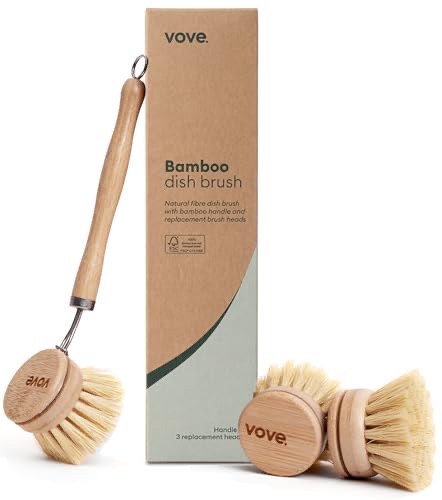
The Vove pairs an FSC-certified bamboo handle with natural fiber bristles and includes three replacement heads. When a head wears down you pop on a fresh one instead of throwing away the whole brush, which cuts waste and keeps the plastic-free handle in service for close to a year.
Natural fiber bristles and a bamboo handle mean there is no molded-plastic body to fracture into microplastics as it wears — and the replaceable heads make it noticeably longer-lived than a one-piece brush.
The draw is the replaceable head on an FSC-certified bamboo handle: each head lasts two to three months and the bundle of spares stretches to six to nine months, which owners like for cutting waste. The honest gripes: some find the handle thick or awkward to grip; the metal wire holding the bristles can loosen over time and need adjusting; and the sisal bristles are on the soft side, so heavy baked-on grime is a struggle — pair it with the EcoCoconut for those jobs.
Three replacement heads in the box — refresh the bristles without buying a whole new brush, for close to a year on one handle.
Why it's safe: A bamboo handle and natural fiber bristles, not molded plastic — nothing petroleum-based to shed microplastics into your dishwater.
Check Today’s Price on Amazon →Amazon prices change daily — tap to see today's price and any active discount.
- Free delivery & returns for Prime members
- Includes three replacement heads
- FSC-certified bamboo handle
"A sponge is a small object you touch every day, on every dish you eat off. That is exactly why swapping it is one of the highest-leverage moves in the kitchen."
How to make a plastic-free sponge last
Natural sponge cloths and brushes reward simple care. The habits below are what keep a cellulose sponge going for 4 months instead of 4 weeks.
- Rinse and squeeze fully after every use. Food particles left in a damp cloth are what create the smell. A clean rinse and a hard squeeze empty most of them out.
- Hang or stand it upright to dry. Air circulation on all sides is the single biggest factor in lifespan — a sponge that sits face-down in a wet dish rack will smell in a week; one that hangs on a hook will not.
- Deep clean weekly. Cellulose sponge cloths and Swedish dishcloths go on the top rack of the dishwasher, or into a hot laundry cycle. Solid natural sponges can soak 15 minutes in a 1:3 vinegar and warm water solution.
- Oil wooden handles occasionally. For untreated wood handles, rub a thin layer of food-safe mineral oil or beeswax into the wood once a month to prevent cracking.
- Compost at end of life. When bristles splay or a cloth thins to the point of tearing, it goes in the compost bin instead of the trash. Metal wires from brushes pull out first.
Want the full kitchen plastic audit?
The Complete Plasticproof Guide covers every room in your home — kitchen, nursery, bathroom, bedroom — with the full research and complete swap list. 47+ peer-reviewed studies, 80+ product recommendations.
Frequently Asked Questions
Almost always, yes. The everyday yellow-and-green kitchen sponge is a polyurethane foam block bonded to a polyester or nylon scrub pad — every layer is a petroleum-based plastic. Melamine "magic eraser" sponges are poly(melamine-formaldehyde) foam, also plastic. Both wear down under normal use and shed microplastic fibers into wash water and onto dishes. A genuinely plastic-free sponge is made from wood pulp cellulose, cotton, loofah plant fiber, or a similar plant material with no synthetic foam or scrub layer.
A 2024 study published in the American Chemical Society journal Environmental Science & Technology measured that melamine cleaning sponges release roughly 6.5 million poly(melamine-formaldehyde) microplastic fibers per gram of worn-down material. The researchers estimated worldwide sponge use could emit on the order of 4.9 trillion of these fibers every month. Standard polyurethane dish sponges also shed fibers — most treatment plants capture only 70-80% of microplastic fibers, meaning the rest flow into rivers and oceans.
For most kitchens, a cellulose sponge cloth is the closest one-for-one swap for a conventional dish sponge — it absorbs like a sponge, wipes like a rag, and composts at end of life. Swedish dishcloths (cellulose and cotton) go a step further: one cloth replaces roughly 17 rolls of paper towels and lasts 6-9 months. For heavy scrubbing jobs a plastic sponge would struggle with — cast iron, sheet pans, baked-on grease — a natural coconut-coir or bamboo brush is the right tool. Our full ranked picks are above.
A 100% cellulose sponge or Swedish dishcloth made from wood pulp and cotton breaks down in a home compost bin within 6-8 weeks. There is no plastic foam or synthetic scrub layer to leave behind. The key word is 100%: many sponges marketed as "natural" still bond a plastic scrub pad to a cellulose core, which is not compostable. Read the material list — a truly plastic-free sponge names only cellulose, wood pulp, cotton, loofah, coconut coir, sisal, or a similar plant fiber.
It depends on the material. A cellulose sponge cloth or Swedish dishcloth lasts 6-9 months with regular use — a weekly deep clean (soak in vinegar solution, or run on the top rack of the dishwasher) extends life significantly. Natural-fiber brushes last 2-4 months of daily use before the bristles splay; a replaceable-head brush stretches this to close to a year by swapping only the head. A loofah scrubber lasts about 3-4 weeks in a wet sink environment.
Sources
- Chen Y, et al. "Estimating the microplastic emissions from melamine sponges." Environmental Science & Technology, American Chemical Society, 2024. Journal home: pubs.acs.org/journal/esthag.
- Li D, Shi Y, Yang L, Xiao L, Kehoe DK, Gun'ko YK, Boland JJ, Wang JJ. "Microplastic release from the degradation of polypropylene feeding bottles during infant formula preparation." Nature Food, 2020. nature.com/articles/s43016-020-00171-y.
- U.S. Environmental Protection Agency. "Microplastics Research." Office of Research and Development, ORD. epa.gov/water-research/microplastics-research.
Protect every room in your home
From the kitchen to the nursery to the bathroom — the Complete Plasticproof Guide covers every swap that matters, backed by 47+ studies.