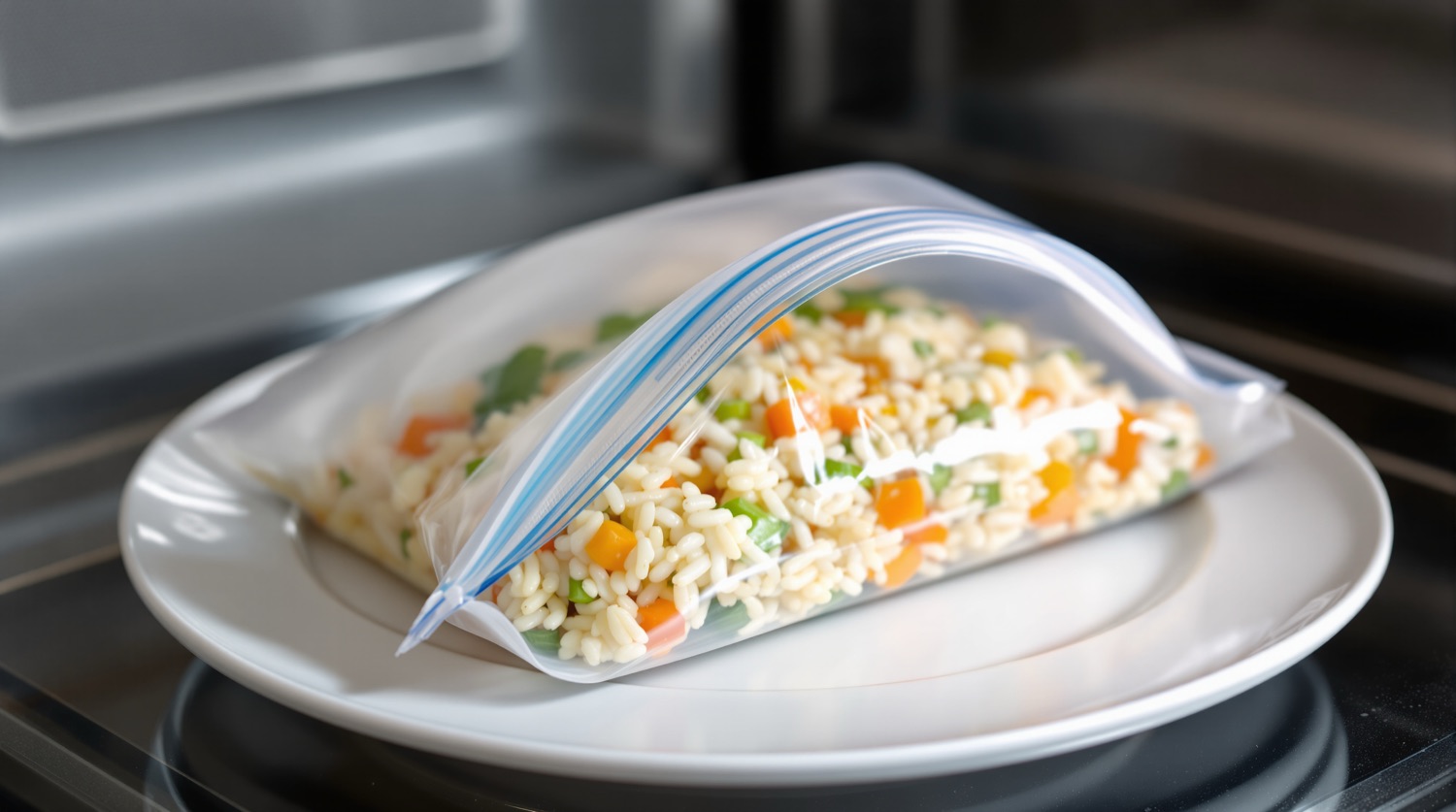
Ziploc's maker allows microwaving its bags for two jobs only — defrosting and reheating — with the zipper opened at least one inch to vent. SC Johnson says bags marked microwaveable meet U.S. FDA requirements for those temperatures, but that its polyethylene bags soften at 230°F, so they are not for cooking, boiling or sous vide. No published study has microwaved a Ziploc-brand bag. The closest data, a 2023 University of Nebraska–Lincoln study in Environmental Science & Technology, found a polyethylene food pouch shed 415,000 to 1.05 million microplastics per square centimeter in water-based storage tests — generally more than polypropylene containers — while the polypropylene containers it microwaved released up to 4.22 million per cm² in 3 minutes. Allowed when used as directed; lower-exposure to thaw in the bag and reheat in glass.
Most people asking this question have a bag of frozen chili or last night's rice in one hand and the microwave door open with the other. The label on the box says you can, the internet says you'll poison yourself, and the truth sits somewhere more useful than either. Ziploc's maker does permit microwaving its bags — for a narrow set of jobs, in a specific way — and the research on heated polyethylene explains why those limits exist.
This guide lays out what SC Johnson actually says (in its own words, with links), why a 230°F softening point matters in a machine that heats fat faster than water, what the heat studies measured on polyethylene and on the polypropylene tubs they're often confused with, where the science is honestly unsettled, and the simple routine that keeps the bag for the freezer and moves the hot part of the job onto glass.
The bottom line up front: use a Ziploc bag in the microwave only to thaw or gently rewarm, with the zipper cracked an inch, on a plate, in short bursts — and never to cook, boil or sous vide. Better still, thaw in the bag and finish reheating in a glass or ceramic dish. For the wider picture on the bags themselves, see are Ziploc bags safe for food storage; for rigid tubs, is it safe to microwave Tupperware.
Are Ziploc bags microwave safe, according to Ziploc?
For defrosting and reheating, yes — and for nothing hotter. The Ziploc FAQ says its bags "can be used in the microwave, but only to defrost or reheat food," tells you to "leave the zipper of the bag open at least one inch to vent any steam or heat," and adds a warning most people skip past: "use caution when reheating foods with a lot of sugar or fat, because they heat up very quickly."
SC Johnson's ingredient disclosure for Ziploc Freezer Bags lists the plastic as low-density polyethylene (LDPE) and linear low-density polyethylene (LLDPE), and states that Ziploc products "marked as 'microwaveable' meet the safety requirements of the U.S. Food and Drug Administration (FDA) for temperatures associated with defrosting and reheating food in microwave ovens." Read that sentence carefully: it is a rating for a temperature range, not a blanket promise that nothing leaves the plastic. The same FAQ rules out sous vide and boiling for polyethylene bags because "the softening point is 230°F and boiling point for water is 212°F." The only Ziploc bags it approves for sous vide are Ziploc Endurables, which are platinum silicone rated up to 425°F. And if you want to actually cook in the microwave, Ziploc sells a separate product for that job, Zip'n Steam bags, with their own cooking directions.
| What you want to do | Ziploc's guidance | The reason |
|---|---|---|
| Defrost frozen food | Allowed — open the zipper at least 1 inch | Thawing keeps the food, and the bag, well below boiling |
| Reheat leftovers | Allowed — vent 1 inch; "use caution" with sugary or fatty food | SC Johnson: fat and sugar "heat up very quickly" |
| Cook raw food in a storage or freezer bag | Not a listed use | Ziploc sells Zip'n Steam bags separately for microwave steam-cooking |
| Boil or sous vide in a polyethylene bag | Not allowed | Softening point 230°F vs. 212°F boiling water |
| Sous vide in Ziploc Endurables | Allowed | Platinum silicone, rated up to 425°F |
Why does a 230°F softening point matter in a microwave?
Because a microwave doesn't heat the bag — it heats the food, and the food heats the bag. The U.S. Food and Drug Administration's microwave oven guidance puts it plainly: containers "can become hot from the heat of the food cooking inside," and "some plastic containers should not be used in a microwave oven because they can be melted by the heat of the food inside." Water-heavy food like soup or rice tops out near 212°F while it still has water to boil off. Fat and sugar don't stop there. A pocket of butter, cheese sauce or syrup pressed against the bag wall can climb past 230°F in seconds, which is exactly why SC Johnson flags sugary and fatty food.
Independent lab measurements line up with Ziploc's number. When the University of Nebraska–Lincoln team behind the 2023 Environmental Science & Technology study ran a polyethylene food pouch through differential scanning calorimetry (a test that tracks when a plastic starts to melt), they found "prominent melting peaks at around 107, 117, and 121 °C" — roughly 225°F to 250°F — "and significant melting occurring at even lower temperatures (between 50 and 100 °C)." The two polypropylene containers they tested peaked about 30°C higher. That pouch wasn't a Ziploc product, but it's the same polymer family, and it shows why thin polyethylene film has so little headroom above boiling.
Do Ziploc bags release microplastics when heated?
Nobody has published a microwave test of a Ziploc-brand bag, so no one can honestly give you a per-bag particle count. What does exist is solid data on the same plastics under similar stress — and it points one way: heat and polyethylene film are a poor pairing.
The most-cited study is Hussain et al., 2023 (PubMed), from the University of Nebraska–Lincoln. The team bought two polypropylene baby-food containers and one reusable food pouch that X-ray analysis confirmed was polyethylene, filled them with water or 3% acetic acid (the U.S. FDA's standard stand-ins for watery and acidic food), and counted what came off. Microwaved at full power (1,000 W) for 3 minutes, the polypropylene containers released 425,000 and 4.22 million microplastics per square centimeter of plastic, plus 169 million and 1.21 billion nanoplastics per cm². The polyethylene pouch was never microwaved — the paper says it "was not tested for microwave heating as it was not suitable for microwave use." Across the three storage tests it did go through, though, the authors report it generally released more particles than the polypropylene tubs.
That detail matters, because the 4.22-million figure is repeated all over the internet in articles about Ziploc bags. It came from a rigid polypropylene container, not a bag. The polyethylene result is the more relevant one for a zipper bag — and it's the one that didn't get microwaved, because the researchers judged the material unfit for it.
| Product tested (water) | Refrigeration (simulated) | Room-temp storage (simulated) | Hot-fill (simulated) | Microwave, 3 min |
|---|---|---|---|---|
| Container 1 (polypropylene) | 49,800 MP / 11.5M NP | 95,000 MP / 47.9M NP | 471,000 MP / 38.6M NP | 425,000 MP / 169M NP |
| Container 2 (polypropylene) | 577,000 MP / 21.5M NP | 841,000 MP / 34.9M NP | 783,000 MP / 183M NP | 4.22M MP / 1.21B NP |
| Reusable food pouch (polyethylene) | 415,000 MP / 59.0M NP | 1.05M MP / 78.6M NP | 873,000 MP / 106M NP | Not tested — "not suitable for microwave use" |
Particles released per square centimeter of plastic into water. MP = microplastics (1 micron and up), NP = nanoplastics (under 1 micron). The storage tests were accelerated lab conditions set by FDA guidance: 20°C for 10 days to stand in for 6–12 months of refrigeration, 40°C for 10 days for long room-temperature storage, and 70°C for 2 hours followed by 10 days at 20°C for hot-filled food. Source: Hussain et al., Environmental Science & Technology, 2023.
Two more studies fill in the picture. Researchers at the U.S. National Institute of Standards and Technology (Zangmeister et al., 2022, Environmental Science & Technology) found that hot-drink cups lined with low-density polyethylene — the main plastic in Ziploc bags — released more than 1 trillion nanoparticles per liter after 20 minutes with 100°C (212°F) water, and that the count depended on water temperature, with hot water releasing more than room-temperature water. And a 2024 study in Nano Express from the University of Newcastle, Australia (Fang et al.) imaged the zipper itself: each time a sliderless zipper is pressed shut and pulled open, friction scrapes off an estimated 5 (±3) micro- and nanoplastic particles per millimeter of zipper — about 50 particles per 10 centimeters, every cycle, with no heat involved at all.
Is microwaving food in a Ziploc bag dangerous?
No study has shown that reheating food in a Ziploc bag harms people, and it would be dishonest to imply otherwise. The particle counts above measure what comes off plastic in a lab, not what happens in a body. In October 2025 the European Food Safety Authority published a review of 122 studies on particles released from food-contact materials. It concluded that "there is evidence of microplastics released during the uses of" those materials, that the release comes mainly from "mechanical stress, such as abrasion or friction," and that "the actual release is much lower than the results presented in many publications" because of widespread methodological problems — leaving "no sufficient basis at this stage to estimate" how much people take in this way. The Nebraska study itself drew a published critique and a rebuttal from its authors in the same journal in 2024.
The question has also been to court. In April 2025, a California shopper sued SC Johnson in federal court (Cheslow v. S.C. Johnson & Son, Northern District of California), arguing that the "microwave safe" and freezer claims on Ziploc bags were misleading because polyethylene sheds particles under those conditions. The case was dismissed later in 2025; SC Johnson told Legal Newsline that "no data was presented in the lawsuit that demonstrates Ziploc sheds any microplastic." No court ruled on the underlying science either way. As for the old dioxin scare, SC Johnson's FAQ says dioxins form only when chlorine meets temperatures around 1,500°F, far beyond any microwave, and that all Ziploc products are dioxin-free.
It is a regulatory rating that the plastic meets FDA requirements at defrosting and reheating temperatures — not a measurement showing zero particles. The evidence that heat increases particle release from polyethylene and polypropylene is consistent; the evidence on health effects is not in yet. Moving the hottest step onto glass costs almost nothing, so it's a sensible hedge while the science catches up.
How do you microwave a Ziploc bag more safely?
If you're going to use the bag in the microwave, stay inside the maker's limits and keep the plastic as cool as possible. These steps come straight from SC Johnson's directions plus what the heat data shows:
- Defrost or rewarm only. Never cook raw food, boil, or sous vide in a storage or freezer bag — that's outside what SC Johnson rates the polyethylene for.
- Open the zipper at least one inch. A sealed bag traps steam, and pressure plus heat is when a seam balloons against hot food.
- Set the bag on a plate or in a bowl. It keeps the thin film from sagging into the hottest spots and catches drips if a seam gives.
- Use the defrost setting or short bursts. Stop as soon as the food is thawed or loose, then finish heating in a glass or ceramic dish.
- Be most careful with fatty and sugary food. Sauces with butter or cheese, fatty meats, and anything syrupy are the foods that race past 230°F. Transfer those before heating.
- Only use bags marked microwaveable. SC Johnson's FDA statement covers products "marked as 'microwaveable'" — check the box before assuming a bag qualifies.
- Don't reheat in a worn bag. A cloudy, creased or stretched bag has already been abraded, and the Newcastle study shows the zipper sheds with every open-and-close.
What should you reheat food in instead of a Ziploc bag?
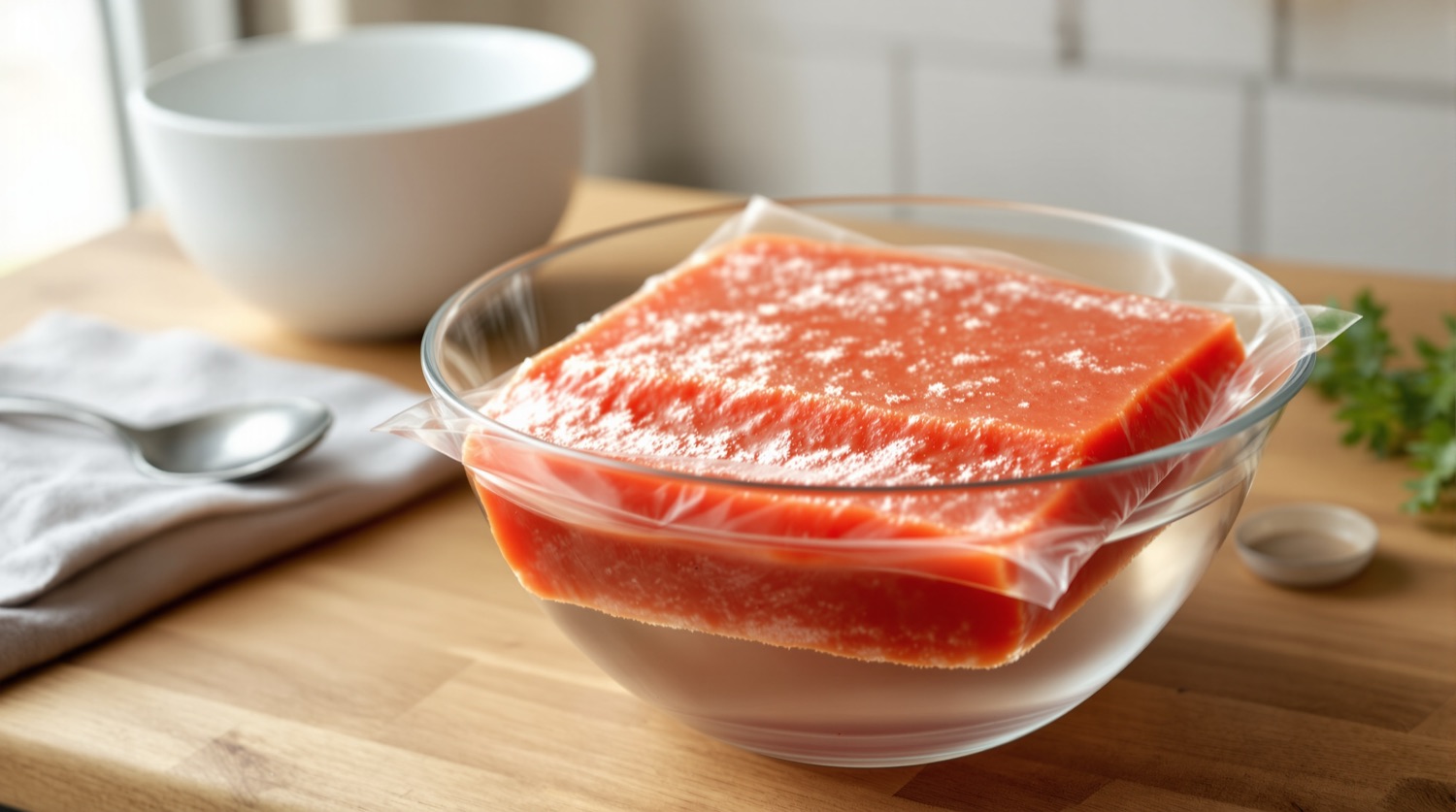
Glass or glazed ceramic, with a plate or a silicone lid on top instead of plastic wrap. The routine that keeps nearly all of a bag's convenience is simple: freeze food flat in the bag, thaw it in the fridge or in a bowl of cold water, then slide it into a glass dish to reheat. The part of the job where plastic meets hot food disappears. If you like the bag format for freezer-to-microwave cooking, platinum silicone bags are rated far hotter than polyethylene — Stasher, for example, says its bags are oven-safe to 425°F.
| Option | What touches the food | Maker's heat rating | Best job |
|---|---|---|---|
| Ziploc storage or freezer bag | LDPE / LLDPE film | Defrost and reheat only; softens at 230°F | Freezing flat, thawing |
| Platinum silicone bag (Stasher, Ziploc Endurables) | Platinum-cured silicone | Rated to 425°F by both makers | Freezer-to-microwave in one bag |
| Tempered glass container (Glasslock, Pyrex) | Glass (lid is plastic) | Glass is microwave- and oven-safe; take the lid off to heat | Reheating leftovers |
| Bowl with a silicone stretch lid | Glass or ceramic; silicone lid | Lid is microwave-, freezer- and dishwasher-safe | Covering food as it reheats, in place of plastic wrap |
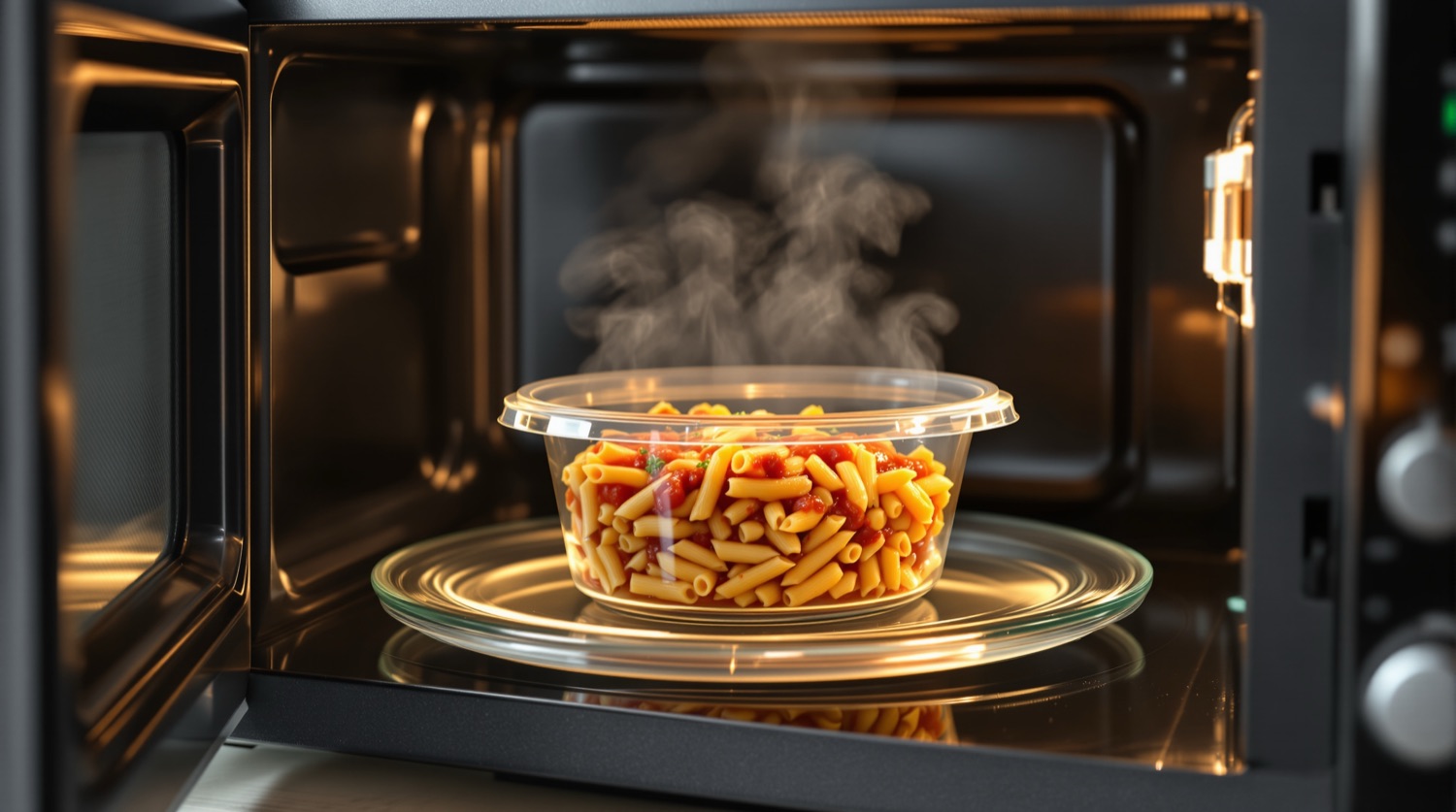
"Keep the bag for the freezer. Thaw in it, then move the food to glass for the hot part — you lose almost none of the convenience and none of the plastic meets hot fat."
Take the hot plastic out of reheating
Glass for leftovers, silicone for the freezer, a lid that isn't plastic wrap — three small swaps cover almost every time food meets heat in your kitchen.
The swaps that take the hot plastic out of reheating
You don't need to throw out a box of Ziploc bags to act on any of this — keep using them for cold storage and freezing. These are the real, currently sold tools for the one step that matters: the moment food gets hot. Prices and availability change, so check current listings.
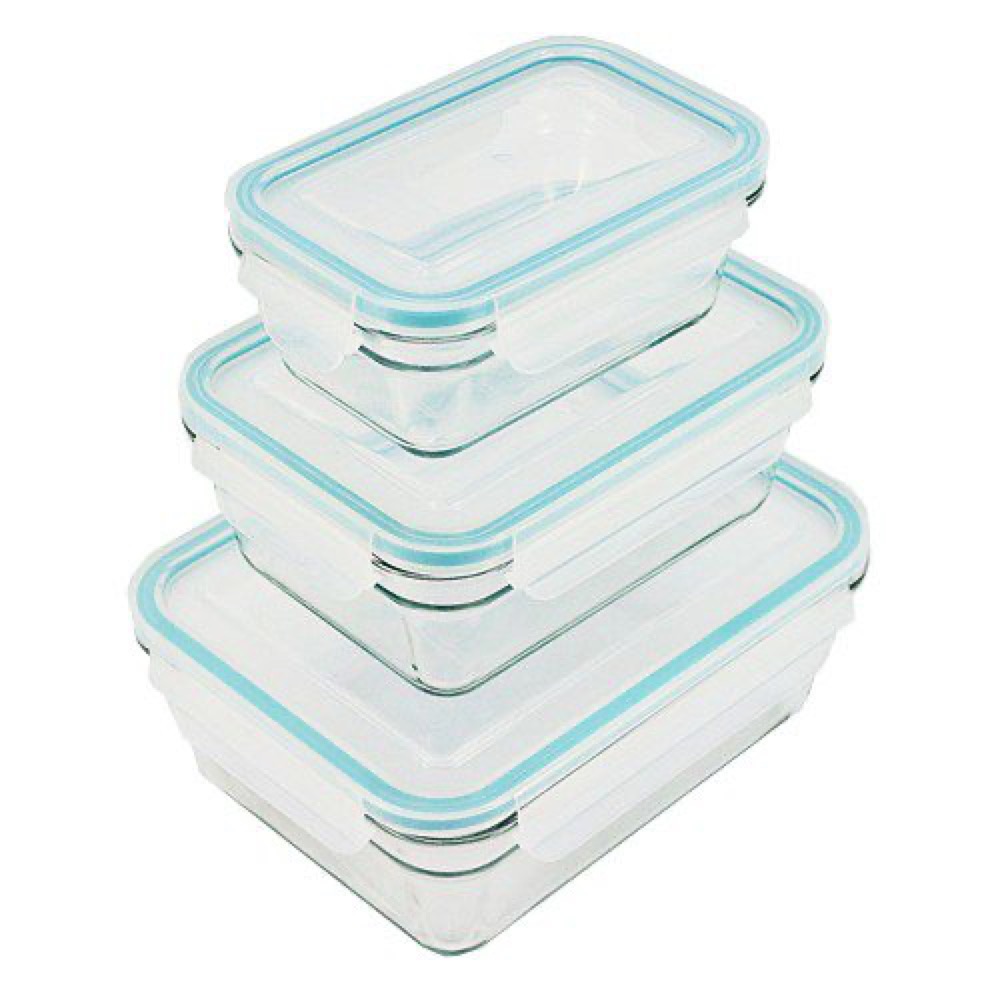
1. Glasslock Oven Safe Container Set (3-Pack) — Best for Reheating Leftovers
 Best for Reheating
Reheat last night's leftovers in the same container you stored them in — no bag, no plastic wrap, no transfer.
Why it's safe: Hot food sits on inert tempered glass, which doesn't soften or shed at microwave temperatures. The silicone gasket only touches the rim.
Check Today's Price on Amazon →Amazon prices change daily — tap to see today's price and any active discount.
- Free delivery & returns for Prime members
- Sold & shipped by Amazon
This is the direct replacement for the "reheat" half of what people use Ziploc bags for. Portion leftovers into glass when you put them away and there is never a moment when hot, fatty food presses against thin film. Take the lid off, cover with a plate or a silicone lid, and heat.
2. Pyrex Simply Store — Best Value Glass
 Best Value Glass
Simply Store is unglamorous and does the one thing that matters here: it takes the reheat out of plastic. The bowls nest, go into the microwave or oven without the lid, and single replacements are easy to find. As with all glass sets, the lid is plastic — treat it as a cold-storage cover and never heat it.
A full set of reheat-ready glass in one box, with single pieces easy to replace.
Why it's safe: Glass doesn't soften, leach or shed at cooking temperatures, so there's no polymer between your food and the heat once the lid is off.
Check Today's Price on Amazon →Amazon prices change daily — tap to see today's price and any active discount.
- Free delivery & returns for Prime members
- Sold & shipped by Amazon
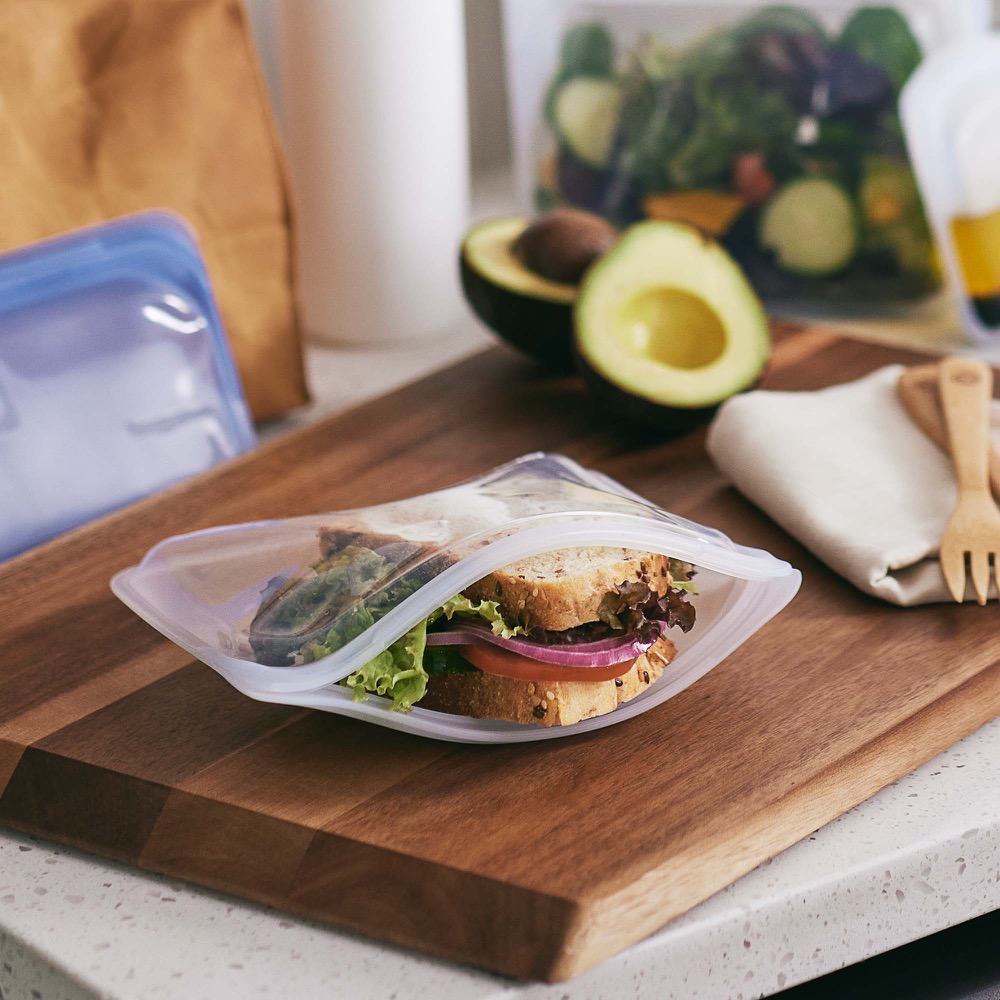
3. Stasher Reusable Silicone Bag Starter Kit — Best Freezer-to-Microwave Bag
 Best Bag Format
Silicone is a cured silicon-and-oxygen material, not a thermoplastic film, so it doesn't soften near boiling the way polyethylene does. Stasher rates its bags from -70°F in the freezer to a 425°F oven, which means a freezer-to-microwave meal can stay in one bag without living at the edge of its rating. The starter kit covers the everyday sizes, so a whole box of disposable bags retires in one purchase.
Freeze, thaw and reheat in the same bag, with a heat rating that isn't 18 degrees from boiling.
Why it's safe: Platinum-cured silicone with no plastic, PVC, BPA, lead, latex, phthalates or PFAS, rated well above any microwave reheating temperature.
Check Today's Price on Amazon →Amazon prices change daily — tap to see today's price and any active discount.
- Free delivery & returns for Prime members
- Sold & shipped by Amazon
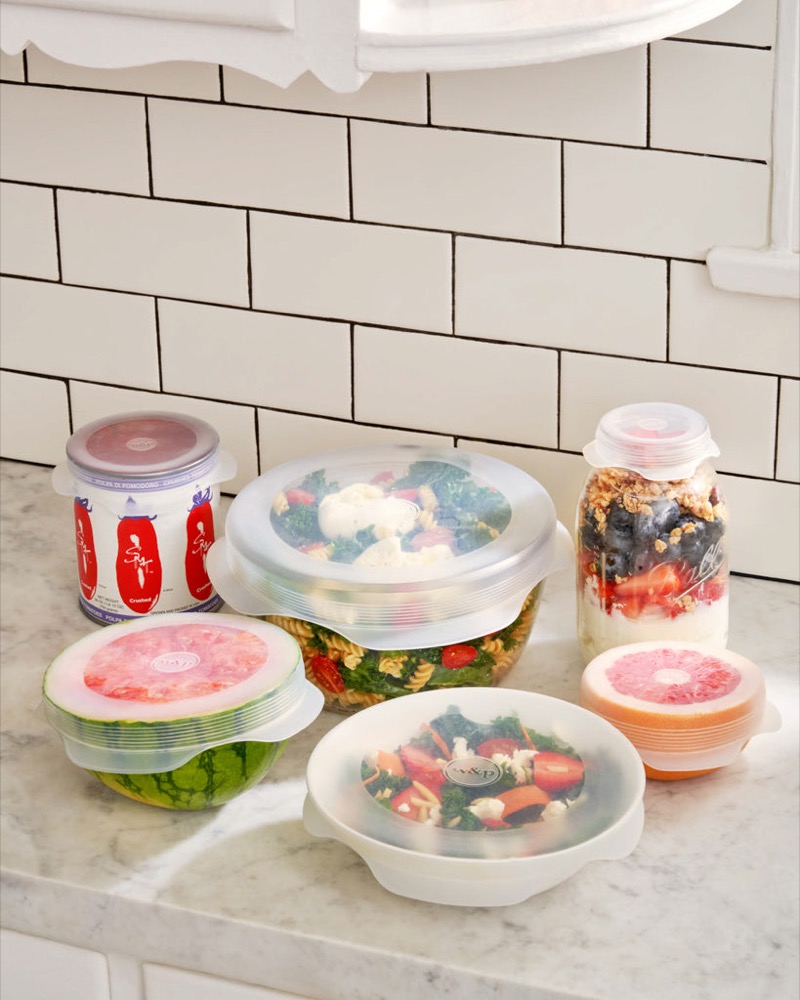
4. W&P Silicone Stretch Lids (6-Pack) — Best Cover for Reheating
 Best Cover
Much of the reason people microwave food in a bag is to keep it from splattering or drying out. A stretch lid does that job on any bowl, from a 2.5-inch can-topper to an 8-inch mixing bowl, and it goes from freezer to microwave to dishwasher. Leave a small gap at one edge for steam, just as you would with a bag.
Cover leftovers as they reheat without plastic wrap or a bag touching the food.
Why it's safe: Food-grade silicone instead of polyethylene or PVC film, rated for the microwave, freezer and dishwasher.
Check Today's Price on Amazon →Amazon prices change daily — tap to see today's price and any active discount.
- Free delivery & returns for Prime members
- Sold & shipped by Amazon
Want the Full Home Protection Guide?
A zipper bag in the microwave is one plastic touchpoint among dozens in a typical kitchen. The Complete Plasticproof Guide covers every room — kitchen, nursery, bathroom, bedroom — with 80+ product recommendations backed by 47+ studies.
The honest verdict
Are Ziploc bags microwave safe? By their maker's definition, yes — for defrosting and reheating, zipper vented, and nothing hotter. SC Johnson rates its microwaveable bags as meeting FDA requirements at those temperatures, and it draws the line itself: polyethylene softens at 230°F, so no cooking, no boiling, no sous vide, and extra care with fatty or sugary food. What nobody has published is a particle count from a microwaved Ziploc bag. The closest evidence — a polyethylene pouch that generally out-shed polypropylene tubs in storage tests, polypropylene tubs that released millions of particles per square centimeter in 3 minutes of microwaving, and polyethylene-lined cups that released trillions of nanoparticles per liter in hot water — all points the same direction: heat makes these plastics shed more.
The health consequences aren't established, and Europe's food-safety agency thinks many published counts run high. But you don't need a verdict to act, because the fix is nearly free. Use the bag for what it's great at — freezing food flat — then thaw it and move the food into glass or ceramic for the hot part. If you want the bag format all the way through, use platinum silicone rated to 425°F. You keep the convenience and lose the one step where hot food meets thin plastic. For the rest of the kitchen, the kitchen plastic detox guide ranks the swaps that matter most, and 7 kitchen mistakes that put microplastics in your food covers the habits worth breaking next.
Cut the plastic that actually adds up
Reheating is one step. The water you drink all day and the containers your food lives in are the steadier sources — and the easiest to fix for good.
Frequently Asked Questions
For two jobs only. SC Johnson, which makes Ziploc, says its bags can be used in the microwave to defrost or reheat food, with the zipper opened at least one inch to vent steam, and that bags marked microwaveable meet U.S. FDA safety requirements for the temperatures of defrosting and reheating. It also says its polyethylene bags soften at 230°F and asks for caution with fatty or sugary food, which heats up very quickly. They are not rated for cooking, boiling or sous vide.
Not in a regular storage or freezer bag. SC Johnson limits those bags to defrosting and reheating. For steam-cooking vegetables, poultry or seafood in the microwave it sells a separate product, Ziploc Zip'n Steam bags, which come with their own cooking instructions.
Not the polyethylene ones. SC Johnson says its polyethylene bags should not be used for sous vide or boiling because their softening point is 230°F, only 18 degrees above the 212°F boiling point of water. The only Ziploc bags it approves for sous vide are Ziploc Endurables, made of platinum silicone rated up to 425°F.
No published study has microwaved a Ziploc-brand bag and counted the particles. The closest evidence is a 2023 University of Nebraska-Lincoln study in Environmental Science & Technology: a polyethylene food pouch released 415,000 to 1.05 million microplastics per square centimeter in water-based storage tests, generally more than polypropylene containers, and the polypropylene containers it microwaved released up to 4.22 million per square centimeter in 3 minutes. The researchers did not microwave the pouch because it was not suitable for microwave use.
SC Johnson says no. Its FAQ states that dioxins only form when chlorine is combined with extremely high temperatures, around 1,500°F, which no kitchen microwave reaches, and that all Ziploc brand products are dioxin-free. The open question about heated plastic bags is particle shedding, not dioxins.
Thaw it in the bag, in the refrigerator or in a bowl of cold water, then move the food into a glass or ceramic dish before heating it. That keeps the convenience of freezing flat in a bag while the hottest part of the process happens against glass. Cover the dish with a plate or a silicone lid instead of plastic wrap.
Sources
- SC Johnson / Ziploc. "Frequently Asked Questions." Accessed September 2026. (Bags may be microwaved "only to defrost or reheat food," vented at least one inch; caution with sugary or fatty food; polyethylene bags not for sous vide because "the softening point is 230°F"; Endurables silicone rated to 425°F; dioxin statement.)
- SC Johnson. "Ziploc Brand Freezer Bags Quart / Medium — Ingredients." Accessed September 2026. (Low-density and linear low-density polyethylene; products "marked as 'microwaveable'" meet FDA requirements for defrosting and reheating temperatures.)
- U.S. Food and Drug Administration. "Microwave Ovens." (Containers "can become hot from the heat of the food cooking inside"; some plastics "can be melted by the heat of the food inside.")
- Hussain KA, Romanova S, Okur I, Zhang D, Kuebler J, Huang X, Wang B, Fernandez-Ballester L, Lu Y, Schubert M, Li Y. "Assessing the Release of Microplastics and Nanoplastics from Plastic Containers and Reusable Food Pouches: Implications for Human Health." Environmental Science & Technology, 2023;57(26):9782–9792. PubMed 37343248. (University of Nebraska–Lincoln; per-cm² release from two polypropylene containers and one polyethylene pouch; microwave test at 1,000 W for 3 minutes; pouch melting peaks near 107, 117 and 121°C.)
- Sun Y, Jiao X, Zhang N, Yan B, Fan D. "Correspondence on ‘Assessing the Release of Microplastics and Nanoplastics from Plastic Containers and Reusable Food Pouches’." Environmental Science & Technology, 2024;58:9013–9014; and the authors' rebuttal, 2024;58:9015.
- Zangmeister CD, Radney JG, Benkstein KD, Kalanyan B. "Common Single-Use Consumer Plastic Products Release Trillions of Sub-100 nm Nanoparticles per Liter into Water during Normal Use." Environmental Science & Technology, 2022;56(9). (NIST; LDPE-lined hot-beverage cups and food-grade nylon bags released more than 1012 particles per liter; release depended on water temperature.)
- Fang C, Yu J, Gopalan S, Naidu R. "Investigating microplastics and nanoplastics released from food bag ziplock using SEM and Raman imaging." Nano Express, 2024;5:025025. (About 5 ± 3 particles per millimeter of zipper per closing and opening.)
- European Food Safety Authority (Barthélémy E, Cariou R, Castle L, et al.). "Literature review on micro- and nanoplastic release from food contact materials during their use." EFSA Supporting Publications, 2025;22(10). (122 studies reviewed; release mainly from abrasion and friction; actual release "much lower than the results presented in many publications.")
- Cheslow v. S.C. Johnson & Son, Inc., No. 3:25-cv-03655 (N.D. Cal., filed April 25, 2025); dismissal and company statement reported by Legal Newsline, September 9, 2025.