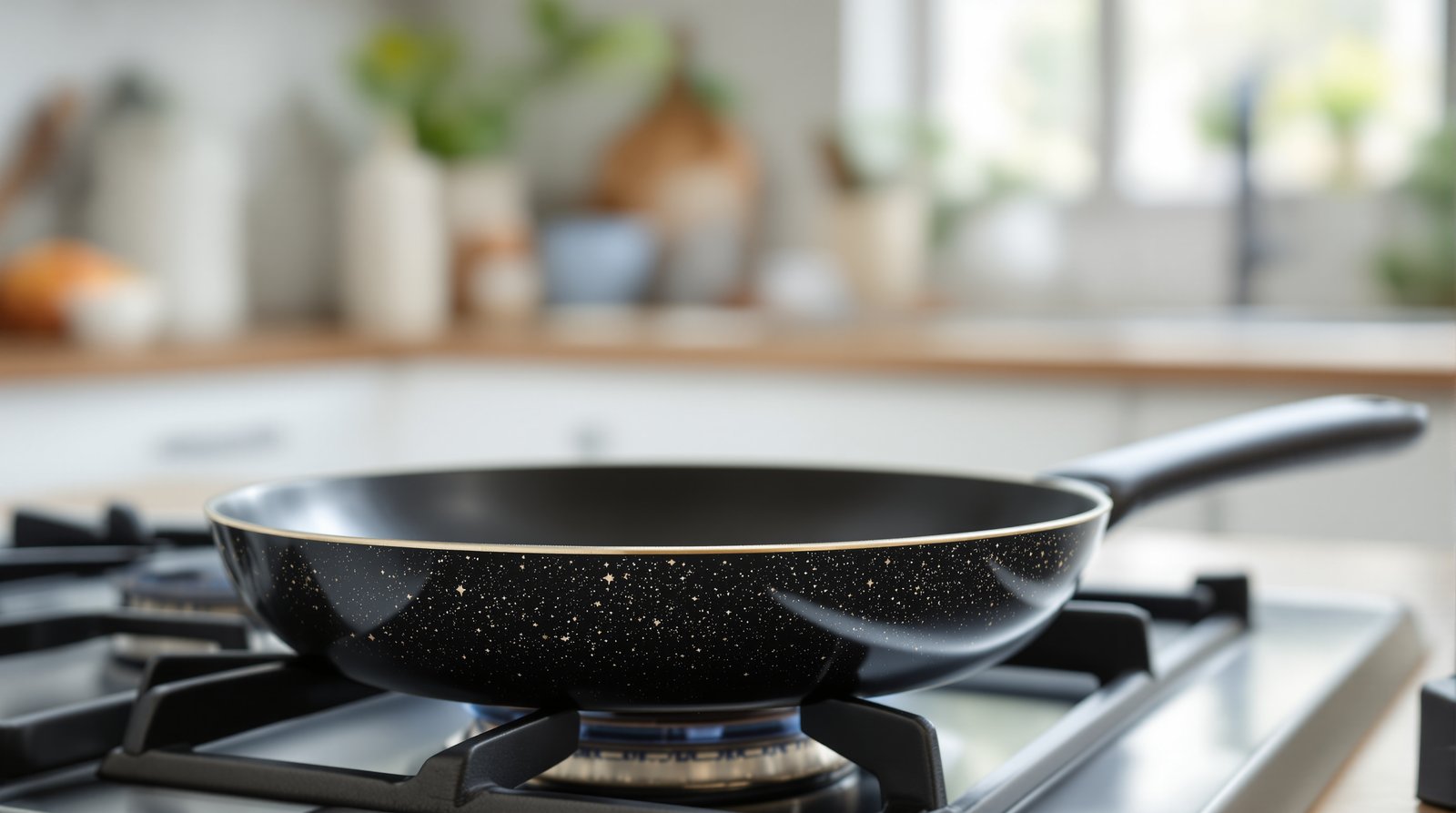
A scratched or worn nonstick pan does shed microplastics — because the coating itself is a plastic. Nonstick surfaces are made of PTFE (polytetrafluoroethylene, sold as Teflon), a fluoropolymer, so flakes that come off are microplastics. A 2022 study in Science of the Total Environment used Raman imaging to detect and count them, and reported that a single surface crack could release about 9,100 microplastic particles, while a broken, deteriorated coating could shed up to roughly 2.3 million micro- and nanoplastics in a short cooking simulation. The number tracks the damage: an intact, well-cared-for coating sheds far less, and a flaking one sheds the most. The study measured how many particles are released, not proven harm — but a peeling pan is an avoidable source, and the cleanest fix is cookware with no coating to shed at all.
“Nonstick” sounds like a surface treatment, but it is really a thin layer of plastic bonded to metal. That plastic — PTFE — is what lets an egg slide, and it is also what breaks loose when the pan is scratched by a fork, scoured with a metal pad, or run too hot. So the real question isn't whether nonstick pans can shed microplastics; a plastic surface that wears down obviously can. It's how much, and under what conditions — and until recently, no one had actually counted.
This guide walks through what the 2022 study found — the particle counts and how sharply they rise with damage — what makes a coating start to shed, whether the amounts are worth worrying about (the honest answer is calmer than the headline), how to make a nonstick pan shed as little as possible, and the uncoated pans that remove the risk entirely.
The bottom line up front: a nonstick pan sheds microplastics in proportion to how damaged its coating is — barely, when it's new and intact; a lot, once it's scratched, chipped or flaking. The levers are simple: use wood or silicone utensils, cook at low-to-medium heat, hand wash, and retire any pan whose coating is scratched or peeling. The permanent fix is uncoated cookware — cast iron, carbon steel or stainless steel — which has no plastic layer to shed. For the wider picture, see whether nonstick cookware is safe, how ceramic compares to nonstick, and where microplastics turn up across the foods you eat.
Do nonstick pans shed microplastics, and how many?
Yes — and the amount depends almost entirely on the condition of the coating. A 2022 study in Science of the Total Environment used Raman imaging, paired with an algorithm to identify Teflon specifically, to detect and count the particles that come off non-stick cookware. It reported that a single surface crack could release about 9,100 microplastic particles, and that a broken, deteriorated coating could shed up to roughly 2.3 million micro- and nanoplastics during a short cooking simulation.
The key word in those numbers is damage. The high figure comes from a coating that is already cracked and flaking; an intact, undamaged surface releases far less. That is why the honest answer is neither “nonstick pans are fine” nor “throw them all out” — it is that a nonstick pan is a microplastic source in direct proportion to how worn it is. And because the coating is PTFE, a fluoropolymer, every particle that comes off is by definition a microplastic. That puts a scratched pan in the same conversation as the other kitchen shedders we've measured, from plastic cutting boards to kitchen sponges — small everyday items that abrade straight into your food.
What makes a nonstick coating start shedding?
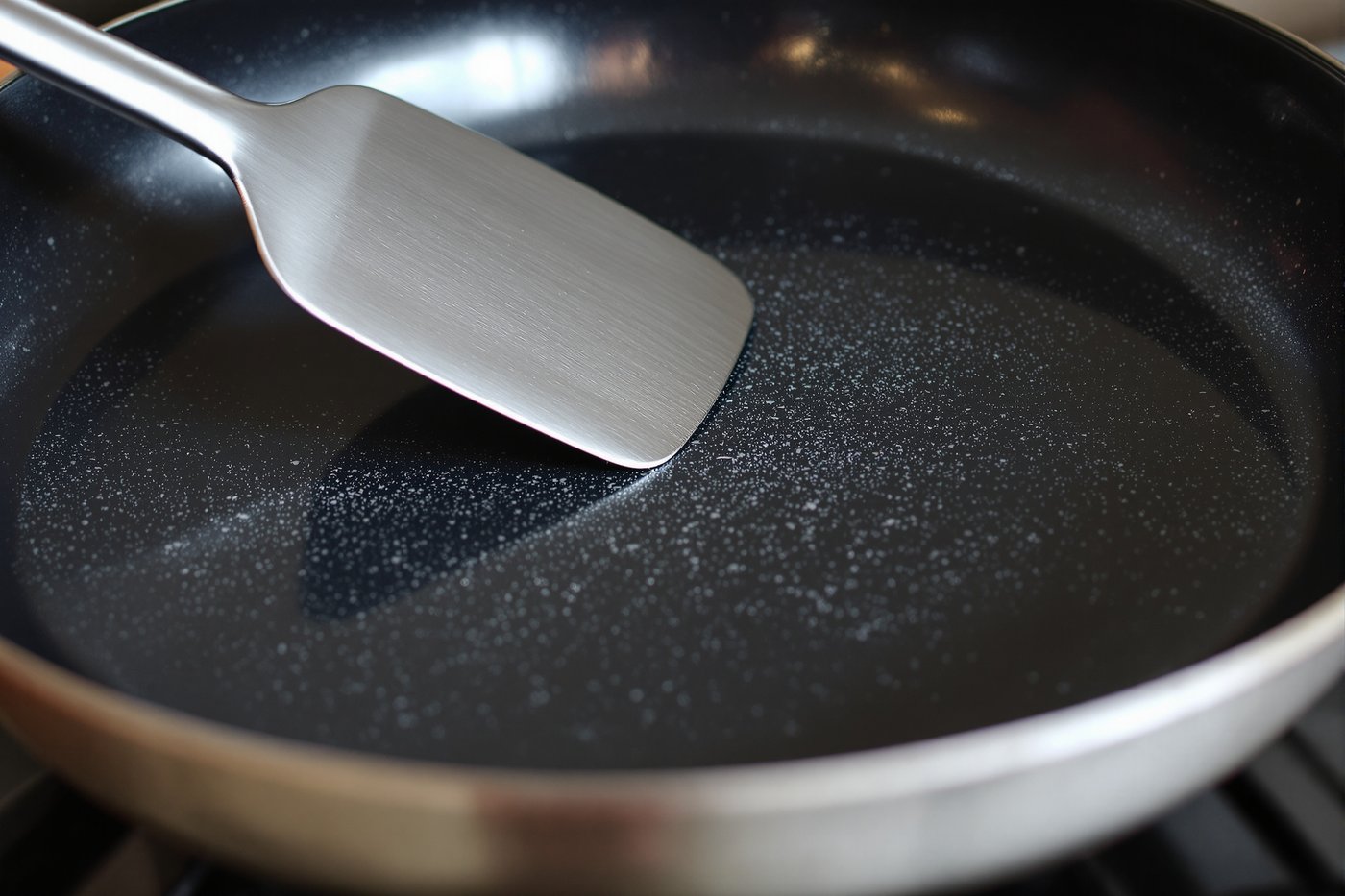
Damage to the PTFE layer — and it comes from ordinary use. The coating is a thin, relatively soft plastic film, so anything that scratches, gouges or overheats it opens the door to shedding. Metal utensils and abrasive scrubbers cut it; stacking pans lets them scrape each other; the dishwasher's heat and harsh detergent wear it down; and high heat degrades it directly, since PTFE begins to break down above about 500°F (260°C) and can release fumes at higher temperatures. Age does the rest: even a careful cook's pan eventually thins and dulls.
This is the crucial difference from most kitchen microplastic sources. A pan doesn't shed because of what you cook in it; it sheds because the plastic surface is being physically worn away, exactly the abrasion mechanism behind plastic cutting boards and black plastic utensils that melt against a hot pan. The table below sorts the everyday habits that speed a coating toward shedding — and the ones that slow it down.
| What you do | Effect on the coating | Shedding risk |
|---|---|---|
| Metal utensils / abrasive scrubbers | Cut and gouge the PTFE film, creating the cracks the 2022 study linked to particle release | High — the main cause |
| High heat / preheating empty | PTFE degrades above ~500°F (260°C) and can emit fumes; empty pans hit that fastest | High |
| Dishwasher & stacking | Harsh detergent and pan-on-pan contact scratch and dull the surface over time | Moderate |
| Age and normal wear | Even careful use thins the coating; most nonstick pans are spent in 3–5 years | Moderate — unavoidable |
| An intact, well-cared-for coating | Wood/silicone tools and low-medium heat keep the film whole, so little comes loose | Low |
Are the microplastics from nonstick pans dangerous?
Here's where honesty matters. The 2022 study was built to detect and count the Teflon particles a pan releases — not to test what those particles do once they're inside a person. So it does not, by itself, establish harm, and no one should read a health verdict into a particle count. PTFE is generally considered biologically inert and thought to pass largely through the gut, which is genuinely reassuring on the narrow chemistry.
What keeps it from being a non-issue is context. Microplastics as a class are now detected throughout the human body — in blood, organs, and even the brain — and researchers are still working out what long-term exposure means. A 2019 analysis in Environmental Science & Technology estimated the average person already swallows tens of thousands of microplastic particles a year from food and drink; a deteriorating pan quietly adds to that total, meal after meal, for no benefit. So the sensible read is proportion, not panic: it's an avoidable source, and one of the cheapest to remove.
"A nonstick pan doesn't shed because of what you cook — it sheds because the plastic surface is wearing away. Once it's scratched or flaking, no amount of care puts the coating back. That's the pan to retire."
Is nonstick cookware still safe to use?
An intact, PFOA-free nonstick pan, used at low-to-medium heat with wood or silicone tools, sheds very little and is reasonable to cook with. Modern nonstick is made without PFOA (the manufacturing chemical phased out years ago), and if the surface is whole, the 2022 study's high numbers — which come from cracked, deteriorated coatings — simply don't apply. The trouble is that this ideal state is temporary.
Every coated pan is on a countdown: coatings scratch, dull and eventually flake, and a damaged one both sheds particles and can emit fumes if you overheat it. So “is nonstick safe?” has a moving answer — yes while it's new and intact, no once it's scratched or peeling. If you can see scratches, chips, or bare metal showing through, that pan has crossed the line and should be retired. Our fuller explainer on whether nonstick cookware is safe covers what else comes off a coated pan, and ceramic vs nonstick explains why a coating that wears out is still a coating.
This is the one rule that matters most. A visibly damaged nonstick coating is the exact condition the 2022 study tied to the highest particle counts — and nothing repairs it. If you can see scratches, flaking, or bare metal, stop cooking on that pan. Replacing it with an uncoated skillet removes the shedding risk for good, which is what the kitchen plastic detox guide walks through, swap by swap.
How do you stop your pans from shedding microplastics?
Two layers of fix: care for the pans you keep, and replace the ones past saving. For any nonstick pan still in good shape, use only wood or silicone utensils, cook at low-to-medium heat and never preheat it empty on high, hand wash instead of using the dishwasher, and store it with a liner or rack so pans don't scrape each other. These habits keep the coating whole, which is the whole game — an intact film sheds little.
The permanent fix, though, is to cook on a surface that has no coating to shed at all. Uncoated cast iron, carbon steel and stainless steel can't produce fluoropolymer particles because there's no fluoropolymer on them — their “nonstick” comes from seasoning (a baked-on layer of oil) or from technique, not a plastic film. They take a little more skill than a Teflon pan, but they last for decades, take any heat you can throw at them, and end the shedding question for good. For the full comparison, see cast iron vs stainless steel vs ceramic and carbon steel vs cast iron. The picks below are the specific pans we'd reach for — every one of them has no coating to crack, or a ceramic surface that wears without shedding fluoropolymer.
Swap the pan, end the shedding question
A scratched nonstick pan is the one worth replacing first — and an uncoated skillet removes the risk permanently. See how the safe materials stack up, then pick the one that fits how you cook.
Safe cookware that can't shed microplastics
There is no such thing as a “microplastic-free nonstick coating” to buy — a coating that wears is a coating that eventually sheds. So instead of chasing a better Teflon, the real fix is a pan with no fluoropolymer on it at all: cast iron and carbon steel that get their release from seasoning, or a true ceramic surface that loses slickness without shedding fluoropolymer particles. These are the specific, currently-sold pans we'd reach for to replace a scratched nonstick, from a lightweight everyday skillet to a full ceramic set. Prices and availability change, so check current listings.
1. Matfer Bourgeat Black Carbon Steel — Best Nonstick Replacement
 Best Nonstick Replacement
Matfer describes the pan as free of PTFE, PFOA and any other chemical coating, with a handle welded to the body rather than riveted, so there are no rivet heads inside the pan for food to collect around. It works on induction, gas, grills and in the oven. The trade-offs are the ones every carbon steel pan shares: it arrives with a protective coating to wash off, you season it yourself before first use, and Matfer says plainly not to cook acidic foods like lemon, vinegar or tomato sauce in it.
Replace the scratched nonstick pan with one that has no coating to scratch — at nearly the same weight and feel.
Why it's safe: Bare carbon steel has no PTFE layer, so there is nothing to crack into the Teflon particles the 2022 study measured coming off damaged nonstick.
Check Today's Price on Amazon →Amazon prices change daily — tap to see today's price and any active discount.
- Made in France
- Induction compatible
- Easy 30-day returns
If you want the closest thing to the nonstick skillet you're retiring — light enough to flip an omelette, quick to heat — carbon steel is the natural swap, and Matfer's welded one-piece pan is the classic. Season it once and it develops its own slick, coating-free surface that only improves with use.
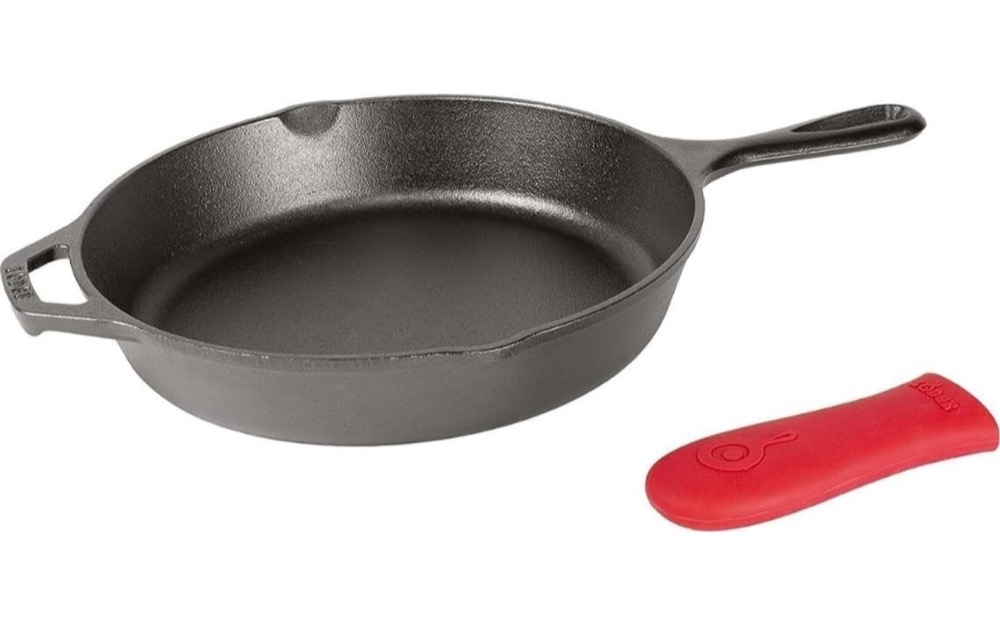
2. Lodge Cast Iron Skillet (10.25″) — Best Value Cast Iron
 Best Value Cast Iron
Every rule that protects a coated pan — medium heat only, no metal, replace when scratched — exists because there is a coating to protect. Cast iron deletes the problem. Its seasoning is polymerized cooking oil that gets better with use, it shrugs off the high heat that degrades PTFE, and a scratch is something you fix with a paper towel and a drop of oil rather than a reason to bin the pan. Lodge ships it seasoned and ready to cook, and makes it in the USA.
One pan, no coating, no replacement cycle — for less than the cost of one mid-range nonstick.
Why it's safe: There is nothing on the cooking surface but iron and polymerized oil — nothing to shed particles, nothing to emit fumes, nothing to wear out.
Check Today's Price on Amazon →Amazon prices change daily — tap to see today's price and any active discount.
- Free delivery for Prime members
- Made in the USA since 1896
- Hundreds of thousands of reviews
If the nonstick pan you're replacing was the worst offender in your kitchen, cast iron is the highest-value swap on this list: it costs a fraction of a coated set, handles searing and baking that would ruin a nonstick, and never needs replacing. The 10.25-inch is the right first pan for most households.
3. de Buyer Mineral B Carbon Steel (12½″) — Best Large Carbon Steel
 Best Large Carbon Steel
The thickness is the point and the catch. At 2.5 to 3 mm, Mineral B holds its shape under high heat better than thin steel, but that same metal makes it heavy. The pan arrives coated in beeswax to stop rust in transit, which you wash off before seasoning. de Buyer says to avoid acidic foods and to keep oven use short, and it lists a lifetime warranty. It's the large, coating-free skillet for anyone who cooks for a household.
A big, coating-free skillet that seasons to a slick finish and lasts decades — no film to shed.
Why it's safe: de Buyer describes Mineral B as having no artificial coating; its nonstick surface is seasoning, not PTFE.
Check Today's Price on Amazon →Amazon prices change daily — tap to see today's price and any active discount.
- Made in France
- Induction compatible
- Easy 30-day returns
When one skillet has to cook for the whole table, thin carbon steel can warp on a fierce burner — de Buyer's thicker Mineral B is built to resist that. It's the large, warp-resistant version of the Matfer above, for the same coating-free reason.
4. Field Company No.10 Cast Iron — Best Lightweight Cast Iron
 Best Lightweight Cast Iron
Field Company machine-polishes its skillets to recreate the smoother, lighter vintage American pans, and seasons each one with organic grapeseed oil before it ships. At about 6 lb for an 11⅝-inch pan it is noticeably lighter than a same-size Lodge, though still heavier than thin carbon steel. The price is the obstacle, but you get cast iron that behaves more like a modern skillet — with nothing synthetic on it.
Cast iron that behaves more like a modern nonstick skillet, with nothing synthetic on it to shed.
Why it's safe: Field states its pans carry no synthetic coatings, no PFOA and no PTFE — just iron and baked-on oil.
Check Today's Price on Amazon →Amazon prices change daily — tap to see today's price and any active discount.
- Made in the USA
- Induction compatible
- Easy 30-day returns
The usual complaints about cast iron — too heavy, too rough for eggs — are exactly what Field's machined, lighter skillet is built to answer, without adding a coating back. It's the premium pick for anyone who wants cast iron's permanence but a smoother, lighter feel.
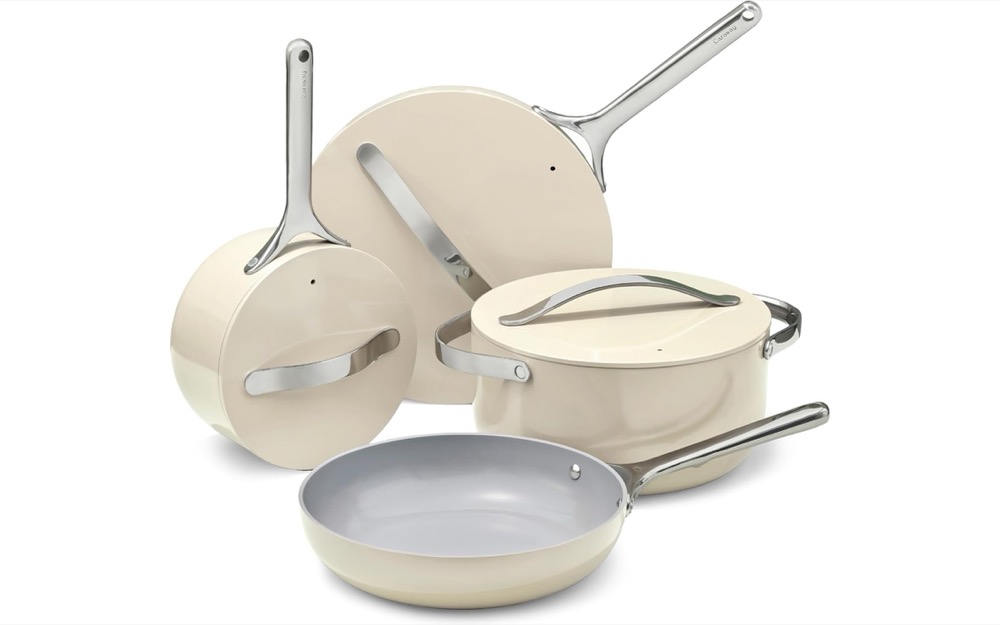
5. Caraway Ceramic Cookware Set — Best Ceramic Set
 Best Ceramic Set
Caraway's cooking surface is a sol-gel ceramic: no PTFE layer to crack and shed the particles the 2022 study documented in nonstick pans. When a ceramic coating wears, it stops being slick — it doesn't shed fluoropolymer into food. Treat it like any coated pan (wood or silicone utensils, medium heat) and expect to trade some longevity for the cleaner chemistry; it's the easy one-purchase way to retire a whole nonstick set at once.
Replace a scratched nonstick set in one move — with a cooking surface that has no fluoropolymer in it.
Why it's safe: The coating is a silica-based glaze. When it wears, it loses slickness — it does not shed fluoropolymer particles the way a damaged PTFE pan does.
Check Today's Price on Amazon →Amazon prices change daily — tap to see today's price and any active discount.
- Free delivery for Prime members
- Thousands of verified reviews
- Easy 30-day returns
If you'd rather keep the ease of a nonstick pan but drop the fluoropolymer, a true ceramic set is the middle path — and Caraway is the one that made it mainstream. It won't last like cast iron, but when it wears it simply loses slickness instead of shedding Teflon.
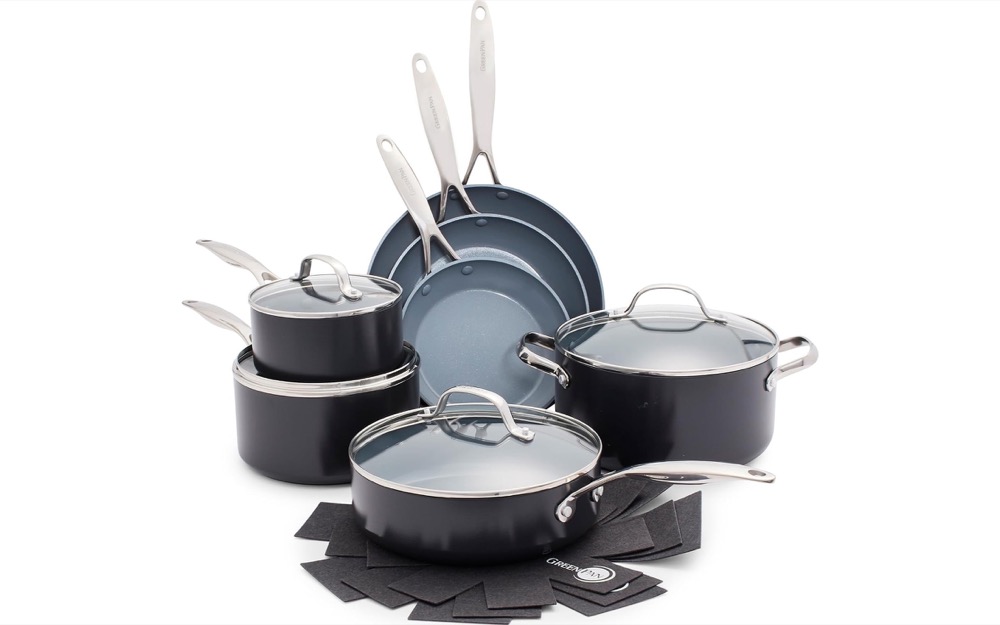
6. GreenPan Valencia Pro — Best Value Ceramic
 Best Value Ceramic
GreenPan created the ceramic nonstick category, and Valencia Pro is its proven mid-line: the silica-based Thermolon surface on a hard-anodized aluminum body with a magnetic base for induction stoves. The safety logic is identical to every true ceramic coating — no PTFE means the scratch-and-shed failure mode documented in nonstick pans simply isn't available. It's the budget way to get ceramic's clean chemistry.
Ceramic-coated cooking without the boutique markup — from the brand that invented the coating.
Why it's safe: Thermolon is a silica-based surface made without PTFE or PFOA (manufacturer-stated) — there is no fluoropolymer layer to crack and shed particles.
Check Today's Price on Amazon →Amazon prices change daily — tap to see today's price and any active discount.
- Free delivery for Prime members
- Thousands of verified reviews
- Category-inventor track record
Ceramic doesn't have to be a premium buy — GreenPan's mid-line gives you the same no-fluoropolymer surface as the boutique sets for less. For the full comparison of coated and uncoated options, see our best non-toxic cookware guide and the deeper dive on ceramic vs nonstick.
Want the Full Home Protection Guide?
A worn nonstick pan is one plastic touchpoint among dozens in a typical kitchen. The Complete Plasticproof Guide covers every room — kitchen, nursery, bathroom, bedroom — with 80+ product recommendations backed by 47+ studies.
The honest verdict
Do nonstick pans shed microplastics? Yes — because the coating is a plastic (PTFE), and a 2022 study using Raman imaging counted the particles that come off: about 9,100 from a single crack and up to roughly 2.3 million from a broken, deteriorated coating. But the number is not a fixed dose; it scales with damage. A new, intact, PFOA-free pan used gently sheds little, while a scratched, flaking one sheds the most. The study measured how much comes off, not proven harm — PTFE is considered largely inert — so the honest read is proportion, not panic.
The practical response is simple, and it's mostly one rule: retire any nonstick pan that is scratched, chipped or flaking, because nothing repairs a damaged coating. For pans you keep, use wood or silicone utensils, cook at low-to-medium heat, and hand wash. And for the permanent fix, cook on a surface with no coating to shed — cast iron, carbon steel or stainless steel. You don't need a plastic scare to act on this one: a $30 skillet or a single careful habit closes the source for good.
Swap the pan, close the source
A scratched nonstick pan is the one worth replacing first. Uncoated cast iron, carbon steel or a true ceramic set removes the shedding risk entirely — see how the safe materials compare and pick the one that fits your cooking.
Frequently Asked Questions
Yes, when the coating is scratched, worn or overheated. Nonstick coatings are made of PTFE (Teflon), a fluoropolymer plastic, so flakes that come off are microplastics. A 2022 study in Science of the Total Environment used Raman imaging to count them and reported that a single crack could release about 9,100 particles, and a broken coating up to roughly 2.3 million micro- and nanoplastics. An intact, well-cared-for coating sheds far less.
Physical and heat damage to the PTFE layer. Metal utensils, stacking pans, abrasive scrubbers and the dishwasher scratch it; high heat degrades it, since PTFE begins to break down above about 500°F (260°C) and can release fumes at higher temperatures; and it simply wears thin with age. Once the surface is cracked, chipped or flaking, the study shows the loose fluoropolymer comes off as particles into your food.
The 2022 study measured how many particles are released, not what they do inside the body, so it does not by itself establish harm. PTFE is considered biologically inert and largely passes through, but microplastics broadly are now found throughout the human body and researchers are still studying their effects. The sensible read is proportion, not panic: a flaking pan is an avoidable source worth replacing, especially because the fix is cheap and permanent.
An intact, PFOA-free nonstick pan used at low-to-medium heat with wood or silicone utensils sheds very little and is reasonable to use. The problem is the failure mode: coatings inevitably scratch and wear, and a damaged one sheds fluoropolymer particles and can emit fumes if overheated. If your pan is scratched, chipped or flaking, stop cooking on it. Uncoated cast iron, carbon steel and stainless steel remove the shedding risk entirely.
Retire any scratched, chipped or flaking nonstick pan — no repair restores the coating. For pans you keep, use only wood or silicone utensils, cook at low-to-medium heat, never preheat empty on high, hand wash instead of using the dishwasher, and store with a liner so pans don't scrape each other. The permanent fix is to switch to uncoated cookware — cast iron, carbon steel or stainless steel — which has no plastic layer to shed.
True ceramic coatings are a silica-based (sol-gel) glaze, not PTFE, so when they wear they lose slickness rather than shedding fluoropolymer particles the way the 2022 study documented for Teflon. That is a cleaner failure mode, but ceramic coatings still wear out in a few years and should be replaced when damaged. For zero coating of any kind, bare cast iron, carbon steel and stainless steel are the surest options.
Sources
- Luo Y, Gibson CT, Chuah C, Tang Y, Naidu R, Fang C. "Raman imaging for the identification of Teflon microplastics and nanoplastics released from non-stick cookware." Science of the Total Environment, 2022;851(Pt 2):158293. (Used Raman imaging with a purpose-built algorithm to detect and count Teflon particles from non-stick cookware; reported ~9,100 microplastic particles released from a single surface crack and up to ~2.3 million micro- and nanoplastics from a broken, deteriorated coating.)
- Luo Y, Gibson CT, Chuah C, Tang Y, Naidu R, Fang C. "Raman imaging for the identification of Teflon microplastics and nanoplastics released from non-stick cookware." PubMed record (PMID 36030853). (Indexed abstract of the 2022 Flinders University / University of Newcastle study, confirming the particle-release findings above.)
- Cox KD, Covernton GA, Davies HL, et al. "Human Consumption of Microplastics." Environmental Science & Technology, 2019;53(12):7068–7074. (Estimated tens of thousands of microplastic particles consumed per person per year from food and drink combined — the exposure context a shedding pan quietly adds to.)