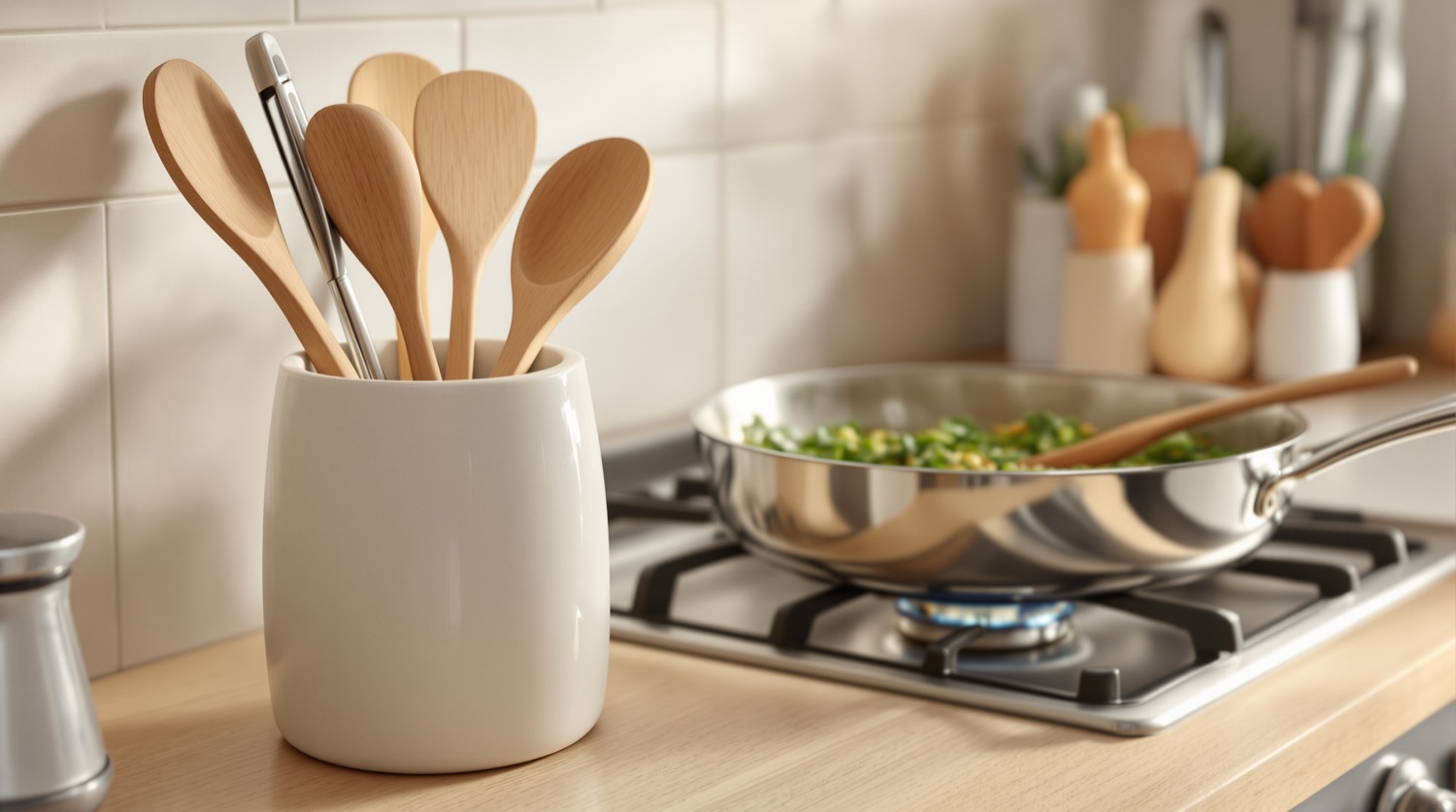
The best non-toxic kitchen utensils in 2026 are the FAAY 3-in-1 Teak Wooden Spoon Set — three spoons each carved from one piece of Thai teak, finished only with coconut oil, for $23.99 on Amazon when we checked on September 13, 2026. For anything you grip or flip, add the OXO Good Grips 12-Inch Stainless Steel Locking Tongs ($17.95), whose food-contact jaws are brushed steel rather than nylon. If you cook on nonstick and need a flexible scraper, the GIR Ultimate Spatula ($15.95) is one piece of platinum-grade silicone rated to 425°F. Full ranked list:
- FAAY 3-in-1 Teak Spoon Set — Best overall. One-piece teak, coconut-oil finish, no lacquer. Details →
- Earlywood 13″ Flat Sauté Spatula — Best spatula. Solid hardwood, made in Red Lodge, Montana. Details →
- OXO Good Grips 12″ Stainless Steel Locking Tongs — Best tongs. Steel jaws, no nylon heads. Details →
- Standcn 18/10 Stainless Steel 8-Piece Set — Best all-metal set. One-piece steel, dishwasher safe. Details →
- GIR Ultimate Silicone Spatula — Best for nonstick. Seamless platinum-grade silicone. Details →
- Berard Olive-Wood Curved Spatula — Best wooden turner. Dense olive wood, beeswax finish. Details →
- OXO Good Grips 3-Piece Wooden Spoon Set — Best budget. FSC-certified beech for about $10. Details →
What to replace first: black plastic spatulas and spoons, and any nylon tool you leave resting in a hot pan or pot. See what the research actually measured →
Check Today’s Price on Amazon →Full details on all seven below, including what touches food, the finish each maker names, how to wash it, and the honest catch on each one.
Quick Navigation
- Compare all 7 utensils
- What makes a kitchen utensil toxic?
- The study data, in one table
- Best overall: FAAY Teak Spoon Set
- Best spatula: Earlywood Flat Sauté
- Best tongs: OXO Stainless Locking Tongs
- Best all-metal set: Standcn 18/10
- Best for nonstick: GIR Ultimate Spatula
- Best wooden turner: Berard Olive Wood
- Best budget: OXO Wooden Spoons
- Is silicone safe for cooking utensils?
- Which utensils should you replace first?
- FAQ
Compare all 7 utensils
Every pick side by side — tap a name to jump to the full write-up, or check today's price.
| Pick | What touches food | Amazon price | |
|---|---|---|---|
 Best OverallFAAY Teak Spoon Set |
TeakCoconut Oil3 Spoons |
$23.99 | Check price → |
 Best SpatulaEarlywood Flat Sauté |
HardwoodMineral OilUSA-Made |
$22.00 | Check price → |
 Best TongsOXO Locking Tongs |
Steel JawsLocking12 Inch |
$17.95 | Check price → |
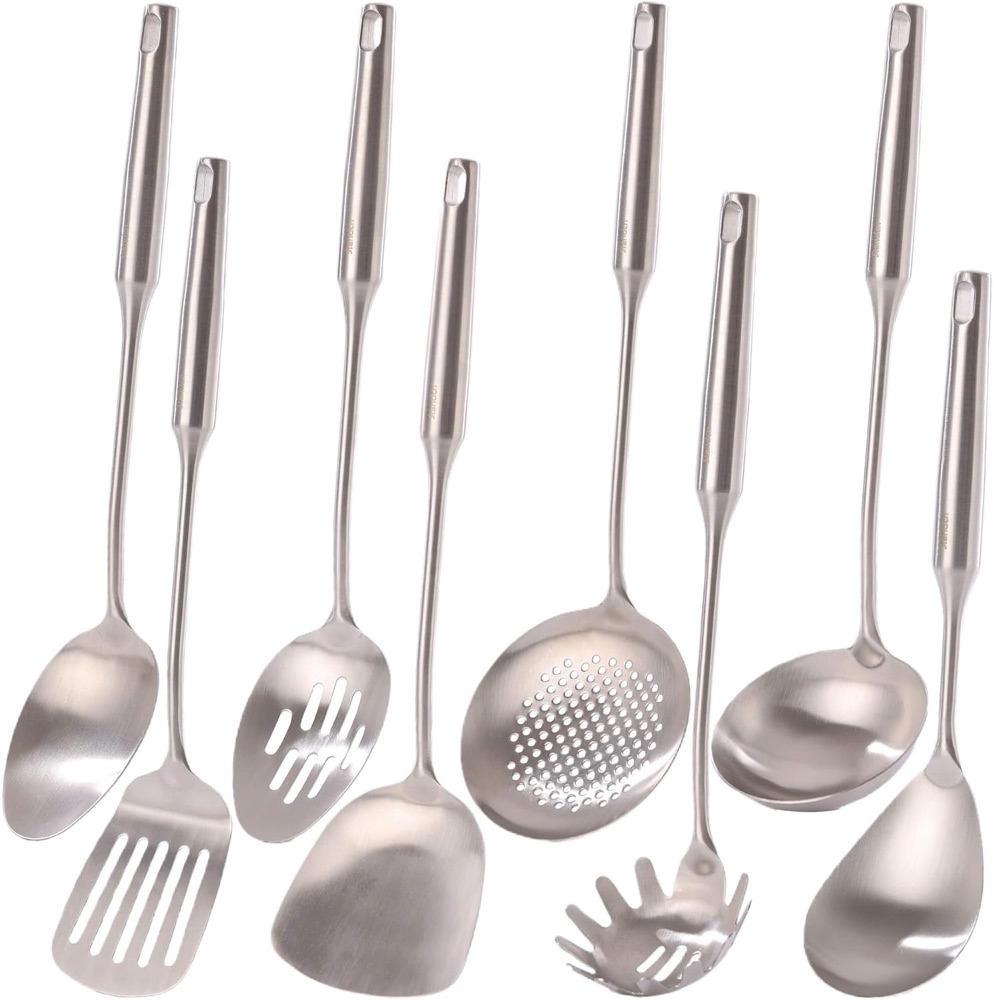 All-Metal SetStandcn 18/10 Set |
18/10 SteelOne-Piece8 Tools |
$59.99 | Check price → |
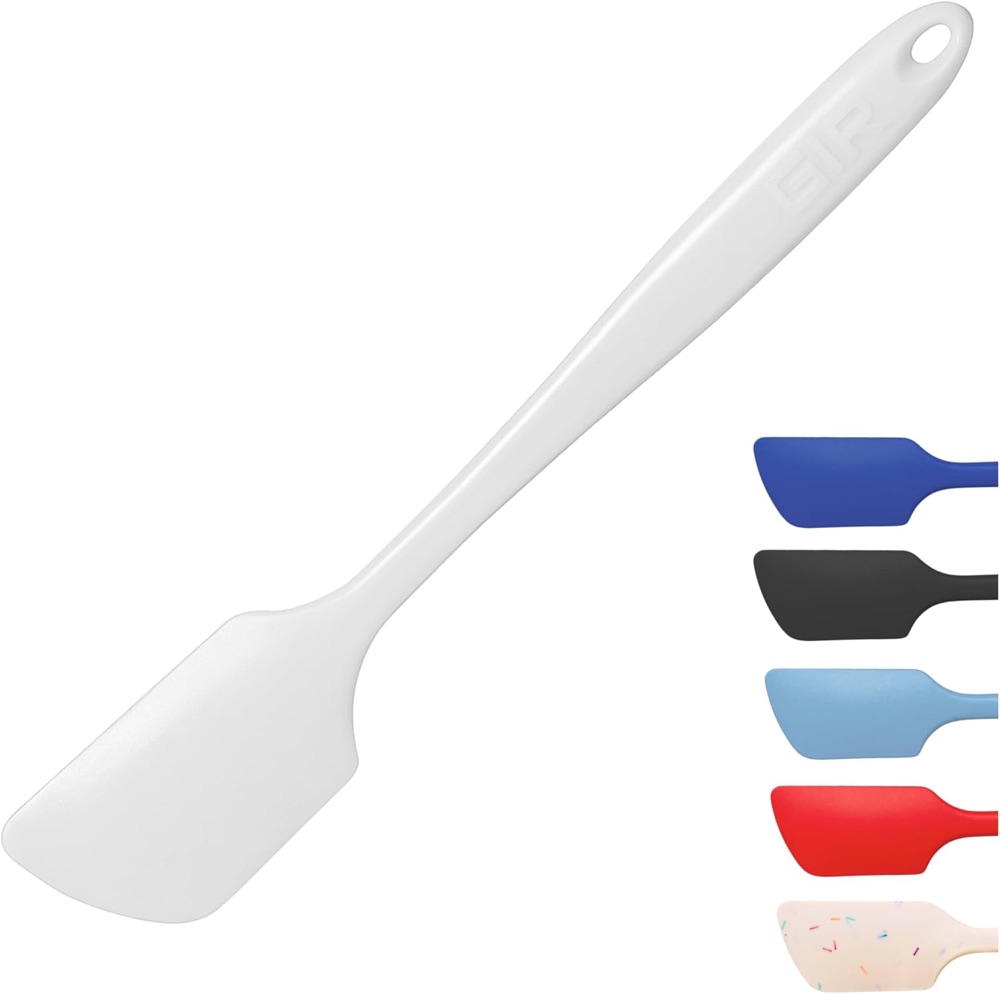 Best for NonstickGIR Ultimate Spatula |
Silicone425°FSeamless |
$15.95 | Check price → |
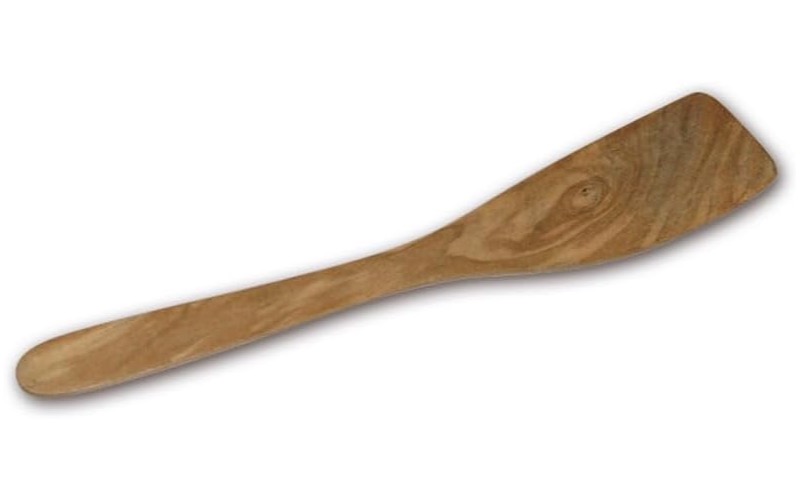 Wooden TurnerBerard Olive Wood |
Olive WoodBeeswaxAngled |
$14.29 | Check price → |
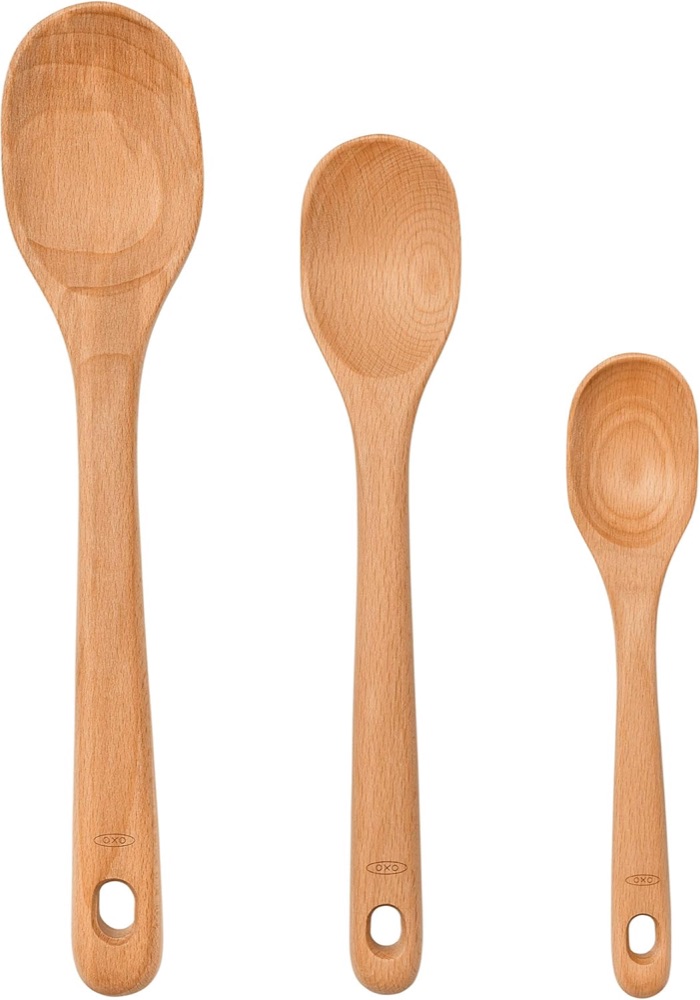 Best BudgetOXO Wooden Spoons |
FSC BeechNatural Oil3 Sizes |
$10.19 | Check price → |
Prices are what Amazon listed on September 13, 2026. They move daily — tap through for today's price.
What Makes a Kitchen Utensil Toxic?
The measured concerns are plastic oligomers that migrate out of nylon into hot food, flame retardants carried into black plastic from recycled electronics, and microplastic particles that plastic tools shed during cooking. Wood and stainless steel avoid all three. Silicone and steel have smaller, well-documented trade-offs of their own, covered below. Here is each one, with what the research actually found.
1. Nylon releases oligomers into hot food
Most black and gray cooking spoons, slotted turners and spatula heads are polyamide, better known as nylon. Making it leaves behind oligomers, short chains of the plastic's building blocks, and some are small enough to move into food. Germany's Federal Institute for Risk Assessment (BfR) assessed test data from food inspectors on 33 polyamide kitchen utensils, 31 of them nylon 6,6, each tested at 100°C for 30 minutes or 2 hours (BfR Opinion No. 036/2019). The combined release ranged from 0.9 to 10.9 mg per kilogram of food, with a median of 2.8. The BfR set 5 mg/kg as the toxicologically acceptable level, and 10 of the 33 utensils exceeded it. Under the more conservative surface-area method in the EU plastics regulation, 30 of the 33, or 91%, did.
What that means for a normal household: the oligomers were assessed as not genotoxic, meaning they are not expected to damage DNA, but high doses caused liver and thyroid effects in animal studies, and the BfR notes there are no studies of lifelong intake, cancer or reproductive effects. Its advice to consumers is to keep polyamide utensils in contact with food “as brief as possible,” especially above 70°C. A nylon spoon left resting in a simmering sauce is the exact case it describes. A wooden or steel spoon removes the question.
2. Black plastic can carry flame retardants from recycled electronics
TV and computer casings are made flame-resistant with added chemicals, and when that plastic is recycled, the chemicals can come along into products that never needed them. A 2024 study in Chemosphere (Liu, Brandsma and Schreder, 2024) screened 203 black plastic household products bought in the U.S., including kitchen utensils, and found flame retardants in 85% of the products it analyzed, at total concentrations of up to 22,800 mg/kg. They included deca-BDE, a restricted compound once used widely in electronics casings. Styrene-based plastics, the kind used in electronics, carried significantly more than polypropylene or nylon. The authors estimated a median intake of 34,700 nanograms a day of BDE-209 for people using contaminated utensils.
The honest correction matters here. The original paper compared that estimate to the U.S. EPA reference dose for BDE-209 and got the math wrong by a factor of ten. The EPA's IRIS reference dose is 0.007 mg per kilogram of body weight per day, which is 420,000 ng a day for a 60 kg adult, not the 42,000 the paper used. The authors published a corrigendum in 2025. Corrected, the estimate is about 8% of the reference dose. That is not an emergency, and we will not describe it as one. It is still an exposure with no benefit attached, and a $10 wooden spoon avoids it. Our full breakdown of black plastic utensils goes deeper on this study.
3. Plastic tools shed microplastics into food, and non-plastic tools did not
A 2024 study in Science of the Total Environment (Cole, Gomiero, Jaén-Gil, Haave and Lusher, 2024) put jelly, used as a stand-in for food, through the steps of home cooking: heating, cooling, mixing, slicing and storage. They ran it three ways: with non-plastic cookware, new plastic cookware and old plastic cookware, including utensils, chopping boards and nonstick pans. Non-plastic cookware did not introduce microplastics. New and old plastic cookware both caused significant increases, with particles of PTFE (the nonstick coating), polyethylene and polypropylene from 13 to 318 micrometers across. If a meal were prepared that way every day, the authors estimate plastic cookware could add 2,409 to 4,964 microplastics a year to home-cooked food, the higher figure from the old, worn tools. They are clear that the health effects of eating microplastics are still unknown.
4. Stainless steel adds a little nickel and chromium, mostly over hours
Steel sheds no plastic, but it is not perfectly inert either. Oregon State University researchers cooked tomato sauce in stainless steel and measured the metals it picked up (Kamerud, Hobbie and Anderson, Journal of Agricultural and Food Chemistry, 2013). After 6 hours of cooking, nickel rose up to 26-fold and chromium up to 7-fold, depending on the grade. New steel leached the most, and the amount fell over repeated uses, leveling off after the sixth cycle. Two things keep this in proportion: that was acidic sauce in a pot for hours, while a spoon or turner touches food for minutes, and the authors frame the risk around people who are already sensitive to nickel. 18/10 steel, the kind in our all-metal pick, is 10% nickel. If you have a nickel allergy, wood is the simpler answer.
What Did the Studies Actually Measure?
Every number in this guide, in one place. Each row links to the study.
| Study | What it tested | Key finding |
|---|---|---|
| BfR Opinion 036/2019 | Oligomer release from 33 nylon kitchen utensils at 100°C | 0.9–10.9 mg/kg of food (median 2.8); 10 of 33 above the 5 mg/kg acceptable level |
| Liu et al., Chemosphere 2024 | Flame retardants in 203 black plastic household products | Found in 85% of analyzed products, up to 22,800 mg/kg; median 34,700 ng/day BDE-209 from utensils |
| Liu et al., corrigendum 2025 | Correction to the reference-dose comparison | EPA reference dose for a 60 kg adult is 420,000 ng/day, not 42,000 |
| Cole et al., Sci Total Environ 2024 | Microplastics from non-plastic, new plastic and old plastic cookware | Non-plastic: none added. Plastic: 2,409–4,964 particles a year, 13–318 µm |
| Eckardt et al., Food Addit Contam 2025 | Siloxane migration from platinum silicone baking molds | Sum D4–D13 into pastry: 153 mg/kg without post-curing, 9.5 mg/kg with it |
| Zhu et al. (Health Canada), J Hazard Mater 2025 | Cyclic siloxanes in 25 silicone bakeware products | 680–4,300 µg/g in the silicone; average 105 µg/g in food simulant after 60 min at 177°C |
| Kamerud et al., J Agric Food Chem 2013 | Nickel and chromium from stainless steel into tomato sauce | After 6 h: nickel up to 26-fold, chromium up to 7-fold; falls with repeated use |
1. FAAY 3-in-1 Teak Wooden Spoon Set — Best Overall
Best Overall
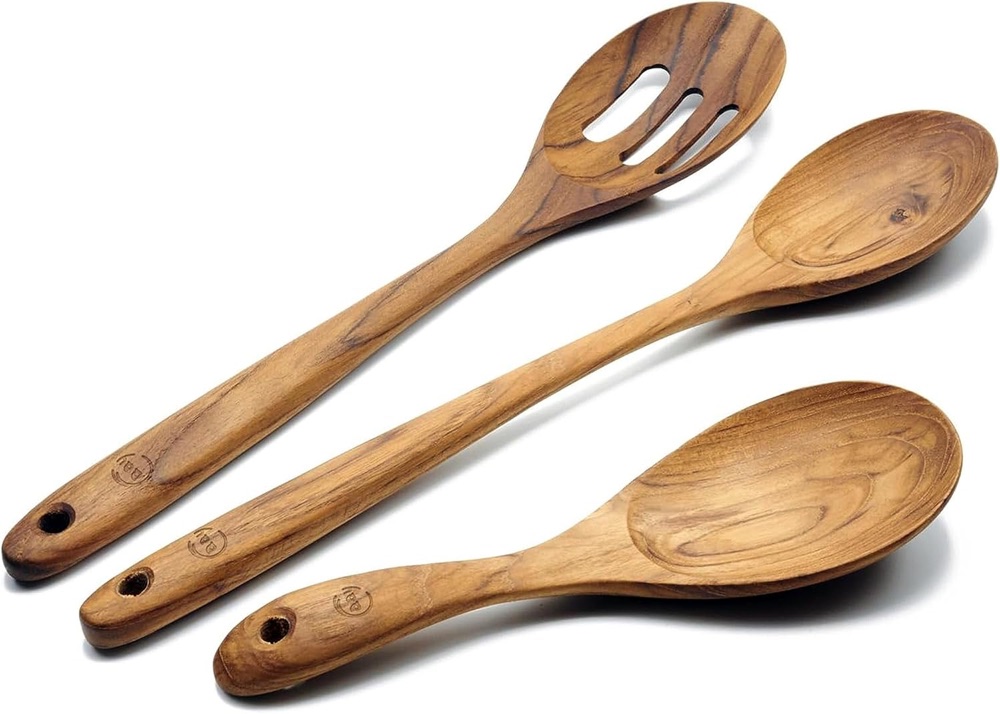
Teak is a traditional boat-building wood because it resists water, and that is the property that matters in a spoon that spends its life in sauce and dishwater. FAAY says these are made by local artisans in Thailand from sustainably sourced teak, and that they are “only coconut oil finished.” Its other teak listings state “no glue or lacquer added,” which is the detail to look for: a spoon carved from one piece has no glued seam for a binder to live in. The set is a 13.5-inch cooking spoon, a slotted spoon and a 9-inch spoon, and at the time of writing it held a 4.6-star average from 335 Amazon ratings.
The catches. All three are spoons, so you still need a flat edge for flipping; pair it with the Earlywood or Berard below. Because each piece is handmade, color and size vary, and FAAY says the teak darkens with oil and heat, which is normal. Care is hand washing with warm water and a soft sponge, then hanging to dry, and FAAY's replacement guarantee covers only the first 30 days.
The three spoons you reach for every night, carved from a wood that resists water and heat, with no plastic, no glue and no lacquer between the wood and your food.
Why it's safe: Solid one-piece teak with a coconut-oil finish. Nothing in it is a plastic, so there is nothing to shed oligomers or microplastics into hot food.
Check Today’s Price on Amazon →Amazon prices change daily — tap to see today's price.
- Carved from one piece
- Coconut-oil finish
- Safe on nonstick
2. Earlywood 13-Inch Flat Sauté Spatula — Best Spatula
Best Spatula
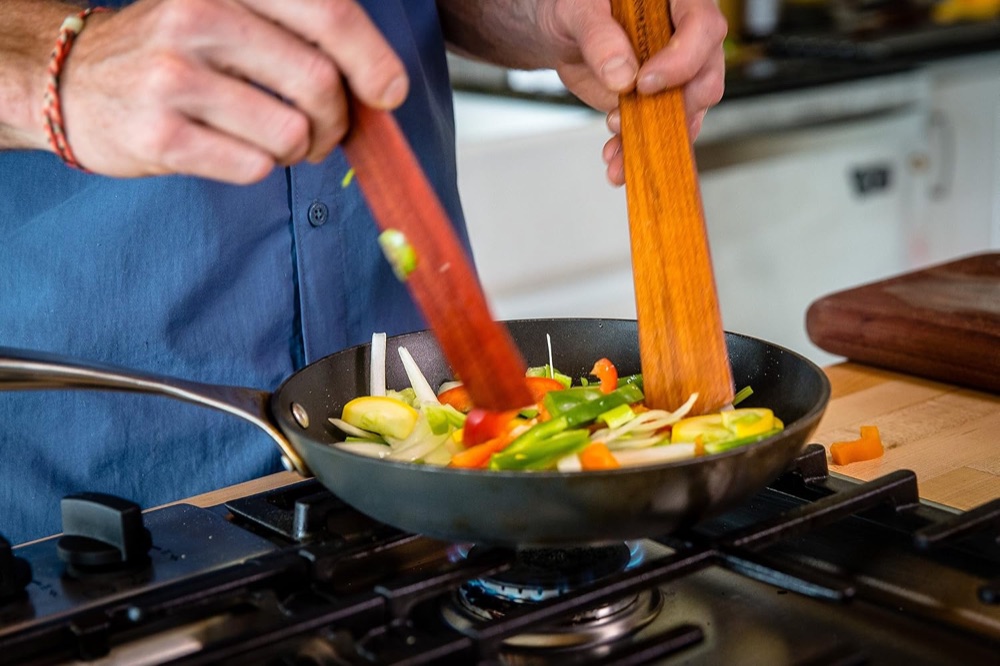
Most wooden spoons are too thick to get under food. The Earlywood is a flat, tapered paddle of solid hardwood, thin enough at the edge to flip a pancake and square enough to scrape fond off a cast iron skillet. Earlywood makes each piece in Red Lodge, Montana, and says on its own site that it finishes its utensils in food-safe mineral oil; the Amazon listing adds “no stain” and a lifetime warranty. The 13-inch size comes in several woods, including bloodwood, Mexican ebony and maple. It was $22.00 on Amazon, with a 4.7-star average from 230 ratings.
The catches. It is not dishwasher safe; Earlywood says to wash it in hot soapy water and set it on a towel to dry, and to re-oil it when it looks dry. Mineral oil is a petroleum product. Food-grade mineral oil is the standard finish on cutting boards and wooden spoons, but if you want nothing petroleum-derived in your kitchen, FAAY's coconut-oil teak is the alternative. And because it is flat, it is a poor choice for ladling or stirring soup.
A made-in-USA wooden spatula thin enough to replace the plastic turner by your stove, backed by a lifetime warranty.
Why it's safe: Solid hardwood with a food-safe mineral oil finish and no stain. No plastic touches your food.
Check Today’s Price on Amazon →Amazon prices change daily — tap to see today's price. Wood choices are on the same listing.
- Made in Montana
- Lifetime warranty
- Flips, stirs and scrapes
3. OXO Good Grips 12-Inch Stainless Steel Locking Tongs — Best Tongs
Best Tongs
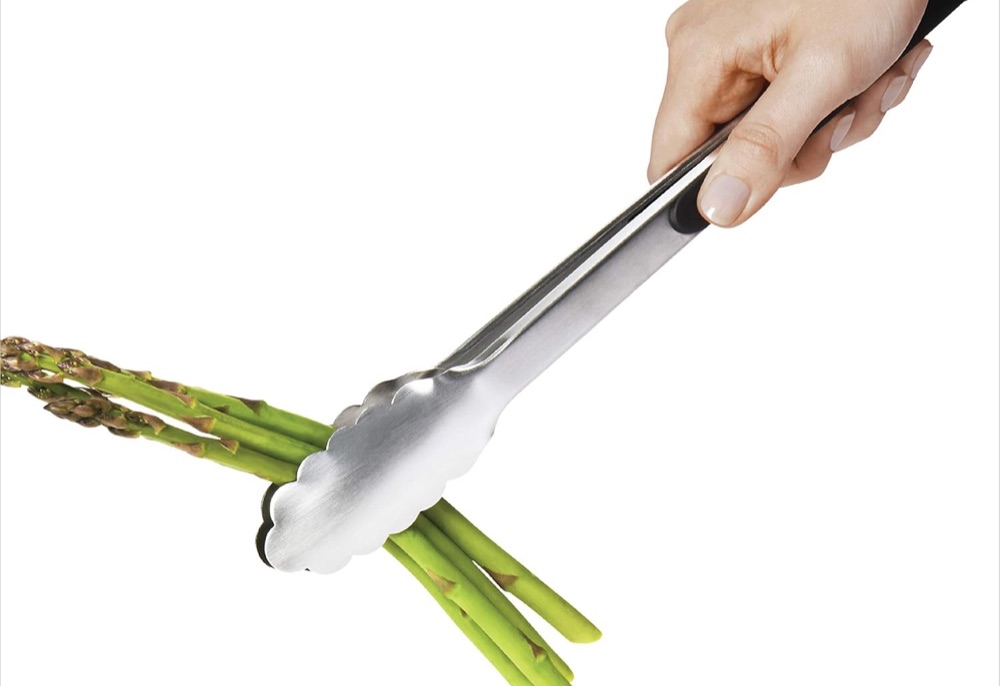
Tongs are the tool most likely to sit in hot oil, turning chicken thighs or lifting pasta out of boiling water, which is exactly where nylon heads fall under the BfR's advice. The arms and jaws are brushed stainless steel, with scalloped edges that hold food, and it locks shut to store. It is dishwasher safe and was $17.95 on Amazon, with a 4.8-star average from 14,192 ratings, the largest rating count on this list by far.
The catches. The handles carry OXO's soft non-slip grips, so there is a rubbery material where your hand goes; it does not touch the food, but the tongs are not all-metal. Steel jaws will scratch nonstick coatings, so use these on stainless, cast iron and carbon steel, and use wood or silicone on nonstick. Be careful which listing you buy: OXO sells near-identical tongs with nylon heads and with silicone heads, and the nylon version is the one to avoid for frying.
Reliable, locking steel tongs for frying, grilling and pasta, with more than 14,000 Amazon ratings behind them.
Why it's safe: The part that touches food is brushed stainless steel, with no nylon heads to leave in hot oil.
Check Today’s Price on Amazon →Amazon prices change daily — tap to see today's price. Check that the listing says stainless steel, not nylon heads.
- Dishwasher safe
- Locks for storage
- 14,000+ ratings
4. Standcn 18/10 Stainless Steel Kitchen Utensil Set, 8 Pieces — Best All-Metal Set
All-Metal Set
Where the OXO tongs still have grips, this set is steel all the way through. Standcn says each tool is “forged in one-piece with no welding or stress points” from 18/10 stainless steel, and the eight pieces are a solid serving spoon, slotted spoon, spatula, skimmer, slotted turner, large spoon, pasta server and ladle, all 15 inches long so your hand stays away from the heat. It is dishwasher safe and was $59.99 on Amazon, with a 4.6-star average from 407 ratings.
The catches. 18/10 means 10% nickel, so if you have a nickel allergy, the Oregon State data above is a reason to choose wood instead. Metal scratches nonstick, so this set belongs with stainless, cast iron and carbon steel pans. Fifteen-inch tools may not fit a small drawer. And Standcn is a smaller brand than OXO: the listing does not state a warranty length, so check the return window when you order.
Eight long, all-steel tools that cover serving, skimming, flipping and ladling, and go straight in the dishwasher.
Why it's safe: One-piece 18/10 stainless steel with no plastic handles or heads, so there is no polymer to release oligomers or microplastics.
Check Today’s Price on Amazon →Amazon prices change daily — tap to see today's price.
- No plastic handles
- Dishwasher safe
- Eight tools
5. GIR Ultimate Silicone Spatula — Best for Nonstick
Best for Nonstick
Wood cannot scrape a bowl clean or fold batter, and metal cannot touch nonstick, which is the gap silicone fills. The GIR is one seamless piece with no joint between head and handle where food and water collect, and GIR describes the material as platinum-grade silicone, heat-resistant to 425°F. Amazon lists the handle materials as fiberglass, metal and silicone, meaning the stiff core is sealed inside. It is dishwasher safe, BPA- and BPS-free, and was $15.95 on Amazon, with a 4.7-star average from 1,613 ratings on this color.
The catches. Silicone is a polymer, and the siloxane research below shows it releases some into hot, fatty food, most of it in the first uses. GIR does not say whether its silicone is post-cured, the factory heat step that cut siloxane migration more than tenfold in the 2025 study, and it does not publish migration test results. GIR also says its tools have “built-in antimicrobial properties” without saying what provides them. At 425°F it is not a searing tool. Use it to scrape, fold and stir briefly, and use wood or steel for anything that sits in the pan.
A seamless, stiff-cored silicone spatula that scrapes nonstick pans and mixing bowls clean without scratching the coating.
Why it's safe: Platinum-grade silicone instead of nylon, in one piece with no seams, rated to 425°F. Best kept to short contact with hot food.
Check Today’s Price on Amazon →Amazon prices change daily — tap to see today's price. Several colors and sizes are on the same listing.
- Dishwasher safe
- Safe on nonstick
- No seams to trap food
6. Berard Olive-Wood Curved Spatula — Best Wooden Turner
Wooden Turner
Olive wood is hard, tight-grained and heavy, so it holds a thin edge and resists soaking up liquid. Berard describes this as a handcrafted, gently curved spatula “for turning or slipping under food,” with wood from sustainably managed forests and a satin finish of mineral oil and beeswax. The angled blade is what separates it from the Earlywood: you can hold the handle at a natural angle and still lay the blade flat against the pan. It measures about 12.5 by 2.8 inches and was $14.29 on Amazon, with a 4.5-star average from 236 ratings.
The catches. The listing says “designed in France, made in Albania,” so do not buy it expecting French-made. It is hand wash only, and as with any wood, a dishwasher will crack it. The finish includes mineral oil, a petroleum product, alongside the beeswax. Every piece has a different grain, so yours will not match the photo exactly.
An olive wood turner with an angled blade that gets under delicate food, for less than the price of a plastic set.
Why it's safe: Solid olive wood with a mineral oil and beeswax finish. No plastic touches your food.
Check Today’s Price on Amazon →Amazon prices change daily — tap to see today's price.
- Dense olive wood
- Angled for turning
- Under $15
7. OXO Good Grips 3-Piece Wooden Spoon Set — Best Budget
Best Budget
If the black nylon spoons are going in the trash today, this is the replacement that costs about the same as a takeout lunch. OXO lists the spoons as solid beech wood from FSC-certified sources, meaning the wood is traced back to responsibly managed forests, with a natural oil finish. The heads are broad and straight-sided, so they reach into the corners of a pot. The set was $10.19 on Amazon, with a 4.5-star average from 7,010 ratings.
The catches. Beech is softer and more porous than teak or olive wood, so it stains and wears faster. Some reviewers report the spoons arrive dry and need oiling before first use, and at least one reports cracks after a few uses, which is what happens to beech left soaking or put in a dishwasher. OXO does not name the oil it uses. Hand wash, dry promptly and rub in a little food-grade oil now and then, and they will last years.
Three solid wooden spoons for about $10, enough to retire every plastic stirring spoon in the kitchen at once.
Why it's safe: Solid FSC-certified beechwood with a natural oil finish. No plastic touches your food.
Check Today’s Price on Amazon →Amazon prices change daily — tap to see today's price.
- FSC-certified wood
- Three sizes
- 7,000+ ratings
Get the full Plasticproof guide
50+ research-backed swaps, room by room — free.
Get the free guide →Is Silicone Safe for Cooking Utensils?
For a spatula or scraper used for short contact, silicone is a reasonable choice. It is not inert, though, and the two newest studies show it matters most when silicone sits in hot, fatty food for a long time. Silicone rubber contains cyclic siloxanes, small ring-shaped molecules left over from manufacturing, and heat drives them out.
In 2025, Health Canada scientists tested 25 silicone bakeware products bought in Canada (Zhu et al., Journal of Hazardous Materials, 2025). The silicone held 680 to 4,300 micrograms of cyclic siloxanes per gram. After 60 minutes of baking at 177°C, a fatty food simulant averaged 105 micrograms per gram, and room air during baking reached 646 micrograms per cubic meter before falling quickly afterward. Release declined steadily with repeated baking, as the silicone ran low on siloxanes.
A second 2025 study by TU Dresden and a Cologne testing laboratory (Eckardt, Seidel, Säger and Simat, Food Additives & Contaminants: Part A, 2025) showed why factory processing matters. In platinum silicone molds, post-curing, an extra heat treatment after molding, cut migration of the smaller siloxanes into shortcrust pastry from 153 mg/kg to 9.5 mg/kg in the first use. The largest siloxanes migrated whether or not the mold was post-cured, and total siloxanes in pastry reached 167 mg/kg by the third use, well above the 60 mg/kg overall migration limit the authors used as a benchmark.
The practical reading: those are baking molds holding fatty dough at 177–180°C for 15 to 60 minutes. A spatula touches food for seconds at a time. Silicone is still a far better scraper material than nylon, but it earns its place as the one flexible tool in the crock, not as the spoon you leave in the pot. Our silicone vs plastic containers breakdown covers silicone for storage.
Which Utensils Should You Replace First?
Replace black plastic tools first, then any nylon tool you use in hot oil or leave resting in a pot, then anything melted, rough or chipped. You do not need to replace everything at once, and the order follows the data.
First: black plastic spoons and spatulas
They carry both concerns at once: they are usually nylon or another plastic that can release oligomers, and the 2024 Chemosphere study found flame retardants from recycled electronics in black plastic. Swapping them costs about $10 with the OXO spoons.
Second: nylon tongs, turners and anything that sits in heat
The BfR's advice is specifically about contact time and temperature above 70°C. Frying, simmering and resting a spoon on the rim of a boiling pot are the uses to move to wood or steel first.
Third: worn, melted or chipped plastic
In the 2024 Science of the Total Environment study, old plastic cookware produced the upper end of the range, about 4,964 particles a year against 2,409 for new. A spatula with a melted edge or a frayed tip is shedding. That is the cue to retire it. If your pans are nonstick and scratched, the same logic applies to them; see whether nonstick cookware is safe.
What to pair with what
For stainless steel, cast iron and carbon steel pans, any of the picks here work, including the steel tongs and the Standcn set. For nonstick, stick to wood and silicone. If you are deciding between cast iron and carbon steel, our carbon steel vs cast iron comparison covers which one replaces nonstick. And while you are clearing plastic from the counter, the non-toxic cutting board guide covers the other tool the 2024 study flagged.
Frequently Asked Questions
Related Reading
Sources cited
- German Federal Institute for Risk Assessment (BfR). (2019). “Polyamide kitchen utensils: Keep contact with hot food as brief as possible.” BfR Opinion No. 036/2019 of 17 September 2019. https://doi.org/10.17590/20191025-145320
- Liu, M., Brandsma, S. H., & Schreder, E. (2024). “From e-waste to living space: Flame retardants contaminating household items add to concern about plastic recycling.” Chemosphere 365, 143319. https://doi.org/10.1016/j.chemosphere.2024.143319 (PubMed)
- Liu, M., Brandsma, S. H., & Schreder, E. (2025). Corrigendum. Chemosphere 370, 143903. https://doi.org/10.1016/j.chemosphere.2024.143903
- U.S. Environmental Protection Agency. Integrated Risk Information System: Decabromodiphenyl ether (BDE-209), oral reference dose 7 × 10⁻³ mg/kg-day. epa.gov
- Cole, M., Gomiero, A., Jaén-Gil, A., Haave, M., & Lusher, A. (2024). “Microplastic and PTFE contamination of food from cookware.” Science of the Total Environment 929, 172577. https://doi.org/10.1016/j.scitotenv.2024.172577 (PubMed)
- Eckardt, M., Seidel, A. K., Säger, S., & Simat, T. J. (2025). “Migration of cyclic dimethyl siloxanes from silicone elastomers into food.” Food Additives & Contaminants: Part A 42(12), 1764–1782. https://doi.org/10.1080/19440049.2025.2575928
- Zhu, J., et al. (2025). “Silicone bakeware as a source of human exposure to cyclic siloxanes via inhalation and baked food consumption.” Journal of Hazardous Materials 497, 139591. https://doi.org/10.1016/j.jhazmat.2025.139591
- Kamerud, K. L., Hobbie, K. A., & Anderson, K. A. (2013). “Stainless steel leaches nickel and chromium into foods during cooking.” Journal of Agricultural and Food Chemistry 61(39), 9495–9501. https://doi.org/10.1021/jf402400v
- Maker and retailer pages, read September 13, 2026: Earlywood care guide, GIR cooking essentials, and the Amazon listings linked from each pick above.
Disclosure: Plasticproof earns a commission on qualifying purchases made through the links on this page, at no extra cost to you. Product selection, the material analysis and every caveat above are our own, and no brand paid for or reviewed this guide. See our affiliate disclosure.