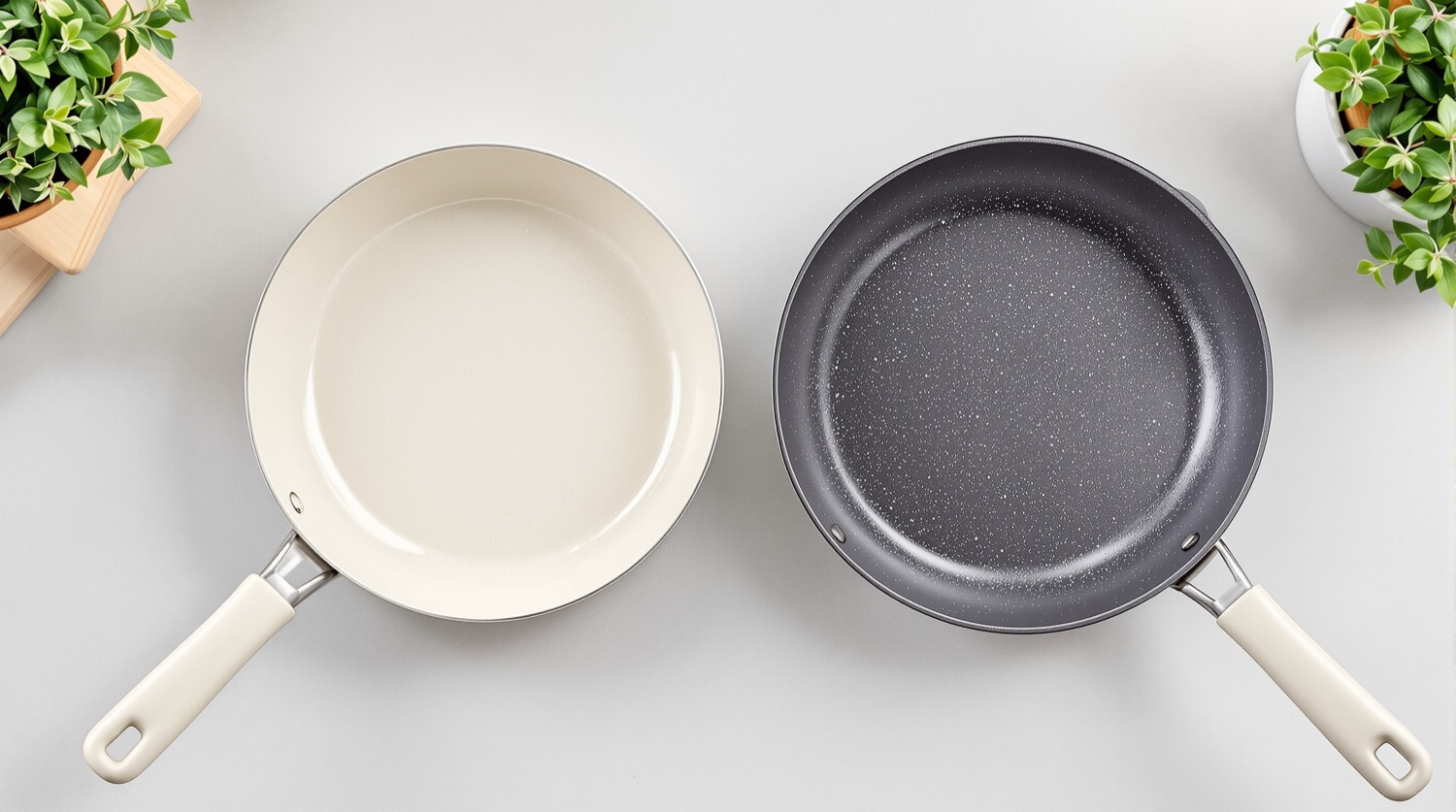
Walk down any cookware aisle in 2026 and you face the same two words on almost every box: “ceramic” and “nonstick.” Both promise eggs that slide. Neither box explains what the coating actually is, what it does when a metal spatula scratches it, or what happens the day you forget a preheating pan on high. Those three questions — not the marketing — are what separate the two materials.
The stakes are concrete. Traditional nonstick is PTFE (polytetrafluoroethylene, best known by the brand name Teflon), a fluoropolymer in the PFAS family. When researchers at Flinders University and the University of Newcastle put damaged PTFE cookware under Raman imaging in 2022, they counted about 9,100 plastic particles released by a single surface crack during simulated cooking — and up to 2.3 million microplastics and nanoplastics from a broken coating. A “ceramic” pan, by contrast, is not fired clay: it is a silica-based sol-gel glaze cured onto an aluminum body. It has its own weaknesses — but shedding fluoropolymer plastic into dinner is not one of them, because there is no fluoropolymer in it. The same PFAS family reaches well beyond the frying pan — it also turns up in the grease-proofing on some food papers, so it pays to check which parchment papers are genuinely PFAS-free.
Bottom line: Buy ceramic if your priority is coating chemistry — no PTFE, no fluoropolymer particles when scratched, no polymer fumes when overheated. Keep an intact PTFE pan only for low-to-medium-heat work, and replace it at the first visible scratch. The genuinely safest long-term move is the one neither box advertises: do your high-heat cooking in uncoated cast iron or stainless steel, where there is no coating to fail at all.
Is Ceramic Cookware Safer Than Nonstick?
On the chemistry of the coating itself, yes. A sol-gel ceramic coating is built from silica — the main ingredient of glass and sand — and contains no PTFE or any other fluoropolymer, so there is no plastic layer to shed particles when the surface wears and no fluoropolymer to break down when the pan overheats. PTFE nonstick is the opposite case: the entire cooking surface is a plastic in the PFAS family, and the 2022 Flinders/Newcastle Raman-imaging study showed that once that surface is cracked or broken, it releases thousands to millions of micro- and nanoplastic particles during ordinary cooking motions.
The honest counterweight: an intact PTFE pan used at sensible temperatures is a much smaller concern than a scratched one. PTFE is chemically inert at normal cooking heat, and the PFOA that made older Teflon production notorious was phased out of US manufacturing under the EPA’s 2010/2015 PFOA Stewardship Program. The comparison below is really about failure modes — because every coated pan eventually fails.
Head-to-Head: Ceramic vs PTFE Nonstick
What each coating is, and what it does when scratched or overheated — at a glance.
| Feature | Ceramic (Sol-Gel) | PTFE Nonstick |
|---|---|---|
| Coating material | Silica-based glaze, cured onto aluminum | PTFE — a fluoropolymer (PFAS family) |
| Contains PTFE / fluoropolymers | No | Yes — the surface is PTFE |
| Sheds plastic when scratched | No fluoropolymer to shed | ~9,100 particles per crack; up to 2.3M from broken coating (2022 study) |
| Overheating behavior | Coating degrades but releases no polymer fumes | Deterioration begins around 500°F; fumes can cause polymer fume fever |
| Nonstick lifespan | Shorter — slickness fades in ~1–3 years of daily use | Longer when babied — but any scratch is a replace-it signal |
| Utensil tolerance | Wood or silicone only | Wood or silicone only |
| High-heat searing | Shortens coating life | Unsafe territory — keep below medium-high |
| Typical price (10–12″ pan) | $–$$ | $–$$ |
| The no-coating alternative | Cast iron / stainless steel — nothing to scratch, nothing to overheat, lasts decades | |
What Is Each Coating Actually Made Of?
The names on the box obscure more than they explain, so here is what is physically on the pan.
PTFE “Nonstick”: A Fluoropolymer Cooking Surface
PTFE is a plastic made of carbon chains saturated with fluorine — the same carbon-fluorine bond that defines the PFAS chemical family and makes these compounds so persistent. It is genuinely inert at everyday cooking temperatures, which is why regulators have long allowed it on cookware. The concerns sit at the edges of normal use. A 2017 perspective in Environmental Science and Pollution Research (Sajid & Ilyas) summarizes the evidence: PTFE coatings begin to deteriorate around 260°C (500°F) — a temperature an empty pan on a high burner can reach in minutes — and the breakdown products at higher temperatures include fumes that cause “polymer fume fever,” a flu-like illness documented in both cooks and birds kept near kitchens. Legacy PFOA is a separate, largely historical issue: the EPA’s PFOA Stewardship Program eliminated it from US production, so a pan made in the last decade should not contain it. That same polymer-fume question hangs over any coated basket near a hot element, which is why it sits at the center of air-fryer safety.
“Ceramic”: A Silica Glaze, Not Fired Clay
A ceramic-coated pan starts life as a spun aluminum body. The nonstick layer is applied as a liquid silica-based sol-gel — think of an engineered glass film — then cured at high temperature. Brands like GreenPan (which introduced the category with its Thermolon coating) and Caraway state their coatings are made without PTFE, PFOA, lead, or cadmium; those are manufacturer claims rather than independent certifications, but the defining fact is structural: there is no fluoropolymer in the recipe, so the wear products of a ceramic pan are not fluoropolymer particles. The trade-off is longevity. Sol-gel surfaces lose their release properties with heat cycles and utensil wear — owners commonly report the slickness fading within one to three years of daily use, noticeably sooner than a carefully treated PTFE pan.
What Happens When a Nonstick Pan Gets Scratched?
This is the question that decides the comparison, because a scratch is not cosmetic on a pan whose cooking surface is plastic. In the 2022 study, researchers Luo, Gibson, Chuah, Tang, Naidu, and Fang used Raman imaging — a technique that identifies particles by their chemical fingerprint — to watch what damaged PTFE cookware sheds during a simulated cooking process. A single surface crack released on the order of 9,100 Teflon micro- and nanoplastic particles. A broken coating released up to 2.3 million. Those particles go where the food is. The authors’ conclusion was measured but direct: damaged nonstick cookware is a meaningful and previously under-counted source of micro- and nanoplastics in food.
A scratched ceramic pan fails differently. The glaze wears through to aluminum, the pan gradually stops releasing eggs, and you eventually retire it for performing badly — annoying, but not a plastic-shedding event, because the coating has no fluoropolymer to shed. That asymmetry in failure modes, more than anything about intact pans, is why we rank ceramic the safer choice.
Can You Still Use PTFE Nonstick Safely?
Yes, within three rules the research supports. Keep the heat at medium or below and never preheat an empty pan — deterioration begins around 500°F, and an empty pan on high gets there fast. Use only wood or silicone utensils, because the failure mode you are preventing is the scratch itself. And retire the pan at the first visible scratch or flake — that is the point where the 2022 particle counts start applying to your dinner. If those rules feel like babysitting, that is an honest signal that an uncoated pan fits your cooking style better.
Which Should You Buy?
Match the pan to how you actually cook, not to the aisle marketing.
Choose ceramic if:
- You want a nonstick surface with no PTFE in it
- You mostly cook eggs, pancakes, fish at low-medium heat
- You are fine replacing the pan when slickness fades
- Anyone in the house tends to grab metal utensils
Skip both coatings if:
- You sear, broil, or cook at high heat regularly
- You want one pan that lasts decades
- You do not want to think about coating damage at all
- Cast iron or stainless steel covers your cooking
For the full field — including stainless, carbon steel, and enameled options — see our ranked guide to the best non-toxic cookware, our picks of PFAS-free cookware, and the three-way cast iron vs stainless steel vs ceramic comparison. If you already own nonstick and want the fuller safety picture, our is nonstick cookware safe deep dive covers it pan-by-pan.
The Three Worth Buying
One ceramic set for design-minded kitchens, one ceramic set for value, and the uncoated skillet that outlasts them both.
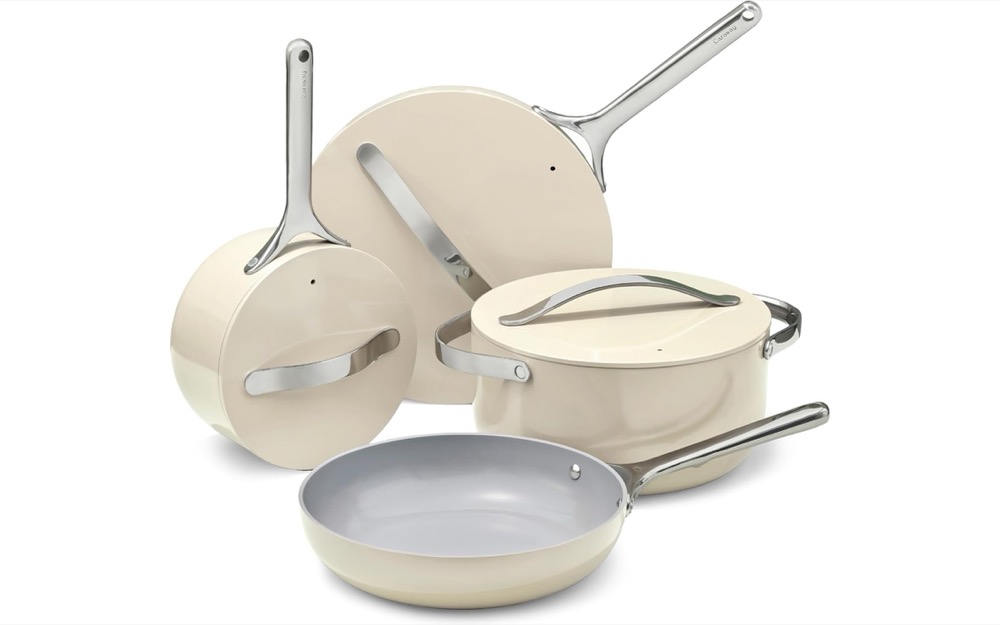 Best Ceramic Set
Caraway’s cooking surface is the sol-gel ceramic described above: no PTFE layer to crack and shed particles, which is the specific failure the 2022 Raman-imaging study documented in nonstick pans. Treat it like any coated pan — wood or silicone utensils, medium heat — and expect to trade some longevity for the cleaner chemistry.
Pros
- No PTFE — nothing fluoropolymer to shed when worn
- Full set covers every daily pan at once
- No polymer-fume risk if accidentally overheated
Cons
- Slickness fades with daily use — expect 1–3 years
- Premium price for a coated pan
- Still needs wood/silicone utensils
Replace a scratched nonstick set in one move — with a cooking surface that has no plastic in it.
Why it's the safer chemistry: The coating is a silica-based glaze. When it wears, it stops being slick — it does not shed fluoropolymer particles into food.
Check Today's Price on Amazon →Amazon prices change daily — tap to see today's price and any current discount.
- Free delivery for Prime members
- Thousands of verified reviews
- Easy 30-day returns
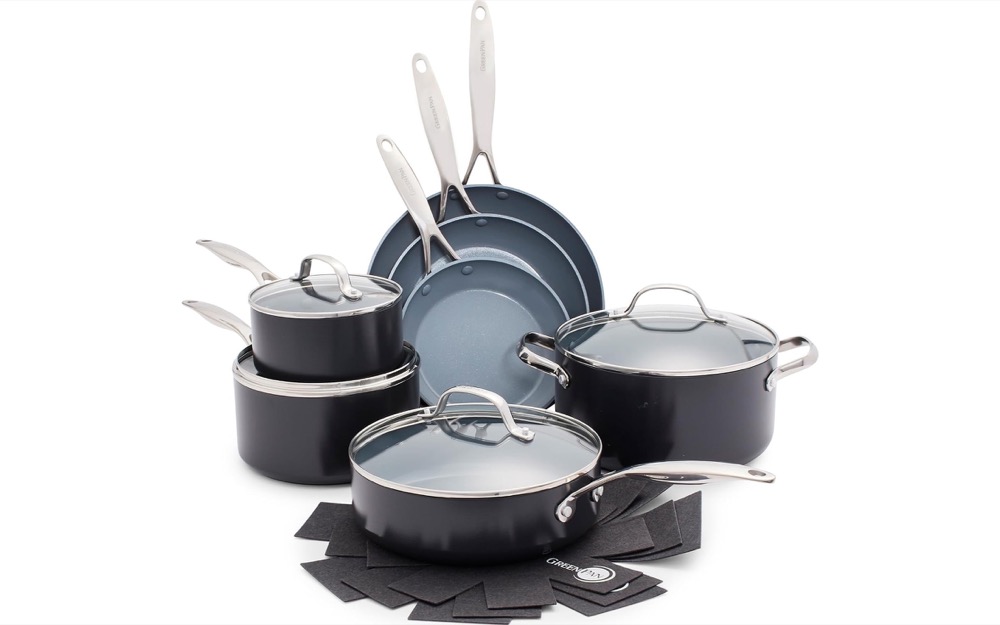 Best Value Ceramic
GreenPan created the ceramic nonstick category, and Valencia Pro is its proven mid-line: the silica-based Thermolon surface on a hard-anodized aluminum body with a magnetic base for induction stoves. The safety logic is identical to every true ceramic coating — no PTFE means the scratch-and-shed failure mode documented in nonstick pans simply is not available.
Pros
- No PTFE, no fluoropolymer wear particles
- Induction-compatible magnetic base
- Costs meaningfully less than premium ceramic sets
Cons
- Same 1–3 year slickness horizon as all ceramic
- High-heat searing shortens coating life
Ceramic-coated cooking without the boutique markup — from the brand that invented the coating.
Why it's the safer chemistry: Thermolon is a silica-based surface made without PTFE or PFOA (manufacturer-stated) — there is no fluoropolymer layer to crack and shed particles.
Check Today's Price on Amazon →Amazon prices change daily — tap to see today's price and any current discount.
- Free delivery for Prime members
- Thousands of verified reviews
- Category-inventor track record
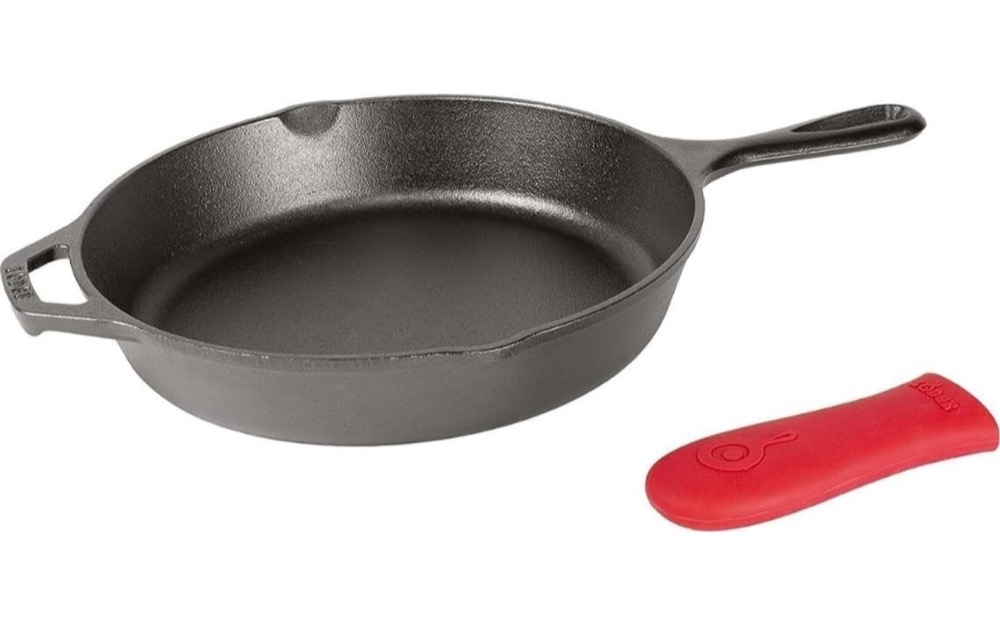 The Uncoated Upgrade
Every rule that protects a coated pan — medium heat only, no metal, replace when scratched — exists because there is a coating to protect. Cast iron deletes the problem. Its seasoning is polymerized cooking oil that gets better with use, it shrugs off the 500°F territory that degrades PTFE, and a scratch is something you fix with a paper towel and a drop of oil rather than a reason to bin the pan.
Pros
- No coating — the failure modes above do not exist
- Unlimited heat: sear, broil, campfire, oven
- Costs a fraction of a coated set, lasts decades
Cons
- Heavy — over 5 pounds
- Needs drying and occasional re-oiling
- Eggs need an established seasoning first
One pan, no coating, no replacement cycle — the long-term answer to coating anxiety.
Why it's the safest: There is nothing on the cooking surface but iron and polymerized oil — nothing to shed particles, nothing to emit fumes, nothing to wear out.
Check Today's Price on Amazon →Amazon prices change daily — tap to see today's price and any current discount.
- Free delivery for Prime members
- Made in the USA since 1896
- Hundreds of thousands of reviews
Frequently Asked Questions
Is ceramic cookware safer than nonstick?
On coating chemistry, ceramic is the safer of the two. A sol-gel ceramic coating is a silica-based glaze with no PTFE in it, so a scratched or worn ceramic pan cannot shed fluoropolymer plastic into food. The 2022 Science of the Total Environment study measured roughly 9,100 plastic particles from a single crack in a PTFE coating and up to 2.3 million from a broken one. An intact PTFE pan at low-to-medium heat is a much smaller risk — the danger concentrates in damage and overheating.
What happens when nonstick cookware gets scratched?
The coating starts shedding plastic into food. Using Raman imaging, researchers counted about 9,100 particles released by a single surface crack during simulated cooking, rising to millions when the coating was broken. Because PTFE is a fluoropolymer in the PFAS family, a visibly scratched nonstick pan is the clearest replace-it signal in the kitchen.
Is ceramic cookware really PFAS-free?
The coating contains no PTFE or other fluoropolymers — that is its defining difference. Brands such as GreenPan and Caraway state their coatings are made without PFAS, PFOA, lead, or cadmium; treat those as manufacturer claims and favor brands that publish testing. Either way, the structural point stands: there is no fluoropolymer layer to shed particles or produce polymer fumes.
How long does ceramic nonstick last compared to PTFE?
Shorter — the honest trade-off. Sol-gel ceramic loses its release properties with heat cycles and utensil wear, and many owners see meaningful decline within one to three years of daily use, while a babied PTFE surface often stays slick longer. When ceramic wears, it merely stops being slick; when PTFE breaks down, it sheds fluoropolymer particles.
What is the safest cookware overall?
Uncoated metal — cast iron, carbon steel, or stainless steel — because there is no coating to scratch, wear, or overheat. A Lodge cast iron skillet costs about as much as one mid-range coated fry pan, handles unlimited heat, and its polymerized-oil seasoning improves with use. Many households land on the practical split: ceramic for low-heat eggs, bare metal for everything else.
Sources
- Luo Y, Gibson CT, Chuah C, Tang Y, Naidu R, Fang C. Raman imaging for the identification of Teflon microplastics and nanoplastics released from non-stick cookware. Science of the Total Environment. 2022;851:158293. doi:10.1016/j.scitotenv.2022.158293 (PubMed PMID 36030853)
- Sajid M, Ilyas M. PTFE-coated non-stick cookware and toxicity concerns: a perspective. Environmental Science and Pollution Research. 2017;24(30):23436–23440. doi:10.1007/s11356-017-0095-y (PubMed PMID 28913736)
- US EPA. Fact Sheet: 2010/2015 PFOA Stewardship Program. epa.gov