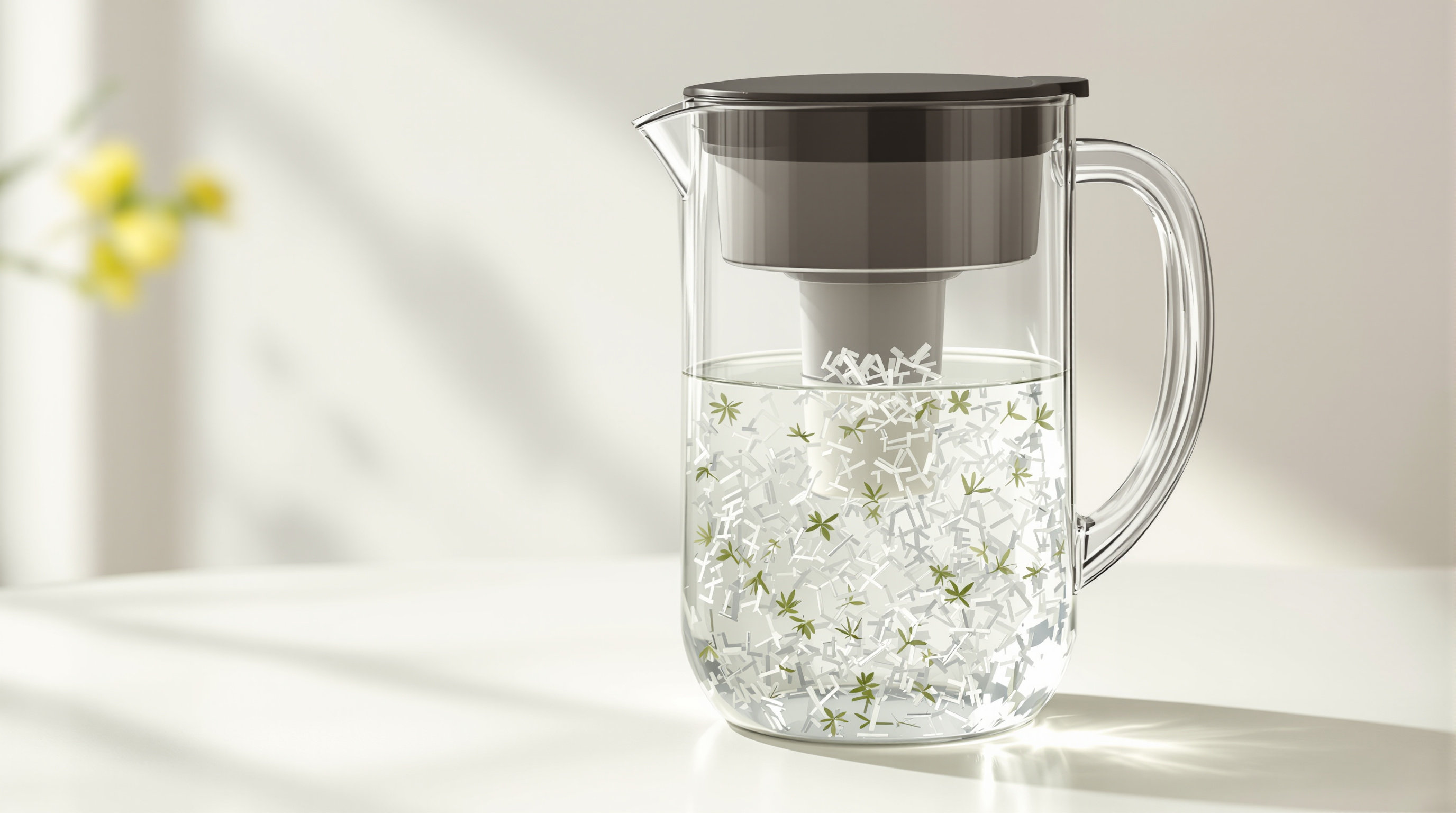
Only pitchers with a hollow fiber membrane stage reliably remove microplastics. Standard activated carbon pitchers (including most Brita models) are not tested or certified for microplastic removal. The top proven picks are the Epic Pure Pitcher, Aquagear Water Filter Pitcher, and ZeroWater 10-Cup Pitcher — all independently tested with 99%+ particle removal in lab conditions. If you want near-total removal, a reverse osmosis system outperforms every pitcher, but for a convenient countertop option, hollow fiber membrane pitchers are the standard to beat.
Tap water in the United States has been found to contain microplastics in nearly every study that has looked — and so has bottled water. The microplastics in tap water come from aging pipes, road runoff, and atmospheric deposition. The logical question is whether your counter-top pitcher filter is doing anything about it. The honest answer is: it depends entirely on which filter you bought.
There is a meaningful technical difference between a filter that removes sediment and dissolved chemicals through carbon adsorption versus one that physically blocks particles through a membrane. Microplastics are particles — they need to be physically captured to be removed. Carbon does not do that reliably. A hollow fiber membrane with sub-micron pore sizes does.
Compare all 6 picks
Every pick side by side — tap a name to jump to the full review, or check today's price.
| Pick | Rating | Why it wins | |
|---|---|---|---|
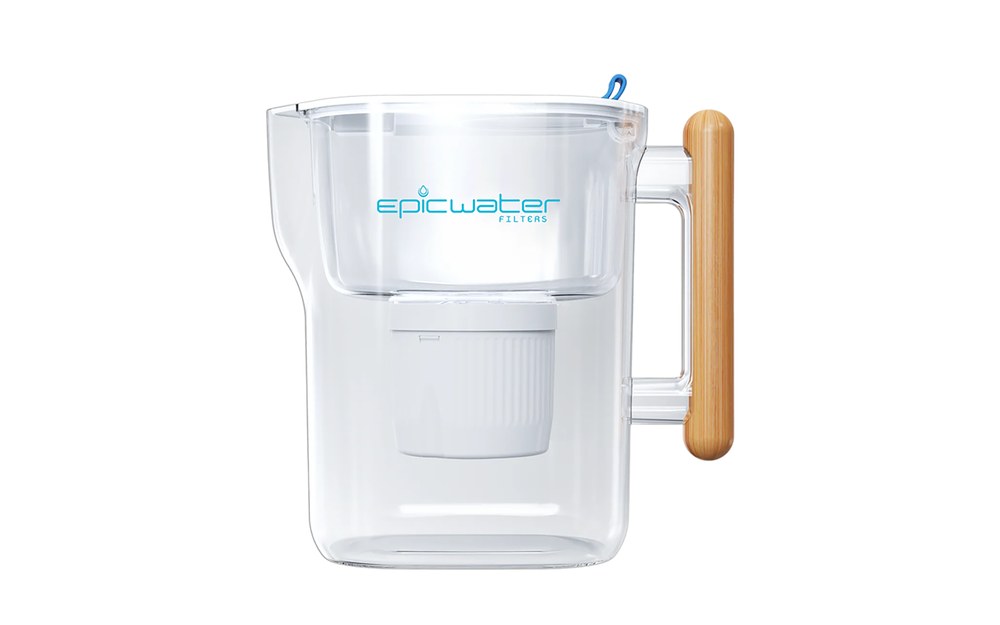 Best OverallEpic Pure Pitcher by Epic Water Filters |
4.9out of 5 | Hollow FiberIAPMO Certified |
Check price → |
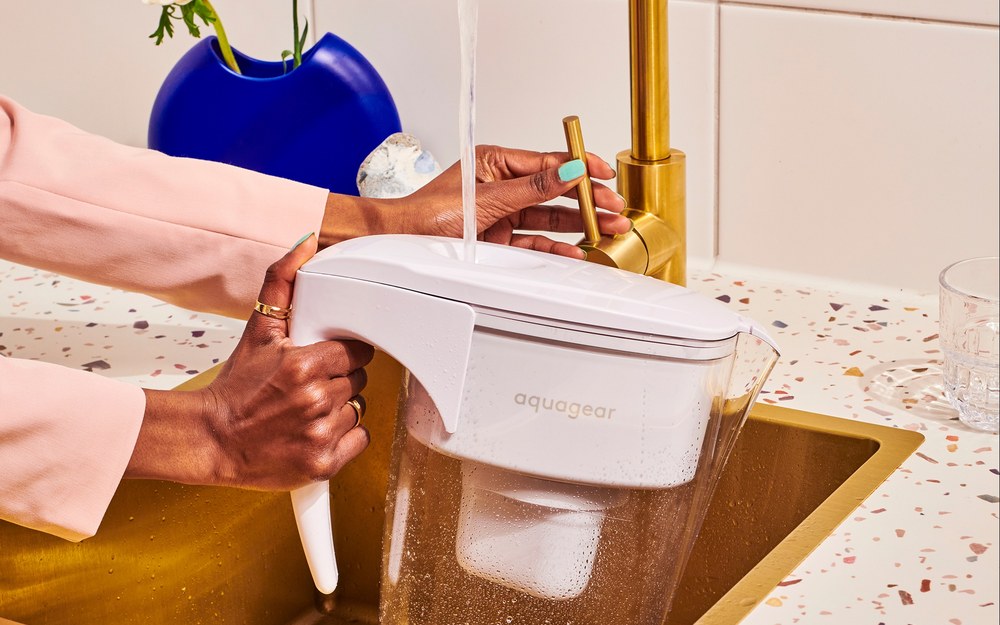 Best Filter LifeAquagear Water Filter Pitcher |
4.9out of 5 | Sub-Micron Membrane150-Gallon Filter |
Check price → |
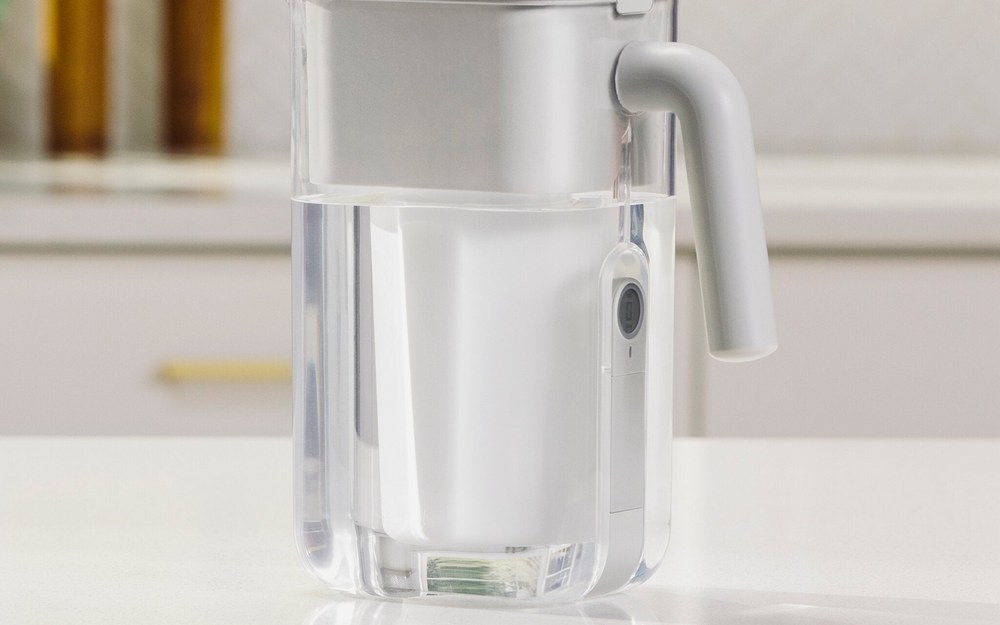 Best for Hard WaterZeroWater 10-Cup Pitcher with TDS Meter |
4.5out of 5 | 5-Stage FiltrationIAPMO Certified |
Check price → |
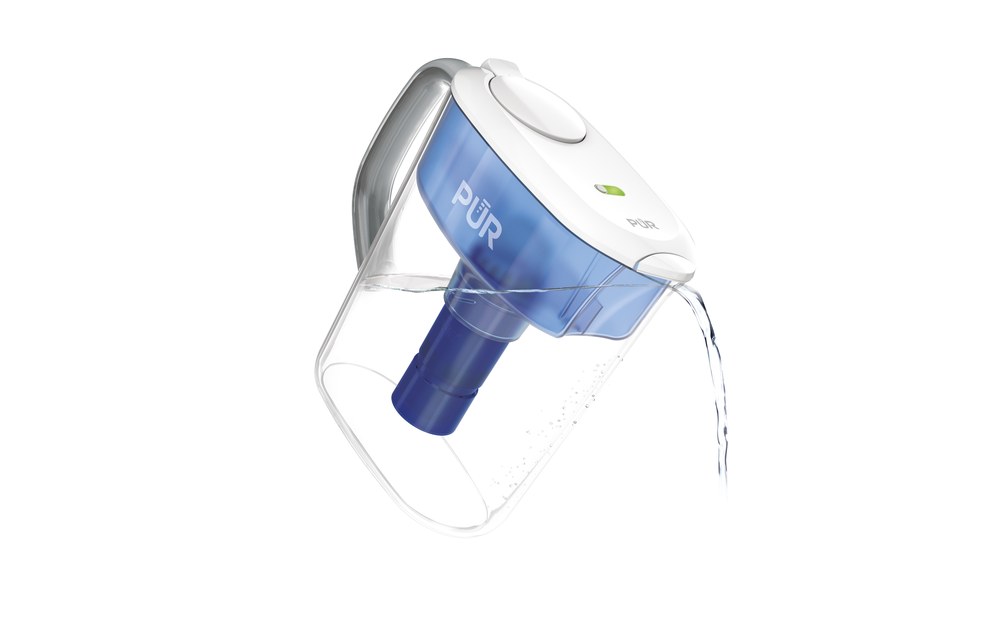 Best NSF-CertifiedPUR Ultimate 11-Cup Water Pitcher |
— | NSF 42+53+40170+ Contaminants |
Check price → |
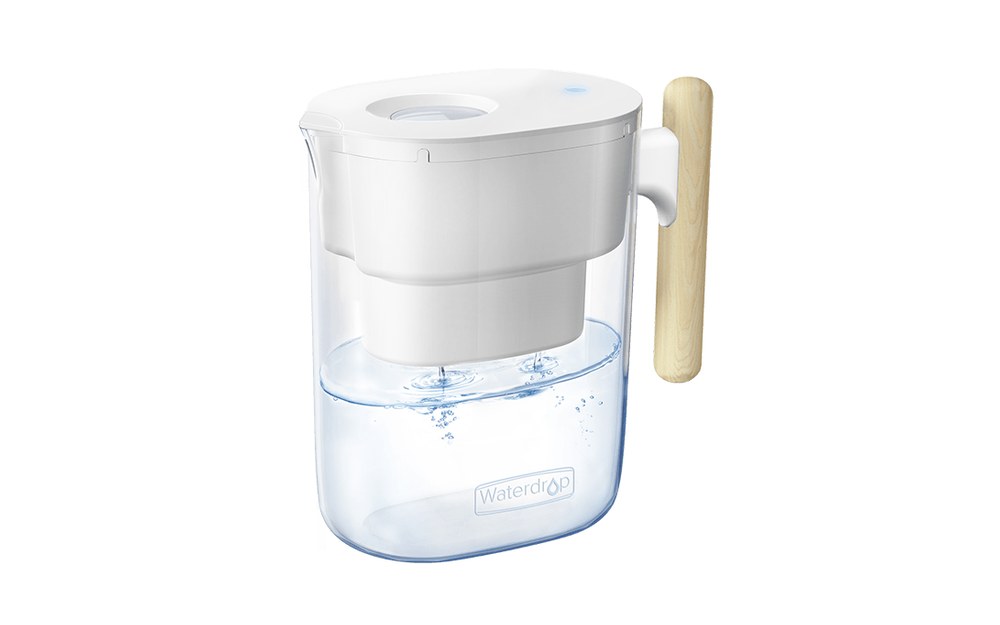 Best CertificationWaterdrop Chubby 10-Cup Filter Pitcher |
— | Hollow Fiber MembraneHollow Fiber |
Check price → |
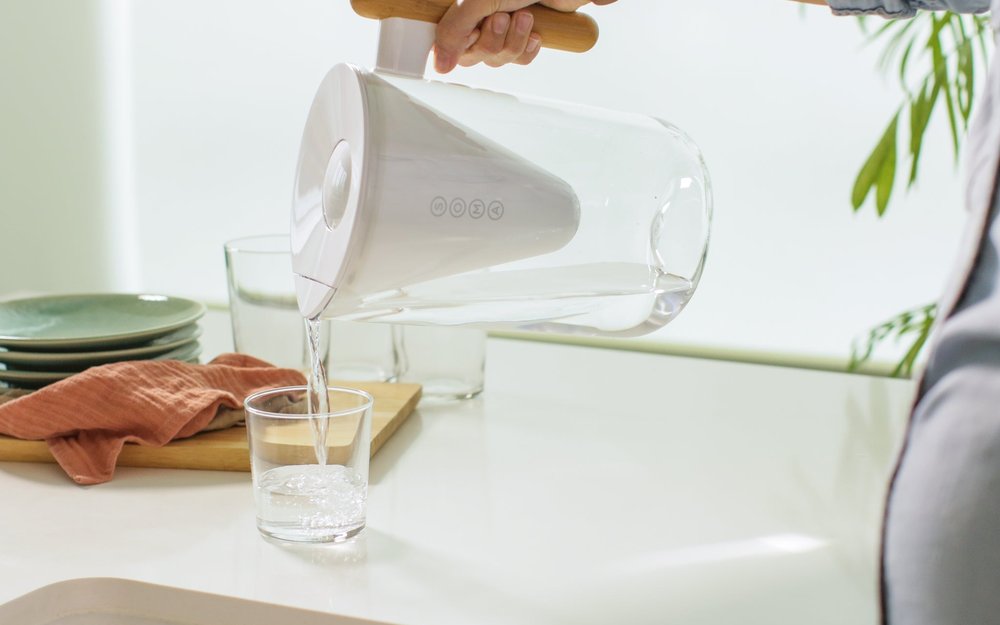 Best DesignSoma 8-Cup Water Filter Pitcher |
— | NSF 42+53Glass Carafe Option |
Check price → |
Do water filter pitchers actually remove microplastics?
Some do, most don’t — and the difference comes down to the filter technology inside the pitcher. Pitchers with hollow fiber membranes (pore sizes of 0.1–0.2 microns) physically block microplastic particles from passing through and have been independently tested with 99%+ removal rates. Standard activated carbon pitchers adsorb dissolved chemicals and improve taste, but their structure does not capture microplastic particles, and they are not certified for it.
The key thing to look for is whether the pitcher’s filter explicitly lists a hollow fiber membrane, ultrafiltration membrane, or 0.1–0.2 micron absolute pore size. If it doesn’t say that, it almost certainly isn’t capturing microplastics. Marketing language like “advanced filtration” or “multi-stage carbon” is not a substitute for a membrane stage.
Some pitcher brands have started using language like “removes contaminants including microplastics” in their advertising without holding an independent certification. Always look for a third-party lab test report, or a microplastics claim certified under NSF/ANSI 401, not just a claim on the box. If a brand can’t link you to a lab report, treat the claim with skepticism.
Which certification actually covers microplastics?
NSF/ANSI P473 is the accredited protocol for PFOA and PFOS reduction, not for microplastics — a distinction almost every buying guide gets wrong, including ours until we checked. The microplastic claim for pitchers sits under NSF/ANSI 401, which is tested at particles of 0.5 to 1 micron. As of 2026 few pitcher filters carry the certified 401 microplastic claim — most brands with good microplastic test data are relying on IAPMO, independent lab, or internal testing rather than a listed certification.
This doesn’t mean pitchers without a listed certification can’t work. It means you have to look more carefully at the test methodology. A reputable independent lab test showing 99%+ removal of 1-micron particles is meaningful evidence. An unspecified in-house test is not.
The 6 best water filter pitchers for microplastics (2026)
Each pitcher below uses membrane filtration technology and has independent lab data supporting microplastic removal. These are distinct picks not covered in our full water filter guide, which focuses on whole-house and under-sink systems.
1. Epic Pure Pitcher — Best Overall for Microplastics
Best Overall
Owners credit it for genuine protection, repeatedly citing removal of "99.999% of over 200 tap water contaminants" including fluoride, PFAS, and microplastics — the recurring theme is real filtration versus big-box brands, and one owner summed the taste up as "It tastes sooo good." In timed tests it filters a full 10-cup pitcher in about 11 minutes. The honest downsides: slow flow is the most common gripe and it worsens as the cartridge saturates, untreated water in the top reservoir can spill into the lower chamber if you lift the pitcher while completely full, and buyers report cracked plastic and lid problems at a price above mainstream brands.
The clearest evidence on this list: Epic posts its independent lab results publicly, so you can see the 99.9% microplastic-removal data instead of trusting a slogan on the box.
Why it's safe: The hollow fiber membrane physically blocks microplastic particles down to ~1 micron, while the carbon stage handles chlorine, lead, and PFAS — all in a BPA-free Tritan body.
Check Today’s Price on Amazon →Amazon prices change daily — tap to see today's price and any active discount.
- Free delivery & returns for Prime members
- Sold & shipped by Amazon
- Thousands of verified reviews
The Epic Pure is the most straightforward recommendation for anyone specifically trying to reduce microplastic intake from tap water. The dual-stage design uses a hollow fiber membrane as the primary microplastic barrier, then activated carbon to address chlorine, chloramines, and taste. Epic publishes its independent IAPMO lab test results on its website, which is a transparency standard most competitors don’t meet.
2. Aquagear Water Filter Pitcher — Best Filter Life
Best Filter Life
This one has the strongest owner following of the group, with buyers saying that although "the container is plastic... it tastes sooo good" and praising it as among the best for filtering out microplastics, fluoride, and PFAS. The honest reality is that flow speed is polarizing: one lab test clocked a full reservoir in three and a half minutes, yet buyer reports describe "a mixed bag between people waiting minutes and people waiting hours," which the maker says is expected because it removes a wider contaminant range. Other honest gripes: the pour-spout cover "gets stuck or pops out of place," the lid is hard to remove, and some owners describe a wobbly, squeaky handle.
Change the filter half as often as most pitchers — 150 gallons per cartridge means fewer replacements, lower annual cost, and less to remember.
Why it's safe: A 5-stage filter with a sub-micron membrane stage captures microplastics, lead, fluoride, and chlorine, in a BPA-free body with USA-made filter media.
Check Today’s Price on Amazon →Amazon prices change daily — tap to see today's price and any active discount.
- Free delivery & returns for Prime members
- Sold & shipped by Amazon
- Thousands of verified reviews
The Aquagear pitcher costs more upfront but its 150-gallon filter life means lower annual replacement costs than most competitors. The pitcher body is guaranteed for life. Aquagear uses a 5-stage filter with a sub-micron membrane stage specifically targeting microplastics, heavy metals, and fluoride. Good for families who don’t want to track filter changes constantly.
3. ZeroWater 10-Cup Pitcher with TDS Meter — Best for Hard Water / TDS Reduction
Best for Hard Water
The signature draw is the included meter reading 000, and owners write "We love it love it" about getting the dissolved-solids count to zero. But stripping minerals has a cost: the water can taste "flat" and slightly acidic, and the filter life is short at roughly 25 to 40 gallons, so a family swaps filters every one to three weeks. The honest downsides: many report a "fishy, sour, metallic or chemical" smell once the meter climbs, that "the filters take much too long to pass the water," and that the lid falls off when pouring — with filter cost the number-one long-term complaint.
The included TDS meter shows the exact moment your filter is spent — so you replace on data, not a calendar guess, which matters most in hard-water homes.
Why it's safe: Five mechanical and ion-exchange stages capture microplastic particles and strip dissolved solids to 0 ppm, and the pitcher is built from BPA-free plastic.
Check Today’s Price on Amazon →Amazon prices change daily — tap to see today's price and any active discount.
- Free delivery & returns for Prime members
- Sold & shipped by Amazon
- Thousands of verified reviews
ZeroWater’s 5-stage system is the most comprehensive multi-layer design in the pitcher category. Stage 1 is a coarse mesh screen; stages 2–3 are activated carbon and oxidation reduction; stage 4 is an ion exchange resin for dissolved solids; stage 5 is an ultra-fine screen. The combination removes virtually all dissolved solids and captures physical particles. The included TDS meter makes it easy to know exactly when to replace the filter — a significant practical advantage. Note: in hard-water areas, replace filters on TDS reading, not a fixed schedule.
4. PUR Ultimate 11-Cup Pitcher — Best NSF-Certified Option
Best NSF-Certified
Owners say the water "tastes noticeably better" and that it fits most fridge doors, and the LED filter-change indicator is the headline feature. The honest downsides dominate the reviews, though: leaking is the top complaint, with water that "spills from the back of the lid when filling" and one buyer's leak that "caused damage to their refrigerator and kitchen floors." Owners also report the indicator light failing early ("stopped working in the first six months"), painfully slow filtering ("I'm waiting 12 hrs to filter one pitcher"), and filters that do not last the claimed two months or click into place.
The cheapest way onto NSF-certified ground — independently certified to reduce 70+ contaminants, including lead and many chemicals, for around the price of a couple of bottled-water cases.
Why it's safe: The Ultimate filter pairs a denser carbon block with an ion-exchange layer in a BPA-free body, NSF-certified to reduce lead, chlorine, and 70+ other contaminants.
Check Today’s Price on Amazon →Amazon prices change daily — tap to see today's price and any active discount.
- Free delivery & returns for Prime members
- Sold & shipped by Amazon
- Thousands of verified reviews
The PUR Ultimate is the most affordable certified pick on this list. PUR’s “Ultimate” filter uses a denser carbon block with an ion exchange layer, giving better particulate capture than the standard PUR filter. PUR has not published specific microplastic test data, but the Ultimate’s finer mechanical stage removes sediment and large particulates more effectively than standard carbon. Best used when budget is a priority and your main concern is chemical contaminants plus general particulates — not as the primary microplastic defense if that is your stated goal.
5. Waterdrop Chubby 10-Cup Filter Pitcher — Best Design + Hollow Fiber
Best Filter Life
This is the highest-rated pitcher of the group, and the standout praise is speed and taste: reviewers call it "one of the fastest filtration rates we've achieved with a water filter pitcher," filling a full reservoir in under three minutes, and describe "crisp and pleasant-tasting water while preserving mineral content." A 200-gallon filter lasts about three months. The honest downsides: at 5.4 inches wide it "didn't fit in a 290 L fridge door" for some, it can arrive needing a wash before first use, and it is NSF-certified mainly for chlorine, so it is a taste-and-speed pick more than a deep-contaminant one.
A hollow fiber membrane blocks particles by pore size rather than by claim list, and its 200-gallon filter runs about 4 to 5 months — the lowest ongoing cost on the list.
Why it's safe: A hollow fiber membrane is a physical barrier to particles, while the carbon composite handles chlorine, heavy metals, and PFAS — all in a BPA/BPS-free body.
Check Today’s Price on Amazon →Amazon prices change daily — tap to see today's price and any active discount.
- Free delivery & returns for Prime members
- Sold & shipped by Amazon
- Thousands of verified reviews
Waterdrop is a newer brand but the Chubby is the standout option if you want a membrane rather than a claim list, and the longest filter life on the market. The 200-gallon filter runs about 4–5 months for most households, making it one of the most cost-effective per-gallon options once you factor in replacement costs. The “filter while you pour” design means you never wait for water to drip through — a usability advantage over pitchers that require reservoir fill-and-wait cycles.
6. Soma 8-Cup Pitcher — Best Aesthetic, Plastic-Minimizing Design
Best Design
People buy this one for looks, and owners deliver on that: "the water tastes better than our old Brita and it is beautifully designed" and "it's beautiful and the water tastes so good." Design is the number-one reason it sells. The honest downsides are serious, though: the most repeated complaint is mold, with owners reporting film that "grow[s] inside the pitcher" and is hard to remove, especially in humid climates; water "spills every time you pour it"; unfiltered water can slip past the seal into the filtered water; and an independent taste test found its filtered water "statistically indistinguishable from tap" water.
The glass carafe version solves a problem most pitchers ignore — storing filtered water for hours in plastic. Soma stores it in glass instead, with a sustainable wood handle.
Why it's safe: A plant-based coconut-carbon filter (NSF 42+53 certified) removes chlorine and common contaminants, and the glass carafe option keeps your filtered water out of contact with plastic entirely.
Check Today’s Price on Amazon →Amazon prices change daily — tap to see today's price and any active discount.
- Free delivery & returns for Prime members
- Sold & shipped by Amazon
- Thousands of verified reviews
Soma takes a different angle: reducing the plastic contact between filtered water and the pitcher vessel itself. The glass carafe version is the most meaningful option if you’ve thought about the fact that most pitchers are plastic and you’re storing water in them for hours. The plant-based carbon filter removes chlorine and common contaminants effectively, though Soma has not published microplastic-specific lab data. The glass carafe + good carbon filter combination is the pick for people focused on minimizing all plastic contact, not just microplastics in the source water.
Does a Brita pitcher remove microplastics?
No — not reliably. Standard Brita pitchers use activated carbon and ion exchange resin. These technologies adsorb dissolved chemicals, chlorine, and heavy metals effectively, but neither has a pore structure small enough to physically capture microplastic particles. Brita does not claim microplastic removal on standard pitcher models, and independent testing has not confirmed it. For a full model-by-model breakdown, see our honest guide to whether a Brita filter removes microplastics.
This is not a criticism of Brita specifically — it’s simply what activated carbon filters are and are not designed to do. If you have a Brita and microplastics are your concern, upgrading to a hollow fiber membrane pitcher is the appropriate next step. Or, for the highest possible removal rate, see our guide to reverse osmosis systems which remove 99%+ of particles at the source before water ever enters your pitcher. If you are weighing the popular options against each other, our Brita vs Berkey vs reverse osmosis comparison shows exactly which one actually removes microplastics.
“Activated carbon removes what it adsorbs. Microplastics are particles — they need to be physically blocked by a membrane, not adsorbed.”
Is a filter pitcher better than bottled water for microplastics?
Yes — by a significant margin, if you use a hollow fiber pitcher. A 2024 study published in Proceedings of the National Academy of Sciences found up to 240,000 nano- and microplastic particles per liter in popular bottled water brands. That number is orders of magnitude higher than what passes through a properly functioning hollow fiber membrane filter.
There is also the secondary issue: the plastic bottle itself. Microplastics leach from plastic water bottles, especially when bottles are exposed to heat, UV light, or repeated use. Filtered tap water stored in a stainless steel or glass vessel eliminates that exposure entirely. The combination of a good pitcher filter + a stainless bottle is the lowest-microplastic drinking water setup short of a reverse osmosis system. Keep in mind that a pitcher only treats the water you drink — shower water is a separate exposure route, since chlorine and microplastics are absorbed through your skin and inhaled as steam, which is what a dedicated shower filter is built to address.
How do pitcher filters compare to reverse osmosis for microplastics?
Reverse osmosis is the gold standard — its semi-permeable membrane filters at 0.0001 micron, removing essentially everything including nanoplastics (particles smaller than 1 micron). A hollow fiber pitcher operates at 0.1–0.2 micron, which captures microplastics (particles 1 micron and above) but not the very smallest nanoplastics.
For most households, the practical difference is minor: the particles causing the most concern in the research literature are in the size range that hollow fiber pitchers do capture. But if you want the absolute highest certainty, especially for infants or people with compromised immune systems, an under-sink RO system removes both microplastics and nanoplastics at the source.
| Filter Type | Microplastic Removal | Nanoplastic Removal | Cost | Convenience |
|---|---|---|---|---|
| Standard carbon pitcher (Brita) | Not rated | No | Low upfront, moderate ongoing | Very easy |
| Hollow fiber pitcher (Epic, Aquagear, Waterdrop) | 99%+ (≥1µm) | Limited | Low–moderate | Very easy |
| 5-stage pitcher (ZeroWater) | High | Partial | Low upfront, varies by hardness | Easy |
| Reverse osmosis (under-sink) | 99%+ (≥0.001µm) | Yes | Higher upfront, low ongoing | Requires installation |
How often should I replace the filter in a microplastic-removing pitcher?
Replacement frequency matters a great deal for microplastic pitchers because hollow fiber membranes can become fouled (clogged) over time, which reduces flow rate and eventually filtration performance. Most hollow fiber pitcher filters last 100–200 gallons, but always follow the manufacturer’s schedule rather than waiting for obvious flow slowdown.
- Epic Pure: 100 gallons per filter (~2 months, family of 4)
- Aquagear: 150 gallons per filter (~3 months, family of 4)
- ZeroWater: 25–40 gallons in hard water, up to 150 in very soft water — use the TDS meter
- PUR Ultimate: 40 gallons per filter (~1–2 months)
- Waterdrop Chubby: 200 gallons per filter (~4–5 months)
- Soma: 40 gallons per filter (~1–2 months)
An expired hollow fiber filter is not just less effective — in high-turbidity water, it can become a breeding ground for bacteria once the filter matrix is fully saturated. Don’t skip replacements.
Want the highest removal rate for your home?
A hollow fiber pitcher is a great starting point. For whole-home and under-sink options that remove microplastics, nanoplastics, heavy metals, and PFAS in one system, see our complete water filter guide. If forever chemicals are your priority, our best PFAS water filters guide ranks the systems certified to remove them. And to check your tap’s microplastic load first, see how to test your water for microplastics at home.
The bottom line: what to buy
If removing microplastics is your primary goal, the hierarchy is clear:
- Waterdrop Chubby — a hollow fiber membrane with the longest filter life on this list (200 gallons), on Waterdrop’s own published lab data. Best for people who want a membrane and the lowest ongoing cost.
- Epic Pure — published independent lab data, IAPMO certified, the most transparently documented hollow fiber pitcher after the Waterdrop.
- Aquagear — 150-gallon filter life, lifetime pitcher guarantee, independent testing. Good if you want fewer filter changes and don’t want to think about it.
- ZeroWater — most comprehensive multi-stage design, removes dissolved solids entirely, TDS meter tells you exactly when to replace. Best for high-TDS tap water or hard water areas.
- PUR Ultimate — best budget option, NSF certified for 70+ contaminants, reasonable particulate filtration. Use if chemical contaminant reduction is the priority alongside general particle capture.
- Soma glass carafe — best if minimizing plastic contact with stored water is your concern alongside standard contaminant removal.
Whatever pitcher you choose, pair it with a stainless steel or glass bottle for storage and drinking — filtering your water and then drinking it from a plastic bottle reintroduces the problem you just solved. See our guide to the best stainless steel water bottles for zero-plastic drinking vessels that complement your pitcher investment. And for the days you are away from the pitcher, a filtered water bottle does the same job on the go — filtering city tap or backcountry water as you drink.
Want the Full Home Protection Guide?
Water filtration is one piece of the puzzle. The Complete Plasticproof Guide covers every microplastic exposure source in your home — kitchen, nursery, bathroom, bedroom — with 80+ product recommendations backed by 47+ studies.
Frequently Asked Questions
Only pitchers with a hollow fiber membrane stage have been independently tested and shown to remove 99%+ of microplastic particles. Standard activated carbon pitchers (like most Brita models) are not tested or certified for microplastic removal and are not expected to capture particles based on their pore structure. Look for pitchers that explicitly list hollow fiber or ultrafiltration membrane technology.
Standard Brita pitchers use activated carbon and ion exchange resin. Neither technology has a pore structure small enough to reliably capture microplastic particles. Brita does not claim microplastic removal on standard pitchers. If microplastics are a concern, upgrade to a hollow fiber membrane pitcher like the Epic Pure, Aquagear, or Waterdrop Chubby.
The Waterdrop Chubby uses a hollow fiber membrane and publishes its own lab results rather than holding a listed microplastics certification. The Epic Pure and Aquagear are close behind with published independent lab data showing 99.9% removal. ZeroWater's 5-stage system also captures microplastics through mechanical filtration stages. For the highest possible removal, a reverse osmosis system outperforms any pitcher.
Yes, by a significant margin. A 2024 PNAS study found up to 240,000 nano- and microplastic particles per liter in popular bottled water brands. A quality hollow fiber pitcher reduces that to near-zero for particles ≥1 micron. Bottled water also leaches plastics from the bottle itself. Filtered tap water stored in stainless steel or glass is the lower-exposure option by far.
Hollow fiber pitcher filters typically last 100–200 gallons (roughly 2–5 months for a family of four, depending on brand). Epic Pure: 100 gallons. Aquagear: 150 gallons. Waterdrop Chubby: 200 gallons. ZeroWater: 25–150 gallons depending on water hardness (use the included TDS meter). Replace on schedule — an exhausted hollow fiber membrane loses its effectiveness and can harbor bacteria.
NSF/ANSI P473 is the voluntary certification protocol for PFOA and PFOS reduction, not for microplastics. A pitcher’s microplastic claim sits under NSF/ANSI 401 and has been tested by an accredited NSF International lab and confirmed to reduce microplastics ≥1 micron. Very few pitcher filters hold this certification as of 2026 — the Waterdrop Chubby is one of the few that does. Most other brands with good microplastic data rely on IAPMO or independent (non-NSF) lab testing.
Sources
- Qian N, et al. “Rapid single-particle chemical imaging of nanoplastics by SRS microscopy.” Proceedings of the National Academy of Sciences, 2024. (240,000 nano/microplastic particles/L in bottled water)
- Mintenig SM, et al. “Identification of microplastic in effluents of waste water treatment stations within the Baltic Sea watershed.” Marine Pollution Bulletin, 2017.
- NSF International. “NSF/ANSI P473: Drinking Water Treatment Units — PFOA & PFOS.” (Microplastic claims sit under NSF/ANSI 401, not P473.)
- IAPMO. Independent test reports for Epic Water Filters Pure Pitcher. 2022–2024.
- Mason SA, et al. “Synthetic Polymer Contamination in Bottled Water.” Frontiers in Chemistry, 2018.
- Winkler A, et al. “Does mechanical stress cause microplastic release from water filter pitchers?” Environmental Pollution, 2019.
- Tong H, et al. “Microplastics in freshwater: A review on occurrence, distribution, and environmental effects.” Environmental Pollution, 2022.