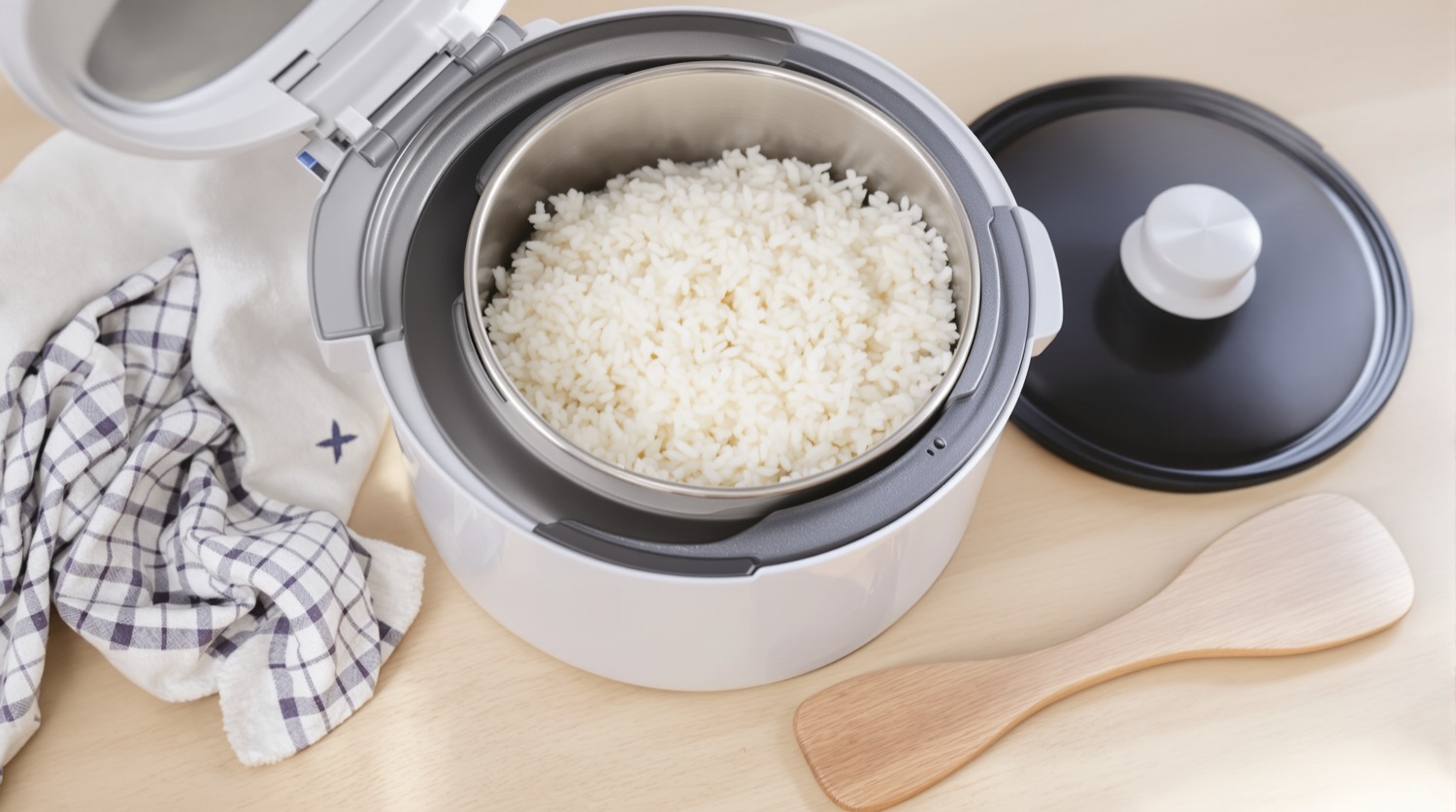
The best non-toxic rice cooker in 2026 is the Aroma Select Stainless ARC-753SG — its inner pot is food-grade 304 stainless steel and Aroma's own listing calls it a “COATING FREE INNER POT,” so there is no nonstick layer under the rice to scratch or flake. The most explicit wording we found on any listing belongs to the Miracle Exclusives ME81: “No ‘Teflon’ nor other non-stick surface materials.” If you want no metal either, the VitaClay VM7900-8 cooks in an unglazed Zisha clay crock. Full ranked list:
- Aroma Select Stainless ARC-753SG — Best overall. Bare 304 steel, one-touch, 6 cups cooked. Details →
- Miracle Exclusives ME81 — Most explicit about coatings. Grade 304 bowl, steel steamer tray. Details →
- Buffalo Classic 10-Cup — Best clad steel. Multi-layer pot, no chemical coating. Details →
- Buffalo Titanium IH Smart Cooker — Best induction. Non-coating clad pot, 11 programs. Details →
- Instant Pot Duo 6 Qt — Best multi-cooker. 18/8 stainless pot with a tri-ply bottom. Details →
- VitaClay VM7900-8 — Best non-metal. Unglazed Zisha clay crock, no glaze, no coating. Details →
What to replace first: any rice cooker whose inner pan is already scratched, chipped or flaking — that is the condition the particle-shedding research measured. See what the studies actually found →
Check Today’s Price on Amazon →Full details on all six below: what the pot is made of, what each maker says in writing, and the honest catch on every one.
Quick Navigation
- Compare all 6 rice cookers
- What makes a rice cooker non-toxic?
- The study data, in one table
- Best overall: Aroma ARC-753SG
- Most explicit: Miracle ME81
- Best clad steel: Buffalo Classic
- Best induction: Buffalo Titanium IH
- Best multi-cooker: Instant Pot Duo
- Best non-metal: VitaClay clay pot
- Three popular cookers we did not rank
- Does washing rice remove microplastics?
- Is a stainless steel rice cooker worth it?
- FAQ
Compare all 6 rice cookers
Every pick side by side — tap a name to jump to the full write-up, or check today's price.
| Pick | What touches the rice | Capacity | |
|---|---|---|---|
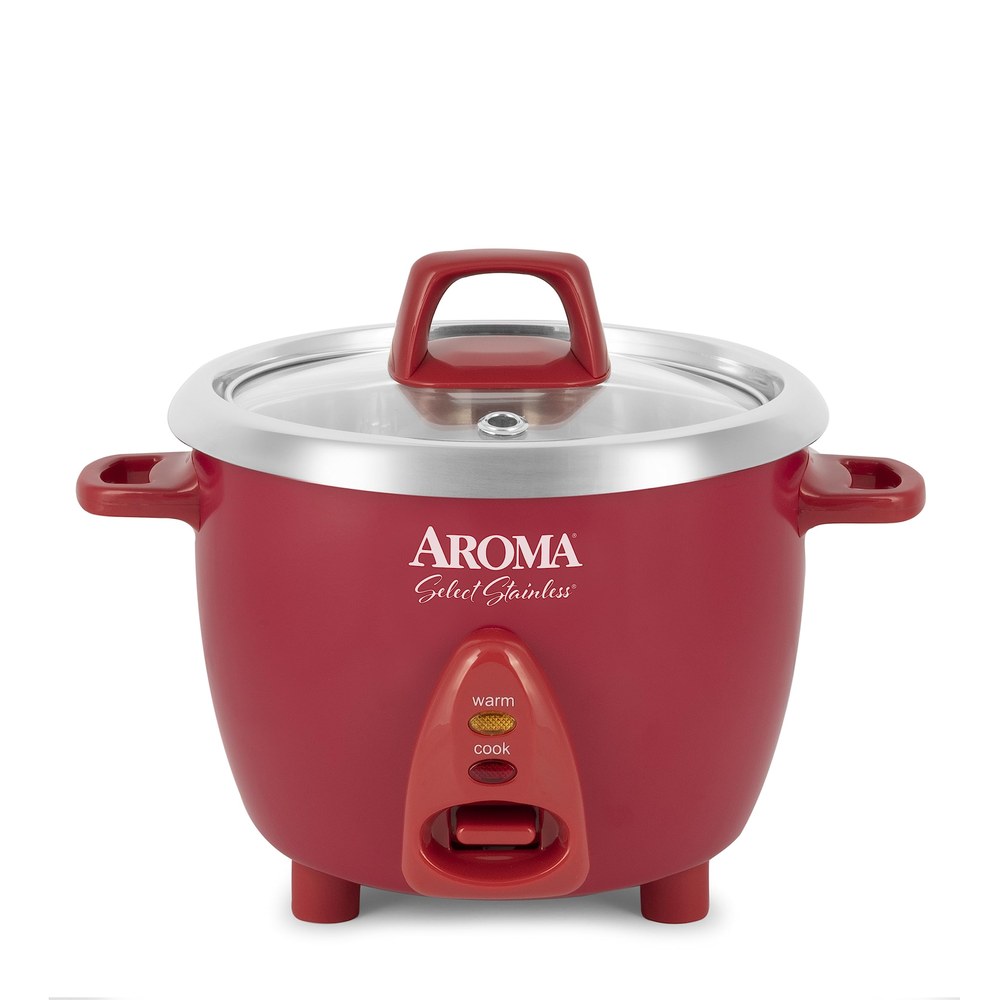 Best OverallAroma ARC-753SG |
Bare 304 SteelCoating FreeOne-Touch |
6 cups cooked (1.2 qt) | Check price → |
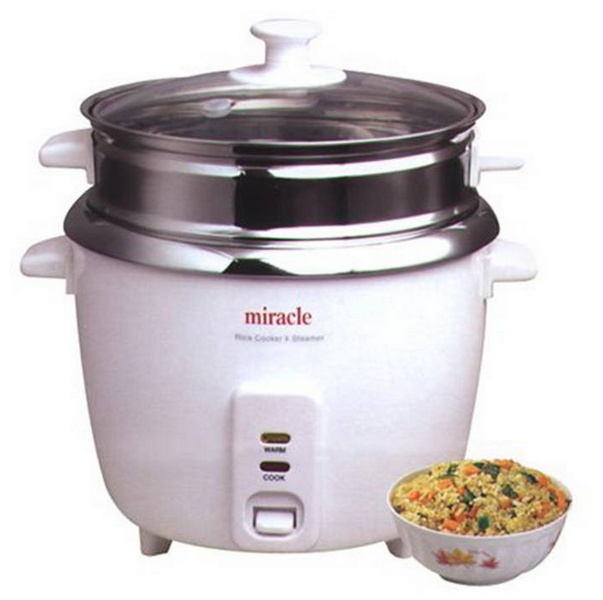 Most ExplicitMiracle ME81 |
Grade 304 BowlNo TeflonGlass Lid |
8 cups uncooked | Check price → |
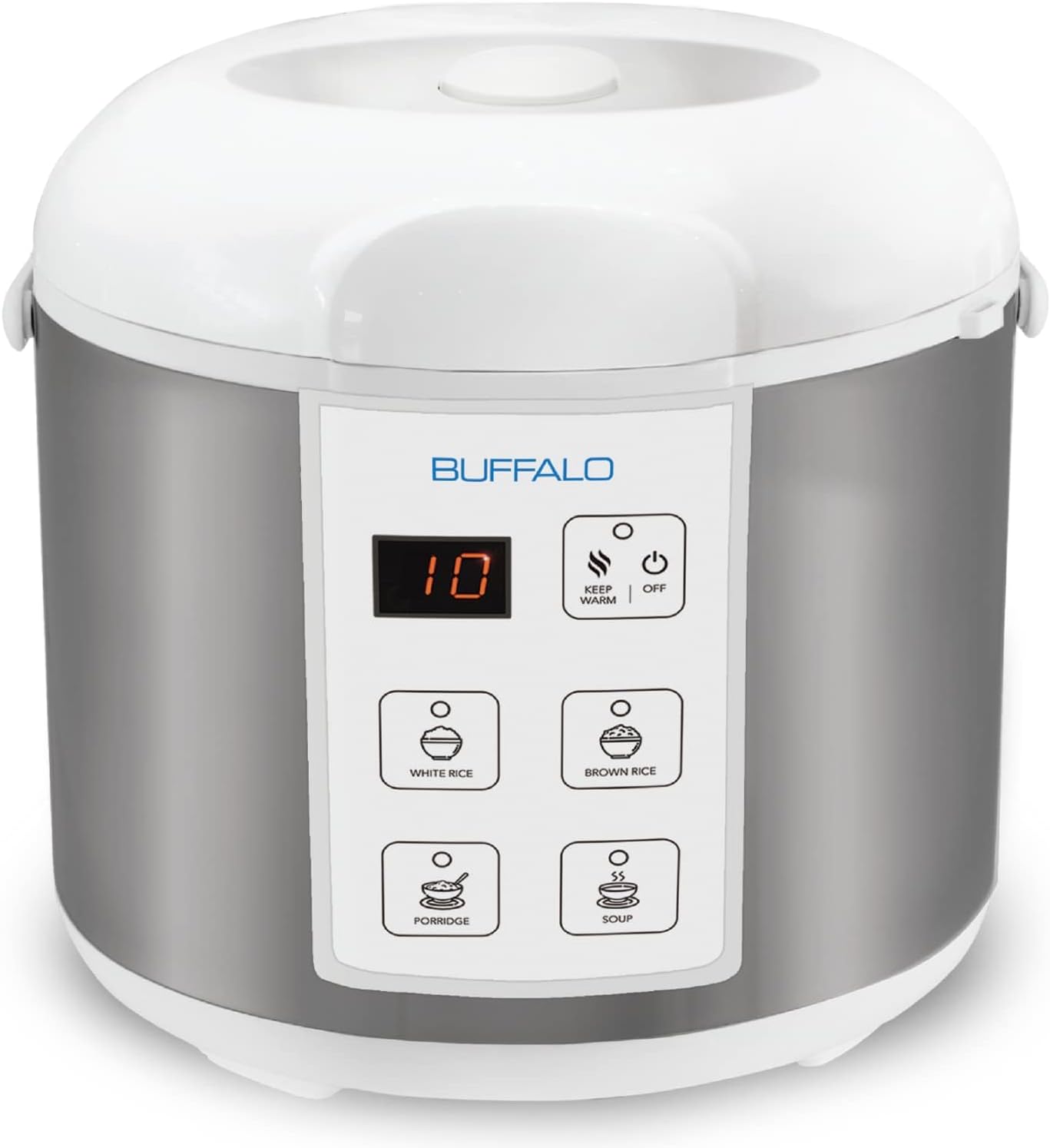 Best Clad SteelBuffalo Classic 10-Cup |
Buffalo CladNo Chemical CoatingMovable Vent |
10 cups | Check price → |
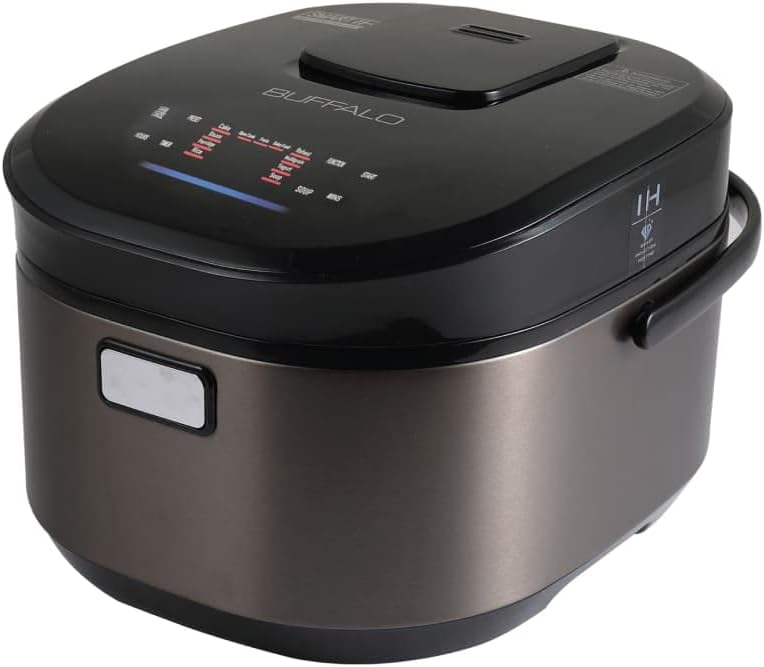 Best InductionBuffalo Titanium IH |
Non-Coating PotInduction Heating11 Functions |
1.5 L (8 cups of rice) | Check price → |
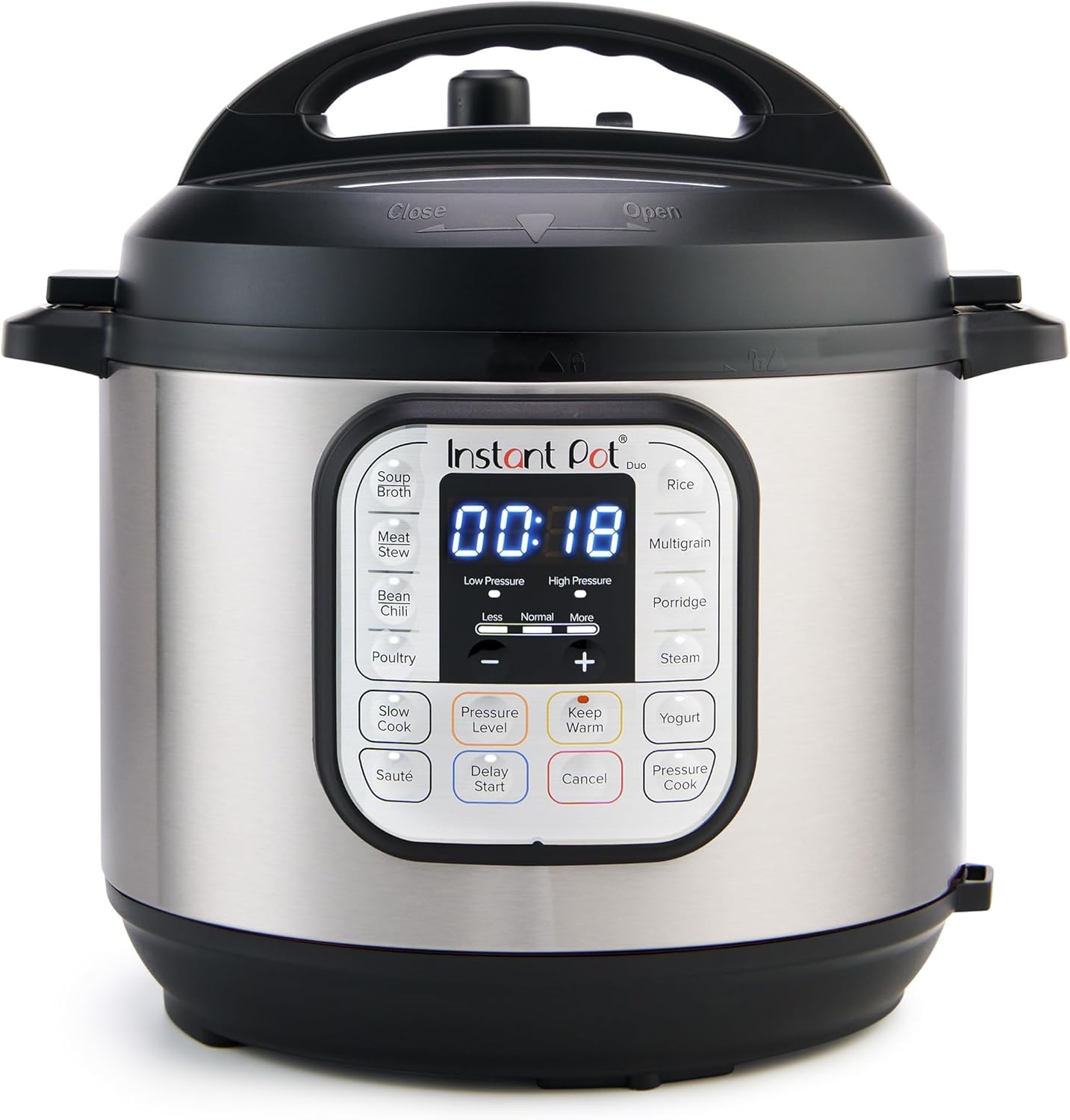 Best Multi-CookerInstant Pot Duo 6 Qt |
18/8 StainlessTri-Ply Bottom7 Functions |
6 quarts | Check price → |
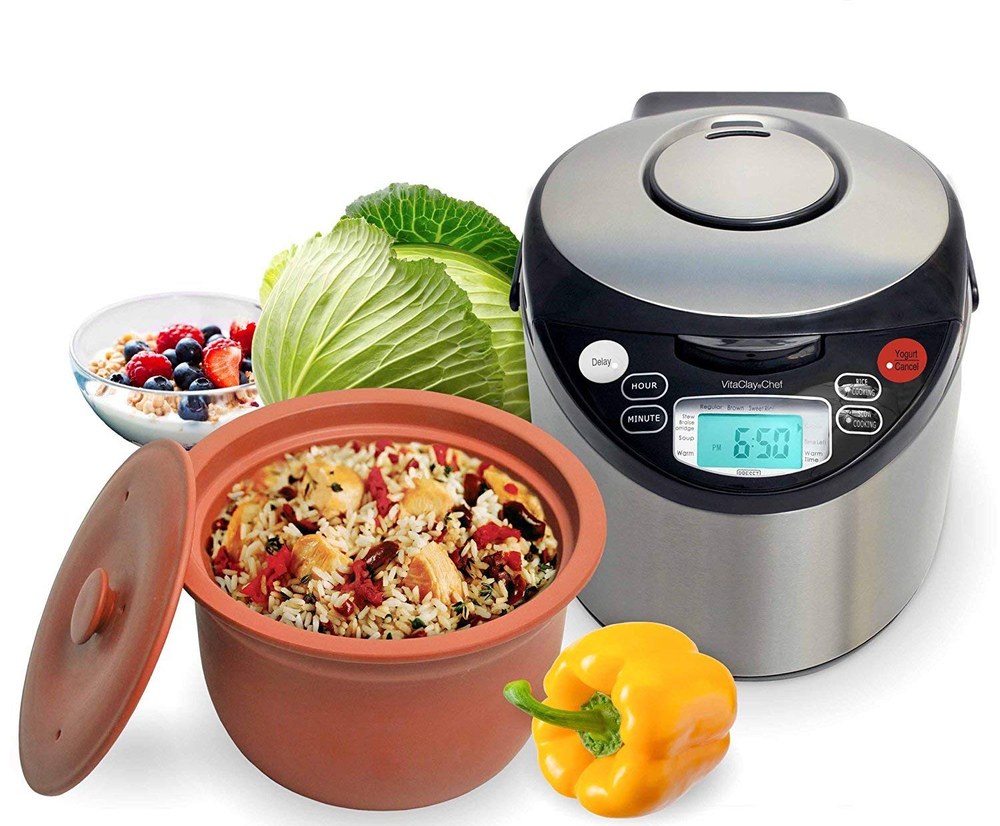 Best Non-MetalVitaClay VM7900-8 |
Unglazed Zisha ClayNo Glaze or Coating7 Functions |
4 qt (8 rice cups) | Check price → |
We do not print prices on this page, because an Amazon price is stale within days and a stale number is worse than none. Tap through for today's.
What Makes a Rice Cooker Non-Toxic?
Three things decide it: whether the inner pot is coated, how worn that coating is, and how much plastic is riding in on the rice before the machine is even switched on. A rice cooker is an unusually demanding case for a coating — boiling water, starch, a metal or plastic paddle scraping the base, and a pot that gets washed every single day. Here is what the published research actually measured on each point.
1. On most rice cookers, the pot is coated — and a damaged coating sheds particles
The standard inner pan on a mainstream cooker is aluminum with a fluoropolymer nonstick layer, and makers say so on the box. Tiger's JNP-S10U is sold as a rice cooker “with Non-Stick Inner Pot.” Zojirushi's NS-ZCC10 uses a nonstick inner cooking pan. Cuckoo's CRP-ST0609F is described as a nonstick stainless steel inner pot. None of that is hidden; it is simply the default.
What that coating does when it is damaged has been counted. A 2022 study in Science of the Total Environment by Fang, Tang, Gibson and colleagues at Newcastle University and Flinders University used Raman imaging to identify and count the fragments coming off Teflon-coated cookware (Luo et al., 2022). A single crack released roughly 9,100 particles. A coating in broken condition released up to 2.3 million micro and nanoplastics. That is the number to carry around: not “nonstick is poison,” but “a scratched nonstick surface is a particle source, and a rice pot gets scratched.”
It is worth being precise about what is not established here, because the honest version is more useful than the scary one. The U.S. Food and Drug Administration's own page on PFAS in food-contact materials says the manufacturing process “vaporizes off virtually all the smaller (i.e., migratable) PFAS molecules,” leaving “a highly polymerized coating bound to the surface of the cookware,” and that “studies show negligible amounts of PFAS in this coating can migrate to food” (FDA, Authorized Uses of PFAS in Food Contact Applications). Of the four authorized PFAS food-contact categories, the FDA says only the grease-proofing agents used on paper and paperboard packaging “would result in dietary exposure to PFAS that may result in a potential safety concern.” So the measured problem with a worn nonstick rice pot is shed particles, not PFAS leaching out of an intact coating. Removing the coating entirely removes the question. Our full look at nonstick cookware walks through the rest of that evidence.
2. Your rice already arrives with plastic in it
This is the part almost no rice-cooker guide mentions, and it is measured. Researchers at the Queensland Alliance for Environmental Health Sciences at the University of Queensland bought rice off the shelf and quantified six plastic polymers in it using pyrolysis gas chromatography/mass spectrometry (Dessì et al., Journal of Hazardous Materials, 2021). Polyethylene was quantifiable in 95% of samples. Uncooked rice averaged 67 µg of plastic per gram when unwashed, ranging from 47 to 168, and 52 µg/g after washing. Unwashed microwavable instant rice came in at 283 µg/g.
Translated to a plate, the authors estimated 3.7 mg of plastic in a 100 g serve of unwashed rice, 2.8 mg if it was washed, and 13.3 mg for a serve of instant rice — roughly four times as much. Annual intake from rice alone came out around a gram a person. Notably, paper packaging was no cleaner than plastic packaging, and country of harvest and organic certification made no significant difference, which points at processing and handling rather than the bag. Our breakdown of microplastics in rice goes through that study in full. The practical reading: rinse your rice, skip the microwave pouches, and do not let a rice cooker's own coating add to a number that already is not zero.
3. Plastic cookware adds particles during ordinary cooking
A 2024 study in Science of the Total Environment ran a food stand-in through the normal steps of home cooking — heating, cooling, mixing, slicing, storage — three ways: with non-plastic cookware, new plastic cookware and old plastic cookware (Cole, Gomiero, Jaén-Gil, Haave and Lusher, 2024). Non-plastic cookware introduced no microplastics. New and old plastic cookware both produced significant increases, with PTFE, polyethylene and polypropylene particles measuring 13 to 318 micrometers, and an estimated 2,409 to 4,964 particles a year added to home-cooked food if you cooked that way daily. The authors are careful to say the health effects of swallowing microplastics are still unknown. This is avoidable exposure with no upside attached, which is a different argument from a proven harm — and it is the argument this whole page rests on.
4. Bare stainless steel has its own, smaller trade-off
Steel sheds no plastic, but it is not inert. Oregon State University researchers cooked tomato sauce in stainless steel and measured what came out of the metal (Kamerud, Hobbie and Anderson, Journal of Agricultural and Food Chemistry, 2013). After six hours, nickel rose up to 26-fold and chromium up to 7-fold, with new pots leaching most and the amount dropping off after about the sixth use. Two things keep that in proportion for a rice cooker: that test was an acidic sauce held for hours, while rice is close to neutral and cooks in under an hour, and the authors frame the concern around people already sensitive to nickel. If you have a diagnosed nickel allergy, that is a conversation for your doctor rather than a reason to keep a coated pot.
What Did the Studies Actually Measure?
Every number on this page in one place. Each row links to the source.
| Source | What it tested | Key finding |
|---|---|---|
| Luo et al., Sci Total Environ 2022 | Particles released from Teflon nonstick cookware, by Raman imaging | ~9,100 particles from a single crack; up to 2.3 million from a broken coating |
| Dessì et al., J Hazard Mater 2021 | Six plastic polymers quantified in store-bought rice | 67 µg/g unwashed vs 52 µg/g washed; instant rice 283 µg/g; 3.7 mg vs 2.8 mg vs 13.3 mg per 100 g serve |
| Cole et al., Sci Total Environ 2024 | Microplastics added by non-plastic vs new vs old plastic cookware | Non-plastic: none added. Plastic: 2,409–4,964 particles a year, 13–318 µm |
| U.S. FDA | Authorized PFAS uses in food-contact applications | Only paper/paperboard grease-proofing agents flagged as a potential dietary safety concern; negligible PFAS migration from a finished nonstick coating |
| Kamerud et al., J Agric Food Chem 2013 | Nickel and chromium from stainless steel into tomato sauce | After 6 h: nickel up to 26-fold, chromium up to 7-fold; falls with repeated use |
1. Aroma Select Stainless ARC-753SG Rice Cooker — Best Overall
Best Overall
Almost every rice cooker under $60 uses an aluminum pan with a fluoropolymer coating. This one does not. Aroma's first Amazon bullet reads “COATING FREE INNER POT: The food-grade 304 stainless steel cooking pot is durable and dishwasher-safe for easy cleaning,” which is about as unambiguous as product copy gets. It is a lever machine: pour in up to 3 cups of uncooked rice, add water, push the lever, and it switches itself to keep-warm when the rice is done. Capacity is 6 cups cooked, 1.2 quarts. The red ARC-753SGR listing linked here held a 4.4-star average from 4,493 ratings when we checked on September 20, 2026; the same cooker is sold in white and black under the same model number.
Cooking for more than three or four people? The identical uncoated pot comes in the 3-quart, 14-cup Aroma ARC-757SG, whose listing calls its pot a “100% surgical-grade 304 stainless steel cooking pot.” The catches on both are the same, and they are real: bare steel is not nonstick, so a layer of rice grips the bottom until you learn the water ratio, and the pot wants a soak rather than a wipe. There is no fuzzy-logic brain, no delay timer and no brown-rice program — it is a switch. And “coating free” describes the pot, not the machine: the lid is glass with a plastic handle, and the body and steam vent are plastic, as on every countertop cooker at this price. What it removes is the coated surface sitting under boiling rice for half an hour, several times a week.
A bare 304 stainless pot under your rice for the price of a coated one, with a lever you push once and forget.
Why it's safe: The food-contact surface is uncoated food-grade 304 stainless steel. There is no nonstick layer on the pot to scratch, flake or shed particles into the rice.
Check Today’s Price on Amazon →Amazon prices change daily — tap to see today's price. White, black and red sit on the same model line.
- Coating-free 304 pot
- Dishwasher-safe pot
- One-touch, auto keep-warm
2. Miracle Exclusives ME81 Stainless Steel Rice Cooker — Most Explicit
Most Explicit
Miracle Exclusives has sold this cooker into the natural-foods market for years, and its Amazon bullets are unusually blunt: “Stainless Steel (grade 304) cooking bowl” and “No ‘Teflon’ nor other non-stick surface materials.” That second line is the only one we found on any rice-cooker listing that rules out the whole category of coatings rather than just naming the pot's metal. It ships with a stainless steel vegetable steamer tray, a measuring cup and a rice paddle, and a glass lid so you can watch without lifting it. It is an 8-cup-uncooked machine with automatic cook-to-warm, and it held a 4.2-star average from 711 ratings on September 20, 2026.
The catches. This is the most basic machine here: one switch, no programs, no timer, no induction. Reviewers report rice sticking, which is simply what bare steel does — rinse the rice, get the water right, let the pot soak. It also costs noticeably more than the Aroma for fewer features, because you are paying for a small specialist brand rather than a volume one. Buy it if the explicit no-coating wording is what you want on the box.
A rice cooker whose maker states in writing that there is no Teflon and no other nonstick material in it, with a steel steamer tray included.
Why it's safe: Grade 304 stainless steel cooking bowl, and the listing explicitly rules out Teflon and any other nonstick surface material.
Check Today’s Price on Amazon →Amazon prices change daily — tap to see today's price.
- States no Teflon
- 304 steel bowl
- Steel steamer tray
3. Buffalo Classic Rice Cooker, 10 Cup (KW-BSC18) — Best Clad Steel
Best Clad Steel
Buffalo's pitch is a construction trick rather than a chemical one. Its listing says the “Patented Buffalo Clad Stainless steel inner pot is scratch-resistant, non-stick, and non-toxic for healthy cooking. It does not contain an unhealthy chemical coating,” and credits the unibody, multi-layer sealed construction for even heat. Read that carefully: “non-stick” here describes how polished clad steel behaves, not a coating applied to it. Buffalo says the range has sold over 1 million units in Asia. It has white-rice, brown-rice, porridge and soup programs, a movable steam vent for cleaning, a measuring cup and a rice paddle, and a 1-year warranty. The 10-cup listing held a 4.2-star average from 595 ratings on September 20, 2026.
The catches. It costs several times what the Aroma does — Buffalo lists the smaller 1.0-liter Classic at $149.00 on its own site — and the word “non-stick” in the listing confuses people into thinking there is a coating, which there is not. Clad steel still rewards a rinse-and-soak habit, and the machine is heavy. If a bare-metal pot that genuinely releases rice is worth the premium, this is the pick.
Clad stainless steel that behaves like a nonstick pot without a coating on it, in a machine built for daily family cooking.
Why it's safe: A multi-layer clad stainless steel inner pot. Buffalo states it does not contain a chemical coating, so the surface under your rice is metal.
Check Today’s Price on Amazon →Amazon prices change daily — tap to see today's price.
- No chemical coating
- Clad unibody pot
- White, brown, porridge, soup
4. Buffalo Titanium Grey IH Smart Cooker — Best Induction
Best Induction
This is the premium end of the coating-free category. The listing states plainly that “the inner pot is made of Buffalo Clad which is resistant to oxidation, non-stick and has no chemical coating,” and the model name itself carries the words “Non-Coating inner pot.” Instead of a hotplate it uses induction heating, which drives heat into the metal of the pot from all around it, and adds a micro-pressure stew function, a controller that senses how much rice is in the pot, and 11 cooking functions behind a touch panel. Capacity is 1.5 liters, about 8 cups of rice, and Buffalo gives 18 months on the outer pot.
The catches. It is the most expensive machine on this list by a wide margin, and it carried only 43 ratings when we checked on September 20, 2026, so there is far less buyer feedback behind it than behind the Instant Pot or the Aroma. A touch panel is one more thing that can fail. Buy it if you cook rice most nights and want induction; otherwise the Classic gets you the same uncoated pot for less.
Induction heat around an uncoated clad-steel pot, with eleven programs and a sensor that reads how much rice is in it.
Why it's safe: Buffalo Clad inner pot with, in the listing's own words, no chemical coating — the rice sits on bare clad metal.
Check Today’s Price on Amazon →Amazon prices change daily — tap to see today's price.
- No chemical coating
- Induction heating
- 11 cooking functions
5. Instant Pot Duo 6 Qt 7-in-1 — Best Multi-Cooker
Best Multi-Cooker
If a dedicated cooker is a hard sell for your counter, this is the coating-free workaround almost everyone already understands. Instant Pot describes the insert as a “Pro-Grade Cooking Pot: Crafted from stainless steel (18/8) with a tri-ply bottom,” and there is a dedicated Rice program among its seven functions, alongside pressure cooking, slow cooking, sauté, steam, yogurt and keep-warm. The tri-ply base is what stops rice scorching in a pot with no coating. It is the most-reviewed appliance here by a distance: 4.7 stars from 184,431 ratings on September 20, 2026.
The catches, and they matter if you are buying on materials. This is a pressure cooker, and its lid carries a silicone sealing ring that sits in the steam every cook and absorbs odors, plus plastic parts around the steam release — so it is not the plastic-free machine the bare pot suggests. Pressure-cooked rice also has a different texture from rice out of a dedicated cooker, softer and stickier, and plenty of people prefer the latter. It is bulky. But nothing is coated where the food sits.
One appliance that pressure cooks, slow cooks, steams and makes rice, on an 18/8 stainless pot with no coating in it.
Why it's safe: The inner cooking pot is 18/8 stainless steel with a tri-ply bottom — no nonstick coating on the food-contact surface.
Check Today’s Price on Amazon →Amazon prices change daily — tap to see today's price. The 6-quart size is the one linked here.
- 18/8 stainless pot
- Tri-ply bottom
- Seven functions
6. VitaClay VM7900-8 Smart Organic Clay Pot Multi-Cooker — Best Non-Metal
Best Non-Metal
Everything else on this page solves the coating problem with steel. VitaClay solves it by removing the metal too. The inner crock is unglazed Zisha clay, and the Amazon listing calls it a “TOXIN FREE POT… an unglazed, Zisha clay crock.” VitaClay's own product page puts it this way: “In a VitaClay pot, your food is always free from added non-stick chemical glazes, lead and aluminum contacting your foods.” That matters because a glaze is the ceramic world's version of a coating, and this crock does not have one. The VM7900-8 holds 4 quarts, 8 rice measuring cups, and does rice, slow cooking, steaming, soup, stew and yogurt from a digital panel with a delay start.
The catches, and there are more here than on any other pick. It is the most expensive machine on this page — VitaClay listed it at $259.00 on its own site on September 20, 2026 — and it holds the lowest rating in this group, 3.9 stars from 586 ratings, with clay crocks being breakable and replaceable the most common theme. Unglazed clay is porous, so it takes on the smell of strongly flavored cooking over time and is hand-wash only. It is also slower than an induction machine. Buy it if a metal-free pot is the point; otherwise one of the steel picks is the better-value route.
An unglazed clay crock instead of a coated or metal pot, in a seven-function cooker that also slow cooks, steams and makes yogurt.
Why it's safe: The food-contact surface is unglazed Zisha clay. VitaClay states there are no added nonstick chemical glazes, lead or aluminum touching the food.
Check Today’s Price on Amazon →Amazon prices change daily — tap to see today's price. The 6-cup VM7900-6 is the smaller version.
- Unglazed clay crock
- No glaze or coating
- Rice, stew, steam, yogurt
Three Popular Rice Cookers We Did Not Rank, and Why
These are good machines. They are not on the list for one reason only: their inner pots are coated, and this guide is specifically about the pots that are not.
- Zojirushi NS-ZCC10 Neuro Fuzzy. Widely regarded as one of the best rice cookers made, and its fuzzy-logic control genuinely produces better rice than a lever machine. Its inner cooking pan is nonstick, with a platinum-infused coating Zojirushi says changes the water chemistry for sweeter rice. If cooking quality outranks materials for you, buy it, and replace the pan the moment it scratches.
- Tiger JNP-S10U. Made in Japan, well built, and sold on Amazon under a title that includes the words “with Non-Stick Inner Pot.” The pot is aluminum with a fluorine coating. The stainless steel in the model's description refers to the machine's outer finish, not the surface your rice sits on — a distinction worth knowing before you buy.
- Cuckoo CRP-ST0609F Twin Pressure. A serious Korean pressure cooker with sixteen menu options and induction heating. Cuckoo describes the inner pot as a nonstick stainless steel pot, which means a steel pot with a coating on it. That is the common trap in this category: “stainless steel inner pot” in a listing often means coated steel, not bare steel.
The lesson generalizes. “Stainless steel inner pot” is not the phrase to search for. The phrases that actually mean what you want are coating free, uncoated, no chemical coating, or a flat statement that there is no Teflon or other nonstick material — which is exactly the wording the six picks above use.
Does Washing Rice Remove Microplastics?
Partly. In the University of Queensland analysis, washing took unwashed rice from 67 µg of plastic per gram down to 52 µg/g, and the per-serving estimate from 3.7 mg to 2.8 mg — a cut of roughly a quarter, for thirty seconds of effort and no money. The same study found that shaking the rice inside its packaging made no significant difference, so the contamination is not just dust sitting on the surface of the grain.
Two more things fall out of that paper. Instant microwavable rice carried about four times the plastic of ordinary rice, which the authors attribute to industrial processing rather than the pouch alone, so plain rice cooked at home is the lower-plastic option by a wide margin. And because paper bags tested no cleaner than plastic ones, choosing a paper-packaged brand is not the fix it looks like. Rinse the rice, cook it in a pot with nothing sprayed on it, and you have done the two things within your control. If your tap water is the next question, our water filter guide for microplastics covers what filtration actually removes.
Is a Stainless Steel Rice Cooker Worth It?
For most households, yes — because the price gap is small and the trade-off is honest. The uncoated Aroma costs about what a coated cooker of the same size costs, so the decision is not really financial. What you give up is release: bare steel holds onto a layer of rice at the bottom until you get the water ratio right, and the pot wants a soak rather than a wipe. What you gain is a food-contact surface that cannot degrade into anything, ever, and a pot you can scrub with steel wool without ruining it. A coated pan is a consumable with a lifespan; a steel pot is not.
If the sticking is a deal-breaker, the clad-steel route is the answer: Buffalo's multi-layer pots release rice by the polished metal itself rather than by a coating, at a real premium in price. And if you already own a coated cooker that is in good condition, the reasonable move is not to bin it today — it is to stop scraping it with metal, stop stacking things inside it, and replace it the day the coating chips. Rice cookers are one of about seven kitchen habits worth fixing at the same time; our kitchen plastic detox guide ranks the rest by impact.
Frequently Asked Questions
Related Reading
Sources cited
- Luo, Y., Gibson, C. T., Chuah, C., Tang, Y., Naidu, R., & Fang, C. (2022). “Raman imaging for the identification of Teflon microplastics and nanoplastics released from non-stick cookware.” Science of the Total Environment 851, 158293. https://doi.org/10.1016/j.scitotenv.2022.158293
- Dessì, C., Okoffo, E. D., O'Brien, J. W., Gallen, M., Samanipour, S., Kaserzon, S., Rauert, C., Wang, X., & Thomas, K. V. (2021). “Plastics contamination of store-bought rice.” Journal of Hazardous Materials 416, 125778. https://doi.org/10.1016/j.jhazmat.2021.125778
- Cole, M., Gomiero, A., Jaén-Gil, A., Haave, M., & Lusher, A. (2024). “Microplastic and PTFE contamination of food from cookware.” Science of the Total Environment 929, 172577. https://doi.org/10.1016/j.scitotenv.2024.172577
- U.S. Food and Drug Administration. “Authorized Uses of PFAS in Food Contact Applications.” fda.gov
- Kamerud, K. L., Hobbie, K. A., & Anderson, K. A. (2013). “Stainless steel leaches nickel and chromium into foods during cooking.” Journal of Agricultural and Food Chemistry 61(39), 9495–9501. https://doi.org/10.1021/jf402400v
- Maker and retailer pages, read September 20, 2026: the Amazon listings linked from each pick above, and Buffalo Cookware's own Classic rice cooker page.
Disclosure: Plasticproof earns a commission on qualifying purchases made through the links on this page, at no extra cost to you. Product selection, the materials analysis and every caveat above are our own, and no brand paid for or reviewed this guide. See our affiliate disclosure.