The biggest reductions come from a handful of changes, not from fearing every piece of plastic. Filter your tap water and skip bottled water, stop heating food in plastic, store food in glass or stainless steel, cut back on ultra-processed and canned food, clear household dust with HEPA vacuuming and ventilation, and choose natural-fiber clothing and PFAS-free personal care. These target the routes that put the most particles into your body — drinking water, heated food contact and indoor air — so a few focused swaps do far more than obsessing over every plastic touch.
"How do I avoid microplastics?" is one of the most common questions people ask once they learn the particles are turning up in human blood, the placenta, lungs and stool. The honest starting point is that total avoidance is impossible — microplastics are now in rain, soil, seafood, tap water and the dust in your living room. But that is not a reason to give up. Exposure is wildly unequal across sources, and a small number of daily habits drive most of it.
This guide is organized by that principle: fix the big sources first. We have ranked nine research-backed changes by how much they actually lower the particles reaching your body, drawing on peer-reviewed studies and agency reviews rather than scare headlines. It is the same evidence-first approach we bring to microplastics in the human body and reducing what is already in you.
The bottom line up front: your drinking water, your food and how you heat it, and your indoor air and dust are the three levers that matter most. Nail those and you have captured the majority of the benefit — everything else is fine-tuning.
Where do most microplastics come from?
Before you can avoid microplastics efficiently, it helps to know which sources dominate. Researchers estimate the average person swallows and inhales tens of thousands of microplastic particles a year, and the biggest contributors are drinking water, certain foods, and the air and dust indoors — not the occasional plastic fork you touch.
A widely cited 2019 analysis in Environmental Science & Technology estimated Americans consume roughly 39,000 to 52,000 microplastic particles a year from food alone, rising to 74,000–121,000 once inhalation is included — and people who drink only bottled water add about 90,000 more, versus roughly 4,000 for those drinking tap (Cox et al., 2019). The World Health Organization's 2019 review confirmed microplastics are widespread in drinking water while calling for more research on health effects (WHO, 2019). The practical message is clear: water and food are where the volume is, so that is where avoidance pays off most.
How do you avoid microplastics in your drinking water?
Start here, because water is the single most controllable high-volume source. The fix is a two-parter: filter the tap water you do drink, and stop drinking bottled water, which testing consistently shows is far higher in particles than filtered tap. Together these two moves remove tens of thousands of particles a year for a modest one-time cost.
On the filter side, a certified carbon-block, reverse-osmosis or distillation system physically traps micro- and nanoplastics because the particles are much larger than the filter's pores; reverse osmosis is the most thorough for the very smallest fragments. Our best water filters for microplastics guide ranks options by certification. If you have hard water, there is a free bonus step: a 2024 study in Environmental Science & Technology Letters found that boiling hard tap water precipitates calcium carbonate that can trap up to about 80–90 percent of nano- and microplastics, which then settle out or are caught by a simple strainer (Yu et al., 2024) — we cover the method in does boiling water remove microplastics.
Bottled water is the mirror image. A 2024 study using advanced Raman imaging found roughly 240,000 plastic fragments per liter in popular bottled waters, around 90 percent of them nanoplastics (Qian et al., 2024), and separate work showed the bottle itself sheds particles as it is opened and squeezed. We lay out the full comparison in bottled water vs tap water. The upgrade is simple: filtered tap water carried in a glass or stainless-steel bottle. If plastic particles in shower water concern you too, a shower filter reduces them at the margins.
How can you keep microplastics out of your food?
Food is the second big lever, and the highest-impact habit here is temperature. Heat and acidity make plastic shed dramatically more particles than cold contact does, so the order of operations matters: never heat food in plastic, and let hot food cool before it touches a plastic container. These few rules prevent a large, avoidable dose at the exact moment plastic is most likely to break down.
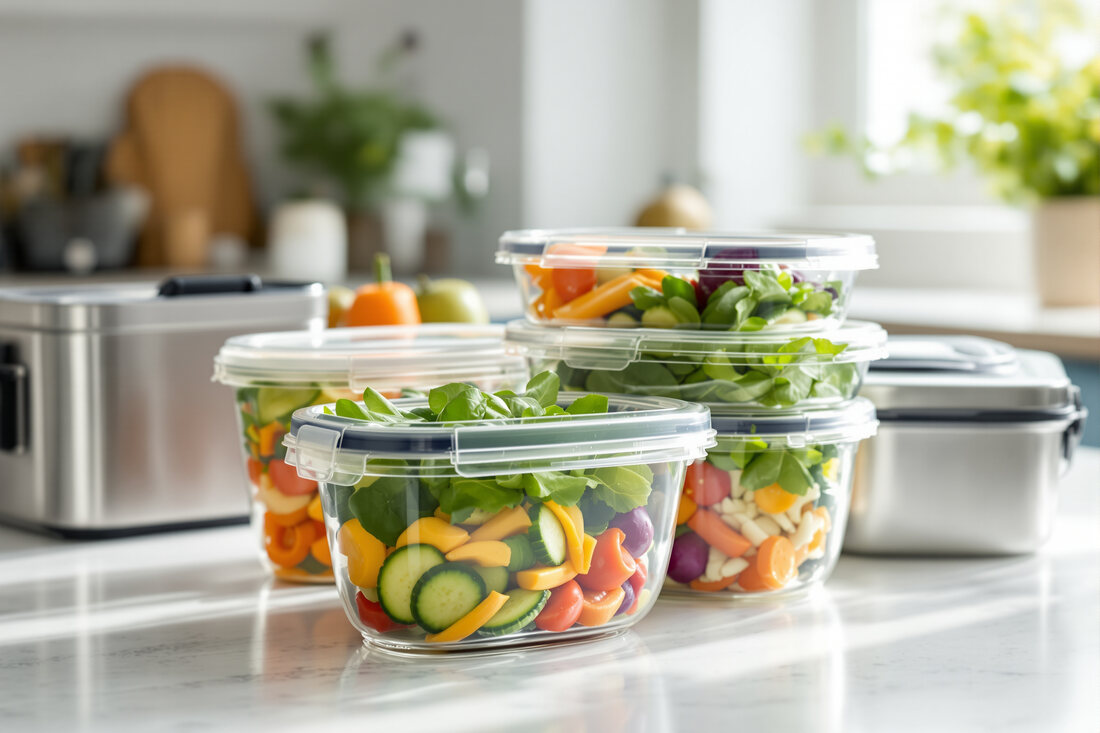
So the kitchen checklist is: microwave and reheat only in glass or ceramic, never plastic — see is it safe to microwave Tupperware; switch your storage to glass containers or stainless steel, a swap we compare in glass vs plastic food storage; and replace plastic cutting boards, which shed tens of thousands of particles into food as you chop, with wood. Also retire scratched nonstick pans in favor of non-toxic cookware, and switch to plastic-free tea bags, since many sealed bags release particles in hot water.
Diet composition matters too. Ultra-processed foods pass through more plastic machinery and packaging and tend to carry more particles than whole foods, and canned foods can leach from plastic linings. Leaning toward fresh, whole, minimally packaged food lowers both your plastic and your chemical exposure at once — one of the few changes that helps on every front.
How do you reduce microplastics in the air and household dust?
Indoor air is the source most people never think about, yet it is a major route. A large fraction of the microplastics we take in are airborne fibers shed from carpets, upholstery, mattresses and synthetic clothing, and they settle into household dust that we then breathe and that lands on food and surfaces. Lowering that particle load is mostly about cleaning and ventilation.
The effective moves are straightforward: vacuum regularly with a sealed HEPA vacuum so fine particles are trapped rather than blown back into the air; damp-dust and damp-mop instead of dry-dusting, which just launches fibers airborne; open windows to ventilate, since indoor particle counts routinely exceed outdoor ones; and run a HEPA air purifier in the rooms where you spend the most time. Reducing wall-to-wall synthetic carpet and choosing natural-fiber soft furnishings cuts the shedding at its source. We go deeper in microplastics in indoor air.
How do you cut microplastics from clothing and personal care?
Synthetic textiles are a double problem: they shed microfibers onto your skin and into the air, and they release billions of fibers into waterways in the wash. You will not replace your whole wardrobe overnight, but steering new purchases toward natural fibers and washing smarter meaningfully cuts the fibers around you.
Favor cotton, wool, linen and other natural-fiber clothing next to the skin, wash synthetics less often and in cooler, fuller loads, and use a microfiber-catching bag or filter — the tactics in reducing microplastics from laundry. On personal care, some products still contain plastic microbeads or are made with PFAS "forever chemicals," so choose PFAS-free, microbead-free options and watch for plastic ingredients in makeup. These are lower-volume than water and food, but they are cheap habit changes that add up.
Can you remove the microplastics already in your body?
This is the question people ask once they have cut their exposure, and the honest answer is that the research is young. Your body does clear some particles through stool and urine, and lowering your daily intake means less goes in to accumulate — which is why prevention is the real lever. There is no proven "detox" that flushes microplastics out, and you should be skeptical of products that promise one.
Why bother at all? Because the early health signals are serious enough to justify caution — we weigh exactly how dangerous microplastics are in a dedicated evidence review. Microplastics have been detected in the blood of most adults tested (Leslie et al., 2022), and a 2024 study in the New England Journal of Medicine found that people with micro- and nanoplastics in their carotid-artery plaque had a markedly higher risk of heart attack, stroke or death over the following three years (Marfella et al., 2024). That is an association, not proof of cause, but it is a strong reason to reduce intake now rather than wait for certainty. For the practical playbook, see how to reduce microplastics in your body.
The 9 changes that cut the most, ranked
If you do nothing else, work down this list in order — it is sorted by how much each change lowers the particles reaching your body relative to the effort it takes:
- Filter your tap water with a certified carbon-block, reverse-osmosis or distillation system — the highest-volume source you control.
- Stop drinking bottled water; carry filtered tap water in glass or stainless steel instead.
- Never heat food in plastic. Microwave and reheat only in glass or ceramic, and let hot food cool before it touches plastic.
- Store food in glass or stainless steel, not plastic tubs or cling film.
- Replace plastic cutting boards, scratched nonstick pans and plastic tea bags with wood, non-toxic cookware and plastic-free tea.
- Eat more whole, fresh food and less ultra-processed and canned food.
- Clear indoor dust and air: HEPA-vacuum, damp-dust, ventilate, and run a HEPA purifier where you spend the most time.
- Choose natural-fiber clothing and wash synthetics less often, cooler, with a microfiber filter.
- Pick PFAS-free, microbead-free personal care and skip products with plastic ingredients.
The honest verdict
You cannot avoid microplastics completely, and trying to is a recipe for anxiety, not better health. What you can do is remove most of your controllable exposure by fixing three things: the water you drink, how you handle and heat your food, and the dust and air inside your home. Everything else — clothing, personal care, the stray plastic touch — is real but secondary.
Spend your money and attention at the top of the ranked list and let the rest follow as easy habits. That is how you get the large, measurable reduction without turning your kitchen into a stress test. For the single best next step, a good water filter does more than any other one change — start there.
Start with the change that matters most
Your water is the highest-volume source you control. These guides show exactly what to buy and what actually filters microplastics.
Frequently Asked Questions
Fix your water and your food contact first. Filtering tap water and skipping bottled water removes one of the largest measurable sources — research estimates that drinking bottled water instead of tap can add roughly 90,000 microplastic particles to your yearly intake versus about 4,000 from tap. Pair that with never heating food in plastic and storing leftovers in glass, and you have cut the two routes that put the most particles into your body for the least effort.
Yes. A good carbon block, reverse-osmosis or distillation system physically traps the overwhelming majority of micro- and nanoplastic particles, because they are far larger than the pores these filters use. Reverse osmosis is the most thorough for the smallest particles. If you have hard water, simply boiling it first also helps: a 2024 study found that boiling can precipitate calcium carbonate that traps up to about 80–90 percent of nano- and microplastics, which you then pour or filter off.
For most people, yes. A 2024 study using advanced imaging found roughly 240,000 plastic fragments per liter in bottled water, about 90 percent of them nanoplastics, and earlier work found that opening and squeezing bottles sheds more particles. Filtered tap water in a glass or stainless-steel bottle is cheaper and consistently lower in particles. Reusable bottled water only helps if the container itself is not plastic.
No — microplastics are now in tap and bottled water, food, soil, indoor dust and the air, so zero exposure is not a realistic goal. The practical aim is to lower your total body burden by cutting the biggest, most controllable sources: drinking water, heated plastic food contact, ultra-processed and canned food, and indoor dust. Chasing every last trace particle is stressful and low-value; the ranked changes in this guide capture most of the available benefit.
Yes, substantially. Heat and acidity drive plastic food containers to shed far more particles than cold storage does, and microwaving is one of the worst cases because it combines heat with direct food contact. The simple fix is to microwave and store hot food only in glass or ceramic, let food cool before it touches plastic, and never run plastic containers through a hot dishwasher cycle if you can avoid it. This is one of the highest-impact habits to change.
They help with a route most people overlook. A large share of the microplastics we take in are airborne fibers and particles in household dust, shed from carpets, upholstery and synthetic clothing. Vacuuming with a sealed HEPA filter, damp-dusting instead of dry-dusting, ventilating rooms, and running a HEPA air purifier all lower the particle load in the air you breathe and the dust that settles on food and surfaces.
Sources
- Cox KD, Covernton GA, Davies HL, Dower JF, Juanes F, Dudas SE. "Human Consumption of Microplastics." Environmental Science & Technology, 2019;53(12):7068–7074, pubs.acs.org/doi/10.1021/acs.est.9b01517. Estimated 39,000–52,000 particles/year from food, ~90,000 added by bottled water vs ~4,000 for tap.
- World Health Organization. "Microplastics in Drinking-Water." WHO, 2019, who.int/publications/i/item/9789241516198. Microplastics are widespread in drinking water; WHO called for more research on health effects.
- Qian N, Gao X, Lang X, et al. "Rapid single-particle chemical imaging of nanoplastics by SRS microscopy." PNAS, 2024;121(3):e2300582121, doi.org/10.1073/pnas.2300582121. Found ~240,000 plastic fragments per liter in bottled water, ~90% nanoplastics.
- Yu Z, Wang J, Liu L, et al. "Drinking Boiled Tap Water Reduces Human Intake of Nanoplastics and Microplastics." Environmental Science & Technology Letters, 2024;11(3):273–279, doi.org/10.1021/acs.estlett.4c00081. Boiling hard water can remove up to ~80–90% of nano/microplastics via calcium-carbonate incrustation.
- Leslie HA, van Velzen MJM, Brandsma SH, Vethaak AD, Garcia-Vallejo JJ, Lamoree MH. "Discovery and Quantification of Plastic Particle Pollution in Human Blood." Environment International, 2022;163:107199, doi.org/10.1016/j.envint.2022.107199. Microplastics detected in the blood of 17 of 22 healthy adults.
- Marfella R, Prattichizzo F, Sardu C, et al. "Microplastics and Nanoplastics in Atheromas and Cardiovascular Events." New England Journal of Medicine, 2024;390:900–910, doi.org/10.1056/NEJMoa2309822. Plastics in carotid plaque linked to higher risk of heart attack, stroke or death.