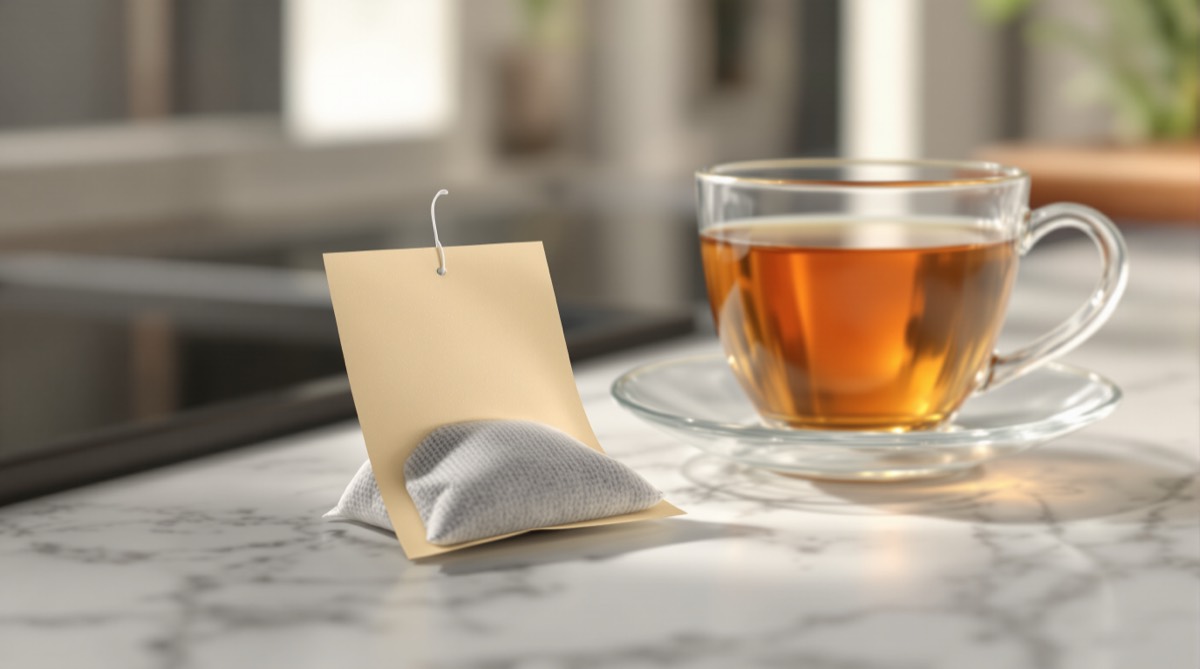
Tea bags without microplastics are flat unbleached-paper bags (abaca, Manila hemp, or wood pulp) closed without a polypropylene heat-seal — or loose-leaf tea in a stainless steel infuser. On US shelves in 2026 the four widely available brands that meet that bar are Numi Organic Tea, Traditional Medicinals, Yogi Tea, and Pukka Herbs. Pyramid “silken” bags, nylon mesh bags, and paper bags with a shiny heat-sealed edge are the ones that shed — a 2024 Universitat Autònoma de Barcelona study (Banaei et al., Chemosphere 368: 143736) measured polypropylene bags releasing about 1.2 billion particles per mL of brewed tea, roughly 9 million times more than unbleached cellulose paper.
Every tea drinker has heard the warning: plastic tea bags release microplastics when you steep them. But most of the advice stops there, leaving you to guess whether your current bag is the dangerous kind or a reasonably safe one.
Three independent measurements now agree on the ranking — a 2019 McGill University study, a 2024 Universitat Autònoma de Barcelona study in Chemosphere, and a September 2025 European Food Safety Authority review. The gap between bag types isn't small — it's orders of magnitude. Here's what the research actually says, and which bags to choose instead.
What the Research Actually Says
Study 1: McGill University (2019)
The first study to quantify the release came from Laura Hernandez, Nathalie Tufenkji and colleagues at McGill University in Montreal. They steeped nylon and PET (polyethylene terephthalate) pyramid-style tea bags at 95 °C — a realistic tea temperature — and counted the particles released into the water.
Their finding: a single plastic pyramid bag released approximately 11.6 billion microplastic particles and 3.1 billion nanoplastic particles per cup (Hernandez et al., Environmental Science & Technology 53(21): 12300–12310, 2019). The paper has been cited hundreds of times and remains the largest single-item exposure finding in the tea literature.
The silken pyramid bag trap: Many premium tea brands market their bags as "silken" or describe them as smooth and high-quality. Most pyramid bags are nylon or PET — both are plastics that shed particles at near-boiling temperatures.
Study 2: Universitat Autònoma de Barcelona (Banaei et al., 2024)
A 2024 study led by Gooya Banaei at the Universitat Autònoma de Barcelona (UAB) went further by comparing multiple bag materials head-to-head: polypropylene (PP), nylon-6 (polyamide), and cellulose (paper). Researchers steeped each type under standardized conditions and measured particle counts per milliliter of tea.
The results were published in Chemosphere (Banaei et al., 368: 143736) and showed a dramatic difference based on material alone:
| Bag Material | Particles per mL | Risk Level | Common Bag Types |
|---|---|---|---|
| Polypropylene (PP) | ~1.2 billion | High | Most standard flat bags |
| Nylon/PET | ~11.6 billion/cup | High | Pyramid "silken" bags (McGill) |
| Nylon-6 | ~8.18 million | Moderate | Some premium flat bags |
| Cellulose (paper) | ~135 | Low | Unbleached paper tea bags |
| Stainless infuser | 0 (from bag) | None | Loose-leaf with metal infuser |
The cellulose bags in the UAB study released ~135 particles per mL — but these were cellulose fibers, not synthetic plastic particles. The health implications of cellulose particles are considered far less concerning than petrochemical-derived plastic, which is what the EPA and WHO assess when discussing microplastic exposure risks.
Study 3: EFSA Scientific Review (September 2025)
In September 2025 the European Food Safety Authority published its own review of the tea-bag literature across more than 100 studies (EFSA Supporting Publication EN-9733). EFSA's revised per-bag figure is 122,300–222,800 total particles greater than 1 µm released from a single plastic tea bag, of which 5,800–20,400 are identified microplastics. The lower number is a methodology correction, not a reversal: EFSA specifically confirmed that unbleached-paper bags with no polypropylene heat-seal released no detectable microplastics under the same protocol. Three independent measurements, one direction — the plastic construction is the source, and paper without a heat-seal is the fix.
Which Tea Bags Release the Fewest Microplastics?
Based on the available research, bag materials rank in this order from lowest to highest release:
- Stainless steel or glass infuser with loose-leaf tea — zero plastic shed from the brewing vessel
- Unbleached cellulose (paper) bags — ~135 cellulose particles/mL; no synthetic plastic
- Nylon-6 flat bags — ~8.18 million particles/mL (far lower than PP, still significant)
- Polypropylene flat bags — ~1.2 billion particles/mL
- Nylon/PET pyramid bags — ~11.6 billion particles/cup at 95 °C
— McGill University, Environmental Science & Technology, 2019
The problem with reading the label
Many bag manufacturers don't disclose materials on the package. The most common unlisted plastic is polypropylene — a thin, heat-sealable film used to seal the edges of paper-looking bags. If you tear open a tea bag and the outer mesh or seal has a slight sheen, it likely contains plastic. Fully paper bags (like those used by some traditional brands) have a matte, fibrous texture throughout and crinkle rather than stretch.
Tea Bag Brands That Are Actually Without Microplastics
Only a narrow set of widely available US brands meet the materials bar — unbleached paper (abaca, Manila hemp, or wood pulp), no polypropylene heat-seal, no nylon or PET mesh. The four we can currently recommend, all with the bag construction disclosed by the brand itself:
- Numi Organic Tea — unbleached abaca fiber bags, non-heat-seal (folded and stitched), USDA Organic. Numi confirms the bag material in writing.
- Traditional Medicinals — unbleached Manila hemp paper, string-and-tag closure with no plastic adhesive, certified organic. The gold standard for herbal teas.
- Yogi Tea — unbleached paper bags with string and tag, USDA Organic on their organic lines. The most widely available on a conventional grocery shelf.
- Pukka Herbs — plant-based Soilon cellulose bags, Soil Association certified organic, stitched closure with no plastic seal.
Full ranked breakdown with per-bag pricing, the five popular brands that failed our screen, and the exact material criteria we used: see our best non-toxic tea bags of 2026 guide.
How to Spot a Plastic Tea Bag in 5 Seconds
You can screen any bag at home before you buy again. Any one of these signals means plastic is somewhere in the construction:
- Pyramid or “silken” shape. Almost all pyramid mesh bags are nylon or PET regardless of what the box says about the tea inside. The McGill 2019 study was run on exactly this bag type.
- A shiny, sealed strip along the top edge. That gloss is polypropylene heat-seal. A plain paper bag closed by fold, staple, or stitch has no shiny strip — only a crimp or a visible thread.
- Bright white paper. Genuinely unbleached bags are the natural tan-brown of Manila hemp or abaca. Bright white bags have been chlorine-bleached and often use plastic sealants alongside.
- Bag stretches when you pull it. Paper crinkles and tears; plastic mesh stretches. If a torn bag’s edge is elastic under a fingernail, it’s a synthetic polymer.
- The word “compostable” with no material listed. This almost always means PLA (a corn-starch bioplastic), which still sheds particles into hot water. Look for the word cellulose or paper in the brand’s own disclosure — not just “compostable.”
How to Make Tea Without Microplastics
Switching doesn't have to mean giving up convenience. The two lowest-exposure methods are straightforward:
Option 1: Loose-leaf in a stainless steel infuser
This is the gold standard. Buy loose-leaf versions of the teas you already drink — Rishi Organic Loose Leaf Tea is one widely available option — and use a fine-mesh stainless steel ball or basket infuser. No plastic touches your hot water at any point. Stainless infusers cost $5–15 and last years. Quality loose-leaf tea is often cheaper per cup than bagged tea from the same brand.
Option 2: Unbleached cellulose paper bags
If you prefer the convenience of bags, look for unbleached paper bags from brands that explicitly confirm their bags are cellulose only — no plastic sealant on the edges, no nylon mesh window. The bag should feel fully matte and papery, not smooth or shiny.
Get the Plasticproof Kitchen Checklist
A one-page guide to the highest-risk swaps in your kitchen, in order of impact.
What about compostable bags?
Some brands market bags as "compostable" or "biodegradable." This generally means the bag is made from PLA (polylactic acid), a corn-starch-derived bioplastic. PLA still sheds particles when steeped in hot water and is not the same as paper. Look for bags explicitly labeled cellulose or paper — not just compostable.
Why Does Bag Material Matter So Much?
The mechanism is straightforward: heat degrades plastic. At near-boiling temperatures (90–95 °C), polymer chains in nylon and polypropylene break apart at the surface, releasing fragments into the water. The faster a material degrades thermally, the more particles it sheds per steep cycle.
Cellulose, the material in paper bags, is also a polymer — but it's a natural one (wood-pulp fibers). The human gut processes cellulose routinely, and it doesn't accumulate in tissue the way synthetic petrochemical plastics do. The WHO's 2019 microplastics report specifically identifies synthetic polymers (polyethylene, polypropylene, nylon, PET) as the particles of greatest concern for human health — not natural cellulose.
The EPA similarly focuses its microplastics health assessment on petrochemical-derived particles and the chemical additives (plasticizers, stabilizers, colorants) they can carry. Natural fiber particles don't carry the same chemical load.
Browse Non-Toxic Kitchen Picks
Every product on our list is selected for real material safety — no greenwashing.
See Safe PicksFrequently Asked Questions
Plastic-based tea bags do. A 2024 Universitat Autònoma de Barcelona study (Banaei et al., Chemosphere 368: 143736) found polypropylene bags release about 1.2 billion particles per mL of brewed tea, and nylon-6 bags release roughly 8.18 million per mL. Cellulose paper bags release about 135 particles per mL — roughly 9 million times fewer than polypropylene.
Unbleached cellulose (paper) tea bags release the fewest microplastics — about 135 particles per mL in the UAB 2024 study. Loose-leaf tea in a stainless steel infuser releases none at all from the bag itself.
Nylon bags are safer than polypropylene but still release millions of microplastic particles per mL of brewed tea. The UAB 2024 study measured nylon-6 at 8.18 million particles per mL — far less than PP but still significant compared to paper bags at 135 particles per mL.
Most pyramid-shaped "silken" tea bags are made from nylon (polyamide) or PET (polyethylene terephthalate) — both are plastics. The McGill 2019 study found nylon/PET pyramid bags release 11.6 billion particles per cup when steeped at 95 °C. They feel smooth but are not safer than standard plastic bags.
Yes. Higher temperatures increase plastic degradation and particle release. The McGill study steeped bags at 95 °C (203 °F) — near boiling — and found 11.6 billion particles per cup from nylon/PET bags. The actual amount you consume may be lower if you steep at lower temperatures, but there is no temperature that makes a plastic bag safe.
The two safest methods are: (1) loose-leaf tea in a stainless steel infuser or fine-mesh stainless strainer — no plastic contact at all; (2) unbleached cellulose paper tea bags — about 135 particles per mL versus billions from plastic bags. Avoid plastic pyramid bags labeled "silken" or "nylon," and standard flat bags made from polypropylene or nylon.
Primary Sources
- Banaei, G. et al. (2024). "Multi-instrumental characterization and toxicological effects of microplastics released from teabags." Chemosphere 368: 143736. Universitat Autònoma de Barcelona. doi.org/10.1016/j.chemosphere.2024.143736
- European Food Safety Authority (2025). "Microplastics in food: state of the science." EFSA Supporting Publication EN-9733, September 2025 — revised per-bag figure of 122,300–222,800 total particles >1 µm per plastic tea bag, of which 5,800–20,400 are identified microplastics; unbleached-paper bags with no polypropylene heat-seal released no detectable microplastics.
- Hernandez, L.M. et al. (2019). "Plastic Teabags Release Billions of Microparticles and Nanoparticles into Tea." Environmental Science & Technology. McGill University. pubs.acs.org/doi/10.1021/acs.est.9b02540
- World Health Organization (2019). "Microplastics in Drinking-water." who.int/publications/i/item/9789241516198
- U.S. Environmental Protection Agency (2023). "Microplastics Research." epa.gov/water-research/microplastics-research