
The only laundry fix with a large measured effect is an external filter plumbed onto the washing machine's drain hose. In a 2019 University of Toronto study in Marine Pollution Bulletin, a 150-micron Lint LUV-R filter cut microfibers leaving the machine from 4,800 per liter to 648 — an 87% reduction by count and 80% by weight. A Cora Ball dropped in the drum managed 26% by count and no statistically significant reduction by weight at all. A 2020 University of Plymouth trial of six devices found reductions ranging from 78% down to 21%, and the variable that separated them was mesh size: nothing coarser than 175 microns produced a significant reduction. Below, six fixes ranked by what was actually measured.
Laundry advice about microplastics has an evidence problem. Search for it and you will be told to wash in cold water, run fuller loads, buy a special ball, buy a special bag, and switch to natural fibers — usually in that order, usually with no number attached to any of it. Some of those moves are worth making. Some of them are close to useless. And until you know which is which, you are spending money and effort on a ranking nobody has checked.
The research does exist, it is just rarely quoted. Between 2019 and 2023, four groups — at the University of Toronto, the University of Plymouth, in a 97-home community pilot in Ontario, and at a textile institute in Barcelona — put real, purchasable devices on real washing machines, filtered the wash water and counted the fibers. This guide ranks the six fixes by what those studies measured, names the study behind each number, and links every one so you can read the results yourself. It is the same approach we take to the clothes themselves and to the broader plastic-free laundry routine.
How many microplastics does one load of laundry actually release?
The most carefully counted answer comes from Hayley McIlwraith, Jack Lin, Lisa Erdle, Nicholas Mallos, Miriam Diamond and Chelsea Rochman at the University of Toronto, writing in Marine Pollution Bulletin in 2019 (McIlwraith et al., Marine Pollution Bulletin 139:40–45). They washed a single new 545-gram polyester fleece blanket in a top-loading machine, collected all the effluent, and counted the fibers under a microscope across four replicate washes.
The control loads averaged 4,800 (±820) microfibers per liter of wash water. Totaled across the wash, that one blanket released more than 120,000 microfibers in a single cycle. The authors are careful about how far that generalizes — a new fleece blanket with unhemmed edges is close to a worst case, and a mixed load of cotton and worn garments will shed differently — but the scale is the point. Canadian households run about 219 wash loads a year, and scaling their measurements across the City of Toronto alone, the authors estimated 23 to 36 trillion microfibers entering the wastewater system every year from washing machines.
The 6 fixes, ranked by what the studies actually measured
Every figure in this table came out of a peer-reviewed experiment, not a manufacturer's marketing page. Read the middle column carefully: what was measured matters as much as the percentage, because a device can look strong by fiber count and do almost nothing by weight.
| Fix | Measured result | What was measured | Study |
|---|---|---|---|
| 1. External drain-hose filter (Lint LUV-R, 150-micron steel mesh) | 87% fewer fibers by count; 80% by weight | Fibers per liter of effluent, 4 replicates | McIlwraith et al., 2019 |
| 2. Best of six devices tested (an external filter) | 78% less release | Microfiber release to wastewater | Napper et al., 2020 |
| 3. Purpose-built external filter, in real homes (Filtrol 160, 100-micron mesh) | 6.4 g of lint per home per week — roughly 179,200 to 2,707,200 fibers | Lint collected in 97 homes over 2 years | Erdle et al., 2021 |
| 4. Fine-mesh wash bag (Guppyfriend, 50-micron mesh) | Second-best of the six devices tested | Microfiber release to wastewater | Napper et al., 2020 |
| 5. In-drum laundry ball (Cora Ball, no mesh) | 26% fewer fibers by count; 5% by weight, not statistically significant | Fibers per liter of effluent, 4 replicates | McIlwraith et al., 2019 |
| 6. Line-dry instead of tumble-dry | Removes a path that vents 35–70 mg of lint outdoors per 3 cycles | Dryer vent exhaust and fibers in nearby snow | Kapp & Miller, 2020 |
| Weakest of the six devices tested | 21% less release | Microfiber release to wastewater | Napper et al., 2020 |
1. An external filter on the drain hose — the only large effect
This is the fix that works, and it is the least talked about, because it involves a plumber's-tape level of effort rather than a purchase you drop in the drum. An external filter is a canister mounted on the laundry-room wall; the machine's drain hose runs into it, and the wash water passes through a fine mesh before it reaches the standpipe.
In the Toronto study, the Lint LUV-R filter took effluent from 4,800 fibers per liter down to 648 (±165). By weight it took 1.99 milligrams of fiber per liter down to 0.40 — an 80% cut, and the difference was statistically significant at p < 0.001. It also caught the long fibers: average fiber length in the effluent fell from 1.5 mm to 0.4 mm. Nothing else in the literature comes close.
2. What the six-device trial found
In 2020, Imogen Napper, Aaron Barrett and Richard Thompson at the University of Plymouth compared six devices — three designed to sit in the drum and three to filter the drain water — in Science of the Total Environment (Napper, Barrett & Thompson, Science of the Total Environment 738:140412). The spread was the finding: the most effective device cut release by 78%; the least effective by 21%, as the university reported when the paper was published. Same category of product, same wash, and a nearly fourfold difference in how much they helped.
3. The filter that has been proven in real houses
Lab results are one thing; a device surviving two years of family laundry is another. In 2021 Lisa Erdle and colleagues installed Filtrol 160 filters — a 100-micron polyester mesh cartridge — in 97 homes in Parry Sound, Ontario, about a tenth of the households connected to the town's wastewater plant, and published the results in Frontiers in Marine Science (Erdle, Nouri Parto, Sweetnam & Rochman, Frontiers in Marine Science 8:777865).
Participants collected their lint for two years. The average household captured 6.4 grams of lint per week, which the authors calculate as somewhere between 179,200 and 2,707,200 microfibers per home per week. More importantly, they measured the treated final effluent leaving the municipal plant before and after installation and found a significant reduction in microfibers. Filters on one household in ten moved a measurable number at the town's outfall.
4. A fine-mesh wash bag — the best in-drum option
If plumbing is not an option — a rental, an apartment laundry room, a machine you do not own — a fine-mesh wash bag is the strongest thing you can do from inside the drum. In the Plymouth six-device trial, the Guppyfriend bag was the second most effective device tested, and it is the only one on this list still readily available on Amazon in the United States.
It works differently from a filter. You put synthetic garments inside the bag, and the bag's 50-micron mesh both reduces the abrasion that breaks fibers loose in the first place and holds onto the ones that do break off. You pull the collected fuzz out of the seam by hand and put it in the trash. That is genuinely fiddly, and it only protects what you remember to put in the bag — but for synthetic athletic wear and fleece, which shed the most, it is the highest-yield use of one bag.
5. The in-drum laundry ball — real, but small
The Cora Ball is the most popular product in this category and the most oversold. The Toronto team measured it honestly and the result is worth reading twice: 26% fewer fibers by count, a real and statistically significant effect (p = 0.02). But by weight the reduction was 5%, and not statistically significant — and the average length of fibers in the effluent barely moved, from 1.5 mm to 1.3 mm.
Read together, those three numbers say the ball snags a slice of fibers across the size range but leaves most of the mass in the water. It is not a fraud, and 26% for something you throw in the drum and forget is not nothing. It is simply a third of what a filter does, and it should be described that way rather than as "the" solution.
6. Line-drying — the path almost nobody counts
Every fix above is about wash water. Kirsten Kapp and Rachael Miller pointed out in PLOS ONE in 2020 that the dryer skips wastewater entirely and puts fibers straight into outdoor air (Kapp & Miller, PLOS ONE 15(10):e0239165). They measured the exhaust from residential dryer vents at 35 (±16) and 70 (±77) milligrams of lint over three cycles at two sites, and sampled the snow around the vents, finding 404 and 1,169 fibers per sampling event — with fibers detected up to 30 feet from the vent.
The lint screen catches the fluff you can see. It does not catch what is small enough to ride the airflow outside. Hanging synthetics on a rack instead of tumbling them removes that path completely, and it is free.
The other half of your household exposure
Laundry fibers mostly leave the house. The microplastics you actually swallow come through drinking water — the one input you can genuinely clean, all day, every day.
Does mesh size matter on a washing machine filter?
It is the specification that decides everything, and it is the one most products do not print. Reviewing the Plymouth trial, the Toronto group put it plainly: no significant reduction in microfibers was observed for filters with a pore size greater than 175 microns, while significant reductions have been observed for filters at 150 microns or finer.
That threshold explains the whole spread between 78% and 21%. Here are the six devices in that trial with the mesh each one uses, as listed in a 2024 literature review by RISE Research Institutes of Sweden:
| Device | Type | Smallest pore size |
|---|---|---|
| Guppyfriend washing bag | In-drum bag | 50 microns |
| Fourth Element bag | In-drum bag | 50 microns |
| XFiltra | External filter | 60 microns |
| Lint LUV-R | External filter | 150 microns |
| PlanetCare (version tested in 2020) | External filter | 200 microns |
| Cora Ball | In-drum ball | No mesh |
Two honest caveats. First, mesh size is not the only variable — the bags partly work by preventing abrasion, not only by straining, which is why a 50-micron bag and a 150-micron filter can both perform well for different reasons. Second, a device tested in 2020 is not necessarily the device sold in 2026; PlanetCare has redesigned its cartridge since, and we have not seen independent measurements of the current version. When a maker will not publish a micron rating at all, treat that silence as the answer.
There is a promising sign that filters get better with use rather than worse. A 2023 study in Polymers by Belzagui and colleagues at the Universitat Politècnica de Catalunya tested four filter designs packed with recycled polyethylene pellets (Belzagui et al., Polymers 15(14):3023). Their best configuration retained 86% of microfibers on the first cycle and 99% by the twentieth, because captured fibers themselves become part of the filter bed. The cartridges stayed usable past 30 washes.
Do the cheap lint traps sold for washing machines work?
Search for a washing machine filter and the first results are usually five-dollar nylon or stainless mesh socks that cable-tie onto the end of the drain hose. There is no published evidence that these reduce microfiber release. They are designed and sold to stop visible lint and pet hair from clogging a drain or a septic field, and none of them publish a micron rating.
That is not a claim that they do nothing; it is a claim that nobody has measured it, and that the one specification that predicted performance in the published trials is exactly the one these products do not disclose. Given every device that worked used a mesh between 50 and 150 microns, and nothing above 175 microns produced a significant reduction, a trap you can see daylight through is not a substitute for a rated filter. Buy one to protect your plumbing. Do not buy one believing it solves this.
The one device you can buy on Amazon today
Most of the equipment in these studies sells direct from the maker rather than through Amazon — the Lint LUV-R from Environmental Enhancements, the Filtrol 160 from Wexco, PlanetCare from its own site. If you want an external filter, that is where to look, and the specification to ask for is the micron rating. The one device measured in the peer-reviewed literature that is straightforwardly available here is the wash bag.
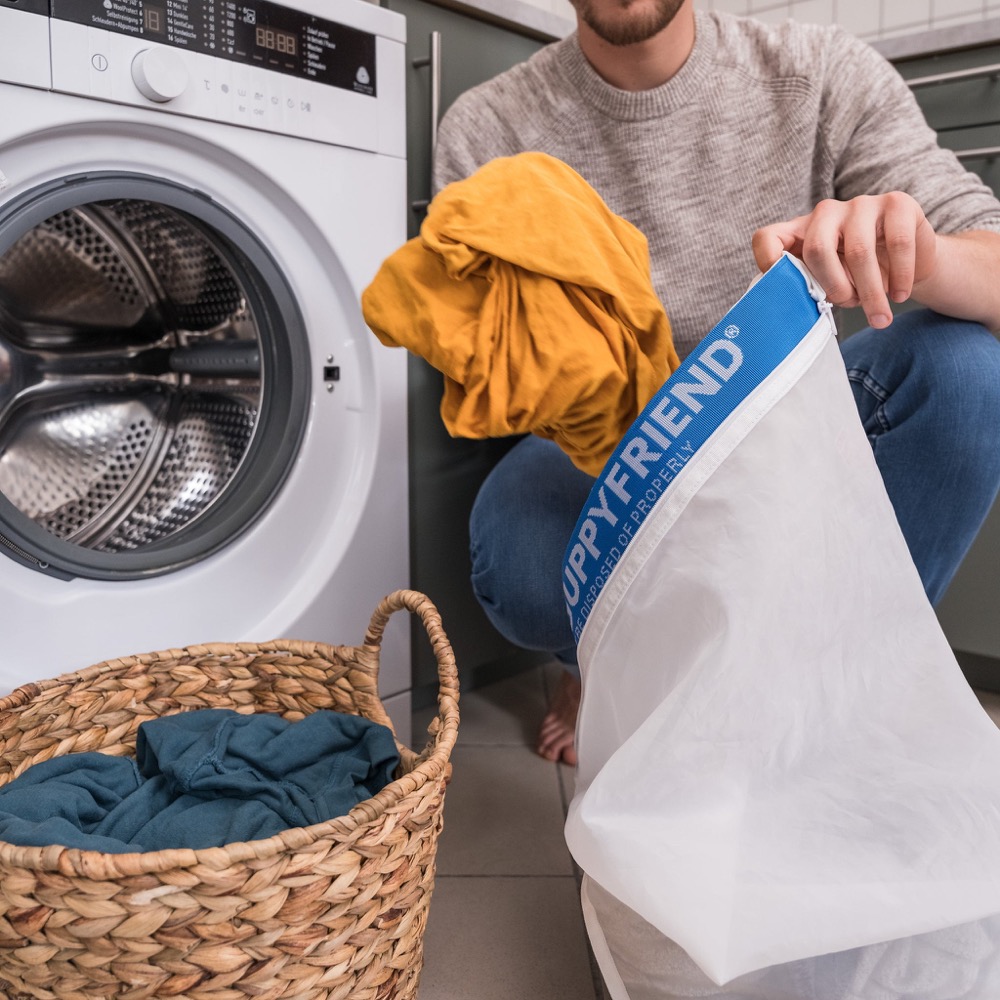 Best In-Drum Option
No plumbing, no landlord conversation, and it protects the garments most responsible for the problem rather than the whole load.
Why it helps: A 50-micron mesh sits well inside the pore size that produced significant microfiber reductions in the published trials, and it cuts the mechanical abrasion that generates the fibers in the first place.
Check Today’s Price on Amazon →Amazon prices change daily — tap to see today's price and any active discount.
- Free delivery & returns for Prime members
- Thousands of verified reviews
- Reusable for years
Whatever you use, the fibers you capture belong in the trash, not the sink — rinsing the mesh out under the tap puts everything you just caught back into the wastewater. And the cheapest fix of all is upstream of every device here: fewer synthetic garments in the first place, which is the case we make in the guide to organic-fiber alternatives. What you wash with matters far less than people assume — if you are choosing a detergent, choose it on its own ingredients, not on a microfiber claim.
Does a washing machine filter change anything outside your own house?
This is the fair skeptical question, because wastewater treatment plants already remove a lot. The Parry Sound pilot is the only study that has answered it at community scale, and the answer was yes: with filters in roughly 10% of connected homes, the researchers measured a significant reduction in microfibers in the plant's treated final effluent — the water that goes back into the lake.
The reason capture upstream still matters is what happens to the fibers a plant does remove. They do not vanish; they concentrate in the sludge, and sludge is frequently spread on farmland, where the fibers wash back into waterways with runoff. A filter on the machine takes the fiber out of the cycle at the only point where it is still dry, visible and easy to throw away.
Most of what your washing machine sheds goes down the drain, not into your lungs or your food. The laundry fixes here are largely about what leaves your house. If your concern is what you personally take in, the bigger levers are the water you drink and the plastic you heat — see what has actually been found in the human body and the measured intake numbers.
The honest ranking
If you own your machine and can spare an hour: fit an external filter with a published micron rating of 150 or finer. That is the only fix in this literature with a large, repeatedly measured effect, and it works on every load without you remembering anything.
If you cannot: use a fine-mesh wash bag for fleece and athletic wear, line-dry your synthetics, and run full loads. Add a laundry ball if you like — 26% by count is real — but do not let it stand in for a filter, and do not believe a hose-sock trap with no micron rating is doing the same job. And if you are replacing clothes anyway, every synthetic garment you do not buy is a fix that needs no device at all.
Frequently Asked Questions
An external filter plumbed onto the washing machine's drain hose is the only fix with a large measured effect. In a 2019 University of Toronto study in Marine Pollution Bulletin, a 150-micron Lint LUV-R filter cut microfibers leaving the machine from 4,800 fibers per liter to 648 — an 87% reduction by count and 80% by weight. Everything you can drop inside the drum measured far weaker.
A little, and less than people assume. The 2019 Marine Pollution Bulletin study measured a 26% reduction in microfiber count with a Cora Ball in the drum — a real, statistically significant effect. But by weight the same test found only a 5% reduction, which was not statistically significant, meaning it catches many small light fibers and misses most of the mass.
It is the single specification that decides whether a filter works. Reviewing the 2020 University of Plymouth trial of six devices, researchers reported that no significant microfiber reduction was observed for filters with a pore size greater than 175 microns, while significant reductions were observed at 150 microns or finer. The devices that performed used mesh between 50 and 150 microns.
In the 2019 University of Toronto experiment, washing a single new polyester fleece blanket released an average of 4,800 microfibers per liter of wash water, and more than 120,000 fibers in total from that one item. Release varies enormously with fabric, garment age and machine type, so treat that as the scale of the problem rather than a fixed number for your own laundry.
Yes, and straight into outdoor air rather than into wastewater. A 2020 PLOS ONE study measured 35 to 70 milligrams of lint blown out of a dryer vent over three cycles and found microfibers in the snow up to 30 feet away from the vent. A lint screen catches the visible fluff, not the fibers small enough to travel, so line-drying is the only fix that removes this path entirely.
There is no published evidence that they do. The inexpensive nylon or stainless hose-sock traps sold as washing machine lint filters are designed to stop visible lint and hair, and they do not publish a micron rating. Every device measured to cut microfiber release in the peer-reviewed literature used a mesh between 50 and 150 microns, and filters coarser than 175 microns showed no significant reduction at all.
Sources
- McIlwraith HK, Lin J, Erdle LM, Mallos N, Diamond ML, Rochman CM. "Capturing microfibers — marketed technologies reduce microfiber emissions from washing machines." Marine Pollution Bulletin, 2019;139:40–45. (Control effluent averaged 4,800 ± 820 fibers/L; Cora Ball 3,580 ± 390, a 26% cut by count and 5% by weight that was not significant; Lint LUV-R 648 ± 165, an 87% cut by count and 80% by weight. Fixes 1 and 5.)
- Napper IE, Barrett AC, Thompson RC. "The efficiency of devices intended to reduce microfibre release during clothes washing." Science of the Total Environment, 2020;738:140412. (Six devices compared; the most effective reduced release by 78%, the least effective by 21%. Fixes 2 and 4.)
- University of Plymouth. "Study shows devices can reduce fibres produced in laundry cycle by up to 80%." 2020. (The university's own report of the six-device trial above, giving the 78% and 21% figures.)
- Erdle LM, Nouri Parto D, Sweetnam D, Rochman CM. "Washing Machine Filters Reduce Microfiber Emissions: Evidence From a Community-Scale Pilot in Parry Sound, Ontario." Frontiers in Marine Science, 2021;8:777865. (Filtrol 160 filters, 100-micron mesh, in 97 homes; an average 6.4 g of lint captured per home per week, equal to 179,200–2,707,200 microfibers, and a significant reduction of microfibers in the plant's treated final effluent. Fix 3, and the mesh-size threshold.)
- Belzagui F, Gutiérrez-Bouzán C, Carrillo-Navarrete F, López-Grimau V. "Sustainable Filtering Systems to Reduce Microfiber Emissions from Textiles during Household Laundering." Polymers, 2023;15(14):3023. (Four recycled-polyethylene filter designs; the best retained 86% of microfibers on the first cycle and 99% by the twentieth, staying usable past 30 washes.)
- Kapp KJ, Miller RZ. "Electric clothes dryers: An underestimated source of microfiber pollution." PLOS ONE, 2020;15(10):e0239165. (Dryer vent exhaust measured at 35 ± 16 mg and 70 ± 77 mg of lint over three cycles at two sites; 404 ± 192 and 1,169 ± 606 fibers per snow sampling event, detected up to 30 feet from the vent. Fix 6.)