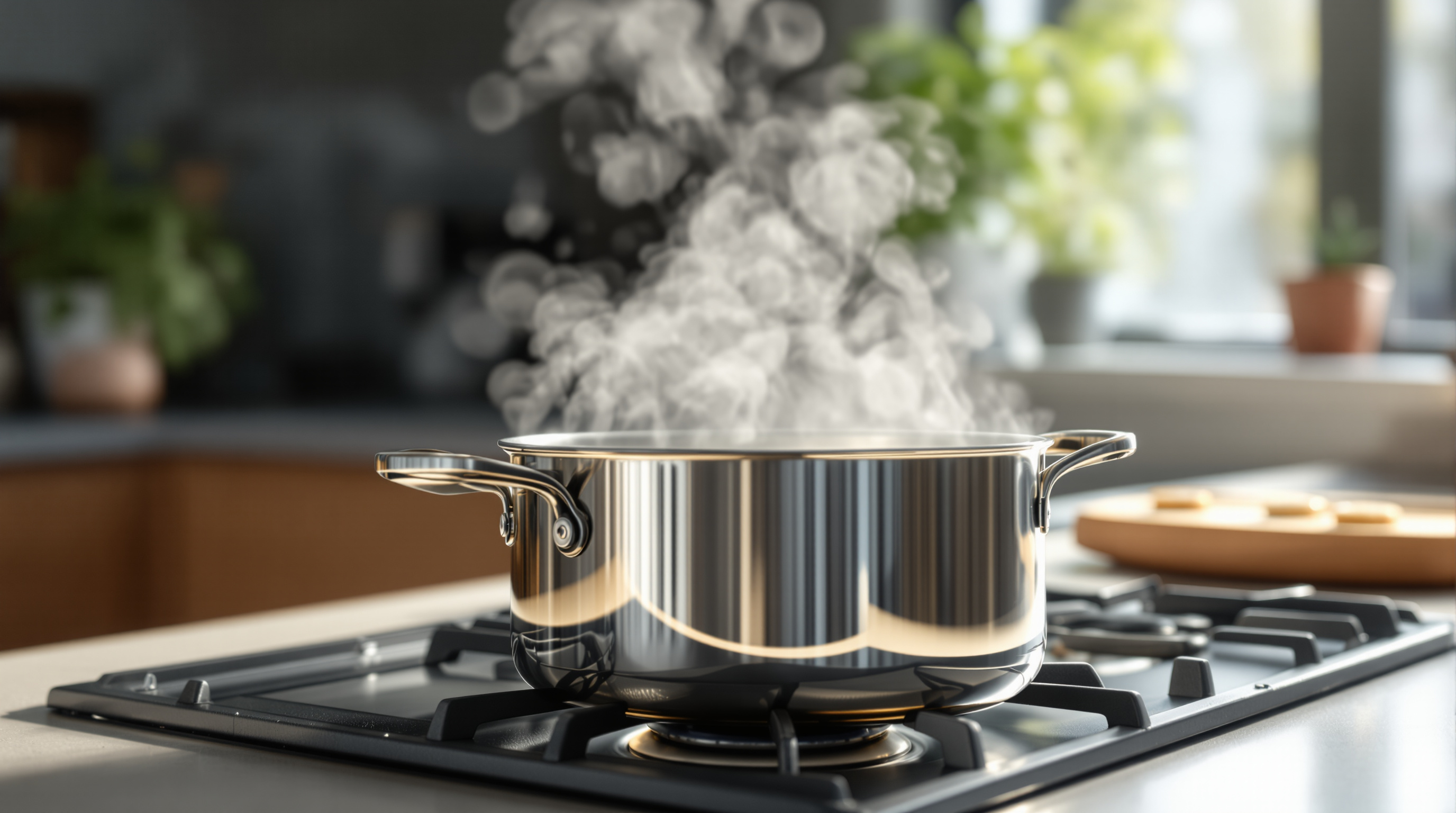
Only in hard water — and only if you filter out the limescale afterward. A 2024 study in Environmental Science & Technology Letters found that boiling hard tap water makes calcium carbonate (limescale) precipitate and trap nano- and microplastic particles; straining out that scale removes up to about 90% of the plastic in very hard water. In soft water, with little scale to trap the particles, removal falls to roughly 25%. Boiling alone does nothing — you have to filter the scale out — and it never addresses plastic that leaches chemically from containers. The reliable finish is still a hollow fiber filter pitcher or a reverse osmosis system.
In early 2024, a study out of China set off a wave of “just boil your water” headlines. The claim sounded almost too convenient: heat your tap water, and up to 90% of its microplastics disappear. Like most things in the microplastics world, the real story is more nuanced than the headline — it's one of the seven claims we untangle in our microplastics myths guide — and understanding the mechanism is the difference between actually reducing your exposure and just feeling like you did.
Tap water contains microplastics in nearly every study that has looked, and bottled water contains far more — a January 2024 PNAS study measured roughly 240,000 plastic particles per liter of bottled water, most of them nanoplastics. The microplastics in tap water come from aging pipes, road runoff, and atmospheric deposition. So a free kitchen trick that removes most of them would be genuinely useful. The catch is that boiling only works under specific conditions, and only as the first half of a two-step process.
Does boiling water actually remove microplastics?
Yes, partly — and only in hard water. Boiling on its own doesn’t destroy or evaporate microplastics; plastic doesn’t boil off the way water does. What the 2024 study found is that boiling hard water triggers a chemical reaction that traps the particles so they can be filtered out. The removal comes from that trap-and-strain sequence, not from the heat itself. In soft water, the effect is much weaker because there’s little of the mineral that does the trapping.
The researchers, publishing in Environmental Science & Technology Letters, boiled tap water spiked with nano- and microplastics at a range of hardness levels. In very hard water (300 mg/L of calcium carbonate) they measured up to about 90% of the plastic particles removed after the scale was filtered out. In soft water (below 60 mg/L), removal fell to roughly a quarter. So the honest answer depends heavily on where you live and what comes out of your tap.
How does boiling trap the microplastics?
The mechanism is the same limescale you already know from your kettle. Hard water carries dissolved calcium carbonate. When you heat it, that mineral comes out of solution and forms solid chalky crystals — the white scale that coats a kettle’s element. As those crystals grow, they form around and encrust the tiny plastic particles floating in the water, locking them inside solid flakes of scale that sink or cling to the pot.
At that point the plastic is no longer freely suspended in your water — it’s trapped inside scale you can physically remove. Pour the cooled water through a simple filter (a paper coffee filter, a fine mesh strainer, or a proper water filter) and the scale — with the plastic inside it — stays behind. Skip the straining step and the particles just settle back into your glass, which is why “just boiling” doesn’t work on its own. This matters most when the water is going into a baby — if you boil tap water to make formula, boiling alone won’t take the plastic out, so pair it with a certified filter (see our best water filters for baby formula).
“Boiling doesn’t remove microplastics — limescale does. The heat just makes the scale form. You still have to strain the scale out to take the plastic with it.”
What boiling does NOT do
This is where the headlines oversell it. Even done perfectly, the boil-and-filter method has three real limits you should know before you rely on it:
- It barely helps in soft water. No scale means nothing to trap the plastic, so removal drops to around 25%. Much of the U.S. has soft or moderately soft water.
- It does nothing about chemical leaching. Boiling captures solid particles; it does not remove the BPA, phthalates, or PFAS that migrate into water from plastic containers — and heating water inside plastic makes that leaching worse, not better.
- It leaves the smallest nanoplastics and dissolved contaminants behind. Chlorine, lead, and the tiniest particles aren’t reliably captured by scale. That’s the job of a real filter.
If you’re boiling specifically to cut microplastics, use an all-stainless-steel or glass kettle or pot. Heating water inside a plastic kettle, a plastic-lined appliance, or a disposable plastic container accelerates microplastic and chemical migration from the plastic into your water — you’d be adding particles at the exact moment you’re trying to remove them. A 2025 study measured just how much a plastic kettle can shed on the boil; see do electric kettles have microplastics and our picks for the best non-toxic electric kettles. If you’re brewing tea, the bag is the second source: many popular pyramid and heat-sealed flat bags shed billions of microplastic particles into the cup on their own. Our guide to the safest tea bags covers the four brands that pass a materials test and the five popular labels that fail it — and which bag materials shed microplastics explains what that test actually measures.
The reliable finish: filter the water
Because boiling only works in hard water and only for solid particles, the dependable way to cut microplastics in any water is to pass it through a membrane filter — and that same filter is exactly what you’d use to strain the scale after boiling. A hollow fiber pitcher physically blocks microplastics down to ~1 micron regardless of hardness, and also removes the chlorine, lead, and PFAS that boiling leaves behind. Below are six filters that pair perfectly with the boil-and-filter method; each has independent data behind its microplastic performance. For the full ranking, see our best water filter pitchers for microplastics guide, the complete water filter guide, or — if you'd rather plumb the filter in permanently — our best under-sink water filters. If you like the logic of boiling, a countertop water distiller takes it to completion — it boils water to steam and recondenses it, leaving microplastics, minerals and dissolved contaminants like fluoride behind in the chamber.
One assumption to clear up first: if you already own a Brita, straining boiled water through it does not turn it into a microplastic filter. Brita is certified for chlorine taste and, on the Elite cartridge, lead — but no Brita filter is NSF-certified for microplastics. See our full Brita filter microplastics breakdown for the sourced test data, Brita’s certified 0.5–1 micron floor, and the certified pitchers that go finer.
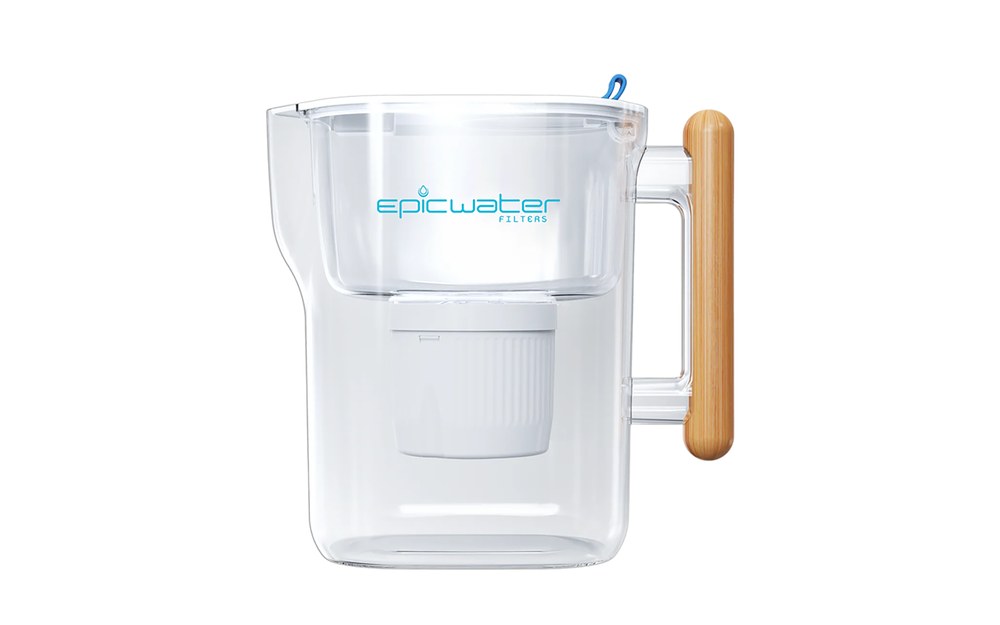
1. Epic Pure Pitcher — Best Overall for Microplastics
 Best Overall
Owners like that Epic publishes its lab results and that the water tastes clean, and several describe the slow pour as reassuring rather than annoying -- one common line is that the deliberate rate lets them know it is working. A fresh filter can take one to two hours to run through at first, then speeds up to roughly 15 to 30 minutes once broken in. The honest gripes: the flow is slow by design and frustrates anyone in a hurry, some buyers report cracked plastic or a spout flap that does not open cleanly, and a few had water leak or spill when pouring.
The clearest evidence on this list: Epic posts its independent lab results publicly, so you can see the 99.9% microplastic-removal data instead of trusting a slogan on the box.
Why it's safe: The hollow fiber membrane physically blocks microplastic particles down to ~1 micron, while the carbon stage handles chlorine, lead, and PFAS — all in a BPA-free Tritan body.
Check Today’s Price on Amazon →Amazon prices change daily — tap to see today's price and any active discount.
- Free delivery & returns for Prime members
- Sold & shipped by Amazon
- Thousands of verified reviews
The Epic Pure is the most straightforward recommendation for anyone specifically trying to reduce microplastic intake from tap water. The dual-stage design uses a hollow fiber membrane as the primary microplastic barrier, then activated carbon to address chlorine, chloramines, and taste. Epic publishes its independent IAPMO lab test results on its website, which is a transparency standard most competitors don’t meet.
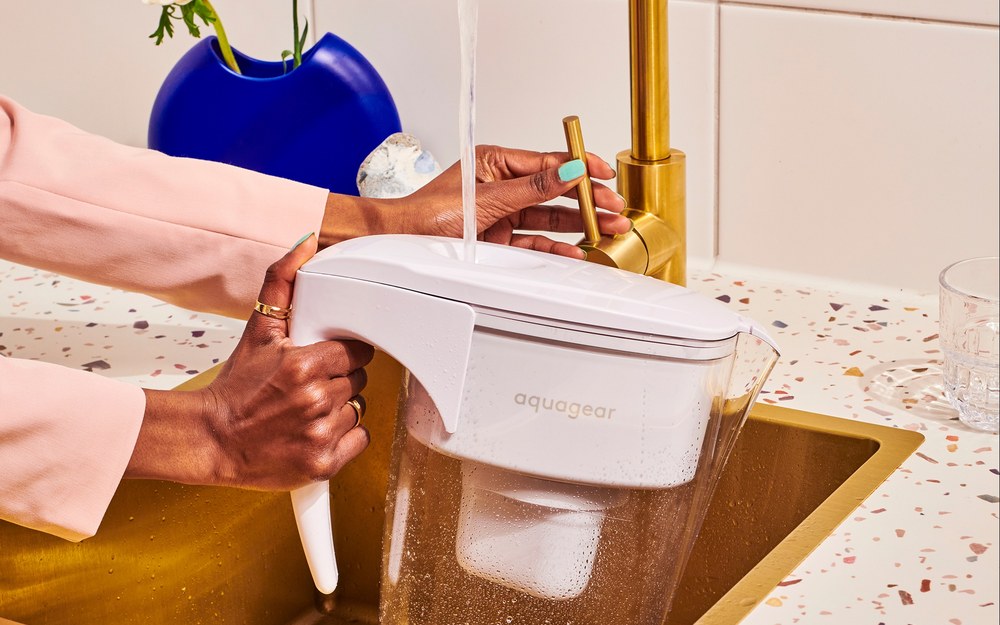
2. Aquagear Water Filter Pitcher — Best Filter Life
 Best Filter Life
Buyers rate Aquagear well for taste and its wide contaminant list, and the company backs it with a strong warranty. The most repeated complaint by far is speed -- reviewers say filtration drags, with some waiting minutes and others reporting close to two hours for a pitcher once the cartridge ages. The honest gripes: filters clog and cannot just be rinsed clean, the lid does not fit well and can pop off when pouring, and the pour-spout cover tends to stick or fall out of place.
Change the filter half as often as most pitchers — 150 gallons per cartridge means fewer replacements, lower annual cost, and less to remember.
Why it's safe: A 5-stage filter with a sub-micron membrane stage captures microplastics, lead, fluoride, and chlorine, in a BPA-free body with USA-made filter media.
Check Today’s Price on Amazon →Amazon prices change daily — tap to see today's price and any active discount.
- Free delivery & returns for Prime members
- Sold & shipped by Amazon
- Thousands of verified reviews
The Aquagear pitcher costs more upfront but its 150-gallon filter life means lower annual replacement costs than most competitors. The pitcher body is guaranteed for life. Aquagear uses a 5-stage filter with a sub-micron membrane stage specifically targeting microplastics, heavy metals, and fluoride. Good for families who don’t want to track filter changes constantly.
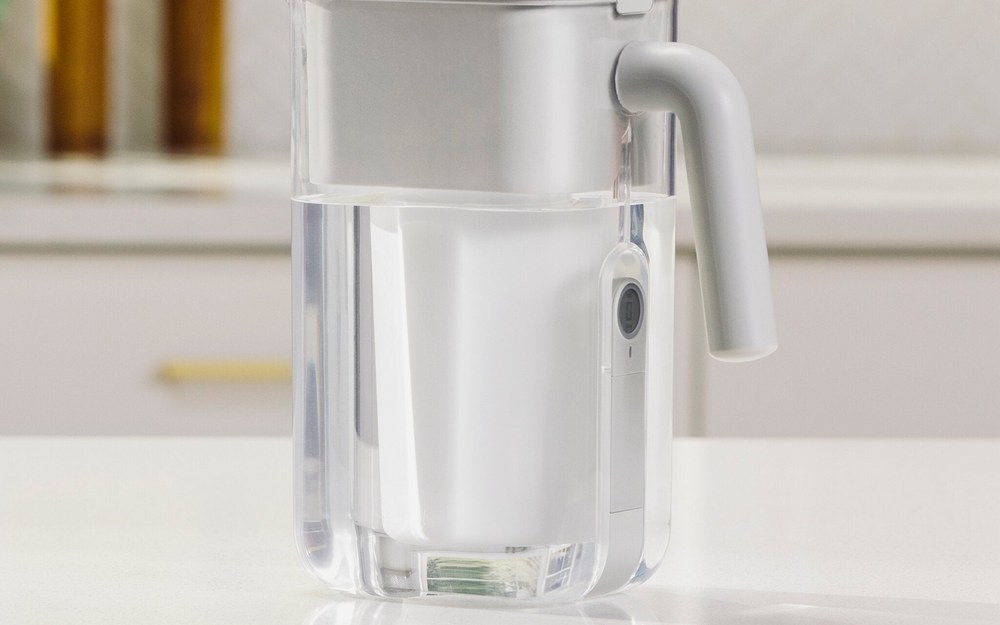
3. ZeroWater 10-Cup Pitcher with TDS Meter — Best for Hard Water / TDS Reduction
 Best for Hard Water
Owners buy ZeroWater for the included TDS meter and the fact that it reads 000 straight from the tap, and many say nothing else gets water this clean. The honest gripes: the ion-exchange resin can throw off a fishy, sour, or lemony smell as it wears out; filter life is short, tapping out around 15 to 40 gallons, so replacements come often and the cost adds up; and the lid can fall off if you pour too fast or tip it too steeply.
The included TDS meter shows the exact moment your filter is spent — so you replace on data, not a calendar guess, which matters most in hard-water homes.
Why it's safe: Five mechanical and ion-exchange stages capture microplastic particles and strip dissolved solids to 0 ppm, and the pitcher is built from BPA-free plastic.
Check Today’s Price on Amazon →Amazon prices change daily — tap to see today's price and any active discount.
- Free delivery & returns for Prime members
- Sold & shipped by Amazon
- Thousands of verified reviews
ZeroWater’s 5-stage system is the most comprehensive multi-layer design in the pitcher category. Stage 1 is a coarse mesh screen; stages 2–3 are activated carbon and oxidation reduction; stage 4 is an ion exchange resin for dissolved solids; stage 5 is an ultra-fine screen. The combination removes virtually all dissolved solids and captures physical particles. The included TDS meter makes it easy to know exactly when to replace the filter — a significant practical advantage. Note: in hard-water areas, replace filters on TDS reading, not a fixed schedule.
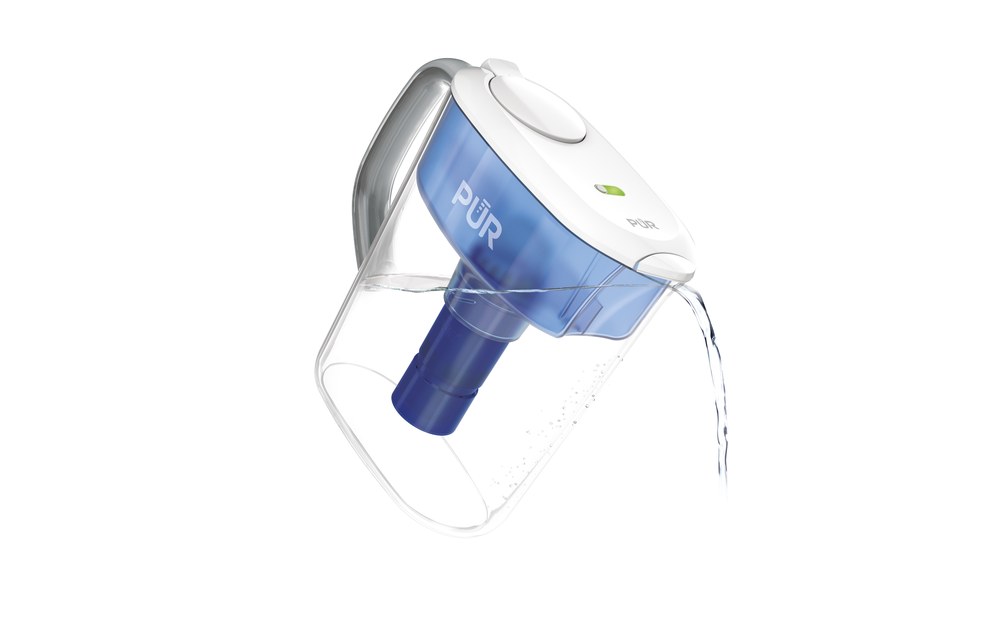
4. PUR Ultimate 11-Cup Pitcher — Best NSF-Certified Option
 Best NSF-Certified
PUR fans like the NSF-certified lead and microplastic claims and say the water tastes noticeably better than straight tap. The honest gripes are consistent and loud: the filtering drags, with owners reporting close to 30 minutes per tank; the cartridges are known to clog and slow to a crawl; and pouring can be a mess -- if the top tank still holds unfiltered water or the pitcher is full, the whole lid can push off and spill.
The cheapest way onto NSF-certified ground — independently certified to reduce 70+ contaminants, including lead and many chemicals, for around the price of a couple of bottled-water cases.
Why it's safe: The Ultimate filter pairs a denser carbon block with an ion-exchange layer in a BPA-free body, NSF-certified to reduce lead, chlorine, and 70+ other contaminants.
Check Today’s Price on Amazon →Amazon prices change daily — tap to see today's price and any active discount.
- Free delivery & returns for Prime members
- Sold & shipped by Amazon
- Thousands of verified reviews
The PUR Ultimate is the most affordable certified pick on this list. PUR’s “Ultimate” filter uses a denser carbon block with an ion exchange layer, giving better particulate capture than the standard PUR filter. PUR has not published specific microplastic test data, but the Ultimate’s finer mechanical stage removes sediment and large particulates more effectively than standard carbon. Best used when budget is a priority and your main concern is chemical contaminants plus general particulates — not as the primary microplastic defense if that is your stated goal.
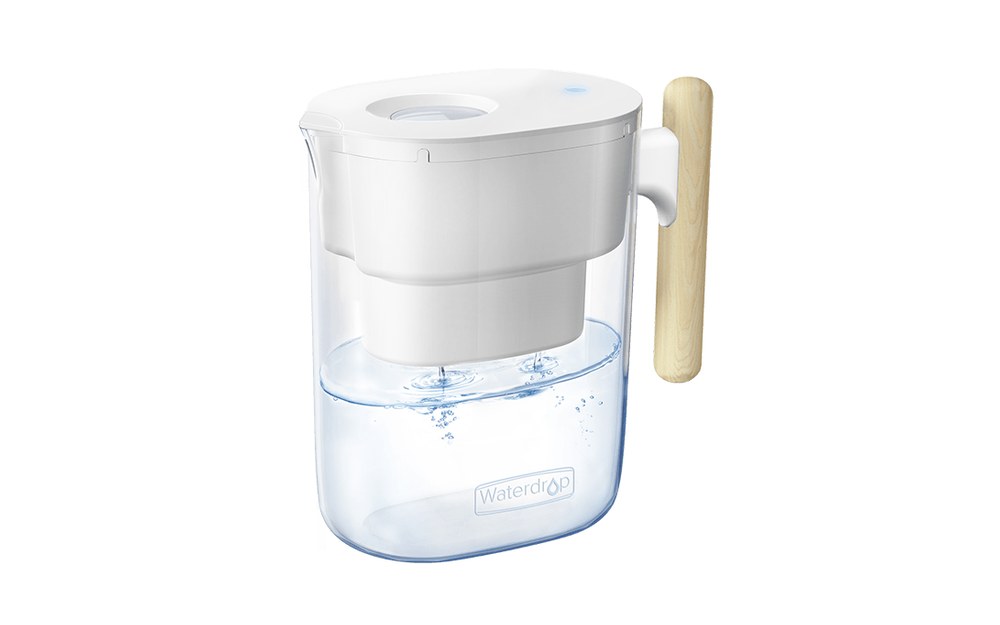
5. Waterdrop Chubby 10-Cup Filter Pitcher — Best Design + Hollow Fiber
 Best Filter Life
The Chubby draws praise for being one of the few pitchers people want to leave out on the counter, and hands-on testers clocked it filtering a full reservoir in under three minutes, faster than most rivals. Owners also point to the 200-gallon filter life as the reason the running cost stays low. The honest gripes: the pour spout is small, so a full pitcher has to be tipped slowly or it makes a mess; new filters trap air bubbles and run slow until you soak and tap them; and the trap-door spring is metal, which a few long-term owners worry could rust over the years.
A membrane blocks particles by pore size rather than by claim list, and its 200-gallon filter runs about 4 to 5 months — the lowest ongoing cost on the list.
Why it's safe: A hollow fiber membrane is a physical barrier to particles, while the carbon composite handles chlorine, heavy metals, and PFAS — all in a BPA/BPS-free body.
Check Today’s Price on Amazon →Amazon prices change daily — tap to see today's price and any active discount.
- Free delivery & returns for Prime members
- Sold & shipped by Amazon
- Thousands of verified reviews
Waterdrop is a newer brand but the Chubby is the standout option if you want a membrane rather than a claim list, and the longest filter life on the market. The 200-gallon filter runs about 4–5 months for most households, making it one of the most cost-effective per-gallon options once you factor in replacement costs. The “filter while you pour” design means you never wait for water to drip through — a usability advantage over pitchers that require reservoir fill-and-wait cycles.
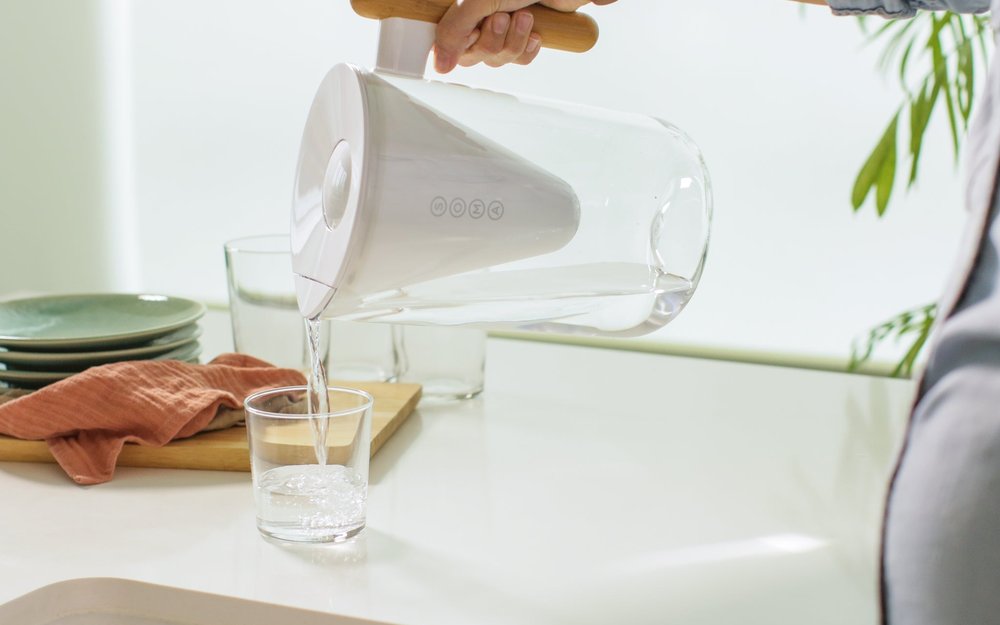
6. Soma 8-Cup Pitcher — Best Aesthetic, Plastic-Minimizing Design
 Best Design
Soma gets picked for looks, with the bamboo handle and clean design, and buyers like the coconut-shell carbon taste. The honest gripes stack up on function: the drip is slow, with owners reporting 30 minutes to an hour to fill, the pitcher clogs from trapped air bubbles even after following the setup steps, mold builds up around the filter rim, and some units arrived with a cracked bamboo handle.
The glass carafe version solves a problem most pitchers ignore — storing filtered water for hours in plastic. Soma stores it in glass instead, with a sustainable wood handle.
Why it's safe: A plant-based coconut-carbon filter (NSF 42+53 certified) removes chlorine and common contaminants, and the glass carafe option keeps your filtered water out of contact with plastic entirely.
Check Today’s Price on Amazon →Amazon prices change daily — tap to see today's price and any active discount.
- Free delivery & returns for Prime members
- Sold & shipped by Amazon
- Thousands of verified reviews
Soma takes a different angle: reducing the plastic contact between filtered water and the pitcher vessel itself. The glass carafe version is the most meaningful option if you’ve thought about the fact that most pitchers are plastic and you’re storing water in them for hours. The plant-based carbon filter removes chlorine and common contaminants effectively, though Soma has not published microplastic-specific lab data. The glass carafe + good carbon filter combination is the pick for people focused on minimizing all plastic contact, not just microplastics in the source water.
How to do the boil-and-filter method correctly
If you live in a hard-water area and want to try it, the method is simple — but every step matters. Skipping the straining step, or boiling in plastic, undoes the benefit. Here is the sequence the researchers used, adapted for a home kitchen:
- Use a stainless steel or glass kettle or pot. Never boil water for this purpose inside a plastic kettle or plastic-lined appliance — that adds particles instead of removing them. The same logic applies to your daily brew: a plastic-free coffee maker keeps hot water off plastic parts, too.
- Bring the water to a full boil for about five minutes. This gives the calcium carbonate time to precipitate and form scale around the plastic particles.
- Let it cool and settle. As the water cools, the scale flakes (with the plastic trapped inside) sink or cling to the pot. Don’t stir them back in.
- Filter out the scale. Pour the cooled water through a paper coffee filter, a fine mesh strainer, or — best of all — a proper hollow fiber water filter. This is the step that actually removes the plastic. The visible white flakes left behind are the scale-plus-plastic you just removed.
- Store it in glass or stainless steel. Pouring your freshly filtered water into a plastic bottle reintroduces the problem you just solved. See our best stainless steel water bottles guide.
The honest takeaway: boiling is a free way to knock down the particle load in hard water, but the filter is doing the real work at the end — and a good filter does that job in any water, no boiling required.
Boiling vs. filtering: which removes more microplastics?
Filtering is the more reliable method because it doesn’t depend on your water hardness and it captures dissolved contaminants boiling leaves behind. Boiling shines only as a free first step in hard-water homes. Here is how the common approaches compare:
| Method | Microplastic Removal | Works in Soft Water? | Removes Chemicals / Nanoplastics? | Cost |
|---|---|---|---|---|
| Boiling only (no straining) | Minimal | No | No | Free |
| Boil + strain out the scale | Up to ~90% (hard water) | ~25% only | No | Free / low |
| Hollow fiber pitcher | 99%+ (≥1µm) | Yes | Chlorine, lead, PFAS | Low–moderate |
| Reverse osmosis (under-sink) | 99%+ (≥0.0001µm) | Yes | Yes, including nanoplastics | Higher upfront, low ongoing |
Reverse osmosis is the gold standard — its semi-permeable membrane filters down to about 0.0001 micron, removing essentially everything including nanoplastics. A hollow fiber pitcher operates at 0.1–0.2 micron, capturing microplastics 1 micron and larger. Both beat boiling on reliability, and both work regardless of your water hardness. For the full breakdown of whole-home and under-sink options, see our complete water filter guide and the best reverse osmosis systems.
Is filtered tap water better than bottled water?
Yes, by a wide margin. A 2024 study in Proceedings of the National Academy of Sciences found up to 240,000 nano- and microplastic particles per liter in popular bottled water brands — far more than what passes through a working hollow fiber filter. Bottled water also leaches plastic from the bottle itself, especially in heat and sunlight. Filtered tap water stored in glass or stainless steel is the lowest-microplastic drinking setup short of reverse osmosis. When you're away from your home filter, a certified filtered water bottle keeps that same protection on the go without boiling. If you’re curious how much you’re actually drinking, see does bottled water have microplastics and microplastics in tap water.
Want the highest removal rate for your home?
A hollow fiber pitcher is a great starting point. For whole-home and under-sink options that remove microplastics, nanoplastics, heavy metals, and PFAS in one system, see our complete water filter guide — or a faucet-mounted filter for a no-plumbing option that screws straight onto the tap.
The bottom line: does boiling work?
Boiling water can remove a meaningful share of microplastics — but only in hard water, only if you strain out the limescale afterward, and only for solid particles (not the chemicals that leach from plastic). Treat it as a free bonus step, not a strategy. For dependable, everyday microplastic reduction in any water, a membrane filter is the answer — and it doubles as the strainer that finishes the boil-and-filter method. If you buy one thing, buy a filter:
- Waterdrop Chubby — a hollow fiber membrane on Waterdrop’s own published lab data, plus the longest filter life (200 gallons). The pour-through design also makes it an easy post-boil strainer.
- Epic Pure — published independent lab data, IAPMO certified, and the most transparently documented hollow fiber pitcher after the Waterdrop.
- Aquagear — 150-gallon filter life and a lifetime pitcher guarantee. Good if you want fewer filter changes and don’t want to think about it.
- ZeroWater — a 5-stage design with a TDS meter, ideal for the hard-water homes where boiling helps most, since it tells you exactly when to swap the filter.
- PUR Ultimate — the budget pick, NSF certified for 70+ contaminants, if chemical reduction is your priority alongside particle capture.
- Soma glass carafe — best if minimizing plastic contact with your stored water matters to you as much as the source water.
Whatever you choose, pair it with a stainless steel or glass bottle for storage and drinking — filtering (or boiling) your water and then drinking it from a plastic bottle reintroduces the problem you just solved — and reusing a disposable plastic bottle is worse still. See our guide to the best stainless steel water bottles for zero-plastic drinking vessels.
Want the Full Home Protection Guide?
Water filtration is one piece of the puzzle. The Complete Plasticproof Guide covers every microplastic exposure source in your home — kitchen, nursery, bathroom, bedroom — with 80+ product recommendations backed by 47+ studies.
Frequently Asked Questions
Partly, and only in hard water. A 2024 study in Environmental Science & Technology Letters found that boiling hard tap water makes calcium carbonate (limescale) precipitate and trap nano- and microplastic particles. Once you filter out that scale, up to about 90% of the plastic is removed in very hard water. In soft water, removal drops to roughly 25%. Boiling alone — without straining out the scale — does not reliably remove microplastics, and it does nothing about plastic that leaches chemically from containers.
When hard water is heated, dissolved calcium carbonate comes out of solution and forms the chalky scale you see on a kettle. As those crystals form, they grow around and encrust the microplastic and nanoplastic particles in the water, locking them inside solid limescale flakes. Pouring the cooled water through a filter — a coffee filter, a fine mesh strainer, or a proper water filter — then removes the scale and the trapped plastic together.
Yes. Boiling only helps in hard water, only captures particles once you strain out the scale, and does nothing for the smallest nanoplastics in soft water. A hollow fiber or reverse osmosis filter physically blocks microplastics regardless of your water hardness and also removes chlorine, lead, and PFAS that boiling leaves behind. Boiling is best thought of as a free first step that a proper filter finishes — not a replacement for one.
It can. Heating water inside a plastic kettle, plastic-lined appliance, or plastic bottle accelerates the migration of microplastics and chemical additives from the plastic into the water. If you are boiling to reduce microplastics, use an all-stainless-steel or glass kettle or pot so you are not adding particles at the same time you are trying to remove them. Never boil or microwave water in a disposable plastic container. The same inert-material logic applies to what you cook in — see how cast iron, stainless steel, and ceramic cookware compare.
Filtering is more reliable. A hollow fiber membrane pitcher removes 99%+ of microplastics 1 micron and larger in any water, and a reverse osmosis system removes nanoplastics too. Boiling-and-filtering can reach ~80–90% but only in hard water. The best approach is to combine them: boil hard water to knock down the particle load for free, then pour it through a certified filter to capture whatever remains along with chlorine, lead, and PFAS.
Microplastics have been detected in the vast majority of tap water samples studied worldwide, though concentrations vary widely by region and infrastructure. They enter through aging pipes, road runoff, and atmospheric deposition. Bottled water is often worse: a 2024 PNAS study found up to 240,000 nano- and microplastic particles per liter in popular bottled brands. Reducing intake is about combining a lower-plastic source (filtered tap water) with a lower-plastic storage vessel (stainless steel or glass).
Sources
- Yu Z, Wang J-J, Liu L-Y, Li Z, Zeng EY. “Drinking Boiled Tap Water Reduces Human Intake of Nanoplastics and Microplastics.” Environmental Science & Technology Letters, 2024. (Up to ~90% NMP removal in hard water via calcium carbonate co-precipitation and filtration.)
- Qian N, et al. “Rapid single-particle chemical imaging of nanoplastics by SRS microscopy.” Proceedings of the National Academy of Sciences, 2024. (240,000 nano/microplastic particles/L in bottled water.)
- Mason SA, et al. “Synthetic Polymer Contamination in Bottled Water.” Frontiers in Chemistry, 2018.
- Kosuth M, Mason SA, Wattenberg EV. “Anthropogenic contamination of tap water, beer, and sea salt.” PLOS ONE, 2018.
- NSF International. “NSF/ANSI P473: Drinking Water Treatment Units — PFOA & PFOS.” (Microplastic claims sit under NSF/ANSI 401, not P473.)
- Tong H, et al. “Microplastics in freshwater: A review on occurrence, distribution, and environmental effects.” Environmental Pollution, 2022.