The best reverse osmosis system in 2026 is the AquaTru Countertop RO — the only countertop RO we recommend: a true 4-stage membrane, NSF/ANSI 58 certified, 99%+ removal of microplastics, nanoplastics, PFAS, lead and arsenic, and no installation. If you can plumb one in under the sink, the Waterdrop G3P800 (800 GPD tankless, NSF/ANSI 58, remineralization) is the performance leader. Full ranked list:
- AquaTru Countertop RO ($$$) — Best overall countertop. NSF/ANSI 58, 4-stage, no installation. Details →
- Waterdrop G3P800 ($$) — Best tankless under-sink. 800 GPD, NSF/ANSI 58, remineralization + smart display. Details →
- iSpring RCC7AK ($) — Best budget. NSF/ANSI 58, 75 GPD, alkaline remineralization. Details →
- APEC ROES-50 ($) — Best value. WQA Gold Seal, 50 GPD. Details →
- Frizzlife PD600-TAM3 ($$) — Best compact tankless. NSF/ANSI 58, 600 GPD, alkaline remineralization. Details →
- Express Water RO5DX ($) — Budget entry. NSF/ANSI 58, 50 GPD. Details →
Why reverse osmosis? Its 0.0001-micron membrane blocks particles thousands of times smaller than the tiniest microplastic — no pitcher or carbon filter matches it. See why RO is the gold standard →
Check Today’s Price on AquaTru →Full head-to-head details of all six systems below, including certifications, GPD flow rate, remineralization, and real owner-review notes.
Quick Navigation
Compare all 6 picks
Every pick side by side — tap a name to jump to the full review, or check today's price.
| Pick | Rating | Why it wins | |
|---|---|---|---|
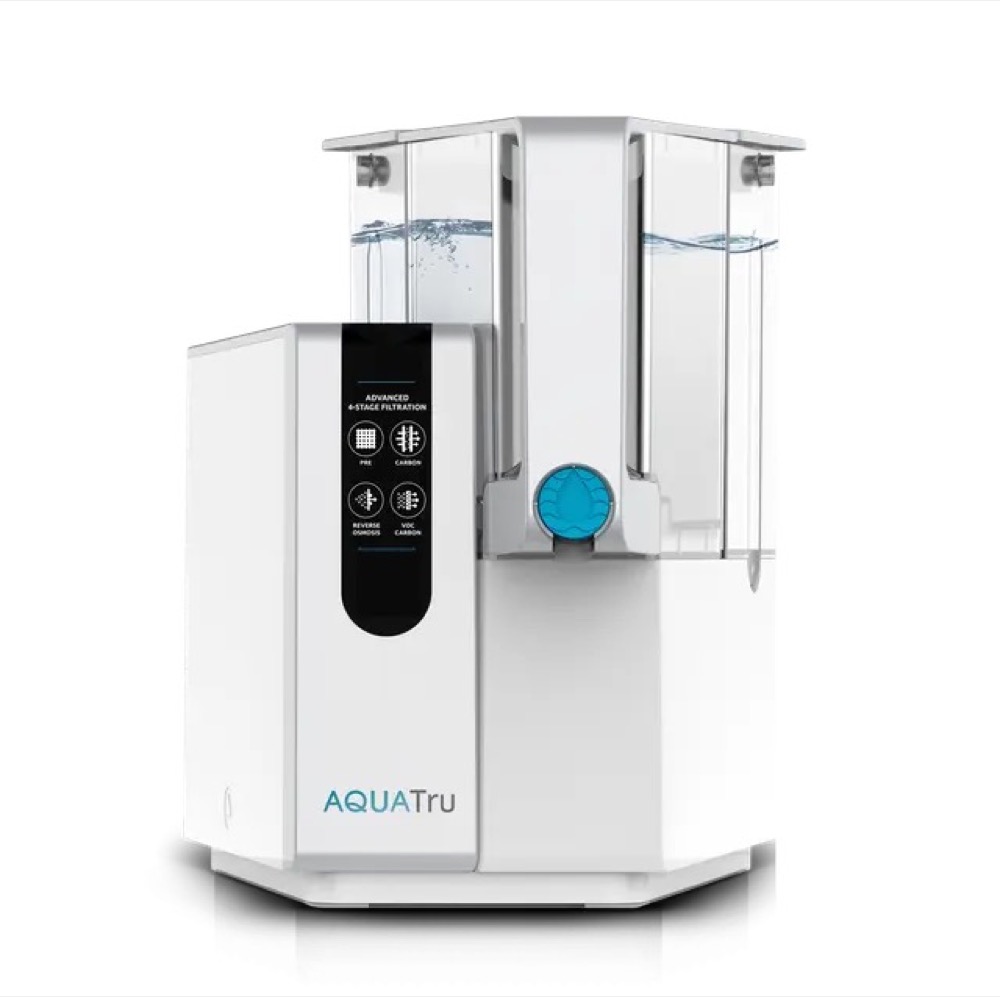 Best OverallAquaTru Countertop RO |
4.7out of 5 | NSF Certified4-Stage RO |
Check price → |
| — | NSF/ANSI 58800 GPD |
Check price → | |
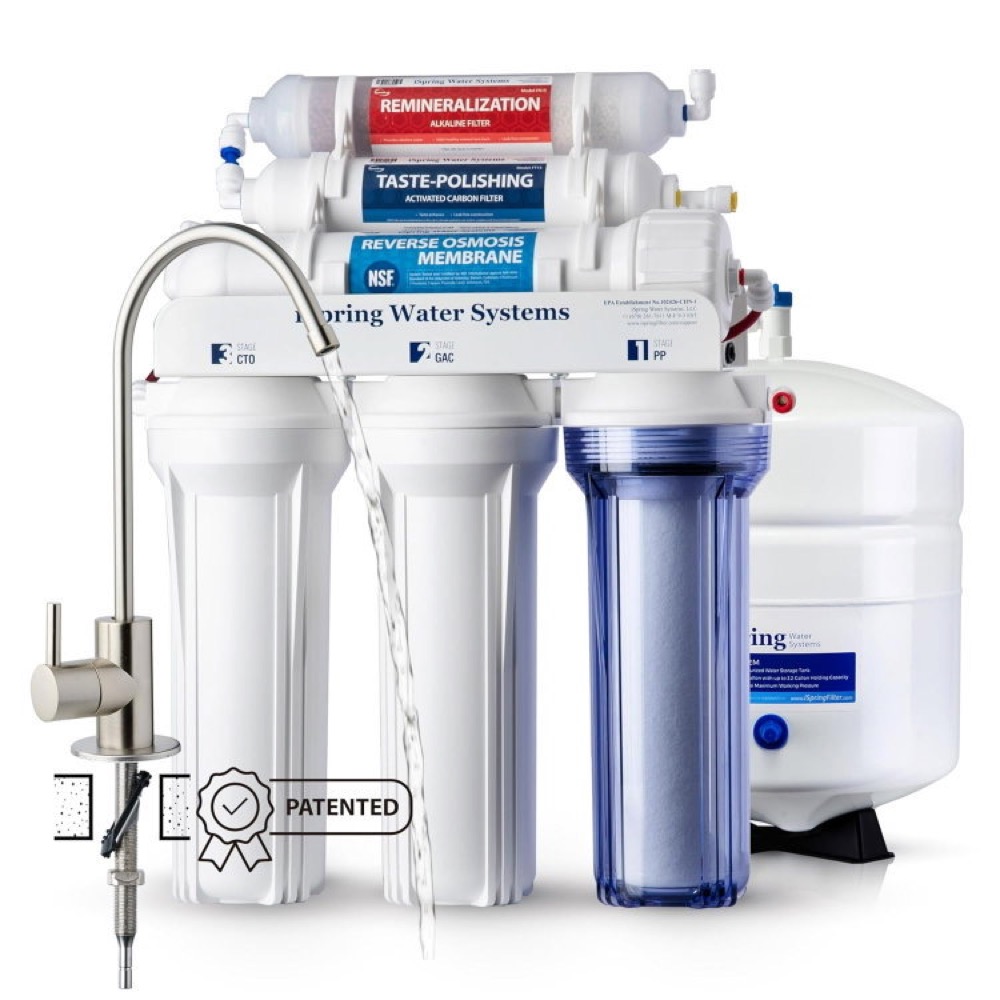 Best BudgetiSpring RCC7AK Under-Sink 6-Stage RO |
4.6out of 5 | NSF/ANSI 586-Stage |
Check price → |
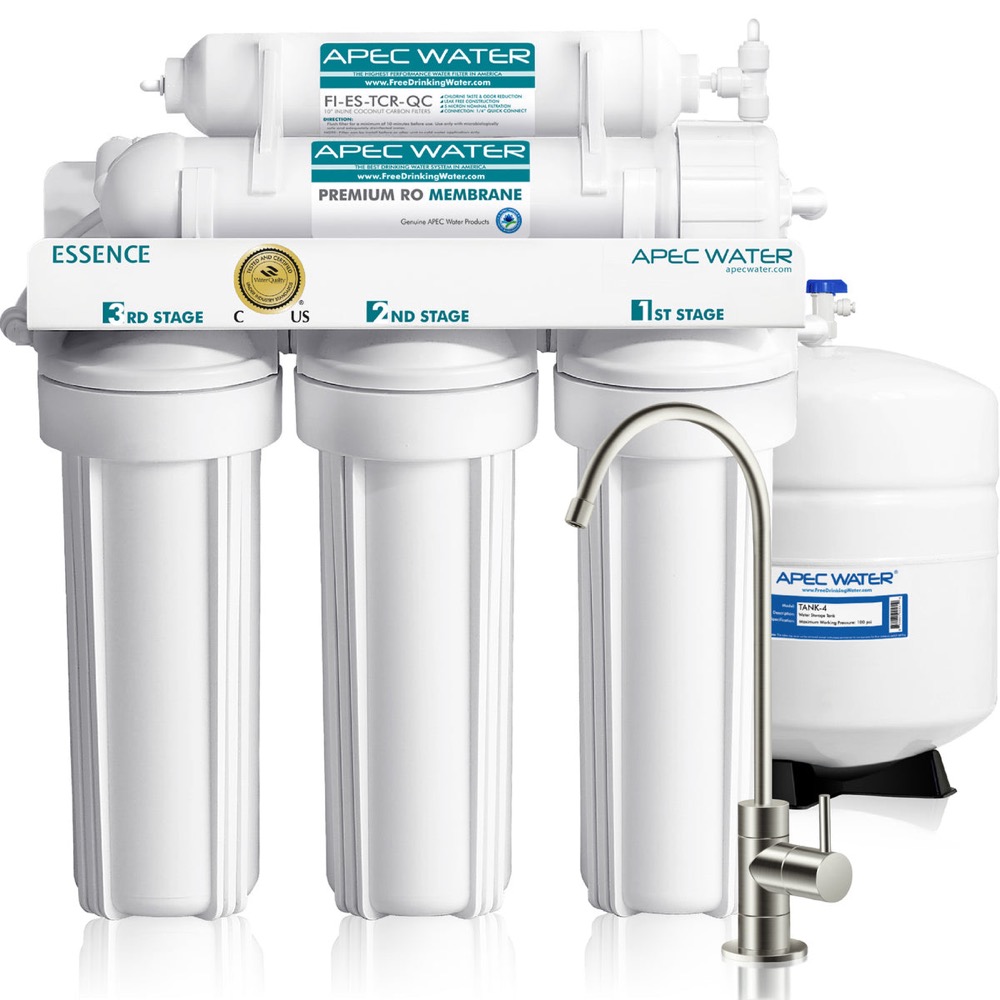 Best ValueAPEC Water ROES-50 Under-Sink 5-Stage RO |
4.7out of 5 | WQA Gold Seal5-Stage |
Check price → |
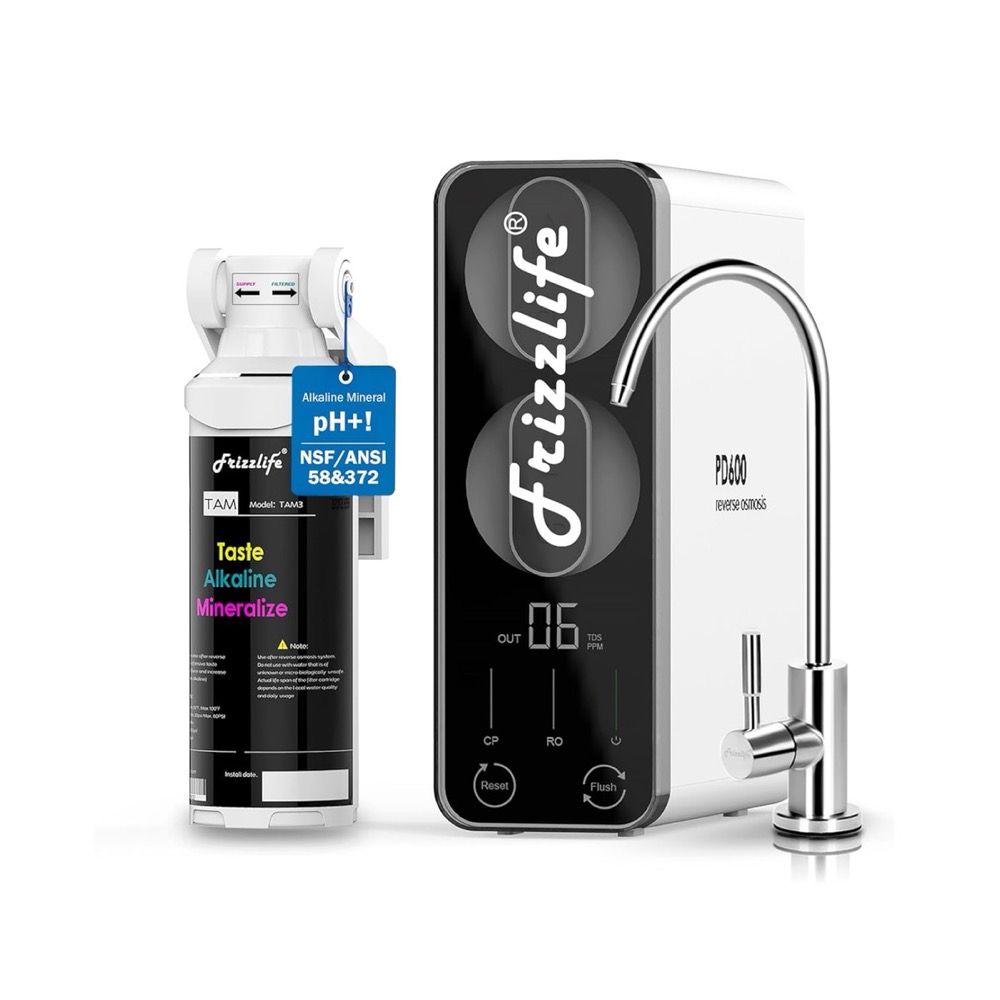 Best CompactFrizzlife PD600-TAM3 Tankless RO |
— | NSF/ANSI 58600 GPD |
Check price → |
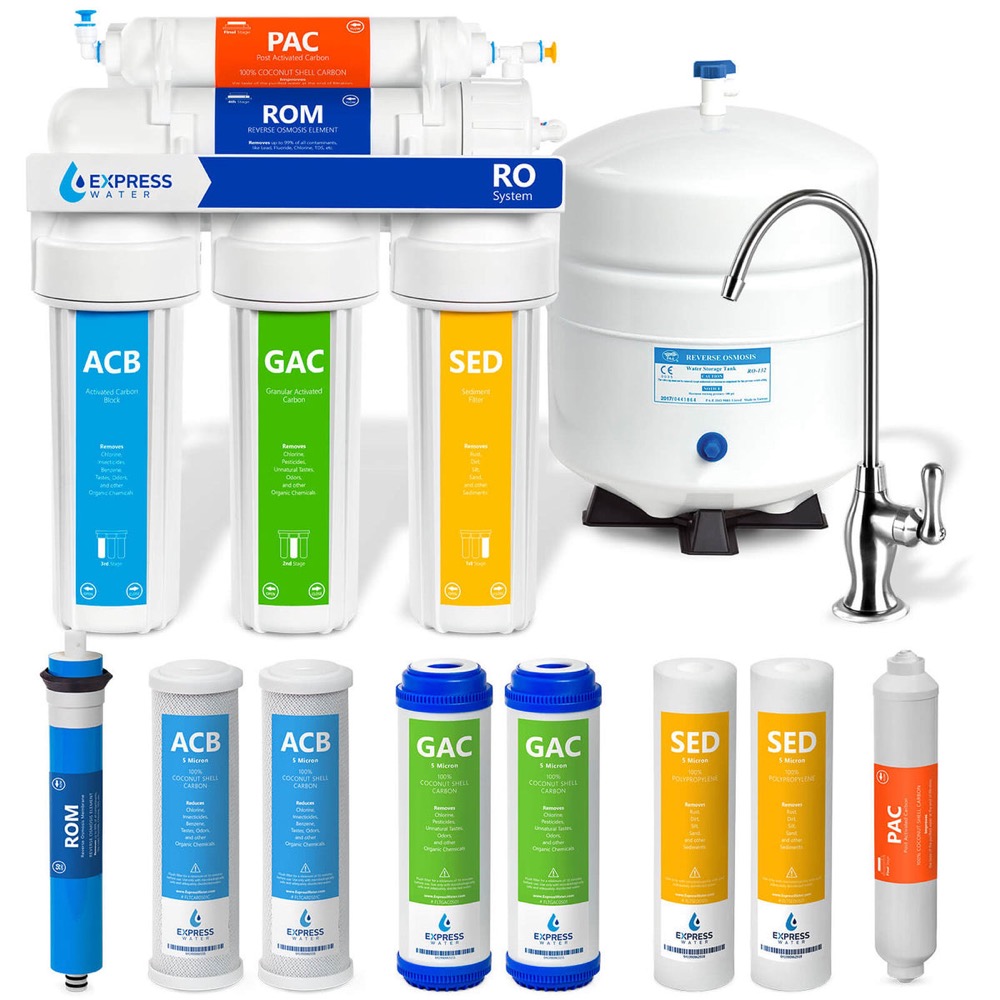 Budget EntryExpress Water RO5DX 5-Stage |
4.5out of 5 | NSF/ANSI 585-Stage |
Check price → |
Why Reverse Osmosis Is the Gold Standard for Microplastic Removal
Pitcher filters and faucet attachments can reduce some contaminants, but when it comes to micro and nanoplastics, most fall short. The problem is particle size. Microplastics range from 1 micron to 5 millimeters. Nanoplastics — the ones most likely to cross cell membranes and reach the bloodstream — are smaller than 1 micron. For a head-to-head on the three approaches most people consider, see Brita vs Berkey vs reverse osmosis for microplastics. The only home method that rivals RO for thoroughness is distillation, which boils water to steam and recondenses it — if that appeals, compare the field in our best countertop water distillers guide, and see best water filters for fluoride for how RO and distillation stack up on the dissolved contaminants carbon misses. RO treats one tap; to filter every tap in the house from the main line — the usual answer for a private well or hard water — see our best whole house water filters.
A reverse osmosis membrane operates at approximately 0.0001 microns. That is 10,000 times smaller than the smallest microplastic. Nothing gets through. No pitcher filter, carbon block, or UV system comes close to this level of particle rejection — and on the specific Brita microplastics question the gap is even wider, because a Brita Elite’s microplastic claim, certified under NSF/ANSI 401, stops at 0.5 micron, while an RO membrane filters thousands of times finer.
Every system on this list uses a true RO membrane and is either NSF/ANSI 58 certified or WQA Gold Seal verified — the two certifications that matter for reverse osmosis performance. We evaluated each on filtration capacity, flow rate, waste water ratio, filter cost, and ease of installation.
The certification to look for: NSF/ANSI 58 is the standard specifically for reverse osmosis systems. It verifies TDS (total dissolved solids) rejection and contaminant removal. The WQA Gold Seal is an equivalent third-party certification. If a system claims "NSF-grade components" without system-level certification, that is marketing — not verification.
Quick Comparison: All 6 RO Systems
| System | Type | GPD | Certification | Remineralization | Price |
|---|---|---|---|---|---|
| AquaTru Countertop | Countertop | ~30 | NSF/ANSI 58 | No | $$$ |
| Waterdrop G3P800 | Tankless under-sink | 800 | NSF/ANSI 58 | Yes | $$ |
| iSpring RCC7AK | Tank under-sink | 75 | NSF/ANSI 58 | Yes (alkaline) | $ |
| APEC ROES-50 | Tank under-sink | 50 | WQA Gold Seal | No | $ |
| Frizzlife PD600-TAM3 | Tankless under-sink | 600 | NSF/ANSI 58 | Yes (alkaline) | $$ |
| Express Water RO5DX | Tank under-sink | 50 | NSF/ANSI 58 | No | $ |
Price guide: $ budget · $$ mid-range · $$$ premium. Tap any pick below for today's exact Amazon price.
1. AquaTru Countertop RO — Best Overall Countertop
Best Overall
The AquaTru is the only countertop RO system worth recommending. Plug it in, fill the tank with tap water, and it produces purified water through a true 4-stage reverse osmosis process. No plumber, no drilling, no under-sink modifications. It is independently certified to NSF/ANSI standards and removes 99%+ of contaminants including microplastics, nanoplastics, PFAS, lead, arsenic, and chlorine. BPA-free construction throughout. The trade-offs are capacity (~1 gallon per batch, ~15-minute fill) and no remineralization stage.
If you rent, move frequently, or simply do not want to deal with installation, this is the one. It delivers the same core RO performance as a plumbed system in a form factor you can set up in minutes and carry to your next home.
Owners keep coming back to one line: it removes close to 100 percent of what testers throw at it, with no plumber and less wastewater than an under-sink system. Renters and people without under-sink space call it the one RO they could set up in minutes. The honest downsides: dispensing is slow, a batch runs about a gallon with a roughly 15-minute fill, and remineralization sits behind a paid upgrade. Some buyers reported the clean-water tank leaking onto the counter or the unit quitting after a couple of months, and a few said support was slow to respond and reluctant to replace parts once the warranty lapsed.
Purified RO water on day one — no plumber, no drilling, no under-sink space. Set it on the counter, fill it, and pour.
Why it's safe: A true 0.0001-micron RO membrane plus carbon and VOC stages, independently certified to NSF/ANSI standards to cut microplastics, nanoplastics, PFAS, lead, and arsenic — all in BPA-free housing.
Check Today’s Price on Amazon →Amazon prices change daily — tap to see today's price and any active discount.
- Free delivery & returns for Prime members
- Sold & shipped by Amazon
- Thousands of verified reviews
2. Waterdrop G3P800 — Best Tankless Under-Sink
The G3P800 is the fastest RO system on this list at 800 gallons per day — fast enough to fill a glass in seconds, not minutes. The tankless design eliminates the bulky storage tank and the risk of stagnant water. A built-in remineralization filter adds calcium and magnesium back for taste, and the smart display tracks filter life and TDS levels in real time. It carries NSF/ANSI 58 certification and runs an efficient 3:1 pure-to-drain ratio.
The trade-offs are a required under-sink installation, a higher filter replacement cost, and the need for an outlet under the sink. If you want the best-performing under-sink RO and do not mind installation, this is it.
In hands-on lab testing the G3P800 did strong work on lead, fluoride, and arsenic, and owners like the tankless footprint. The honest gripes are more about the marketing than the water: Waterdrop advertises removal of 1,000-plus contaminants, but the actual NSF 58 certification covers only a short list such as TDS and chromium-6, and one reviewer said support did not produce more documentation when asked. There is no remineralization stage, and Waterdrop says the system is not for untreated well water.
800 GPD on demand — fill a glass in seconds with no storage tank and a live TDS readout that tells you the water is clean.
Why it's safe: An NSF/ANSI 58-certified RO membrane rejects microplastics, nanoplastics, PFAS, lead, and dissolved solids, while the tankless design removes the stagnant-water risk of a storage tank entirely.
Check Today’s Price on Amazon →Amazon prices change daily — tap to see today's price and any active discount.
- Free delivery & returns for Prime members
- Sold & shipped by Amazon
- Thousands of verified reviews
3. iSpring RCC7AK — Best Budget Pick
Best Budget
The iSpring RCC7AK has been one of the best-selling RO systems for years, and for good reason. Six filtration stages — including an alkaline remineralization filter that restores pH and adds minerals back for better taste. It typically costs less than half the price of tankless systems while delivering the same core RO performance. The NSF/ANSI 58-certified 0.0001-micron membrane removes 99%+ of microplastics, nanoplastics, TDS, lead, arsenic, fluoride, and chlorine. DIY installation takes about an hour.
The trade-offs are the under-sink tank footprint, slower flow than a tankless unit, and a standard 3:1 waste ratio. Replacement filters are affordable and widely available, which keeps long-term cost low.
Owners call it economical and quick to install, and independent testing backed up the fluoride reduction at roughly 97 to 99 percent. The built-in leak sensor that shuts the unit off if it detects water gets specific praise, and iSpring's support is described as quick to help. The honest downsides: the cartridges have a shorter rated life than some competitors, offset by their low cost; a handful of owners saw a canister crack and weep after several years; and a few hit a small leak at the flow restrictor while changing filters.
Certified 6-stage RO with mineral-restoring alkaline filtration for roughly half what a tankless system costs — the value pick that doesn't cut filtration corners.
Why it's safe: An NSF/ANSI 58-certified RO membrane strips microplastics, nanoplastics, lead, arsenic, and fluoride, then the alkaline stage adds calcium and magnesium back so the water isn't flat.
Check Today’s Price on Amazon →Amazon prices change daily — tap to see today's price and any active discount.
- Free delivery & returns for Prime members
- Sold & shipped by Amazon
- Thousands of verified reviews
4. APEC Water ROES-50 — Best Value
Best Value
APEC is a California-based manufacturer that builds its systems domestically and backs them with a 2-year warranty and lifetime technical support. The ROES-50 is a straightforward 5-stage RO system carrying the WQA Gold Seal — the independent equivalent of NSF/ANSI 58 certification. It does exactly what it needs to: remove 99%+ of contaminants including microplastics and nanoplastics. No smart features, no remineralization, no frills — just dependable filtration.
The trade-offs are a slower 50 GPD output, no remineralization stage, a larger under-sink footprint, and a basic faucet. For buyers who value a domestically built system and real human support over gadgets, it's the value standout.
Buyers with basic DIY skills say they had it installed in well under a day and noticed cleaner, better-tasting water right away, and APEC's customer service gets repeated praise as polite and responsive. The honest gripes: it sends about three gallons to the drain for every gallon it makes, some owners had to grab a couple of extra plumbing fittings from the hardware store to finish, and the most serious complaint is filter housings cracking where the fittings join, which soaked a few people's under-sink cabinets.
US-built, WQA Gold Seal-certified RO with a 2-year warranty and lifetime support — dependable filtration with a real person to call if anything goes wrong.
Why it's safe: The WQA Gold Seal independently verifies the RO membrane's contaminant rejection — microplastics, nanoplastics, lead, arsenic, and dissolved solids — to the same bar as NSF/ANSI 58.
Check Today’s Price on Amazon →Amazon prices change daily — tap to see today's price and any active discount.
- Free delivery & returns for Prime members
- Sold & shipped by Amazon
- Thousands of verified reviews
5. Frizzlife PD600-TAM3 — Best Compact Tankless
Best Compact
The Frizzlife PD600-TAM3 has the best waste-water ratio on this list at 1.5:1 — it wastes only 1.5 gallons for every gallon of purified water, versus 3-4 gallons for most tank-based systems. It is NSF/ANSI 58 certified, includes alkaline remineralization to restore minerals and pH, and its twist-and-lock filter design makes replacements tool-free. At 600 GPD, flow is fast enough for continuous use.
The trade-offs are a required plumbing connection, a slightly higher filter cost than tank systems, and the need for an outlet under the sink. If under-sink space is tight and water efficiency matters, the Frizzlife is the pick.
Tankless fans like that it reclaims the under-sink space a tank would eat, and they give it a 4.6 across more than 1,200 reviews. The honest downsides come with the tankless design: its built-in pump makes it one of the louder systems people have tested, some owners hit leaks or had a unit go bad within a few months, and a few said the filter-life indicator lit up while the filters were still new. One owner tip others echo: the first cup in the morning can read higher TDS, so run the faucet a few seconds before filling your glass.
Wastes barely more water than it makes (1.5:1) in a slim tankless body — the efficient choice when both cabinet space and water bills count.
Why it's safe: An NSF/ANSI 58-certified RO membrane removes microplastics, nanoplastics, PFAS, lead, and dissolved solids, while the alkaline stage restores minerals — and the tankless design avoids stagnant-water risk.
Check Today’s Price on Amazon →Amazon prices change daily — tap to see today's price and any active discount.
- Free delivery & returns for Prime members
- Sold & shipped by Amazon
- Thousands of verified reviews
6. Express Water RO5DX — Budget Entry Pick
Budget Entry
The Express Water RO5DX is the most affordable way to get true reverse osmosis filtration. It is a no-frills 5-stage system, NSF/ANSI 58 certified, with the same 0.0001-micron RO membrane as systems costing twice as much. Quick-connect fittings make filter changes straightforward without tools, and replacement filters are standard sizes that are widely available.
The trade-offs are basic build quality, no smart features or monitoring, no remineralization stage, and the slowest output on this list at 50 GPD. But the core job — removing microplastics, nanoplastics, and dissolved contaminants — it does well. If budget is the primary constraint, start here.
Across thousands of reviews the RO5DX lands high, with owners citing the built-in leak-stop shutoff, low-cost replacement filters, and noticeably better taste; most say installation went smoothly. The honest downsides: a few reported the RO membrane clogging or failing after only a couple of months, some had to add extra tightening or plumber's tape to stop small drips at the fittings, and one owner described calling support repeatedly over months about a leak with no resolution.
The lowest-cost route to true RO — the same 0.0001-micron membrane as premium systems, with tool-free quick-connect filter changes.
Why it's safe: An NSF/ANSI 58-certified RO membrane blocks microplastics, nanoplastics, lead, and dissolved solids down to 0.0001 microns — the same particle-rejection bar as systems twice the price.
Check Today’s Price on Amazon →Amazon prices change daily — tap to see today's price and any active discount.
- Free delivery & returns for Prime members
- Sold & shipped by Amazon
- Thousands of verified reviews
Get the full Plasticproof guide
Water is step one. The complete guide covers kitchen, bedroom, air, and baby — every swap that matters.
Get the free guideBuyer's Guide: How to Choose an RO System
Countertop vs Under-Sink vs Tankless
Countertop RO (like the AquaTru) requires zero installation. You plug it in, fill the reservoir with tap water, and it produces purified water. The trade-off is capacity — most countertop units hold about 1 gallon at a time and produce water slowly. Best for: renters, small households, people who want portability.
Tank-based under-sink RO (like the iSpring RCC7AK, APEC ROES-50, and Express Water RO5DX) connects to your cold water line and stores filtered water in a pressurized tank. Water flows on demand from a dedicated faucet. Flow rates are listed as 50-75 GPD, but because water is pre-stored in the tank, dispensing is near-instant. The downside is that the tank occupies significant under-sink space. Best for: families, homeowners, anyone who wants reliable daily-use filtration at a lower cost.
Tankless under-sink RO (like the Waterdrop G3P800 and Frizzlife PD600-TAM3) filters water on demand without a storage tank. They offer higher flow rates (600-800 GPD), a smaller footprint, and no risk of bacterial growth in a stagnant tank. They cost more upfront and typically have higher filter replacement costs. Best for: tech-forward households, limited under-sink space, anyone who wants the fastest flow.
Certifications That Matter
For reverse osmosis systems, there are two certifications worth looking for:
- NSF/ANSI 58 — The standard specifically for RO systems. Verifies TDS rejection and contaminant removal including the effectiveness of the RO membrane. This is the most important certification.
- WQA Gold Seal — An equivalent third-party certification from the Water Quality Association. The APEC ROES-50 carries this instead of NSF/ANSI 58, and it is equally credible.
Be wary of systems that claim "NSF-grade components" or "NSF-tested materials" without actual system-level certification. These phrases are marketing, not verification. The system itself needs to be certified, not just the parts.
Filter Costs: The Real Long-Term Expense
The purchase price is only part of the cost. Every RO system requires periodic filter replacements — typically every 6-12 months for pre/post filters and every 2-3 years for the RO membrane itself. Annual filter costs range from ~$40 (Express Water) to ~$80 (Waterdrop). Over 5 years, this can add $200-$400 to the total cost of ownership. Tank-based systems generally have cheaper replacement filters because they use more standardized sizes.
Waste Water Ratios
Reverse osmosis works by forcing water through a semi-permeable membrane. Contaminants that cannot pass through are flushed away with drain water. Traditional tank-based systems waste 3-4 gallons for every 1 gallon of purified water. Modern tankless systems are more efficient — the Frizzlife PD600-TAM3 achieves a 1.5:1 ratio, and the Waterdrop G3P800 achieves 3:1.
If water waste is a concern, you can repurpose drain water for watering plants, mopping floors, or other non-drinking uses. Some systems also allow you to adjust the drain ratio, though this can affect water quality.
Our recommendation: For most households, the iSpring RCC7AK offers the best balance of performance, certification, remineralization, and value. If you want the fastest flow and smartest features, upgrade to the Waterdrop G3P800. If you cannot install anything, the AquaTru Countertop is the clear choice.