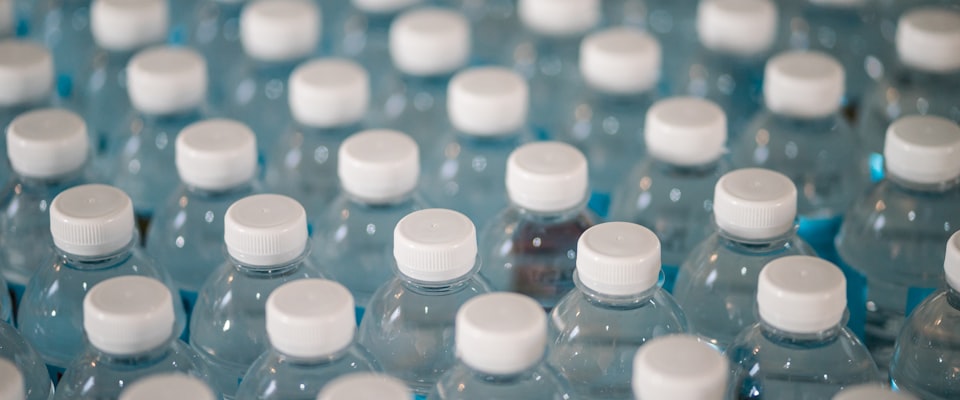
How many microplastics are in a water bottle? Roughly 240,000 plastic particles per liter in a standard single-use plastic bottle — so about 120,000 in a 500 ml (16.9 oz) bottle and closer to 60,000 in a 250 ml (8.5 oz) bottle. Around 90% are nanoplastics, small enough to cross the intestinal wall and enter the bloodstream.
That count comes from a January 2024 study published in PNAS by Qian and colleagues at Columbia and Rutgers, which used a new laser-imaging technique (stimulated Raman scattering microscopy) to see particles down to 100 nanometers — roughly a hundred times smaller than earlier methods could detect. The figure held across three popular U.S. bottled-water brands (Qian et al., PNAS, 2024).
How that compares to other water sources:
- Bottled water (2024 PNAS method): ~240,000 particles per liter — ~90% nanoplastic.
- Bottled water (older 2018 method): ~325 particles per liter, average across 259 bottles from 11 brands and 9 countries (Mason et al., Frontiers in Chemistry, 2018).
- U.S. tap water: ~9.24 particles per liter, average across 33 U.S. samples (Kosuth et al., PLOS ONE, 2018).
- Water in glass bottles: ~4.5 particles per liter — traced to paint flaking off the metal caps, not the glass itself (ANSES, 2025).
- Reusable polypropylene bottle with hot water in it (e.g. an infant feeding bottle at ~70 °C): an average of 4.0 million microplastic particles per liter of prepared formula, and up to 16.2 million per liter in hotter-water regions, from a WHO-referenced Trinity College Dublin study led by Dunzhu Li (Li et al., Nature Food, October 2020). Cold water in the same bottles released far less.
- Stainless steel or borosilicate glass bottle: zero detectable shed — both materials are chemically inert.
What to do about it: the switch that eliminates the 240,000-per-liter exposure is a stainless steel or glass bottle filled with filtered tap water — our top picks (Hydro Flask, YETI, Klean Kanteen, Stanley IceFlow, Lifefactory Glass) are all ~$25–$37 on Amazon and reviewed in detail below.
A liter of bottled water contains approximately 240,000 detectable plastic fragments, according to a landmark study published in the Proceedings of the National Academy of Sciences (PNAS, January 2024) by researchers at Columbia and Rutgers universities. About 90% of these are nanoplastics -- particles small enough to cross cell membranes and enter the bloodstream. The safest alternatives are stainless steel bottles like the Hydro Flask Wide Mouth (~$35), YETI Rambler (~$35), Klean Kanteen TKWide (~$37), and Stanley IceFlow (~$35), or glass bottles like the Lifefactory 22 oz (~$25). All of these are made from chemically inert materials that release zero microplastics into your water. For a head-to-head comparison of Owala, Stanley, Hydro Flask, and Klean Kanteen on lead and microplastics, see our safest water bottle brands guide.
See also: Microplastics by the numbers — the key statistics across water, food, and the human body, each linked to its study.
This is not a theoretical concern. The PNAS study represents a 10 to 100-fold increase over previous estimates of plastic contamination in bottled water. Earlier studies could only detect larger microplastics. The new technique -- stimulated Raman scattering microscopy -- revealed the nanoplastic particles that previous methods missed entirely.
Below, you will find the full research breakdown, detailed reviews of five safe alternatives, a comparison table, and a straightforward plan for making the switch.
Our Top 5 Safe Water Bottles
How Many Microplastics Are in a Bottle of Water?
The short answer is roughly 240,000 detectable plastic particles per liter of bottled water, of which about 90% are nanoplastics small enough to enter the bloodstream. That is the figure from the January 2024 Proceedings of the National Academy of Sciences paper by Naixin Qian, Beizhan Yan, Wei Min and colleagues at Columbia University's Lamont-Doherty Earth Observatory and Rutgers — the first study to see below the 1 micrometer detection floor of older methods. It held across three widely-sold U.S. brands (Qian et al., PNAS, January 2024).
Scaled by bottle size, the number in front of you looks like this:
| Bottle size | Volume | Approx. total plastic particles | Of which nanoplastic (~90%) |
|---|---|---|---|
| Hotel / kids bottle | 0.25 L (8.5 oz) | ~60,000 | ~54,000 |
| Standard single-serve | 0.5 L (16.9 oz) | ~120,000 | ~108,000 |
| Sport bottle | 0.7 L (23.7 oz) | ~168,000 | ~151,000 |
| Large single bottle | 1 L (33.8 oz) | ~240,000 | ~216,000 |
| Sharing / family size | 1.5 L (50.7 oz) | ~360,000 | ~324,000 |
| Case of 24 × 16.9 oz | ~12 L | ~2,880,000 | ~2,592,000 |
Particle counts scaled linearly from Qian et al., PNAS, January 2024 (~240,000 detectable fragments per liter, 90% nanoplastic; measured on three popular U.S. brands using stimulated Raman scattering microscopy). Not every brand or run will hit the mean exactly — Qian et al. reported per-liter counts ranging from roughly 110,000 to 370,000 across the tested samples.
Over a year, the exposure compounds
The U.S. National Academies' recommended daily fluid intake is 2.7 liters for adult women and 3.7 liters for adult men, of which roughly 80% comes from beverages and 20% from food (Institute of Medicine, National Academies, 2004). Read against the 240,000-per-liter figure, if bottled water were the sole beverage source:
- An adult woman drinking ~2.2 L of bottled water a day would ingest roughly 193 million plastic particles a year (528,000 per day × 365).
- An adult man drinking ~3.0 L of bottled water a day would ingest roughly 263 million plastic particles a year (720,000 per day × 365).
- A formula-fed 6-month-old at ~1 L of reconstituted bottled water a day would ingest roughly 88 million particles a year.
Bottled water vs. tap water, per year, for the average American
A widely-cited 2019 peer-reviewed synthesis in Environmental Science & Technology by Kieran Cox and colleagues at the University of Victoria added up microplastic intake across the American diet. Using the older, larger-particle detection methods that were the state of the art at the time, they estimated the average U.S. adult ingests 39,000 to 52,000 microplastic particles per year from food alone (seafood, sugar, salt, honey, beer). Drinking only tap water added roughly another 4,000 particles per year. Drinking only bottled water added roughly another 90,000 particles per year — more than 22 times the tap-water figure (Cox, Covernton, Davies, Dower, Juanes & Dudas, Environmental Science & Technology, 2019).
Two things put those numbers in context. First, the Cox estimate is a floor, not a ceiling: it counted only microplastics visible to conventional filtration and microscopy. The 2024 PNAS laser technique now shows bottled water carries roughly 100 times more particles than those older methods could see, so the true bottled-water figure is far higher than 90,000 per year. Second, the choice of bottle is doing most of the work: swapping bottled for filtered tap cuts the drinking-water share of the exposure by more than 95%, before anything else in the diet changes. If you want to make that swap once and be done, our best water filter for microplastics guide compares the six systems that actually filter particles down to nanoscale.
A February 2025 Nature Medicine paper led by Marcus Garcia and Matthew Campen at the University of New Mexico measured nanoplastic in 52 post-mortem human brain samples and found an average of 4,917 micrograms of plastic per gram of brain tissue, with 2024 brains carrying roughly 50% more plastic than brains sampled in 2016. The dominant plastic type was polyethylene (Nihart, Garcia, Campen et al., Nature Medicine, February 2025). It is now clear that some of what people drink does not simply pass through — it accumulates.
Does the brand matter?
Not enough to solve the problem. Qian and colleagues reported that per-liter counts varied by roughly a factor of 3 across the three brands they tested — a real spread, but not the kind of gap that separates safe from unsafe. An earlier 2018 Frontiers in Chemistry analysis by Sherri Mason (State University of New York at Fredonia), Victoria Welch and Joseph Neratko sampled 259 bottles from 11 popular brands across nine countries — Aquafina, Dasani, Evian, Nestlé Pure Life, San Pellegrino, Bisleri, Gerolsteiner, Wahaha, Minalba, Aqua, and Epura — and found microplastic contamination in 93% of them, averaging 325 particles per liter using a method that could only see fragments larger than about 6.5 micrometers (Mason, Welch & Neratko, Frontiers in Chemistry, 2018). Every brand tested had plastic. The safest number stays zero, and the only way to reach zero is to stop drinking water out of plastic.
Does switching to glass bottled water help?
Less than you would expect — because of the cap. In 2025, France's food-safety agency ANSES published a survey of microplastic levels in beverages sold in France, led by Iseline Chaïb, in the Journal of Food Composition and Analysis. Water sold in glass bottles averaged 4.5 microplastic particles per liter, versus about 1.6 per liter for water in plastic bottles or cartons — and cola, lemonade, iced tea, and beer in glass bottles ran around 100 particles per liter, 5 to 50 times more than the same drinks in plastic bottles or cans (ANSES, 2025).
The plastic was not coming from the glass itself. The ANSES team traced the particles to the paint on the metal caps, which picks up microscopic scratches as caps rub against each other in storage and transport, then sheds flakes into the drink. When they cleaned the caps before sealing — blowing them with air, then rinsing with water and alcohol — contamination in the same filtered water fell from 287 particles per liter to 87, a drop of about 70%.
Two caveats keep these numbers honest. First, they are not comparable to the 240,000-per-liter figure above: ANSES counted only the larger microplastic fragments that conventional methods can see, not the nanoplastics the PNAS laser technique revealed. Second, the finding does not indict reusable glass — a borosilicate bottle like our Lifefactory pick has no painted single-use cap, so the shedding path this study found is simply not part of it.
What the Research Actually Found
The 2024 PNAS study tested three popular brands of bottled water sold in the United States. Using a novel dual-laser imaging technique called stimulated Raman scattering (SRS) microscopy, researchers could identify and count individual plastic particles down to 100 nanometers -- roughly 1,000 times thinner than a human hair.
The researchers identified seven common plastic types. The most prevalent were polyethylene terephthalate (PET) -- the plastic most water bottles are made from -- and polyamide, a nylon commonly used in water filtration membranes. This means the water is picking up plastic both from the bottle itself and from the purification process.
Previous studies using older detection methods estimated approximately 300 microplastic particles per liter of bottled water. The new count of 240,000 particles represents a 100-fold increase -- not because contamination got worse, but because we can finally see what was always there.
Why nanoplastics matter more than microplastics
Microplastics are particles between 1 micrometer and 5 millimeters. Nanoplastics are smaller than 1 micrometer. The distinction matters because of biology: nanoplastics are small enough to pass through the intestinal wall, enter the bloodstream, and travel to organs including the brain, liver, kidneys, and placenta.
A 2022 study in Environment International detected microplastics in human blood for the first time. A separate study by Ragusa et al. (2021) found microplastics in human placental tissue. These findings suggest that the particles we ingest do not simply pass through us. Some of them stay.
The problem is not that bottled water recently became contaminated. The problem is that we only recently developed the technology to see how contaminated it has always been.
Heat and sunlight make it worse
Plastic water bottles left in warm environments -- a car, a sunny kitchen counter, a warehouse without climate control -- degrade faster. Heat accelerates the breakdown of PET plastic, increasing both particle release and chemical leaching. A study published in the Journal of Hazardous Materials (2020) found that PET bottles stored at elevated temperatures released significantly more antimony and phthalates into the water. These are endocrine-disrupting compounds linked to hormonal effects even at low concentrations.
The practical implication is clear: if you are still using plastic water bottles, never drink from one that has been left in a warm car, near a window, or in direct sunlight. Better yet, switch to a material that does not have this problem at all.
Reusable plastic bottles are not the answer
Some people assume the issue is limited to single-use bottles. It is not. A 2022 study published in the Journal of Hazardous Materials tested reusable plastic water bottles made from Tritan and polypropylene. The result: microplastic release during normal use, with squeezing, temperature fluctuation, and dishwasher exposure all increasing particle shedding. Reusable plastic is still plastic.
The most striking numbers come from the case parents care about most: infant formula prepared in a reusable polypropylene bottle. A landmark October 2020 study in Nature Food by Dunzhu Li, Yunhong Shi, Luming Yang and colleagues at Trinity College Dublin followed the WHO's official formula-prep protocol — sterilise the bottle at 95 °C, shake at 70 °C — and measured what came out of the bottle. Ten of the world's most popular baby-bottle brands, all made of PP, released an average of 4.0 million microplastic particles per liter of prepared feed, with a range across the ten brands from 1.3 to 16.2 million per liter. Projected across formula-fed infants in different regions, daily exposure ran from ~14,600 particles in low-hot-water countries to ~4.55 million particles per day in higher-hot-water countries (Li et al., Nature Food, October 2020). Cold-water rinsing produced far lower counts — the driver is heat plus repeated agitation, not the plastic sitting still. For a bottle-by-bottle guide to formula-safe options, see our best water filter for baby formula and best microplastic-free sippy cups guides.
The pattern generalises to any plastic container heated with water in it — a reusable tea infuser bag is the same story at a smaller scale. A 2019 Environmental Science & Technology study by Laura Hernandez, Nathalie Tufenkji and colleagues at McGill University measured what happens when a single nylon or PET-mesh pyramid tea bag is steeped at 95 °C: it released roughly 11.6 billion microplastic and 3.1 billion nanoplastic particles into a single cup of tea (Hernandez et al., Environmental Science & Technology, 2019). A 2024 study went further and compared bag materials head to head, finding heat-sealed polypropylene bags shed vastly more than plain paper — see which tea bags actually stay microplastic-free for both studies in one place. For a paper-only alternative list, see our plastic-free tea bag brands guide.
Side-by-side: microplastic count by container, across the major peer-reviewed studies
| Container / source | Particles per liter (or per cup) | Study & year |
|---|---|---|
| Bottled water, PET single-use, new laser method | ~240,000 / L (~90% nanoplastic; range 110,000–370,000) | Qian, Yan & Min, PNAS, 2024 |
| Bottled water, PET single-use, older method | ~325 / L (avg. of 259 bottles, 11 brands, 9 countries) | Mason, Welch & Neratko, Frontiers in Chemistry, 2018 |
| U.S. tap water | ~9.24 / L (avg. of 33 U.S. samples) | Kosuth, Mason & Wattenberg, PLOS ONE, 2018 |
| Reusable polypropylene baby bottle, hot-water formula prep | ~4,000,000 / L (avg. across 10 top brands; up to 16,200,000 / L) | Li, Shi & Yang, Nature Food, 2020 |
| Nylon / PET-mesh pyramid tea bag, 95 °C brew | ~11.6 billion microplastic + 3.1 billion nanoplastic particles per cup | Hernandez & Tufenkji, Environmental Science & Technology, 2019 |
| Water in glass bottles with painted metal caps | ~4.5 / L (soft drinks in glass: ~100 / L — the source is cap paint, not glass) | Chaïb et al. / ANSES, Journal of Food Composition and Analysis, 2025 |
| Stainless steel (18/8) or borosilicate glass bottle | Zero detectable shed (chemically inert materials) | Same evidence base — no plastic to shed |
Every figure above is the reported study mean or the reported range. The tea-bag row is per single 250 ml cup, not per liter — the total plastic released is so large relative to volume that scaling further is misleading. Studies are listed by container, not ranked; different detection methods (SRS microscopy vs. optical vs. Raman spectroscopy) measure down to different particle sizes, which is why the two bottled-water rows differ by a factor of ~740.
What that means for the bottle in your hand
Three practical rules fall out of the numbers above. First: any plastic container used with cold water at room temperature is much lower-risk than the same container used with hot water — heat and agitation, not the plastic sitting still, drive most of the shedding. Second: reusable plastic does not solve the problem, because normal use IS repeated heat and agitation. Third: the only rows in the table that report zero detectable shed are the ones where the water-contact surface is stainless steel or glass. That is the choice the whole rest of this page is built around.
What about filtered tap water?
Tap water generally contains far fewer microplastics than bottled water -- roughly 5 particles per liter according to a 2018 study by Kosuth et al. A quality carbon block or reverse osmosis filter can reduce that further. If buying a reusable bottle, filling it with filtered tap water is the safest option for both health and cost. If you want the most thorough filtration, our reverse osmosis reviews compare six systems side by side.
The 5 Safest Water Bottles (Detailed Reviews)
All five of these bottles are made from materials that are chemically inert -- they do not degrade, leach, or shed particles into your water under any normal conditions. The choice between them comes down to durability, insulation, weight, and personal preference.
Hydro Flask Wide Mouth
✓ Ships free with Prime · Free returns · Amazon A-to-z purchase guarantee (on eligible items)
Hydro Flask is the most popular insulated stainless steel bottle for good reason. The TempShield double-wall vacuum insulation keeps cold drinks cold for up to 24 hours and hot drinks hot for 12 hours. The wide mouth opening is easy to fill, easy to clean, and fits standard ice cubes. Available at REI, Target, Amazon, and most outdoor retailers.
Pros
- Lifetime warranty
- Excellent insulation performance
- Wide range of sizes, colors, and lid styles
- Sweat-proof exterior (no condensation)
- Interchangeable lid system
Cons
- Hand wash recommended for insulated models
- Can dent if dropped on hard surfaces
- Premium price point
YETI Rambler with Chug Cap
✓ Ships free with Prime · Free returns · Amazon A-to-z purchase guarantee (on eligible items)
YETI builds their Rambler bottles like they build their coolers -- to be virtually indestructible. The kitchen-grade 18/8 stainless steel body resists dents better than any competitor, and the no-sweat DuraCoat finish will not peel, crack, or fade. Unlike most insulated bottles, YETI Ramblers are fully dishwasher-safe. Available at YETI.com, REI, Dick's Sporting Goods, and Amazon.
Pros
- Dishwasher-safe (rare for insulated bottles)
- Most dent-resistant construction
- DuraCoat finish resists peeling
- Interchangeable cap system
- Excellent grip and ergonomics
Cons
- Heavier than Hydro Flask
- Fewer color options
- Chug Cap has a small drinking opening
Klean Kanteen TKWide
✓ Ships free with Prime · Free returns · Amazon A-to-z purchase guarantee (on eligible items)
Klean Kanteen is the original stainless steel water bottle company (founded 2004) and the most sustainability-focused brand in this category. The TKWide is made with 90% certified post-consumer recycled 18/8 stainless steel, and Klean Kanteen is Climate Neutral certified. The Climate Lock insulation keeps drinks cold for 20 hours and iced for 50 hours. Available at kleankanteen.com, REI, and Amazon.
Pros
- 90% recycled steel construction
- Climate Neutral and B Corp certified
- Chip-resistant Klean Coat finish
- Exceptional iced retention (50 hours)
- Electropolished interior (no metallic taste)
Cons
- Slightly higher price
- Can dent on hard impacts
- Fewer retail locations than Hydro Flask or YETI
Stanley IceFlow Fast Flow
✓ Ships free with Prime · Free returns · Amazon A-to-z purchase guarantee (on eligible items)
Stanley's IceFlow is designed specifically for people who drink on the go. The fast-flow drinking spout lets you drink quickly without removing a cap, and the leakproof design means it goes in a bag without worry. The bottle fits standard car cup holders -- a surprisingly rare feature in the insulated bottle category. Available at Stanley1913.com, Target, Amazon, and Dick's.
Pros
- Fits in car cup holders
- Fast-flow spout for easy drinking
- Leakproof design
- Excellent cold retention
- Lifetime warranty
Cons
- Flip straw lid can scratch with heavy use
- Narrower mouth than Hydro Flask
- Harder to clean thoroughly by hand
Lifefactory Glass Bottle
✓ Ships free with Prime · Free returns · Amazon A-to-z purchase guarantee (on eligible items)
For people who prefer the purity of glass over stainless steel, Lifefactory makes the best daily-carry glass bottle. The borosilicate glass body is the same material used in laboratory equipment -- highly resistant to thermal shock and impact. The protective silicone sleeve adds grip and drop protection without introducing plastic. No metallic taste, no coating, just glass and water. Available on lifefactory.com, Amazon, and Whole Foods.
Pros
- Zero metallic taste (pure glass)
- Borosilicate glass resists thermal shock
- Silicone sleeve adds drop protection
- Dishwasher-safe
- Lowest price on this list
Cons
- No insulation (drinks warm up)
- Heavier than stainless steel per ounce
- Can break if dropped on hard surface without sleeve
Head-to-Head Comparison
| Feature | Hydro Flask | YETI | Klean Kanteen | Stanley | Lifefactory |
|---|---|---|---|---|---|
| Price | ~$35 | ~$35 | ~$37 | ~$35 | ~$25 |
| Material | Stainless | Stainless | Recycled SS | Stainless | Glass |
| Insulated | Yes (24h) | Yes | Yes (20h) | Yes | No |
| Dishwasher-safe | Hand wash | Yes | Hand wash | Yes | Yes |
| Leakproof | Yes | Yes | Yes | Yes | Yes |
| Cup holder fit | No (32oz) | No (26oz) | No | Yes | Yes |
| Warranty | Lifetime | 5 years | Lifetime | Lifetime | Lifetime |
| Best for | All-around | Durability | Sustainability | Commuting | Purity |
3 Popular Reusable Plastic Bottles That Don't Solve the Problem
The five bottles above are the honest answer to the 2024 PNAS finding. These next three are widely-loved reusable bottles that keep showing up in "safe alternatives" lists but still fail the material test — not because they are illegal or unregulated, but because the whole reason to switch is to stop putting hot, cold, or squeezed water through plastic. Every one below still does that. The 2022 Journal of Hazardous Materials reusable-bottle study cited earlier tested exactly these plastic categories (Tritan copolyester and polypropylene) and documented microplastic shedding during ordinary squeezing, temperature swings, and dishwasher cycles.
Nalgene Sustain (Tritan Renew)
Nalgene's flagship is now molded from Eastman Tritan Renew, a BPA-free copolyester made partly from recycled feedstock. It is genuinely durable, dishwasher-safe, and shatter-resistant — and Nalgene has done real work on the recycled-content story. What it is not is a fix for the microplastics question. Tritan is the same broad polymer family the 2022 Journal of Hazardous Materials study tested when it documented particle release from reusable plastic bottles during squeezing and temperature swings. Removing BPA does not remove the shedding. If you want the shatter-resistance and mouth shape of a classic Nalgene, buy the Klean Kanteen TKWide or YETI Rambler above instead.
CamelBak Eddy+ (non-insulated plastic body)
The non-insulated CamelBak Eddy+ is one of the most popular reusable bottles in the US, and the bite-valve straw is a genuinely well-designed drinking mechanism. The body, however, is BPA-free Tritan, the same copolyester family the 2022 Journal of Hazardous Materials paper found sheds particles during ordinary use, and every sip pulls water directly through a plastic bite valve and silicone straw. CamelBak's own insulated stainless steel line (the Chute Mag and the Eddy+ Vacuum Insulated Stainless Steel) uses 18/8 steel for the water-contact surface and is a materially safer swap if you like the CamelBak ergonomics.
Brita Premium Filtering Water Bottle (plastic)
Brita's filtering water bottle is marketed for health, but the health story is only half told. The filter is real — it reduces chlorine taste and some particulates from tap water, but no Brita filter is certified for microplastic removal, in a bottle or in a pitcher. The bottle body itself is BPA-free plastic, which puts your filtered water back into contact with the exact category of material the 2024 PNAS paper flagged. And because the filter sits inline with a plastic straw, every sip is drawn through additional plastic surfaces. If you want tap water filtration on the go, the honest combination is a good pitcher or under-sink filter at home, then a stainless steel bottle from the list above for the road. For the narrower case where you genuinely can't refill from a trusted source — travel, backcountry, or tap you don't know — a purpose-built bottle earns its place, but only a few are certified to remove what they claim; our best filtered water bottle guide ranks the seven worth carrying.
Why we're not endorsing "safer" plastics
Every "safer plastic" story eventually gets rewritten. BPA-free polycarbonate turned out to still leach BPS. Food-grade Tritan and polypropylene still shed particles when tested with modern microscopy. Stainless steel and borosilicate glass avoid the whole cycle because they cannot break down the same way — the chemistry does not degrade under normal use. That is why the five picks above are all one of those two materials, and why we do not include any BPA-free plastic bottle in this ranking regardless of brand.
How to Choose the Right Bottle
If you want the best all-around option
Get the Hydro Flask Wide Mouth 32 oz. It has the best combination of insulation, durability, size options, and availability. The lifetime warranty means if anything goes wrong, you get a replacement. It is the safe default choice.
If durability is your priority
The YETI Rambler takes the most abuse. It is the bottle you throw in a gym bag, take camping, and let your kids use without worrying. The fact that it is dishwasher-safe is a genuine convenience advantage over Hydro Flask and Klean Kanteen.
If sustainability matters to you
The Klean Kanteen TKWide is made from 90% post-consumer recycled steel and the company is Climate Neutral certified. If reducing your environmental impact beyond just personal health is a priority, this is the bottle that matches your values.
If you drink in the car
The Stanley IceFlow is one of the few quality insulated bottles that actually fits in a car cup holder. The fast-flow spout also makes one-handed drinking safer while driving.
If you prefer glass
The Lifefactory 22 oz gives you the absolute purest drinking experience. No metallic taste, no coating, just glass and water. The trade-off is no insulation and slightly more weight. Many people keep a glass bottle at home or at their desk and use stainless steel for on-the-go. The same logic carries over to hot drinks — a non-toxic travel mug in borosilicate glass or 18/8 steel keeps coffee and tea off plastic the way these bottles do for water.
Any of these five bottles eliminates the 240,000 nanoplastic particles you would otherwise ingest from a single liter of bottled water. The best choice is the one you will actually use every day.
Making the Switch (A Simple Plan)
You do not need to overhaul your hydration routine in a weekend. Here is a practical approach:
Step 1: Stop buying cases of bottled water. This is the single highest-impact change. One stainless steel bottle replaces hundreds of plastic bottles per year. At $35, a Hydro Flask pays for itself in weeks compared to buying bottled water.
Step 2: Get a water filter. A water-filter pitcher (~$25) or faucet-mounted filter (~$20) removes most contaminants from tap water. If you can’t plumb one in, a best countertop water filter for microplastics pick (like the AquaTru or Bluevua) is a no-install reverse-osmosis unit that sits on the counter. For the highest filtration overall, a plumbed reverse osmosis system (~$200-400) removes virtually everything, including nanoplastics. Fill your reusable bottle from filtered tap water.
Step 3: Replace reusable plastic bottles. If you currently use a reusable plastic or Tritan bottle, replace it with stainless steel or glass when it is convenient. Do not rush -- the exposure from a reusable plastic bottle is lower than from single-use disposables.
Step 4: Equip the family. Kids' bottles matter too. Hydro Flask, YETI, and Klean Kanteen all make kid-sized versions with straw lids. For very young children, Lifefactory makes glass baby bottles with silicone sleeves. For a full lineup sized for small hands, see our guide to the best plastic-free water bottles for kids.
Step 5: The bigger daily source most people miss. A 2025 Ecotoxicology and Environmental Safety paper (Wang et al., DOI 10.1016/j.ecoenv.2025.118694) measured a standard nylon-bristle toothbrush shedding around 2.33 million microplastic particles per person per year straight into the mouth — a larger annual figure than any single water-source swap. A microplastic-free toothbrush with plant-based bristles removes the largest measured single source in daily life.
The cost of switching
A quality stainless steel bottle costs $25-40 and lasts 5-10 years minimum. The average American household spends $300-600 per year on bottled water. The switch pays for itself within the first month and saves money every month after that -- while eliminating hundreds of thousands of nanoplastic particles per day from your family's intake.
Frequently Asked Questions
A 2024 study published in PNAS by researchers at Columbia and Rutgers universities found approximately 240,000 detectable plastic fragments per liter of bottled water. About 90% of these are nanoplastics -- particles small enough to cross cell membranes and enter the bloodstream. This was measured using stimulated Raman scattering microscopy, a technique capable of detecting particles down to 100 nanometers.
Plastic water bottles release nanoplastic particles into the water they contain. While the long-term health effects are still being studied, researchers have confirmed that nanoplastics can cross intestinal barriers and enter the bloodstream, and have been found in human blood, placental tissue, and organs. Heat, sunlight, and repeated use increase particle release. Stainless steel or glass bottles eliminate this exposure entirely.
Yes. A 2022 study found that reusable plastic bottles, including those made from Tritan and polypropylene, release microplastics during normal use. Squeezing, temperature changes, and dishwasher cycles all accelerate particle release. The exposure is generally lower than single-use bottles, but it is not zero. Stainless steel and glass bottles eliminate this problem completely. If you tend to refill a disposable bottle instead of replacing it, read our guide on whether plastic water bottles are safe to reuse for the full breakdown of antimony, BPA and bacteria risks.
An average of about 4 million microplastic particles per liter of prepared feed, and up to 16.2 million per liter in the highest-shedding brands, according to a WHO-referenced October 2020 study in Nature Food led by Dunzhu Li at Trinity College Dublin (Li et al., 2020). The team followed the WHO's official protocol — sterilise the bottle at 95 °C, shake the formula at 70 °C — on ten of the world's most popular polypropylene baby bottles. Projected daily infant exposure ran from ~14,600 particles a day in low-hot-water regions to ~4.55 million particles a day in higher-hot-water regions. Cold-water use of the same bottles released far less: heat plus agitation is the driver. Stainless steel and glass baby bottles avoid the problem entirely — see our best water filter for baby formula guide for the safe-material picks.
Stainless steel (18/8 food-grade) and borosilicate glass are the safest materials for water bottles. Both are chemically inert and release zero microplastics under any normal conditions. Top-rated stainless steel options include Hydro Flask (~$35), YETI Rambler (~$35), Klean Kanteen TKWide (~$37), and Stanley IceFlow (~$35). For glass, Lifefactory (~$25) is the best daily-carry option.
Yes. Heat significantly accelerates plastic degradation and particle release. PET bottles stored at elevated temperatures release more antimony and phthalates -- endocrine-disrupting compounds -- in addition to increased microplastic shedding. A plastic bottle left in a car on a warm day can reach temperatures that substantially increase contamination. Never drink from a plastic bottle that has been exposed to heat or direct sunlight.
A small amount, yes — and it comes from the cap, not the glass. A 2025 survey by France's food-safety agency ANSES found an average of 4.5 microplastic particles per liter in glass-bottled water, versus about 1.6 in plastic bottles or cartons, counting only the larger fragments conventional methods can detect. Soft drinks and beer in glass bottles averaged around 100 particles per liter. The particles were traced to the plastic-based paint on the metal caps, which flakes off through microscopic scratches. A reusable borosilicate glass bottle has no painted single-use cap and avoids this source entirely.
Modern glass water bottles use borosilicate glass, the same material used in laboratory equipment. It is highly resistant to thermal shock and everyday impacts. Brands like Lifefactory and Ello include silicone sleeves for additional drop protection. Glass bottles are heavier than stainless steel, but many people use them at home or at a desk and switch to stainless steel for active use.
Sources
- Qian, N. et al. "Rapid single-particle chemical imaging of nanoplastics by SRS microscopy." Proceedings of the National Academy of Sciences (PNAS), January 2024. PNAS
- Leslie, H.A. et al. "Discovery and quantification of plastic particle pollution in human blood." Environment International, 2022. PubMed
- Ragusa, A. et al. "Plasticenta: First evidence of microplastics in human placenta." Environment International, 2021. PubMed
- Zuccarello, P. et al. "Exposure to microplastics (<10 micrometers) associated to plastic bottles mineral water consumption." Water Research, 2019.
- Westerhoff, P. et al. "Antimony leaching from polyethylene terephthalate (PET) plastic used for bottled drinking water." Water Research, 2008.
- Kosuth, M. et al. "Anthropogenic contamination of tap water, beer, and sea salt." PLoS ONE, 2018. PLOS ONE
- Mason, S. A., Welch, V. G., Neratko, J. "Synthetic polymer contamination in bottled water." Frontiers in Chemistry, 2018. Frontiers
- Li, D., Shi, Y., Yang, L. et al. "Microplastic release from the degradation of polypropylene feeding bottles during infant formula preparation." Nature Food, October 2020. Nature Food
- Hernandez, L. M., Xu, E. G., Larsson, H. C. E., Tahara, R., Maisuria, V. B., Tufenkji, N. "Plastic Teabags Release Billions of Microparticles and Nanoparticles into Tea." Environmental Science & Technology, 2019. ACS ES&T
- Cox, K. D., Covernton, G. A., Davies, H. L., Dower, J. F., Juanes, F., Dudas, S. E. "Human Consumption of Microplastics." Environmental Science & Technology, 2019. ACS ES&T
- Nihart, A. J., Garcia, M. A., Campen, M. J. et al. "Bioaccumulation of microplastics in decedent human brains." Nature Medicine, February 2025. Nature Medicine
- Bach, C. et al. "Effect of temperature on the release of intentionally and non-intentionally added substances from PET bottles." Journal of Hazardous Materials, 2020.
- National Institutes of Health. "Plastic particles found in bottled water." NIH Research Matters, 2024. NIH