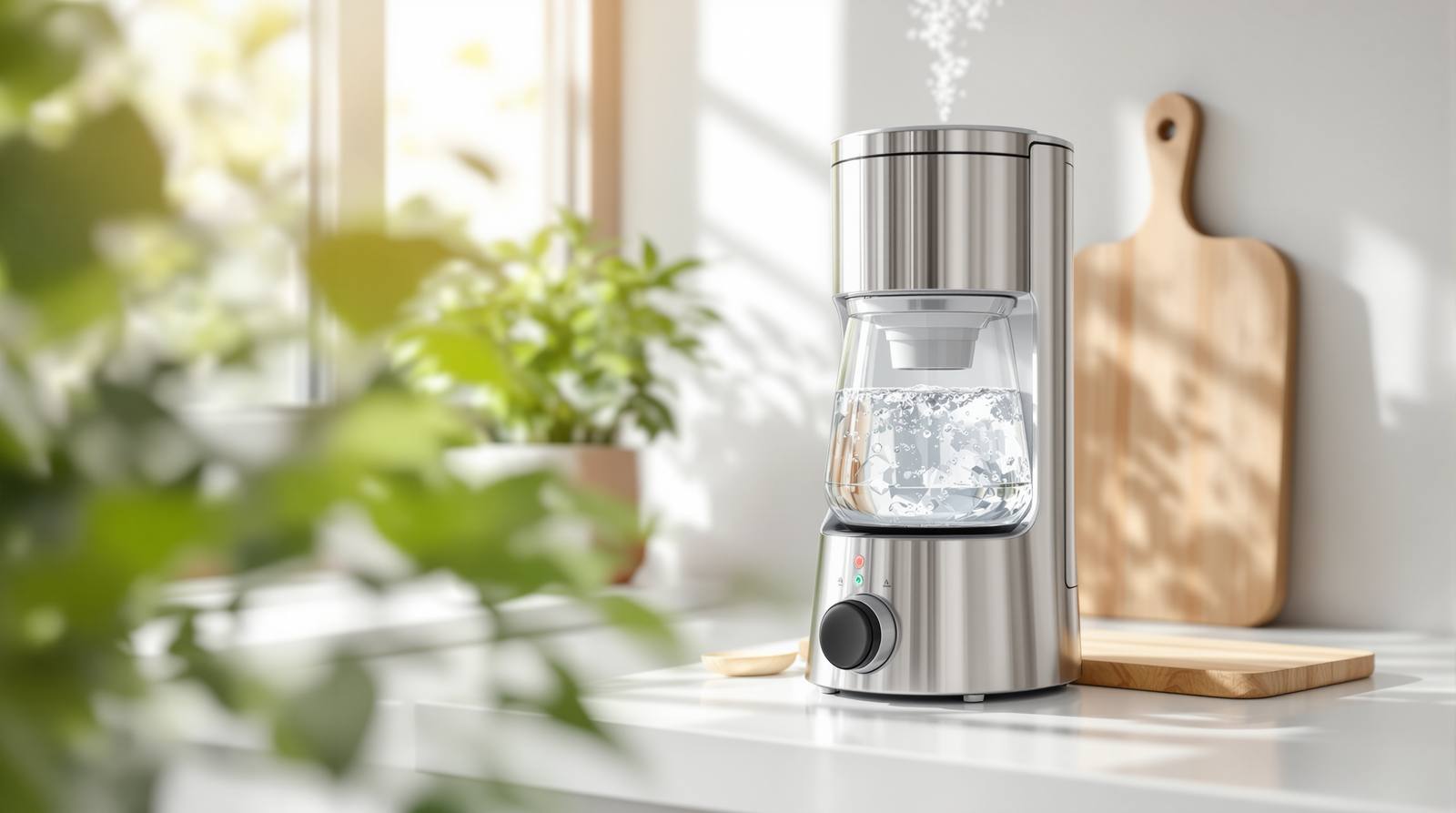
The short answer
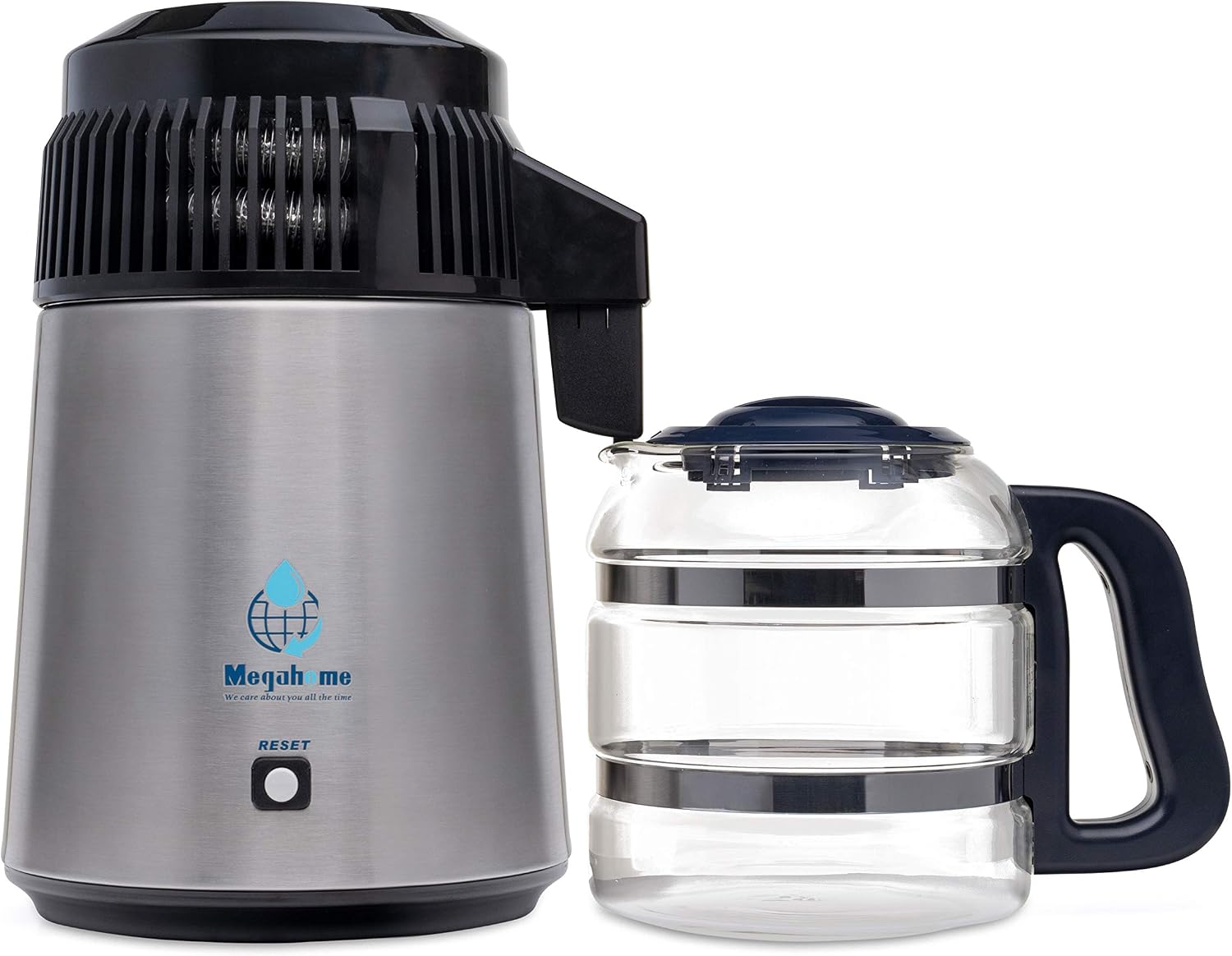
The best countertop water distiller in 2026 is the Megahome Countertop Water Distiller with glass collection (~$249). It pairs a 316L medical-grade stainless-steel boiling chamber with a real glass collection carafe (no plastic touches the finished water), a porcelain nozzle liner, and a 20-year Amazon review base at 4.5 stars. Steam distillation removes 99.9%+ of microplastics, PFAS, lead, arsenic, and fluoride — physically, not through a filter. For pharmaceutical-grade purity the H2oLabs 300SS goes further; on a budget under $150 the CO-Z 4L is the honest entry.
Quick Navigation
- Why a water distiller (and when a filter is enough)
- What is the best water distiller?
- Do water distillers remove microplastics?
- Is distilled water safe to drink long term?
- Quick comparison: all 7 distillers
- Best overall: Megahome Glass Collection
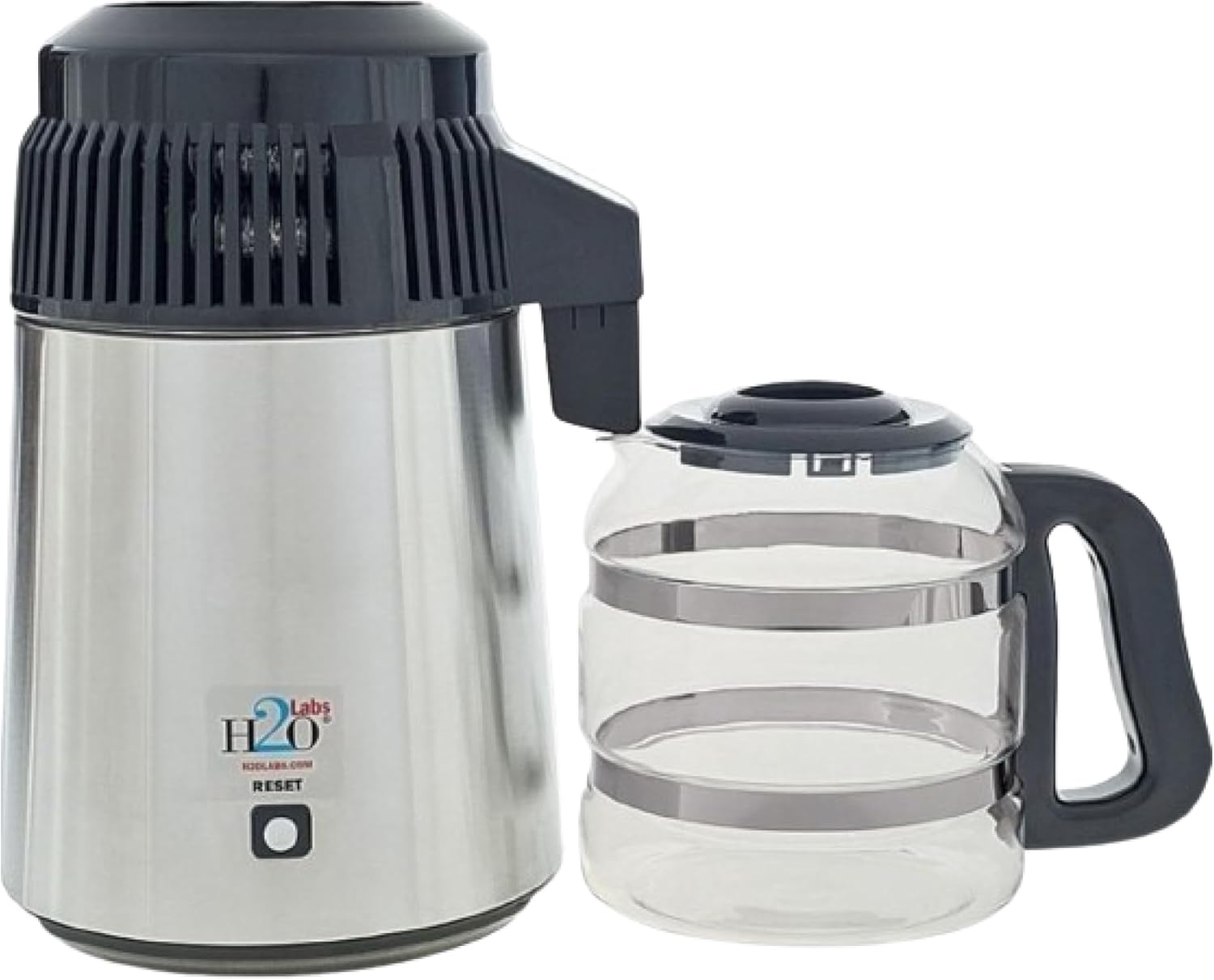
- Best pharmaceutical-grade: H2oLabs 300SS
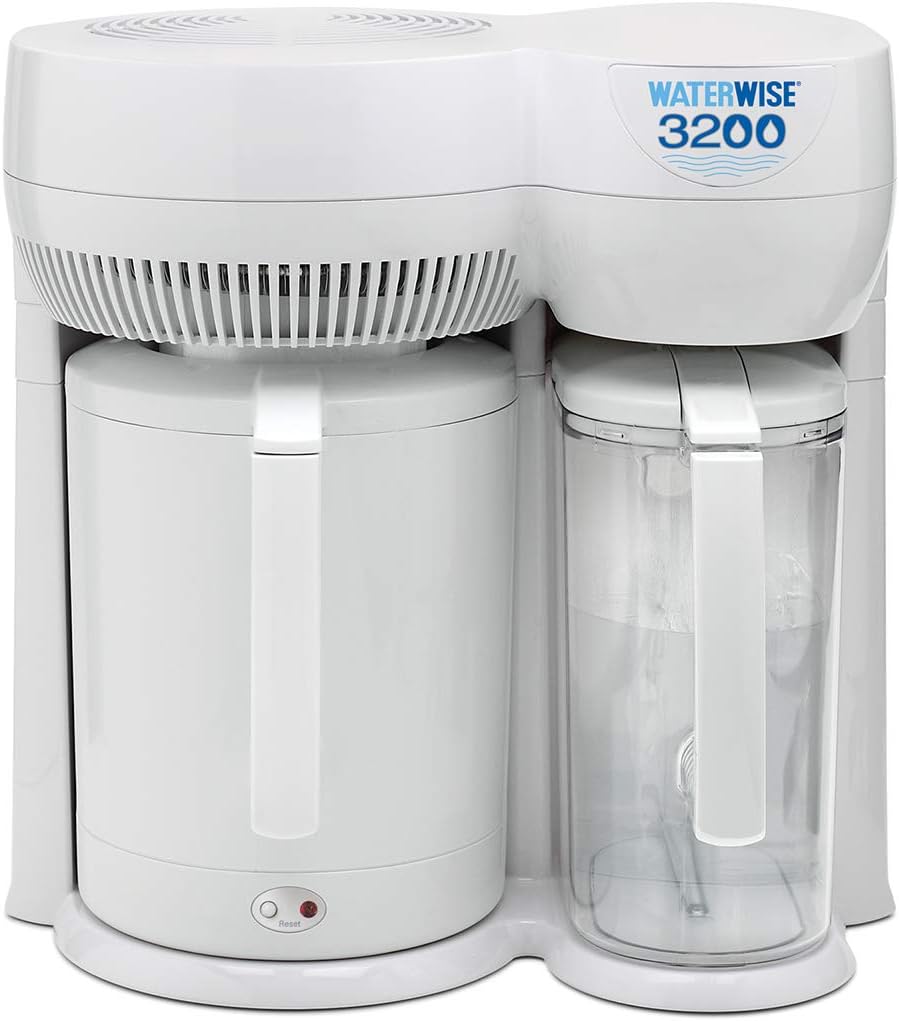
- Best U.S. specialist brand: Waterwise 3200
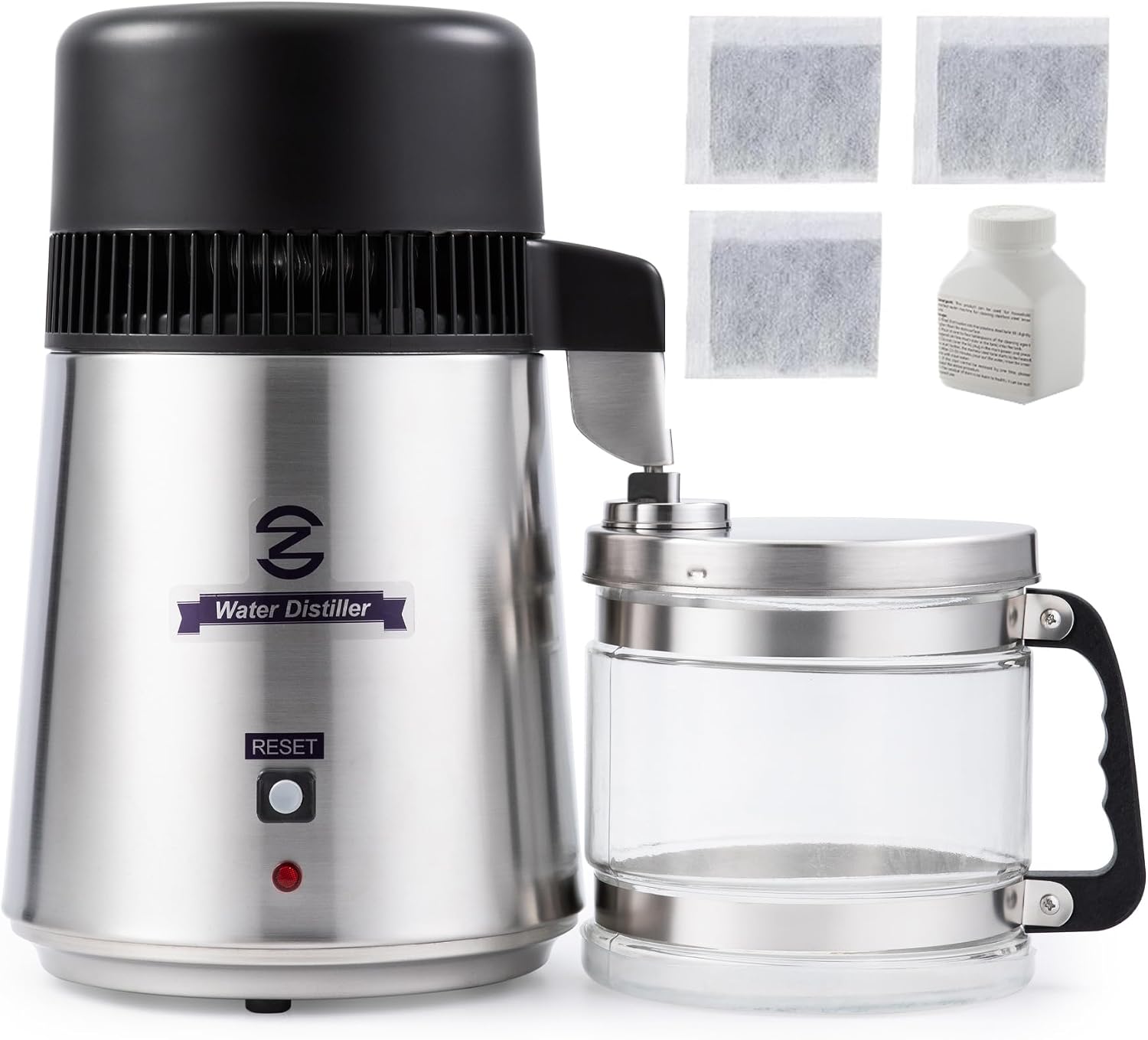
- Best under $150: CO-Z 4L
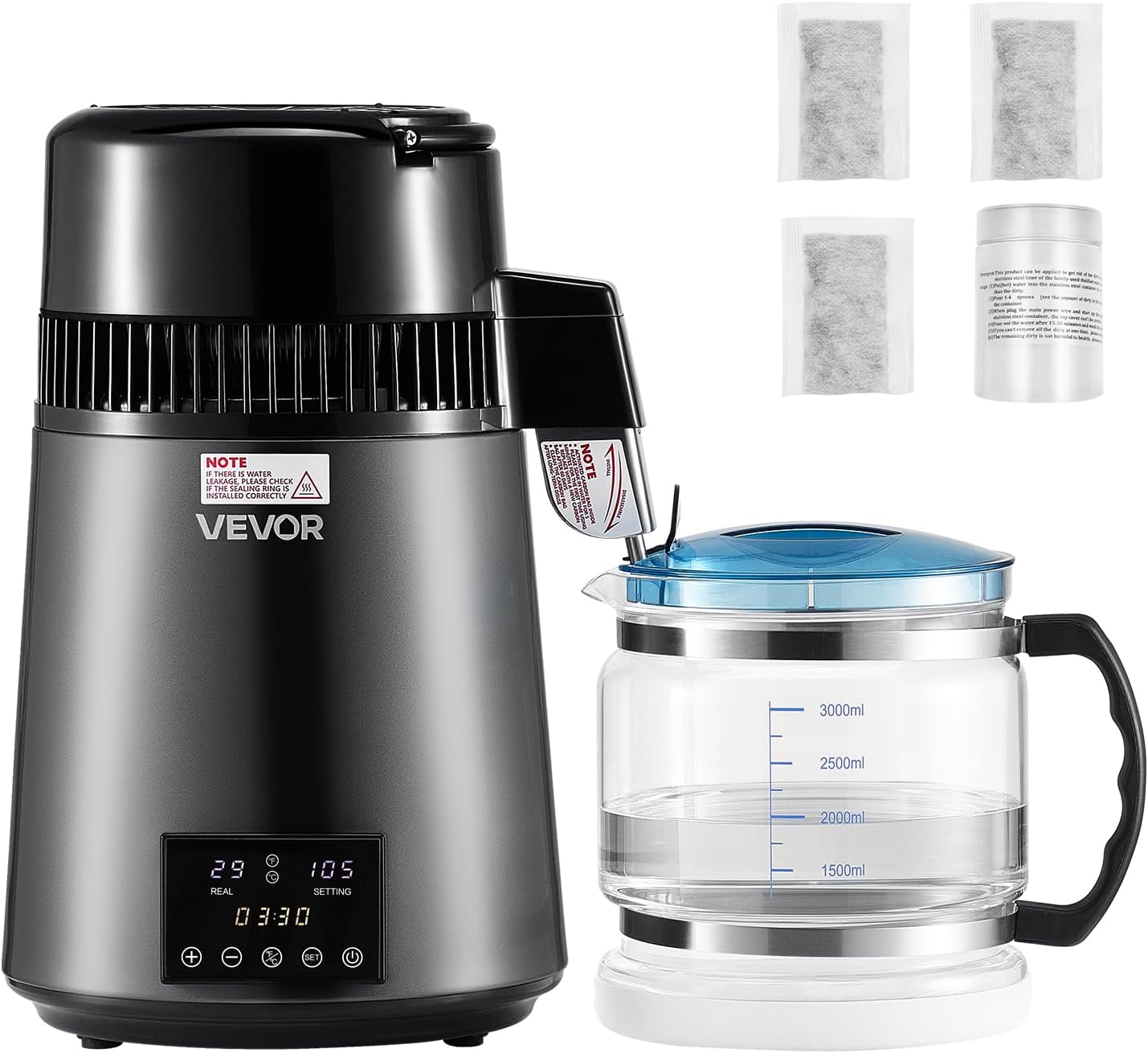
- Best entry glass upgrade: VEVOR 4L
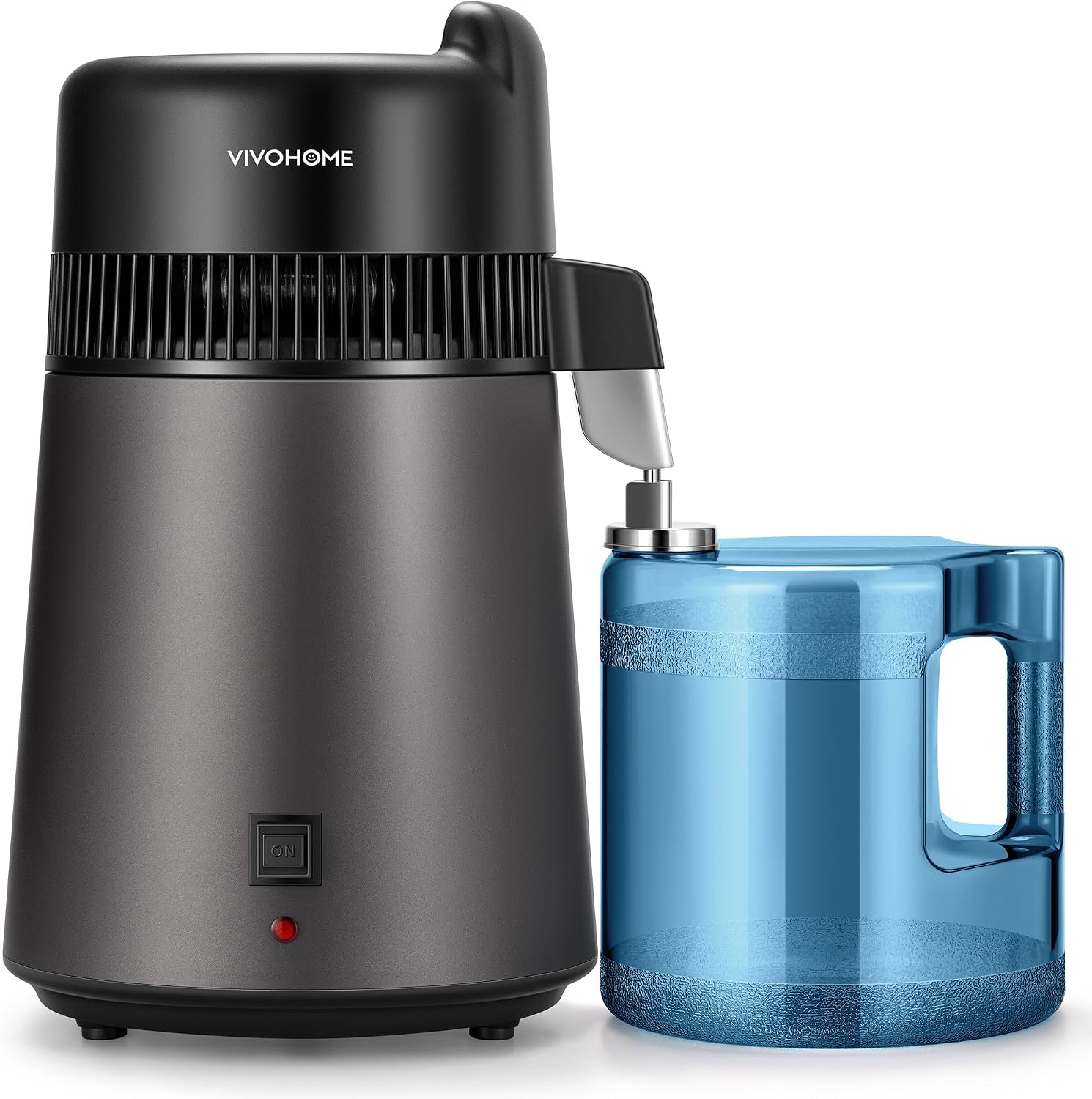
- Best oversized 6L: VIVOHOME 900W
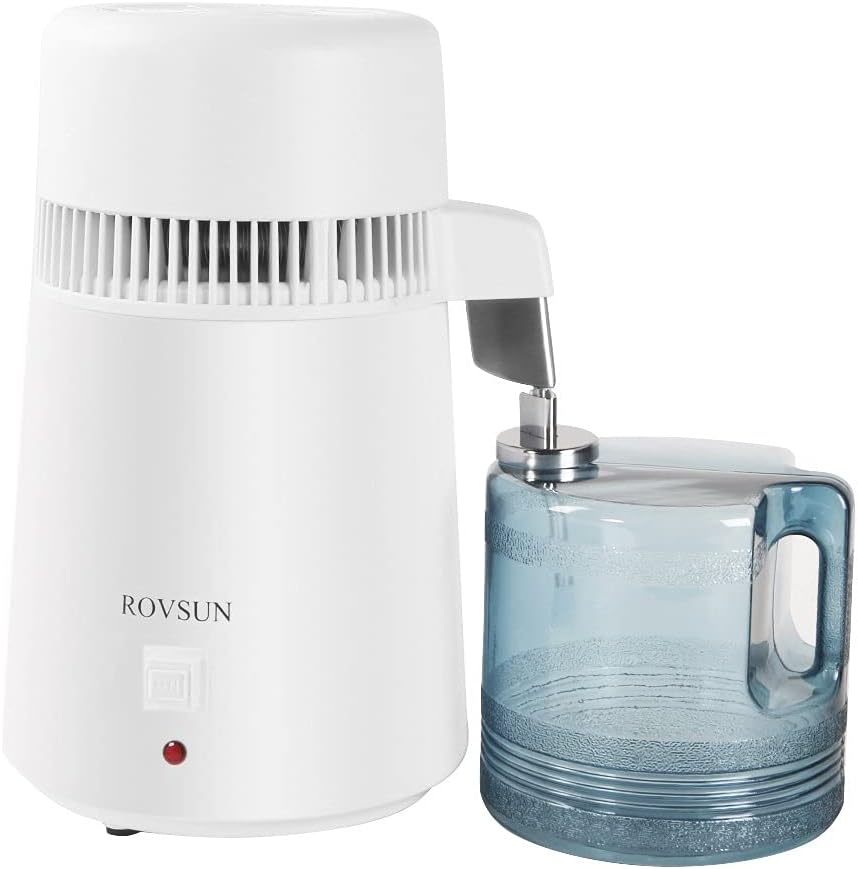
- Best entry budget: ROVSUN 4L
- Buyer's guide
- FAQ
Compare all 7 picks
Every pick side by side — tap a name to jump to the full review, or check today's price.
| Pick | Rating | Why it wins | |
|---|---|---|---|
| 4.6out of 5 | 316L Stainless BoilerGlass Carafe |
Check price → | |
 Best Pharmaceutical-GradeH2oLabs Model 300SS Stainless Steel Countertop Water Distiller |
4.6out of 5 | Full Stainless BodyGlass Carafe |
Check price → |
 Best U.S. BrandWaterwise 3200 Countertop Water Distiller |
4.3out of 5 | 304 Stainless BoilerTritan Collection Carafe |
Check price → |
 Best Under $150CO-Z 4L Countertop Water Distiller |
4.5out of 5 | 304 Brushed StainlessGlass Collection Pot |
Check price → |
 Best Entry w/ GlassVEVOR 4L Countertop Water Distiller |
4.3out of 5 | 304 Stainless BoilerGlass Upgrade Available |
Check price → |
 Best OversizedVIVOHOME 6L Water Distiller Countertop |
4.4out of 5 | 304 Stainless Interior6L Boiler / 1.6 gal |
Check price → |
 Best Entry BudgetROVSUN 4L Water Distiller Countertop |
4.2out of 5 | 304 Stainless InteriorFlame-Retardant Housing |
Check price → |
Why a Water Distiller (And When a Filter Is Enough)
A countertop water distiller does something no filter — not reverse osmosis, not the best certified under-sink filters, not any pitcher — can match: it removes contaminants by changing the state of the water. Tap water is heated to boiling in a stainless-steel chamber. Only pure H₂O molecules vaporize into steam. That steam rises through a stainless nozzle, past a cooling coil, and condenses back into liquid water inside a separate collection carafe. Everything that cannot vaporize at 100 degrees Celsius — every microplastic particle, every PFAS molecule, every lead ion, every fluoride ion, every arsenic atom, every mineral, every bacterium — stays behind in the boiling chamber as a residue you rinse out at the end of the cycle.
Independent testing consistently shows steam distillation removes 99.9%+ of virtually every drinking-water contaminant, including the specific categories a carbon filter struggles with: fluoride (which cannot be adsorbed onto activated carbon at meaningful rates), PFAS (which certain carbon blocks reduce but no standard carbon block eliminates), arsenic, nitrate, and dissolved metals — the exact contaminant profile of many untreated private wells. For anyone concerned about the results from the 2024 PNAS microplastics in bottled water study — 240,000 particles per liter — a distiller is the most thorough single answer you can put on a countertop.
The trade-off is speed, energy, and minerals. Distilling one gallon takes 4 to 6 hours on a 750-watt element (about 3.5 hours on a 900-watt VIVOHOME) and consumes 3 to 4 kWh — roughly $0.35 of electricity at U.S. average rates. Distillation also strips beneficial minerals (calcium, magnesium, potassium) alongside the bad stuff, which many owners restore with a few drops of trace-mineral concentrate or a pinch of Celtic sea salt. If your top concern is chlorine taste or PFAS-under-carbon and you drink less than a gallon a day, an under-sink filter or reverse osmosis system is faster and cheaper. If your top concern is fluoride, arsenic, or every microplastic particle imaginable — a distiller is the honest answer.
What separates a good distiller from a bad one: A 316L medical-grade stainless-steel boiling chamber (not standard 304 stainless), a porcelain nozzle liner or an all-stainless steam path (never plain plastic in the vapor line), a glass collection carafe (never plastic touching finished distilled water), an activated-carbon post filter for volatile organics that carry over with the steam, and a real auto-shutoff. The Megahome and H2oLabs 300SS meet all five; most sub-$150 distillers meet three or four. Below we score every pick against this checklist.
What Is the Best Water Distiller?
The Megahome Countertop Water Distiller with glass collection (~$249) is our top pick, because it is the only distiller in this price class with a 316L stainless-steel boiling chamber, a porcelain nozzle liner, and a real glass collection carafe — meaning no plastic ever touches your finished distilled water. Megahome has been building this exact machine for two decades, and the Amazon review base is the deepest in the category. For pharmaceutical-grade purity or a full stainless-steel body, step up to the H2oLabs 300SS (~$299). If you want a U.S.-brand specialist and a compact footprint, the Waterwise 3200 (~$379) is the pick. On a budget under $150 the CO-Z 4L is the most-reviewed honest entry.
Do Water Distillers Remove Microplastics?
Yes — better than any other point-of-use technology. Steam distillation boils water into vapor and captures only the pure steam, leaving every microplastic particle behind in the boiling chamber. Because the process works by state-change rather than by filtration, particle size is irrelevant: a 100-nanometer nanoplastic (invisible to a 0.5-micron carbon block) is left behind for the same reason a 10-micron polyester fiber is. Independent testing shows 99.9%+ removal of microplastics, along with PFAS, lead, arsenic, fluoride, and dissolved solids. (If removing lead specifically is the goal, our best water filters for lead compares the certified point-of-use options.) The trade-off is time — 4 to 6 hours per gallon — and the loss of beneficial minerals.
Is Distilled Water Safe to Drink Long Term?
Yes — with a footnote. The WHO and mainstream medical literature agree distilled water is safe to drink daily. It is the water used in hospital dialysis machines, sterilization equipment, and CPAP humidifiers for exactly the same reason it is good drinking water: nothing else is in it. The footnote is minerals. Distillation removes calcium, magnesium, and potassium alongside contaminants; in a normal diet those come from food, but many owners add a few drops of trace-mineral concentrate (Concentrace, ionic magnesium) or a pinch of Celtic sea salt to a gallon of finished distilled water to restore minerals and improve taste. Distilled water tastes flat to some people; adding minerals fixes that in about 10 seconds.
Quick Comparison: All 7 Water Distillers
| Distiller | Boiling chamber | Collection material | Watts | Cycle time (1 gal) | Price |
|---|---|---|---|---|---|
| Megahome (glass) | 316L stainless steel | Glass carafe | 580W | ~5.5 hr | $$$ |
| H2oLabs 300SS | 316L stainless steel | Glass carafe | 800W | ~4 hr | $$$ |
| Waterwise 3200 | 304 stainless steel | Tritan (BPA-free) | 800W | ~4 hr | $$$ |
| CO-Z 4L | Brushed stainless | Glass pot | 750W | ~5 hr | $ |
| VEVOR 4L | 304 stainless steel | BPA-free / glass option | 750W | ~5 hr | $ |
| VIVOHOME 6L | 304 stainless steel | BPA-free plastic | 900W | ~3.5 hr | $$ |
| ROVSUN 4L | 304 stainless steel | BPA-free plastic | 750W | ~5 hr | $ |
Price guide: $ under $150 · $$ $150–225 · $$$ $225+. Tap any pick below for today's Amazon price.
1. Megahome Countertop Water Distiller (Glass Collection) — Best Overall
 Best Overall
Megahome has been making this exact machine, unchanged in its essentials, since the early 2000s. The 316L stainless-steel boiling chamber is the medical-grade alloy used in surgical instruments — it resists pitting from long-term boiling far better than the 304 stainless in cheaper units. The porcelain nozzle liner at the top of the boiler is the detail that separates Megahome from most competitors: it stops the vapor from ever touching the exterior painted or plastic coating on the boiler cap, so no coating chemistry ever hitches a ride into the finished water. The real glass collection carafe means the final distilled water — which is chemically aggressive because it has no dissolved minerals — never contacts a polymer.
The math: at 580 watts, one full 4-liter cycle takes about 5.5 hours and produces about 1 gallon of distilled water. Amazon lists the wattage as "580W distilling" (versus 750W in nominal power draw), which is why cycle time is a touch longer than the CO-Z or VEVOR at the same tank size. That trade of speed for gentleness of boil is intentional: a slower, cooler boil produces less steam carryover of volatile organics, which is why the same detail also shows up in H2oLabs's premium distiller.
The honest trade-offs: the Megahome ships with an included activated-carbon post filter that captures VOCs but adds a $12/year consumable to the operating cost. The glass carafe is fragile — dropping it means a full replacement (about $35 from Megahome). And the total wattage over a full year of daily distilling adds ~$150 to your electric bill at U.S. average rates. If those trade-offs are unacceptable, the H2oLabs 300SS is the "no compromises" upgrade; if the glass carafe is the deal-breaker, the CO-Z 4L or VEVOR 4L glass-jug variant is a cheaper path to the same benefit.
Long-time owners consistently praise the Megahome's simplicity — "no electronics to break." Owners with hard water report the boiler pot showing chalky mineral deposits after every cycle (that's the point, it's the contaminants you would have drunk) and appreciate that a monthly citric-acid rinse restores it to like-new. The honest gripes that repeat: the fan is audibly noisier than the H2oLabs, the plastic top-cap latch feels less premium than the price, and the porcelain nozzle liner can chip if the boiler pot is dropped during cleaning. Replacement glass carafes are readily available.
The only sub-$275 countertop distiller with a 316L medical-grade stainless boiler AND a real glass collection carafe — no plastic touches your finished distilled water.
Why it's safe: 316L stainless steel is the alloy used in medical implants, and the porcelain-lined nozzle isolates the vapor from any external coating chemistry — a Megahome is the same appliance sold in dental and pharmaceutical labs.
Check Today’s Price on Amazon →Amazon prices change daily — tap to see today's price and any active discount.
- Free delivery & returns for Prime members
- Sold & shipped by Amazon
- Thousands of verified reviews
2. H2oLabs Model 300SS Stainless Steel Water Distiller — Best Pharmaceutical-Grade
Best Pharmaceutical-Grade
H2oLabs makes distillers specifically marketed at buyers who want laboratory-grade water at home — the exact same machines are used by chemistry teachers, small pharmacies, and CPAP users who need to guarantee zero contaminants. The 300SS steps up from the Megahome in three ways. Full stainless-steel outer body means no enamel or paint on any surface — nothing that can ever chip, discolor, or shed under repeated heat cycling. The silicone lid gasket is redesigned around a tighter tolerance seat, which H2oLabs specifies is the same gasket profile used in pharmaceutical-grade autoclaves. And the 800-watt heating element is tuned to hit a specific "gentle boil" set point that maximizes distillate purity while cutting cycle time from ~5.5 hours to ~4 hours per gallon.
The included 1-gallon glass carafe is the same borosilicate glass used in laboratory beakers — it can be safely heated on a stovetop to sterilize (Megahome's is soda-lime and cannot). The porcelain nozzle liner is standard. H2oLabs also ships their distillers with a starter pack of activated-carbon post-filter capsules that reduce residual VOCs an extra step beyond what the boiling process alone achieves.
The honest trade-offs: the H2oLabs 300SS costs about $50 more than the Megahome and does not have the same 20-year Amazon-review depth. H2oLabs is a smaller brand — customer service is by email rather than phone, and returns are through the seller rather than Amazon. If you would use distilled water for a CPAP machine, a laboratory, or you simply want the strictest possible spec, this is the pick. For everyday home drinking-water, the Megahome delivers 95% of the same benefit at 80% of the price.
CPAP users, small business owners, and chemistry-teacher owners consistently rate the 300SS's build quality as noticeably tighter than any competitor — the lid seats with an audible click, the fan is quieter than Megahome's, and the finished water is described as "chemistry-lab clean." Owners with hard water report a very slightly slower mineral buildup versus Megahome, though both need a citric-acid rinse monthly. Honest downsides: the borosilicate glass carafe is heavy and less balanced than Megahome's smaller carafe, and H2oLabs's warranty support is described as thorough but slow (5-7 business days to a first response).
Full stainless-steel body, borosilicate glass carafe, and pharmaceutical-grade lid gasket — the pick if you want CPAP-grade or laboratory-grade distilled water at home.
Why it's safe: The 316L stainless boiling chamber and borosilicate glass carafe are the same materials specified by ASTM standards for laboratory-grade Type II distilled water — no plastic, no enamel, no coating chemistry ever in the distillate path.
Check Today’s Price on Amazon →Amazon prices change daily — tap to see today's price and any active discount.
- Free delivery & returns for Prime members
- Sold & shipped by Amazon
- Thousands of verified reviews
3. Waterwise 3200 — Best U.S. Specialist Brand
Best U.S. Brand
Waterwise is one of the oldest continuously-operating countertop water-distiller brands in North America, founded in Florida in 1979. The 3200 is their compact 1-gallon model, purpose-designed to sit on a kitchen counter without dominating it — it is meaningfully smaller than the Megahome or H2oLabs. The 304 stainless-steel boiling chamber is a step below the 316L of the top two picks but still significantly better than aluminum or coated-metal alternatives; the 800-watt element runs a full cycle in about 4 hours. A coconut-shell activated-carbon post-filter is included for volatile-organic polishing, and the built-in auto-shutoff triggers at end of cycle plus a dry-boil safety cutoff.
Waterwise's engineering choice worth calling out: they use a Tritan copolyester carafe (Eastman's food-grade BPA-free plastic). Tritan is genuinely FDA-safe and does not leach the estrogenic compounds that BPA plastics do — but any polymer touching pure distilled water represents a very small trace-migration risk over months of daily use. That is the trade-off in choosing the Waterwise 3200 over the Megahome: a more compact, more premium-feeling appliance with a plastic carafe rather than glass. Waterwise sells a glass-carafe upgrade separately if you want to eliminate that concern.
The honest trade-offs: Waterwise's Amazon pricing has crept up over the last two years — you can get similar spec from the Megahome for less. The carbon post-filter is proprietary (no generics fit). And the Amazon review base is thinner than the top two picks, so you are relying more on the 45-year brand pedigree than on 2,000+ verified buyer opinions.
Owners praise the compact footprint and quiet fan — several call it the quietest distiller they have owned. Long-time Waterwise buyers who bought earlier generations report the current 3200 build quality feels closer to the older Waterwise 4000 (a larger, higher-priced model) than to the entry Chinese-import distillers, which they consider high praise. The honest downsides that repeat: the Tritan carafe is described as less premium-feeling than a glass one, the operating fan makes a "wobble" noise if the machine is not on a perfectly level surface, and replacement carbon filters cost noticeably more than generic activated-carbon alternatives.
45+ years of distiller-only engineering from a U.S. specialist brand, packed into a compact 1-gallon countertop footprint with the quietest fan in the category.
Why it's safe: 304 stainless-steel boiling chamber, Tritan food-grade BPA-free collection carafe, coconut-shell activated-carbon post-filter, and dual auto-shutoff (end-of-cycle and dry-boil safety).
Check Today’s Price on Amazon →Amazon prices change daily — tap to see today's price and any active discount.
- Free delivery & returns for Prime members
- Sold & shipped by Amazon
- Thousands of verified reviews
4. CO-Z 4L Countertop Water Distiller — Best Under $150
Best Under $150
The CO-Z 4L is the volume seller in the sub-$150 countertop-distiller market and has the deepest verified-buyer review base of any budget distiller. What earns it a spot here: a brushed 304 stainless-steel boiling chamber (not aluminum, not enamel-coated metal), a real glass collection pot (not the polymer jug that most competitors ship at this price), an activated-carbon post-filter capsule that mounts inside the nozzle to catch residual VOCs, and standard 4-liter capacity that produces roughly 1 gallon of distilled water per 5-hour cycle at 750 watts.
The auto-shutoff triggers on both end-of-cycle (all water in the boiling chamber has evaporated) and a temperature-limit safety cutoff. The stainless-steel interior is easy to clean — mineral deposits wipe off with a monthly citric-acid rinse. And the glass carafe is compatible with generic replacements (the Megahome and CO-Z carafes are physically interchangeable, which is why the Amazon "1 gallon plastic carafe" replacement listing explicitly names both brands).
The honest trade-offs: CO-Z is a Chinese brand with less transparency than Megahome or H2oLabs about the specific stainless-steel grade (they specify "304 stainless" but do not certify the boiler as 316L). The plastic top-cap latch is less premium-feeling than Megahome's. And the operating fan is audibly louder — several owners describe it as "acceptable but you can hear it across a small kitchen." If those trade-offs matter, the extra $100 to step up to the Megahome buys tangible build-quality improvements. If they do not, this is the honest starter.
Budget-conscious owners consistently rate the price-to-performance ratio as the reason they bought — "same distilled water, less money." First-time distiller owners appreciate the simplicity: fill, plug in, walk away. Honest downsides that repeat: the fan is noisier than the premium picks, the top-cap latch loosens slightly over time and needs occasional re-tightening, and CO-Z's customer service is described as slow to respond (5-10 business days) — most warranty issues are resolved through Amazon's return process rather than through CO-Z directly. Replacement glass carafes and carbon filters are inexpensive and widely stocked.
The most-reviewed sub-$150 countertop distiller on Amazon — 304 stainless-steel interior, real glass collection pot, activated-carbon post-filter, and dual auto-shutoff.
Why it's safe: Steam distillation is chemistry-based, not brand-based — the physics of a 100 degrees C boil leaving microplastics, PFAS, and lead in the boiling chamber applies exactly the same at $130 as at $300.
Check Today’s Price on Amazon →Amazon prices change daily — tap to see today's price and any active discount.
- Free delivery & returns for Prime members
- Sold & shipped by Amazon
- Thousands of verified reviews
5. VEVOR 4L Countertop Water Distiller — Best Entry With Glass Upgrade
Best Entry w/ Glass
VEVOR is one of the largest volume distributors of small appliances on Amazon, selling under their own name what is essentially a licensed variation of the Chinese-manufactured 4-liter distiller platform (the same platform the CO-Z, ROVSUN, and half a dozen other budget brands share). The core specs match the CO-Z: 304 stainless-steel boiling chamber, 750-watt element, ~5-hour cycle time per gallon, and dual auto-shutoff. What differentiates VEVOR: they list an optional glass-carafe upgrade in the same product line at not much more than the base BPA-free polymer version — most competitors force you to source a generic glass carafe separately, which never fits perfectly.
The rest of the build is honest budget-tier. The stainless boiling chamber is solid and easy to clean; the exterior housing is painted steel; the top-cap uses a simple locking latch. The included activated-carbon post-filter is generic and inexpensive to replace. VEVOR ships spares (carbon filter capsules) with the initial purchase — a small but useful touch at this price.
The honest trade-offs: VEVOR's customer service reputation is thin — most owners report resolving issues through Amazon returns rather than through VEVOR directly. Some Amazon reviews complain about inconsistent quality control (a small share of units arriving with a loose fan mount or a top-cap that does not seat fully), which is a real risk when buying a Chinese-white-label appliance from a volume distributor. If those risks matter, spend the extra $10-30 for the CO-Z (better QC track record) or the extra $100 for the Megahome (best QC in the category).
Owners consistently rate the value proposition as the reason they bought — especially the glass-carafe variant, which several call the cheapest way to get a plastic-free distiller. First-cycle water is described as tasting "surprisingly clean" for a $120 appliance. The honest downsides that repeat: a small but non-trivial share of owners report an initial "new smell" during the first two cycles (VEVOR recommends throwing out the first two distillates, which is standard for any new distiller regardless of brand), and warranty support is slow with returns handled through Amazon rather than through VEVOR. The activated-carbon capsule needs to be replaced every 2 months to prevent it from becoming a source of chemistry instead of a scrubber.
Same core 4-liter, 750-watt, 304-stainless-steel distiller as the CO-Z — with an official glass-carafe upgrade in the same product line for a low-cost plastic-free build.
Why it's safe: Steam distillation is a physics-based purification method — a $120 unit and a $300 unit both leave microplastics, PFAS, lead, and fluoride behind in the boiling chamber for the same reason: those contaminants cannot vaporize at 100 degrees C.
Check Today’s Price on Amazon →Amazon prices change daily — tap to see today's price and any active discount.
- Free delivery & returns for Prime members
- Sold & shipped by Amazon
- Thousands of verified reviews
6. VIVOHOME 6L Water Distiller — Best Oversized (Fastest Cycle)
Best Oversized
The VIVOHOME 6L breaks from the standard 4-liter/750-watt distiller pattern in two useful ways. First, the boiling chamber is 6 liters (1.6 gallons) instead of the usual 4 liters, so one complete cycle produces 1.6 gallons of distilled water — enough for two days of drinking for a couple, or 24 hours for a family. Second, the heating element is 900 watts instead of the standard 750, which raises boiling water temperature faster and shortens cycle time to roughly 3.5 hours per gallon (versus 5 hours for a 4L/750W design). If you drink 1+ gallon of water per day, the faster cycle and larger tank meaningfully change the ownership experience.
Build details worth calling out: smart-switch controls with an LCD status display are standard on the VIVOHOME — not an essential feature but a genuine step up from the pure electromechanical timer on cheaper units. The 304 stainless-steel boiling interior matches the CO-Z, VEVOR, and ROVSUN spec. The included coconut-shell activated-carbon post-filter capsule mounts in the nozzle and needs replacement every 2 months.
The honest trade-offs: the collection carafe on the VIVOHOME base configuration is BPA-free polymer, not glass — so if plastic-free is the deciding factor, either upgrade to a Megahome (or aftermarket generic glass carafe, which some VIVOHOME owners do). The larger 6L boiler also means the appliance itself has a bigger countertop footprint than a 4L distiller — 15 inches tall by 11 inches wide is a real fridge-sidebar's worth of counter space. And the 900-watt element means each cycle uses slightly more electricity per gallon than a 750-watt design (about $0.42 versus $0.35 per gallon at U.S. average rates).
Owners who bought the VIVOHOME after starting with a 4L unit consistently rate the faster cycle and larger tank as "the upgrade that made distilled water actually livable." Multi-person households appreciate that one overnight run produces enough distilled water for a day. Honest downsides that repeat: the LCD status panel gets criticized for being a plastic overlay that is not perfectly weather-sealed (a very small share of long-term owners report the LCD dimming after 2-3 years), and the BPA-free carafe is described as functional but "not what you would want touching drinking water." Some owners upgrade to an aftermarket glass carafe within the first year.
A 1.6-gallon boiler plus a 900-watt element means one cycle produces enough distilled water for two days — the fastest cycle time in this guide.
Why it's safe: 304 stainless-steel boiling chamber, coconut-shell activated-carbon post-filter, dual auto-shutoff (end-of-cycle and dry-boil safety), and a Tritan-analogue BPA-free polymer carafe that meets FDA food-contact safety standards.
Check Today’s Price on Amazon →Amazon prices change daily — tap to see today's price and any active discount.
- Free delivery & returns for Prime members
- Sold & shipped by Amazon
- Thousands of verified reviews
7. ROVSUN 4L Countertop Water Distiller — Best Entry Budget
Best Entry Budget
The ROVSUN 4L sits at the very bottom of the sub-$130 countertop-distiller price ladder. What it shares with the CO-Z and VEVOR at similar sizes: a 304 stainless-steel interior, 750-watt heating element, roughly a 5-hour cycle for one gallon of distilled water, and a dual auto-shutoff. What it does differently: ROVSUN adds a flame-retardant polymer outer housing — a UL94-V0 material rating that Chinese-white-label distillers sometimes advertise and sometimes do not, and which is genuinely useful for a heating appliance that sits on a wooden counter or near a stovetop.
The base configuration ships with a BPA-free polymer collection jug. Unlike the VEVOR, ROVSUN does not currently list an official glass-carafe upgrade in the same product line — you would need to source a generic aftermarket glass carafe if plastic-free is your ceiling, which usually costs about $30 extra. A 4L stainless-steel boiling chamber and standard porcelain nozzle liner round out the build.
The honest trade-offs: ROVSUN is the smallest-reputation brand in this guide. The Amazon verified-review base is thinner than the CO-Z or VEVOR (though still substantial), and warranty support is described as email-only with slow response times. If the $10-20 savings versus the CO-Z or VEVOR matters, the ROVSUN is the honest choice; if it does not, spend the small difference on a distiller with either a stronger review base or a native glass-carafe option.
Budget owners consistently rate the ROVSUN as "gets the job done" — the distilled water quality is described as indistinguishable from the CO-Z, which is exactly what physics would predict for two 750-watt/304-stainless designs. Owners appreciate the flame-retardant housing on a counter next to a stovetop. Honest downsides that repeat: replacement carbon filters are the same generic capsule the CO-Z and VEVOR use (widely available), but ROVSUN's own website is thin on support content; a small share of owners report the top-cap latch feeling loose from day one, which requires a small O-ring adjustment. Warranty support is by email only.
The lowest-price countertop distiller in this guide with a UL94-V0 flame-retardant housing — the entry point when the sub-$130 tier is a hard budget line.
Why it's safe: 304 stainless-steel boiling interior, flame-retardant polymer exterior housing, dual auto-shutoff, and a BPA-free polymer collection jug meeting FDA food-contact standards.
Check Today’s Price on Amazon →Amazon prices change daily — tap to see today's price and any active discount.
- Free delivery & returns for Prime members
- Sold & shipped by Amazon
- Thousands of verified reviews
Get the full Plasticproof guide
Water is step one. The complete guide covers kitchen, bedroom, air, and baby — every swap that matters.
Get the free guideBuyer's Guide: How to Choose a Water Distiller
Distiller vs reverse osmosis vs carbon filter
Countertop water distillers (this list) use state-change chemistry — boil water into steam, capture only the pure vapor — to leave every non-volatile contaminant behind in the boiling chamber. That includes microplastics, PFAS, lead, fluoride, arsenic, bacteria, and dissolved solids. Removal rates hit 99.9%+ for essentially every contaminant that cannot boil away with the steam. The trade-offs: 4 to 6 hours per gallon, ~$0.35/gallon in electricity, no beneficial minerals in the finished water (you add them back), and about 1 kWh of heat dumped into your kitchen per cycle.
Reverse osmosis (RO) uses a 0.0001-micron membrane to filter contaminants under water pressure — it strips fluoride, arsenic, PFAS, and dissolved solids similarly to distillation but 20 to 40 times faster. RO wastes 1.5 to 4 gallons of drain water per gallon produced and needs a storage tank under the sink, but for households drinking multiple gallons a day it is the practical choice.
Certified carbon-block filters (under-sink, pitcher, countertop) at NSF/ANSI 401 remove microplastics, most VOCs, and — in the lead-certified 53 versions — lead. They do not remove fluoride, arsenic, or PFAS at the same rate a distiller does. A common Brita pitcher does not qualify here — see does a Brita filter remove microplastics? for what its granular activated carbon is (and isn't) certified to do, and Brita vs Berkey vs reverse osmosis for microplastics for the head-to-head numbers.
The honest decision tree: if you have well water, elevated fluoride, or arsenic — buy a distiller. If you drink multiple gallons a day and have municipal chlorinated water — buy RO. If you drink less than a gallon a day and mainly want chlorine, taste, and microplastics gone — buy a certified carbon-block under-sink filter.
What to check before you buy a distiller
- Boiling-chamber material — 316L stainless steel is the medical-grade alloy (Megahome, H2oLabs 300SS). 304 stainless is a step down but still fine (Waterwise, CO-Z, VEVOR, VIVOHOME, ROVSUN). Aluminum or coated metal — avoid.
- Collection carafe material — glass is the plastic-free choice (Megahome, H2oLabs, CO-Z, VEVOR glass upgrade). BPA-free polymer or Tritan is FDA-safe but introduces a very small trace-migration risk over years of daily use.
- Nozzle liner — porcelain (Megahome, H2oLabs) or all-stainless steam path. Plain plastic in the vapor line is a red flag; distilled water is chemically aggressive.
- Activated-carbon post-filter — captures the small share of VOCs (like chloroform, if your source water is chlorinated) that carry over with the steam. All seven picks include one; replace every 2 months.
- Auto-shutoff — a real dual auto-shutoff (end-of-cycle plus a dry-boil safety cutoff) is standard on every pick here.
Cost per gallon (not sticker price) is the real number
Sticker price is only part of the story. The number to compare is cost per gallon of distilled water — sticker amortized over 5 years plus annual carbon-filter cost plus the electricity of each cycle:
- Electricity — about $0.30 to $0.40 per gallon at U.S. average residential rates (3.5 to 4 kWh per gallon). Same for every 750W distiller; the 900W VIVOHOME uses about 20% more electricity per gallon.
- Carbon filter capsules — about $30 to $60 per year for replacements (bi-monthly swaps).
- Sticker amortized — a $250 Megahome over 5 years is about $0.05/gallon; a $130 CO-Z is closer to $0.025/gallon.
- All-in cost per gallon — roughly $0.35 to $0.50 per gallon of distilled water, dominated by electricity. Cheaper than bottled water, more expensive than any filter that does not use heat.
The mineral question
Distilled water is the purest drinking water you can make at home, but it contains no beneficial minerals — calcium, magnesium, and potassium are removed alongside the contaminants. In a normal diet minerals come from food, but many owners add trace minerals back to improve taste and boost mineral intake. The two options: a few drops of Concentrace trace-mineral drops per gallon (widely available on Amazon), or a small pinch of Celtic or Redmond Real sea salt in the finished carafe. Both are inexpensive, both restore the "spring water" mouthfeel, and both put minerals back into a form your body can absorb.
Our recommendation: For most households, the Megahome Countertop Water Distiller with glass collection is the pick — the only sub-$275 distiller with both a medical-grade stainless boiling chamber and a real glass collection carafe, plus a 20-year track record. If you want the strictest pharmaceutical-grade spec, step up to the H2oLabs 300SS. If your budget is under $150, the CO-Z 4L with its glass collection pot is the honest entry. If you drink multiple gallons a day and want the fastest cycle, get the VIVOHOME 6L and plan on an aftermarket glass carafe upgrade.
Frequently Asked Questions
Sources & further reading
- World Health Organization — Nutrients in Drinking Water: Health significance of demineralized water.
- U.S. EPA — Key EPA Actions to Address PFAS.
- Cox et al., Environmental Science & Technology (2019) — Human Consumption of Microplastics.
- Qian et al., PNAS (2024) — Rapid single-particle chemical imaging of nanoplastics in bottled water.
- ASTM International — Standard Specification for Reagent Water (ASTM D1193).