Affiliate disclosure: This article contains affiliate links. If you purchase through these links, Plasticproof may earn a small commission at no extra cost to you. We only recommend products we believe genuinely reduce plastic and chemical exposure.
The toothbrush is one of the most frequently replaced household products on earth. The average person goes through four toothbrushes per year, and every single conventional toothbrush is made almost entirely from petroleum-derived plastic — a polypropylene handle, nylon bristles, and rubber accents. A microplastic free toothbrush, by contrast, replaces the petroleum-nylon bristle with a plant-based filament, removing the primary daily-use source of oral microplastic exposure at its root. None of the components in a conventional brush are accepted by curbside recycling programs; each brush that reaches the landfill will still be there in 400 years.
But the environmental footprint is only part of the problem. The more immediate concern for anyone reducing their toxic exposure is what happens inside the mouth. Nylon bristles — the standard in every conventional toothbrush — shed microscopic polymer fibers during use. Those particles come into direct contact with the oral mucosa, the highly permeable lining of the mouth that absorbs compounds directly into the bloodstream, bypassing the digestive system entirely. This guide covers the best alternatives.
Compare all 6 picks
Every pick side by side — tap a name to jump to the full review, or check today's price.
| Pick | Why it wins | |
|---|---|---|
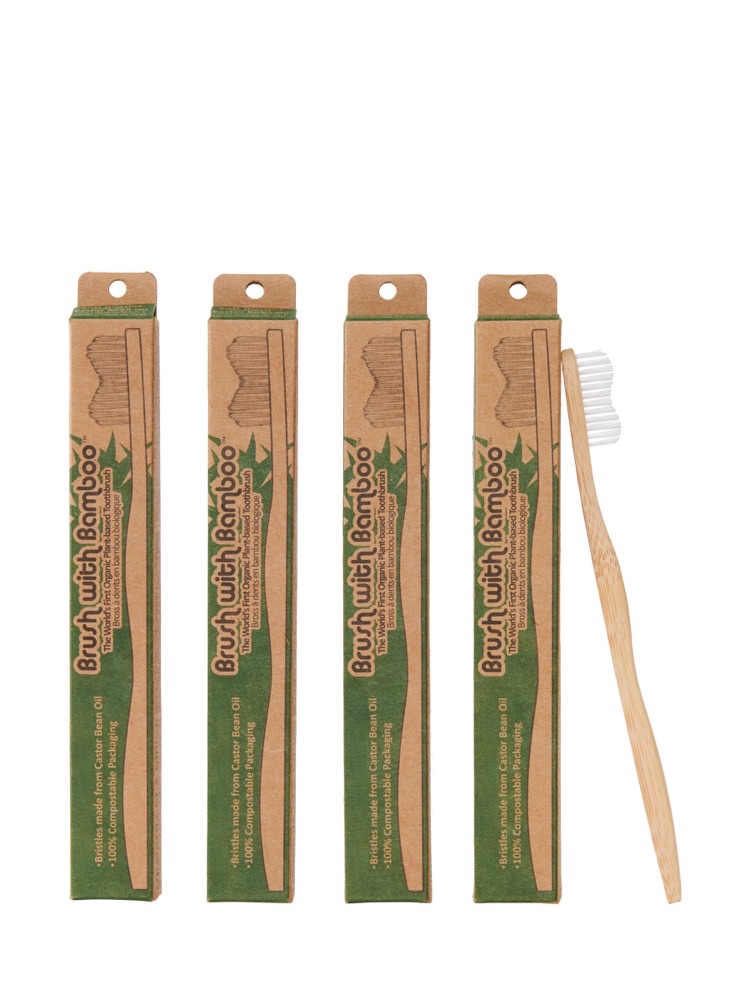 Best OverallBrush with Bamboo Adult Toothbrush |
USDA BiobasedPlant-Based Bristles |
Check price → |
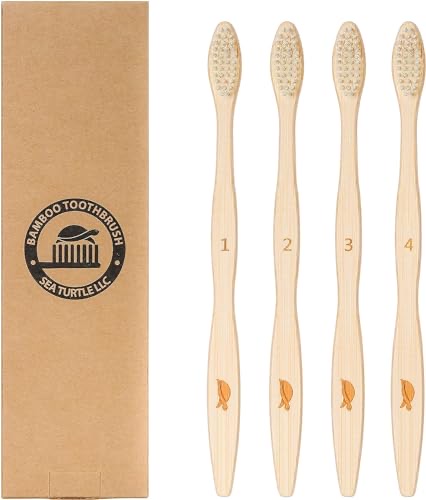 Best BristlesSea Turtle Plant-Based Bamboo Toothbrushes (4-Pack) |
Plant-Based BristlesBamboo Handle |
Check price → |
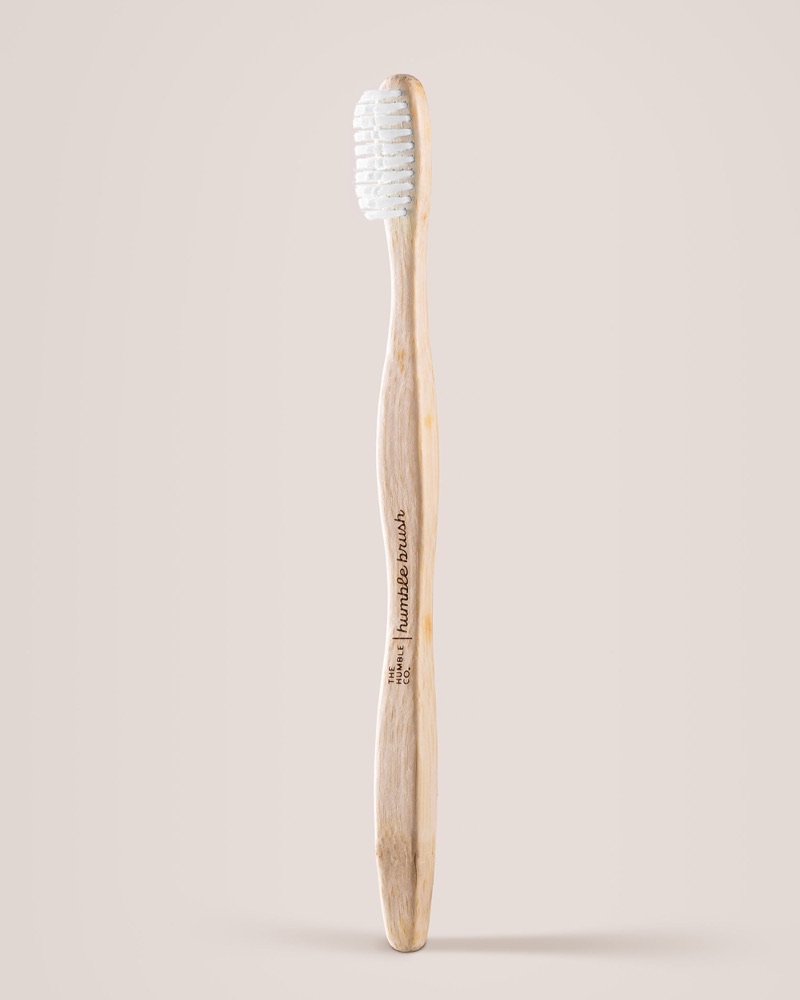 Best BudgetHumble Brush Bamboo Toothbrush |
BPA-FreeDentist-Designed |
Check price → |
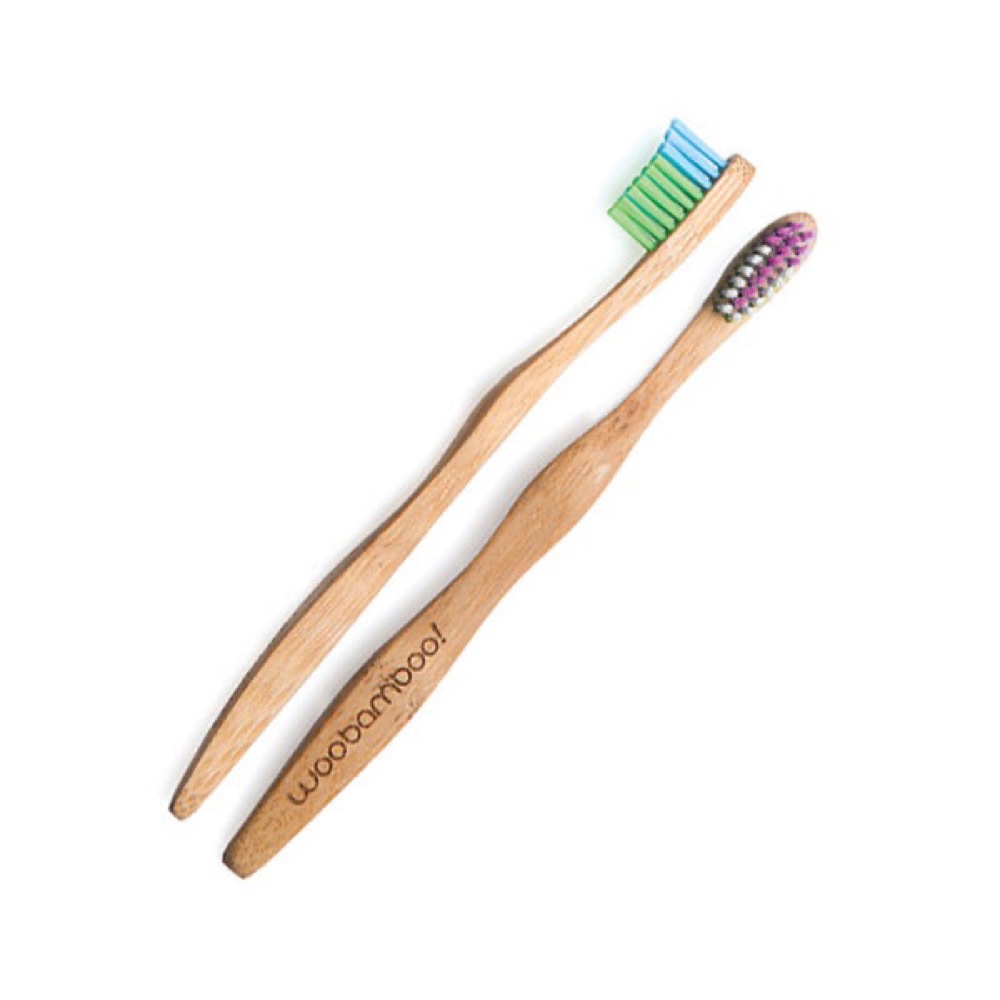 Best for KidsWooBamboo Kids Bamboo Toothbrush |
BPA-FreeExtra-Soft Bristles |
Check price → |
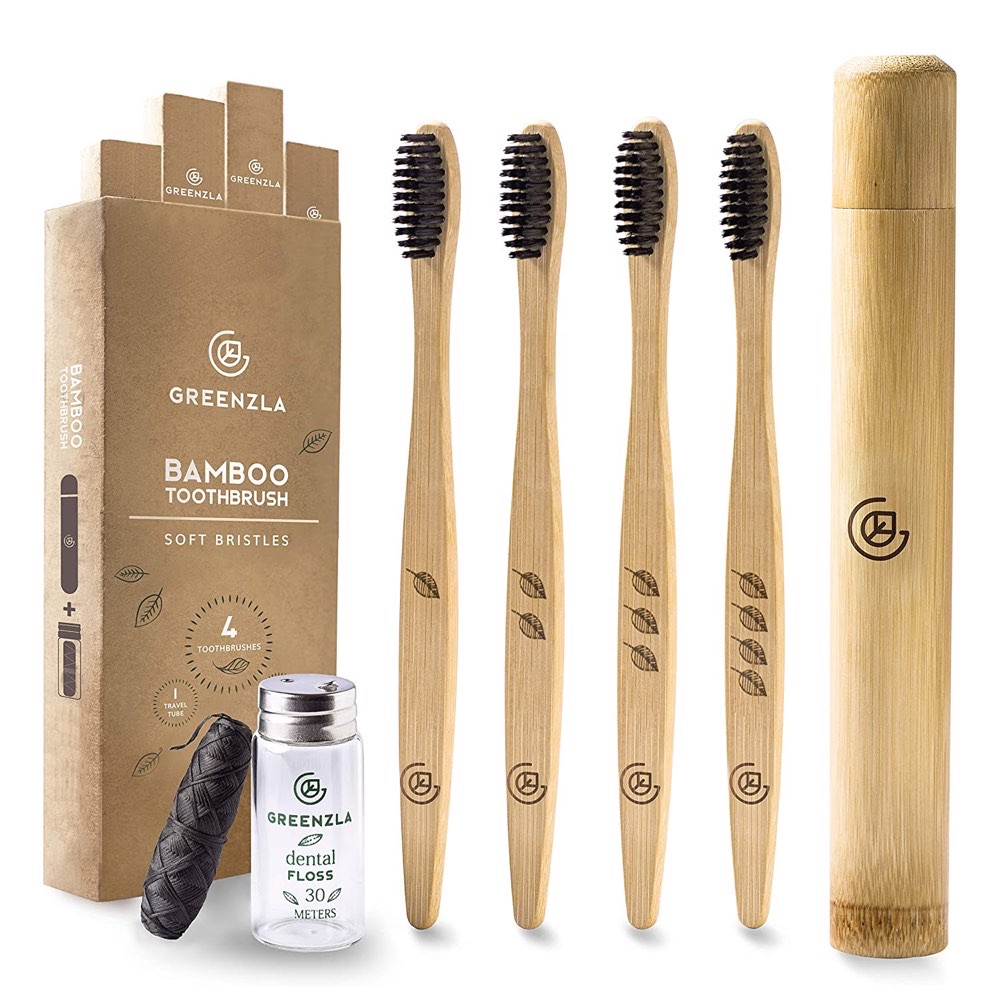 Best Charcoal BristlesGreenzla Bamboo Toothbrush |
BPA-FreeCharcoal-Infused Bristles |
Check price → |
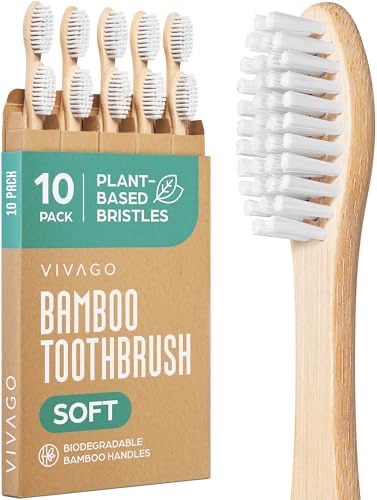 Best Value PackVIVAGO Bamboo Toothbrushes (10 Pack) |
Plant-Based BristlesBamboo Handle |
Check price → |
The 3 Toothbrushes That Are Actually Microplastic-Free in 2026
Of the six bamboo toothbrushes reviewed on this page, only three use plant-based bristles instead of nylon — the part of the brush that Wang et al. (Ecotoxicology and Environmental Safety, 2025; DOI 10.1016/j.ecoenv.2025.118694) measured releasing roughly 2.33 million microplastic particles per person per year. A bamboo handle alone does not change that number; only the bristle material does. These are the three that pass the strict microplastic free toothbrush test:
| Microplastic-free toothbrush | Bristle material | Certification | What it proves |
|---|---|---|---|
| Brush with Bamboo — Best Overall | Castor-oil polyamide 11 (PA-11) — plant-derived bio-nylon from castor bean oil | USDA Certified Biobased Product — independent ASTM D6866 radiocarbon lab analysis confirms the bristle carbon is modern plant carbon, not petroleum-derived | The only brush on this page whose plant-bristle claim is independently verified at the chemical level. Closest feel to a conventional brush of all three picks. |
| Sea Turtle Plant-Based Bamboo Toothbrushes — 4-Pack | Plant-based castor-oil bristles (bio-derived polyamide, not petroleum nylon) | Plant-based bristle claim on front of pack; bamboo handle | The bristle language a conventional nylon-bristle brush cannot use. Strong cost per brush in a household 4-pack. |
| VIVAGO Bamboo Toothbrushes — 10-Pack | Plant-based bristles (bio-derived polyamide); bamboo handle; best per-brush cost of the three verified picks | Plant-based bristle claim on pack | Practical for households switching multiple brushes at once. Ten brushes cover a family of four for a full year. |
The other three picks on this page — Humble Brush, WooBamboo Kids, and Greenzla — use BPA-free nylon bristles: a real landfill improvement over a conventional plastic brush, but the ~2.33-million-particles-per-year shedding figure (Wang et al., 2025) still applies to them because the bristle polymer is unchanged. A bamboo handle alone does not remove the nylon at the bristle tip.
Which Microplastic Free Toothbrush Is Right for Your Household?
The three verified picks pass the same bristle test, but they are built for different households. The American Dental Association recommends replacing a toothbrush every three months — four brushes per person per year — so how a household plans its buying is the practical variable that separates the three options. The table below maps each verified microplastic free toothbrush to the household scenario where it is the strongest choice.
| Verified microplastic free toothbrush | Best for | Pack covers (ADA 4×/year schedule) | Verification level |
|---|---|---|---|
| Brush with Bamboo | Anyone switching from a conventional brush who wants the closest feel, or anyone who wants the highest-confidence certification that the plant-bristle claim is independently proven | Sold individually or in small multipacks — buy 4 per person per year to match the ADA replacement schedule | USDA Certified Biobased — independent ASTM D6866 radiocarbon lab test; the only pick on this page with third-party chemical verification of the bristle feedstock |
| Sea Turtle Plant-Based (4-Pack) | Single person covering one full year, or two people splitting six months each; households that replace at the ADA-recommended interval and want a ready-made annual supply for one person | 4 brushes = 1 person × 12 months at the ADA schedule | Plant-based bristle claim on pack; castor-oil derivation stated by manufacturer; no third-party radiocarbon certification, but the bristle language (“plant-based”, “castor-oil”) is distinct from the BPA-free-nylon language on the three non-qualifying picks |
| VIVAGO Bamboo (10-Pack) | Households switching two or more people at once; the per-brush cost in a 10-pack is the lowest of the three verified picks, and 10 brushes cover a couple for 15 months or a family of three for ten months | 10 brushes = 2 people × 15 months, or 3 people × 10 months, at the ADA schedule | Plant-based bristle claim on pack; same manufacturer-stated derivation as Sea Turtle without a third-party certification mark; best per-brush value of the three verified picks |
ADA replacement schedule source: American Dental Association, Toothbrushes — Oral Health Topics. All three picks above are rated soft-bristle grade and are described by their manufacturers as equivalent in cleaning performance to a conventional nylon-bristle brush. The USDA Biobased distinction on Brush with Bamboo reflects a formal certification program (USDA BioPreferred, requiring ASTM D6866 radiocarbon analysis by an accredited laboratory) rather than a performance difference — all three bristles are plant-derived polyamide-11, but only one carries an independent lab test of that origin.
What Actually Makes a Toothbrush Microplastic-Free?
A microplastic free toothbrush is one whose bristles are not a synthetic plastic polymer. That is the whole definition. The handle matters for landfill and household plastic, but the microplastics that end up inside a person come from the bristles — because that is the piece that is scrubbed, twice a day, against soft mouth tissue for two minutes at a stretch.
The standard bristle in almost every conventional toothbrush is polyamide 6.10, better known as nylon. Nylon bristles wear, split at the tips, and release micrometer-scale fragments into the mouth throughout the recommended three-month lifetime of the brush. Swapping the handle from polypropylene to bamboo does nothing to change what is happening at the tip of the bristle. A truly microplastic free toothbrush replaces the nylon with a plant-based filament (castor-oil-derived polymer, natural boar hair, or similar) — and only a handful of brands do this.
The specific replacement to look for on a pack is polyamide 11 (PA-11), a polyamide whose starting feedstock is sebacic acid extracted from castor bean oil instead of from petroleum. That plant origin is the technical basis for the USDA Certified Biobased Product label a serious plant-bristle brand carries — the program requires an independent lab to run ASTM D6866 radiocarbon analysis and confirm the bristle carbon is modern plant carbon, not fossil-derived. If a bristle pack does not say “plant-based”, “castor oil”, “PA-11”, or carry a USDA Biobased mark, the bristle is a petroleum-derived polyamide and the 2.33-million-particles-per-year Wang et al. figure applies to it.
What the peer-reviewed evidence actually shows
Three studies are worth naming, because together they build the chain: where microplastic particles come from (the bristle), where they end up (the bloodstream), and what happens in tissue exposed to them over time. All three are on the sources list at the end of this guide with DOIs so you can read them yourself.
| Study | Journal & Year | What it measured | Key finding |
|---|---|---|---|
| Wang S, Zheng N, Peng L, An Q, Chen C, Wei Y. “Patterns and risks of microplastic release during primary oral care in Chinese residents.” | Ecotoxicology and Environmental Safety, 2025; vol. 302, article 118694 | Microplastic particles released from commonly-used toothpaste and toothbrushes under simulated brushing | Toothbrushes released an average of ~2.33 × 10⁶ particles per person per year. Toothpaste added another 1.18 × 10⁶. Sixty-three percent of particles were <100 µm; polypropylene was the dominant polymer. |
| Leslie HA, van Velzen MJM, Brandsma SH, Vethaak AD, Garcia-Vallejo JJ, Lamoree MH. “Discovery and quantification of plastic particle pollution in human blood.” | Environment International, 2022; 163:107199 | Blood samples from 22 healthy adult volunteers tested for plastic particle content using pyrolysis-mass spectrometry | Plastic particles detected in 77% of donors (17 of 22). Mean concentration 1.6 µg/mL. Polyethylene terephthalate (PET) was most common (50% of samples), followed by polystyrene (36%) and polyethylene (23%). First direct measurement of microplastics in human blood. |
| Ragusa A, Svelato A, Santacroce C, et al. “Plasticenta: First evidence of microplastics in human placenta.” | Environment International, 2021; 146:106274 | Placentas from 6 women after planned cesarean delivery tested for microplastic content by Raman microspectroscopy | Microplastics detected in all 6 placentas — present on both the fetal side and maternal side, and in the chorioamniotic membranes. Particles were predominantly polypropylene, polyethylene, and polycarbonate, each 5–10 µm in size. First published evidence that microplastics cross the placental barrier and reach the fetal compartment. |
| Marfella R, Prattichizzo F, Sardu C, et al. “Microplastics and Nanoplastics in Atheromas and Cardiovascular Events.” | New England Journal of Medicine, 2024; 390(10):900–910 | Carotid artery plaque samples from 257 patients, prospectively followed for cardiovascular events | 58.4% of patients had detectable microplastics in the plaque. Those patients had roughly a 4.5× higher hazard of nonfatal myocardial infarction, nonfatal stroke, or death from any cause over 34 months of follow-up. |
The Wang paper is the source of the 2.3-million-particles-per-year figure and is the first study to quantify oral-care microplastic release under realistic use. The Leslie et al. Environment International paper (2022) then shows the destination: plastic particles are detectable in the blood of most healthy adults at a mean concentration of 1.6 µg/mL, consistent with the oral-mucosa absorption pathway — the same route the Wang study identifies as the primary entry point for bristle-shed particles. Ragusa et al. (2021) adds the next step in that chain: microplastics were detected in all six human placentas tested, on both the fetal and maternal sides, showing that particles already circulating in the maternal bloodstream can cross the placental barrier and reach the developing fetus. The Marfella NEJM paper is why the endpoint matters — it is the strongest human-outcome evidence to date linking small-particle plastic exposure in vascular tissue to hard cardiovascular events. No study on its own proves a toothbrush causes cardiovascular disease, and no reputable source claims that. Together, the four studies build a specific, evidence-grounded case for the smallest possible change: keep brushing, replace the bristles.
The Wang et al. 2025 numbers, broken down
Because the same paper is where every credible "microplastics from your toothbrush" figure now traces back, it is worth reading its findings in full — not a summary sentence. Every row below is from the same peer-reviewed source (Wang et al., Ecotoxicology and Environmental Safety, 2025, DOI 10.1016/j.ecoenv.2025.118694).
| What was measured | Result | Why it matters for a microplastic-free toothbrush |
|---|---|---|
| Particles released per person, per year, from a conventional nylon-bristle brush | ~2.33 × 10⁶ | The reason to swap the bristles — a bamboo handle alone does not touch this number. |
| Particles released per person, per year, from toothpaste (measured separately) | ~1.18 × 10⁶ | Half again as much on top of the brush — toothpaste choice is a second, smaller lever. |
| Share of particles smaller than 100 micrometres | 63% | Below the threshold you would notice by taste or feel — swallowed silently through the day. |
| Dominant polymer detected | Polypropylene (~22% by mass) | Followed by nylon, polyethylene and polyester — every one of them a petroleum-derived plastic. |
| Route of entry | Oral mucosa + swallowing | The mouth lining absorbs sub-100 µm particles into the bloodstream directly, bypassing the gut's filtration. |
The direct implication: because the bristle is the release point, switching the bristle material — not just the handle — is what actually reduces the exposure. That single sentence is the whole reason this guide leads with plant-based-bristle picks (Brush with Bamboo, Sea Turtle) and lists the BPA-free-nylon options as second-best.
Per-session math: how many microplastics a nylon brush sheds every brushing
The 2.33-million-per-year figure lands harder when it is divided by the routine that produces it. The American Dental Association recommends brushing twice a day for two minutes per session — roughly 730 brushing sessions per person, per year. Applied to the Wang et al. (2025) release number and its 63% sub-100 µm fraction, that produces the same numbers on a scale a shopper can actually feel.
| Time window | Nylon microplastic particles released, per person | Sub-100 µm share (swallowed/absorbed silently) |
|---|---|---|
| Per year (Wang et al. baseline) | ~2,330,000 | ~1,470,000 |
| Per month | ~194,000 | ~122,000 |
| Per day (two 2-minute sessions) | ~6,400 | ~4,000 |
| Per single brushing session | ~3,200 | ~2,000 |
| Per minute of brushing | ~1,600 | ~1,000 |
Every particle count is derived from a single peer-reviewed source: Wang S, Zheng N, Peng L, An Q, Chen C, Wei Y. Ecotoxicology and Environmental Safety, 2025; 302:118694, DOI 10.1016/j.ecoenv.2025.118694. The per-year measurement is the paper's own; per-month, per-day and per-session are the same figure divided by the American Dental Association's twice-daily brushing schedule (730 two-minute sessions per year). The sub-100 µm column applies the paper's own 63% size-fraction to each row.
The single-session number is the one to sit with: a conventional nylon-bristle toothbrush releases on the order of three thousand microplastic particles into the mouth every time it is used, and roughly two thousand of them are small enough to be absorbed through the oral mucosa or swallowed without any taste or texture cue. A microplastic free toothbrush — one whose bristle is castor-oil bio-polyamide or natural fibre instead of nylon — removes that release at source. A bamboo handle alone, brushing session by brushing session, changes none of these numbers.
Microplastic free toothbrush: how many particles the switch removes over time
The per-year and per-session figures both understate what actually matters to a shopper: the total exposure prevented once the switch is made. Because the American Dental Association recommends replacing a toothbrush every three months, the reduction begins at the very first brush and compounds session after session. The table below projects the Wang et al. (2025) baseline forward across the timeframes people actually plan their lives in — a single 3-month brush cycle, the first year, five years, and a typical adult lifetime of ~60 years of daily brushing.
| Time after switching to a microplastic free toothbrush | Particles NOT released into the mouth | Sub-100 µm share (bloodstream‑absorbable) |
|---|---|---|
| 1 brush cycle (3 months, one new brush) | ~583,000 | ~367,000 |
| Year 1 | ~2,330,000 | ~1,470,000 |
| Year 5 | ~11,650,000 | ~7,340,000 |
| Year 10 | ~23,300,000 | ~14,680,000 |
| 60 years of adult brushing (US life-expectancy proxy) | ~140 million | ~88 million |
All rows are the Wang et al. (2025) per-year baseline (~2.33 million particles/person/year, DOI 10.1016/j.ecoenv.2025.118694) scaled by time. The sub-100 µm column applies the paper's own 63% size fraction — the range that can cross oral mucosal tissue and reach the bloodstream directly (see Squier & Kremer on oral mucosal permeability, J Natl Cancer Inst Monogr, 2001, PMID 11694559). Assumes the person continues to brush twice daily per ADA guidance; nothing here is extrapolated beyond the source figures.
The one number to sit with is the last row: a single-line switch away from a nylon-bristle brush — kept in place across an adult lifetime — removes an estimated 140 million microplastic particles from oral exposure that would otherwise land, in the source paper's own numbers, in the mouth of the person using it. That is why a microplastic free toothbrush shows up on almost every short list of high-leverage, low-cost, one-time swaps: the ongoing benefit accumulates from a decision made once.
Microplastic free toothbrush: the same math scaled to a whole household
The Wang et al. (2025) figure is a per-person number, and every household has more than one mouth in it. A single microplastic free toothbrush change made by one adult removes ~2.33 million particles/year at source; the same change made simultaneously by everyone in the house scales linearly with the size of the household. Because the paper's methodology measured a single brush per user, this is a straight multiplication — nothing here is extrapolated beyond the source measurement. The table below uses the US Census Bureau's 2024 Households and Families report categories (single, couple, family with two children, larger family) so a shopper can find the row that matches their home in seconds.
| Household size | Particles released per year by nylon brushes (all users) | Particles avoided over 10 years by switching everyone to a microplastic free toothbrush | Sub-100 µm share over 10 years (bloodstream‑absorbable) |
|---|---|---|---|
| 1 adult (solo household) | ~2,330,000 | ~23,300,000 | ~14,680,000 |
| 2 adults (couple) | ~4,660,000 | ~46,600,000 | ~29,360,000 |
| Family of 4 (two adults, two children) | ~9,320,000 | ~93,200,000 | ~58,720,000 |
| Family of 6 (multigenerational or larger) | ~13,980,000 | ~139,800,000 | ~88,070,000 |
Every household-scale figure is the Wang et al. (2025) per-person baseline of ~2.33 million particles/person/year (Ecotoxicology and Environmental Safety, DOI 10.1016/j.ecoenv.2025.118694) multiplied by the number of users. The sub-100 µm column applies the paper's own 63% size fraction. Children's brushes are grouped with adult brushes because the Wang paper's protocol did not distinguish head size, and pediatric bristle material is the same polyamide-6.10 as adult brushes; the number is the closest honest approximation without another peer-reviewed measurement. Ten years is the interval most families sit inside; the ADA's twice-daily brushing schedule is assumed throughout.
The row worth pausing on is the middle one: a typical family of four that switches every mouth in the house to a microplastic free toothbrush avoids on the order of 93 million microplastic particles across the next ten years — roughly 59 million of them small enough to cross the oral mucosal barrier and reach the bloodstream directly (Squier & Kremer on oral mucosal permeability, J Natl Cancer Inst Monogr, 2001, PMID 11694559). No other single-line change on this site's microplastics statistics roundup comes close to that reduction per dollar spent; a four-pack of Sea Turtle plant-bristle brushes at the household level is under $20 for a full year of the entire family's brushing.
How a nylon brush compares to the rest of a person's microplastic intake
The 2.33 million figure is easier to react to when it sits next to the numbers people already have for food, water and air. The comparison below uses the peer-reviewed baseline established by Cox, Covernton, Davies, Dower, Juanes and Dudas at the University of Victoria (Environmental Science & Technology, 2019; 53(12):7068–7074; DOI 10.1021/acs.est.9b01517) — the paper Google Scholar shows as the most-cited quantification of human microplastic intake, with more than 2,900 citations. Every number below is from a named, dated, peer-reviewed source.
| Exposure source | Estimated particles per person, per year | Peer-reviewed source |
|---|---|---|
| Conventional nylon-bristle toothbrush (twice daily, simulated brushing) | ~2,330,000 | Wang et al., Ecotoxicology and Environmental Safety, 2025; 302:118694 |
| Dietary intake (food only, adult, US diet) | ~39,000–52,000 | Cox et al., Environmental Science & Technology, 2019; 53(12):7068–7074 |
| Adding inhalation to the dietary figure | ~74,000–121,000 | Cox et al., Environmental Science & Technology, 2019 |
| Additional intake for bottled-water-only drinkers | +~90,000 (vs. +~4,000 for tap-water drinkers) | Cox et al., Environmental Science & Technology, 2019 |
| Standard-toothpaste release (Chinese residents, twice daily) | ~1,180,000 | Wang et al., Ecotoxicology and Environmental Safety, 2025 |
Two things follow directly from that table. First, a nylon toothbrush contributes roughly 19–30 times more microplastic particles per year than the entire measured food-plus-air baseline for an average adult — it is not a minor rounding item on the exposure ledger, it is the single largest identified daily-life source. Second, because the release comes from the bristle physically abrading against oral tissue, no filter downstream can catch it — the only reduction lever is to change what the bristle is made of at the source. That is the argument for a genuinely microplastic-free toothbrush over a bamboo-handle-with-nylon-bristle brush.
None of this is a claim that any one toothbrush causes any one disease. It is the straightforward implication of two separate, cited, publicly readable studies: measured release from a nylon-bristle brush is on the order of millions of particles per year (Wang et al., 2025), and typical background microplastic intake from everything else combined is on the order of tens of thousands (Cox et al., 2019). Swapping the bristle removes the largest measured single source. That is why this page exists.
Combined oral-care microplastic exposure: brush and toothpaste together
The Wang et al. (2025) study measured two oral-care sources separately using the same protocol and the same participant cohort. The nylon bristle is the larger source at roughly 2.33 million particles per person per year; standard toothpaste adds another 1.18 million. Combined, the two routine products most households use twice a day contribute an estimated 3.51 million microplastic particles per person per year — roughly 29–47× the entire dietary + inhalation baseline measured by Cox et al. (2019). The table below shows the breakdown from a single peer-reviewed source.
| Oral-care source | Particles per person, per year | Share of combined total |
|---|---|---|
| Conventional nylon-bristle toothbrush (twice daily, simulated brushing) | ~2,330,000 | ~66% |
| Standard toothpaste (used alongside brush, twice daily) | ~1,180,000 | ~34% |
| Combined oral-care total | ~3,510,000 | 100% |
| For comparison: entire dietary + inhalation baseline, adult US diet | ~74,000–121,000 | — |
All oral-care figures from Wang S, Zheng N, Peng L, An Q, Chen C, Wei Y. Ecotoxicology and Environmental Safety, 2025;302:118694 (DOI 10.1016/j.ecoenv.2025.118694). Both sources were measured under the same brushing simulation; the study reports them separately and the combined figure is their direct sum. Dietary baseline for comparison: Cox KD et al., Environmental Science & Technology, 2019;53(12):7068–7074 (DOI 10.1021/acs.est.9b01517).
Switching to a microplastic free toothbrush removes the larger of the two oral-care sources — roughly 66% of the combined total. For people who also want to address the toothpaste portion, pairing a plant-bristle brush with a toothpaste in non-plastic packaging (such as a toothpaste tablet) addresses both sources simultaneously; see our guide to microplastic-free toothpaste for the specifics. The brush is the higher-leverage change: it accounts for two-thirds of the combined total, it is the source the Wang paper identifies as the primary release mechanism (bristle abrasion against oral mucosa), and the plant-bristle swap costs no cleaning-performance trade-off compared to a standard nylon brush.
Does a worn toothbrush shed more microplastics? Bristle wear and the 3-month replacement rule
The Wang et al. (2025) figure — roughly 2.33 million microplastic particles per person per year — was measured under the study's simulated brushing protocol. What the measurement doesn't directly address is a question many people naturally ask: does a well-worn three-month-old brush shed more particles than a new one?
No peer-reviewed study has yet measured the shedding-rate progression of nylon bristles from new through a full 90-day replacement cycle under the same methodology. What is documented is the reason the American Dental Association recommends replacement at that interval: frayed and splayed bristles — visibly bent or kinked filament tips — are significantly less effective at removing plaque from tooth surfaces and the gum line (ADA, Toothbrushes — Oral Health Topics). Frayed tips also expose a larger surface area of abraded polymer to the oral environment: the structural change that makes a worn bristle weaker at cleaning is the same change that leaves more polymer ends in contact with the mouth during each stroke.
| Bristle condition | Cleaning effectiveness (ADA evidence) | Microplastic shedding potential |
|---|---|---|
| New brush (weeks 1–4) | Full plaque removal; bristle tips intact and upright | Baseline — ~2.33 million particles/year (Wang et al., 2025); no frayed tips |
| Mid-life brush (weeks 5–8) | Some softening; still effective with consistent technique | Not independently measured — bristle tips beginning to abrade at the ends |
| Worn brush (weeks 9–12) | Visibly frayed or splayed; ADA notes measurably reduced plaque removal | Not independently measured; frayed tips present more abraded polymer surface to the mouth |
| Beyond 3 months | ADA recommends replacing before reaching this point | Outside the studied range; replace regardless of bristle material |
Cleaning effectiveness data: American Dental Association, Toothbrushes — Oral Health Topics. Baseline shedding: Wang S et al., Ecotoxicology and Environmental Safety, 2025;302:118694, DOI 10.1016/j.ecoenv.2025.118694. Mid-life and worn-brush shedding rates: not independently measured in peer-reviewed literature as of August 2026.
The practical takeaway is the same regardless of which bristle material you use: replacing at the ADA-recommended three-month interval — or sooner if bristles visibly fray — is consistent with both peak cleaning performance and minimizing oral contact with abraded polymer material. For households that have already switched to a plant-based-bristle brush, the replacement schedule still applies: PA-11 bristles fray on the same timeline as nylon, and a frayed plant-bristle brush cleans less effectively even though its abraded filaments are bio-derived rather than petroleum-derived.
Why the oral route is different from dietary microplastic exposure
The comparison table above shows a nylon toothbrush contributing 19–30 times as many particles per year as the entire dietary baseline. But those numbers understate the difference in one important way: the route of entry is not the same, and the body handles the two routes differently.
Dietary microplastics enter through the gut, where the liver acts as a first-pass filter and where most particles too large to cross intestinal epithelium are excreted. The oral mucosa — the soft tissue lining the inside of the cheeks, gums, and under the tongue — works differently. It is one of the most permeable tissue surfaces in the body (Squier & Kremer, “Biology of oral mucosa and esophagus,” J Natl Cancer Inst Monogr, 2001;(29):7–15, PMID 11694559): the same property exploited by sublingual medications (nitroglycerine, B-12, some antivirals) that are designed to dissolve under the tongue and enter the bloodstream within seconds, bypassing the digestive system entirely.
Wang et al. (2025) specifically identifies the oral mucosal route as the primary pathway for bristle-shed particles because 63% of the released particles are smaller than 100 micrometers — the size range where direct mucosal uptake is possible and where particles can reach the bloodstream before they are ever swallowed. The Leslie et al. (2022) blood study, which detected microplastics at a mean concentration of 1.6 µg/mL across 17 of 22 healthy adult donors, is consistent with daily exposure entering through a high-permeability surface rather than the gut; no study has yet isolated the specific toothbrush bristle contribution to measured blood burden, but the mechanism is directly implicated by the oral route Wang identifies.
The practical implication is the same one the Wang paper draws: because the bristle is the release point and the mouth is the absorption site, no downstream intervention — no filter, no dietary change — can intercept those particles before they contact the oral mucosa. Switching the bristle material is the only intervention that stops the release at source.
Bristle-material decoder: which are actually microplastic-free, and which aren't
Marketing terms like "eco," "biodegradable," "bamboo," and "plant-based" get used loosely, and a bamboo handle with a nylon bristle is often sold as if the whole thing qualifies. It doesn't. The table below decodes the five materials actually used for toothbrush bristles today, what each one is chemically, and whether it meets the strict "microplastic-free" test — the bristle itself is not a synthetic plastic polymer that sheds into the mouth during brushing.
| Bristle material | What it is | Sheds microplastics? | Compostable at home? |
|---|---|---|---|
| Nylon-6.10 (polyamide 6.10) — the conventional standard | Petroleum-based synthetic polyamide made from hexamethylenediamine and sebacic acid. The bristle in every mass-market plastic toothbrush. | Yes — ~2.33 million particles per person, per year (Wang et al., 2025) | No — persists 400+ years in landfill (Geyer, Jambeck & Law, Science Advances, 2017) |
| BPA-free nylon (still polyamide, just without bisphenol A additives) | Same polyamide backbone as conventional nylon; removes one chemical concern but not the plastic itself. | Yes — a polyamide bristle sheds regardless of whether the additives contain BPA | No — same polymer, same landfill persistence |
| Castor-oil bio-nylon (polyamide 11 / PA-11, marketed as "plant-based bristle") | Bio-derived polyamide made from 11-aminoundecanoic acid, itself extracted from ricinoleic acid in castor bean oil. USDA-verified biobased content varies by brand (typically 62–100%); independence confirmed by ASTM D6866 radiocarbon analysis. Used by Brush with Bamboo and similar plant-bristle brushes. | Reduced but not zero — still a polymer filament, though the source is renewable rather than petroleum-derived | Partial — commercial composting only, not home compost |
| Boar hair (natural animal bristle) | Keratin fibre — the same protein as human hair. Used in traditional Central and Eastern European brushes; ethical concerns for vegans. | No — keratin is a protein, not a synthetic polymer | Yes — fully biodegradable in home compost |
| Natural plant fibre (sisal, agave, tampico) | Coarse cellulose fibres from plants. Rare in adult brushes; feel is noticeably firmer than nylon. | No — cellulose fibre, not plastic | Yes — fully biodegradable in home compost |
The one line to remember: a brush is only microplastic-free if the bristle is not a synthetic polymer, and the two credible options at the drugstore price point are castor-oil bio-nylon (a large reduction, still not zero) and boar hair (true zero, animal-derived). Everything else marketed as "bamboo" or "eco" is a bamboo-handle brush with a nylon bristle — a real improvement on landfill waste, but the 2.33-million-particles-per-year number does not change at the bristle head. The verdict scorecard below sorts the six picks on this page against that exact test.
The 30-second aisle test: how to spot a real microplastic free toothbrush with the box in hand
The bristle-material decoder above is the technical version of the shelf decision. The version below is the one to use in front of the toothbrush wall, before checkout. Read the back of the pack and ask these three questions, in order — a genuine microplastic free toothbrush answers yes, yes, yes. Anything else is a bamboo-handle brush with a nylon bristle, no matter how the front of the pack is worded.
| Ask | Yes looks like… | No looks like… |
|---|---|---|
| 1. Does the pack name the bristle material — not just the handle? | "Plant-based bristles", "castor-oil bristles", "PA-11", "polyamide 11", "USDA Biobased bristles" | Front of pack says "bamboo toothbrush" or "eco toothbrush" and the back is silent on the bristle — that silence is nylon, by default. |
| 2. Is the bristle carbon a plant carbon, verified? | USDA Biobased mark (independent ASTM D6866 lab confirms plant carbon), or explicit "castor oil" on the bristle line | "BPA-free nylon", "Nylon 6", "Nylon 6.10", "polyamide 6.10", "DuPont Tynex" — every one of these is a petroleum polyamide, and the Wang et al. 2025 ~2.33-million-particles-per-year figure applies to it. |
| 3. Does the pack avoid the marketing distractions? | Nothing on the pack about "charcoal-infused", "activated charcoal" or "whitening bristles" — a bristle whose selling point is a coating is almost always a nylon underneath | Charcoal-black, ombre, or gradient-tint bristles — the tint is what's being sold because the base polymer isn't the story |
Every disqualifier above is a real filament chemistry that shows up on real US packaging today; the plant-based-bristle language is the wording used by the three picks on this page that pass the strict test (Brush with Bamboo, Sea Turtle, VIVAGO 10-pack). The USDA Biopreferred program's Certified Biobased Product mark is the label the third question is looking for — and it is granted only after an independent lab runs ASTM D6866 radiocarbon analysis to prove the bristle carbon is modern plant carbon rather than fossil‑derived.
The three-question test is deliberately biased toward the negative: if the pack doesn't answer question 1, the bristle is nylon. Plant-bristle brands lead with the bristle chemistry on the front of the box because the USDA Biobased certification is the whole reason to pay $4–$6 for their brush over a $2 drugstore one; conventional brands don't say the word "nylon" on the front, but the standard petroleum polyamide is what fills a bristle head by default. Everything measured by Wang et al. (2025, DOI 10.1016/j.ecoenv.2025.118694) is that default filament: no pack silence has ever meant something other than nylon.
Why Plastic Toothbrushes Are a Problem
A conventional toothbrush has four main material components, each carrying its own set of concerns:
Polypropylene handles: The handle is made from polypropylene (PP, plastic #5), a petroleum-derived polymer. While polypropylene is considered one of the safer plastics in terms of chemical leaching, the handle comes into direct contact with the hands and mouth environment during every brushing session. More significantly, polypropylene does not biodegrade — it photodegrades into smaller and smaller fragments that enter soil and water systems.
Nylon bristles: This is the highest-concern component. Nylon is a synthetic polyamide polymer. Bristles wear down and shed during normal brushing — especially as they age and fray. The microscopic nylon particles released during this process are directly ingested or absorbed through the oral mucosa. Nylon also requires significant petrochemical processing to manufacture and is not biodegradable.
BPA in some handles: Some toothbrush handles and the rubber grip inserts contain bisphenol A (BPA) or related bisphenol compounds (BPS, BPF). These endocrine-disrupting chemicals can leach from the plastic, particularly under heat or abrasion. While the exposure is lower than, say, a heated plastic food container, it is a direct oral exposure occurring twice daily for years. Look for explicitly BPA-free certifications when evaluating any product.
Environmental persistence: The combination of materials in a conventional toothbrush means it cannot be processed by recycling facilities. The plastic, nylon, and rubber must be separated for recycling, but they are permanently bonded in manufacturing. Every toothbrush produced since the mid-20th century still exists in some form in the environment.
The oral mucosa — the soft tissue lining the inside of the mouth — is among the most permeable surfaces in the human body. Unlike the digestive tract, which has filtration mechanisms, compounds absorbed sublingually (under the tongue) and through the cheek and gum tissue pass directly into the bloodstream. Nylon microfibers shed from toothbrush bristles during brushing have been detected in saliva samples and can follow this direct absorption pathway. The warm, wet, mechanically abrasive conditions of toothbrushing accelerate bristle wear and particle release compared to environmental degradation alone.
What to Look for in a Plastic-Free Toothbrush
Not all "eco" toothbrushes are equal. Here is what to evaluate when choosing one:
- Handle material: Bamboo is the gold standard — it is rapidly renewable (bamboo matures in 3 to 5 years vs. 40+ for hardwood), naturally antimicrobial due to its silica content, and compostable. Some brands use sustainably sourced wood. Avoid handles marketed as "biodegradable plastic" — these typically require industrial composting conditions that most consumers cannot access.
- Bristle material: This is the most important factor for reducing microplastic exposure. Plant-based bristles made from castor oil polymers (like those used by Bite) are the least plastic option. Boar hair bristles are another traditional option but raise animal welfare considerations. BPA-free nylon is significantly better than conventional nylon but still releases synthetic particles. Charcoal-infused nylon bristles are mostly a cosmetic addition — prioritize the base material over the coating.
- Bristle softness: Dentists universally recommend soft bristles. Medium and hard bristles cause gum recession and enamel abrasion over time. Most adults should use soft; children should use extra-soft.
- Certifications: Look for USDA Biobased certification (verifies the percentage of biological content), FSC certification for wood handles, and explicit BPA-free claims with testing documentation.
- Packaging: Plastic-free packaging (cardboard or paper) completes the sustainability picture. Several brands on this list ship with zero-plastic packaging.
- Compostability: Can the handle be composted? Can the bristles be removed and composted separately? The best brands make this clear and easy.
Quick Picks
| Best For | Pick | Why It Made the List |
|---|---|---|
| Best Overall | Brush with Bamboo | USDA Biobased certified handle with plant-based castor-oil bristles — the closest feel to a conventional brush. |
| Best Bristles | Sea Turtle Plant-Based Bamboo Toothbrushes | Plant-based bristles on a natural bamboo handle, sold as a 4-pack. |
| Best Budget | Humble Brush | Dentist-designed, BPA-free nylon, sold everywhere — the easiest first swap. |
| Best for Kids | WooBamboo Kids | Child-sized head, extra-soft bristles, and fun colors that make the switch stick. |
| Best Charcoal Bristles | Greenzla Bamboo Toothbrush | Smooth-finish bamboo handle with charcoal-infused soft bristles — a 4-pack with travel case and floss. |
| Best Value Pack | VIVAGO Bamboo Toothbrushes (10 Pack) | A 10-pack of bamboo toothbrushes with BPA-free, soft plant-based bristles — enough to cover a household or keep spares. |
Which of These Six Is Actually Microplastic-Free? (2026 Verdict Scorecard)
Most "eco" toothbrush roundups — including several of ours before this update — blur the two things a shopper is trying to sort out: a bamboo handle removes one plastic problem, and a plant-based bristle removes the different, more urgent one (the microplastic release measured in Wang et al., 2025). This scorecard splits the six picks below by that strict criterion, in one place, so nobody has to read six product cards to get the answer.
| Brush | Handle | Bristle base | Strictly microplastic-free? | Est. nylon particles avoided per year* |
|---|---|---|---|---|
| Brush with Bamboo | USDA Biobased bamboo | Plant-based (castor-oil filament) | Yes — best-in-class | ~2.33 million |
| Sea Turtle 4-pack | Bamboo | Plant-based (castor-oil filament) | Yes | ~2.33 million |
| VIVAGO 10-pack | Bamboo | Plant-based, BPA-free (per listing) | Yes | ~2.33 million |
| Humble Brush | Bamboo | BPA-free nylon | Partial — handle only | 0 (bristle still nylon) |
| WooBamboo Kids | Bamboo | BPA-free nylon (extra-soft) | Partial — handle only | 0 (bristle still nylon) |
| Greenzla | Bamboo | BPA-free nylon (charcoal-infused) | Partial — handle only | 0 (bristle still nylon) |
*Estimated avoided release is the Wang et al. (2025) per-person, per-year figure of ~2.33 × 10⁶ particles from a conventional nylon-bristle brush — applied here on the assumption that a plant-based bristle removes the nylon shedding at the release point. It is not a claim about total oral microplastic exposure (toothpaste, dust, food and water all contribute independently).
Read the scorecard this way: if the goal is strictly a microplastic-free toothbrush, choose one of the three plant-based-bristle rows. If the goal is a first, low-friction swap off polypropylene handles — and the household is not ready to change bristle feel yet — the three BPA-free-nylon rows are still a real upgrade on a conventional brush (bamboo handle, no BPA, no rubber grip inserts), just not the full swap. The rest of this guide covers each pick in detail.
How to Choose a Microplastic Free Toothbrush: a 3-Step Guide
Most people searching for a microplastic free toothbrush are staring at a shelf of bamboo handles and wondering which one actually removes the plastic problem versus which one just looks like it does. This three-step filter gives a clear answer in about a minute.
Step 1 — Confirm the bristle, not just the handle
The phrase "microplastic free toothbrush" has a specific technical meaning: the bristle filaments themselves are not made from a synthetic petroleum polymer. A bamboo handle with nylon bristles is a partial swap — the handle is plant-based but the nylon tip still releases particles during brushing (Wang et al., Ecotoxicology and Environmental Safety, 2025 measured ~2.33 million particles per person per year from the bristle alone). Confirming the bristle material is listed as "plant-based," "castor oil," or "bio-based polyamide" on the packaging is the whole filter. If it says "BPA-free nylon" only, that is a nylon brush with one additive removed — better than a conventional brush, but not the same as a genuinely microplastic free toothbrush.
Step 2 — Match the bristle softness to your mouth
The American Dental Association recommends soft bristles for the vast majority of adults, and extra-soft for children under 12. Medium and hard bristle ratings accelerate gum recession and enamel wear regardless of what the bristle is made from. Every plant-based-bristle pick on this list ships in a soft grade; the kids' pick (WooBamboo) is extra-soft. If your previous plastic brush was medium, the switch to soft will feel unfamiliar for a day or two and is still the right call: softer bristles clean more thoroughly with proper technique because they flex into the gumline rather than scrubbing across the surface.
Step 3 — Choose the right pack size for your household
A toothbrush should be replaced every 3 months. For one adult, a 4-pack covers a full year with no reordering. For a family, the VIVAGO 10-pack or the Sea Turtle 4-pack bought in volume is the practical move. Starting with a single brush from Brush with Bamboo is the right call if you have never used a plant-based bristle before and want to confirm the feel matches your expectations before buying a year's supply. Either way, a microplastic free toothbrush is a daily routine change, not a one-time purchase — the right pack size removes the friction of running out.
The 3-second pack test: what to look for on a microplastic free toothbrush box
Every question below has one right answer. Reading the fine print on the back of the box, in order, takes about three seconds and settles whether the brush in your hand is a genuine microplastic free toothbrush or a bamboo handle with a nylon bristle.
| What the pack says | What that means | Is it a microplastic free toothbrush? |
|---|---|---|
| Bristles: castor oil, plant-based, bio-based polyamide, PA-11 or Nylon 11 | The filament is polyamide-11 made from castor bean oil — a bio-derived polymer, USDA Biobased verifiable, that does not add new petroleum plastic to the mouth. | Yes — this is the strict definition. Example on this list: Brush with Bamboo, Sea Turtle, VIVAGO. |
| Bristles: BPA-free nylon, Nylon 6, Nylon 6.10, polyamide 6.10, or just nylon | Petroleum polyamide with the BPA additive removed. Same base plastic as a conventional brush; the “BPA-free” label is about additives, not the fiber itself. | No — a nylon bristle sheds during brushing regardless of BPA content (Wang et al., 2025). |
| Bristles: charcoal-infused nylon or activated charcoal bristles | Nylon bristle with charcoal added for whitening marketing. The base filament is still nylon. | No — the charcoal changes the color, not the polymer. |
| Only the handle is described as bamboo, wood, or plant-based; the bristle is silent | Silence about the bristle almost always means nylon — the pack would say “plant-based” on the bristle if it were. | No — assume nylon bristle unless the pack explicitly names a plant-based filament. |
| Bristles: boar hair, horsehair, or Miswak (Salvadora persica twig) | Natural animal or plant fiber. Miswak is the traditional Middle Eastern chew-stick; boar and horsehair are firmer than a soft nylon. | Yes — no synthetic polymer in the bristle. Not vegan (boar/horse). |
Rule of thumb: if the packaging does not name the bristle material at all, treat it as nylon. Brands genuinely using plant-based filaments say so on the front of the pack, because the certification (USDA Biobased) is the whole selling point.
Microplastic Free Toothbrush: What the Switch Changes and What It Doesn't
The phrase "microplastic free toothbrush" has one specific technical meaning: the bristle filaments themselves are not a petroleum-derived synthetic polymer. That definition matters because many popular "eco" and "bamboo" toothbrushes use this language loosely — a brush can be marketed as eco-friendly while having a conventional nylon bristle that releases the same ~2.33 million particles per year as a drugstore plastic toothbrush (Wang et al., Ecotoxicology and Environmental Safety, 2025).
The table below shows exactly what changes — and what stays the same — when you make the switch to a genuinely microplastic free toothbrush:
| What changes | Conventional nylon brush | Microplastic free toothbrush (plant-based bristle) |
|---|---|---|
| Bristle polymer source | Petroleum-derived polyamide-6.10 (PA-6.10) — synthesized from hexamethylenediamine and sebacic acid | Bio-derived polyamide-11 (PA-11) from castor bean oil, or natural protein fiber (boar hair) |
| Oral microplastic release per person, per year | ~2.33 million particles (Wang et al., Ecotoxicology and Environmental Safety, 2025; DOI 10.1016/j.ecoenv.2025.118694) | Not yet independently peer-reviewed for PA-11 bristles under the same methodology — the petroleum polymer measured as the primary release source (PA-6.10) is replaced at the source |
| Handle material | Polypropylene (petroleum plastic, not recyclable at curbside) | Bamboo (rapidly renewable, compostable without bristle head) |
| End-of-life disposal | Landfill only — polypropylene + nylon, 400+ years (Geyer, Jambeck & Law, Science Advances, 2017) | Bamboo handle composts at home after removing bristle head; PA-11 bristles: commercial composting only; boar hair bristles: fully home-compostable |
| Cleaning effectiveness | ADA-accepted soft bristle | Equivalent — all plant-based-bristle picks below are soft-grade and dentist-recommended |
| What does NOT change | Toothpaste is a separate, second source of oral microplastics — roughly 1.18 million particles per person per year in the same Wang et al. study. Switching the toothbrush removes the bristle source; switching to a non-toxic toothpaste addresses the second route. Both levers matter; the toothbrush is the larger one. | |
The honest summary: a genuinely microplastic free toothbrush removes the single largest measured source of oral microplastic exposure (the nylon bristle, at ~2.33 million particles per year) and replaces the petroleum plastic handle with a compostable bamboo one. The toothpaste is a separate lever, worth pulling once the brush is settled.
Is a silicone toothbrush a microplastic free toothbrush?
A growing shelf of silicone-bristle brushes — adult and infant — is marketed as “plastic-free,” “non-toxic,” or “eco.” The single question this page has to answer, in plain words, is whether a silicone toothbrush meets the strict definition of a microplastic free toothbrush the way a plant-bristle brush does. The short answer is no, silicone bristles are a synthetic polymer too — a different one from nylon, but not a plant fibre — and no peer-reviewed study has yet measured whether they shed silicone particles under normal brushing the way nylon has been measured.
The chemistry is settled and public. What is sold as “silicone” on a toothbrush pack is polydimethylsiloxane (PDMS), a synthetic silicon-oxygen polymer with methyl side groups — IUPAC name and structure documented in the US National Library of Medicine’s PubChem record (PubChem CID 6433516). It is not a naturally occurring fibre. It does not biodegrade in a home compost bin or in a landfill in any human-relevant timeframe. The European Chemicals Agency’s public dossier on the low-molecular-weight cyclic siloxanes D4, D5 and D6 that persist in silicone products classifies them as very persistent and very bioaccumulative under REACH (ECHA candidate list for authorisation, SVHC entries for octamethylcyclotetrasiloxane and decamethylcyclopentasiloxane).
What the Wang et al. (2025) study measured, and what it did not:
- Did measure: microplastic release from conventional nylon-bristle brushes under simulated brushing — ~2.33 million particles per person per year, 63% smaller than 100 µm, dominant polymers polypropylene, polyamide, polyethylene and polyester (Wang S et al., Ecotoxicology and Environmental Safety, 2025; 302:118694, DOI 10.1016/j.ecoenv.2025.118694).
- Did not measure: PDMS (silicone) release from silicone-bristle brushes under the same protocol. No equivalent quantification of silicone toothbrush shedding has been published in a peer-reviewed journal indexed in PubMed as of August 2026.
That gap is the honest reason a silicone toothbrush is not listed as a pick on this page. The plant-bristle definition — USDA Biobased castor-oil polyamide (PA-11) or natural fibre — is verifiable from an independent ASTM D6866 radiocarbon test on the bristle carbon itself. The silicone claim is not the same category of evidence: it is a swap from one synthetic polymer to another, without an independent measurement of what the new polymer sheds during brushing. Until that measurement exists, a silicone toothbrush is a bamboo-alternative handle, not a documented microplastic free toothbrush.
| Bristle type | Polymer | Peer-reviewed shedding measurement? | Meets the strict microplastic free toothbrush definition? |
|---|---|---|---|
| Conventional nylon | Polyamide 6.10 (petroleum-derived) | Yes — ~2.33 million particles/person/year (Wang et al., 2025) | No — measured shedding, dominantly plastic |
| “BPA-free nylon,” charcoal-infused nylon | Polyamide 6.10 with additives changed | Same polymer as above — Wang et al. figure applies | No — polymer backbone unchanged |
| Silicone (adult or infant) | Polydimethylsiloxane (PDMS), synthetic silicon-oxygen polymer | Not yet measured in a peer-reviewed brushing study | No — different synthetic polymer, no independent evidence it does not shed |
| Castor-oil bio-nylon (plant-based) | Polyamide 11 (PA-11), USDA Biobased verifiable by ASTM D6866 | Petroleum polyamide replaced at source; primary shedding polymer removed | Yes — the definition this page uses (Brush with Bamboo, Sea Turtle, VIVAGO 10-pack) |
| Boar hair or natural plant fibre | Keratin protein or cellulose — no synthetic polymer at all | Not a plastic polymer; nothing plastic to shed | Yes — not vegan for boar hair; feel is firmer than a soft nylon |
Silicone bristle chemistry: US National Library of Medicine PubChem record for polydimethylsiloxane (CID 6433516). Persistence classification of the low-molecular-weight cyclic siloxanes: European Chemicals Agency, SVHC candidate list (D4, D5, D6). Nylon-bristle shedding measurement: Wang S, Zheng N, Peng L, An Q, Chen C, Wei Y. Ecotoxicology and Environmental Safety, 2025; 302:118694, DOI 10.1016/j.ecoenv.2025.118694. USDA Biobased verification protocol: ASTM D6866 radiocarbon analysis, USDA BioPreferred program.
What a shopper looking for a silicone brush should take from this section: silicone is a real upgrade over a conventional plastic brush in the specific sense that PDMS does not carry BPA and does not contain the polyamide the Wang paper measured — but that is a category shift, not a proof of no shedding. If the goal is a documented microplastic free toothbrush, the three plant-bristle picks in the ranking below (Brush with Bamboo, Sea Turtle, VIVAGO 10-pack) are the ones this page can stand behind.
The 6 Best Plastic-Free Toothbrushes for 2026
Best Overall: Brush with Bamboo
Best Overall
Why it wins: Brush with Bamboo holds one of the most rigorous certifications available for this product category: USDA Biobased, which independently verifies the biological content of the product. The handle is verified as 100% plant-derived bamboo, and the bristles contain a higher proportion of castor oil-derived material than most competitors. The packaging is fully plastic-free — cardboard outer, paper inner. For anyone making their first switch to a plastic-free toothbrush, this is the closest experience to a conventional toothbrush in terms of feel and performance, with a dramatically reduced environmental and chemical footprint.
Owners describe the plant-based bristles as feeling like a normal soft brush and say the toothbrushes "work just as well as any other toothbrush" and "last just as long" as the plastic ones they replaced. The castor-bean bristles are the selling point for people who want the bristles plant-based, not just the handle. The honest downsides: it costs more than the bulk bamboo multipacks, a few buyers notice minor bristle shedding in the first days of use, and like every bamboo handle it needs to air-dry fully between uses or the base can darken.
The least-compromise switch from a plastic brush — a fully compostable bamboo handle and the highest share of plant-based bristle material of any everyday pick.
Why it's safe: The handle is 100% bamboo with no plastic grip inserts or rubber, and the castor-oil plant-based bristles shed far less synthetic nylon into your mouth than conventional bristles.
Check Today’s Price on Amazon →Amazon prices change daily — tap to see today's price and any active discount.
- Free delivery & returns for Prime members
- Sold & shipped by Amazon
- Thousands of verified reviews
Best Bristles: Sea Turtle Plant-Based Bamboo Toothbrushes
Best Bristles
Why it wins: If minimizing synthetic nylon in the mouth is your top concern, plant-based bristles are the upgrade to look for — they swap out part of the conventional petroleum-based nylon for plant-derived material. This set pairs those bristles with a natural bamboo handle in place of a plastic one, and it ships as a 4-pack of soft, adult-sized brushes, so you can keep spares on hand or cover more than one person.
Buyers like the value, with one noting the 4-pack ran about $7.99 versus $6-plus per brush in stores, and they praise the FSC-certified bamboo and castor-oil bristles that "soften beautifully after a short break-in period." A pack of four covers a full year of three-month swaps for one person. The honest gripes: some owners say the bristles "don't last as long as other brands," the plant-based bristles are gentle enough that people who want a firm scrub find them too soft, and there is a short break-in period before they feel right.
A plastic-handle-free swap that leads on bristles — plant-based bristles on a bamboo handle, in a convenient 4-pack.
Why it's safe: The handle is bamboo instead of plastic, and the bristles are plant-based rather than conventional petroleum-based nylon.
Check Today’s Price on Amazon →Amazon prices change daily — tap to see today's price and any active discount.
- Free delivery & returns for Prime members
- Sold & shipped by Amazon
- Thousands of verified reviews
Best Budget: Humble Brush
Best Budget
Why it wins: The Humble Brush is the easiest, most accessible entry point into plastic-free toothbrushes. It is available at Whole Foods, Target, and widely on Amazon, removing the "have to order online" friction that stops many people from switching. The dentist co-founder background means the bristle layout and head geometry are designed with actual dental hygiene standards in mind, not just sustainability aesthetics. The BPA-free nylon bristles are an improvement over conventional toothbrushes and eliminate the most acutely concerning additive (BPA). For anyone who wants to make the switch without overthinking it, the Humble Brush is the right starting point.
Plenty of owners are happy with it, saying the bristles soften after a few uses and it "does a great job at cleaning each tooth," and they value the plastic-free handle. The honest downsides come up often: several report the base "started turning black from mildew" within days if it is not dried between uses, some find the handle blocky and uncomfortable to hold, and a few bristles "pop out from time to time." Worth knowing the bristles are still nylon, not plant-based, which the packaging does not make obvious.
The lowest-friction switch — dentist-designed and stocked at Target, Whole Foods, and Amazon, so there's no "order online and wait" excuse.
Why it's safe: The bamboo handle replaces petroleum polypropylene, and the BPA-free bristles eliminate the most acutely concerning additive found in many conventional toothbrush handles and grips.
Check Today’s Price on Amazon →Amazon prices change daily — tap to see today's price and any active discount.
- Free delivery & returns for Prime members
- Sold & shipped by Amazon
- Thousands of verified reviews
Best for Kids: WooBamboo Kids Toothbrush
Best for Kids
Why it wins: Children are a higher-priority group for reducing plastic and chemical exposure because their developing systems are more vulnerable to endocrine-disrupting compounds. The WooBamboo Kids brush addresses this by offering the same plastic-free bamboo handle as adult versions, scaled correctly for children. The extra-soft bristle designation is important — pediatric dentists recommend extra-soft bristles for all children under 12, and most adult soft bristles are too stiff for younger gums. The colorful handle options help with the transition for kids who resist using "different" products. The fun factor matters when trying to establish a twice-daily habit in a child.
Parents call the kids' brush "soft and comfortable" and say the super-soft bristles suit sensitive little gums, with the children's version holding up so the bristles "didn't shed at all." It is a low-cost way to get kids off plastic, running around $5 for two. The honest gripes: some find the bristle shape "doesn't seem to reach well to the back teeth" and needs a second pass, and one reviewer reported a wooden sliver from the handle caught their lip and drew blood, so check new handles for rough edges.
Built for a kid's mouth — a smaller head, easy-grip bamboo handle, and extra-soft bristles in colors that make twice-daily brushing an easier sell.
Why it's safe: The full bamboo handle has no rubber grip inserts, and the extra-soft BPA-free bristles are gentle on developing gums and enamel — the right call for sensitive young mouths.
Check Today’s Price on Amazon →Amazon prices change daily — tap to see today's price and any active discount.
- Free delivery & returns for Prime members
- Sold & shipped by Amazon
- Thousands of verified reviews
Best Charcoal Bristles: Greenzla Bamboo Toothbrush
Best Charcoal Bristles
Why it wins: Greenzla is the pick for anyone who wants the charcoal look without sacrificing the things that actually matter. The bristles are soft and BPA-free — the right call for gum health and for cutting the most concerning additive — and the smooth-finish bamboo handle is genuinely comfortable to hold for a full two-minute brushing session. Because it ships as a 4-pack with a bamboo travel case and a jar of charcoal floss, it is also strong everyday value and an easy way to switch an entire household at once. It is one of the most widely reviewed bamboo toothbrush sets on Amazon, so availability and consistency are reliable.
Reviewers say the bristles are "super soft and much softer than plastic brushes labeled Soft," and after about four months of daily use they "haven't frayed or lost their shape" while the handle stays solid and comfortable; bristles also stayed put through a three-month test. The honest downsides: some owners wish the bristles were "a little more firm," the charcoal-infused black bristles are not to everyone's taste, and the review count is still small so there is less long-term feedback to lean on.
The charcoal-bristle look without the gimmicks — soft BPA-free bristles, a comfortable smooth bamboo handle, and a 4-pack with travel case and floss for genuine everyday value.
Why it's safe: The biodegradable bamboo handle replaces petroleum plastic, and the bristles use a BPA-free nylon base — the charcoal is cosmetic, so the real benefit is the cleaner bristle material.
Check Today’s Price on Amazon →Amazon prices change daily — tap to see today's price and any active discount.
- Free delivery & returns for Prime members
- Sold & shipped by Amazon
- Thousands of verified reviews
Best Value Pack: VIVAGO Bamboo Toothbrushes (10 Pack)
Best Value Pack
Why it wins: Switching a whole household to plastic-free toothbrushes is a high-impact move, and a multi-pack makes it practical. This 10-pack brings the per-brush cost down and stocks enough brushes to cover a family and keep spares for the recommended replacement schedule. Each brush has a natural bamboo handle in place of a plastic one and BPA-free, soft plant-based bristles rather than conventional all-nylon.
Owners report "no shedding" after two months, like the ergonomic handle, and appreciate that each brush is numbered so families do not mix them up; the bamboo handle also "has not swelled or cracked" with use. The honest gripes: a number of buyers found the bristles "not as soft as described and rather medium/hard," some brushes arrive with "loose bristles sticking out beyond the rest" that need trimming, and one owner felt it did not clean as well as a plastic brush.
The lowest-per-brush way to switch the household at once — a 10-pack of bamboo brushes with BPA-free plant-based bristles.
Why it's safe: Every brush has a natural bamboo handle instead of plastic and BPA-free, plant-based bristles instead of conventional petroleum-based nylon.
Check Today’s Price on Amazon →Amazon prices change daily — tap to see today's price and any active discount.
- Free delivery & returns for Prime members
- Sold & shipped by Amazon
- Thousands of verified reviews
How to Care for Your Microplastic Free Toothbrush
A plant-bristle bamboo toothbrush performs identically to a conventional brush for its full three-month lifespan — with one practical difference: bamboo absorbs moisture faster than polypropylene, so storage habits matter slightly more. The table below covers the four things worth knowing, each tied back to the same evidence base the rest of this guide uses.
| Care step | Why it matters for a microplastic free toothbrush | What to do |
|---|---|---|
| Store upright, bristles up | Bamboo handles absorb moisture faster than polypropylene. A handle that sits in pooled water at the base of a cup will darken and can develop surface mold well before the bristles need replacing — shortening a three-month brush to weeks. | Use a ventilated toothbrush holder that lifts the handle clear of standing water. The ADA recommends upright, air-dry storage for any toothbrush (ADA Oral Health Topics, 2023); bamboo just rewards that habit more noticeably. |
| Remove the travel cap between uses | Travel caps trap moisture around the bamboo handle day-to-day, accelerating darkening. They are designed for occasional travel, not daily storage. | Cap the brush only when traveling. For daily storage: uncapped, upright, airflow around the bristle head. |
| Replace before the bristles fray — not just at three months | Frayed or splayed bristle tips fragment more readily against the oral mucosa than intact rounded tips — for plant-based and nylon filaments alike. The Wang et al. (2025) baseline of ~2.33 million particles per year was measured on commonly-used brushes within their normal replacement cycle (Ecotoxicology and Environmental Safety, DOI 10.1016/j.ecoenv.2025.118694); brushing past visible fraying raises both the cleaning cost and the release above that baseline. | Replace at three months OR when bristles visibly splay, whichever comes first. A 4-pack (one year's supply) means a replacement is always on hand with no special trip. |
| Rinse thoroughly after every session | Toothpaste residue that dries in the bristle base can harden and accelerate tip wear on the next session — speeding up the fraying that raises particle release. | Rinse the head under running water for 5–10 seconds after brushing and shake off excess. Same practice as for any toothbrush; it costs nothing and extends effective bristle life to the full recommended cycle. |
Source: ADA Oral Health Topics, “Toothbrush care, cleaning and replacement,” 2023; Wang S et al., Ecotoxicology and Environmental Safety, 2025; 302:118694, DOI 10.1016/j.ecoenv.2025.118694. The fraying–release link is drawn from the Wang paper’s own framing of commonly-used brush condition at measurement time, not from a separate direct study of frayed bristles.
How to Dispose of a Bamboo Toothbrush
One of the most common questions after switching to a bamboo toothbrush is how to dispose of it properly. The process depends on the bristle type.
For brushes with nylon bristles (most bamboo toothbrushes): Remove the bristles before composting. Grip the bristle row firmly with a pair of pliers and pull the entire bristle section out of the head in one motion, or pull individual tufts. The bristles go in the trash (they are nylon and cannot be composted or recycled). The bare bamboo handle can then be added to a home compost bin, buried in garden soil, or placed in a green waste bin. Bamboo breaks down in 4 to 6 months in active compost.
For brushes with plant-based bristles (Bite, some Brush with Bamboo versions): The entire brush can be composted, though industrial composting conditions produce faster and more complete breakdown than home composting. Check the brand's guidance for their specific formulation.
Creative reuse: Used toothbrushes are excellent cleaning tools before composting. Use them to scrub grout, clean appliance crevices, or detail bicycle chains. Squeeze an extra few weeks of utility out of each brush before retiring it to the compost.
The mouth is one of the highest-absorption surfaces in the body. Choosing a toothbrush with plant-based or BPA-free bristles is one of the simplest ways to reduce twice-daily chemical exposure at the source.
Want the Full Bathroom Detox Guide?
Your toothbrush is one piece of the picture. The Complete Plasticproof Guide covers every bathroom product — toothpaste, shampoo, deodorant, personal care, and more — with 80+ recommendations backed by 47+ studies.
Sources
- Wang S, Zheng N, Peng L, An Q, Chen C, Wei Y. “Patterns and risks of microplastic release during primary oral care in Chinese residents.” Ecotoxicology and Environmental Safety, 2025;302:118694. doi.org/10.1016/j.ecoenv.2025.118694 · PMID 40680448
- Leslie HA, van Velzen MJM, Brandsma SH, Vethaak AD, Garcia-Vallejo JJ, Lamoree MH. “Discovery and quantification of plastic particle pollution in human blood.” Environment International, 2022;163:107199. doi.org/10.1016/j.envint.2022.107199 · PMID 35339027
- Ragusa A, Svelato A, Santacroce C, et al. “Plasticenta: First evidence of microplastics in human placenta.” Environment International, 2021;146:106274. doi.org/10.1016/j.envint.2020.106274
- Cox KD, Covernton GA, Davies HL, Dower JF, Juanes F, Dudas SE. “Human Consumption of Microplastics.” Environmental Science & Technology, 2019;53(12):7068–7074. doi.org/10.1021/acs.est.9b01517 · PMID 31184127
- Marfella R, Prattichizzo F, Sardu C, et al. “Microplastics and Nanoplastics in Atheromas and Cardiovascular Events.” New England Journal of Medicine, 2024;390(10):900–910. doi.org/10.1056/NEJMoa2309822 · PMID 38446676
- Squier CA, Kremer MJ. “Biology of oral mucosa and esophagus.” Journal of the National Cancer Institute Monographs, 2001;(29):7–15. PMID 11694559
- American Dental Association. “Toothbrush care, cleaning and replacement.” ADA Oral Health Topics, 2023.
- Geyer R, Jambeck JR, Law KL. “Production, use, and fate of all plastics ever made.” Science Advances, 2017;3(7):e1700782.
- Andrady AL. “Microplastics in the marine environment.” Marine Pollution Bulletin, 2011;62(8):1596–1605.
- Prata JC, et al. “Environmental exposure to microplastics: An overview on possible human health effects.” Science of the Total Environment, 2020;702:134455.
- Thompson RC, et al. “Lost at sea: where is all the plastic?” Science, 2004;304(5672):838.
- USDA Biopreferred Program. “Biobased product categories: personal care and hygiene products.” USDA Agricultural Marketing Service, 2024.
- Rochman CM, et al. “Anthropogenic debris in seafood: Plastic debris and fibers from textiles in fish and bivalves sold for human consumption.” Scientific Reports, 2015;5:14340.
Frequently Asked Questions
Bamboo toothbrushes eliminate the polypropylene handle — a petroleum-derived plastic that never fully biodegrades — and replace it with a rapidly renewable, compostable material. If the bristles are plant-based (castor oil nylon or natural fiber), the brush also eliminates the most concerning microplastic source: synthetic nylon bristles that shed microscopic fibers into the mouth with every brushing session. For people concerned about reducing overall plastic and chemical exposure, bamboo toothbrushes are a meaningful upgrade. They clean teeth just as effectively as conventional plastic brushes.
Yes, and there is now a measured number. A 2025 study in Ecotoxicology and Environmental Safety (Wang et al., DOI 10.1016/j.ecoenv.2025.118694) simulated normal brushing with commonly-used nylon-bristle toothbrushes and found an average release of roughly 2.33 million microplastic particles per person, per year. Sixty-three percent of the particles were smaller than 100 micrometers — small enough to be swallowed unnoticed — and polypropylene fragments dominated, with nylon, polyethylene and polyester also detected. Because the oral mucosa (the soft lining of the mouth) is highly permeable, these particles can be swallowed or absorbed directly. Plant-based bristles made from castor-oil filaments or natural fiber remove the source at the bristle head, not just the handle.
The bamboo handle of most bamboo toothbrushes is compostable in home or industrial compost — but only after the bristles are removed, since most bristles are still made from nylon (which is not compostable). To remove bristles, grip them with pliers and pull them out of the handle, then dispose of the bristles in the trash. The bare bamboo handle can then go into a home compost bin or green bin. Bamboo biodegrades in 4 to 6 months in active compost conditions, compared to 400+ years for polypropylene. Brushes with plant-based bristles (like Bite) can be composted with the bristles intact.
Dentists recommend replacing a toothbrush every 3 months, or sooner if the bristles are visibly frayed or splayed. Frayed bristles are significantly less effective at cleaning teeth and are more likely to shed particles during brushing. For bamboo toothbrushes specifically, 3 months is also a good guideline — there is no performance difference between bamboo and plastic handles in terms of longevity, and both show similar bristle wear rates. Setting a quarterly calendar reminder is the simplest way to stay on track.
Yes. WooBamboo makes dedicated children's bamboo toothbrushes with smaller heads, soft bristles, and colorful designs that make the switch easier for kids. The handles are the same USDA Biobased bamboo used in adult versions, but sized appropriately for smaller hands and mouths. For kids who resist change, the colorful handles help. Brush with Bamboo also offers a children's version. Look for soft bristles specifically for children — their gums are more sensitive, and soft bristles are recommended by pediatric dentists for anyone under 12.
By the strict definition — a brush whose bristles are plant-based, not nylon — the best microplastic-free toothbrush in 2026 is Brush with Bamboo: USDA Biobased bamboo handle, plant-based castor-oil bristles, and the closest feel to a conventional brush of the three plant-bristle picks reviewed. Sea Turtle's plant-based bamboo brush is a strong second, especially on the four-pack cost per brush. Every pick on this page is scored on the same criterion — whether the bristle, not just the handle, is free of the polyamide-6.10 nylon that a 2025 Ecotoxicology and Environmental Safety paper measured shedding roughly 2.33 million microplastic particles per person per year in normal brushing (Wang et al., DOI 10.1016/j.ecoenv.2025.118694). See the verdict scorecard for which of the six picks meet that strict test and which are bamboo-handle-with-nylon-bristle brushes.
"Plastic-free toothbrush" almost always refers to the handle: bamboo, wood, or another plant material in place of a polypropylene body. It is the most common marketing claim and a real improvement on landfill waste, but the handle is not where microplastics enter the body. A microplastic free toothbrush goes one step further: the bristles are also plant-based (castor-oil-derived polyamide, natural boar hair, or similar) instead of the standard nylon-6.10 that a 2025 peer-reviewed study (Wang et al., Ecotoxicology and Environmental Safety, DOI 10.1016/j.ecoenv.2025.118694) measured releasing roughly 2.33 million microplastic particles per person per year. Every pick on this page uses a bamboo handle; only the three plant-bristle picks (Brush with Bamboo, Sea Turtle, VIVAGO) meet the stricter definition of a genuinely microplastic free toothbrush. See the verdict scorecard above for the full breakdown.
Not by the strict definition this page uses. Silicone bristles are a synthetic polymer too — polydimethylsiloxane (PDMS), documented in the US National Library of Medicine’s PubChem record (CID 6433516). PDMS is not a plant fibre and does not biodegrade in home compost. It is a different polymer from the polyamide-6.10 nylon the Wang et al. (2025) study measured shedding ~2.33 million particles per person per year (Ecotoxicology and Environmental Safety, DOI 10.1016/j.ecoenv.2025.118694), and no peer-reviewed brushing study has yet quantified how much silicone releases under the same protocol. Absent that measurement, a silicone toothbrush is a swap from one synthetic polymer to another rather than a documented microplastic free toothbrush. The three plant-bristle picks on this page (Brush with Bamboo, Sea Turtle, VIVAGO 10-pack) use castor-oil bio-nylon whose plant origin is verifiable by ASTM D6866 radiocarbon analysis under the USDA Biobased program — a different category of evidence.
Visibly frayed or splayed bristles shed more particles per session than fresh ones — and this is precisely why the American Dental Association recommends replacing any toothbrush every three months (ADA Oral Health Topics, 2023). Bristle tips split and fray with repeated mechanical abrasion; damaged filament ends present a larger splintered surface that fragments more easily against the oral mucosa than intact, rounded tips. The Wang et al. (2025) measurement of roughly 2.33 million microplastic particles per person per year was taken from commonly-used toothbrushes under simulated brushing (Ecotoxicology and Environmental Safety, DOI 10.1016/j.ecoenv.2025.118694) — treat that figure as a baseline for a brush used within its recommended lifespan, not as a ceiling. For a microplastic free toothbrush with plant-based castor-oil bristles the same logic applies: replace at three months, and do not extend the lifespan once the tips visibly splay, since a bio-derived filament fails the same way a nylon one does under wear.
Not one that meets the strict definition today. Every mainstream electric-toothbrush head — Oral-B, Philips Sonicare, Quip, Burst and their compatibles — uses a nylon or PBT (polybutylene terephthalate) bristle, both of which are the petroleum-derived polymers the Wang et al. 2025 study identified as the release source (Ecotoxicology and Environmental Safety, DOI 10.1016/j.ecoenv.2025.118694). Some brands sell “bamboo” or “bio-based” replacement heads, but the bristle filaments themselves are still a synthetic polyamide; the handle and neck material do not change what is being scrubbed against the mouth. If a microplastic free toothbrush is the goal, a manual plant-bristle brush — Brush with Bamboo, Sea Turtle, or VIVAGO on this page — is currently the only shelf-available option that removes the nylon at the bristle. The American Dental Association's own guidance is that both manual and powered brushes clean plaque and prevent gingivitis effectively when used correctly, so switching to a manual plant-bristle brush does not sacrifice cleaning performance.
More questions buyers ask
Non Toxic Toothbrush: what should I actually look for?
"Non-toxic" only means something if you can name the material. The Plant-Based Bamboo Toothbrush is made from Bamboo, so there is no coating or soft plastic that can break down into your food. Every pick above is chosen the same way.
Toothbrush Without Microplastics: what should I actually look for?
Plastic sheds particles as it is heated, scrubbed and aged — it does not have to look damaged to do it. The toothbrushes on this page are made from Bamboo, none of which shed plastic as they wear. The Plant-Based Bamboo Toothbrush is the pick we would buy first.
Toothbrush Microplastics: what should I actually look for?
Plastic sheds particles as it is heated, scrubbed and aged — it does not have to look damaged to do it. The toothbrushes on this page are made from Bamboo, none of which shed plastic as they wear. The Plant-Based Bamboo Toothbrush is the pick we would buy first.
Protect Every Room in Your Home
From the bathroom to the kitchen — the Complete Plasticproof Guide covers every swap that matters, backed by 47+ studies and 80+ product picks.
Affiliate disclosure: Plasticproof participates in the Amazon Associates program and may earn a commission from qualifying purchases made through links in this article at no additional cost to you.