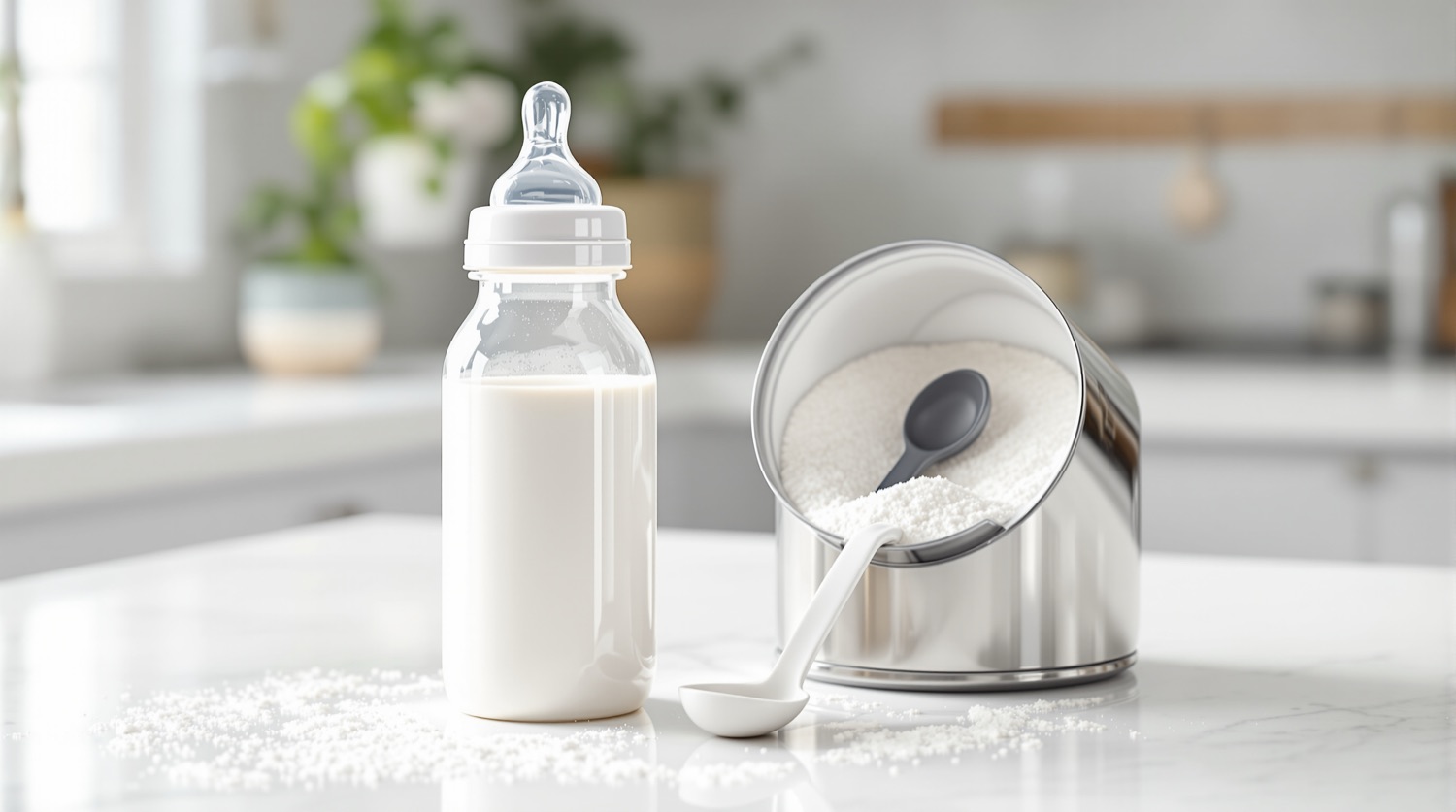
Every one of the 30 powdered infant formulas tested in a 2024 Food Chemistry study contained microplastics — but the powder is the smaller half of the story. That study estimated a child fed exclusively formula swallows about 49 ± 32 plastic particles a day from the powder itself. The bigger source is the bottle: Trinity College Dublin researchers, publishing in Nature Food, measured polypropylene baby bottles releasing up to 16.2 million microplastic particles per liter when formula was prepared hot inside them, following the WHO’s own recommended steps. The fix costs little and breaks no safety rules: mix in glass or stainless steel, let the formula cool before it touches plastic — or take plastic bottles out of the rotation entirely.
Baby formula gets scrutinized like almost no other food — regulated composition, batch testing, recall systems — which is exactly why the microplastics findings surprised people. None of that scrutiny was looking for plastic. The powder is processed through industrial equipment and packed in lined cans and cartons, and the finished bottle is often shaken, heated, and sterilized in polypropylene — the same plastic that sheds particles in electric kettles when it meets hot water.
Three studies, from three different research groups on two continents, now put real numbers on each step: what’s in the powder, what the bottle adds, and what actually shows up in babies. This guide walks through all three, in plain language, and ends with the short list of changes that cut the exposure most — without violating the safe-preparation rules that protect infants from something far more immediately dangerous than plastic.
The bottom line up front: the powder is a minor source; the hot-prep-in-plastic step is the major one. A glass or stainless baby bottle removes the largest measured source in one purchase, and filtering the water you mix with covers the other input. For the whole room, see the plastic-free nursery guide.
Does baby formula have microplastics?
The most direct test of the powder itself came in 2024, when a team at the Medical University of Gdańsk led by Kornelia Kadac-Czapska analyzed 30 infant formula products and published the results in Food Chemistry. Microplastics turned up in every single product — fibers, fragments, and films, in colorless, black, and brown varieties. The most common polymers were polyamide, polyethylene, polypropylene, and PET: the standard cast of characters in food processing lines and packaging, which is a strong hint about where the particles enter.
The team then did the arithmetic that matters to a parent: a child fed exclusively on formula takes in roughly 49 ± 32 microplastic particles a day from the powder. For context, that puts formula powder in the same modest league as salt or honey — real, measurable, and small next to what comes out of the preparation step below. It also echoes what researchers keep finding in milk: the food picks up plastic from the machinery and packaging it passes through, not from some single contaminated ingredient.
How much does the bottle add?
This is where the numbers change scale. In 2020, researchers at Trinity College Dublin published a study in Nature Food that did something simple and clever: they took ten brand-new polypropylene baby bottles and prepared formula in them exactly the way the World Health Organization tells parents to — sterilize the bottle, mix the powder with hot water — then counted the particles in the liquid using Raman spectroscopy.
The bottles released microplastics at concentrations as high as 16.2 million particles per liter. Two things made it worse in the lab: sterilization, and hotter water — both of which the standard preparation routine requires. A 21-day repeat test showed the shedding fluctuates but doesn’t stop; the bottle keeps releasing particles for as long as it’s used this way. Scaling the results across the feeding volumes and bottle types of 48 regions, the team estimated bottle-fed infants swallow between 14,600 and 4,550,000 microplastic particles per day, depending on where they live — with high-income regions, where polypropylene bottles dominate, at the top of the range.
Set the two sources side by side and the priority is obvious. The powder contributes on the order of tens of particles a day; hot preparation in a polypropylene bottle can contribute tens of thousands to millions. If you change one thing about how you formula-feed, change the container the hot water touches. Here’s the full scorecard:
| Study | What was tested | Key finding |
|---|---|---|
| Kadac-Czapska et al., Food Chemistry, 2024 | 30 powdered infant formula products | Microplastics in 100% of products (polyamide, PE, PP, PET); ≈49 ± 32 particles/day for an exclusively formula-fed child |
| Li et al., Nature Food, 2020 | 10 polypropylene bottles through WHO-protocol prep | Up to 16.2 million particles/L released; sterilization and hotter water increased shedding; est. 14,600–4,550,000 particles/day across 48 regions |
| Zhang et al., Environ. Sci. & Technol. Letters, 2021 | PET & polycarbonate in infant vs. adult stool (New York) | Infant PET concentrations averaged 10× higher than adults’ — median 36,000 ng/g, range 5,700–82,000 ng/g |
Do babies actually end up with more plastic in their bodies?
The exposure math above would stay theoretical if nothing showed up in actual infants. It shows up. In 2021, a team at New York University School of Medicine measured PET and polycarbonate microplastics in stool samples — three newborns, six one-year-olds, ten adults — and published the results in Environmental Science & Technology Letters. Every sample contained at least one plastic type. The headline: infant stool carried PET microplastics at a median of 36,000 nanograms per gram, more than 10 times the adult average, with individual infants ranging from 5,700 to 82,000 ng/g.
Two honest caveats. It was a small pilot — sixteen people is a signal, not a census. And stool measures what passes through, not what stays. But the direction fits everything else on this page: infants drink hot-prepared liquid out of plastic, chew plastic teethers, and mouth plastic toys, all at the developmental stage researchers most want to protect. The study’s authors pointed to exactly those routes.
“The stool samples settle the question of whether formula-fed babies are exposed. What the particles do inside an infant is the question science hasn’t answered — and the reason cheap prevention makes sense while we wait.”
Should you stop using hot water? The 70°C dilemma
Here’s the tension every formula parent should understand. The WHO’s safe-preparation guidelines say to mix powdered formula with water at 70°C (158°F) or hotter, because that temperature inactivates Cronobacter sakazakii — a rare bacterium that is genuinely life-threatening to newborns. The Trinity study showed that same hot water is what drives the biggest microplastic release from polypropylene bottles. So the two safety goals collide.
They resolve cleanly, though, because the WHO rule is about the water temperature, not the container material. Nothing in safe preparation requires the hot water to meet plastic. The Trinity team’s own accompanying guidance threads the needle: prepare the formula hot in a non-plastic container, let it cool to feeding temperature, and only then pour it into the feeding bottle — and after sterilizing a plastic bottle, rinse it with cooled boiled water rather than letting it air-dry with whatever the hot cycle loosened.
Do not lower your water temperature or skip sterilization to reduce microplastics. Cronobacter infection is rare but immediately dangerous to young infants; the microplastic risk is real exposure with unproven harm. Keep every safe-preparation step — and change the material the hot water touches, not the temperature.
How do you cut microplastics in formula feeding?
Ranked by how much measured exposure each one removes, based on the studies above:
- Switch to a glass or stainless steel bottle. This is the whole ballgame — it removes the up-to-16.2-million-particles-per-liter source in one purchase. Borosilicate glass handles boiling water and sterilizers without shedding anything. Our full ranking is in the safest baby bottles guide.
- If you keep plastic bottles, prepare formula outside them. Mix the powder with 70°C water in a glass or stainless container, cool it to feeding temperature, then transfer. The particles surge when hot water meets polypropylene — so don’t let it.
- Rinse sterilized plastic bottles with cooled boiled water. Sterilization was one of the two release drivers in the Trinity data; a rinse with cooled boiled (already-sterile) water carries the loosened particles away instead of into the first feed.
- Never microwave or shake hot formula in plastic. Heat plus agitation is the worst-case combination in the lab data. Warm bottles in a bowl of hot water, and swirl rather than shake while the formula is hot. The same logic applies to microwaving any food in plastic.
- Fix the water going in. Formula is mostly water, and tap water carries its own particle load. A filter with a genuine microplastics claim covers that input — see the best water filters for baby formula — and boil it in a glass or stainless non-toxic kettle rather than a plastic-bodied one.
Take the plastic out of the bottle
One glass or stainless bottle removes the largest measured microplastic source in formula feeding. The water filter covers the other input.
The gear that takes plastic out of formula feeding
These are the four purchases that map directly onto the studies above: two borosilicate glass bottles, the one bottle on the market with zero plastic in any component, and a water filter with published microplastic-removal data for the water you mix with. Prices and availability change, so check current listings.
1. Dr. Brown’s Options+ Glass Narrow Bottle — Top Glass Pick
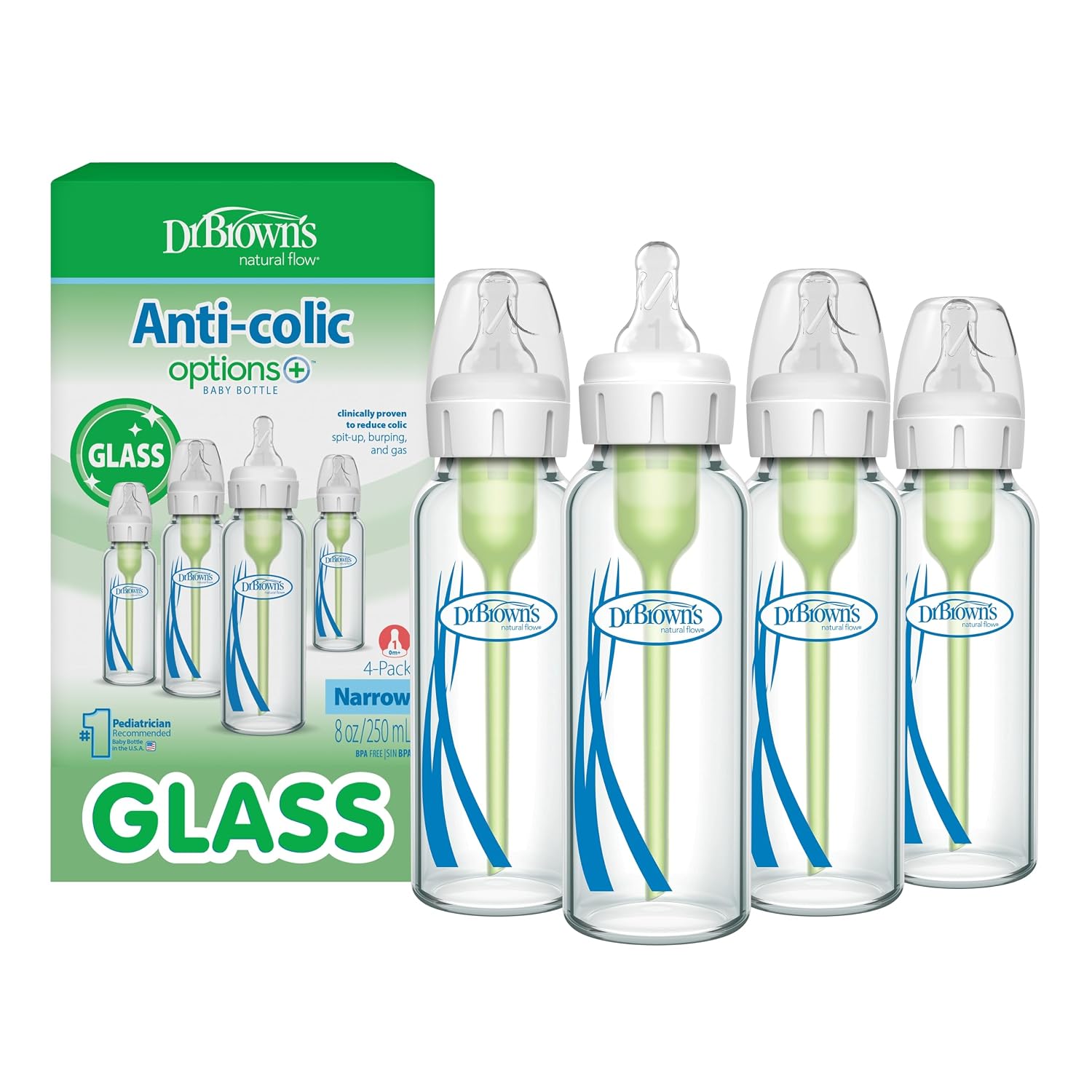 Top Glass Pick
Parents credit the internal vent system with real reductions in colic, gas, and spit-up, and the borosilicate glass survived counter-height drop tests without cracking. The honest downsides: it has the most parts of any bottle here, so cleaning and reassembly is fiddly and needs the included brush, and intermittent leaking is a recurring complaint if the pieces are not seated just right.
The single highest-impact swap on this page: it moves the hot-water step from polypropylene — the material measured shedding millions of particles per liter — to glass, which sheds none.
Why it’s safe: Borosilicate glass is inert at every temperature formula prep uses — sterilizing, 70°C mixing, warming — so there is nothing to leach and nothing to shed.
Check Today’s Price on Amazon →Amazon prices change daily — tap to see today’s price and any active discount.
- Free delivery & returns for Prime members
- Sold & shipped by Amazon
- Thousands of verified reviews
If your baby is formula-fed from day one, this is the configuration to start with: the anti-colic vent earns its keep in the newborn months, and the glass body means the 70°C preparation water never touches plastic at all.
2. Philips Avent Natural Glass Bottle — Easiest to Find
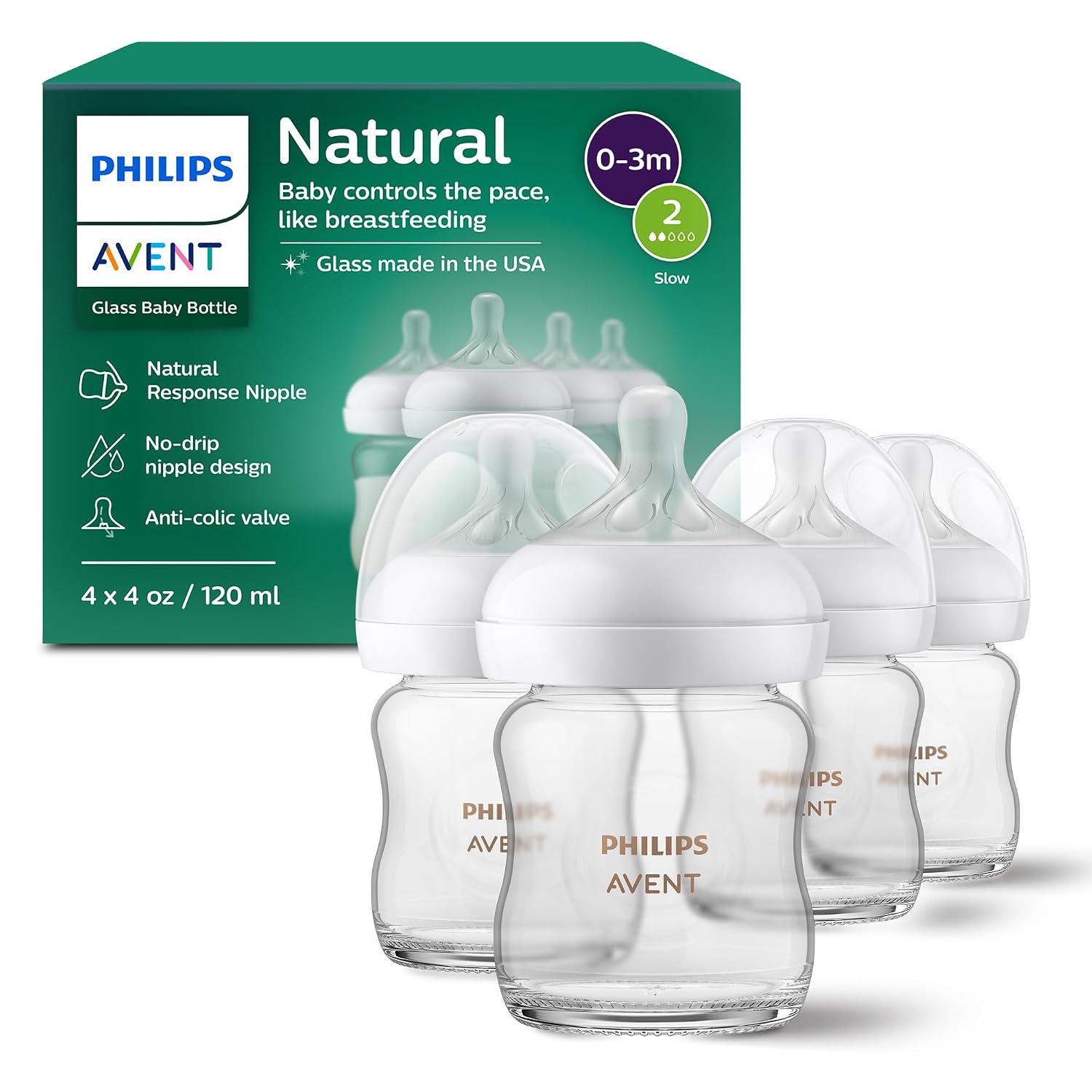 Easiest to Find
Parents praise the wide, breast-shaped nipple for a smoother switch from nursing, the glass that wipes clean, and durability that passed drop tests; several said it ended their colic troubles. The honest downsides: the Level 1 no-drip nipple flows so slowly that some babies sucked at it like a pacifier and took 30-plus minutes to finish, a few bottles leaked when shaken or arrived with warped rims, and one parent worried it made her baby a lazy nurser.
The same glass-instead-of-polypropylene fix, in the bottle system designed for combination feeding — and the easiest glass bottle to actually buy in a pinch.
Why it’s safe: Pharmaceutical-grade heat-resistant glass takes sterilization and hot mixing water without releasing particles, and the anti-colic valve works without any extra plastic parts inside the milk path.
Check Today’s Price on Amazon →Amazon prices change daily — tap to see today’s price and any active discount.
- Free delivery & returns for Prime members
- Sold & shipped by Amazon
- Thousands of verified reviews
For breastfed babies taking occasional formula bottles, the Natural Response nipple is the difference-maker — and because Target, Walmart, and Amazon all stock it, replacing a broken one never takes more than a day.
3. Pura Kiki Stainless Steel Infant Bottle — 100% Plastic-Free
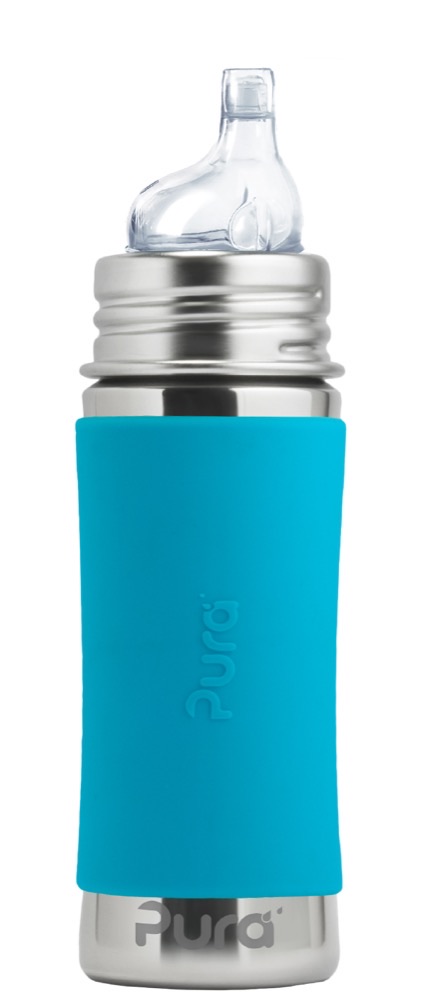 100% Plastic-Free
Parents value that it is fully plastic-free stainless steel, tough enough to survive toddlerhood, and that it converts from newborn nipple to straw cup as the child grows; Wirecutter has named it a top pick. The honest downsides: it is not compatible with breast pumps and cannot be microwave-sterilized, and it is one of the pricier systems. Independent XRF testing by Tamara Rubin has also reported lead in the dot under the base cap, which is worth knowing given the plastic-free, non-toxic positioning.
Glass bottles still wear plastic collars and caps; this one doesn’t — stainless body, silicone everything else, so no plastic touches the formula at any step, hot or cold.
Why it’s safe: Food-grade #304 stainless steel is inert under heat and drops, the nipple and seals are medical-grade silicone, and the MADE SAFE screen covers every component — not just the body.
Check Today’s Price on Amazon →Amazon prices change daily — tap to see today’s price and any active discount.
- Free delivery & returns for Prime members
- Sold & shipped by Amazon
- Thousands of verified reviews
The stainless option matters most for parents who prepare formula directly in the bottle: you can pour 70°C water straight in, swirl, and cool it under the tap, with no plastic anywhere in the process.
4. Epic Pure Water Filter Pitcher — For the Mixing Water
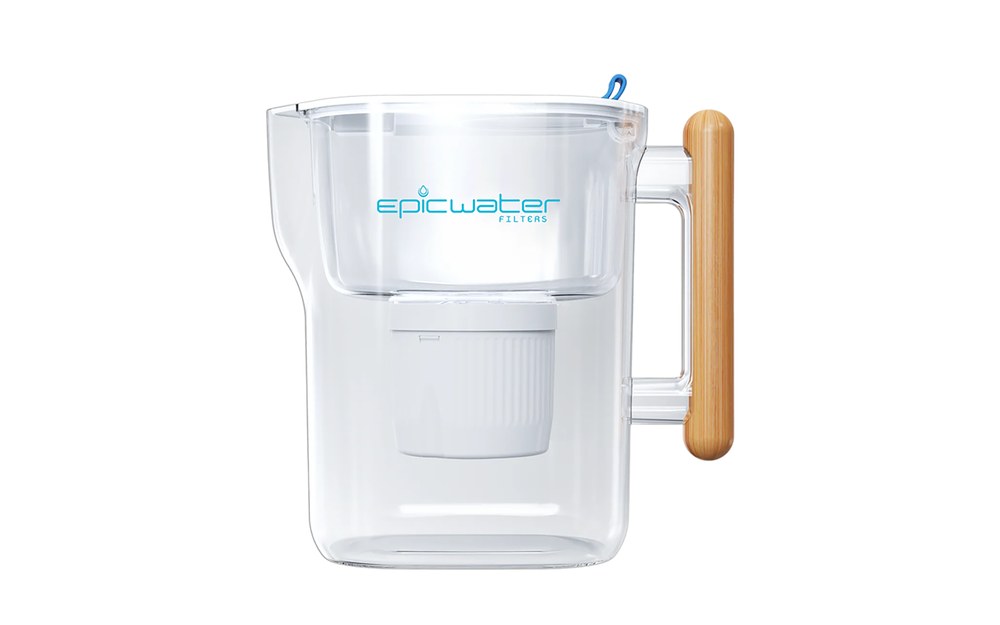 For the Mixing Water
Reviewers point to published independent lab data and a long-lasting filter as the reasons they trust it, and several describe the slow, deliberate drip as reassuring rather than annoying. The honest downsides: owners report the filtration is genuinely slow and not the pick if you want a glass of water in a hurry, and some mention flip-top lids that stick or water that spills from the lid when you pour a full pitcher.
Every bottle of formula is 85%+ water — filtering it through a membrane with published 99.9% microplastic-removal data cleans up the input the bottle swaps can’t touch.
Why it’s safe: The hollow fiber membrane physically blocks microplastic particles down to ~1 micron, while the carbon stage handles chlorine, lead, and PFAS — all in a BPA-free Tritan body.
Check Today’s Price on Amazon →Amazon prices change daily — tap to see today’s price and any active discount.
- Free delivery & returns for Prime members
- Sold & shipped by Amazon
- Thousands of verified reviews
If your tap water is the question mark — older pipes, well water, or you simply haven’t checked — the deeper comparison lives in our water filters for baby formula guide, which also covers under-sink and reverse osmosis options.
Want the Full Nursery Protection Guide?
Bottles are one plastic touchpoint among dozens in a baby’s first year. The Complete Plasticproof Guide covers every room — nursery, kitchen, bathroom — with 80+ product recommendations backed by 47+ studies.
The honest verdict
Does baby formula have microplastics? In every product tested by the 2024 Food Chemistry analysis, yes — about 49 particles a day for a fully formula-fed child, from polymers that point to processing equipment and packaging. But the powder was never the main event. The main event is the measured collision of 70°C water, sterilization, and polypropylene: up to 16.2 million particles per liter in the Trinity College Dublin data, and an estimated 14,600 to 4.55 million particles per day reaching bottle-fed infants. The 2021 stool study suggests that exposure is not hypothetical — infants carried roughly ten times the PET microplastics adults did.
What none of these studies show is harm — they counted particles, not outcomes, and that distinction is the difference between prudence and panic. The prudent version costs about as much as a week of formula: put glass or stainless steel wherever hot water meets the feed, keep every WHO safety step exactly as written, and filter the water going in. Formula itself remains what it has always been — a safe, regulated, complete food for babies. The plastic around it is the part you can fix in a weekend.
Start with the bottle
One swap removes the largest measured source. The full ranking of glass and stainless options — including budget picks — is in the bottles guide.
Frequently Asked Questions
In the products tested so far, yes. A 2024 Food Chemistry analysis of 30 powdered infant formulas found microplastics in every product tested — mostly polyamide, polyethylene, polypropylene, and PET, as fibers, fragments, and films — and estimated that a child fed exclusively formula swallows about 49 plastic particles a day from the powder itself. The far larger source is preparing hot formula in a polypropylene bottle, which a Nature Food study measured releasing up to 16.2 million particles per liter.
Mostly the bottle. The powder contributes on the order of tens of particles a day, while Trinity College Dublin’s Nature Food study measured hot preparation in polypropylene bottles releasing up to 16.2 million particles per liter, and estimated bottle-fed infants take in between 14,600 and 4,550,000 particles per day depending on the region. Sterilizing the bottle and using hotter water both significantly increased the release.
No. The World Health Organization recommends mixing powdered formula with water at 70°C or hotter because it inactivates Cronobacter, a rare but genuinely dangerous bacterium for newborns. That risk is immediate and proven; the microplastic risk is unquantified. Keep the hot water, and work around the plastic instead: prepare the formula in a glass or stainless container, let it cool, then pour it into the feeding bottle — or use a glass or stainless bottle for the whole process.
A borosilicate glass bottle, or a plastic-free stainless steel bottle. Glass releases no microplastics at any temperature a parent will use, which removes the largest measured source in one purchase. Dr. Brown’s Options+ and Philips Avent Natural both come in glass versions of their standard bottles, and Pura Kiki makes a stainless bottle with no plastic in any component. Our full ranking is in the safest baby bottles guide.
Nobody knows yet — and that is the honest answer. These studies measured how much plastic is present, not what it does inside an infant. No health harm from bottle-derived microplastics has been demonstrated. But infants are a group scientists treat with extra caution, the measured exposure is far higher than anyone assumed before 2020, and the fixes are cheap — which is why cutting the avoidable part is reasonable even while the health question stays open.
One small study points that way. A 2021 study in Environmental Science & Technology Letters measured PET microplastics in infant and adult stool from New York and found infant concentrations averaged more than 10 times higher — a median of 36,000 nanograms per gram. It was a small pilot (six infants, ten adults, three newborns), so treat it as a signal rather than a final number. The authors pointed to bottles, teethers, and toys as likely reasons.
Sources
- Li D, Shi Y, Yang L, et al. “Microplastic release from the degradation of polypropylene feeding bottles during infant formula preparation.” Nature Food, 2020;1(11):746–754. (10 PP bottles through WHO-protocol prep; up to 16.2 million particles/L; sterilization and hotter water increased release; est. 14,600–4,550,000 particles/day across 48 regions.)
- Kadac-Czapska K, Jutrzenka Trzebiatowska P, Mazurkiewicz M, et al. “Isolation and identification of microplastics in infant formulas — A potential health risk for children.” Food Chemistry, 2024;440:138246. (30 formulas; microplastics in all; polyamide, PE, PP, PET; est. 49 ± 32 particles/day for exclusively formula-fed children.)
- Zhang J, et al. “Occurrence of Polyethylene Terephthalate and Polycarbonate Microplastics in Infant and Adult Feces.” Environmental Science & Technology Letters, 2021. (Infant stool PET median 36,000 ng/g, range 5,700–82,000 ng/g — more than 10× the adult average.)
- World Health Organization. “Safe preparation, storage and handling of powdered infant formula: guidelines.” WHO, 2007. (Recommends preparation water at no less than 70°C to inactivate Cronobacter sakazakii.)