
Polypropylene is the most common plastic in baby bottles, the same recycling-code-5 material used for yogurt tubs and takeout containers. It is light, cheap, shatterproof and free of BPA, which is why it took over the category. It is also a long chain of carbon atoms, and long chains of carbon atoms break into fragments when you pour near-boiling water on them and shake. Those fragments are microplastics, and for a bottle-fed infant they end up in the one thing the baby consumes all day.
Glass has no chain to break. A glass bottle body is amorphous silica, chemically closer to sand than to any plastic, and it does not fragment, soften or leach polymer particles at any temperature a kitchen can produce. That is the whole reason this comparison is lopsided. What makes it worth reading anyway is the detail: how much plastic bottles actually release and under which conditions, what a glass bottle still cannot protect you from, and what to do if you are not replacing a drawer full of bottles this week.
Bottom line: Switch to glass or stainless steel for any bottle that will hold warm formula or milk — the measured microplastic release from heated polypropylene is in the tens of millions of particles per liter, and glass releases none. Whatever the body is made of, stop steam-sterilizing the silicone nipple daily and rinse it after each sterilization, because the nipple sheds too. And if you are keeping plastic bottles for now, prepare the formula in a glass or steel vessel and pour it into the bottle only after it cools — that single change removes the hot-water contact that produced the worst numbers in the study.
Which Releases Fewer Microplastics — Glass or Plastic Baby Bottles?
Glass, and it is not a matter of degree. The definitive measurement comes from Dunzhu Li, Yunhong Shi and colleagues at Trinity College Dublin's AMBER research center, published in Nature Food in October 2020. They bought polypropylene infant feeding bottles, ran them through the World Health Organization's recommended sterilization and formula-preparation routine, and counted what came off. Under that standard routine the bottles released microplastics at values as high as 16,200,000 particles per liter, and the paper's own summary is blunt: sterilization and exposure to high-temperature water “significantly increase microplastic release.” Trillions of even smaller nanoplastic particles came off alongside them.
The temperature curve is the finding worth memorizing. In the university's published summary of the work, the same polypropylene bottles released roughly 600,000 particles per liter at 25°C (room temperature), 16.2 million per liter at 70°C, and 55 million per liter at 95°C. That 70°C figure is the one that matters, because 70°C is exactly the water temperature the WHO's guidelines on safe preparation of powdered infant formula recommend to kill Cronobacter sakazakii, a bacterium that is rare but can be fatal to newborns. The two safety rules, hot water against bacteria and cool water against plastic shedding, point in opposite directions inside a plastic bottle. Inside a glass bottle there is no conflict.
A 21-day repeat test in the same paper showed the release does not fade after the first few washes; it fluctuated periodically through the three weeks. So the plastic bottle you have used for months is not “worn in” and finished shedding. It keeps going, and the scratches that accumulate with washing give the water more surface to work on.
Head-to-Head: Glass vs Plastic Baby Bottles
What each material is, and what peer-reviewed testing has measured coming out of it — at a glance.
| Feature | Glass Bottle | Polypropylene (PP) Plastic Bottle |
|---|---|---|
| What the body is made of | Borosilicate or soda-lime glass (amorphous silica) | Polypropylene, recycling code 5 — a carbon-chain polymer |
| Sheds microplastics from the body | No — not a polymer, nothing to fragment | Yes — up to 16.2 million particles/L at 70°C (Nature Food, 2020) |
| At room temperature (25°C) | None measured from the glass | About 600,000 particles/L |
| At 95°C (near boiling) | None measured from the glass | About 55 million particles/L |
| Effect of steam or boil sterilizing | None on the glass; the silicone nipple still sheds | Significantly increases release; nipple sheds too |
| Behaves worse with age | No — does not scratch or cloud in normal use | Yes — release persisted over a 21-day test; scratches add surface |
| BPA and other additives | None in the material | BPA-free by law, but stabilizers and other additives are rarely disclosed |
| Weight and breakage | Heavier; can break if dropped (silicone sleeves help) | Light and shatterproof |
| Typical price per bottle | About $9–$10 per bottle in the multipacks NBC News listed | Usually less than glass; varies widely by brand |
| Lifespan | Indefinite unless broken; safe to hand down | Makers advise replacing when scratched or cloudy |
How Many Microplastics Does a Bottle-Fed Baby Actually Swallow?
The Trinity team did not stop at the bottle. They combined the per-liter release with real bottle-feeding rates and formula volumes across 48 countries and regions to estimate what an infant takes in over the first twelve months. The answer ranged from 14,600 to 4,550,000 particles per capita per day depending on the region, with a global average of about 1,580,000 particles a day. The wealthy, high-bottle-feeding regions sat at the top: roughly 2,280,000 particles a day in North America, 2,610,000 in Europe and 2,100,000 in Oceania. The authors' conclusion was that infant exposure “is higher than was previously recognized” and that there is an urgent need to find out whether it does harm — which is the honest state of the science. The particle counts are measured; the health consequences at these doses are not yet known.
What the Study Measured, by Condition
Polypropylene infant feeding bottles, particles released per liter, from Li et al., Nature Food (2020) and Trinity College Dublin's summary of the work.
| Condition | Microplastics released | What it means at home |
|---|---|---|
| Water at 25°C (room temperature) | ~600,000 particles/L | The floor — even cold contact sheds |
| Water at 70°C (WHO formula-prep temperature) | ~16.2 million particles/L | Standard formula preparation in a PP bottle |
| Water at 95°C | ~55 million particles/L | Pouring freshly boiled water straight in |
| Sterilization plus hot-water exposure | “Significantly increased” release | The everyday routine most parents follow |
| Repeat use over 21 days | Periodic fluctuation, no fade-out | An old bottle is not a finished bottle |
| Estimated infant intake, global average | ~1,580,000 particles/day | Range 14,600 to 4,550,000 across 48 regions |
| Estimated infant intake, North America | ~2,280,000 particles/day | Among the highest regions studied |
Do Glass Baby Bottles Release Any Microplastics?
The glass does not. Everything attached to the glass can, and a fair comparison has to say so. The most important piece is the nipple, which on virtually every bottle sold today, glass or plastic, is silicone rubber. In 2022, Yu Su, Rong Ji and colleagues at Nanjing University, with Baoshan Xing of the University of Massachusetts, published in Nature Nanotechnology the first study to look at what steam sterilization does to a silicone nipple at the sub-micron scale. Using a technique called optical-photothermal infrared microspectroscopy, they found steam etched and chemically modified the nipple surface and released flake- and oil-film-shaped micro- and nanoplastics in the 0.6 to 332 micron range into the wash water, derived from the silicone base polymer and from a polyamide resin additive. Their estimate was that by the age of one year a baby could ingest more than 660,000 of these elastomer-derived particles, about 81% of them in the 1.5 to 10 micron range that is small enough to cross the gut wall.
Two things follow from that. First, the nipple is a shared problem, not a plastic-bottle problem, so switching the body to glass does not make the feeding system particle-free. Second, the release was driven by steam heating, so the practical fix is to sterilize nipples only as often as your pediatrician actually recommends, rinse them after each sterilization, and replace them when they go cloudy or tacky rather than pushing them for months. That is a manageable exposure sitting on top of a body that sheds nothing, which is a different situation from a nipple sitting on top of a body shedding 16 million particles per liter.
There is one more caveat worth knowing, because it made headlines in 2025 and it is easy to misread. France's food-safety agency ANSES tested beverages sold in glass, plastic and cans and found that drinks in glass bottles carried around 100 microplastic particles per liter, five to fifty times more than the same drinks in plastic bottles or cans. The particles matched the color and chemistry of the paint on the metal caps, which scratched against each other in storage and shed flakes into the bottle. Blowing the caps clean with air and rinsing them cut the count from 287 to 87 particles per liter. The glass itself was never the source. Baby bottles do not use painted metal crown caps, so the finding does not transfer directly, but the principle does: on a glass bottle, the only parts that can contaminate the milk are the closure and the nipple, so buy a bottle whose collar and cap are silicone or steel where you can, and keep the plastic ring out of the milk path.
Is It Safe to Keep Using Plastic Baby Bottles?
Safer than the headline numbers suggest, if you change how you use them, and the Trinity authors published a four-step routine for exactly this. It is built on one observation from their data: the worst release came from hot water touching the plastic, so keep the hot water away from the plastic.
- After sterilizing the bottle, rinse it at least three times with room-temperature sterilized water. Sterilization leaves loosened particles on the surface; the rinse carries them down the drain instead of into the first feed.
- Prepare the formula in a non-plastic container — a glass measuring jug or a stainless steel pitcher — using water of at least 70°C, as the WHO advises for killing Cronobacter. Let it cool to room temperature, then pour it into the bottle. The plastic never meets water hotter than 25°C. Boil that water in a glass or stainless-steel kettle rather than a plastic one, because a plastic electric kettle can shed microplastics into the water it heats.
- Never reheat prepared formula in a plastic container, and avoid the microwave. If a bottle needs warming, use a bottle warmer or a bowl of warm water, and only with glass.
- Do not vigorously shake the formula in the bottle. Shaking hot liquid against the walls is mechanical abrasion on softened plastic. Swirl in the preparation jug instead.
Those four steps keep you inside both safety rules at once: the water is hot enough for the bacteria in the jug, and cool enough for the plastic in the bottle. If you have been pouring boiled water straight into a polypropylene bottle and shaking, step two alone moves you from the 55-million-per-liter row of the table toward the 600,000 row. For the water itself, our guide to the best water filters for baby formula covers what to remove before it ever reaches the kettle.
What these steps cannot do is make polypropylene a good material for a baby. Every scratch adds shedding surface, every wash cycle is warm, and the bottle is used four to eight times a day for a year. If you are choosing new bottles rather than nursing old ones along, the decision is easy. Dr. Tracey Woodruff, who directs the Program on Reproductive Health and the Environment at the University of California, San Francisco, put it plainly to NBC News: “We recommend that you don't put heated food or drink in plastic because that can increase shedding. I would personally choose glass baby bottles.” Her team also produced the first systematic review linking microplastics to respiratory, reproductive and digestive harms — and, as our explainer on why BPA-free does not mean safe lays out, swapping one additive does nothing about the particles themselves.
Which Should You Buy: Glass or Stainless Steel?
Both have a body that sheds nothing, so this is a lifestyle question rather than a safety one. The honest split looks like this.
Choose glass when:
- You want to see the milk level and check for clumps
- Bottles stay mostly at home, on a counter or in a warmer
- You sterilize by boiling or steam — borosilicate handles the shock
- You want the widest choice of anti-colic and breast-shaped nipples
Choose stainless steel when:
- The bottle rides in a daycare bag or a stroller every day
- Your baby has started throwing things
- You want one bottle that converts to a sippy and then a straw cup
- You want zero plastic anywhere, including the cap and collar
Our full ranking of ten bottles across both materials is in the safest baby bottles of 2026, and the deeper look at what “BPA-free” polypropylene actually leaches is in are plastic baby bottles safe? The three below are the picks that best answer the specific question this article is about.
The Three Worth Buying
Two borosilicate glass bottles with different nipple philosophies, and the one steel bottle with no plastic in any component.
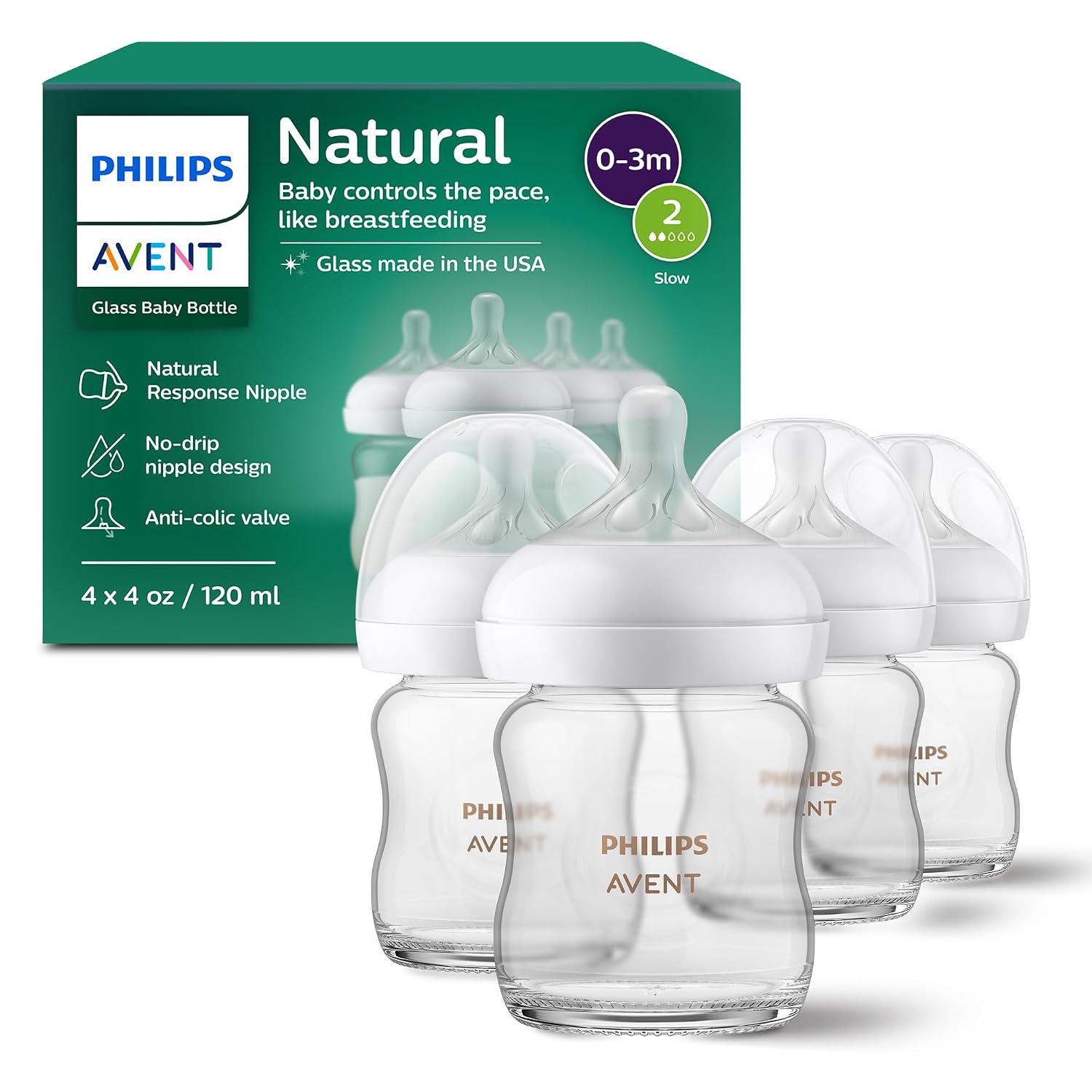 Best Overall Glass
The wide neck matters more than it sounds for this specific problem: it lets you pour cooled formula from a glass jug without a funnel, which is the step that keeps hot water off the nipple and collar. NBC News listed the 8-ounce four-pack at $39.95 in its 2025 plastic-free bottle roundup, about $10 a bottle. The collar is plastic; keep the milk below it and it never touches the feed.
Pros
- Glass body releases no microplastics at any temperature
- Wide neck is easy to fill from a jug and easy to clean
- Replacement nipples available in every supermarket
Cons
- Heavier than plastic, and no protective sleeve included
- Slow-flow newborn nipple frustrates some babies
- Collar and cap are still plastic
Take the bottle body out of the microplastic equation without changing how you feed.
Why it's the safer material: Glass is silica, not a polymer — there is no carbon chain in the bottle wall to fragment into the particles the 2020 study counted.
Check Today's Price on Amazon →Amazon prices change daily — tap to see today's price and any current discount.
- Free delivery for Prime members
- Tens of thousands of verified reviews
- Easy 30-day returns
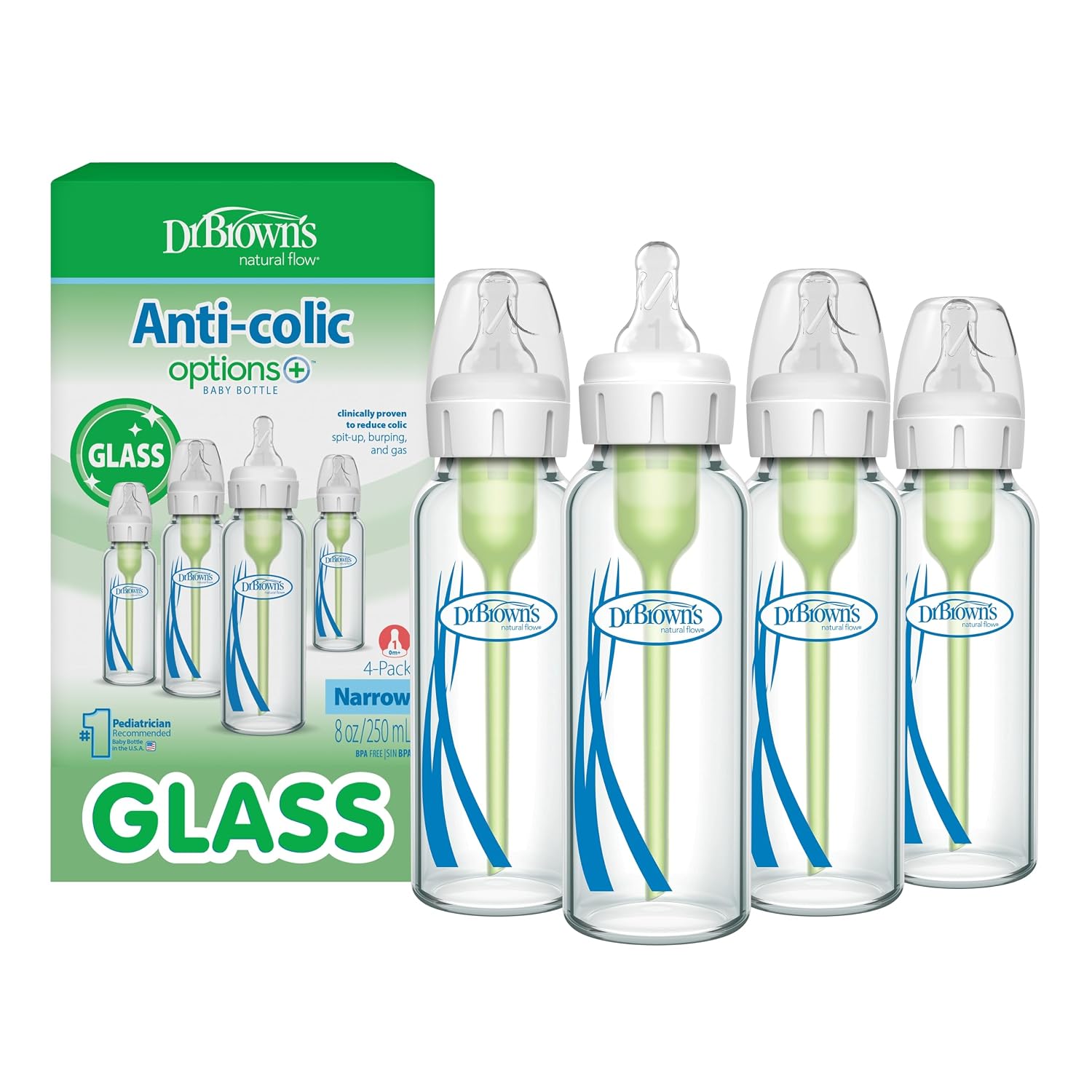 Best Anti-Colic Glass
The trade-off is honest and worth stating: the vent insert is plastic and sits in the milk path, so this bottle is glass-bodied rather than plastic-free. Because the vent is a separate small part, it can be rinsed after sterilization and replaced cheaply when it clouds, which is the same logic the Trinity authors apply to the whole bottle. Borosilicate tolerates going from a cold rinse to a boiling sterilizer without cracking. NBC News listed the 5-ounce three-pack at $28.49, about $9.50 a bottle.
Pros
- Borosilicate glass shrugs off sterilizer temperature swings
- The most proven anti-colic vent on the market
- Vent can be removed once the colic stage passes
Cons
- Most parts of any bottle here — more to wash and reassemble
- Vent insert is plastic and touches the milk
- Leaks if the pieces are not seated exactly right
Keep the anti-colic system your baby already tolerates, and lose the plastic body.
Why it's the safer material: The bottle wall, where the hot water sits, is borosilicate glass with nothing to shed. The only plastic left is a small, replaceable vent insert.
Check Today's Price on Amazon →Amazon prices change daily — tap to see today's price and any current discount.
- Free delivery for Prime members
- Thousands of verified reviews
- Easy 30-day returns
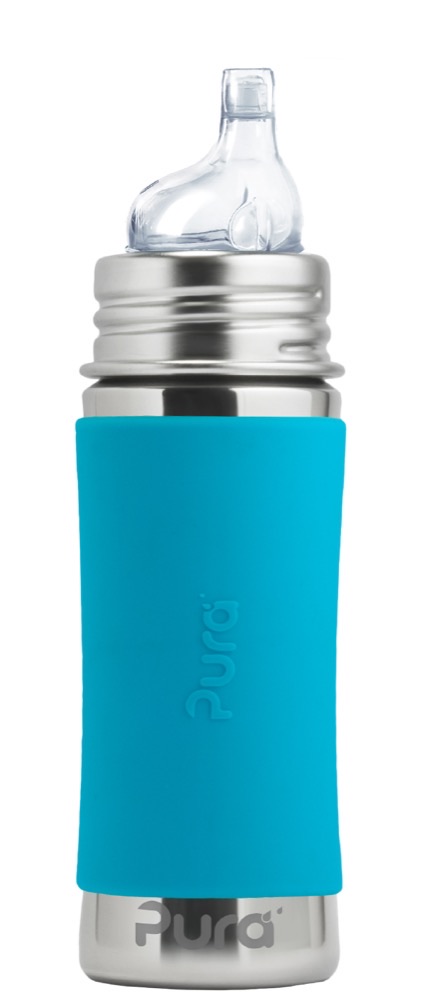 Best Plastic-Free Alternative
Steel solves the two complaints glass earns: weight and breakage. What it gives up is visibility, since you cannot see the milk level through the wall, and it cannot be sterilized in a microwave sterilizer. The nipple is silicone, like every bottle here, so the nipple-care advice above still applies. NBC News listed it at $32.99. Independent home testing by Tamara Rubin has reported lead in a dot under the base cap, outside the milk path; we note it because the bottle is sold on a non-toxic promise.
Pros
- No plastic anywhere — body, cap, collar or seals
- Survives drops, daycare and toddlers
- Converts from infant bottle to straw cup as the child grows
Cons
- Cannot see how much milk is left
- Not compatible with breast pumps or microwave sterilizers
- Priciest single bottle in this comparison
One bottle, no plastic, from the first feed to the first straw cup.
Why it's the safer material: Food-grade stainless steel is inert at feeding temperatures and does not fragment, scratch into shedding surface, or leach polymer particles.
Check Today's Price on Amazon →Amazon prices change daily — tap to see today's price and any current discount.
- Free delivery for Prime members
- Thousands of verified reviews
- Easy 30-day returns
How to Feed With Less Plastic, Whatever Bottle You Own
The bottle body is the biggest lever, but it is not the only one. The formula itself can carry microplastics from its own packaging and processing, which our guide to whether baby formula has microplastics covers with the measured figures, and our ranking of the safest baby formulas weighs packaging alongside ingredients. Tap water contributes particles of its own before the kettle is ever switched on. And the nursery beyond the bottle, from pacifiers to teething toys, is a separate room-by-room job we walk through in the plastic-free nursery guide. Fix the bottle first, because it is the item that meets hot liquid eight times a day, then work outward from there.
Frequently Asked Questions
Are glass baby bottles better than plastic for microplastics?
On the measured evidence, glass is better by a wide margin. The 2020 Nature Food study from Trinity College Dublin found polypropylene bottles released up to 16.2 million microplastic particles per liter when formula was prepared with 70°C water, and about 55 million per liter at 95°C. A glass bottle body is silica, not a polymer, so there is nothing in it to fragment. The honest caveat is that the silicone nipple on any bottle, glass or plastic, was shown in a 2022 Nature Nanotechnology study to shed micro- and nanoplastics during steam sterilization.
How many microplastics do plastic baby bottles release?
About 600,000 particles per liter at room temperature, 16.2 million per liter at the 70°C the WHO recommends for mixing powdered formula, and 55 million per liter at 95°C, according to the Trinity College Dublin measurements. Sterilizing the bottle and exposing it to hot water both significantly increased release. Modeled across 48 countries and regions, a bottle-fed infant swallows an average of about 1.58 million particles a day in the first year, with North America at roughly 2.28 million and Europe at roughly 2.61 million.
Do glass baby bottles release any microplastics?
The glass body does not. What can shed on a glass bottle is everything that is not glass: the silicone nipple, which the 2022 Nature Nanotechnology study found releases flake-shaped particles in the 0.6 to 332 micron range during steam disinfection, and any plastic collar or cap. France's food-safety agency ANSES showed in 2025 that glass beverage bottles carried around 100 particles per liter, traced to paint flaking off metal caps — the closure, not the glass, was the source.
Is it safe to keep using plastic baby bottles?
The release can be cut substantially without replacing anything, using the four steps the Nature Food authors published: rinse a sterilized bottle three times with room-temperature sterilized water; prepare formula in a non-plastic container with water of at least 70°C, cool it, then transfer it to the bottle; never reheat formula in plastic or in a microwave; and do not shake formula vigorously in the bottle. Those steps remove the hot-water contact that drove the highest numbers in the study.
Is borosilicate glass safer than regular glass for baby bottles?
Both are inert against microplastic release; the difference is thermal shock. Borosilicate glass, the type used in laboratory glassware and most premium glass baby bottles, expands very little when heated, so it tolerates going from a cold rinse to boiling sterilization without cracking. Ordinary soda-lime glass is more likely to crack under a sudden temperature swing. For a bottle sterilized daily, borosilicate is the practical choice; for microplastics specifically, either glass releases nothing.
What about stainless steel baby bottles?
Food-grade stainless steel gives the same zero-polymer body as glass without the breakage risk, which is why it suits daycare bags and toddlers who throw things. The trade-offs are that you cannot see the milk level, most steel bottles cannot be microwave-sterilized, and the nipple is still silicone. Pura Kiki is the one widely sold bottle whose every component, including the cap and seals, is plastic-free.
Sources
- Li D, Shi Y, Yang L, Xiao L, Kehoe DK, Gun'ko YK, Boland JJ, Wang JJ. Microplastic release from the degradation of polypropylene feeding bottles during infant formula preparation. Nature Food. 2020;1:746–754. doi:10.1038/s43016-020-00171-y (PubMed PMID 37128027)
- Trinity College Dublin. High levels of microplastics released from infant feeding bottles during formula prep. tcd.ie
- Su Y, Hu X, Tang H, Lu K, Li H, Liu S, Xing B, Ji R. Steam disinfection releases micro(nano)plastics from silicone-rubber baby teats as examined by optical photothermal infrared microspectroscopy. Nature Nanotechnology. 2022;17(1):76–85. doi:10.1038/s41565-021-00998-x (PubMed PMID 34764453)
- World Health Organization / FAO. Safe preparation, storage and handling of powdered infant formula: guidelines. who.int
- Silano M, Paganin P, Davanzo R. Time for the 70°C water precautionary option in the home dilution of powdered infant formula. Italian Journal of Pediatrics. 2016;42:17. PMC4761158
- ANSES (French Agency for Food, Environmental and Occupational Health & Safety). The caps of glass bottles contaminate beverages with microplastics. 2025. anses.fr; study published in Journal of Food Composition and Analysis, doi:10.1016/j.jfca.2025.107719
- NBC News Select. Are glass baby bottles safer than plastic? What experts want you to know. nbcnews.com (source of the listed retail prices and the Woodruff quote)