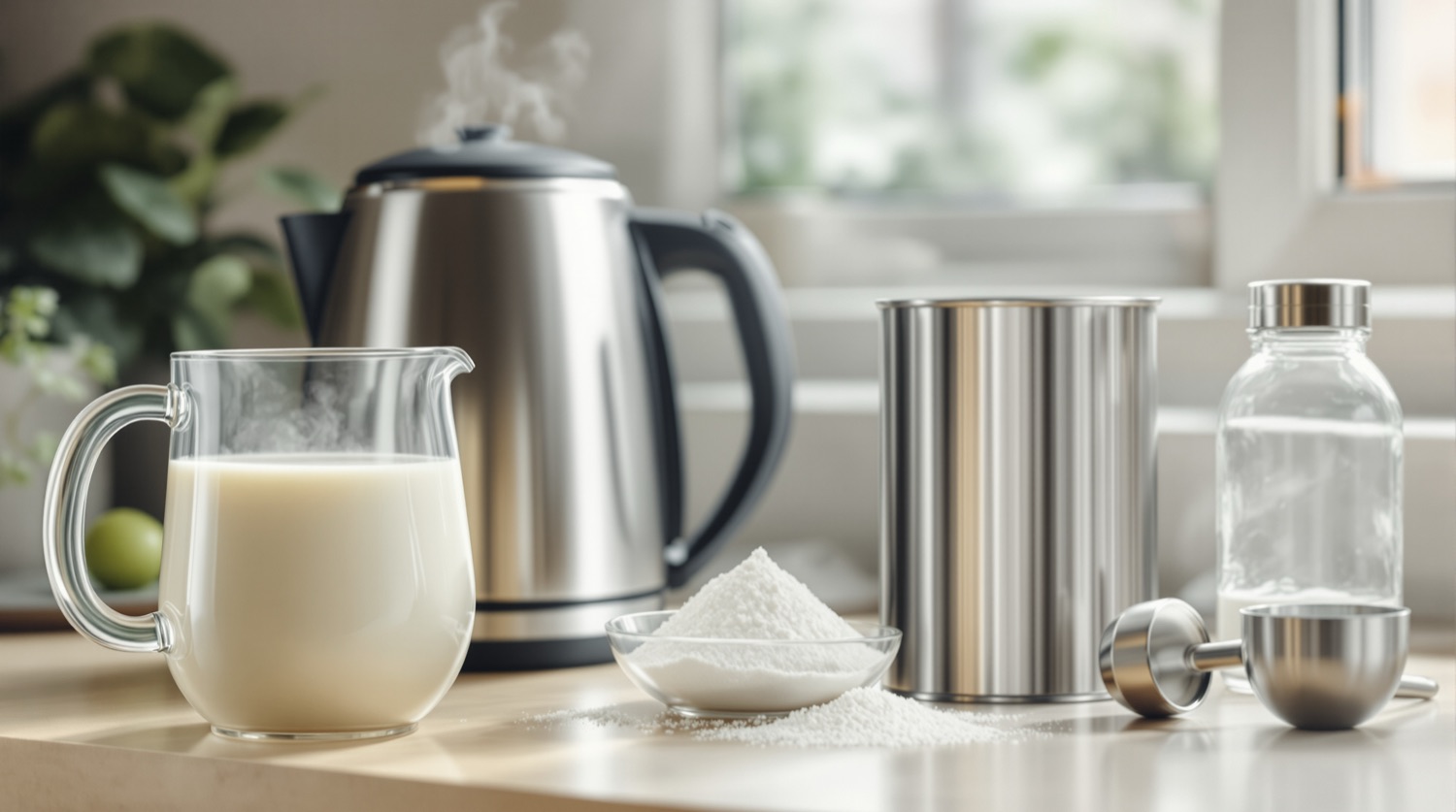
Polypropylene infant feeding bottles released between 1.3 million and 16.2 million microplastic particles per liter of prepared formula when researchers at Trinity College Dublin followed the World Health Organization's own preparation steps, and as much as 55 million particles per liter at the 95°C used for sterilizing (Li et al., Nature Food, 2020). Heat against plastic and agitation inside it are what drives the release, so the team published a six-step routine that moves every hot step into glass or steel and only transfers the feed once it has cooled. It does not lower the water temperature: the CDC still requires water at 70°C / 158°F to kill Cronobacter in powdered formula, and that rule wins.
Most advice about microplastics and babies stops at "use glass." That is good advice, and it is also useless to the several million households already holding a cupboard of polypropylene bottles, a sterilizer, and a feeding schedule that does not pause for a shopping decision. The more useful question is the one the researchers themselves asked after they finished counting: given the bottle you already own, what in the routine is actually generating the particles, and what changes if you reorder it?
The answer turns out to be unusually clean, because one variable dominates everything else. It is not the brand of bottle, the formula, or how old the bottle is. It is temperature. Everything below follows from that single finding, including why one popular "fix" is genuinely dangerous and should not be attempted.
How many microplastics does a plastic baby bottle actually release?
The measurements come from Dunzhu Li, Yunhong Shi, Liwen Xiao, John J. Boland, Jing Jing Wang and colleagues at AMBER and the School of Engineering at Trinity College Dublin, published in Nature Food in 2020 (Li et al., Nature Food volume 1, 2020). They took ten polypropylene infant feeding bottle models, put them through the WHO's recommended cleaning, sterilizing and mixing procedure, and counted what came off the plastic — repeating it over a 21-day period to see whether a bottle calms down with use. It does not.
Under that standard routine the bottles released 1.3 million to 16.2 million microplastic particles per liter of prepared feed. Polypropylene is not a niche material here: it accounts for roughly 82% of the global baby-bottle market, so this is the ordinary case rather than a worst case. The authors then combined their per-liter figures with real bottle-feeding rates across 48 regions and estimated daily intake for infants under 12 months.
Why water temperature is the whole story
The study varied one thing at a time, and temperature moved the result by nearly a hundredfold. That is the finding the six-step routine is built around: the plastic is not leaching a chemical slowly over months, it is being mechanically and thermally abraded in the sixty seconds you spend making a feed.
| Water temperature | Particles released per liter | Where this happens in a real routine |
|---|---|---|
| 25°C / 77°F (room temperature) | about 600,000 | Rinsing a cooled bottle, or pouring in an already-cooled feed |
| 70°C / 158°F (the food-safety minimum) | up to 16.2 million | Mixing powdered formula directly in the bottle, as most instructions say |
| 95°C / 203°F (sterilizing) | as much as 55 million | Boiling or steam-sterilizing the bottle; boiling water poured into it |
Read the middle row twice. The single most common instruction in the world — pour hot water into the bottle, add the scoops, shake — is the step that puts the largest number of particles into the feed. Nothing about that instruction is careless; it exists because powdered infant formula is not sterile and the water has to be hot enough to kill what may be in it. The routine below keeps that protection and moves the heat somewhere inert.
The 6 steps, and what each one is actually doing
These are the recommendations the Trinity team published alongside their measurements. The right-hand column is our note on which part of the mechanism each step is attacking — heat against plastic, or abrasion inside it.
| Step | What to do | What it targets |
|---|---|---|
| 1. Boil in glass or steel | Heat water in a glass or stainless steel kettle, never a plastic-bodied one | Removes a second polypropylene surface from the hottest water in the house |
| 2. Sterilize, then cool | Sterilize to WHO guidance and let the bottle come back to room temperature | Sterilizing is unavoidable and is where release peaks; cooling ends it |
| 3. Rinse three times | Rinse the cooled bottle at least 3× with room-temperature sterilized water | Flushes out particles already loosened by sterilizing, before food touches them |
| 4. Mix outside the bottle | Make the feed in a glass or steel jug with water at 70°C or hotter | Keeps the 70°C food-safety step away from plastic entirely |
| 5. Cool, then transfer | Cool the prepared feed to room temperature, then pour it into the bottle | Drops the bottle's exposure from the 16.2M row to the 600,000 row |
| 6. Swirl, never shake or microwave | Swirl gently; rewarm by standing the bottle in warm water | Removes mechanical abrasion and the single worst heat event of all |
1. Boil the water in glass or stainless steel
A plastic-bodied electric kettle holds the hottest water in your kitchen against polypropylene for several minutes, several times a day. The study's own temperature curve is the argument: the same polymer that gives 600,000 particles per liter cool gives up to 55 million at boiling. Swapping to a borosilicate glass or stainless kettle removes that surface from the chain. We ranked the models that keep plastic out of the water path entirely in our guide to non-toxic electric kettles, and measured the underlying problem in do electric kettles have microplastics.
2. Sterilize to the guidance, then let it cool
This step is not optional and the routine does not try to skip it. Sterilizing is simply acknowledged as the peak-release event, after which the bottle is left alone to return to room temperature instead of being used hot. Everything downstream depends on the bottle being cool when formula meets it.
3. Rinse the cooled bottle at least three times
This is the step nobody does and the one the authors singled out. Sterilizing does not just release particles into the sterilizer — it leaves a population of loosened fragments on the inner wall. Three rinses with room-temperature sterilized water carry them out before the first drop of feed arrives. It costs about fifteen seconds and no money.
4. Mix the formula in a glass or steel jug
Make the feed the way you always would, at the temperature food safety demands, in a vessel that does not shed. A glass measuring jug or a stainless steel pitcher both work. This is the structural change in the whole routine: the 70°C step and the plastic step stop happening in the same container. The quality of the water matters here too — see the best water filters for baby formula for what to filter before it is boiled.
5. Cool it, then transfer into the bottle
Pouring a room-temperature feed into a room-temperature bottle moves the whole operation from the 16.2-million row of the table to the 600,000 row. If your baby takes a warm feed, warm the bottle afterwards by standing it in a bowl of warm water — the water heats, the plastic stays well under sterilizing temperature, and nothing is abraded.
6. Swirl instead of shaking, and never microwave
Shaking is mechanical abrasion against a polymer wall, which is the second half of the release mechanism the study describes. Swirl, or mix in the jug before transferring. Microwaving is a separate and much larger problem, covered in its own section below.
Does the 70°C water rule conflict with reducing microplastics?
It looks like it does, and this is where the internet gets dangerous. The obvious "fix" for a heat-driven problem is cooler water, and that one is genuinely unsafe. Powdered infant formula is not a sterile product. The CDC states plainly that water of about 158°F (70°C) is needed to kill germs such as Cronobacter, a rare but frequently fatal infection in young infants (CDC, Preventing Cronobacter in Infants).
For babies under two months old, born prematurely, or with a weakened immune system, the CDC goes further and advises boiling the water and letting it stand about five minutes before mixing (CDC, Infant Formula Preparation and Storage). The same page sets the handling limits worth memorizing: use a prepared feed within two hours, within one hour of the start of a feeding, or refrigerate it and use it within 24 hours. The WHO's underlying guidance is the document the Dublin protocol is written on top of (WHO/FAO, Safe preparation, storage and handling of powdered infant formula).
A documented, sometimes fatal bacterial risk outranks a measured-but-unquantified particle exposure. The entire point of the published routine is that you never have to choose: the water still reaches 70°C, it just does so in a jug made of glass instead of a bottle made of polypropylene. If your baby is under two months, premature, or immunocompromised, the CDC's stricter boil-and-cool instruction applies and takes priority over everything on this page.
Is microwaving a bottle worse than everything else?
By a wide margin, and it is the easiest habit on this list to break. In 2023, Kazi Albab Hussain and colleagues at the University of Nebraska–Lincoln measured what comes out of food-grade polypropylene and polyethylene baby-food containers under a microwave, publishing in Environmental Science & Technology (Hussain et al., Environmental Science & Technology 57(26), 2023). Three minutes of microwaving released up to 4.22 million microplastic and 2.11 billion nanoplastic particles from a single square centimeter of container. Both plastics were FDA-approved as food contact materials; approval covers chemical migration, not particle shedding.
The same team exposed cultured embryonic kidney cells to the particles their containers had actually released and saw up to 75% cell death. That is a cell-culture result and not a finding about children — but it is the reason we would retire the microwave from bottle-warming duty tonight rather than next month. Stand the bottle in a bowl of warm water instead. The broader case is in is it safe to microwave Tupperware.
Is it better to just switch the bottle?
Yes, if you are buying anyway — and the honest framing is that the six steps manage a source while a material change removes it. Every number on this page is a measurement of polypropylene degrading under heat. Borosilicate glass and 304 stainless steel do not shed polymer particles when hot, which is why they are the default recommendation in our safest baby bottles guide and the subject of glass vs plastic baby bottles.
Two caveats keep this honest. A glass bottle still carries a silicone teat and usually a plastic collar, so the switch is a large reduction, not a zero. And a dropped glass bottle in a dark nursery at 3am is a real event — a silicone sleeve, which most glass bottles ship with, is not an optional extra. Here is the equipment the routine above actually calls for.
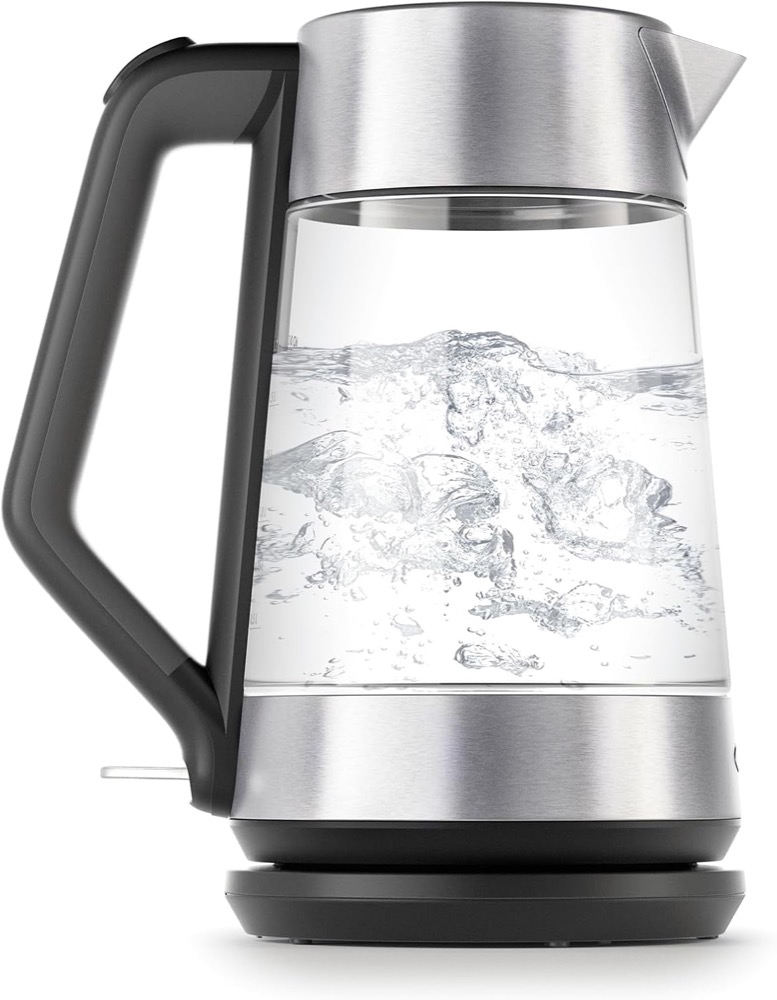 For Step 1
You will boil water for feeds several times a day for a year. This is the cheapest way to take one polypropylene surface out of that loop permanently.
Why it helps: The water touches only borosilicate glass and stainless steel. Neither sheds polymer particles at boiling temperature, which is exactly where polypropylene release peaked in the 2020 measurements.
Check Today’s Price on Amazon →Amazon prices change daily — tap to see today's price and any active discount.
- Free delivery & returns for Prime members
- Thousands of verified reviews
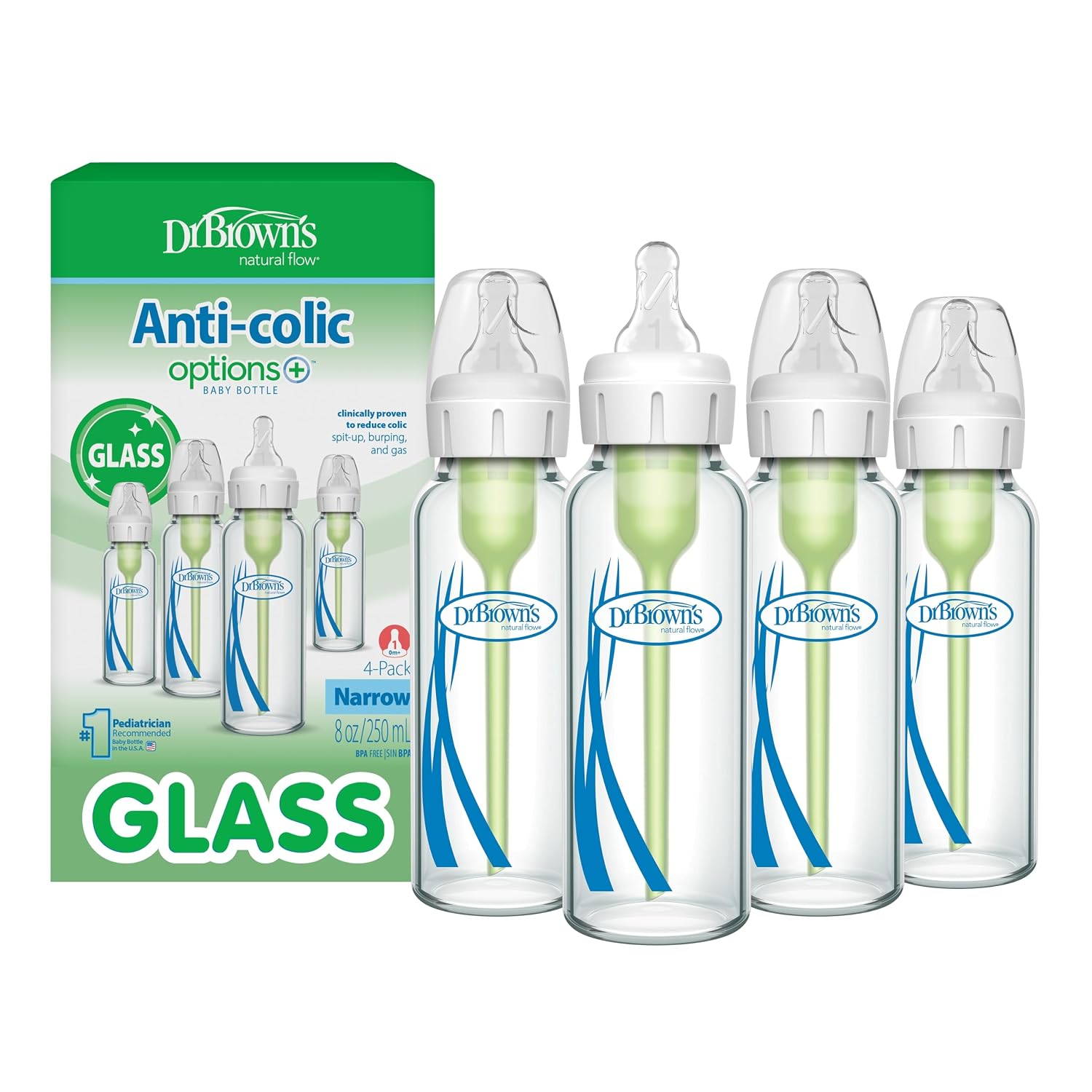 Glass Bottle
If you are buying bottles anyway, this is the step that makes the other five optional rather than necessary.
Why it helps: Borosilicate glass is thermally stable through sterilizing and does not degrade into particles the way polypropylene did across the 21-day Nature Food test.
Check Today’s Price on Amazon →Amazon prices change daily — tap to see today's price and any active discount.
- Free delivery & returns for Prime members
- Replacement teats widely stocked
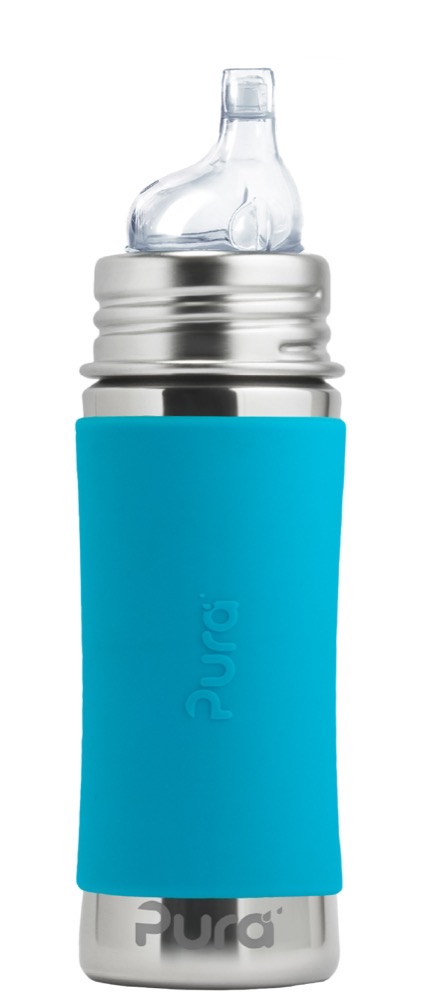 Steel Alternative
It outlasts the bottle stage entirely — the same body takes a sippy top later, so it is not a one-year purchase.
Why it helps: 304 stainless steel does not shed polymer particles at any temperature in this routine, so sterilizing, mixing and warming all stop being release events.
Check Today’s Price on Amazon →Amazon prices change daily — tap to see today's price and any active discount.
- Free delivery & returns for Prime members
- Converts to a toddler sippy cup
What the study did not find
It did not find harm. The Nature Food paper measured exposure — particles released, particles swallowed — and its authors said directly that the health consequences are unknown and need urgent research. Nobody has shown that a bottle-fed infant is injured by these particles, and anyone telling you otherwise has gone past the evidence.
What the paper did establish is the scale. Combining their per-liter measurements with feeding rates across 48 regions, they estimated an average daily intake of about 1.58 million particles per infant, ranging from 14,600 to 4.55 million depending on region, with North America around 2.28 million and Europe around 2.61 million. Those are large numbers attached to an unknown risk — which is exactly the situation where a free change to a routine is worth making and a panic is not. The wider picture of what has actually been detected in people is in microplastics in the human body, and the rest of the nursery is covered in the plasticproof nursery guide and microplastics in baby food.
The honest ranking
If you are still choosing bottles: buy glass or stainless steel and most of this page becomes unnecessary. If you already own polypropylene bottles and are not replacing them today, the two steps with the clearest mechanism behind them are mixing the feed in a glass jug and transferring it cool, and retiring the microwave. The three rinses after sterilizing cost nothing and the authors named them specifically.
And whatever you do, keep the water at 70°C. Every other line on this page is a precaution against an exposure nobody has yet tied to an illness. That one is a defense against an infection that has killed infants.
Frequently Asked Questions
Keep heat and agitation away from plastic. The Trinity College Dublin team behind the 2020 Nature Food measurements published a six-step routine: sterilize the bottle per WHO guidance and let it cool, rinse it at least three times with room-temperature sterilized water, boil water in a glass or stainless kettle rather than a plastic one, mix the formula in a non-plastic jug using water at 70 degrees Celsius or hotter, cool it to room temperature before transferring it into the bottle, and swirl rather than shake. Never reheat a bottle in a microwave.
The particles are not sitting in the bottle — they are shed by it during preparation. Across ten polypropylene bottle types tested over 21 days, the 2020 Nature Food study measured releases of 1.3 million to 16.2 million microplastic particles per liter of prepared formula. Release scaled with water temperature: about 600,000 particles per liter at 25 degrees Celsius, up to 16.2 million at 70 degrees, and as much as 55 million at the 95-degree temperature used for sterilizing.
Temperature is the single biggest driver the study found. Moving the water from 25 degrees Celsius to 95 degrees raised release from roughly 600,000 particles per liter to as much as 55 million — a change of nearly two orders of magnitude from the same bottle. That is why the published protocol moves every hot step out of the plastic bottle and into glass or stainless steel, and only transfers the formula once it has cooled.
No — and this is the one step where the microplastic advice must give way. The CDC states that water at about 158 degrees Fahrenheit (70 degrees Celsius) is needed to kill Cronobacter, a rare but frequently fatal bacterium that can live in powdered formula. Cooling the water below that to reduce particle shedding trades a theoretical exposure for a documented infant infection risk. Use 70-degree water, in a glass or steel jug, then cool the made-up feed before it goes near plastic.
Microwaving is the worst thing you can do to food-grade plastic. In a 2023 Environmental Science & Technology study, University of Nebraska–Lincoln researchers measured up to 4.22 million microplastic and 2.11 billion nanoplastic particles released from a single square centimeter of polypropylene or polyethylene baby-food container during three minutes of microwave heating. Warm a bottle by standing it in a bowl of warm water instead.
It removes the source rather than managing it, which is why it is the step we would make first if you are still buying bottles. Polypropylene accounts for about 82% of the global baby-bottle market, and every measurement in the Nature Food study is a measurement of polypropylene degrading under heat. Glass and 304 stainless steel do not shed polymer particles when hot. A glass bottle still has a silicone teat and a plastic collar, so it is a large reduction rather than a zero.
It did not, and the authors were explicit about that. The paper measured exposure — how many particles are released and swallowed — and stated that the health consequences of that exposure are unknown and urgently need research. Treat the numbers as a reason to make cheap, harmless changes to a routine you are doing anyway, not as a diagnosis.
Sources
- Li D, Shi Y, Yang L, Xiao L, Kehoe DK, Gun'ko YK, Boland JJ, Wang JJ. "Microplastic release from the degradation of polypropylene feeding bottles during infant formula preparation." Nature Food, volume 1, 2020. DOI 10.1038/s43016-020-00171-y. (Ten polypropylene bottle models over 21 days; 1.3–16.2 million particles per liter under WHO preparation; about 600,000 per liter at 25°C rising to as much as 55 million at 95°C; estimated daily infant intake averaging 1.58 million particles across 48 regions, 14,600 to 4.55 million by region. Source of all six steps.)
- Hussain KA, Romanova S, Okur I, Zhang D, et al. "Assessing the Release of Microplastics and Nanoplastics from Plastic Containers and Reusable Food Pouches: Implications for Human Health." Environmental Science & Technology, 2023;57(26):9782–9792. (Up to 4.22 million microplastic and 2.11 billion nanoplastic particles released from one square centimeter of polypropylene or polyethylene baby-food container during three minutes of microwaving; up to 75% death in cultured embryonic kidney cells exposed to the released particles.)
- Centers for Disease Control and Prevention. "Preventing Cronobacter in Infants." (Water at about 158°F / 70°C is needed to kill germs such as Cronobacter in powdered infant formula; ready-to-feed liquid formula is sterile.)
- Centers for Disease Control and Prevention. "Infant Formula Preparation and Storage." (Boil the water and wait about 5 minutes before mixing for infants under 2 months, born prematurely, or immunocompromised; use a prepared feed within 2 hours, within 1 hour of starting a feeding, or refrigerate and use within 24 hours.)
- World Health Organization and Food and Agriculture Organization. "Safe preparation, storage and handling of powdered infant formula: guidelines." 2007. (The preparation procedure the Nature Food team followed and wrote their mitigation steps on top of.)
- Trinity College Dublin. "Bottle-fed babies may consume millions of microplastic particles, our research suggests." 2020. (The research team's own write-up, listing the sterilization and preparation recommendations in order.)