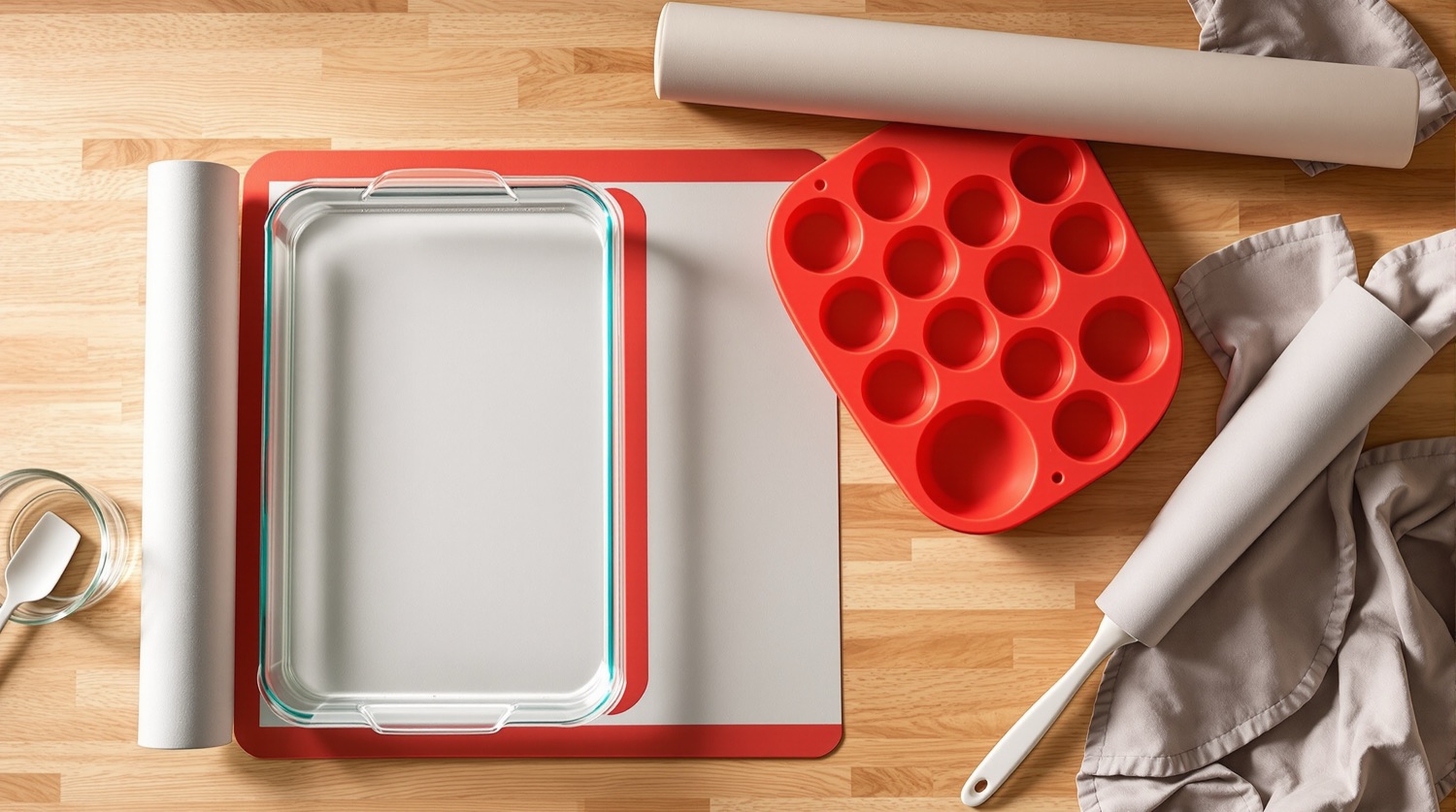
Cold silicone barely registers. Hot, greasy silicone measures. Health Canada researchers tested 25 silicone bakeware products and found 680 to 4,300 µg/g of cyclic siloxanes inside the rubber itself, an average of 105 µg/g transferring into a fatty food simulant after 60 minutes at 177°C, and 646 µg/m³ of the same compounds in the room air during the bake. A 2026 analysis of 30 silicone molds, bowls, spoons and straws found migration over the 2 mg/kg action limit proposed for children in every sample but one. No study found BPA, phthalates or PFAS. What comes out of silicone is silicone — short siloxane chains left behind when the rubber was cured — and heat plus fat is the dial that controls them.
There is a quiet assumption underneath most non-toxic kitchen advice, including a lot of ours: that silicone is the safe end of the spectrum. It usually is. It does not need a plasticizer to bend, it carries no BPA, no phthalates and no fluorinated coating, and it survives heat that would warp a polypropylene container into a different shape. Every one of those statements survives the testing.
What the testing adds is a second axis nobody puts on the label. Silicone rubber is cured, and curing never finishes the job: a fraction of the chains stay short, loose and mobile inside the finished product. Those are the siloxane oligomers, named D4 through D25 by how many silicon-and-oxygen units long they are. They sit in the material doing nothing until you heat them against fat, which is the precise description of baking.
Below are the numbers four separate labs measured — 92 silicone items between them, plus the baby-teat work that found something different again. Where a study did not measure something, we say so rather than fill the hole.
The bottom line up front: keep silicone for the cold half of the kitchen, where it is genuinely excellent, and move the hot fatty jobs — roasting, cake moulds, greasy baking mats — onto bare metal or glass. If you keep baking in silicone, run a new item empty in a hot oven first; factory post-curing is the single biggest variable in the data and you cannot tell from a shop shelf which version you have. Related reading: silicone vs plastic food containers, the best silicone food storage bags, and non-toxic baking sheets.
Is silicone safe for food?
For cold and room-temperature contact, yes in every practical sense — the measured migration is small, nothing hazardous was identified beyond silicone's own oligomers, and it beats the plastic it replaces. For prolonged hot contact with fatty food, it is a different material with a different answer: real products shed measurable amounts of themselves into the food, and the amount climbs with temperature, with fat content, and with how badly the item was finished at the factory.
Both of those are true at the same time, which is why the question as usually asked has no single answer. The useful version is not “is silicone safe” but “is silicone safe for this job,” and the studies below answer that one job by job.
Is silicone a plastic?
Not in the ordinary sense, and the difference is real rather than marketing. Conventional plastics are built on a carbon backbone. Silicone is built on a repeating silicon-and-oxygen chain — polydimethylsiloxane, or PDMS — that starts life as quartz sand rather than crude oil. It is also an elastomer, not a thermoplastic: it does not soften and reflow when heated, which is why a silicone spatula survives a hot pan and a black plastic utensil degrades in one.
None of that makes it inert. Curing a silicone product — the chemical step that turns liquid rubber into a solid muffin tray — always leaves a tail of chains that never joined the network. They are named for their length: D4 is a four-unit ring, D5 is five, up to D25 and beyond. The short ones are volatile, the longer ones are oily, and both are soluble in fat. That is the entire mechanism behind every number on this page.
What did lab testing of real silicone products actually measure?
Four published studies have put real, shop-bought silicone through migration testing. Here is what each one measured, with the numbers as reported.
| Study | What was tested | What it measured |
|---|---|---|
| Zhu et al., Journal of Hazardous Materials, 2025 (Health Canada) | 25 silicone bakeware products, Canadian market | 680–4,300 µg/g total cyclic siloxanes (D4–D16) in the material; 105 µg/g average into a fatty food simulant after 60 min at 177°C; 646 µg/m³ in room air during the bake |
| Chen et al., Foods, 2026 | 30 silicone molds, bowls, spoons and straws | 27 of 35 target siloxanes migrated; D6 up to 7.51 mg/kg, D5 up to 7.11 mg/kg at 70°C for 2 h; sum D3–D13 over the 12 mg/kg adult action limit in several samples and over the 2 mg/kg children's limit in all but one; molds held 8,323–25,046 mg/kg of siloxane residue |
| Eckardt et al., Food Additives & Contaminants: Part A, 2025 | Post-cured and non-post-cured platinum silicone moulds, baked with real food | Sum D4–D13 into shortcrust pastry, first cycle: 153 mg/kg from the non-post-cured mould vs 9.5 mg/kg post-cured; single highest transfer D7 at 29.9 mg/kg; 167 mg/kg total siloxanes by the third cycle; 21.5 mg/kg even at 45°C making chocolate |
| Helling et al., Food Additives & Contaminants: Part A, 2009 | 37 silicone baking moulds | Cyclic oligomers found in all 37; migration into cakes never exceeded 21 mg/kg (3 mg/dm²), comfortably under the EU overall migration limit of 60 mg/kg |
A note on units, because the studies do not agree on one. Milligrams per kilogram (mg/kg) is the same thing as parts per million. Micrograms per gram (µg/g) is also parts per million — so the Canadian figure of 105 µg/g in a fatty simulant and the German figure of 153 mg/kg in pastry are measuring in the same currency, under different conditions, with different silicone.
Does heat and fat really change the number that much?
They change it by more than an order of magnitude, and this is the single most useful thing in the literature. The same material behaves completely differently depending on what you ask it to hold.
| Condition | What migrated | Source |
|---|---|---|
| Chocolate preparation, max 45°C, 2 h, third cycle | 21.5 mg/kg total siloxanes | Eckardt 2025 |
| Cake baking, repeated cycles, 37 moulds | Never above 21 mg/kg (3 mg/dm²) | Helling 2009 |
| Shortcrust pastry, 180°C / 15 min, post-cured mould, first cycle | 9.5 mg/kg (sum D4–D13) | Eckardt 2025 |
| Shortcrust pastry, 180°C / 15 min, non-post-cured mould, first cycle | 153 mg/kg (sum D4–D13) | Eckardt 2025 |
| Shortcrust pastry, third cycle, total siloxanes including oligomers above D20 | 167 mg/kg — above the EU 60 mg/kg overall limit | Eckardt 2025 |
| Fatty simulant, 60 min at 177°C, 25 bakeware products | 105 µg/g average (sum D4–D16) | Zhu 2025 |
Read the two shortcrust rows together, because they are the finding that matters most. Two platinum-cured silicone moulds, the same food, the same oven, the same 15 minutes — and a sixteen-fold difference in what ended up in the pastry. The only variable was whether the factory had post-cured the mould, which is a second heat treatment that drives the loose short chains out before the product is boxed. Nothing on a package tells you which one is in your hand.
Eckardt's team also found that the heavier oligomers, above D20, migrate almost independently of post-curing — which is why total siloxanes still reached 167 mg/kg by the third bake, over the EU limit, in a mould that had been post-cured. And they flagged a methodological problem with real consequences: testing silicone with the standard fatty food simulant underestimates the third cycle badly, because the simulant strips almost everything out in the first two. Their recommendation was to test silicone against real food. That is why the 2009 cake numbers and the 2025 pastry numbers both belong on this page.
Does silicone bakeware put anything into the air?
This is the part almost nobody discusses, and it is where the largest share of the material actually goes. Zhu and colleagues measured the room air during 60-minute baking sessions at 177°C and recorded one-hour average concentrations of the sum of D4 to D16 reaching 646 µg/m³, falling away quickly once baking stopped.
Eckardt's team found the same thing from the other direction: across five baking cycles with a non-post-cured mould, roughly 98% of the initial D5 evaporated while only about 1% migrated into the food. The volatile fraction of a silicone mould does not mostly end up in your cake. It ends up in your kitchen.
Two practical consequences. First, if you bake in silicone, run the extractor hood and crack a window — the same advice that applies to overheated nonstick pans, for a completely different chemical reason. Second, both studies estimated that young children carry the highest exposure per unit of body weight, by both routes. If anyone in the house is small, the ventilation is not optional politeness.
Do silicone baby bottle nipples release microplastics?
Steam disinfection does release particles, and this is a separate mechanism from the siloxane migration above. Su and colleagues, publishing in Nature Nanotechnology in 2022, used a newer technique called optical photothermal infrared microspectroscopy — which can see particles down to well under a micrometer, where conventional spectroscopy stops at about 20 — on steam-disinfected silicone-rubber teats.
The wash water contained flake- and oil-film-shaped micro- and nanoplastics spanning 0.6 to 332 micrometers, formed when moist heat broke down the polydimethylsiloxane and a polyamide resin additive. Their estimate: a baby could ingest more than 0.66 million of these particles by the age of one, roughly 81% of them in the 1.5 to 10 micrometer range, with global emission from teat disinfection running as high as 5.2 × 10¹³ particles a year.
The honest framing matters here. The authors state plainly that the health risk of these particles is not yet known. Silicone is also still the mainstream teat material and the realistic alternatives are latex, which brings its own allergy question. The actionable part is narrower: do not over-sterilize past what your pediatrician advises, and replace teats once they go cloudy, tacky or visibly degraded, because surface breakdown is what the study was watching. Our guide to the safest baby bottles and the page on whether plastic baby bottles are safe cover the bottle itself, which is a larger source than the teat.
Is there a legal limit, and does silicone meet it?
There are limits, and they are not the limits most people assume. In the United States, silicone cookware sits under 21 CFR 177.2600, the FDA rule for rubber articles used repeatedly with food. It caps total extractives: not more than 20 milligrams per square inch into refluxing distilled water over the first seven hours and 1 mg/in² in the following two, or 175 mg/in² into refluxing n-hexane and 4 mg/in² thereafter.
That is a bulk weight test. It does not name a single siloxane, it sets no limit on D4 or D5 or D7 in food, and nothing in it obliges a manufacturer to post-cure anything. “FDA food-grade silicone” on a listing means the item passed a total-weight extraction test. It does not mean anyone measured what came out.
The European figure people quote — 60 mg/kg, equivalently 10 mg/dm² — is the overall migration limit for food-contact materials generally. The 2009 cake results sat well under it. The 2025 third-cycle pastry result, at 167 mg/kg, did not. Separately, Denmark's DTU Food has proposed action limits specific to siloxanes: 12 mg/kg of food for adults and 2 mg/kg for children. In the 2026 panel of 30 items, several samples cleared the adult figure and all but one cleared the children's.
One more thing worth knowing and worth not over-reading: the European Chemicals Agency identified D4, D5 and D6 as substances of very high concern in 2018 on persistence and bioaccumulation grounds, and an EU restriction capping them at 0.1% starts applying after 6 June 2026. That restriction covers cosmetics, personal care and cleaning products. It does not cover food-contact bakeware. Nobody has written that rule.
Which silicone uses are actually low risk?
Sorting it by the two variables the data actually cares about — temperature and fat — produces a clear ranking, and most of the silicone in a typical kitchen falls on the good end of it.
| Use | Temperature | Fat contact | Where it lands |
|---|---|---|---|
| Freezer and fridge storage bags, stretch lids | Cold | Low | Lowest measured exposure — keep using it |
| Spatulas, tongs heads, trivets, straws | Brief | Varies | Low — contact time is seconds, not an hour |
| Steaming vegetables in a silicone basket | 100°C | Low | Moderate — hot but not fatty |
| Muffin and cake moulds, baking mats under greasy food | 175–180°C | High | Highest measured — this is the swap worth making |
| Oiled air-fryer liners, sous vide in fat | Prolonged heat | High | Highest measured — and repeated cycles do not help |
| Baby teats, repeatedly steam-sterilized | Steam | n/a | Particle shedding documented; health effect unknown |
That ranking is also why the honest version of this article is not “throw out your silicone.” A silicone storage bag doing the job a disposable zip-lock used to do is sitting in the safest row of the table, and a silicone straw is in the second. The muffin tray is the one that moved.
How to make the silicone you already own safer
Six things, in order of how much the measured data supports them.
1. Bake out anything new before it touches food. Factory post-curing cut first-cycle migration from 153 mg/kg to 9.5 mg/kg, and you cannot tell which version you bought. Zhu's team found repeated baking produced a steady decline in both migration and air emissions, and Eckardt's found about 98% of the volatile D5 leaves as vapor rather than into food. So: empty oven, around 200°C (400°F), two to four hours, extractor on and a window open. No study has tested a home bake-out protocol specifically — this is the practical read of two findings that both point the same way, and we are not going to pretend it is more than that.
2. Move the hot, fatty jobs off silicone. Roasting, greasy traybakes, cake and muffin moulds. Bare metal or glass does the same job with no oligomer question at all.
3. Keep silicone for the cold half of the kitchen. Storage, freezing, lids, marinating in the fridge. This is where it is genuinely the better material and the numbers agree.
4. Ventilate while baking in it. 646 µg/m³ in the room air is the measured figure, and children take the highest dose per unit of body weight.
5. Retire anything tacky, cloudy, warped or sticky. Surface degradation is the condition both the teat study and the migration studies were watching. A silicone item that has gone gummy is telling you about its own chemistry.
6. Prefer platinum-cured where a brand says so. Platinum (addition) curing leaves no peroxide by-products behind, unlike the cheaper peroxide route. It does not eliminate the oligomer question — every mould in the Eckardt study was platinum-cured — but it removes one variable, and a brand willing to state its cure chemistry is a brand telling you something.
What to use instead when silicone is the wrong tool
Three items that cover the two rows at the bottom of the table above, plus the one place silicone still earns its spot. Nothing here needs replacing tomorrow; these are what to buy when the current thing wears out. Prices change daily, so check the current listing.
1. Nordic Ware Naturals Half Sheet — Best Swap for Silicone Baking Mats and Moulds
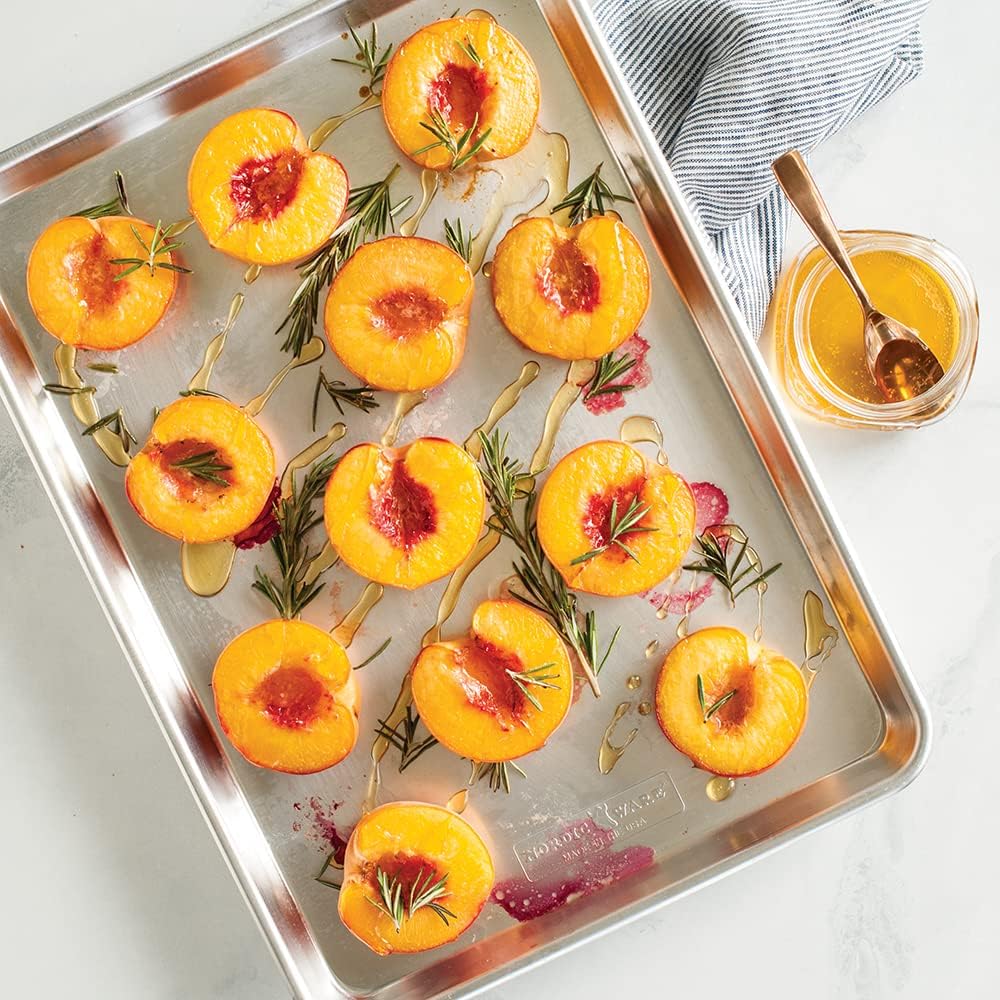 Best Overall
The one change the migration data actually argues for: take the fat and the 177°C off the silicone.
Why it's safe: Bare aluminum with a steel rim and no coating of any kind — no PTFE, no ceramic sol-gel, no silicone, nothing to shed.
Check Today’s Price on Amazon →Amazon prices change daily — tap to see today's price and any active discount.
2. Glasslock Oven Safe Set — Best for Baked and Roasted Dishes
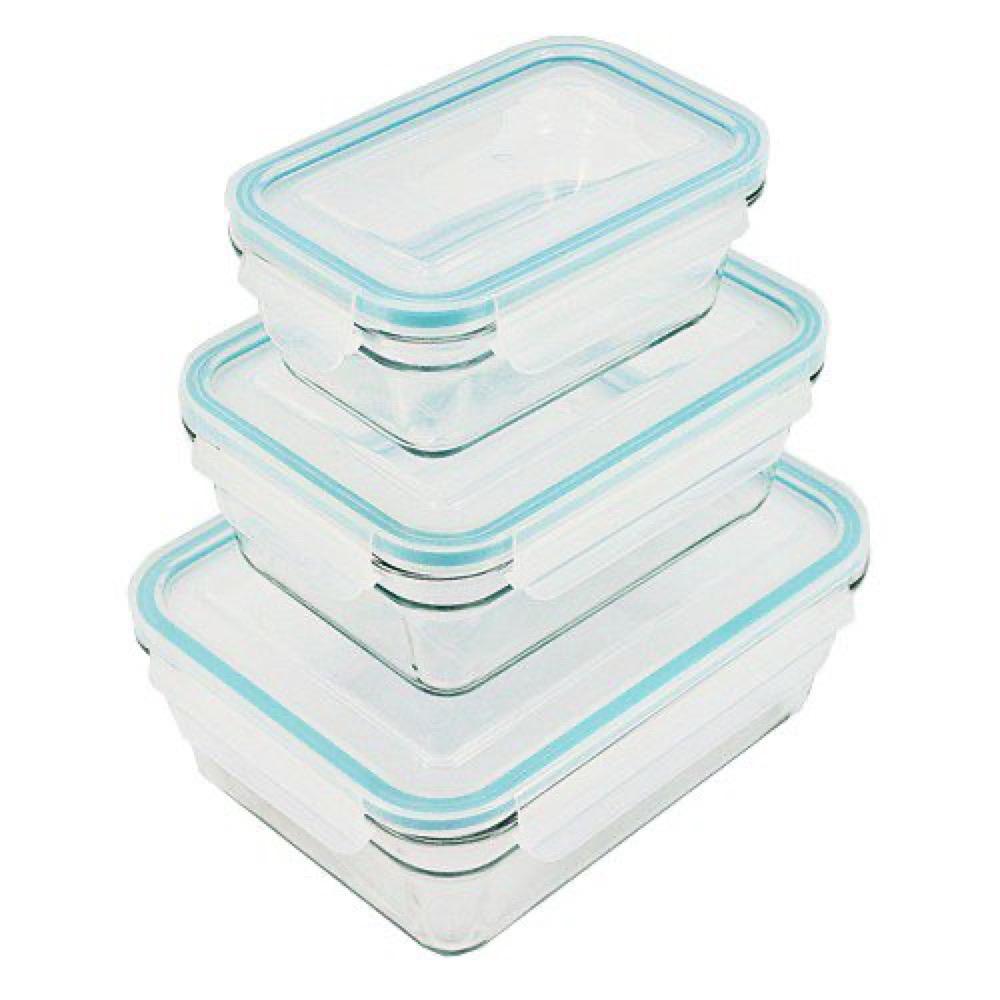 Best for Hot Food
Hot plus fatty is the exact combination the siloxane numbers respond to. Glass does not have the chemistry to respond.
Why it's safe: Tempered soda-lime glass is non-porous and chemically stable — nothing leaches out of it into hot or acidic food.
Check Today’s Price on Amazon →Amazon prices change daily — tap to see today's price and any active discount.
3. Stasher Reusable Silicone Bag Starter Kit — Where Silicone Still Wins
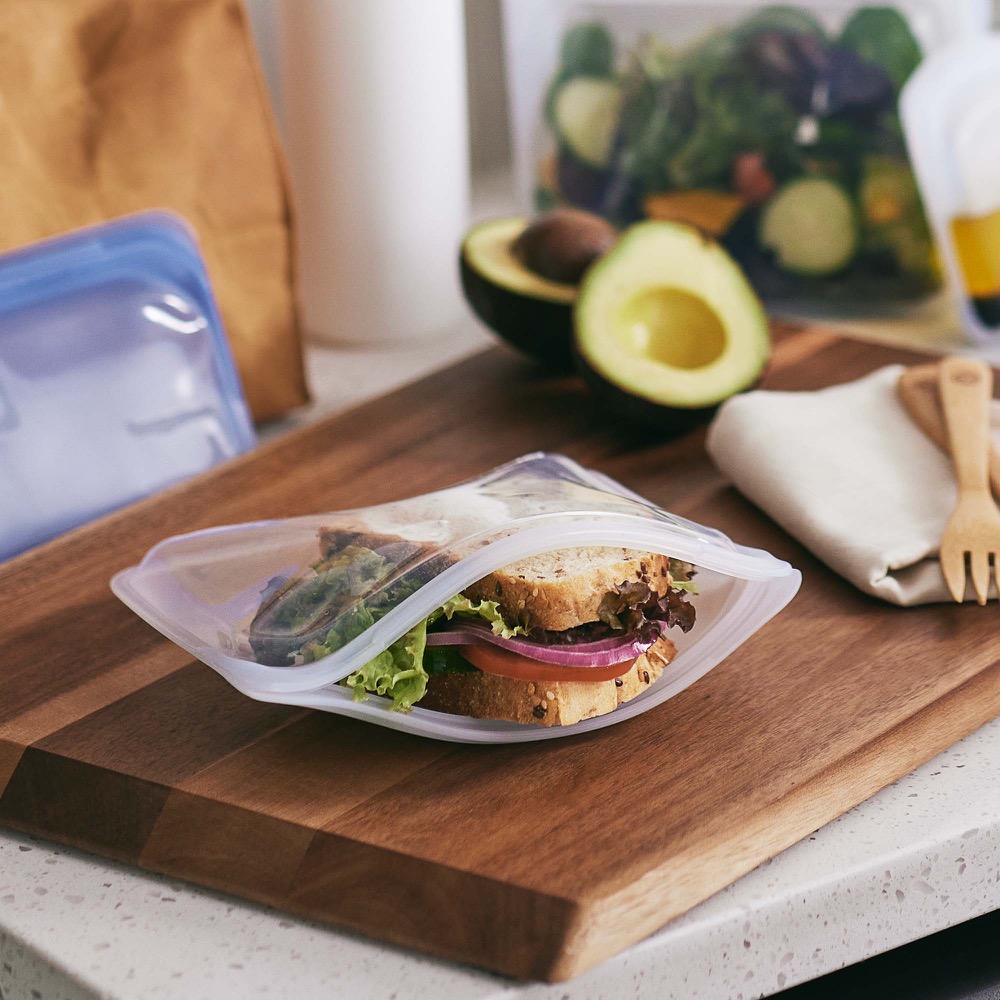 Best Cold Use
Replaces the disposable bag in the one role where silicone measured lowest — cold, sealed, and used for years.
Why it's safe: Platinum-cured (addition-cured) silicone leaves no peroxide by-products, and cold storage is the condition under which siloxane migration measured lowest.
Check Today’s Price on Amazon →Amazon prices change daily — tap to see today's price and any active discount.
The honest verdict
So, is silicone safe for food? As a material sitting in a drawer, there is nothing alarming in it — no BPA, no phthalates, no PFAS, and four studies looking hard found none. What they found instead is that silicone is slightly soluble in hot fat, in a way that is invisible, legal, and almost entirely determined by a factory step nobody discloses.
The practical shape of that is narrow and cheap to act on. One row of the table — hot, fatty, prolonged — carries essentially all of the measured exposure. Move that row onto metal or glass and the rest of your silicone is in the clear, doing a job it does better than the plastic it replaced. A storage bag is not a muffin tray, and treating them as one question is how this subject gets argued badly in both directions.
The part that genuinely deserves more attention is the air. A measured 646 micrograms per cubic meter of cyclic siloxanes in a kitchen during one hour of baking is not a trace, roughly 98% of the volatile fraction leaves as vapor rather than into food, and the exposure falls hardest on the smallest people in the room. There is no regulation addressing that at all, in either the US rule or the European one. Until there is, an extractor fan is the entire mitigation, and it costs nothing.
The bigger source is probably your tap
A muffin tray is an hour a week. Drinking water is every day, for everyone in the house — and unlike bakeware, it is something you can filter.
Frequently Asked Questions
It depends almost entirely on how hot the food is and how fatty it is. In cold and room-temperature use — storage bags, lids, freezer containers — measured migration is very low and silicone is a straightforward upgrade on plastic. In prolonged hot contact with fatty food it is a different material: Health Canada researchers measured an average of 105 micrograms per gram of cyclic siloxanes moving into a fatty food simulant after 60 minutes at 177°C across 25 bakeware products. Nothing in that work found BPA, phthalates or PFAS. What migrates is silicone's own short siloxane chains, left behind when the rubber was cured.
Not in the usual sense. Conventional plastics are built on a carbon backbone; silicone is built on a repeating silicon-oxygen chain called polydimethylsiloxane, made from quartz sand rather than petroleum, and it is an elastomer rather than a thermoplastic — it does not melt and reflow. That difference is real, and it is why silicone tolerates heat that would deform polypropylene. It is not, however, the same as being inert. Curing always leaves behind short unreacted chains, named D4 through D25 by how many silicon-oxygen units they contain, and those are what the migration studies keep finding in food.
In measurable amounts, and how much depends on whether the manufacturer post-cured it. Eckardt and colleagues, publishing in Food Additives & Contaminants: Part A in 2025, baked shortcrust pastry in platinum-cured silicone moulds at 180°C. The sum of D4 to D13 reaching the pastry on the first cycle was 153 mg/kg from a mould that had not been post-cured and 9.5 mg/kg from one that had — a sixteen-fold difference between two items that look identical in a shop. By the third cycle, total siloxanes including the heavier oligomers reached 167 mg/kg, above the EU overall migration limit of 60 mg/kg.
The evidence supports the idea, though no study has tested a home bake-out protocol specifically. Two findings point the same way. Eckardt and colleagues found that under hot-use conditions roughly 98% of the initial D5 in a non-post-cured mould evaporated into the air across five baking cycles, while only about 1% migrated into the food. Zhu and colleagues separately reported that repeated baking produced a steady decline in both migration and air emissions, consistent with the siloxanes being depleted over time. Running a new silicone item empty in a hot oven for two to four hours, with the extractor on and a window open, is the practical version of that.
Steam disinfection does release particles. Su and colleagues, publishing in Nature Nanotechnology in 2022, used optical photothermal infrared microspectroscopy on steam-disinfected silicone-rubber teats and found flake- and oil-film-shaped micro- and nanoplastics from 0.6 to 332 micrometers across in the wash water, generated by steam breaking down the polydimethylsiloxane. They estimated a baby could ingest more than 0.66 million of these particles by the age of one, about 81% of them in the 1.5 to 10 micrometer range. The authors are explicit that the health risk of those particles is not yet known.
It does not. The relevant US rule, 21 CFR 177.2600, sets limits on total extractives from rubber articles used repeatedly with food — not more than 20 milligrams per square inch into refluxing distilled water in the first seven hours, and not more than 175 milligrams per square inch into refluxing n-hexane. It is a bulk weight test. It does not name a single siloxane, sets no limit on D4 or D5 or any individual oligomer in food, and nothing in it requires a manufacturer to post-cure. That is the gap the migration studies keep walking into.
Sources
- Zhu J, Wawrzynczak A, Niu J, Chan WY, Vivas M, Das D, Tourangeau J, Zhang G, Cao XL, Feng YL. “Silicone bakeware as a source of human exposure to cyclic siloxanes via inhalation and baked food consumption.” Journal of Hazardous Materials, 2025;497:139591. PMID 40876430. (25 bakeware products from the Canadian market; total cyclic siloxanes D4–D16 in the materials 680–4,300 µg/g; average sum D4–D16 in baked food simulant 105 µg/g after 60 minutes at 177°C; one-hour average indoor air concentration of the sum D4–D16 reaching 646 µg/m³; migration influenced by bakeware type, surface area and fat content; repeated baking produced a steady decline; young children had the highest intake per unit body weight by both routes.)
- Chen Y, Li H, Huang H, Shentu X. “Migration of 35 Siloxanes from Silicone Food Contact Materials in China and Their Potential Exposure Assessment.” Foods, 2026;15(8):1387. doi:10.3390/foods15081387. (30 silicone food-contact items — molds, bowls, spoons, straws — from five top-selling domestic brands, seven imported brands and ten regional manufacturers; 35 target siloxanes D3–D22 and L2–L14; migration tested at 70°C for 2 hours; 27 of 35 migrated; D6 up to 7.51 mg/kg and D5 up to 7.11 mg/kg into 95% ethanol; sum D3–D13 above the 12 mg/kg DTU Food action limit for adults in several samples and above the 2 mg/kg limit for children in all but one; molds held 8,323–25,046 mg/kg siloxane residue.)
- Eckardt M, Seidel AK, Säger S, Simat TJ. “Migration of cyclic dimethyl siloxanes from silicone elastomers into food — determination of D4 to D25 via on-line coupled HPLC-GC-FID.” Food Additives & Contaminants: Part A, 2025;42(12):1764–1782. PMID 41134974. (Post-cured and non-post-cured platinum silicone moulds, baking at 180°C for 15 minutes and chocolate preparation at max 45°C for 2 hours; maximum single transfer D7 at 29.9 mg/kg into shortcrust pastry, 6.4% of its initial content; sum D4–D13 into shortcrust pastry on the first cycle 153 mg/kg non-post-cured vs 9.5 mg/kg post-cured; approximately 98% of initial D5 evaporated across five baking cycles against roughly 1% migrating into food; 167 mg/kg total siloxanes into shortcrust pastry by the third cycle, above the 60 mg/kg overall migration limit; 21.5 mg/kg total siloxanes at chocolate-preparation temperature, third cycle.)
- Helling R, Mieth A, Altmann S, Simat TJ. “Determination of the overall migration from silicone baking moulds into simulants and food using 1H-NMR techniques.” Food Additives & Contaminants: Part A, 2009;26(3):395–407. doi:10.1080/02652030802520852. (37 silicone baking moulds; cyclic organosiloxane oligomers identified in all samples; migration into cakes never exceeded 21 mg/kg, equivalent to 3 mg/dm², against the overall migration limit of 60 mg/kg or 10 mg/dm²; migration into simulants differed substantially from migration into real food.)
- Su Y, Hu X, Tang H, Lu K, Li H, Liu S, Xing B, Ji R. “Steam disinfection releases micro(nano)plastics from silicone-rubber baby teats as examined by optical photothermal infrared microspectroscopy.” Nature Nanotechnology, 2022;17(1):76–85. PMID 34764453. (Micro- and nanoplastics in the size range 0.6–332 µm found in the wash waters of steam-disinfected teats, generated by steam-induced degradation of the polydimethylsiloxane elastomer and a polyamide resin additive; estimated ingestion of more than 0.66 million elastomer-derived microplastics by the age of one year, roughly 81% in the 1.5–10 µm range; global emission from teat disinfection estimated as high as 5.2 × 10¹³ particles per year; the authors state the health risks are as yet unknown.)
- US Food and Drug Administration. “21 CFR 177.2600 — Rubber articles intended for repeated use.” (Total extractives for repeated-use rubber food-contact articles: not to exceed 20 mg per square inch into distilled water at reflux during the first 7 hours and 1 mg per square inch during the succeeding 2 hours; not to exceed 175 mg per square inch into n-hexane at reflux during the first 7 hours and 4 mg per square inch during the succeeding 2 hours. The rule sets no limit on any individual siloxane in food.)