Quick Answer
Mostly yes for cold, dry, one-time storage — but no for heating or repeated reuse. Ziploc bags are FDA-approved and made from polyethylene, a BPA- and dioxin-free plastic. The catch is that "approved" does not mean "inert": like all plastics, polyethylene sheds microscopic particles, and a 2023 study found plastic food bags release hundreds of microplastic fragments per bag per use — rising sharply with heat, fatty foods, and reuse.
Use them for occasional cold storage and they are low-risk. Microwave them, boil sous-vide in them, freeze-then-reheat in them, or wash and reuse them, and microplastic exposure climbs fast. The clean fix is a reusable silicone or glass swap that seals just as well and sheds nothing.
"Are Ziploc bags safe?" is one of the most-searched plastic-safety questions, and the honest answer is "it depends on how you use them." The bags themselves clear the FDA's food-contact bar, and the polyethylene they are made from is one of the more stable food plastics — no BPA, no phthalate plasticizers, no dioxins. For tossing crackers in a lunchbox or storing dry pasta, that is genuinely reassuring.
But the question people are really asking is about microplastics — the particles that flake off plastic during everyday use and have now turned up in human blood, lungs, and placenta. On that question, the research has gotten clearer, and the answer is more nuanced than the bright "FDA-approved" label suggests. The variables that matter are heat, fat, and reuse.
Are Ziploc bags safe for food storage?
For cold, dry, one-time storage, Ziploc bags are reasonably safe: they are FDA-approved, made from polyethylene, and contain no BPA, phthalates, or dioxins. The risk is low for a sandwich or some crackers. It climbs once you add heat, oily food, or repeated reuse — that is when microplastic shedding takes off.
Ziploc is a brand, but most people use the word for any zip-seal plastic storage bag. SC Johnson, which makes Ziploc, confirms its bags are made from polyethylene (the sandwich and storage lines are mostly low-density polyethylene, or LDPE; freezer bags are a thicker grade). Polyethylene is genuinely one of the better food plastics — it does not need the bisphenol or phthalate additives that make some other plastics chemically worrying, and a persistent internet rumor that Ziploc bags contain dioxins is false.
So on the classic "toxic chemical" question, Ziploc bags look fine. The reason this question keeps trending is a newer concern the FDA's decades-old approval never tested for: microplastics. Every plastic, no matter how stable its chemistry, physically sheds tiny particles as it is handled, flexed, warmed, and washed — and those particles end up in the food.
Do Ziploc bags contain BPA or harmful chemicals?
No. Ziploc bags are BPA-free and phthalate-free, and have been since long before "BPA-free" became a marketing line. Polyethylene does not require BPA (a hardener used in rigid polycarbonate) or phthalate plasticizers (used to soften PVC), so the two chemicals people worry about most simply are not part of the recipe.
That is worth stating plainly because a lot of bad information circulates here. Ziploc bags do not contain BPA, BPS, PVC, or dioxins. If your only concern is endocrine-disrupting plasticizers, a polyethylene zip bag is one of the lower-risk plastics in the kitchen — far safer than soft PVC cling films or polycarbonate containers.
BPA-free tells you about one chemical additive. It says nothing about microplastics — the polymer itself physically sheds particles regardless of which additives it does or does not contain. A bag can be 100% BPA-free and still release plastic fragments into your food when it is warmed or reused. The two issues are separate, and only one of them is on the box.
For the bigger picture on how plastic additives affect the body, see our overview of microplastics and hormone disruption.
Do Ziploc bags contain PFAS or "forever chemicals"?
Many plastic food storage bags do — but Ziploc-brand bags have tested clean in the two most-cited independent studies. This is where one brand actually separates from the pack.
The peer-reviewed evidence comes from Stroski & Sapozhnikova, published in the Journal of Chromatography Open in November 2023 (DOI: 10.1016/j.jcoa.2023.100106). The USDA and Baylor chemists tested 18 consumer- and lab-grade plastic food storage bags using liquid chromatography–mass spectrometry. Two findings matter for a shopper:
- 57% of the 18 bags had detectable PFAS, at 0.5–26.6 nanograms per gram of bag material. Perfluorobutane sulfonic acid (PFBS) was found at the highest concentration; 6:2 fluorotelomer phosphate diester (6:2 diPAP) was the most frequently detected compound.
- PFBS migrated out of the bag within two hours, at 22–75% efficiency in the migration test. The PFAS that was there did not stay in the plastic — it moved into what the plastic was holding.
The consumer-testing complement is Mamavation's ongoing plastic sandwich-bag investigation (samples collected December 2022–February 2024, updated February 2025), which sent 11 brands to an EPA-certified lab to screen for organic fluorine — the standard indicator that PFAS is present. Nine of the eleven brands (81%) came back with organic fluorine above 10 parts per million. Ziploc Sandwich Bags were non-detect, and a February 2025 re-test of Ziploc Slider Power Shield Technology 15-gallon Storage Bags was also non-detect.
| Study | Bags tested | % with PFAS detected | Ziploc-brand result |
|---|---|---|---|
| Stroski & Sapozhnikova, J. Chromatogr. Open (2023) | 18 | 57% (0.5–26.6 ng/g) | Not individually reported |
| Mamavation lab testing (Dec 2022–Feb 2024) | 11 sandwich-bag brands | 81% (>10 ppm organic fluorine) | Non-detect |
| Mamavation update (Feb 2025) | Ziploc Slider Power Shield 15 gal | — | Non-detect |
The takeaway. If your worry is PFAS "forever chemicals," Ziploc has cleaner independent testing than most competing sandwich-bag brands, and Ziploc's parent SC Johnson publicly committed in 2022 to phasing intentionally added PFAS out of its packaging. If you want to eliminate PFAS risk and stop the microplastic shedding that follows below in the same swap, a reusable silicone bag replaces the disposable bag one-for-one — see the picks below.
Do plastic bags shed microplastics?
Yes. This is the real answer to "are Ziploc bags safe," and it is where polyethylene's clean chemistry stops helping. Plastic bags release microplastic particles during ordinary use — opening, closing, flexing, and especially when warmed or reused — and a 2023 study measured hundreds of fragments shed per bag.
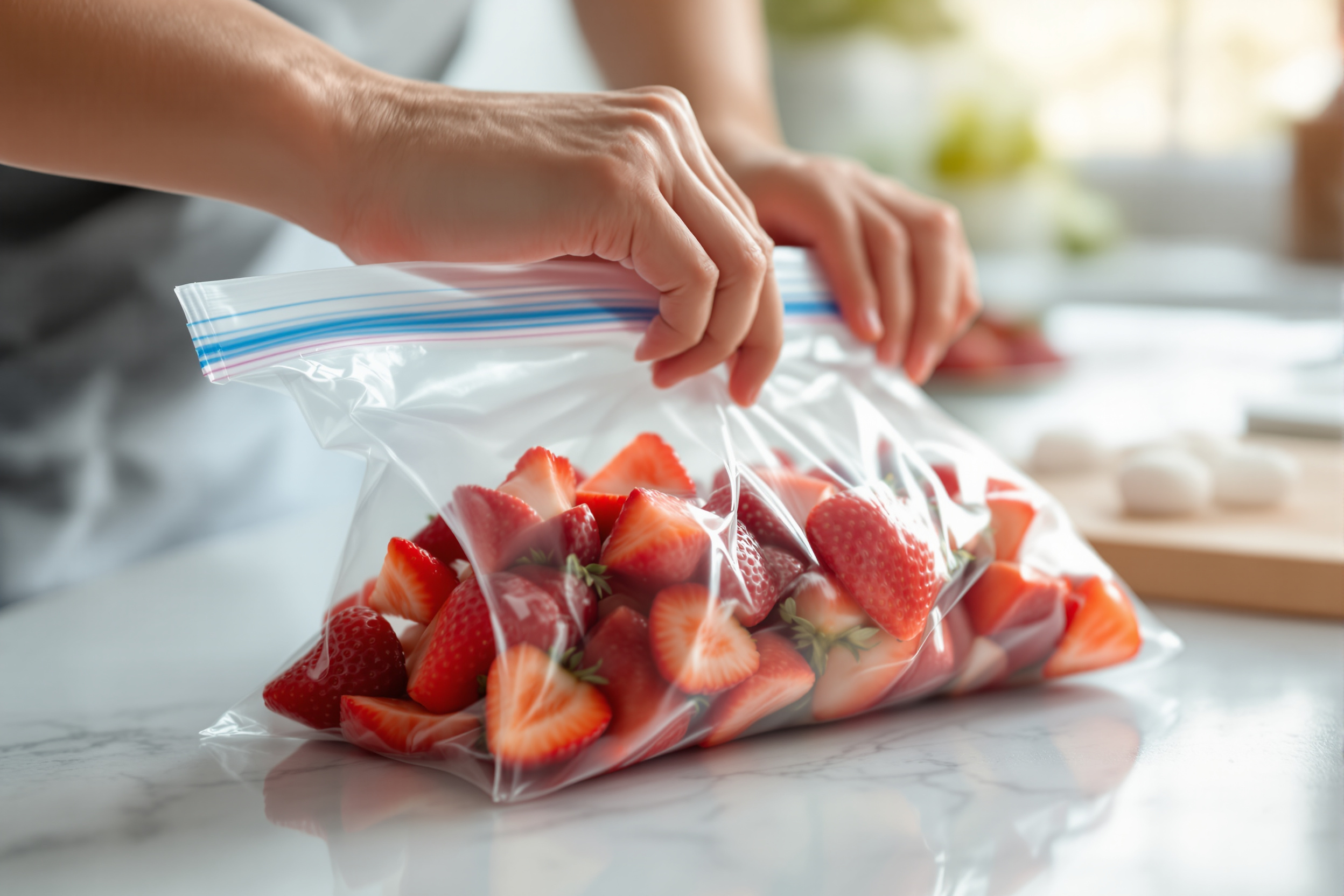
The clearest data comes from a 2023 paper in Environmental Science & Technology. Researchers tested common plastic food containers and reusable plastic pouches under everyday conditions — refrigeration, room-temperature storage, and heating — and measured the microplastics and nanoplastics released into the food. Two findings matter for bags:
- Mechanical handling sheds particles. Just folding, flexing, and opening a plastic bag abrades its surface and releases hundreds of fragments per use.
- Heat is the multiplier. Heating the plastic released the most particles of any condition — up to 4.22 million microplastics and 2.11 billion nanoplastics per square centimeter. Cold storage released far fewer.
Nanoplastics matter more than their size suggests. They are small enough to cross biological barriers that larger particles cannot, and microplastics have now been detected in human blood, lung tissue, the placenta, and breast milk. For the full picture on dietary sources, see our pillar guide on which foods have the most microplastics. The same “heat + polymer” problem plays out inside a mug of tea — a September 2025 EFSA review put a plastic-containing tea bag’s per-serving release at 5,800–20,400 identified microplastic particles, while unbleached-paper bags released none of it. Only four US brands pass that test: see the safest tea bags of 2026 for the four that pass and the five that fail.
"BPA-free tells you what is not in the plastic. It says nothing about the plastic itself flaking into your food."
Is it safe to microwave or reuse Ziploc bags?
These are the two uses that turn a low-risk bag into a higher-risk one. Microwaving applies direct heat — the single biggest driver of particle release — and reuse mechanically abrades the plastic over and over. Both push microplastic shedding up sharply, so both are worth avoiding.
A few specific cautions:
- Do not microwave food in a Ziploc bag. Ziploc markets some bags as safe for "defrosting and reheating," but heating plastic is exactly the condition that released billions of nanoplastics in the lab. Transfer food to a glass or ceramic dish first. The same logic applies to microwaving Tupperware and plastic containers.
- Do not boil or sous-vide in a regular plastic bag. Standard storage bags are not built for sustained heat; the "boil-in-bag" method belongs to bags specifically rated for it, or better, to a platinum-silicone bag rated to 400°F.
- Do not wash and reuse them. Rinsing a plastic bag in hot water and flexing it dry abrades the surface and increases shedding. If you reuse bags to cut waste, that instinct is right — just switch to a reusable silicone bag built for thousands of washes.
- Freezing is the lowest-risk use. Cold temperatures release far fewer particles, so freezing dry or solid food in plastic is the least concerning use — as long as you thaw it in the fridge, not the microwave.
What should you use instead of Ziploc bags?
The cleanest fix is a reusable bag made from an inert material that seals like plastic but sheds nothing: food-grade or platinum-cured silicone. For liquids and anything you will reheat, an inert glass container is even better, and for wrapping solids a bag handles awkwardly — cheese, bread, a cut avocado — a breathable beeswax wrap covers the job with zero plastic. Below are six specific swaps — five reusable silicone bags and a glass lunch container — that cover every job a box of Ziplocs does.
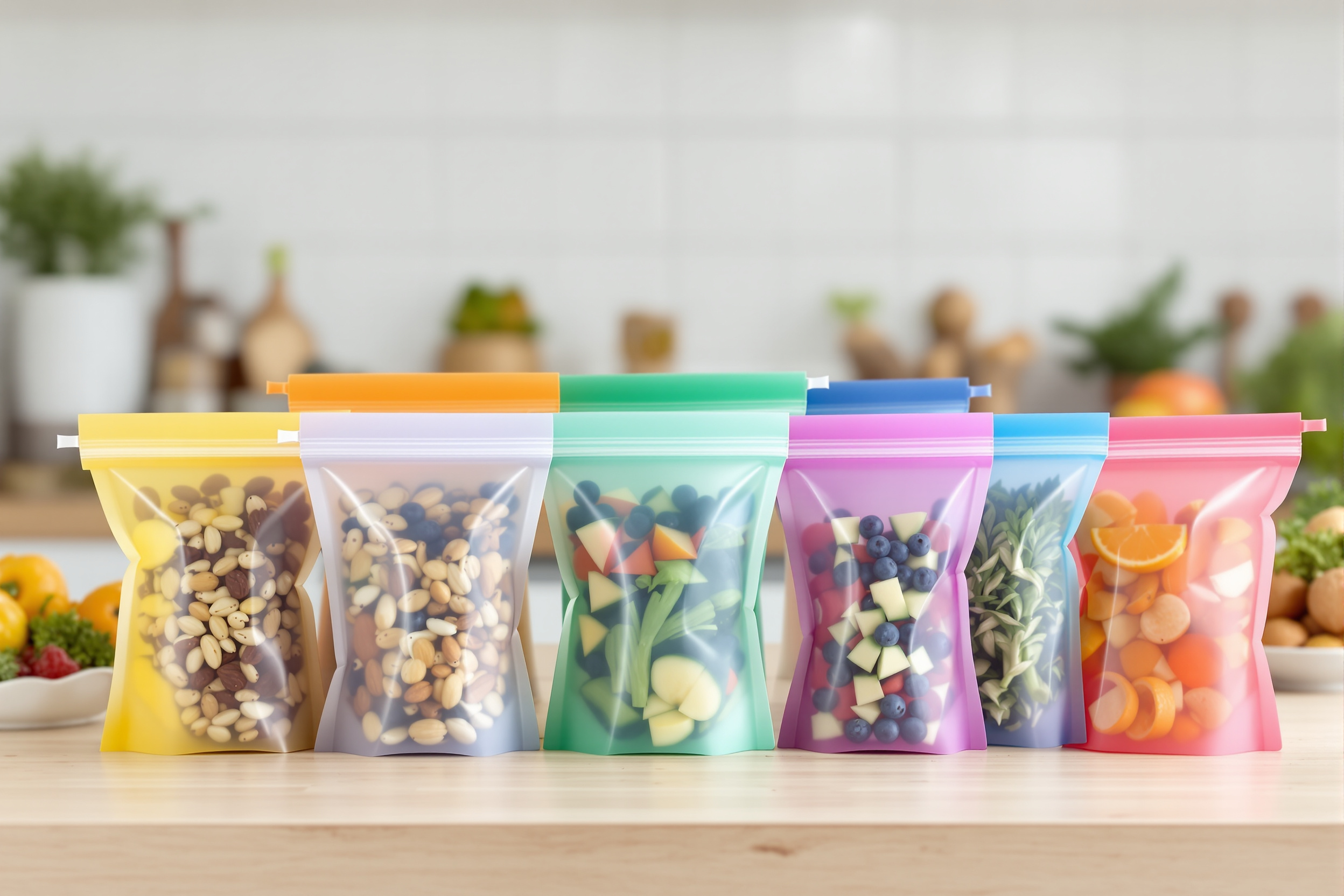
Quick Picks
| Pick | Product | Material | Best For |
|---|---|---|---|
| Best overall | Stasher Sandwich Bag | Platinum silicone | The everyday one-for-one zip-lock replacement |
| Best for kids | Zip Top Reusable Silicone Bags | Platinum silicone | Easy silicone zipper kids can open themselves |
| Best budget | Bumkins Silicone Reusable Bags | Platinum silicone | Cheapest way into real silicone, lunchbox sizes |
| Best design | W&P Porter Silicone Bag | LFGB silicone | Good-looking everyday snack & fruit storage |
| Best for freezing | Stasher Silicone Bag Starter Kit | Platinum silicone | Freezer-to-microwave soups, sauces & leftovers |
| Best for lunches | Bentgo Glass Lunch Container | Borosilicate glass | Reheating lunch at the office, lid off |
Tap any pick below for today's exact Amazon price. Silicone bags replace zip-locks one-for-one; glass is the better choice for liquids and anything you will reheat.
Our Top Picks
Best Overall: Stasher Sandwich Silicone Bag
 Best Overall
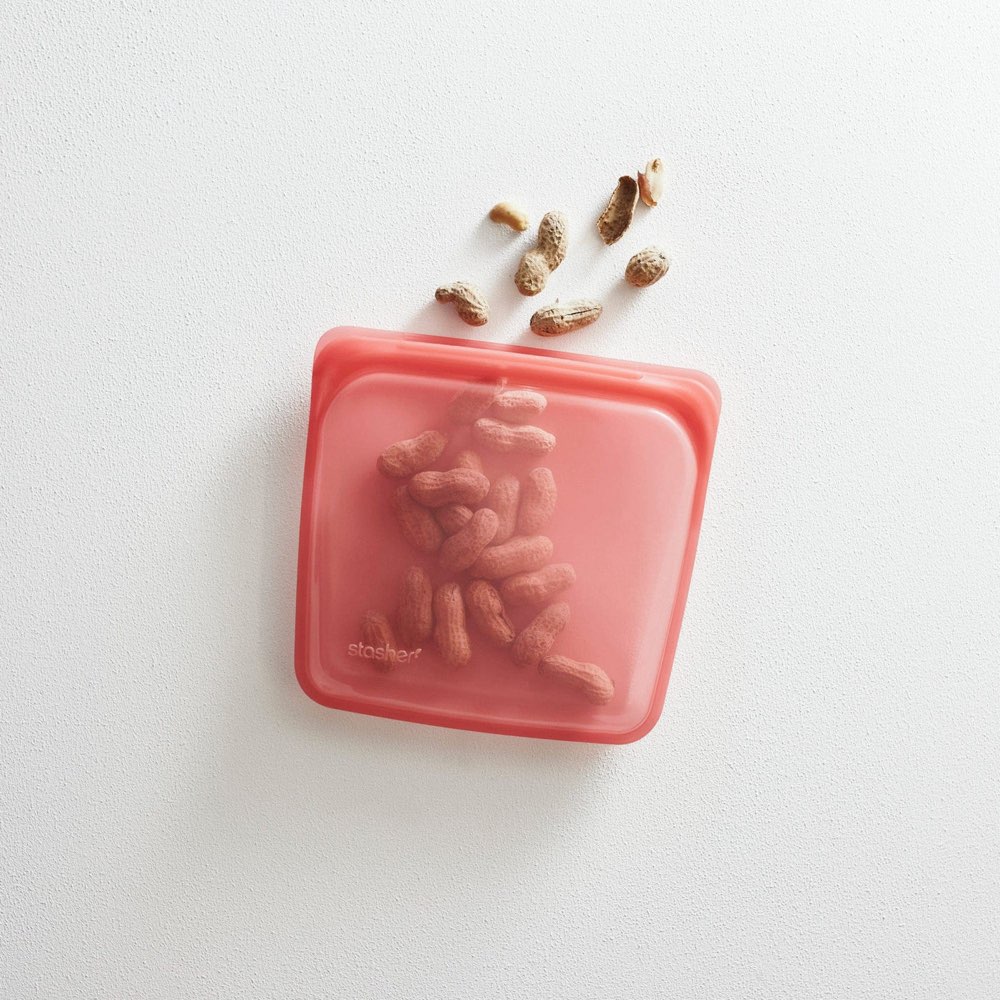
Stasher invented the silicone storage bag and still makes the best one. The pinch-seal — two interlocking silicone ridges you press together — creates an airtight, liquid-tight seal that holds up over hundreds of uses, with no zipper mechanism to break or plastic slider to crack.
The sandwich size is the everyday workhorse that replaces your standard zip-lock; the gallon size handles marinating, freezing soups, or storing leftovers. Across the range it is platinum food-grade silicone, rated to 400°F, freezer safe to -70°F, and dishwasher safe. If you are weighing silicone against the plastic tubs and bags it replaces, our guide to silicone vs. plastic food containers compares how much each one actually leaches.
The sandwich-size Stasher earns the same loyalty owners give the whole line: it goes freezer to microwave to dishwasher and holds up to repeated washing over years. Reviewers pack sandwiches, snacks, and cut fruit in it as a direct swap for a disposable bag. The honest gripes: the pinch seal is fiddly to open and not always watertight with liquids, the inside dries slowly and can trap odors or mildew if you seal it damp, and it costs far more up front than the throwaway bag it replaces.
One bag that handles the lunchbox, the freezer, and the sous vide bath — replacing hundreds of disposable plastic zip-locks over its life.
Why it's safe: Made entirely from 100% food-grade platinum silicone with no BPA, BPS, or phthalates — it is chemically inert and sheds no microplastics, even with warm or fatty food.
Check Today's Price on Amazon →Amazon prices change daily — tap to see today's price and any active discount.
- Free delivery & returns for Prime members
- Sold & shipped by Amazon
- Tens of thousands of verified reviews
Why it made the list: If your "Ziploc problem" is really a drawer full of disposable sandwich bags, this is the direct swap. Stasher's platinum silicone seals airtight, survives the dishwasher and freezer, and replaces hundreds of throwaway bags. For the full lineup, see our guide to the best silicone food storage bags.
Best for Kids: Zip Top Reusable Silicone Bags
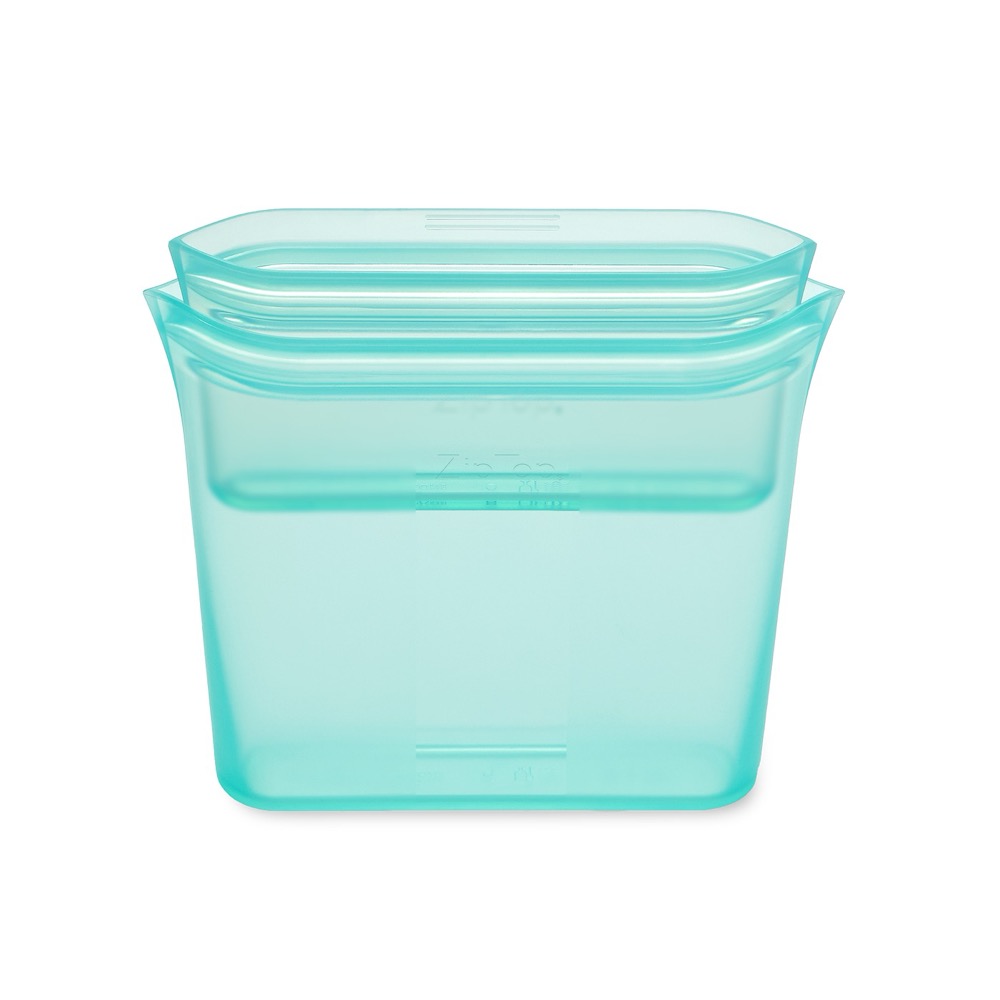 Best for Kids
Zip Top uses a true silicone zipper — a slide-and-lock mechanism made entirely of food-grade silicone. For anyone who finds Stasher's pinch-seal fiddly (especially kids), Zip Top is immediately intuitive. You zip it shut exactly like a plastic bag, except there is no plastic anywhere.
It also stands upright without assistance, making it practical for storing yogurt, cut fruit, or liquid-heavy foods in the fridge. The snack size is ideal for the kids' lunchbox; the medium replaces the standard sandwich bag.
The stand-up design is the most-praised feature: owners call them ridiculously sturdy and like that they stay open on their own for filling and cleaning. Reviewers use them for snacks, produce, and leftovers and say the wide base makes them less messy to load than flat bags. The honest downsides: the most common complaint is that the seal is not airtight, and some owners say the zip top comes apart when the bag is packed full. The silicone also has a tacky feel that picks up dust, hair, and crumbs, so many people give them a quick rinse before filling.
Kids can open and close it themselves, and it stands open on the counter while you fill it — the closest thing to a plastic zip-lock that contains zero plastic.
Why it's safe: Built from a single piece of 100% platinum food-grade silicone with no plastic slider, BPA, BPS, or phthalates — nothing to leach or shed into food, reusable for years.
Check Today's Price on Amazon →Amazon prices change daily — tap to see today's price and any active discount.
- Free delivery & returns for Prime members
- Made in the USA
- Thousands of verified reviews
Why it made the list: The intuitive zipper makes this the easiest plastic-free bag to hand to a child, and it stands upright so it doubles as a mini container. A practical entry point for families replacing single-use baggies.
Best Budget: Bumkins Silicone Reusable Bags
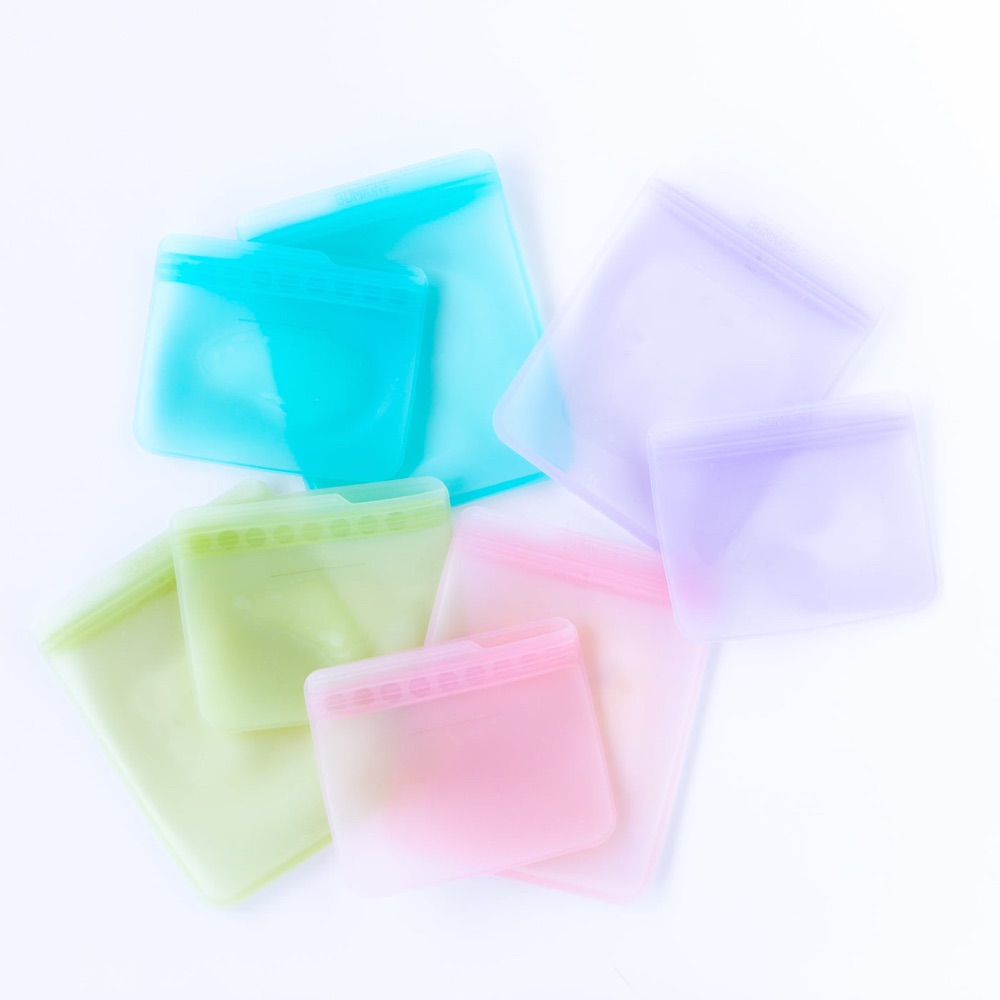 Best Budget
Bumkins makes one of the most affordable true food-grade silicone bags, sized well for toddler portions and lunchboxes. (Note: this is Bumkins' silicone flat reusable bag — not its older fabric snack-bag line.) Made from 100% LFGB-grade platinum silicone, it uses a textured seal-loc closure with grip circles that is easy for little hands and adults alike.
Build is lighter-duty than Stasher — great for dry snacks, fruit, and refrigerator storage, less suited to heavy freezer or sous vide use. For families churning through a lot of bags for school lunches, the value is hard to beat.
Reviewers describe them as just as good as a zip lock but better because you can reuse it over and over, and parents like the textured seal circles that kids can open and close on their own. Owners use them for snacks, sandwiches, and freezer storage and note they lay flat or stand up. Review volume is thinner here than for Stasher or Zip Top, so long-term durability data is limited; the sticky platinum-silicone interior that helps lock in freshness is also what draws dust and lint on an open shelf, and the top-rack, under-400F guidance is worth checking before you microwave.
Real platinum silicone at the lowest price on this list — and a seal a three-year-old can actually open and close at the lunch table.
Why it's safe: Made from 100% food-safe platinum (LFGB-grade) silicone with no BPA, BPS, or phthalates — it is leak-resistant, reusable, and sheds no microplastics into food.
Check Today's Price on Amazon →Amazon prices change daily — tap to see today's price and any active discount.
- Free delivery & returns for Prime members
- Sold & shipped by Amazon
- LFGB-grade platinum silicone
Why it made the list: It is the cheapest way to start replacing disposable bags with real silicone, and the kid-friendly seal makes it the natural first buy for school lunches. Upgrade to Stasher once the kids are less rough on them.
Best Design: W&P Porter Silicone Bag
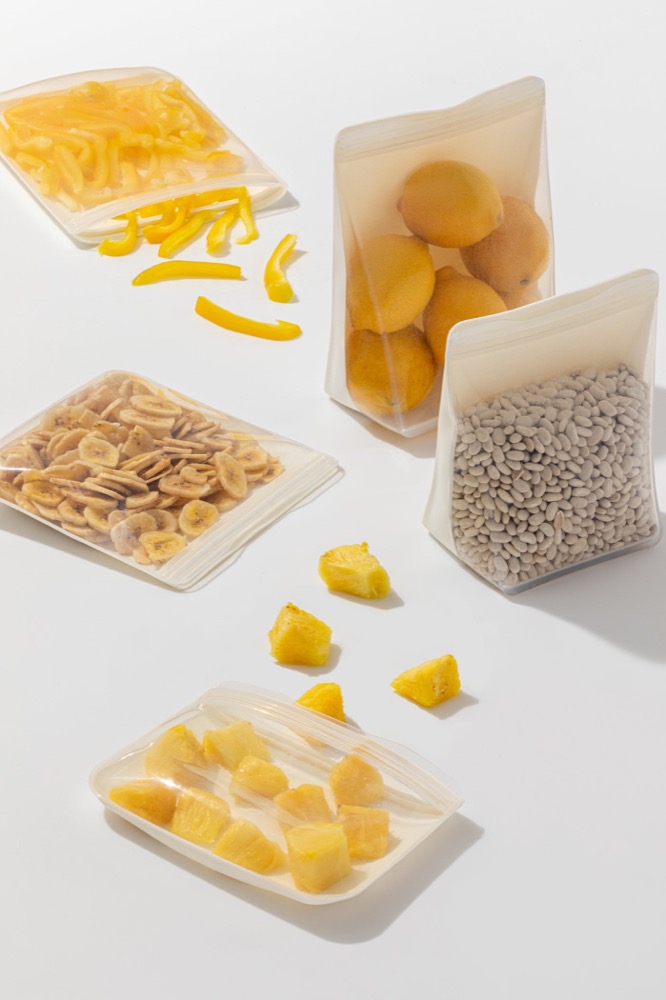 Best Design
W&P's Porter bag is the most premium-looking silicone bag available. It is matte, minimal, and available in sophisticated colorways (cream, slate, blush, mint) that do not look out of place at a work desk. Each bag is molded from one piece of LFGB-certified silicone — no chemicals, glues, or adhesives — with rounded corners so there is nowhere for buildup to hide.
It comes in both layflat and stand-up designs across five sizes. It is excellent for dry snacks, fruit, sandwiches, and freezer storage, and it is microwave and dishwasher safe.
Testers say these come closest to looking and feeling like a disposable zip-top bag, with thin, clear, pliable LFGB-certified silicone and a seal reviewers call leak-proof. Owners like that they wash up without the lingering odor other silicone bags hold. The honest downsides: like every silicone bag they are slow to dry after washing, the stand-up bag is pricey next to a box of disposables, and detailed long-term complaints are sparse, so buy for the feel and seal rather than a bargain.
A reusable bag you will not want to hide in a drawer — clean lines, muted colors, and curved corners that actually wipe clean after greasy snacks.
Why it's safe: Made from a single piece of LFGB-certified food-grade silicone — completely free of PEVA, BPA, PVC, and phthalates, with no glue or adhesive and nothing to leach into food.
Check Today's Price on Amazon →Amazon prices change daily — tap to see today's price and any active discount.
- Free delivery & returns for Prime members
- Sold & shipped by Amazon
- LFGB-certified silicone
Why it made the list: It proves a plastic-free swap does not have to look utilitarian. The Porter bag wipes clean, handles snacks and fruit, and is handsome enough to leave on your desk — a low-friction way to drop disposable snack bags for good.
Best for Freezing & Leftovers: Stasher Reusable Silicone Bag Starter Kit
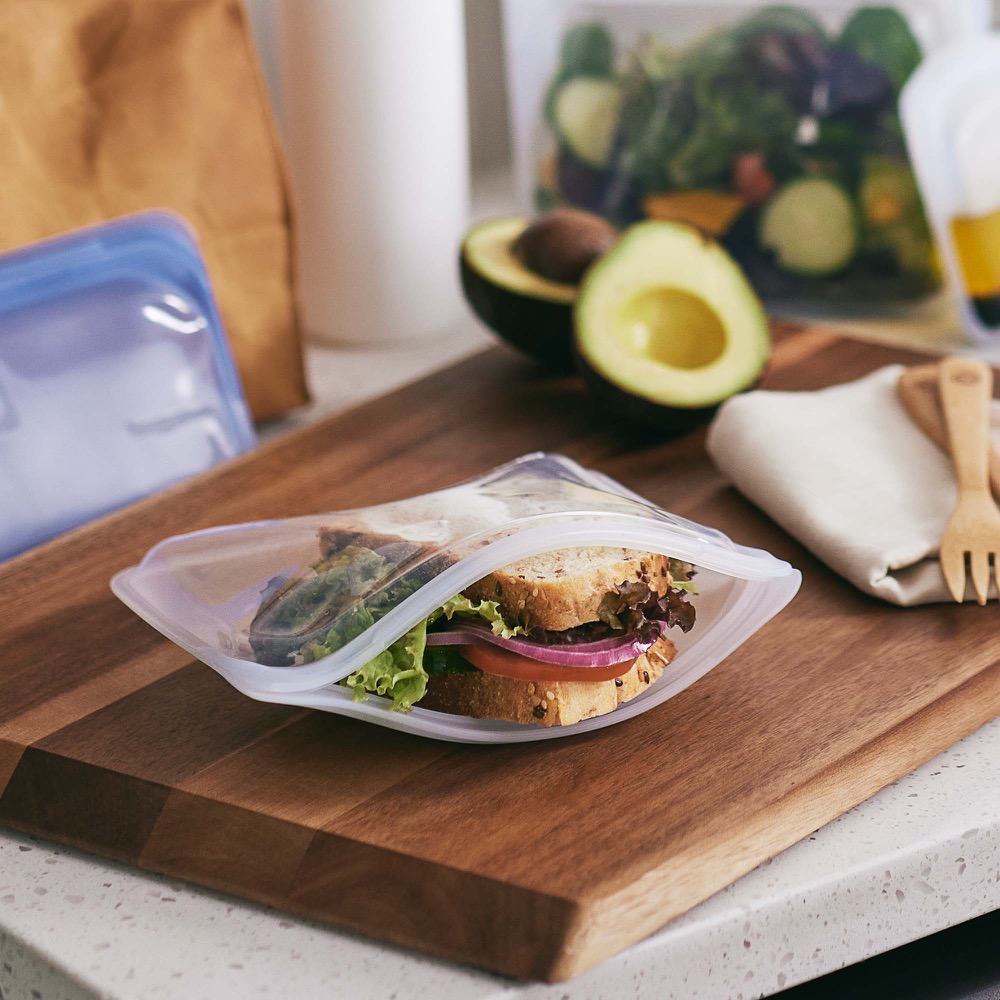 Best for Freezing
For freezing, marinating, or anything you would reach for a heavy-duty freezer bag, Stasher's platinum-cured silicone is the upgrade — sturdier than any disposable bag and free of the chemicals that migrate from plastic. The patented Pinch-Loc seal is genuinely airtight and leakproof, so it holds liquids without the freezer drips a plastic bag is famous for.
It is freezer safe to -70°F and goes straight to the microwave or a 425°F oven. The starter kit covers the everyday sizes — sandwich, snack, and stand-up half-gallon — so you can retire a whole box of single-use freezer bags in one purchase.
Owners keep Stasher bags for years and like that a single bag goes from freezer to microwave to dishwasher. Reviewers use them for marinades, snacks, sous vide, and leftovers and say food stays fresh. The honest gripes: the pinch-lock seal can be tricky to open and does not always stay watertight with liquids, the inside dries slowly and can hold odors or mildew if you seal it damp, and the silicone attracts dust and pet hair on the shelf. Some owners report tears after heavy sous vide use, and the price is the most common knock.
Freeze soups, sauces, and batch-cooked leftovers in airtight silicone instead of leak-prone plastic — then thaw and reheat in the same bag, no transfer needed.
Why it's safe: Platinum-cured silicone — the highest-purity, chemically inert grade — with no plastic, PVC, BPA, lead, latex, phthalates, or PFAS.
Check Today's Price on Amazon →Amazon prices change daily — tap to see today's price and any active discount.
- Free delivery & returns for Prime members
- Sold & shipped by Amazon
- Tens of thousands of verified reviews
Why it made the list: Freezer bags are the plastic most people keep longest, and they are the messiest to thaw and reheat. A multi-size silicone kit replaces the whole box at once and skips the transfer-to-a-dish step entirely. For the full lineup, see our guide to the best silicone food storage bags.
Best for Lunches: Bentgo Glass Lunch Container
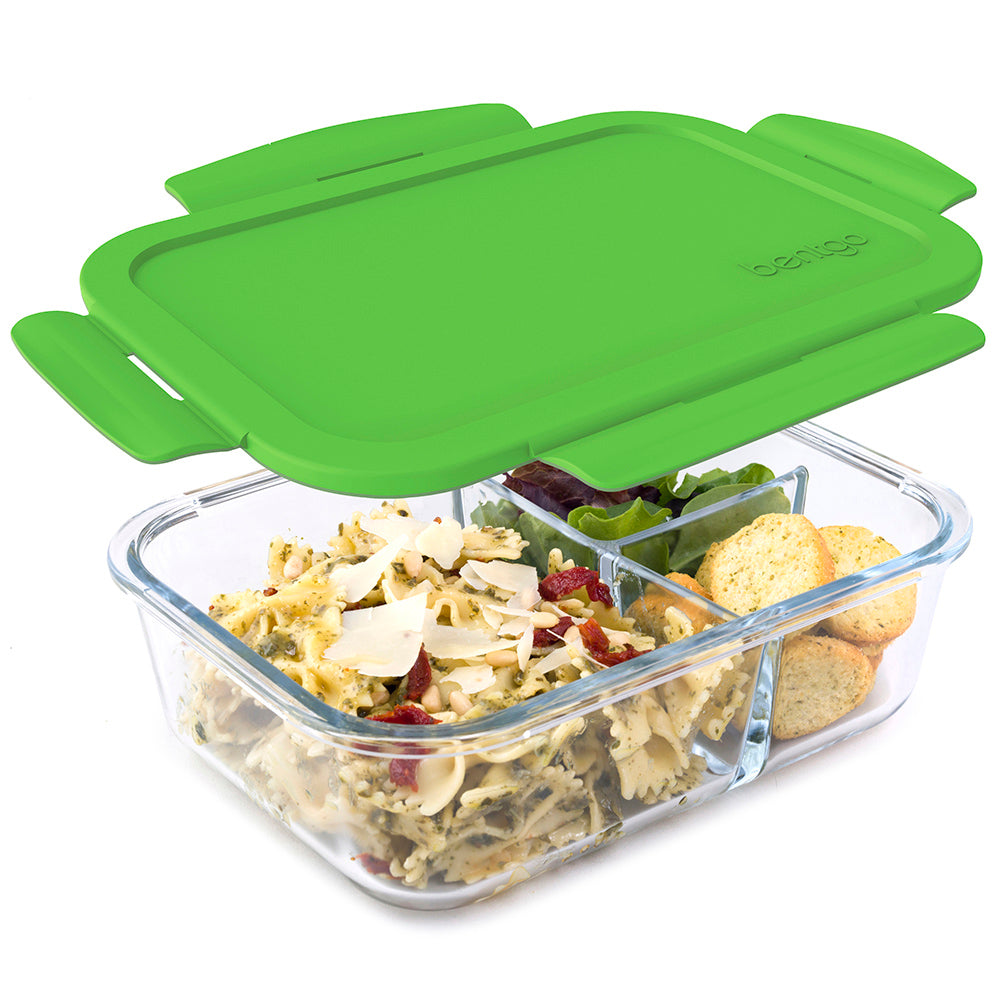 Best for Lunches
Owners praise the excellent seal and thick, sturdy glass, and say food does not seep between compartments even when the box is tipped upside down. Reviewers meal-prep in them and run them through oven, microwave, and dishwasher. The honest gripes: the glass is heavy and bulky to carry, the vacuum lid can be hard to close (some describe needing real force) and can seal shut after heating, and a few owners report the glass chipping more readily than expected. Watery foods can also cross between the two inner compartments even though the outer lid holds.
Pack lunch in glass instead of a sandwich bag, then take the lid off and microwave straight from the fridge — no plastic touching hot food.
Why it's safe: The food-contact body is borosilicate glass — chemically inert and thermal-shock resistant, so storing and reheating release nothing. The silicone gasket only seals the rim.
Check Today's Price on Amazon →Amazon prices change daily — tap to see today's price and any active discount.
- Free delivery & returns for Prime members
- Sold & shipped by Amazon
- Thousands of verified reviews
Why it made the list: For anyone whose Ziplocs mostly carry a packed lunch, a single glass container does the job better — it stores, travels, and reheats without plastic against hot food. The only trade-off is weight. For more options, see our roundup of the best non-toxic lunch containers for adults.
How to use plastic bags more safely (and phase them out)
You do not have to throw out the box you already own. The goal is to use plastic bags only for their lowest-risk job — cold, dry, one-time storage — and to never heat or reuse them. Here is the simple routine:
- Never microwave or boil food in a plastic bag. This is the single highest-exposure habit. Transfer food to a glass or ceramic dish to reheat — the same rule that applies to plastic containers in the microwave.
- Do not wash and reuse disposable bags. Reuse mechanically abrades the plastic and increases shedding. Use each disposable bag once, then recycle it.
- Keep plastic bags for dry, cold, low-fat foods. Crackers, bread, dry pantry goods, and frozen solids are the lowest-risk contents. Skip plastic for oily, acidic, or hot foods.
- Thaw frozen bags in the fridge, not the microwave or hot water. Cold release is low; warming a frozen bag spikes it.
- Replace the bags you reach for daily first. Buy one or two silicone bags for everyday sandwiches and snacks — the highest-frequency uses — before worrying about the once-a-year stuff.
- Tackle your tap water too. Filtering drinking water removes another major microplastic source — see our guide to the best water filters for microplastics, and the wider kitchen plastic detox guide.
Want the Full Kitchen Swap Checklist?
The Complete Plasticproof Guide covers every kitchen swap — containers, cookware, cutting boards, wraps, and more — with the full research and 80+ product recommendations backed by 47+ peer-reviewed studies.
Frequently Asked Questions
For basic cold storage, yes — Ziploc bags are FDA-approved and made from polyethylene, one of the more chemically stable food plastics, and they are BPA- and dioxin-free. But "approved" is not the same as "inert." Like all plastics, polyethylene sheds microscopic particles, and that release rises sharply with heat, fatty or acidic foods, and repeated reuse. For occasional cold, dry storage the risk is low; for anything warm, oily, or used over and over, a reusable silicone or glass alternative removes the exposure entirely.
No. Heat is the single biggest trigger for plastic to shed particles and leach additives into food. A 2023 study in Environmental Science & Technology found that heating plastic food bags and containers released up to 4.22 million microplastic and 2.11 billion nanoplastic particles per square centimeter. Ziploc does not market its bags for boiling, and "defrost" settings still warm the plastic. To thaw, move the bag to the fridge; to reheat, transfer food to a glass or ceramic dish first.
Reusing the same plastic bag increases microplastic shedding, because the friction of repeated opening, closing, washing, and flexing physically abrades the polyethylene surface. A 2023 study found hundreds of fragments released per bag per use, and that figure climbs with wear. Washing in hot water makes it worse. If you find yourself rinsing and reusing plastic bags to cut waste, that is the clearest signal to switch to a reusable silicone bag built to be washed thousands of times.
Freezer bags are thicker and more puncture-resistant, but they are made from the same polyethylene plastic and offer no chemical advantage. Freezing itself is low-temperature and releases far fewer particles than heating, so cold storage in plastic is the lowest-risk use. The bigger issue is what happens next: if you thaw or reheat the bag in warm water or the microwave, particle release jumps. For freezing, a platinum-silicone bag rated to sub-zero temperatures is the cleaner long-term choice.
Food-grade or platinum-cured silicone bags are the closest one-for-one swap — they seal like a plastic bag, are dishwasher safe, and shed no microplastics. Stasher's pinch-seal is the most airtight (and freezer-to-microwave safe), Zip Top has a true silicone zipper that is easiest for kids, and Bumkins is the budget option. For carrying or reheating a packed lunch, an inert borosilicate-glass container like Bentgo Glass is better than any bag.
Sources
- Hussain KA, Romanova S, Okur I, et al. "Assessing the Release of Microplastics and Nanoplastics from Plastic Containers and Reusable Food Pouches: Implications for Human Health." Environmental Science & Technology, 2023.
- Pelch KE, et al. "Endocrine-disrupting chemicals (EDCs) and their effects." Current Opinion in Endocrine and Metabolic Research, 2020.
- Rochester JR, Bolden AL. "Bisphenol S and F: A systematic review and comparison of the hormonal activity of bisphenol A substitutes." Environmental Health Perspectives, 2015.
- Leslie HA, et al. "Discovery and quantification of plastic particle pollution in human blood." Environment International, 2022.
- Jenner LC, et al. "Detection of microplastics in human lung tissue using μFTIR spectroscopy." Environment International, 2022.
- Ragusa A, et al. "Plasticenta: First evidence of microplastics in human placenta." Environment International, 2021.
- U.S. Food & Drug Administration. "Food Contact Substances (FCS) — Polyethylene for food packaging." FDA Guidance.
Protect Every Meal — Not Just Leftovers
From the kitchen to the office to the nursery — the Complete Plasticproof Guide covers every swap that matters, backed by 47+ studies and 80+ product recommendations.