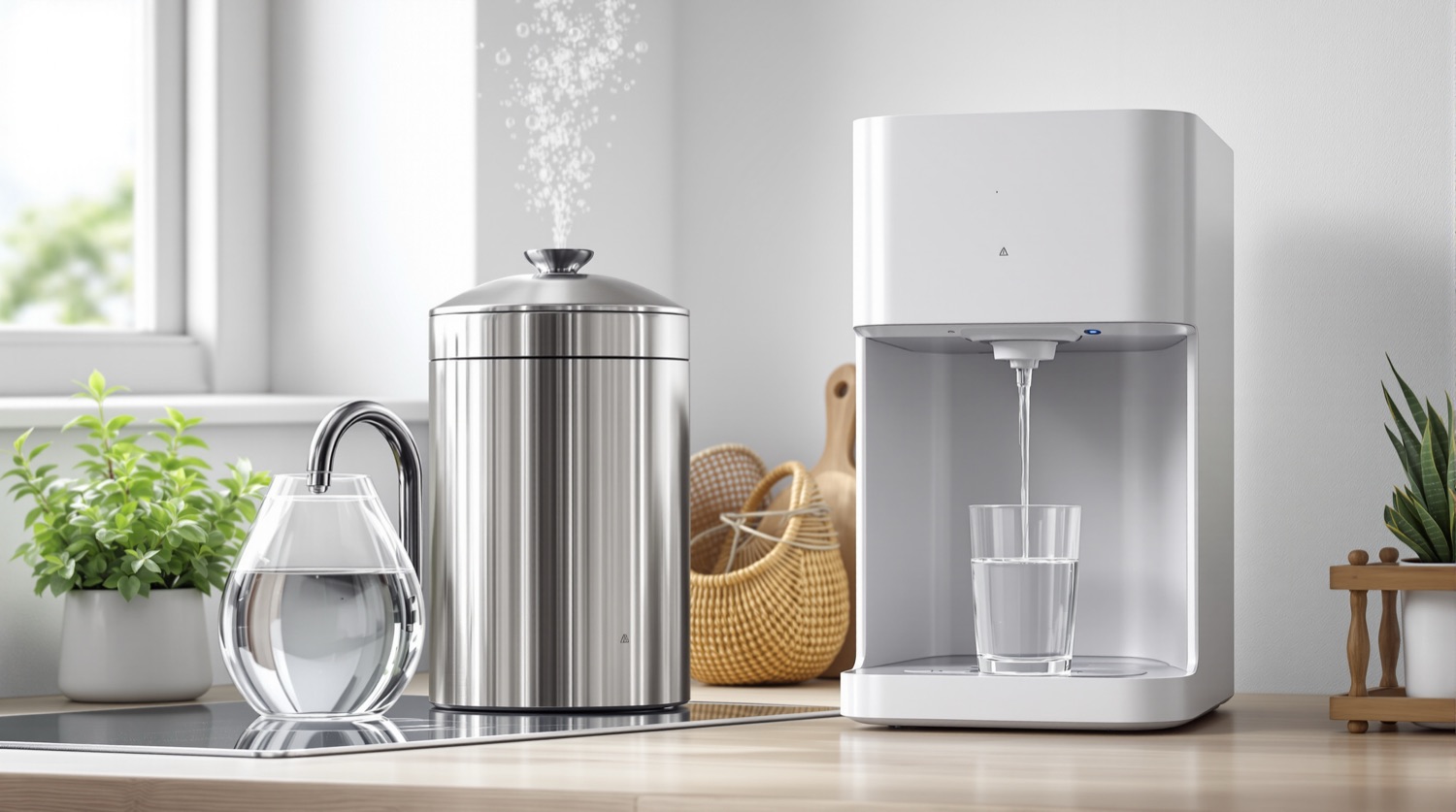
If you have decided to get microplastics out of your drinking water for good, you have probably narrowed the field to the two technologies that actually finish the job: steam distillation and reverse osmosis. Both go far beyond what a pitcher or faucet filter can do. Both remove essentially every microplastic particle, plus PFAS, lead, and other dissolved contaminants that carbon filters miss.
The contamination they are removing is real and measured. A 2018 study in Science of the Total Environment analyzed water at three drinking-water treatment plants and found 338 to 628 microplastic particles per liter in treated tap water — and up to 95% of those particles were smaller than 10 micrometers, far too small for ordinary sediment filters to catch. A separate global survey published in PLOS ONE found anthropogenic particles in 81% of 159 tap water samples across 14 countries, with US samples averaging 9.24 particles per liter — the highest of any country tested.
So the question is not whether a distiller or an RO system works against microplastics — both do, decisively. The question is which one fits how your household actually uses water. That comes down to speed, cost per gallon, counter space, and taste.
Bottom line: For most households, reverse osmosis is the more practical choice — purified water on demand, NSF/ANSI 58 certification behind the removal claims, and a lower cost per gallon once you drink more than a gallon or two a day. A countertop distiller is the right tool if you want the simplest physical process there is, you drink modest amounts, and you like that every batch is effectively lab-grade — with no plumbing and no membranes.
Do Distillers and Reverse Osmosis Both Remove Microplastics?
Yes — and they are the only two point-of-use technologies that remove essentially all of them, including the sub-10-micrometer fraction that dominates tap water. A distiller removes particles by physics: water leaves as vapor and microplastics cannot. An RO membrane removes them by exclusion: its pores are thousands of times smaller than the smallest microplastic. The World Health Organization’s 2019 assessment of microplastics in drinking water likewise identified fine treatment barriers such as membrane filtration as the most effective removal step available. Every other common filter type — pitcher carbon, faucet mounts, most shower and whole-house units — removes only part of the size range.
Head-to-Head: Distiller vs. Reverse Osmosis
What each technology removes, produces, and costs — at a glance.
| Feature | Countertop Distiller | Reverse Osmosis |
|---|---|---|
| Microplastics | 99.9%+ (left in boiling chamber) | 99%+ (0.0001-micron membrane) |
| Nanoplastics | Yes — particles cannot vaporize | Yes — pore size far below nano range |
| PFAS, lead, arsenic, fluoride | Yes (non-volatile contaminants stay behind) | Yes (membrane + carbon stages) |
| Speed | 4–6 hours per gallon (750W units) | On demand |
| Realistic daily output | ~4 gallons/day per machine | Household-scale — tank or tankless |
| Ongoing cost | 3–4 kWh electricity per gallon + carbon sachets | Replacement filters 1–2x per year |
| Wastewater | None | Some — drain ratio varies by system |
| Install | None — plug in anywhere | Countertop: none. Under-sink: DIY or plumber |
| Third-party certification | Rare | NSF/ANSI 58 (common) |
| Minerals in finished water | Stripped — add trace drops if desired | Stripped — many systems remineralize |
How Each Technology Works
The two systems reach the same destination by opposite routes — one uses heat, the other pressure. Understanding the mechanics explains both the removal numbers and the practical trade-offs.
Steam Distillation: Boil, Capture, Condense
A countertop distiller is a kettle with a condenser on top. It boils water in a stainless-steel chamber, captures the steam, and condenses it back into liquid in a separate collection carafe. Everything that cannot vaporize at 100 degrees Celsius stays behind in the boiling chamber — every microplastic particle, every PFAS molecule, every lead ion, every mineral. There is no membrane to foul, no cartridge whose micron rating you have to trust, and nothing to certify: the physics does the filtering.
The trade-offs are speed and power. Distilling one gallon takes 4 to 6 hours on a typical 750-watt unit and consumes about 3 to 4 kWh of electricity — at typical US residential rates of 15 to 17 cents per kWh, that is roughly 45 to 70 cents per gallon in electricity alone. Most owners run the machine overnight so finished water is ready in the morning. A small activated-carbon sachet in the spout catches the handful of volatile compounds that can ride along with the steam.
Reverse Osmosis: Pressure Through a 0.0001-Micron Membrane
A reverse osmosis system pushes tap water against a semi-permeable membrane with a pore size of approximately 0.0001 microns. Water molecules pass; virtually everything else — microplastics, nanoplastics, PFAS, lead, arsenic — is rejected and flushed to the drain. Under-sink systems pair the membrane with sediment and carbon pre-filters and deliver water through a dedicated faucet; countertop units like the AquaTru run the same stages internally with no plumbing at all — our guide to the best countertop water filters ranked for microplastic removal tests six such no-install units head to head.
RO’s advantages are exactly where distillation is weak: it is on-demand, it scales to a whole household’s drinking and cooking water, and its removal claims can be independently certified. NSF/ANSI 58 is the standard written specifically for reverse osmosis systems — a certified system has had its membrane performance verified by an independent lab rather than a marketing department. The main trade-offs: membranes send some water to the drain (the ratio varies widely by system), and filters need replacing on schedule for the removal numbers to hold true.
Is Distilled or Reverse Osmosis Water Better for Daily Drinking?
Nutritionally they end up in the same place: both strip beneficial minerals like calcium and magnesium along with the contaminants, and both are safe to drink every day. The practical difference is taste and convenience. Fully demineralized water tastes flat to most people. Many RO systems solve this with a built-in remineralization stage that adds healthy minerals back before the faucet; distiller owners typically add trace-mineral drops to the carafe, or simply get used to the neutral taste. If a household member is on a sodium-restricted or mineral-managed diet, both technologies produce a consistent, essentially mineral-free baseline — something no carbon filter can.
Which Setup Is Right for You?
Your daily water volume and your tolerance for waiting decide this more than anything else.
Choose a water distiller if:
- You drink 1–2 gallons a day or less
- You want zero plumbing and zero installed parts
- You rent, move often, or want it portable
- You value the simplest verifiable process over speed
- You do not want any water sent to the drain
Choose reverse osmosis if:
- You want purified water on demand, all day
- Your household drinks and cooks with multiple gallons daily
- You want NSF/ANSI 58 certification behind the claims
- You want a remineralization option for taste
- Lower cost per gallon matters over time
There is no wrong answer on contaminant removal — that part is a tie at the top of the field. Households that try both usually keep the RO system running daily and reserve the distiller for small-batch uses like humidifiers, CPAP machines, and steam irons.
The Two Worth Buying
These are the top picks from our full ranked guides to countertop water distillers and reverse osmosis systems — chosen on real specs and honest trade-offs.
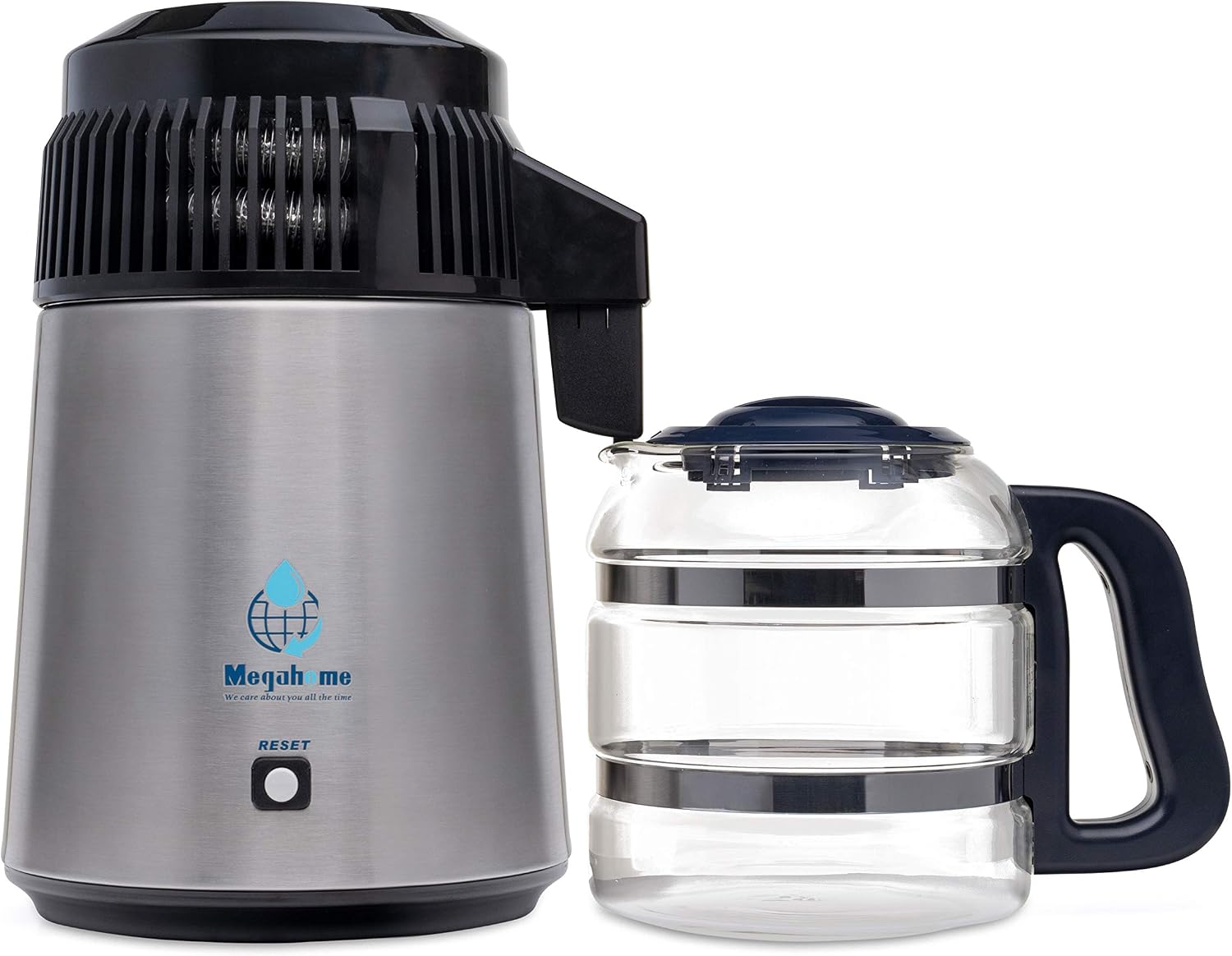 Best Distiller
The Megahome pairs a 316L stainless-steel boiling chamber with a glass collection carafe (~$249) — the detail that matters most on a site about plastic exposure, because several cheaper distillers condense ultra-pure water straight into a plastic jug. Steam distillation removes 99.9%+ of microplastics, PFAS, lead, arsenic, and fluoride by physics rather than filtration. Expect about a gallon every 5 to 6 hours; most owners run it overnight.
Pros
- Glass carafe — no plastic contact after purification
- Removes microplastics, PFAS, lead, fluoride by physics
- No plumbing, no install, fully portable
- Two decades of verified reviews
Cons
- 4–6 hours per gallon
- 3–4 kWh of electricity per gallon
- Boiling chamber needs periodic descaling
Lab-grade water from any outlet — every microplastic, PFAS molecule, and lead ion stays behind in the boiling chamber.
Why it works: Water leaves as vapor; contaminants cannot. The 316L stainless chamber and glass carafe keep the purified water plastic-free end to end.
Check Today's Price on Amazon →Amazon prices change daily — tap to see today's price and any current discount.
- Free delivery for Prime members
- 20-year track record on Amazon
- Thousands of verified reviews
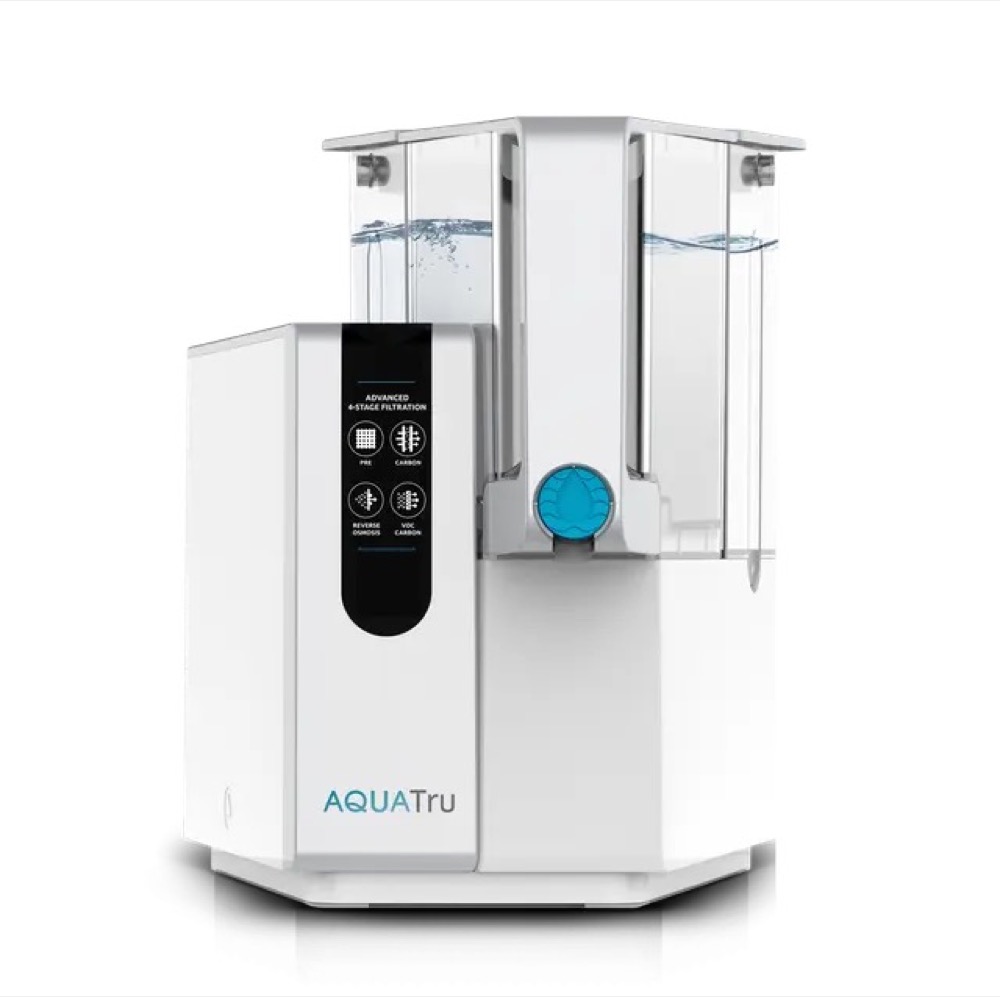 Best Reverse Osmosis
The AquaTru runs a true 4-stage reverse osmosis process — sediment pre-filter, carbon pre-filter, RO membrane, carbon polish — in a countertop unit you fill like a coffee maker. It is NSF/ANSI 58 certified, which means its 0.0001-micron membrane performance was verified by an independent lab. Fill the rear tank, and purified water is ready in minutes rather than hours. If you later want a permanent installed option, our ranked guide covers under-sink systems from budget to tankless as well.
Pros
- NSF/ANSI 58 certified — independently verified
- Purified water in minutes, on demand
- No plumbing — renter-friendly like a distiller
- Removes microplastics, nanoplastics, PFAS, lead
Cons
- Higher upfront cost than a distiller
- Filter replacements on a schedule
- Sends some water to the drain
Certified 99%+ microplastic removal with none of the waiting — fill the tank and pour purified water in minutes.
Why it's certified: NSF/ANSI 58 is the independent standard written specifically for reverse osmosis systems. Certification means a lab verified the membrane's performance — not the manufacturer.
Check Today's Price on Amazon →Amazon prices change daily — tap to see today's price and any current discount.
- Free delivery for Prime members
- NSF/ANSI 58 certified
- Thousands of verified reviews
Frequently Asked Questions
Does a water distiller remove microplastics?
Yes — steam distillation boils water into vapor and condenses only the steam, leaving microplastic particles behind in the boiling chamber. Because plastic particles cannot vaporize at 100 degrees Celsius, independent testing consistently shows 99.9%+ removal, including the sub-10-micrometer particles that a 2018 Science of the Total Environment study found make up as much as 95% of the microplastics in treated tap water.
Does reverse osmosis remove microplastics and nanoplastics?
Yes. An RO membrane has a pore size of approximately 0.0001 microns — thousands of times smaller than the smallest microplastic — so it blocks microplastics and nanoplastics alike, along with PFAS, lead, and arsenic. Choose a system certified to NSF/ANSI 58, the standard written specifically for reverse osmosis, so the membrane's performance has been independently verified.
Which is faster: a distiller or reverse osmosis?
Reverse osmosis, by a wide margin. An RO system delivers purified water on demand. A typical 750-watt countertop distiller takes 4 to 6 hours to produce a single gallon, and a realistic ceiling for one machine is about 4 gallons per day — which is why most distiller owners run the machine overnight and treat the finished water as a daily batch.
Is distilled water safe to drink every day?
Yes. Distilled water is simply water with everything else removed — including beneficial minerals like calcium and magnesium, which is why it tastes flat to some people. If you drink it as your main water source, trace-mineral drops restore both minerals and taste. Reverse osmosis water is demineralized in the same way, and many RO systems include a remineralization stage for exactly this reason.
Which costs less long-term: a distiller or an RO system?
For light use they are close; for family-scale drinking water, reverse osmosis wins. Distilling a gallon consumes 3 to 4 kWh of electricity — roughly 45 to 70 cents per gallon at typical US residential rates — plus periodic carbon sachets and descaling. An RO system's ongoing cost is replacement filters once or twice a year spread across every gallon it makes, which drops the per-gallon cost well below a distiller's once a household drinks more than a couple of gallons a day.
Sources
- Pivokonský M, et al. Occurrence of microplastics in raw and treated drinking water. Science of the Total Environment. 2018;643:1644–1651. doi:10.1016/j.scitotenv.2018.08.102 (PubMed PMID 30104017)
- Kosuth M, Mason SA, Wattenberg EV. Anthropogenic contamination of tap water, beer, and sea salt. PLOS ONE. 2018;13(4):e0194970. doi:10.1371/journal.pone.0194970
- World Health Organization. Microplastics in Drinking-Water. 2019. who.int
- US EPA. National Primary Drinking Water Regulations. epa.gov