Quick Navigation
- Direct answer: which whole house filter to buy
- Why a whole house filter (and when it's overkill)
- Quick comparison table
- Best overall: Aquasana Rhino EQ-1000
- Best value: iSpring WGB32B-KS
- Best for well water: Home Master HMF3SDGFEC
- Best for heavy metals: Express Water WH300SCKS
- Best with UV: Aquasana EQ-1000-AST-UV
- Best compact: Waterdrop WHF3T-PG
- Buyer's guide
- FAQ
The short answer
Best overall: Aquasana Rhino EQ-1000 — 1,000,000-gallon (10-year) dual-tank system, 97% chlorine reduction, tested to NSF/ANSI 42, WQA-certified tank to NSF/ANSI 61. Best-certified whole home filter on this list.
Best value: iSpring WGB32B-KS — 3-stage sediment + carbon + KDF at roughly one-quarter the Aquasana's price. 15 GPM, DIY install.
Best for well water: Home Master HMF3SDGFEC — the only pick engineered for iron, manganese, and sulfur up to 3 ppm combined.
A whole house filter treats every tap in your home; for PFAS-level drinking water, pair one with an under-sink reverse osmosis system — or a no-plumbing countertop water filter — at the kitchen faucet.
Compare all 6 picks
Every pick side by side — tap a name to jump to the full review, or check today's price.
| Pick | Rating | Why it wins | |
|---|---|---|---|
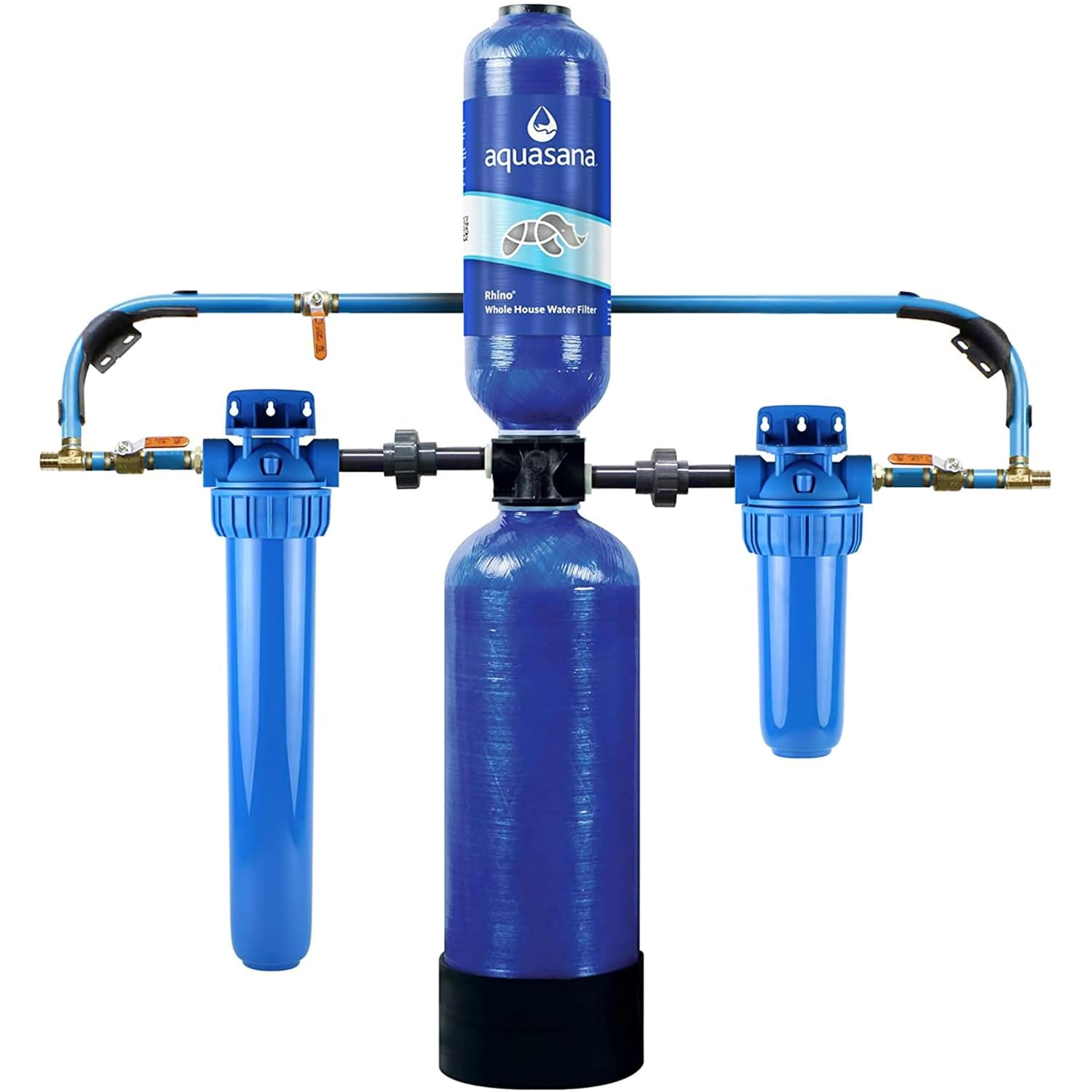 Best OverallAquasana Rhino EQ-1000 Whole House Water Filter |
4.6out of 5 | NSF/ANSI 42, 61, 401, P4731,000,000 gallons |
Check price → |
| 4.6out of 5 | Components NSF/ANSI 42, 61~100,000 gallons |
Check price → | |
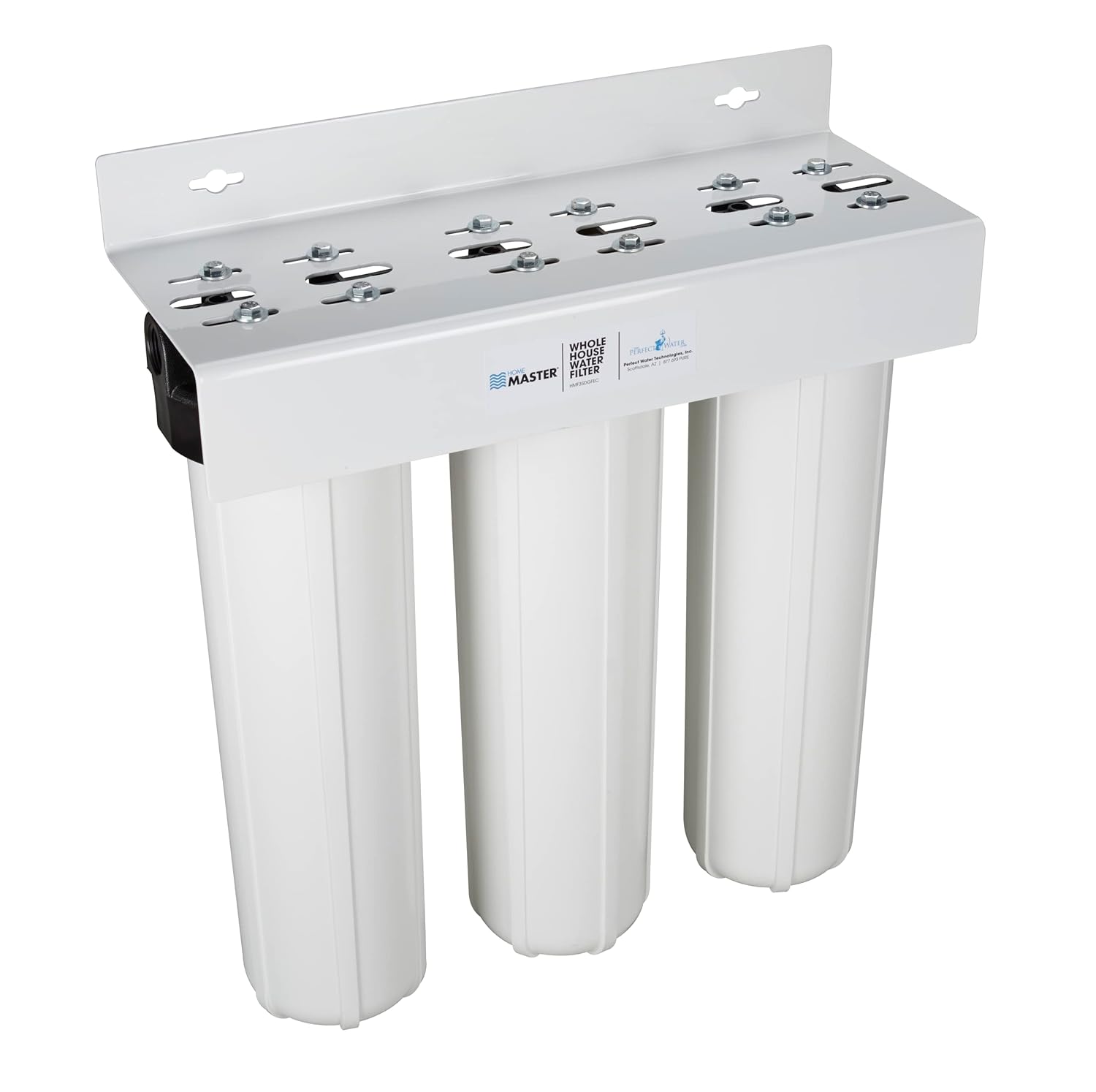 Best Well WaterHome Master HMF3SDGFEC 3-Stage Whole House Well Water Filter |
4.5out of 5 | Components NSF/ANSI 42, 61~95,000 gallons / 1 yr |
Check price → |
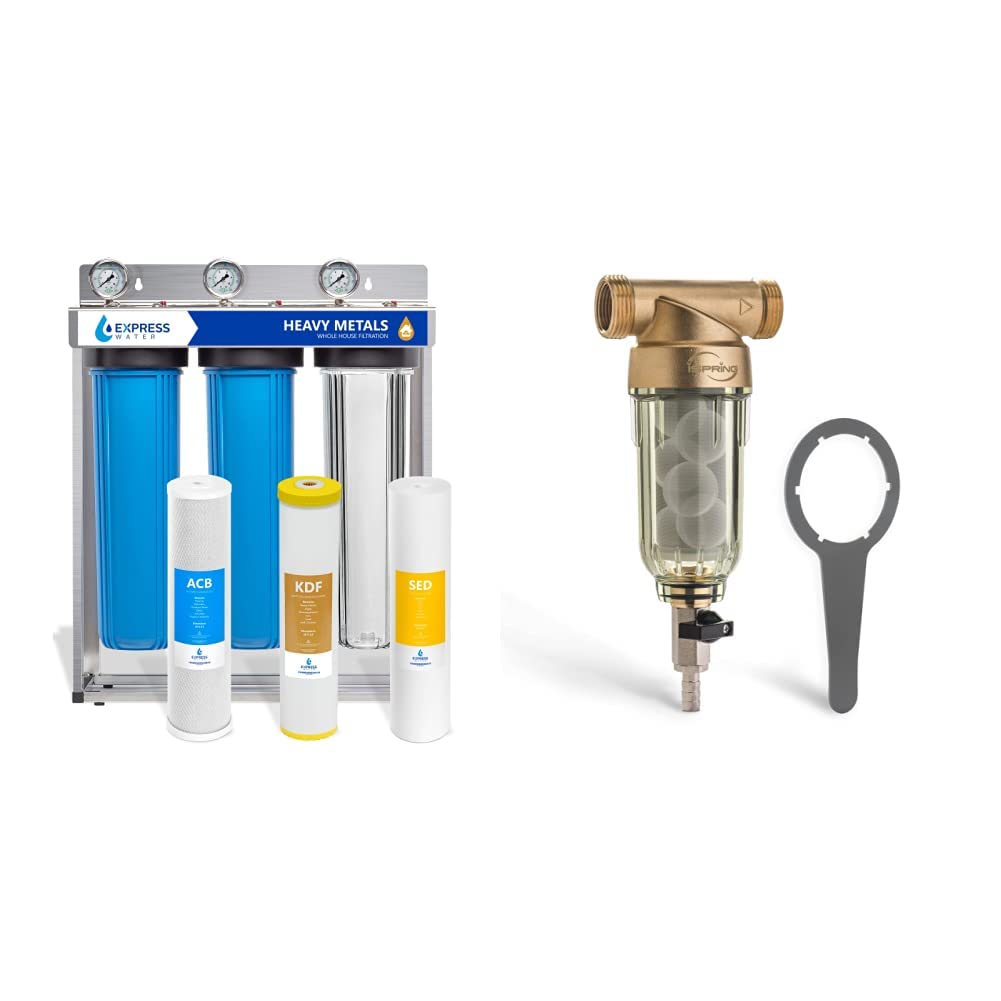 Best Heavy MetalsExpress Water WH300SCKS Heavy Metal Whole House Water Filter |
4.7out of 5 | Components tested to NSF/ANSI 42~100,000 gallons |
Check price → |
| 4.4out of 5 | NSF/ANSI 42, 61 + UV Certified1,000,000 gallons |
Check price → | |
| 4.4out of 5 | Components NSF/ANSI 42, 372~50,000 gallons / 6–12 mo |
Check price → |
Why a whole house water filter (and when it's overkill)
A whole house water filter — also called a point-of-entry (POE) system — is installed on the main line where water enters your home. Every tap, shower, washing machine, and dishwasher then draws from filtered water. That matters because chlorine, chloramine, and volatile organic compounds don't just show up in what you drink. You inhale them from hot showers, absorb them through skin, and cook with them. A 2002 study by the American Journal of Public Health found showering and bathing can be a larger route of exposure to certain VOCs than drinking the water itself. A whole house filter closes all of those doors at once.
It is not the same job as a reverse osmosis system. Whole house filters use large cartridge tanks or tank-style media beds designed for high flow (10–15+ gallons per minute across the whole home), which means the media has less contact time with the water than a slow drinking-water filter. They excel at reducing chlorine, chloramine, sediment, and (with the right media) heavy metals and PFAS. For the last-mile drinking-water job — removing 99%+ of PFAS, nanoplastics, and dissolved solids at your kitchen tap — a whole house system is the foundation and a point-of-use reverse osmosis system is the finisher. Buying both is the professional playbook; buying just one is a trade-off. If a pitcher is the drinking-water piece you already own, know its limits: our guide to whether a Brita filter removes microplastics lays out exactly what the Standard and Elite cartridges are certified for — and where those claims stop.
Every pick below was evaluated on: system-level certification (NSF/ANSI 42, 53, 61, 401, P473 — not just "NSF-tested components"), media type and contaminants targeted (KDF-55 for chloramine and heavy metals; catalytic carbon for chloramine and VOCs; standard GAC for chlorine and taste), flow rate (does it drop water pressure below usable), capacity in gallons (what you actually pay per gallon over 10 years), and the honest catch most reviews don't mention.
The certifications that matter: NSF/ANSI 42 (chlorine, taste, odor), NSF/ANSI 53 (lead, cyst, VOCs), NSF/ANSI 61 (materials safe for drinking water), NSF/ANSI 401 (pharmaceuticals, pesticides), NSF/ANSI P473 (PFOA/PFOS). Watch the exact language: "certified system" is the standard. "Made with NSF-certified components" or "NSF-tested materials" is marketing.
Quick comparison: all 6 whole house water filters
| System | Stages | Capacity | Flow (GPM) | Key media | Certifications | Price tier |
|---|---|---|---|---|---|---|
| Aquasana Rhino EQ-1000 | 3 (pre + tank + post) | 1,000,000 gal / ~10 yr | 7.0 | KDF-55 + catalytic carbon | NSF/ANSI 42, 61, 401, P473 | $$$ |
| iSpring WGB32B-KS | 3 cartridge | ~100,000 gal / ~1 yr | 15.0 | Sediment + carbon + KDF-55 | Components NSF/ANSI 42, 61 | $ |
| Home Master HMF3SDGFEC | 3 cartridge (well) | ~95,000 gal / ~1 yr | 15.0 | Sediment + radial-iron + GAC | Components NSF/ANSI 42, 61 | $$ |
| Express Water WH300SCKS | 3 cartridge | ~100,000 gal / ~1 yr | 15.0 (0.25 gal/sec) | Sediment + KDF + carbon block | Components tested to NSF/ANSI 42 | $$ |
| Aquasana EQ-1000-AST-UV | 3 + UV + salt-free scale | 1,000,000 gal / ~10 yr | 14.6 | KDF + carbon + UV + SCM scale control | NSF/ANSI 42, 61 + UV certified | $$$$ |
| Waterdrop WHF3T-PG | 3 cartridge (compact) | ~50,000 gal / 6–12 mo | 15.0 | 5-micron sediment + carbon block | Components NSF/ANSI 42, 372 | $ |
Price tier: $ under $300 · $$ $300–$700 · $$$ $700–$1,200 · $$$$ $1,200+. Tap any pick for today's Amazon price and any active discount.
1. Aquasana Rhino EQ-1000 — Best Overall Whole House Filter
Best Overall
The Aquasana Rhino EQ-1000 is a three-stage point-of-entry system: a 20-micron pre-filter catches sediment, a large dual-tank body with copper-zinc KDF-55 and catalytic carbon media handles chlorine, chloramine, heavy metals, and organic contaminants, and a 0.35-micron post-filter polishes the water on the way out. Aquasana claims 97% chlorine reduction over the tank's 1,000,000-gallon (or 10-year, whichever comes first) life. The system is independently tested to NSF/ANSI Standards 42, 401, and P473, and the Rhino tank itself is WQA-certified to NSF/ANSI/CAN 61 for materials safety.
Flow rate is 7.0 GPM — enough to run two showers and a dishwasher at once in a typical 3-bathroom home without a noticeable pressure drop. The upflow, dual-tank design maximizes contact time with the KDF/carbon media and, per Aquasana, prevents the channeling failure that shortens the life of many single-tank whole home units. It ships with the pro-grade Schedule 80 PVC install kit (shutoff, drain valve, tank connections) and a 10-year limited warranty. The honest catches: it is the most expensive pick on the list, professional installation is strongly recommended and typically adds $300–$600, and it does not remove iron, manganese, or sulfur (for those, see the Home Master below).
Long-term owners repeatedly describe the same before-and-after: the pool smell in showers is gone within a day, skin stops feeling stripped, and the ice tastes like nothing. Reviews of the 10-year build praise the pro-grade fittings, the tank change requiring only a valve-swap (not a whole re-plumb), and Aquasana's support. The honest gripes: it is bulky (a full tank plus two filter housings need real utility-room space), professional installation is often described as necessary because the included instructions assume some plumbing experience, and Aquasana pushes the salt-free scale upgrade hard even though it is not a real water softener and won't rescue hard-water appliances the way a salt softener would.
10 years of chlorine-free water at every tap — the most-certified whole home filter on this list, from the brand every plumber knows.
Why it's safe: Independently tested to NSF/ANSI 42, 401, and P473; the Rhino tank is WQA-certified to NSF/ANSI/CAN 61 for materials safety. The KDF-55 stage means it also reduces chloramine (which standard carbon does not) and heavy metals.
Check Today’s Price on Amazon →Amazon prices change daily — tap to see today's price and any active discount.
- Free delivery & returns for Prime members
- Sold & shipped by Amazon
- Thousands of verified reviews
2. iSpring WGB32B-KS — Best Value Whole House Filter
 Best Value
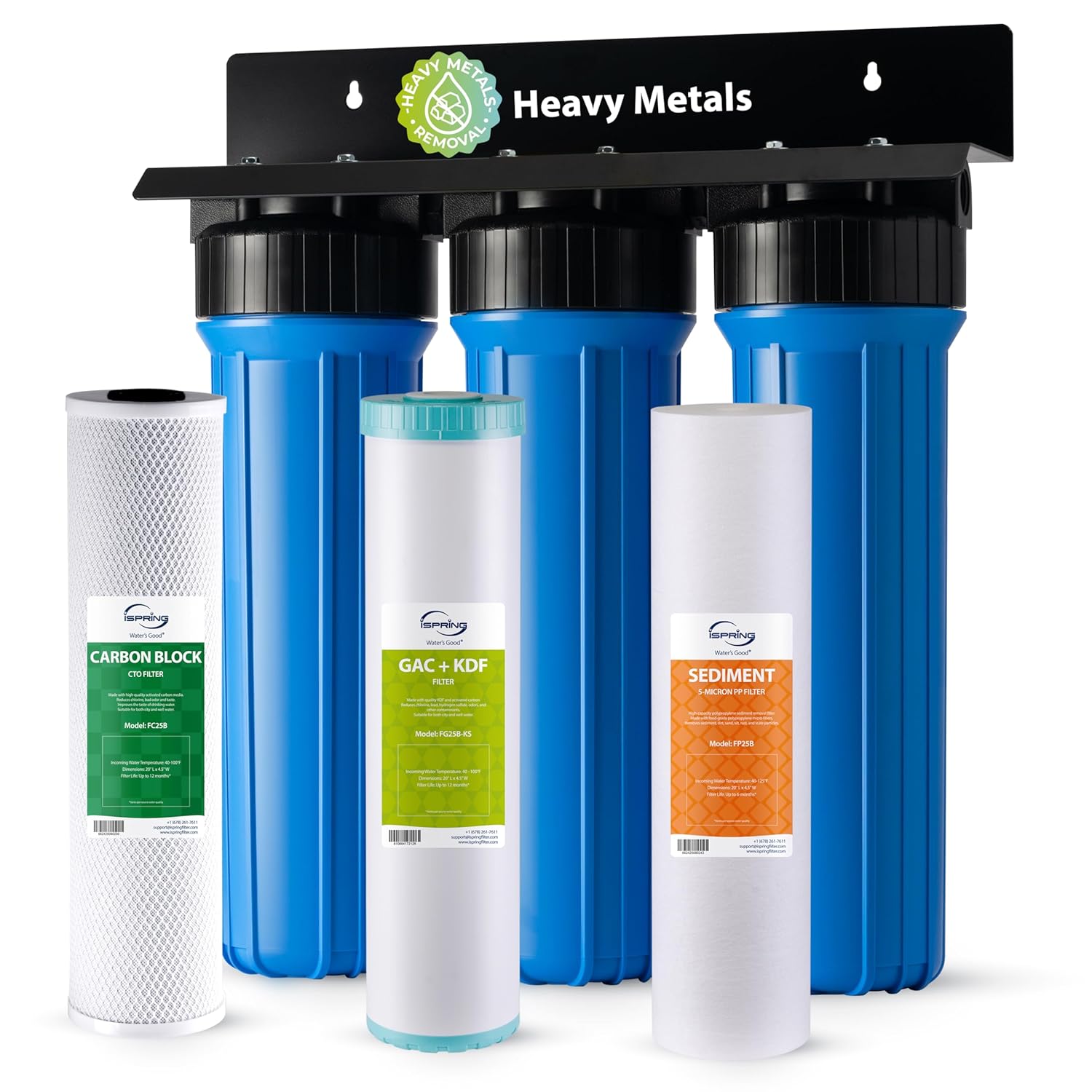
The KS variant of iSpring's popular WGB32B swaps a plain carbon-block third stage for a KDF-55-plus-carbon cartridge, which is what makes it a genuine chloramine and heavy-metal filter rather than a chlorine-and-taste filter. All three cartridges are 20″ big-blue standard sizes, which means replacements are widely available (iSpring and generic) at roughly $80–$120 for a full annual set. Rated capacity is around 100,000 gallons or 12 months of typical family-of-four use, whichever comes first. Individual filter components are certified to NSF/ANSI 42 and 61 (the system as a whole is not, which is the difference between it and the Aquasana).
Flow rate is a real 15 GPM — the highest of any pick on this list — so it can supply a large 4-bathroom home without measurable pressure drop. It installs on 1″ main lines with the included push-fit stainless steel hose connectors, and buyers with basic plumbing skill routinely report 2–3 hour DIY installs. The honest catches: filters need changing every 6–12 months (so annual cost is closer to $100 vs the Aquasana's essentially $0 for a decade), the cartridge housings are physically taller than they look and want ~30″ of vertical space, and it does not reduce fluoride, iron, or hardness.
Owners describe a real drop in chlorine smell within a day and softer, cleaner skin in the shower — and repeatedly praise iSpring's US-based support, which will walk a first-timer through the install by phone. Multi-year buyers say cartridge changes take 15 minutes with the included filter wrench. The honest downsides come up too: a handful reported cracked housings after several years (iSpring's warranty covered most, per follow-up comments); a few had to add extra thread tape to stop small drips at the fittings; and because the cartridges are big-blue 20″ standards, some buyers say the sediment cartridge clogs faster on well water than the spec implies, though a pre-installed spin-down sediment filter fixes that.
A real 3-stage whole home filter — including KDF-55 for chloramine and heavy metals — at roughly a quarter of the Aquasana's price, with 15 GPM to run every faucet at once.
Why it's safe: Filter components carry NSF/ANSI 42 (chlorine, taste) and NSF/ANSI 61 (materials safety) certification. KDF-55 is the media that actually reduces chloramine and heavy metals like lead — standard carbon-only whole house filters do not.
Check Today’s Price on Amazon →Amazon prices change daily — tap to see today's price and any active discount.
- Free delivery & returns for Prime members
- Sold & shipped by Amazon
- Thousands of verified reviews
3. Home Master HMF3SDGFEC — Best for Well Water (Iron, Manganese, Sulfur)
Best Well Water
The Home Master HMF3SDGFEC is a well-water specialist. Stage 1 is a 4-layer graded-density sediment cartridge (25 to 1 micron) that holds roughly 3× the sediment of a standard 5-micron cartridge before clogging — important because well water carries far more grit than city water. Stage 2 is a radial-flow iron and manganese filter rated to remove up to 3 ppm combined of iron, manganese, and hydrogen sulfide (the rotten-egg smell). Stage 3 is a large radial-flow GAC carbon cartridge that catches pesticides, herbicides, VOCs, and residual taste. Individual cartridges are NSF/ANSI 42 and 61 certified.
Flow rate is 15 GPM through 1″ ports, so it will not choke a large home. Home Master claims up to 95% reduction of silt, sediment, dirt, microplastics, herbicides, pesticides, iron, manganese, and hydrogen sulfide. The honest catches: it does not remove hardness (limescale on fixtures) or TDS, and if your well tests over 3 ppm iron you'll need to add a dedicated air-injection iron filter upstream. It also doesn't remove chloramine (well water rarely has any), so if you're on city water use the iSpring or Aquasana instead.
Well-water owners repeatedly describe the same three-part before-and-after: orange staining in toilets and tubs stops within days, the sulfur smell in the shower disappears, and cartridge changes reveal how much the sediment stage was catching (many report the first-stage cartridge is a startling shade of brown by month three). The honest gripes: the iron cartridge is the wear item — on high-iron water it might last 4–6 months rather than the advertised 12; a few owners hit small leaks at the port fittings that were fixed with an extra wrap of thread tape; and Home Master's paperwork is clear that untreated water over 3 ppm iron will overwhelm the system, so a real well test is a prerequisite before buying.
Iron, manganese, and hydrogen sulfide gone — the plain-carbon whole home filters can't do this job. Made specifically for well water.
Why it's safe: Cartridges are NSF/ANSI 42 (chlorine, taste, odor) and NSF/ANSI 61 (materials safety) certified. The radial-flow design lets more water contact the iron and carbon media than an axial cartridge, so contact time actually meets spec at 15 GPM.
Check Today’s Price on Amazon →Amazon prices change daily — tap to see today's price and any active discount.
- Free delivery & returns for Prime members
- Sold & shipped by Amazon
- Thousands of verified reviews
4. Express Water WH300SCKS — Best for Heavy Metals & Chloramine
Best Heavy Metals
The WH300SCKS is a heavy-metal focused variant of Express Water's 3-stage whole house line. Stage 1 is a 5-micron sediment cartridge; Stage 2 is a Kinetic Degradation Fluxion (KDF) filter (copper-zinc alloy) that reduces chlorine, chloramine, heavy metals (lead, mercury, iron), and hydrogen sulfide via a redox reaction that other media can't do; Stage 3 is an activated carbon block that catches pesticides, herbicides, VOCs, and pharmaceuticals. Filter components are tested to NSF/ANSI Standard 42. Cartridge life is up to 100,000 gallons or 6–12 months. If lead at the tap is the real worry rather than whole-house treatment, a point-of-use unit is usually the better buy — see our best water filters for lead.
What separates this from the iSpring is the build. The whole assembly sits on a free-standing stainless-steel frame with three pressure gauges (one per stage) and integrated pressure-release buttons on each housing — so filter changes are quick and you can see immediately when a stage is clogging. Flow is spec'd at up to 0.25 gallons per second (roughly 15 GPM). The honest catches: components are tested to NSF/ANSI 42, not certified at the system level; there is no fluoride reduction; and it does not remove hardness or scale, so if you're on hard water you may still want a salt-free descaler downstream.
The 4.77 average across 600+ reviews is unusually high for a whole home filter. Owners repeatedly cite the pressure gauges as the killer feature — you know exactly when to change a cartridge instead of guessing on the calendar — and the fittings and housings feel noticeably heavier-duty than the iSpring at a similar price. Installers with basic plumbing skill report 2–3 hour installs. The honest downsides: at ~30″ tall the assembly needs real utility-room clearance, replacement filters are Express Water's own sizes (still standard 20″ big-blue but priced slightly above generic), and shipping damage on the fragile pressure gauges shows up in a small number of reviews (Express Water replaces them but it delays install).
Serious KDF-based heavy metal and chloramine reduction on a heavy-duty stainless frame with pressure gauges — you see clogging before it costs you pressure.
Why it's safe: Filter components are tested to NSF/ANSI Standard 42 and the housings are BPA-free. KDF-55 media is the specific technology validated for chloramine and heavy-metal reduction; standard whole home carbon filters do neither well.
Check Today’s Price on Amazon →Amazon prices change daily — tap to see today's price and any active discount.
- Free delivery & returns for Prime members
- Sold & shipped by Amazon
- Thousands of verified reviews
5. Aquasana EQ-1000-AST-UV — Best Premium with UV Sterilization
 Best Premium
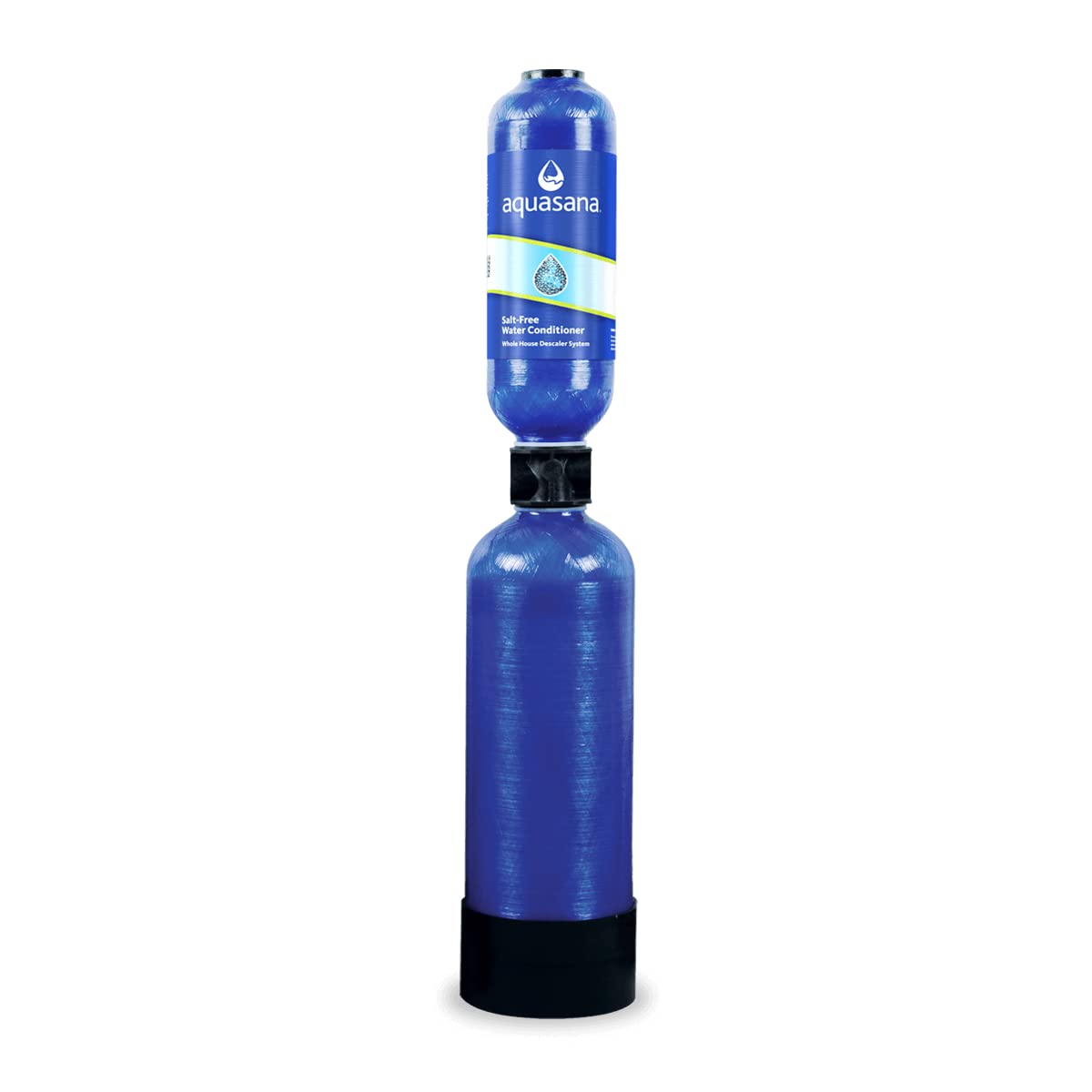
The AST-UV variant stacks two upgrades on top of the standard EQ-1000. First, an integrated UV chamber (rated to reduce up to 99.99% of bacteria, viruses, and cysts) — useful if you have well-adjacent city water, a history of boil-water notices, or you're just risk-averse about municipal supply. Second, a salt-free scale conditioner (SCM template-assisted crystallization) that reduces scale build-up on water heaters, faucets, and shower heads without adding sodium or requiring a drain line. Flow rate is 14.6 GPM — higher than the standard Rhino's 7.0 GPM.
The honest catches: it is the most expensive pick on the list; salt-free scale conditioning genuinely reduces scale build-up but is not a real water softener — if you have serious hard-water damage (crusted heaters, itchy skin from calcium), a salt-based softener will outperform it; and the UV chamber has a lamp that draws power continuously and must be replaced roughly once a year (roughly $80–$120). Warranty is 10 years on the tank.
Owners on borderline water — older municipal systems, city water plus a private well as backup, homes that get boil-water notices — describe this as the “never have to think about the water” upgrade. The UV lamp on/off indicator gets specific praise. The honest downsides are the same as the standard Rhino: install is not trivial (professional plumber recommended), physical footprint is real, and the salt-free scale portion is oversold in Aquasana's marketing — some owners with truly hard water (~15+ grains) still describe visible scale, which is expected because template-assisted crystallization doesn't remove hardness, it just changes the crystal shape.
Full 10-year Rhino filtration + UV bacterial/viral sterilization + salt-free scale control in a single system — the maximum-protection build for city water.
Why it's safe: Tank certified to NSF/ANSI 42 and NSF/ANSI/CAN 61 for materials safety; the UV module is independently rated to reduce up to 99.99% of bacteria, viruses, and cysts (NSF/ANSI 55 Class B equivalent). Salt-free scale control keeps calcium and magnesium in the water rather than replacing them with sodium.
Check Today’s Price on Amazon →Amazon prices change daily — tap to see today's price and any active discount.
- Free delivery & returns for Prime members
- Sold & shipped by Amazon
- Thousands of verified reviews
6. Waterdrop WHF3T-PG — Best Compact Whole House Filter
 Best Compact
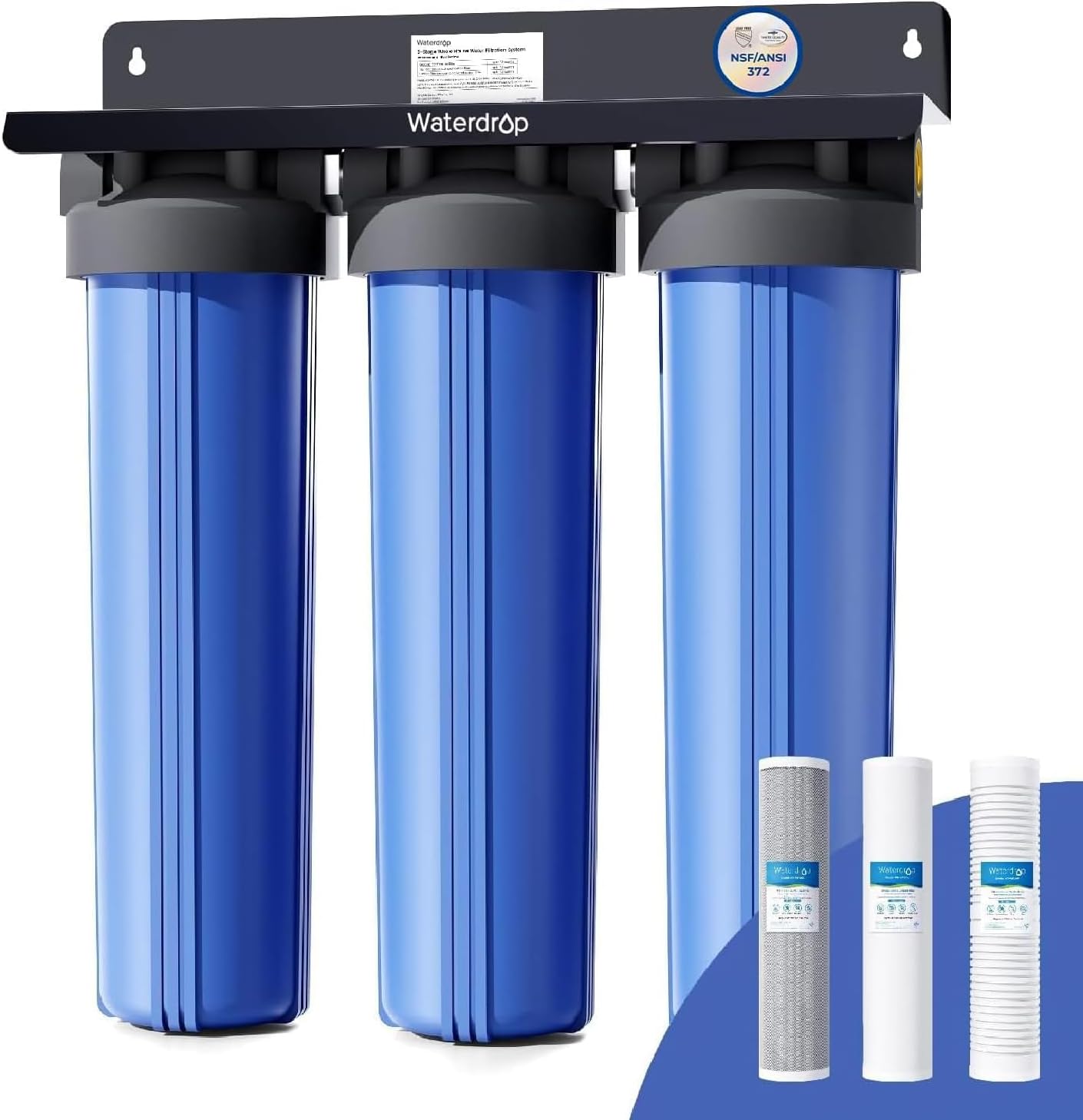
The Waterdrop WHF3T-PG is a 3-stage cartridge whole house system built around shorter, narrower housings than the iSpring, Home Master, or Express Water rigs. That makes it the pick when vertical clearance is limited (utility closets, condo mechanical rooms, garage installs with low ceilings). Stage 1 is a 5-micron sediment cartridge; Stages 2 and 3 use a multi-layer carbon block with iron/lead reduction media. Individual components are certified to NSF/ANSI 42 (chlorine, taste, odor) and NSF/ANSI 372 (lead-free materials).
Flow is rated at 15 GPM through 1″ ports — enough to run a family home without a pressure hit. The honest catches: capacity is lower than the full-size cartridge systems (roughly 50,000 gallons or 6–12 months per set, vs 100,000 for iSpring), it does not include a KDF-55 stage so chloramine reduction is minimal, and Waterdrop's replacement cartridges are proprietary sizing rather than standard big-blue — so you're committed to buying replacements from Waterdrop rather than any brand of cartridge.
Compact-space owners repeatedly say this was the only 3-stage whole house they could actually fit — the smaller footprint is the whole point. Reviews cite quick 1–2 hour DIY installs with the included push-fit fittings, and a real drop in chlorine smell. The honest downsides come up consistently: replacement cartridges are proprietary and cost slightly more per year than standard 20″ big-blue cartridges; the cartridges have a shorter life than a full-size system on the same water; and a small number of owners hit small leaks at the housing O-rings that were fixed by re-seating (Waterdrop replaced units where the issue was manufacturing).
A real 3-stage whole home filter in a compact footprint — the pick when a full big-blue rig won't fit your closet, garage, or condo mechanical room.
Why it's safe: Filter components certified to NSF/ANSI 42 (chlorine, taste, odor) and NSF/ANSI 372 (lead-free materials); housings are BPA-free. 5-micron sediment removal protects both the carbon stage and every appliance downstream.
Check Today’s Price on Amazon →Amazon prices change daily — tap to see today's price and any active discount.
- Free delivery & returns for Prime members
- Sold & shipped by Amazon
- Thousands of verified reviews
Get the full Plasticproof guide
Water is step one. The complete guide covers kitchen, bedroom, air, and baby — every swap that matters.
Get the free guideBuyer's guide: how to choose a whole house water filter
City water vs well water — the first fork
On city (municipal) water? Your main enemies are chlorine, chloramine, disinfection byproducts (trihalomethanes), lead from old service lines, and PFAS — and if forever chemicals are your main worry, a point-of-use unit from our best PFAS water filters guide will out-remove any whole-house system at the drinking tap. The Aquasana Rhino EQ-1000 is the certified default; the iSpring WGB32B-KS is the value pick that still uses KDF-55 for chloramine and heavy metals; the Express Water WH300SCKS is the pick if a recent water quality report flagged heavy metals in your ZIP.
On well water? Your enemies are different: sediment, iron, manganese, hydrogen sulfide (the rotten-egg smell), and sometimes bacteria (if your well tests positive). Get a professional well test before buying anything — it will tell you if you need iron removal (Home Master HMF3SDGFEC), softening (a separate salt-based system), or bacterial protection (the Aquasana EQ-1000-AST-UV, or a dedicated UV like the Viqua IHS12-D4). The iSpring and Waterdrop cartridge systems are city-water designs; they'll clog quickly on high-sediment well water without a dedicated pre-filter.
Cartridge system vs tank system — the second fork
Cartridge systems (iSpring, Home Master, Express Water, Waterdrop) use 3–4 replaceable filters in big-blue housings. Upfront cost is $200–$500; filter changes run $80–$200 per year. They're DIY-installable, replace the wear items yourself in 15 minutes, and are the correct pick if you rent, plan to move within 5 years, or want to avoid a plumber.
Tank systems (Aquasana Rhino EQ-1000 and the AST-UV variant) use a large media tank plus separate pre- and post-filters. Upfront cost is $800–$1,600 with professional install; the main tank runs 6–10 years before replacement, so 10-year total cost of ownership is often lower than a cartridge system. Tank systems have more media contact time (better filtration) but a real footprint (a real utility-room corner) and are the correct pick if you own the home and expect to stay 5+ years.
The certifications that matter (and the ones that don't)
For a whole house filter, the five certifications worth looking for:
- NSF/ANSI 42 — Aesthetics: chlorine, taste, odor. Baseline.
- NSF/ANSI 53 — Health: lead, cyst, VOCs, chromium-6. This is the important one for lead-in-water concerns.
- NSF/ANSI 61 — Materials safety: verifies the housings and media don't leach anything back into the water.
- NSF/ANSI 401 — Emerging contaminants: pharmaceuticals, personal-care products, pesticides.
- NSF/ANSI P473 — PFOA and PFOS specifically. Currently the only Amazon-buyable whole-house system with this is the standard Aquasana Rhino EQ-1000.
Be wary of these marketing phrases: "NSF-grade components," "NSF-tested materials," "made with NSF-certified parts." None of those mean the assembled system is certified. Only "certified to NSF/ANSI [number]" applies at the whole-system level. Individual filter-cartridge certification is a real thing (iSpring, Home Master, Waterdrop all have it on their cartridges), but it's a step below system-level certification.
Flow rate: don't buy a filter that chokes your pressure
Total household demand for a 2-bathroom home is roughly 6–8 GPM at peak; a 3-bathroom home is 8–12 GPM; a 4-bathroom home is 12–15+ GPM. A filter rated below your peak demand will drop shower pressure noticeably. All the cartridge systems on this list are spec'd at 15 GPM through 1″ ports. The Aquasana Rhino EQ-1000 is 7 GPM (fine for most 2–3 bath homes; borderline for 4-bath). The AST-UV upgrades to 14.6 GPM.
10-year total cost of ownership
Purchase price is only part of the math. A realistic 10-year budget:
- Aquasana Rhino EQ-1000: ~$1,000 unit + $400 install + $300 pre/post-filter replacements over 10 years = ~$1,700 for a decade of whole-home filtration.
- iSpring WGB32B-KS: ~$275 unit + DIY install + $100/year filter set × 10 = ~$1,275.
- Home Master HMF3SDGFEC: ~$450 unit + DIY install + $130/year filter set (iron cartridge is the wear item on well water) × 10 = ~$1,750.
- Express Water WH300SCKS: ~$400 unit + DIY install + $120/year × 10 = ~$1,600.
- Aquasana EQ-1000-AST-UV: ~$1,500 unit + $500 install + ~$150/year UV lamps and pre-filters = ~$3,500.
- Waterdrop WHF3T-PG: ~$200 unit + DIY install + $140/year filters (proprietary sizing) × 10 = ~$1,600.
The Aquasana Rhino EQ-1000 and the iSpring WGB32B-KS are within ~$400 of each other over ten years, which is why the choice usually comes down to certification (Aquasana wins) vs upfront cost (iSpring wins).
Our recommendation: For most homes on city water, the Aquasana Rhino EQ-1000 is the correct default — the most certifications, best media, and lowest 10-year total cost per gallon. If upfront cash is the constraint, the iSpring WGB32B-KS delivers a real 3-stage KDF system at roughly one-quarter of the price. If you're on well water with iron or sulfur, the Home Master HMF3SDGFEC is the specialist pick. And in every scenario, pair the whole-house filter with a reverse osmosis system at the kitchen sink to hit true PFAS and nanoplastic removal at the drinking tap.
Frequently asked questions
Related reading
- Best Reverse Osmosis Systems 2026 — the point-of-use pair for whole home filtration →
- Best Water Filters for Microplastics 2026 — Full Guide →
- Best Under-Sink Water Filters 2026 — Ranked →
- Best Shower Filters for Chlorine, Skin & Hair (2026) →
- Microplastics in Bottled Water: What the Research Shows →