Single-use plastic utensils are consistently ranked among the top ten items found in beach cleanups worldwide. They snap, splinter, and fragment into microplastics that persist in soil and water for centuries. But the problem starts before they reach the ocean — it starts at your lunch.
When plastic forks and spoons contact hot food, they leach measurable amounts of microplastics and chemical additives including styrene, phthalates, and bisphenol-A into whatever you're eating. A 2020 study in Environmental Science & Technology found that polystyrene cutlery released detectable microplastic particles after just three minutes of contact with food at 70°C (158°F). The hotter the food, the greater the release.
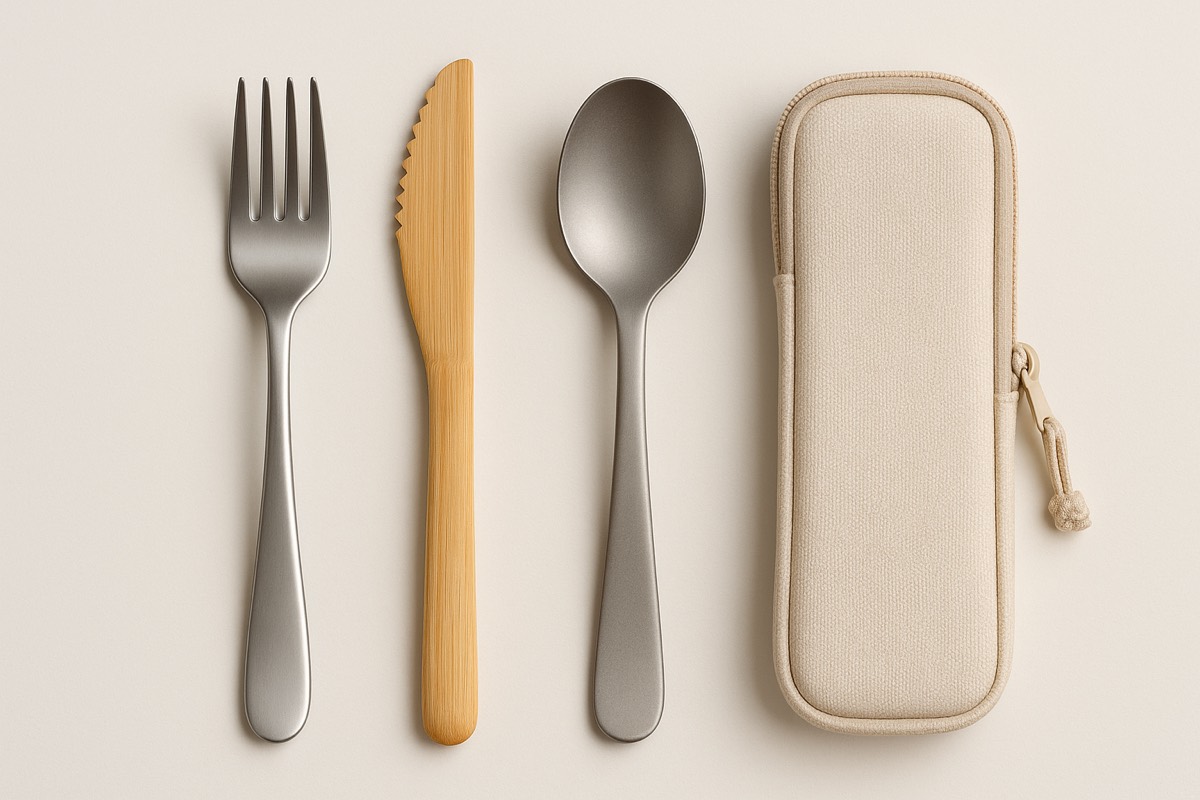
The fix is straightforward: carry a reusable utensil set made from stainless steel, titanium, or bamboo. No plastic handles, no silicone grips with hidden fillers — just materials that are inert, durable, and safe at any temperature. We screened dozens of options down to the six sets worth owning in 2026.
Compare all 6 picks
Every pick side by side — tap a name to jump to the full review, or check today's price.
| Pick | Rating | Why it wins | |
|---|---|---|---|
 Best OverallQuatish Travel Utensils with Case |
— | Stainless SteelReusable |
Check price → |
 Best UltralightValtcan Titanium 3-Piece Utensil Set |
4.6out of 5 | 100% Plastic-FreeGrade-1 Titanium |
Check price → |
 Best BudgetTo-Go Ware Bamboo Utensil Set |
4.6out of 5 | Plastic-Free UtensilsOrganic Bamboo |
Check price → |
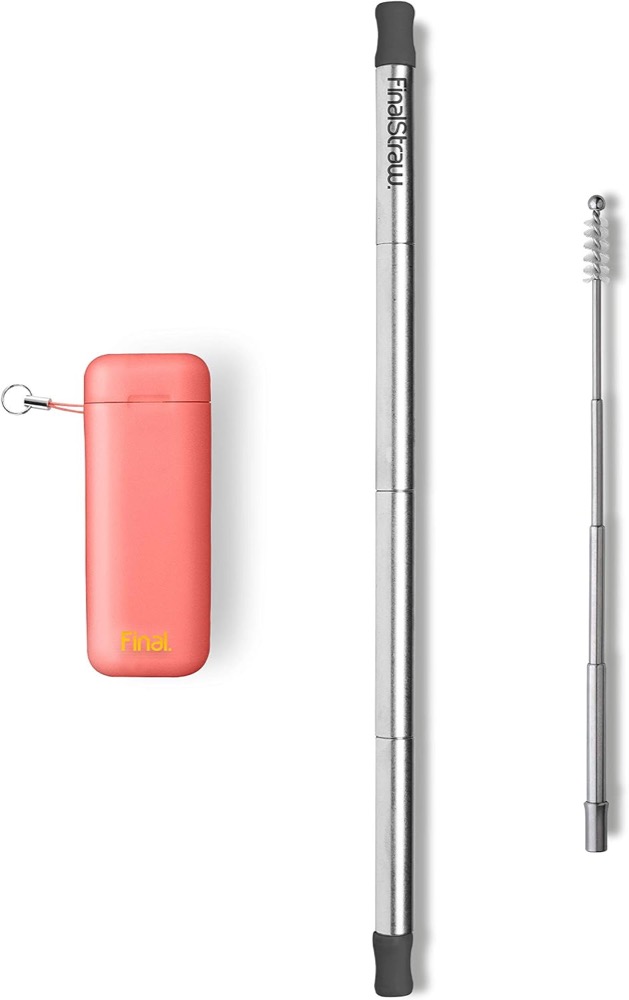 Best StrawFinalStraw Collapsible Straw + Case |
4.4out of 5 | Plastic-Free StrawStainless Steel |
Check price → |
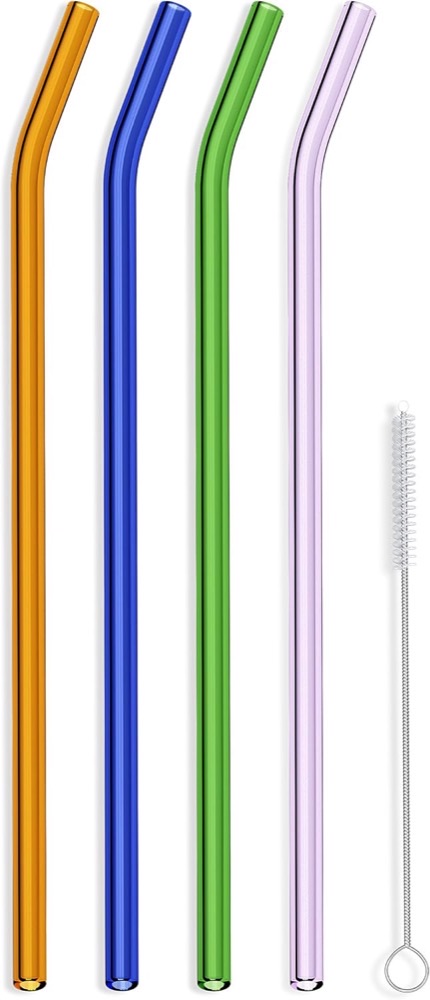 Best GlassHummingbird Glass Straws (4-Pack) |
4.8out of 5 | Plastic-Free StrawBorosilicate Glass |
Check price → |
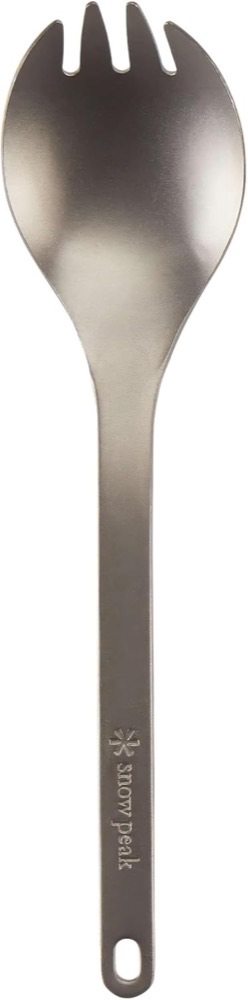 Best MinimalistSnow Peak Titanium Spork (SCT-004) |
4.8out of 5 | 100% Plastic-FreeSingle-Piece Titanium |
Check price → |
What We Screened For
Not all "reusable" utensils are created equal. Many travel cutlery sets marketed as eco-friendly still use plastic handles, nylon carrying cases, or silicone components. We applied strict criteria to our picks:
- Material: Only stainless steel (18/8 or 18/10 grade), titanium, or bamboo. No plastic handles, no silicone grips, no nylon components.
- Portability: Must include a carry case or integrated storage solution compact enough for a bag, lunchbox, or jacket pocket.
- Dishwasher safe: Stainless steel and titanium picks must be dishwasher safe. Bamboo sets are hand-wash only by nature — we note this clearly.
- Durability: Built to last years, not months. We favored sets with strong owner reviews after 12+ months of daily use.
- Price-to-value: We included options from $11 to $35 — every set here justifies its cost relative to what you get.
Our 6 Picks for 2026
Best Overall
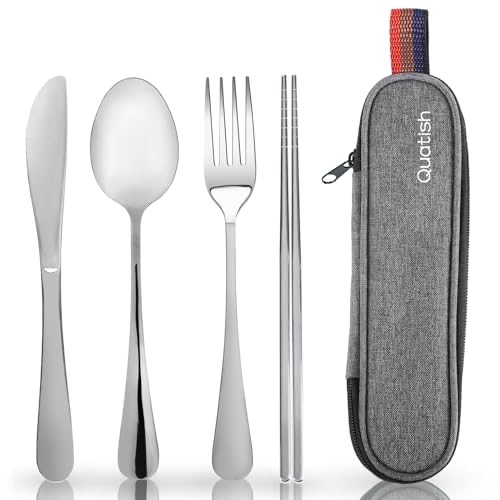
Owners reach for this set because it is compact and self-contained, with a case whose interior elastic band "securely holds each piece in place, preventing rattling" and a wipeable lining, and buyers like that the fork, spoon, knife, and chopsticks are stainless that "feels solid without being heavy." The honest downsides: reviewers note the pieces run smaller than they look in photos, one said "the knife isn't as sharp as I expected" and "I wouldn't recommend them for really tough tasks, like cutting through tough meats," and a few found the case snug to repack; Quatish is a genuine Amazon-native brand, but most of its online reviews are affiliate-style pages, so weight the size and knife gripes above the glowing summaries.
Carry a real fork and spoon instead of disposable plastic — the set packs into its own case that drops into a bag or lunch box.
Why it's safe: The fork and spoon are stainless steel, which is inert — no plastic utensils touching your hot food, so nothing can leach or shed microplastics.
Check Today’s Price on Amazon →Amazon prices change daily — tap to see today's price and any active discount.
- Free delivery & returns for Prime members
- Sold & shipped by Amazon
- Thousands of verified reviews
Best Ultralight
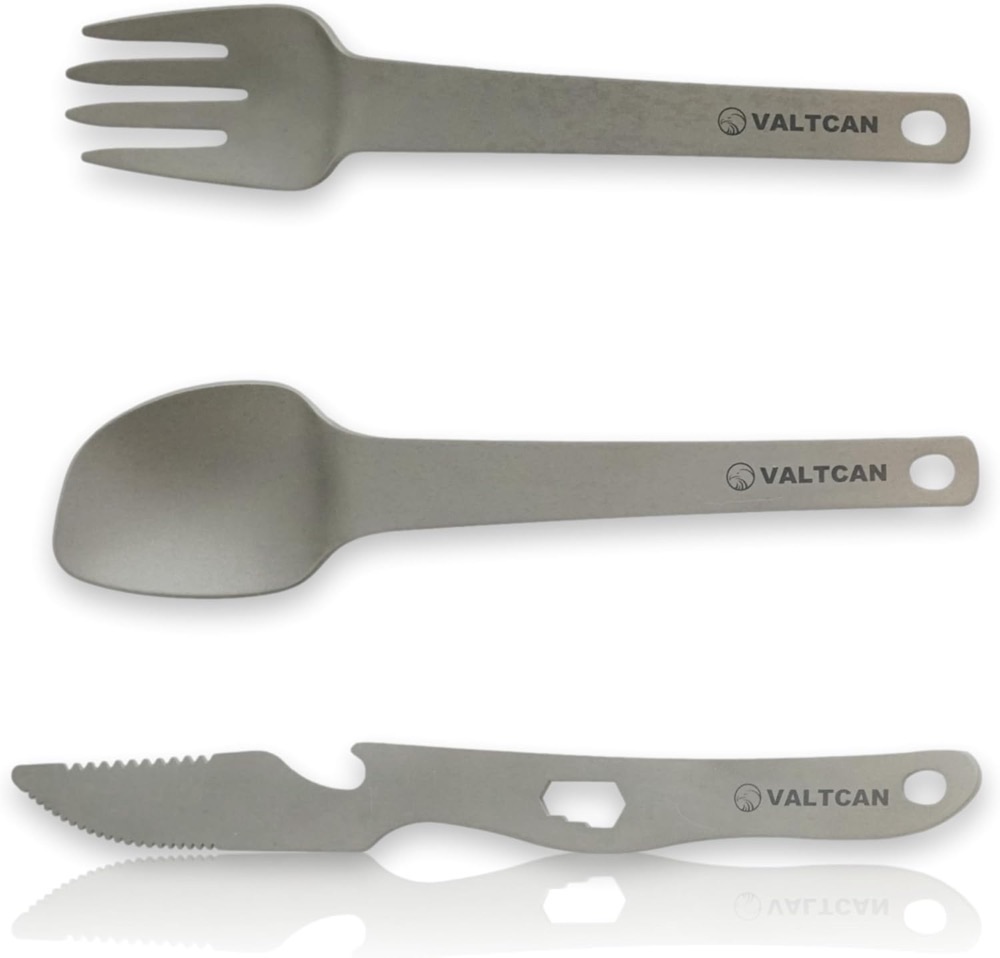
The praise buyers give centers on weight and taste: the titanium is "super lightweight and more durable than plastic utensils," and owners like that bare titanium leaves "zero metallic taste" compared with coated or steel travel cutlery, so it rides along as everyday carry that will not bend like a plastic fork. Independent verified complaints for this exact set are thin, so read single claims with caution. The honest caveats are inherent to the design: a flat titanium camp knife is closer to a spreader than a steak knife and struggles on tough food, and the compact pieces are shorter than home flatware, which some find undersized for a full dinner.
Drop a real fork, spoon, and knife into your pack for the weight of a couple of AA batteries — titanium gives you full-size cutlery without the heft of steel.
Why it's safe: Bare, uncoated Grade-1 titanium is one of the most inert food-contact metals there is — no plastic, no coating to flake, and no leaching at any food temperature.
Check Today’s Price on Amazon →Amazon prices change daily — tap to see today's price and any active discount.
- Free delivery & returns for Prime members
- Sold & shipped by Amazon
- Thousands of verified reviews
Best Budget
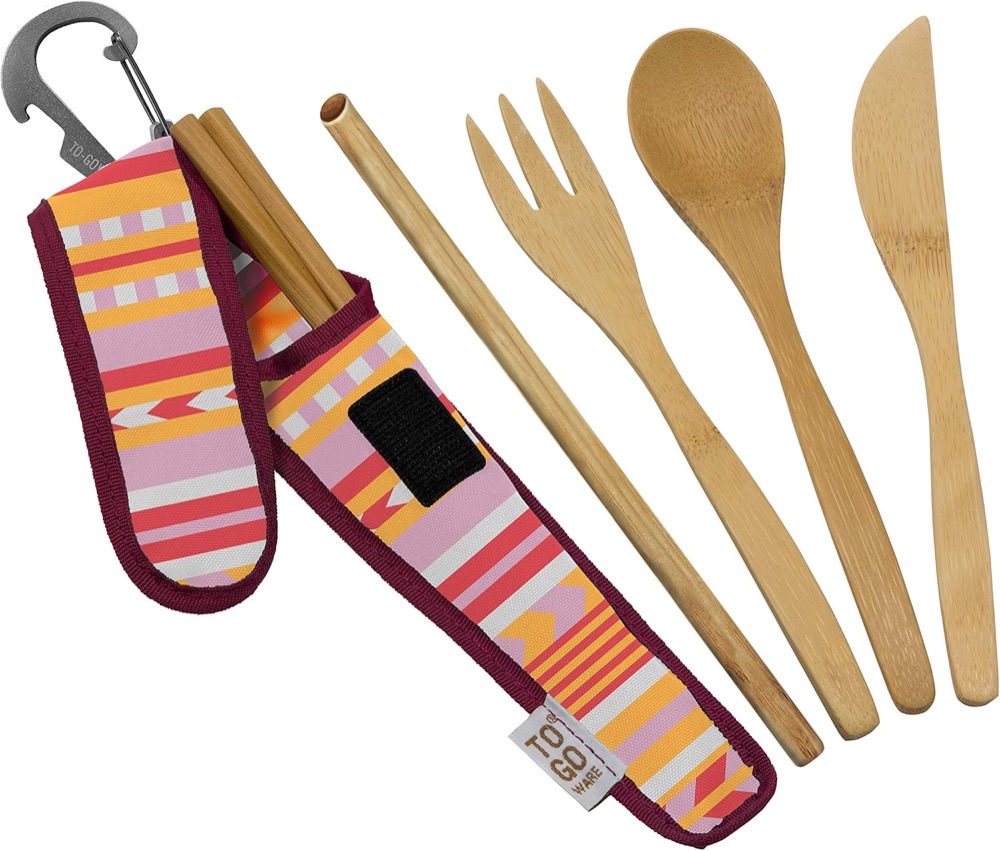
Owners like that the whole kit weighs about 1.7 ounces, the bamboo carries no metal taste, and the pieces are "good quality without splintering" out of the box, and it travels well clipped to a bag for lunch or camp meals. The honest gripes: durability is uneven, with owners reporting a fork that "split down the middle less than a month after purchase" or a tine that "broke off in salad," the spoon is shallow so it "wouldn't be effective for soup," the knife "isn't serrated or very sharp," and reviewers call the aluminum carabiner "pretty much junk.
The cheapest no-plastic place setting you can carry — four lightweight bamboo pieces plus a clip-on pouch that drops into any bag without adding noticeable weight.
Why it's safe: The utensils are solid bamboo finished with food-safe oil — no plastic, no synthetic coatings, and nothing that leaches into hot food. At end of life the bamboo simply composts.
Check Today’s Price on Amazon →Amazon prices change daily — tap to see today's price and any active discount.
- Free delivery & returns for Prime members
- Sold & shipped by Amazon
- Verified buyer reviews
Best Straw
The draw is portability and novelty: the compact case is "easy to throw on your keys or in your bag," the straw "unfolds on its own," and the silicone interior is comfortable to drink from with no clogging on thick drinks. The honest warning, and it is a real one, is cleaning and odor: reviewers describe the process as "very messy and prone to mold and mildew," say it is "incredibly difficult to clean between the rubber and metal," and report it starting to "smell like mold" or coffee even after vinegar soaks; a couple also note the case is bulky and "doesn't neatly fit on a keychain (despite the company's claims).
Always have a straw on you — it clips to your keys, folds flat, and the cleaning brush rides inside the case, so there's no reason to ever take a single-use plastic one.
Why it's safe: The straw is food-grade stainless steel with only small food-grade silicone connector tips — no plastic in the drinking path, so nothing leaches into cold or hot drinks.
Check Today’s Price on Amazon →Amazon prices change daily — tap to see today's price and any active discount.
- Free delivery & returns for Prime members
- Sold & shipped by Amazon
- Thousands of verified reviews
Best Glass
Buyers choose these because glass "is essentially tasteless, so it won't change the flavor of your drink," the borosilicate straws are dishwasher safe with an included cleaning brush, and reviewers call the look "absolutely gorgeous," with one long-term owner saying they had "still not had any issues with them breaking." The honest downside is the obvious one, breakage: drop testing found they "stood up to landing on carpet and tile, but immediately shattered on concrete," and "pieces chipped after the fourth time," so reviewers flag them as "not good for young children" and best kept as a home-and-desk straw rather than a travel one.
Sip with zero aftertaste — glass adds none of the faint metallic note steel straws can leave, so coffee, smoothies, and cocktails taste exactly as intended.
Why it's safe: Borosilicate glass is completely inert and non-porous — no plastic, no coatings, nothing to leach, and it's clear enough that you can see it's truly clean.
Check Today’s Price on Amazon →Amazon prices change daily — tap to see today's price and any active discount.
- Free delivery & returns for Prime members
- Sold & shipped by Amazon
- Verified buyer reviews
Best Minimalist
This is a backcountry classic, and the most-repeated praise is value and durability: reviewers call it "among the most affordable pieces of quality titanium gear you can buy" and "durable enough to last a lifetime," feathery at about 16 grams yet with "a comfy, familiar feel in the hand," and owners keep the same one for years. The honest downsides are about compromise: as a spork it is "neither the perfect fork nor the ideal spoon," the "deep fork prongs struggle with liquids and don't pierce food as well as a true fork," the short handle makes reaching the bottom of deep meal pouches messy, and the brushed finish "scratches easily.
Keep one in every bag — at the weight of a few coins with literally nothing to break, it covers most meals and you'll never think about it again.
Why it's safe: It's a single piece of bare titanium with no coatings, no joints, and no plastic — completely inert at any food temperature and impossible for microplastics to come from.
Check Today’s Price on Amazon →Amazon prices change daily — tap to see today's price and any active discount.
- Free delivery & returns for Prime members
- Sold & shipped by Amazon
- Thousands of verified reviews
Quick Picks
- Best Overall: Quatish Travel Utensils — a stainless steel fork and spoon with a carrying case
- Best Budget: To-Go Ware Bamboo Utensil Set — four pieces, biodegradable
- Best Ultralight: Valtcan Titanium 3-Piece Set — full fork/spoon/knife, ~2 oz, built for travel
- Best Minimalist: Snow Peak Titanium Spork — one piece, indestructible
- Best Straw: FinalStraw Collapsible — keychain-sized, stainless steel
- Best for Home: Hummingbird Glass Straws — taste-neutral, dishwasher safe
Comparison Table
| Product | Material | Pieces | Weight | Case Included | Price |
|---|---|---|---|---|---|
| Quatish Travel Utensils | Stainless Steel | 2 (fork, spoon) | — | Yes | $$ |
| Valtcan Titanium 3-Piece | Titanium | 3 (fork, spoon, knife) | 2.0 oz | Yes (pouch) | $$ |
| To-Go Ware Bamboo Set | Bamboo | 4 (fork, knife, spoon, chopsticks) | 2.0 oz | Yes (fabric pouch) | $ |
| FinalStraw Collapsible | Stainless Steel | 1 (straw) | 1.2 oz | Yes (keychain) | $$ |
| Hummingbird Glass Straws | Borosilicate Glass | 4 (straws + brush) | 3.0 oz | No | $ |
| Snow Peak Titanium Spork | Titanium | 1 (spork) | 0.6 oz | No | $ |
Price guide: $ budget · $$ mid-range · $$$ premium. Tap any pick above for today's exact Amazon price.
Materials Guide: Stainless Steel vs. Titanium vs. Bamboo
Each material has distinct advantages. The right choice depends on how you plan to use your utensils.
Stainless Steel (18/8 or 18/10)
Pros: Extremely durable, dishwasher safe, completely inert (no chemical leaching at any temperature), widely available, affordable. The 18/8 designation means 18% chromium and 8% nickel — the standard for food-grade steel used in professional kitchens. Feels substantial in hand, closest to regular home cutlery.
Cons: Heavier than titanium or bamboo. Can impart a slight metallic taste with highly acidic foods (citrus, tomato), though most people don't notice. Not ideal for ultralight backpacking.
Best for: Daily commuters, office workers, families. Our default recommendation for most people.
Titanium
Pros: 40% lighter than stainless steel at comparable strength. Completely corrosion-proof — will never rust even in saltwater. No metallic taste whatsoever. Virtually indestructible under normal use. Dishwasher safe.
Cons: More expensive per piece than steel. Fewer full cutlery set options (most titanium offerings are sporks or single pieces). Thinner feel in hand — some people prefer the heft of steel.
Best for: Backpackers, hikers, ultralight travelers, and anyone who wants the absolute lightest option.
Bamboo
Pros: Lightest material of the three. Fully biodegradable at end of life — the only option here that returns to the earth completely. Naturally antimicrobial. Warm, natural feel in hand. Most affordable option.
Cons: Hand-wash only (dishwasher causes cracking and warping). Shorter lifespan — expect 1–2 years with daily use versus 10+ years for metal. Requires occasional oiling to prevent drying. Can develop mold if stored damp.
Best for: People who prioritize full biodegradability and natural materials, or who want the lowest-cost entry point into reusable cutlery.
How to Build a Zero-Plastic Lunch Kit
A reusable utensil set is one piece of a fully plastic-free lunch setup. Here is what a complete zero-plastic lunch kit looks like:
- Reusable utensils: Any of the six sets above. The Quatish travel set is our top pick for the office; the Snow Peak spork for minimalists.
- Stainless steel or glass food container: Replace plastic Tupperware with stainless steel bento boxes or glass containers with steel lids. See our best plastic-free lunch box guide for specific recommendations — or, if you're packing for children, our best plastic-free lunch box for kids.
- Stainless steel water bottle: Ditch the plastic bottle entirely. Our stainless steel water bottle guide covers the best options.
- Cloth napkin: A simple organic cotton napkin replaces paper towels and plastic-wrapped wet wipes.
- Reusable straw (if you use straws): The FinalStraw for portability, Hummingbird glass straws for home use — see our best plastic-free reusable straws guide for the full ranked lineup.
The total cost of a complete zero-plastic lunch kit ranges from $50 to $120 depending on your choices — and it pays for itself within months by eliminating daily disposable purchases. More importantly, it eliminates a significant daily microplastic exposure pathway that most people never think about.
"The lunch hour is one of the highest single-use plastic exposure moments in most adults' daily routines. A reusable kit eliminates that exposure completely."
For a comprehensive walkthrough of every swap in your kitchen, see our Kitchen Plastic Detox Guide, which covers food storage, cookware, and cleaning products in addition to lunch gear.
Want the Full Room-by-Room Protection Guide?
The Complete Plasticproof Guide covers every room in your home — kitchen, nursery, bathroom, bedroom — with the full research and complete swap list. 47+ peer-reviewed studies, 80+ product recommendations.
Frequently Asked Questions
Yes. When plastic cutlery contacts hot food — soups, stir-fries, heated takeout — the heat accelerates the release of microplastics and chemical additives like phthalates and styrene. A 2020 study in Environmental Science & Technology found that polystyrene cutlery released measurable microplastic particles after just three minutes of contact with food at 70°C (158°F). Stainless steel, titanium, and bamboo utensils do not leach any synthetic chemicals regardless of food temperature.
It depends on your priorities. Stainless steel (18/8 or 18/10 grade) is the most durable, dishwasher safe, and widely available — it is our top recommendation for most people. Titanium is 40% lighter than steel and virtually indestructible, making it ideal for backpacking and ultralight travel, but it costs more. Bamboo is the lightest and most affordable option, fully biodegradable, but requires hand-washing and will eventually wear out. All three are completely plastic-free and food-safe.
Stainless steel and titanium utensils are fully dishwasher safe — top or bottom rack. Bamboo utensils should be hand-washed only; repeated dishwasher cycles will cause cracking, warping, and a shortened lifespan. If dishwasher convenience is a priority, choose stainless steel or titanium sets.
Yes, particularly if you use straws regularly. An estimated 500 million plastic straws are used daily in the U.S. alone. A single reusable stainless steel or glass straw replaces hundreds of disposable plastic straws per year. Glass straws (like Hummingbird) are taste-neutral and easy to clean. Collapsible straws (like FinalStraw) fit on a keychain for true portability. Both options pay for themselves within weeks of regular use.
Wash bamboo utensils with warm soapy water immediately after use and dry them thoroughly before storing. Never leave them soaking or store them damp in a closed case — moisture is the primary cause of mold growth on bamboo. Every few weeks, rub a thin coat of food-grade mineral oil onto the bamboo to maintain the wood and prevent cracking. With proper care, a bamboo utensil set lasts 1 to 2 years of daily use.
Sources
- Li D, et al. "Microplastic release from the degradation of polypropylene feeding bottles during infant formula preparation." Nature Food, 2020.
- Zimmermann L, et al. "Are bioplastics and plant-based materials safer than conventional plastics? In vitro toxicity and chemical composition." Environment International, 2020.
- Sobhani Z, et al. "Microplastics generated when opening plastic packaging." Scientific Reports, 2020.
- Ocean Conservancy. "International Coastal Cleanup Report: Top 10 Items Found." 2023.
Protect Every Room in Your Home
From the kitchen to the nursery to the bedroom — the Complete Plasticproof Guide covers every swap that matters, backed by 47+ studies.