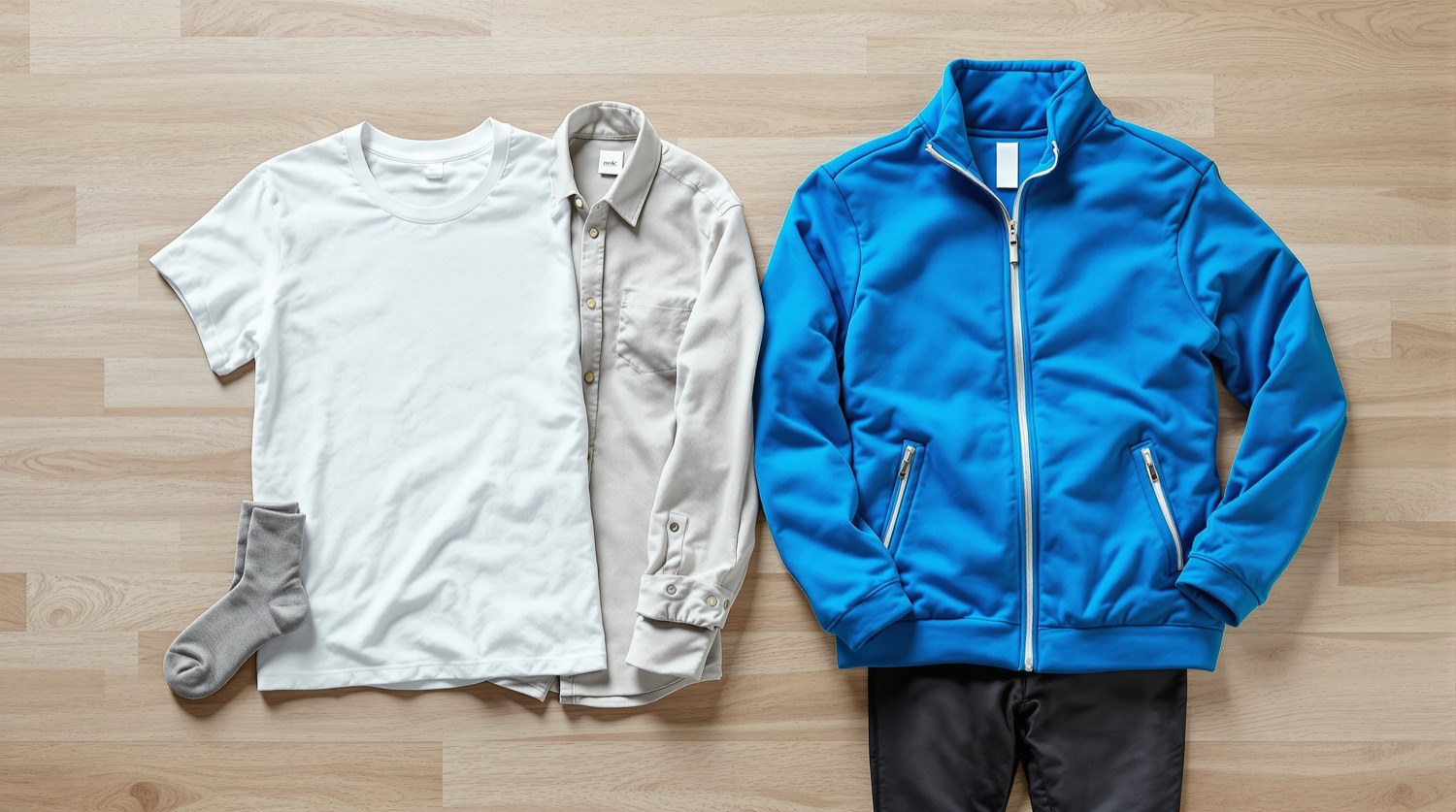
Wearing synthetic clothes sheds about as many plastic microfibers as washing them, so the biggest swap is the polyester you wear closest to your skin for the most hours. De Falco and colleagues reported in Environmental Science & Technology (2020) that fibers released to air from wearing polyester are of a similar order of magnitude to those released by laundering; the University of Plymouth's summary put it at up to 400 fibers per gram of fabric in 20 minutes of normal activity. Replace fleece and acrylic first (acrylic shed 728,789 fibers per 6 kg wash in a 2016 Plymouth test), skip the delicate cycle, line-dry, and vacuum with a HEPA vacuum. The table below ranks all seven swaps.
Search for how to avoid microplastics in clothing and you get the same three tips: buy natural fibers, wash in cold water, get a laundry ball. Some of that is right. But almost none of it tells you why, which garments matter, or how big each change actually is — and the one exposure route that matters most to your own body, the fibers your clothes shed into the air you breathe, rarely appears at all.
This guide is built the other way around. Every swap below is tied to a named, peer-reviewed study, and every study is linked so you can check the figure yourself. Where the evidence is thin or the authors have an interest, we say so. If you want the washing-machine side in full detail, our ranked guide to laundry filters covers the devices; this page is about the clothes themselves and how they reach you.
Do clothes really shed microplastics when you wear them?
They do, and in roughly the same quantity as the washing machine. Francesca De Falco, Mariacristina Cocca, Maurizio Avella and Richard Thompson compared polyester garments in the wash and in everyday wear, and concluded that "release of microfibers per person per year to the air is of a similar order of magnitude to that released to wastewater by laundering" (De Falco et al., Environmental Science & Technology, 2020).
The University of Plymouth's summary of the study gives the scale: up to 400 fibers per gram of fabric during 20 minutes of normal activity, against up to 4,000 per gram in a single conventional wash. Scaled up per person per year, that is almost 300 million polyester microfibers by washing and more than 900 million to the air by wearing. The paper itself is more cautious than the press release — it calls the two routes comparable, not one larger — and we use its wording.
How do clothing microplastics actually get into your body?
Mostly through the air and the dust, not the skin. Rachid Dris and colleagues sampled two Paris apartments and an office and found 1.0 to 60.0 fibers per cubic meter of indoor air, against 0.3 to 1.5 outdoors; fibers settled indoors at 1,586 to 11,130 per square meter per day, and settled dust held 190 to 670 fibers per milligram. About 33% of the fibers contained petrochemicals (Dris et al., Environmental Pollution, 2017). The authors note most of those fibers are probably too large to inhale deeply, but that people — "particularly young children" — can swallow them with dust.
Smaller particles do get breathed in. Alvise Vianello's group at Aalborg University put a breathing, heated mannequin in three apartments and measured 1.7 to 16.2 microplastic particles per cubic meter; they estimated an average man doing light activity could inhale up to 272 microplastic particles over 24 hours. Polyester was the predominant synthetic polymer, at 81% of the plastic found (Vianello et al., Scientific Reports, 2019). Polyester is, overwhelmingly, the fabric your clothes are made of. As for the skin itself, intact skin is a poor route for plastic particles — see what the research says about skin absorption.
That is why swap order matters. Textile Exchange's 2025 Materials Market Report put polyester at 59% of the 132 million tonnes of fiber made worldwide in 2024, with synthetics as a whole at 69% (Textile Exchange, 2025). You cannot replace all of it at once, so start where shedding and contact are highest.
The 7 swaps, ranked by impact
Ranked by how directly each one cuts the fibers you breathe and swallow, then by how much the studies say it cuts. "Impact" is our judgment from the cited numbers; the evidence column tells you exactly what was measured.
| Swap | Why it ranks here | Key measured figure | Cost |
|---|---|---|---|
| 1. Natural fibers for next-to-skin basics (underwear, tees, socks, sleepwear) | Worn the most hours, closest to your face and bedding | Up to 400 fibers/g shed in 20 min of wear (De Falco, 2020) | $–$$, replace as items wear out |
| 2. Retire polyester fleece | Brushed surfaces shed significantly more than smooth polyester | One fleece blanket: 120,000+ fibers in one wash (McIlwraith, 2019) | $$ for wool or cotton fleece |
| 3. Skip acrylic knits | Highest shedder in the best-known fabric comparison | 728,789 fibers per 6 kg load vs 137,951 for poly-cotton (Napper, 2016) | Free — check the label |
| 4. If synthetic, buy tight weaves with finished edges | Fabric construction changed release by more than 300-fold | 210 to 72,000 fibers per gram per wash across 12 polyesters (Cai, 2020) | Free — a buying habit |
| 5. Buy fewer new synthetics, wash new ones in a bag | New garments shed most in their first washes | First fleece wash 0.008–0.021% of mass vs 0.0012% later (Pirc, 2016) | Free, or about $30 for a wash bag |
| 6. Skip the delicate cycle, run full loads | More water per kilo of fabric pulls more fibers loose | 800,000 more fibers per delicate wash (Kelly, 2019) | Free |
| 7. Line-dry and vacuum with HEPA | Removes fibers from your air and dust after they are shed | Dust held 190–670 fibers per mg (Dris, 2017) | Free to $$ |
Swap 1: Which clothes should you replace first?
Replace the synthetics you wear longest and closest: underwear, undershirts, socks, sleepwear and leggings. These are on your body for most of the day and night, they rub constantly, and sleepwear sheds into the bedding and bedroom air you breathe for eight hours. A synthetic coat worn twenty minutes a day matters far less than polyester pajamas worn every night.
The good news is that these are the cheapest items to swap and the ones you replace most often anyway. Do it as things wear out rather than all at once. For tees and basics, 100% organic cotton is the simplest choice; for socks and base layers, merino wool works where cotton gets clammy. Check the label for a small percentage of elastane or nylon — it is common in underwear and socks for stretch, and a 95/5 cotton blend still sheds far less plastic than an all-polyester garment.
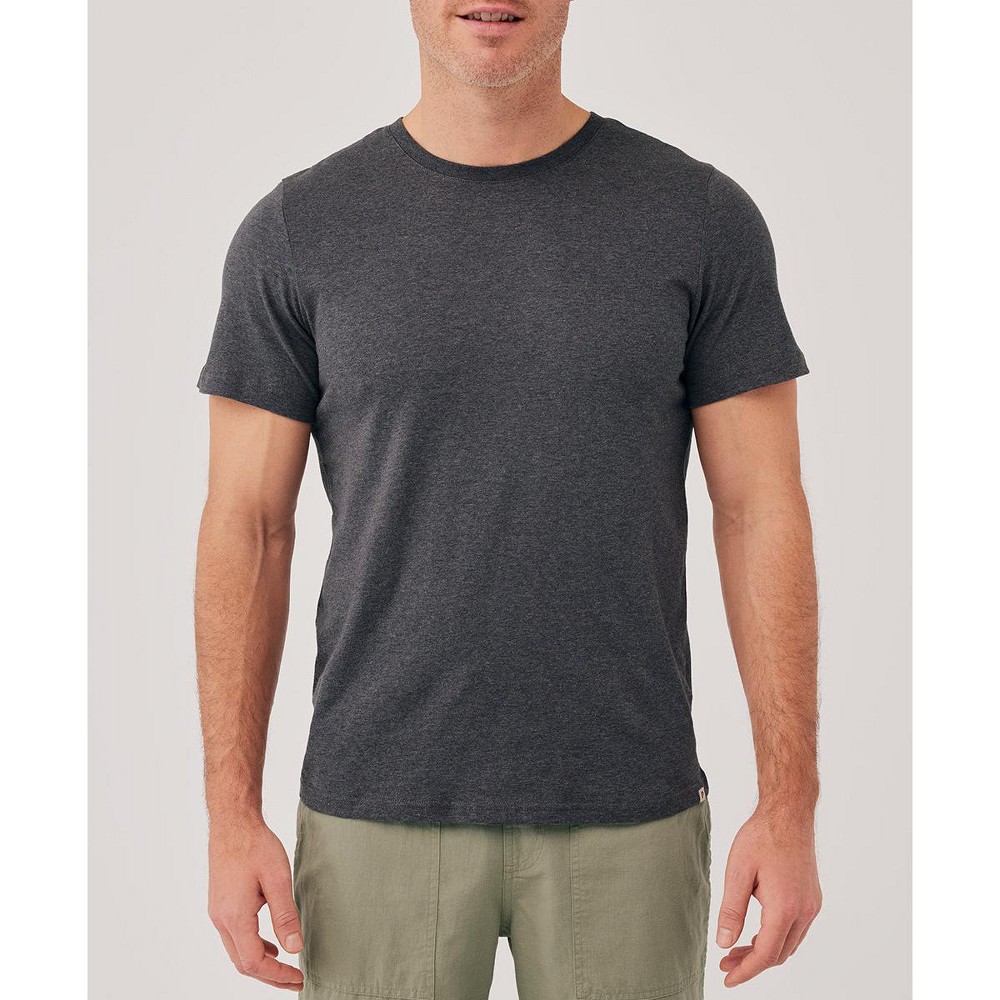 Swap 1 Pick
Swap the underwear, tees and pajamas you wear the most hours of every day.
Why it helps: 100% cotton sheds cellulose lint, not plastic, and cotton fibers biodegrade in water where polyester does not.
Check Today’s Price on Amazon →Amazon prices change daily — tap to see today's price and any active discount.
- Free delivery & returns for Prime members
- GOTS-certified organic cotton
Is organic cotton actually better for microplastics?
Cotton is not shed-free — it sheds plenty of lint — but that lint is cellulose, not plastic, and it breaks down. Marielis Zambrano and colleagues at North Carolina State University tested fibers from laundering and found cotton and rayon yarns reached more than 70% biodegradation in lake water and about 50% in seawater, while "polyester did not appreciably degrade" (Zambrano et al., Marine Pollution Bulletin, 2020).
Two caveats, stated plainly. Two of the authors work for Cotton Incorporated, the cotton industry's research group, and the paper itself says its results "indicate potential not absolutes in nature." The finding is consistent with basic chemistry — microbes digest cellulose and do not digest polyester — but it is lab evidence, not a field guarantee. "Organic" matters for pesticides and farm chemicals, not for shedding; conventional cotton sheds the same non-plastic fiber. For bedding, the same logic applies to organic cotton sheets.
Swaps 2 and 3: Which fabrics shed the most microplastics?
Fleece and acrylic. Brushing a fabric to make it fluffy breaks filaments at the surface, and those loose ends are what come off. In a study of 12 different polyester textiles, Yaqi Cai, Denise Mitrano, Bernd Nowack and colleagues at Empa in Switzerland found fabrics with mechanically processed surfaces like fleece released significantly more (Cai et al., Environmental Science & Technology, 2020). At the University of Toronto, a single new polyester fleece blanket released more than 120,000 microfibers in one wash (McIlwraith et al., Marine Pollution Bulletin, 2019).
Acrylic, common in cheap sweaters, scarves and blankets, was the worst fabric in the best-known head-to-head. Imogen Napper and Richard Thompson estimated a 6 kg wash load releases 728,789 fibers from acrylic, 496,030 from polyester and 137,951 from a polyester-cotton blend (Napper & Thompson, Marine Pollution Bulletin, 2016). For warm layers, wool fleece, boiled wool and cotton sweatshirt fabric do the same job without the plastic.
Swap 4: If you buy synthetic, what should you look for?
Sometimes synthetic is the right tool — a rain shell, swimwear, technical running gear. Then construction is what matters, and it matters a lot: across Cai's 12 polyesters, release ranged from 210 to 72,000 fibers per gram per wash. Two things stood out. Edges cut with scissors released 3 to 21 times more fibers than laser-cut, heat-sealed edges, and on average 84% of all release came from cut edges. So look for clean hems, sealed or bound seams, and no raw edges.
De Falco's team found the same pattern in wear: a compact, woven polyester made from highly twisted continuous-filament yarn released the least to both air and water. In practice, a smooth, tightly woven shell sheds far less than a brushed, loosely knit fleece, even if both say "100% polyester."
Swap 5: Do new clothes shed more microplastics?
Generally yes, at first. Cai's group found release from every textile fell with repeated washing before leveling off at a small, continuous rate after 5 to 6 washes — most likely loose fibers left over from manufacturing being used up. Pirc and colleagues washed new polyester fleece blankets ten times: the first wash released 0.008 to 0.021% of the fabric's weight, settling to about 0.0012% per wash (Pirc et al., Environmental Science and Pollution Research, 2016). By our arithmetic, that first wash shed roughly 7 to 17 times the later rate.
There is a catch at the other end of a garment's life. Hartline and colleagues found jackets that had been artificially aged released more mass than new ones (Hartline et al., Environmental Science & Technology, 2016). So the rule is: buy fewer new synthetics, keep the ones you have through their middle years, and retire fleece once it pills badly. When you do buy something synthetic, give its first few washes in a fine-mesh bag.
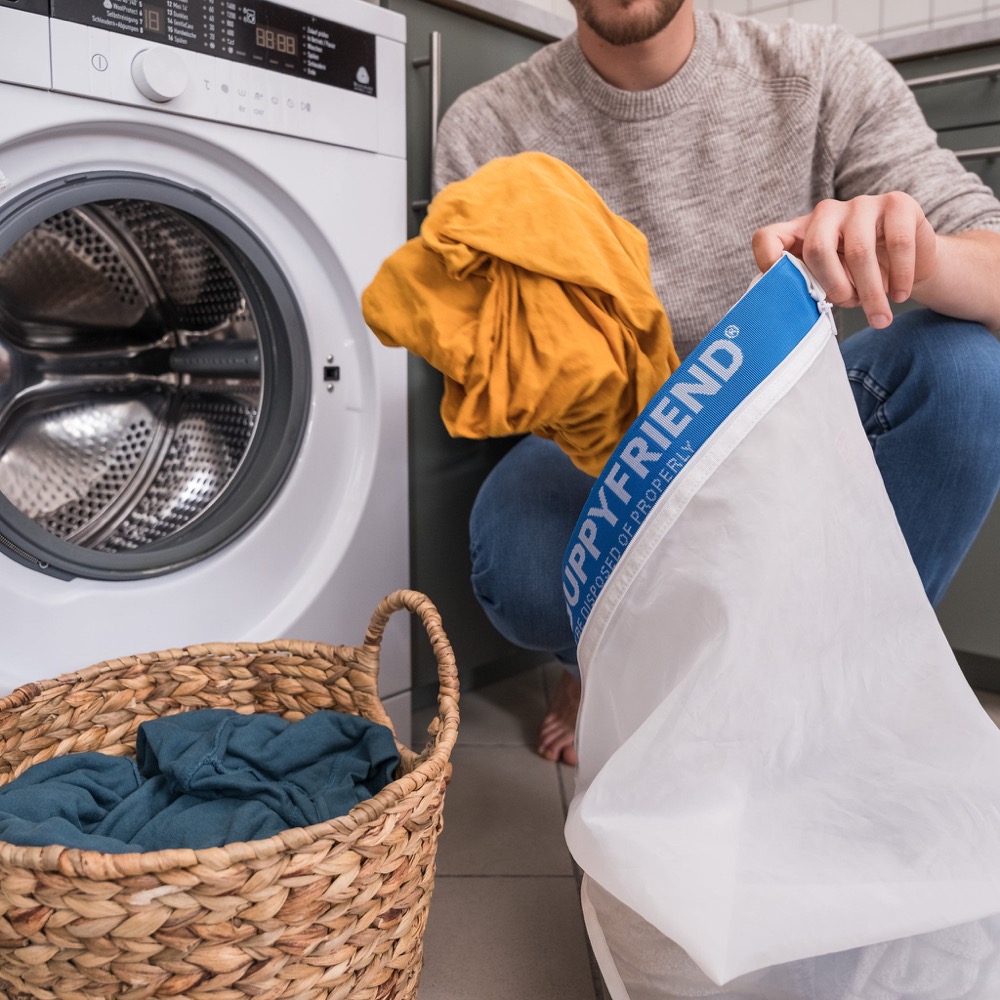 Swap 5 Pick
Protects the garments that shed most, without a plumber or a landlord conversation.
Why it helps: 50-micron mesh sits inside the pore size that produced significant reductions in published trials.
Check Today’s Price on Amazon →Amazon prices change daily — tap to see today's price and any active discount.
- Free delivery & returns for Prime members
- Reusable for years
Swap 6: What wash settings reduce microplastics from clothes?
Skip the delicate cycle and run full loads. It sounds backwards — "delicate" should be gentle — but Max Kelly and colleagues at Newcastle University found the high-water-volume delicate cycle released 800,000 more microfibers per wash (94 mg per kg of fabric) than a lower-water standard cycle, and kept releasing more in later washes. Their conclusion: the ratio of water to fabric matters more than agitation, so full loads in lower-water machines shed less (Kelly et al., Environmental Science & Technology, 2019).
The machine you own matters too: front-loaders shed far less than top-loaders in testing, which we cover in top load vs front load washers. If you own your machine, an external filter with a 150-micron or finer mesh is the biggest single laundry upgrade — ranked in the laundry filter guide. Wash fewer times overall, too: jeans, sweaters and outer layers rarely need washing after every wear.
Swap 7: Does the dryer release microplastics into your home?
It sends them outside, and it wears your clothes down. Kirsten Kapp and Rachael Miller measured 35 ± 16 mg and 70 ± 77 mg of lint blown from dryer vents at two homes over three drying cycles, with polyester fibers landing up to 30 feet from the vent (Kapp & Miller, PLOS ONE, 2020). The tumbling that produces that lint is also abrading the garments, which is why line-drying synthetics is free and worth doing. If you keep the dryer, wool dryer balls replace plastic dryer sheets — see dryer sheets vs wool dryer balls.
Then deal with what is already shed. Indoor fibers settle into dust at thousands per square meter per day, and dust is how young children swallow them. Vacuum with a sealed HEPA vacuum, damp-dust rather than dry-dust, and keep laundry folding and fleece-wearing out of the bedroom where you can. For airborne particles, a true-HEPA air purifier helps; our guide to microplastics in indoor air and the air purifier rankings cover what the filters catch.
Clothing is one source among several. Drinking water, food packaging and plastic heated with food are larger, better-measured routes into the body — see the full guide to avoiding microplastics and how to reduce microplastics in your body. The swaps on this page are worth doing because most of them are free; you do not need to throw out a wardrobe to make progress.
The short version
Replace polyester underwear, tees, socks and pajamas with cotton or wool as they wear out. Retire fleece and acrylic first. When you buy synthetic, choose tight weaves with clean, sealed edges, and wash new pieces in a fine-mesh bag. Skip the delicate cycle, run full loads, and line-dry. Vacuum with a HEPA vacuum. None of it requires a new wardrobe, and the first four cost nothing but attention to the label.
Frequently Asked Questions
Start with the synthetic garments you wear closest to your skin for the most hours, and replace fleece and acrylic first, because they shed the most. If you buy synthetics, choose tightly woven fabrics with finished edges, avoid the delicate wash cycle, run full loads, line-dry, and vacuum with a HEPA vacuum, because most clothing fibers you take in arrive through indoor air and dust.
Yes, and about as much as washing. De Falco and colleagues reported in Environmental Science & Technology in 2020 that microfibers released to air per person per year from wearing polyester clothing are of a similar order of magnitude to those released to wastewater by laundering. The University of Plymouth's summary of the study put it at up to 400 fibers per gram of fabric during 20 minutes of normal activity.
Acrylic, in the best-known comparison. Napper and Thompson at the University of Plymouth estimated 728,789 fibers from a 6 kg wash load of acrylic, 496,030 from polyester and 137,951 from a polyester-cotton blend (Marine Pollution Bulletin, 2016). Among polyesters, brushed and napped fabrics like fleece release significantly more than smooth ones.
Cotton still sheds fibers, but they are not plastic and they break down. In a 2020 Marine Pollution Bulletin study, cotton and rayon yarn fibers reached more than 70% biodegradation in lake water and about 50% in seawater, while polyester did not appreciably degrade. Two of the authors work for Cotton Incorporated, the cotton industry group, so treat the result as strong lab evidence rather than a guarantee for every environment.
Usually at first. Cai and colleagues washed 12 polyester textiles repeatedly and found release fell with every wash cycle before leveling off after 5 to 6 washes, and a 2016 fleece study by Pirc and colleagues found the first wash released roughly 7 to 17 times the rate it later settled at. But heavily worn garments can shed more again, so retire fleece once it pills badly.
Intact skin is a poor route for plastic particles. The fibers clothing sheds reach you mainly through the air you breathe and the dust you swallow: a 2019 Scientific Reports study using a breathing mannequin in three apartments estimated a person could inhale up to 272 microplastic particles in 24 hours, with polyester the dominant synthetic polymer.
Sources
- De Falco F, Cocca M, Avella M, Thompson RC. "Microfiber Release to Water, Via Laundering, and to Air, via Everyday Use: A Comparison between Polyester Clothing with Differing Textile Parameters." Environmental Science & Technology, 2020;54(6):3288–3296. (Release to air from wear of a similar order of magnitude to release to wastewater by laundering; compact woven continuous-filament polyester released least. Per-gram and per-year counts from the University of Plymouth summary, March 2020.)
- Dris R, Gasperi J, Mirande C, et al. "A first overview of textile fibers, including microplastics, in indoor and outdoor environments." Environmental Pollution, 2017;221:453–458. (Indoor air 1.0–60.0 fibers/m³, outdoor 0.3–1.5; deposition 1,586–11,130 fibers/day/m²; dust 190–670 fibers/mg; 33% petrochemical.)
- Vianello A, Jensen RL, Liu L, Vollertsen J. "Simulating human exposure to indoor airborne microplastics using a Breathing Thermal Manikin." Scientific Reports, 2019;9:8670. (1.7–16.2 particles/m³; up to 272 microplastics inhaled over 24 hours; polyester 81% of synthetic particles.)
- Cai Y, Yang T, Mitrano DM, Heuberger M, Hufenus R, Nowack B. "Systematic Study of Microplastic Fiber Release from 12 Different Polyester Textiles during Washing." Environmental Science & Technology, 2020;54(8):4847–4855. (210–72,000 fibers/g per wash; scissor-cut edges 3–21x laser-cut; 84% of release from cut edges; release fell with repeated washes.)
- Napper IE, Thompson RC. "Release of synthetic microplastic plastic fibres from domestic washing machines: Effects of fabric type and washing conditions." Marine Pollution Bulletin, 2016;112:39–45. (Per 6 kg load: acrylic 728,789; polyester 496,030; polyester-cotton 137,951, as reported by the University of Plymouth.)
- McIlwraith HK, Lin J, Erdle LM, et al. "Capturing microfibers — marketed technologies reduce microfiber emissions from washing machines." Marine Pollution Bulletin, 2019;139:40–45. (One new polyester fleece blanket released more than 120,000 fibers in a single wash.)
- Pirc U, Vidmar M, Mozer A, Kržan A. "Emissions of microplastic fibers from microfiber fleece during domestic washing." Environmental Science and Pollution Research, 2016;23:22206–22211. (First wash 0.008–0.021 wt%; stabilized near 0.0012 wt% per wash.)
- Hartline NL, Bruce NJ, Karba SN, et al. "Microfiber Masses Recovered from Conventional Machine Washing of New or Aged Garments." Environmental Science & Technology, 2016;50:11532–11538. (Aged jackets released more mass than new ones.)
- Kelly MR, Lant NJ, Kurr M, Burgess JG. "Importance of Water-Volume on the Release of Microplastic Fibers from Laundry." Environmental Science & Technology, 2019;53(20):11735–11744. (Delicate cycles released 800,000 more microfibers, 94 mg/kg, per wash.)
- Zambrano MC, Pawlak JJ, Daystar J, Ankeny M, Goller CC, Venditti RA. "Aerobic biodegradation in freshwater and marine environments of textile microfibers generated in clothes laundering." Marine Pollution Bulletin, 2020;151:110826. (Cotton and rayon over 70% biodegraded in lake water, about 50% in seawater; polyester did not appreciably degrade.)
- Kapp KJ, Miller RZ. "Electric clothes dryers: An underestimated source of microfiber pollution." PLOS ONE, 2020;15(10):e0239165. (35 ± 16 mg and 70 ± 77 mg of vent lint over three cycles; fibers found up to 30 feet away.)
- Textile Exchange. "Materials Market Report 2025." (2024 global fiber production 132 million tonnes; polyester 59%; synthetics 69%.)