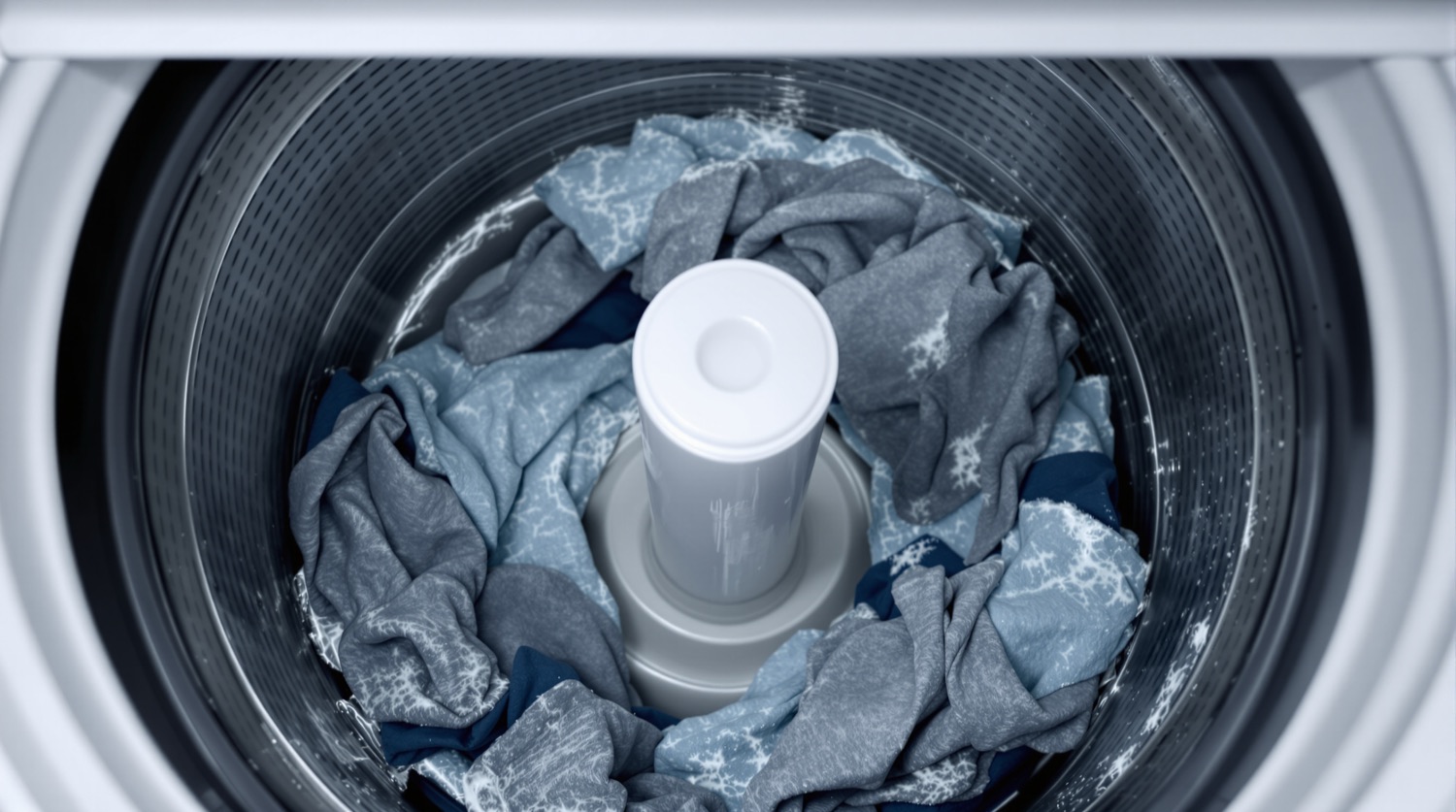
Laundry is one of the largest household sources of microplastic fiber pollution, and the machine doing the washing turns out to matter more than almost any product you can buy to sit inside it. Three independent research groups have measured the difference between a top-loading and a front-loading washer under instrumented conditions and published the results. They agree on the direction, they agree roughly on the size, and — most usefully — one of them worked out why.
That “why” is the part worth your attention, because it overturns the obvious explanation. It is not the agitator beating fibers loose. It is the water.
Bottom line: Top-loaders released about 7x the microfiber mass of front-loaders (Hartline 2016), and traditional top-loaders released 69.7% more from fleece than high-efficiency machines (Lant 2020). The driver is the water-to-fabric ratio, not agitation (Kelly 2019) — so running fuller loads, skipping the delicate cycle and washing cold and short cuts shedding substantially without replacing anything. Do not buy a washing machine for this reason alone.
What the Three Studies Actually Measured
Every number on this page comes from one of three peer-reviewed wash trials. They used different methods and measured slightly different quantities, which is why the percentages are not interchangeable — but they point the same way.
Measured Microfiber Release by Machine Type and Setting
“ppm” here means milligrams of microfiber per kilogram of fabric washed — the unit the 2020 consumer-laundry study reported.
| What was compared | Measured result | Study |
|---|---|---|
| Top-load vs front-load (microfiber mass, same garments) | Top-load released ~7x more | Hartline et al., 2016 |
| Highest single-garment release recorded | Up to ~2 g per garment per wash | Hartline et al., 2016 |
| High-efficiency vs traditional top-loader — fleece | 69.7% less microfiber | Lant et al., 2020 |
| High-efficiency vs traditional top-loader — polyester t-shirts | 37.4% less microfiber | Lant et al., 2020 |
| Delicate cycle vs standard (higher water volume) | ~800,000 more fibers per wash (94 mg/kg) | Kelly et al., 2019 |
| Small load (1.0–3.5 kg) vs large load (3.5–6.0 kg) | 132.4 ppm vs 66.3 ppm — a 50% cut | Lant et al., 2020 |
| 40°C conventional cycle vs 15°C quick cycle | 181.6 ppm vs 129.5 ppm — a 30% cut | Lant et al., 2020 |
| New garment vs after 8+ washes | 114 ppm average falling to 28.7 ppm | Lant et al., 2020 |
| Detergent pods | No significant effect (p = 0.65) | Lant et al., 2020 |
| Fabric softener | No significant effect (p = 0.50) | Lant et al., 2020 |
One caution before reading too much into any single figure. The 7x result came from a deliberately controlled experiment — detergent-free washes of five specific jackets and sweaters, repeated in both machine types. The 69.7% figure came from the opposite kind of study: 79 loads of real, dirty, mixed household laundry. Controlled trials isolate the variable; real-laundry trials tell you what happens in a kitchen. Agreement between those two designs is stronger evidence than either one alone.
Does a Top Load or Front Load Washer Release More Microplastics?
The top-loader, by a wide margin, in every trial that has compared them. Hartline and colleagues at the University of California ran detergent-free wash experiments on five new and mechanically aged jackets and sweaters, replicated in both conventional front-load and top-load home machines, then recovered and weighed the microfibers from the effluent. Microfiber masses from top-load machines were approximately seven times those from front-load machines.
The 2020 consumer-laundry study approached it from a completely different angle and landed in the same place. Neil Lant and colleagues collected 79 real loads of soiled laundry from households and measured what came out, including a North American arm comparing high-efficiency machines against traditional top-loaders. Fleece shed 69.7% less in the high-efficiency machines; polyester t-shirts shed 37.4% less. Both results were statistically strong rather than marginal.
Why Does a Top-Loading Washer Shed More Fibers?
Because of how much water sits in the drum — not because of the agitator. This was the central finding of a 2019 study by Kelly and colleagues, and it corrected an assumption the field had been carrying for years. Researchers had reasonably supposed that mechanical agitation tore fibers loose. When the team isolated the variables, the dominant factor turned out to be the ratio of water volume to fabric.
The mechanism is straightforward once stated. A traditional top-loader fills its tub and floats the load in a large standing volume of water. A front-loader lifts clothes with paddles and drops them through a shallow bath at the bottom of the drum, using a fraction of the water. Fibers break loose in both machines. In the top-loader, far more water is available to carry those loose fibers away and out through the drain. The machine is not generating more fiber so much as flushing out more of it.
The thing that moves microfiber release is how much water is in the drum — which is a setting on most machines, not just a purchase.
Does the Delicate Cycle Protect Your Clothes?
It protects the garment and makes the fiber problem worse, which is the most useful counterintuitive result in this entire body of research. Kelly and colleagues measured that a delicate cycle released roughly 800,000 more microplastic fibers per wash — 94 mg per kg of fabric — than a standard, lower-water-volume cycle.
The reason follows directly from the water-volume finding. A delicate cycle is gentle precisely because it surrounds each garment with much more water, reducing abrasion between items. That generous water volume is exactly the condition that flushes the most fiber out of the fabric and into the drain. Anyone who has been putting activewear and fleece on delicates to be careful with them has, on this measure, been doing the opposite of what helps.
Should You Replace a Top-Loader to Cut Microplastics?
No — not on this evidence alone, and we would be doing you a disservice to imply otherwise. A washing machine is a major purchase that carries its own substantial manufacturing footprint, and scrapping a working appliance to chase a fiber statistic is rarely the right environmental or financial trade. If your machine is genuinely at the end of its life and you are replacing it anyway, a front-loading or high-efficiency model is clearly the better choice on this measure. That is a tiebreaker, not a reason.
The stronger argument is that the settings on your existing machine recover a meaningful share of the difference at no cost. From the 2020 data: running larger loads rather than small ones cut release by half (132.4 ppm down to 66.3 ppm), and a 15°C quick cycle cut a further 30% against a 40°C conventional one (181.6 ppm down to 129.5 ppm). Skipping the delicate cycle removes the 800,000-fiber penalty Kelly measured. A full, cold, short, standard-cycle wash in a top-loader is a very different machine from a half-empty warm delicates cycle.
Is Most Washing Machine Lint Actually Plastic?
No, and this deserves saying plainly because it is routinely reported the other way around. When the 2020 team characterized the fibers coming out of those 79 real consumer loads, natural fibers made up an average of 96% of the total — cotton, wool and viscose — across a range of 90% to 99%. Synthetic fibers averaged just 4%.
That does not make laundry microplastics a non-issue; it reframes it. The absolute volume of fiber leaving household washing machines is enormous, so even 4% is a very large number of plastic fibers entering wastewater. But it does mean the lint in your trap is mostly cotton, and it means the single highest-leverage change is not a gadget at all — it is how much of your wardrobe is made of plastic in the first place. Our guide to microplastics in clothing and the natural-fiber alternatives covers what to replace first, and bedding is usually the largest single block of textile in a home — see the best organic cotton sheets guide.
What Actually Cuts Laundry Microfibers the Most
In rough order of measured impact, and none of the first four costs anything:
- Own fewer synthetic textiles. A cotton, linen, wool or hemp garment sheds plant or protein fiber, not plastic. There is nothing to capture.
- Run full loads. Halved release in the 2020 data — the single biggest free lever, and it works on any machine.
- Stop using the delicate cycle on synthetics. Worth about 800,000 fibers per wash.
- Wash cold and short. A further 30% cut, with 42% less whiteness loss as a bonus in the same trial.
- Fit a drain-hose filter. The only device class that reached 78–87% capture in independent trials — see our comparison of laundry microfiber capture devices.
- Use a capture bag if plumbing work is not an option. Roughly 54% measured capture, no installation.
For the full set of habits and the detergent and dryer choices that sit alongside them, see our guide to reducing microplastics from laundry and the wider plastic-free laundry guide.
The Two Products the Data Actually Supports
Neither of these replaces your machine, and both work on a top-loader and a front-loader alike.
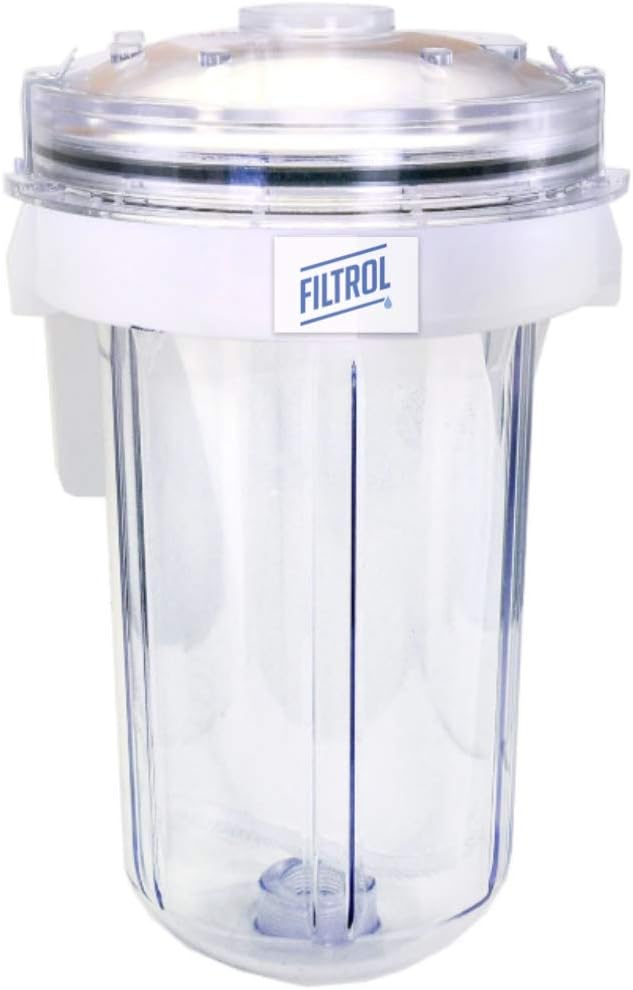 Highest Measured Capture
Pros
- Catches fiber from every load automatically
- Neutralizes the top-loader penalty entirely
- Also protects drains and septic fields from lint
- Reusable bag rather than a disposable cartridge
Cons
- Needs plumbing access behind the machine
- Costs several times what a bag does
- Performance falls if the bag is not cleaned
- The 89% figure is the maker’s, not independent
The one upgrade that makes your machine type irrelevant.
Why it matters: a filter sits downstream of the drum and sees every liter of water leaving the machine — including the extra water that makes a top-loader shed more.
Check Today’s Price on Amazon →Amazon prices change daily — tap to see today’s price and any current discount.
- Free delivery for Prime members
- Replacement filter bags sold separately
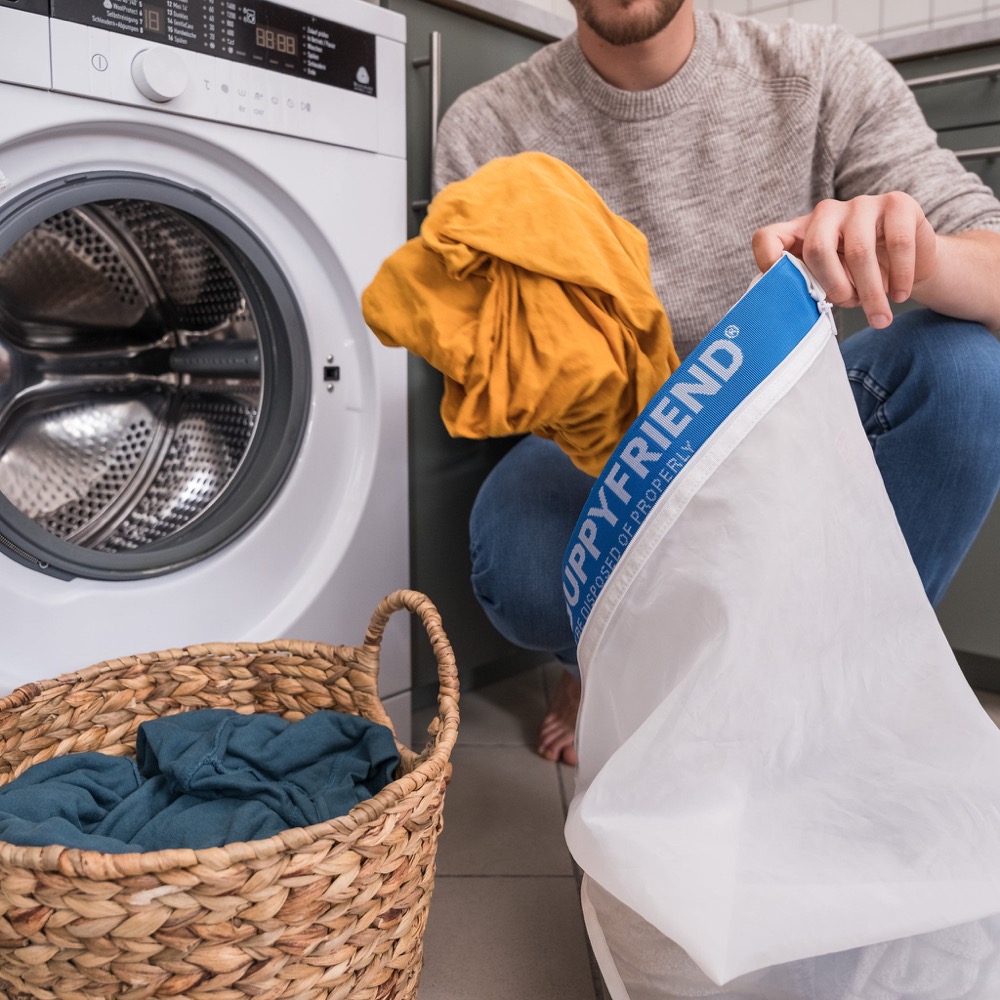 Best With No Installation
Pros
- Best measured result of any no-install device
- Reduces shedding as well as capturing fiber
- Works in a laundromat or shared building machine
- Nothing to maintain beyond emptying it
Cons
- Only protects what you remember to put inside
- Cannot be packed full, so it shrinks load size
- Still lets roughly half of shed fiber through
- Collected fuzz must be removed by hand
The best capture available without touching the plumbing.
Check Today’s Price on Amazon →Amazon prices change daily — tap to see today’s price and any current discount.
- Free delivery for Prime members
- Thousands of verified reviews
What We Are Not Claiming
Two honest limits on the numbers above. First, the 7x result is a mass comparison from a controlled detergent-free experiment on five garments — it is a robust finding about machine types, not a promise that your next load will contain exactly one seventh as much fiber. Second, the three studies used different machines, fabrics, temperatures and detection methods, so the percentages should be read as consistent evidence of a large effect rather than as figures to subtract from one another.
What all three agree on is the part that matters for a decision: more water per kilogram of fabric means more microfiber out the drain, top-loaders use more water, and the settings that reduce water per garment reduce shedding on any machine you own.
Frequently Asked Questions
Does a top load or front load washer release more microplastics?
The top-loader. Hartline and colleagues recovered roughly 7 times more microfiber mass from top-load machines than front-load machines washing the same garments (Environmental Science & Technology, 2016). A 2020 PLOS ONE study of 79 real household loads found high-efficiency machines released 69.7% less microfiber from fleece and 37.4% less from polyester t-shirts than traditional top-loaders.
Why does a top-loading washer shed more?
Water volume, not agitation. Kelly and colleagues found in 2019 that the ratio of water to fabric is the most influential factor in microfiber release — more influential than mechanical agitation, which had previously been assumed to be the cause. A top-loader floats the load in a full tub; a front-loader tumbles it through a shallow bath. More water carries more loose fiber out of the drum.
Does the delicate cycle reduce shedding?
It increases it. A delicate cycle released about 800,000 more microplastic fibers per wash — 94 mg per kg of fabric — than a standard lower-water-volume cycle in the 2019 trial. Delicate cycles are gentle because they use much more water per garment, and that water is exactly what flushes fiber out.
Should I buy a new washing machine for this?
Not for this reason alone. Scrapping a working appliance carries its own environmental cost, and the free settings recover much of the gap: full loads halved release in the 2020 data, a cold quick cycle cut a further 30%, and avoiding delicates removes the 800,000-fiber penalty. If you are replacing a machine anyway, choose the front-loader or high-efficiency model.
Is the lint in my trap all microplastic?
No. In the 2020 analysis of 79 real consumer loads, natural fibers — cotton, wool and viscose — averaged 96% of the fiber recovered, ranging from 90% to 99%. Synthetics averaged 4%. The total fiber volume leaving household machines is large enough that 4% still matters, but most lint is cotton.
Do detergent pods or fabric softener make a difference?
Neither showed a significant effect. Detergent pods came in at p = 0.65 and fabric softeners at p = 0.50 in the European arm, with the North American tests also showing no effect. Those products matter for fragrance, skin sensitivity and packaging — not for microfiber shedding.
Do clothes shed less as they get older?
Yes, substantially. Release averaged 114 ppm across the consumer loads overall but settled to 28.7 ppm for garments washed more than about eight times. Most of a garment’s lifetime shedding happens in its first handful of washes, which is one more reason buying fewer new synthetic clothes outperforms any capture device.
Sources
- Hartline NL, Bruce NJ, Karba SN, Ruff EO, Sonar SU, Holden PA. “Microfiber Masses Recovered from Conventional Machine Washing of New or Aged Garments.” Environmental Science & Technology 2016; 50(21):11532–11538. https://pubmed.ncbi.nlm.nih.gov/27689236/
- Kelly MR, Lant NJ, Kurr M, Burgess JG. “Importance of Water-Volume on the Release of Microplastic Fibers from Laundry.” Environmental Science & Technology 2019; 53(20):11735–11744. https://doi.org/10.1021/acs.est.9b03022
- Lant NJ, Hayward AS, Peththawadu MMD, Sheridan KJ, Dean JR. “Microfiber release from real soiled consumer laundry and the impact of fabric care products and washing conditions.” PLOS ONE 2020; 15(6):e0233332. https://doi.org/10.1371/journal.pone.0233332
- Napper IE, Barrett AC, Thompson RC. “The efficiency of devices intended to reduce microfibre release during clothes washing.” Science of the Total Environment 2020; 738:140412. https://doi.org/10.1016/j.scitotenv.2020.140412