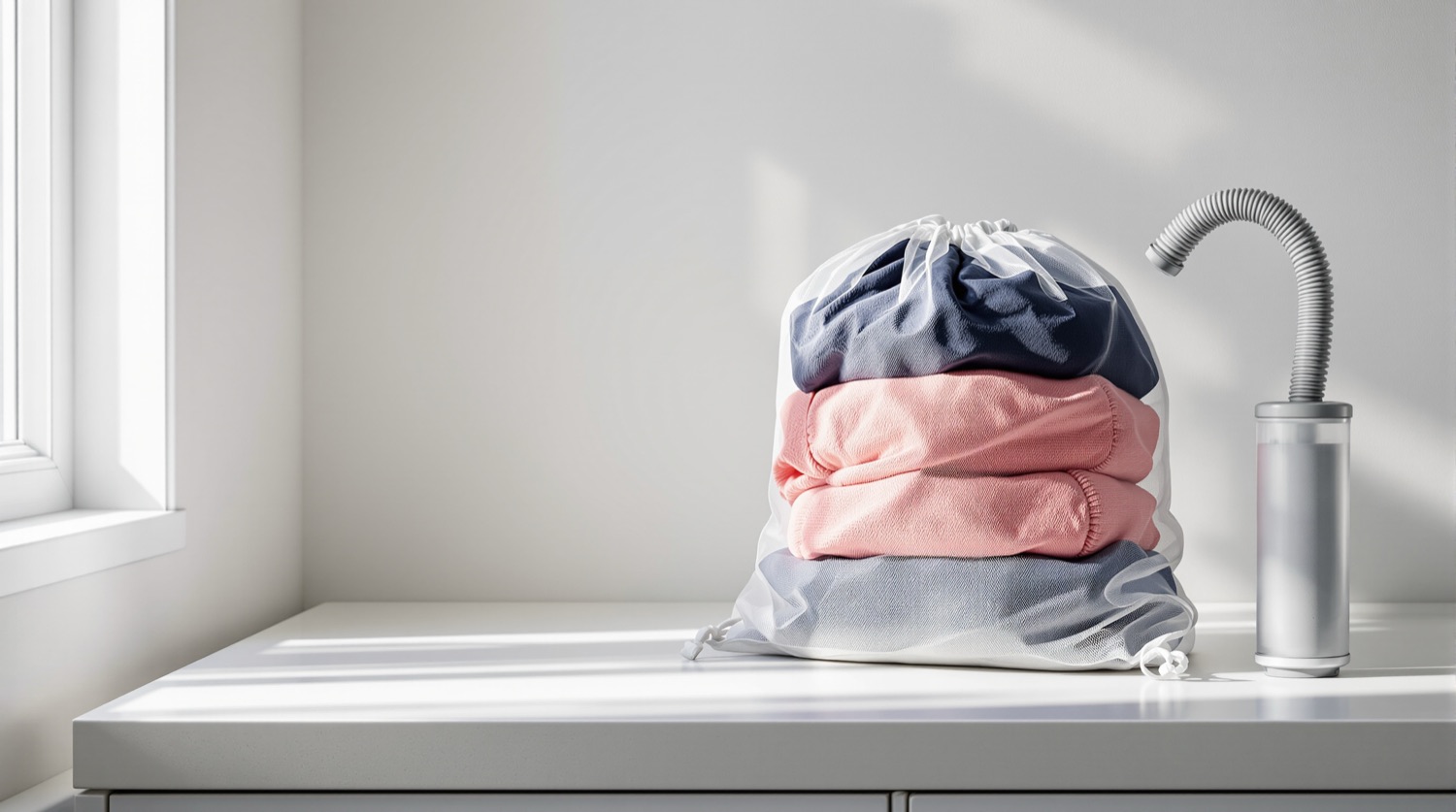
Two products dominate the shelf for people who have just learned that their laundry is one of the largest household sources of microplastic pollution: a zippered mesh bag you put clothes inside, and a spiky plastic ball you throw in the drum. The Guppyfriend and the Cora Ball have been sold alongside each other for most of a decade, and almost every comparison written about them repeats the manufacturers’ own claims.
There is a better source. Two independent research groups have put these devices through instrumented wash trials and published the results in peer-reviewed journals, and one of those papers tested both devices in the same machine, on the same fabrics, in the same experimental run. That is the comparison this guide is built on.
Bottom line: The Guppyfriend caught roughly 54% of shed microfibres; the Cora Ball caught 31% ± 8% in the same trial and 26% in an earlier one. Neither is close to the 78–87% measured for external filters that attach to the washing machine’s drain hose. In-drum devices are the convenient option, not the effective one — and the most effective option of all is owning fewer synthetic clothes.
What Each Device Actually Is
The Guppyfriend: A Bag With a Fine Enough Mesh to Hold Fibres In
The Guppyfriend is a zippered wash bag made from an untreated polyamide (nylon) monofilament mesh. Synthetic garments go inside it, the bag goes in the drum, and the mesh is fine enough that fibres shed during the cycle stay trapped against the inside of the bag rather than washing out with the drain water. You peel the collected fuzz out of the seams after the wash.
It works on two mechanisms at once, which is part of why it measured better than the ball. It physically retains fibres that have already broken off, and it also reduces how many break off in the first place: the bag cushions the garments against the mechanical abrasion of the drum and against each other. The manufacturer has always made both claims; the 2020 trial is what separated them from marketing copy.
The Cora Ball: A Drum Insert Inspired by Coral
The Cora Ball is a roughly four-inch ball of flexible recycled plastic arms, modelled on the way coral filters particles from moving water. It tumbles loose in the drum and the stalks catch passing fibres, which gather into visible tufts you pull off by hand. Its appeal is that it requires nothing of you — no sorting, no bagging, no plumbing. You throw it in and forget it.
That convenience is also its ceiling. A loose ball can only intercept the fibres that happen to drift through it during the cycle, where a bag holds a garment’s shed fibres in a sealed volume. The measured results line up exactly with that difference.
Measured Capture Rates: Every Device That Has Been Tested
Figures are the reduction in microfibre release to wastewater reported in peer-reviewed trials. Prices are tiers because retail pricing changes constantly.
| Device | Type | Measured capture | Source | Install | Price tier |
|---|---|---|---|---|---|
| Lint LUV-R | External drain-hose filter | 87% | McIlwraith et al., 2019 | Plumbed to drain hose | $$ |
| XFiltra | Integrated machine filter (prototype) | 78% | Napper et al., 2020 | Not sold to consumers | — |
| Guppyfriend Washing Bag | In-drum bag | ~54% | Napper et al., 2020 | None — drop it in | $ |
| Cora Ball | In-drum ball | 31% ± 8% 26% in earlier trial |
Napper et al., 2020 McIlwraith et al., 2019 |
None — drop it in | $ |
| PlanetCare filter (version tested) | External drain-hose filter | 25% | Napper et al., 2020 | Plumbed to drain hose | $$ |
| Filtrol 160 | External drain-hose filter | 89% (manufacturer-stated) | Filtrol — not peer-reviewed | Plumbed to drain hose | $$ |
Two things in that table deserve flagging before anything else. The 89% beside the Filtrol 160 is the manufacturer’s own figure, not a peer-reviewed one, and we have labelled it that way rather than letting it sit next to the independent numbers as though it were the same kind of evidence. And the 25% beside PlanetCare is a real published result for the version of that filter tested in 2020 — a reminder that “external filter” is a category, not a guarantee.
Does the Guppyfriend Catch More Microfibers Than the Cora Ball?
Yes, by roughly 23 percentage points in the only trial that measured both under identical conditions. Imogen Napper, Aaron Barrett and Richard Thompson at the University of Plymouth tested six devices — a mix of commercial products and prototypes — washing 100% polyester, 100% acrylic, and a 60/40 polyester-cotton blend to represent a normal mixed load. The Guppyfriend reduced microfibre release to wastewater by around 54%. The Cora Ball reduced it by 31% ± 8%. The least effective device in that same test managed 21%.
The earlier trial, by Hayley McIlwraith and colleagues at the University of Toronto and published in Marine Pollution Bulletin in 2019, did not test the Guppyfriend but did test the Cora Ball, and put it at 26%. Those two Cora Ball results are not in conflict: 26% sits comfortably inside 31% ± 8%. The honest reading is that the Cora Ball removes somewhere between a quarter and a third of shed fibres, and the Guppyfriend removes roughly half.
Why Do the Two Studies Report Different Cora Ball Numbers?
Because they measured different quantities under different conditions, which is normal and is the reason a single number from a single study should never be treated as a product specification. McIlwraith and colleagues counted microfibres in laundry effluent. Napper and colleagues measured both count and mass, across three distinct fabric types, and published an error margin rather than a single figure.
That error margin is the most useful thing in either paper. A device reported as “31% ± 8%” performed anywhere from 23% to 39% depending on the load, and that variance is inherent to a loose object tumbling in water: how much it catches depends on what else is in the drum, how full the machine is, and how long the cycle runs. Any marketing claim that quotes one decimal place for an in-drum device is quoting a precision the measurement does not have.
Are Washing Machine Filters Better Than In-Drum Devices?
On the published evidence, decisively. The best in-drum device in either trial reached 54%. External filters reached 78% and 87%. That is not a small edge — it is roughly the difference between letting half the fibres through and letting an eighth through.
The reason is structural rather than a matter of build quality. A bag or a ball can only act on fibres that come into contact with it inside the drum. A filter spliced into the drain hose sits downstream of everything and sees every litre of water that leaves the machine, whether that water came from a bagged garment, an unbagged one, or the drum walls. The filter does not depend on the user remembering to bag the right clothes.
The cost is real and worth stating plainly: a drain-hose filter needs physical access to the plumbing behind the machine, it costs several times what a bag or a ball does, and it has a filter bag or cartridge that must be cleaned or replaced on a schedule. A filter nobody maintains stops being a filter. If the honest answer is that the plumbing is not accessible or the maintenance will not happen, the Guppyfriend at 54% is a genuinely good outcome and far better than nothing.
How Many Microfibers Does One Wash Actually Release?
This is the number every capture percentage is a fraction of, and it is large enough to change how you read those percentages. Napper and Thompson measured it directly in Marine Pollution Bulletin in 2016, washing 6 kg loads of polyester, acrylic and polyester-cotton at 30°C and 40°C with various detergent and conditioner combinations, then extracting and counting the fibres from the effluent under electron microscopy.
A single 6 kg domestic wash released hundreds of thousands of synthetic fibres — up to roughly 700,000 from the highest-shedding fabric. Acrylic shed the most; the polyester-cotton blend shed the least. The study also found that fabric conditioner and higher temperatures changed the totals.
What that arithmetic means: a device that captures 54% of a 700,000-fibre load still lets more than 300,000 fibres into the drain. A device at 31% lets nearly half a million through. Capture devices reduce a very large number to a slightly less large number — which is exactly why the fabric in the drum matters more than the gadget beside it.
Which Should You Buy?
Match the device to your plumbing and your patience, not to the marketing.
Buy a drain-hose filter if:
- You can reach behind the washing machine
- You wash a lot of polyester, fleece or activewear
- You will actually clean the filter bag on a schedule
- You want the highest measured capture available to a household
- You are on a septic system — lint is a real problem there too
Buy a Guppyfriend bag if:
- You rent, or the plumbing is not accessible
- You use a shared or laundromat machine
- You want the best result that needs zero installation
- Your synthetic clothes are a minority of each load and easy to separate
- You want the device that also reduces shedding, not just captures it
For the habits that cost nothing and work alongside either device, see our guide to reducing microplastics from laundry, and the wider plastic-free laundry guide for detergent, dryer and storage choices.
The Two Devices Worth Buying
One external filter and one in-drum bag — the two picks the measured data actually supports.
 Best Overall
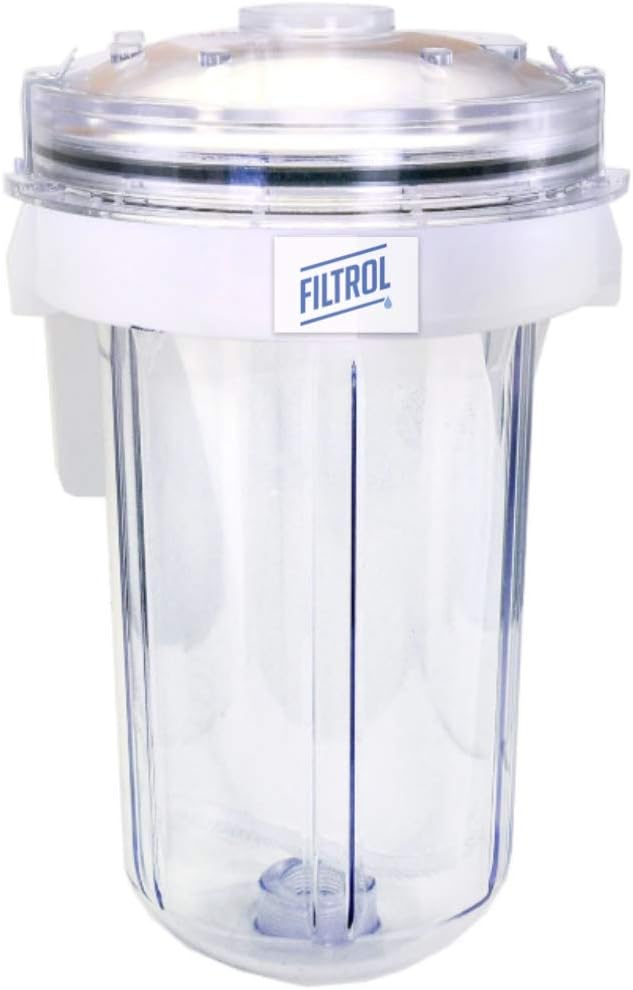
Installation means pulling the machine out, cutting the discharge hose, and clamping the filter inline — a job most people manage with a screwdriver and twenty minutes, but one that needs physical access to the back of the machine. Maintenance is the part that decides whether it keeps working: the internal bag fills with lint and has to be rinsed or swapped, and how often depends entirely on how much synthetic fabric you wash. The upside beyond microfibres is the one Filtrol sells hardest and the one plumbers care about — lint is a leading cause of drain and septic-field clogging.
Pros
- Highest-capture device class in both published trials
- Works on every load automatically — nothing to remember
- Catches pet hair and lint, protecting drains and septic fields
- Reusable filter bag rather than a disposable cartridge
Cons
- Requires plumbing access behind the machine
- Several times the price of a bag or a ball
- Filter bag must be cleaned regularly or performance falls
- The 89% figure is the manufacturer’s, not independent
Catches fibres from every load, including the ones you forget to bag.
Why it matters: external drain-hose filters are the only device class that reached 78% or better in independent wash trials. Every in-drum alternative measured at or below 54%.
Check Today’s Price on Amazon →Amazon prices change daily — tap to see today’s price and any current discount.
- Free delivery for Prime members
- Replacement filter bags sold separately
 Best With No Installation
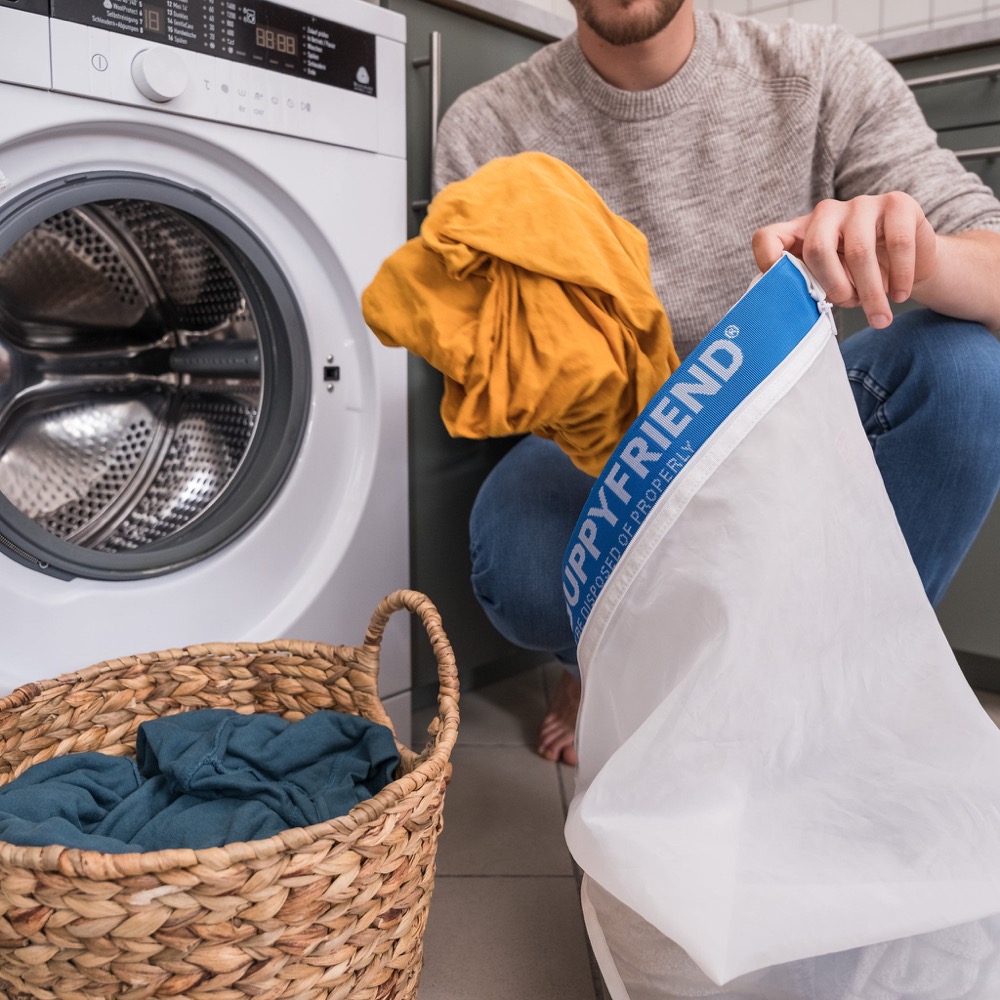
Practical notes from how it works rather than how it is sold. Do not overfill it — the mesh needs room for water to move through the clothes, and a bag stuffed to the zip washes badly and catches less. Peel the collected fibres out of the corner seams by hand after each few washes rather than shaking them into the air, which is how captured fibres end up in household dust instead of the bin. The bag itself is a synthetic, which sounds like a contradiction until you note that it is built from a continuous monofilament rather than spun staple fibre, so it has far less loose fibre end to shed.
Pros
- Best measured result of any no-install device (~54%)
- Reduces shedding as well as capturing fibres
- Works in a laundromat or a shared building machine
- Doubles as protection for delicate synthetics
Cons
- Only protects what you remember to put inside it
- Reduces usable load size — it cannot be packed full
- Still lets roughly half of shed fibres through
- Needs the collected fuzz removed by hand
The best capture you can get without touching the plumbing.
Check Today’s Price on Amazon →Amazon prices change daily — tap to see today’s price and any current discount.
- Free delivery for Prime members
- Thousands of verified reviews
What We Are Not Recommending, and Why
Three devices appear in the research and none of them earns a buy button here.
The Cora Ball. It is the weakest independently measured device of the group, at 26% in one trial and 31% ± 8% in the other, and at the time of writing it is not sold through Amazon in the United States — it is bought direct from the maker and a handful of specialist retailers. If you already own one, keep using it: a quarter to a third of fibres is a real reduction and it costs nothing extra to keep throwing it in the drum. We are simply not going to point a first-time buyer at the lowest-performing option in the data.
XFiltra. At 78% it was the top performer in the 2020 trial, but it was tested as a prototype integrated machine filter and is not sold as a consumer retrofit. It matters as evidence for what filtration can do, not as something you can order tonight.
The PlanetCare filter. The version tested in 2020 measured 25% — below the Cora Ball and well below its fellow external filters. The company has released later versions since; we have not found an independent test of those, and we will not substitute a press release for a measurement.
The Thing That Beats Every Device in This Guide
No capture device in either published trial reached 90%. Every one of them is working downstream of the actual source, which is a wardrobe made of plastic. Polyester, acrylic, nylon and fleece shed plastic fibres because they are plastic; cotton, linen, hemp and wool shed cellulose and protein, which is lint rather than microplastic.
Which is why the highest-impact change is not a gadget at all. Bedding is usually the largest single block of textile in a home and the easiest to switch in one purchase — see our best organic cotton sheets guide. For clothing, our breakdown of microplastics in clothing and the natural-fibre alternatives covers what to replace first. And because the fibres that leave the wash are only half the story, microplastics in indoor air covers the ones that come off the same fabrics while you wear them.
Alongside the fabric question, the free habits still apply and still help: wash cold, run fuller loads, choose shorter cycles, skip the fabric conditioner, and line dry where you can. None of them needs a purchase. Our non-toxic laundry detergent guide and the comparison of dryer sheets vs wool dryer balls cover the two products most likely to be sitting beside your machine right now.
Frequently Asked Questions
Does the Guppyfriend catch more microfibers than the Cora Ball?
Yes. In the only published trial that tested both devices in the same machine on the same fabrics — Napper, Barrett and Thompson, Science of the Total Environment, 2020 — the Guppyfriend cut microfibre release to wastewater by around 54% and the Cora Ball by 31% ± 8%. An earlier independent trial measured the Cora Ball at 26%. Both numbers put the ball in the same range, and both put it behind the bag.
Is a washing machine filter better than a Guppyfriend bag?
By the published numbers, yes, and not narrowly. External filters plumbed into the drain hose measured 78% in the 2020 trial and 87% in the 2019 trial, against 54% for the best in-drum device. A bag can only act on fibres that reach it; a drain-hose filter sees every litre leaving the machine. The trade-off is installation and ongoing maintenance, which a bag does not need.
Why do different studies give the Cora Ball different numbers?
They measured different things. The 2019 trial counted fibres and reported 26%. The 2020 trial measured count and mass across three fabric types and reported 31% ± 8%, which spans 23–39%. The two results overlap rather than contradict. Treat the Cora Ball as removing roughly a quarter to a third of shed fibres, not as a precise figure.
How many microfibers does one load of laundry release?
Napper and Thompson measured it in Marine Pollution Bulletin in 2016: a 6 kg domestic wash released hundreds of thousands of synthetic fibres, up to roughly 700,000 from the highest-shedding fabric, with acrylic shedding most and a polyester-cotton blend least. That is the number any capture device is working against.
Is the Cora Ball worth buying at all?
It is the weakest independently measured device of the group, and it is not currently sold through Amazon in the United States. If you already own one, keep using it — a quarter to a third of fibres captured is real and costs nothing more. If you are buying your first device today, the data points at a drain-hose filter first and the Guppyfriend second.
What reduces laundry microfibers the most?
Owning fewer synthetic textiles. No capture device reached 90% in either trial, but a cotton, linen, wool or hemp garment sheds plant or protein fibre rather than plastic, so there is nothing to catch. After that, in order of measured impact: an external drain-hose filter, then a capture bag, then the free habits — cold water, fuller loads, shorter cycles, no fabric conditioner, and line drying where possible.
Sources
- Napper IE, Barrett AC, Thompson RC. “The efficiency of devices intended to reduce microfibre release during clothes washing.” Science of the Total Environment 2020; 738:140412. https://doi.org/10.1016/j.scitotenv.2020.140412
- McIlwraith HK, Lin J, Erdle LM, Mallos N, Diamond ML, Rochman CM. “Capturing microfibers — marketed technologies reduce microfiber emissions from washing machines.” Marine Pollution Bulletin 2019; 139:40–45. https://doi.org/10.1016/j.marpolbul.2018.12.012
- Napper IE, Thompson RC. “Release of synthetic microplastic plastic fibres from domestic washing machines: Effects of fabric type and washing conditions.” Marine Pollution Bulletin 2016; 112(1–2):39–45. https://doi.org/10.1016/j.marpolbul.2016.09.025
- Belzagui F, Gutiérrez-Bouzán C, Carrillo-Navarrete F, López-Grimau V. “Sustainable Filtering Systems to Reduce Microfiber Emissions from Textiles during Household Laundering.” Polymers 2023; 15(14):3023. https://pmc.ncbi.nlm.nih.gov/articles/PMC10383179/
- Filtrol (Wex Companies). Product information and stated catch rate. https://www.filtrol.net/