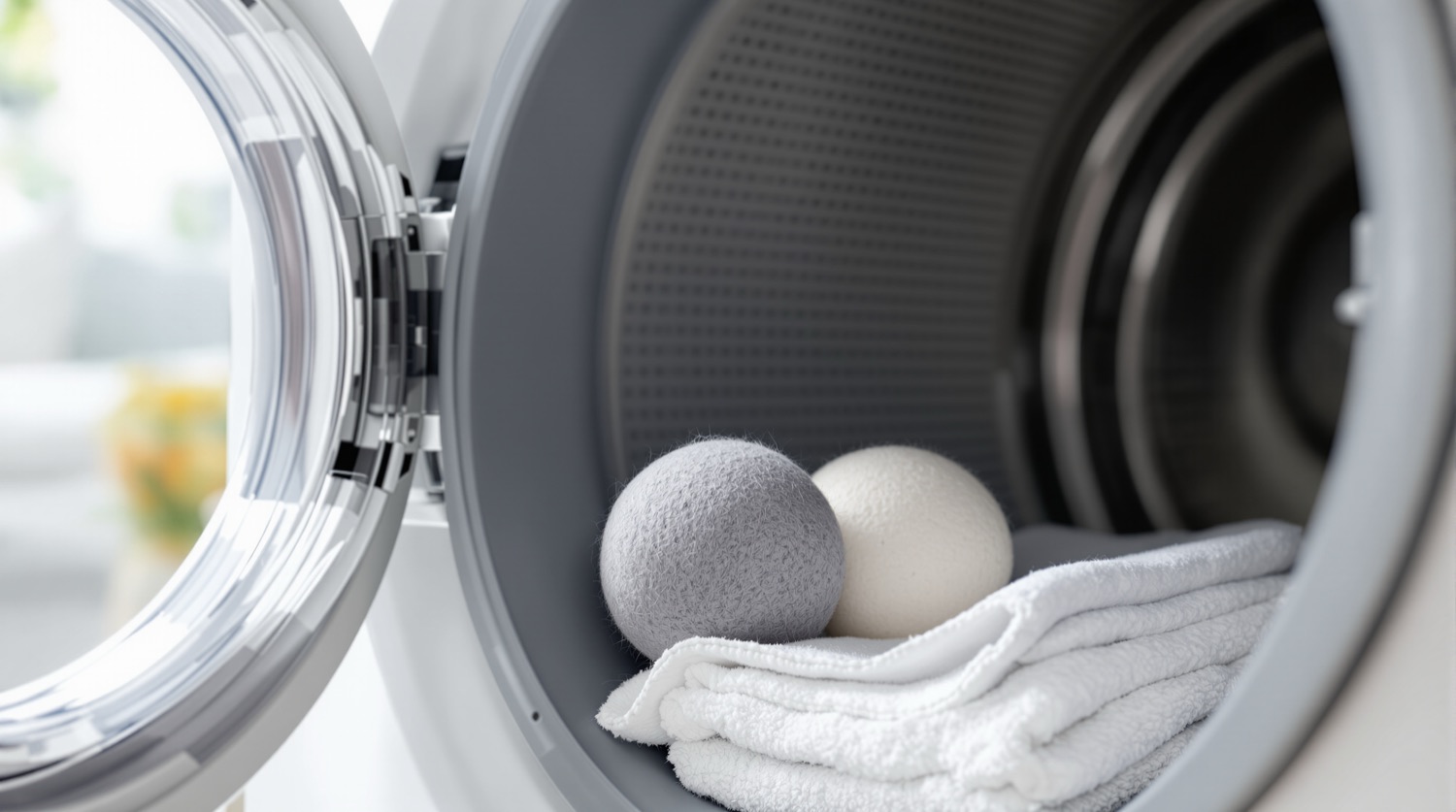
The swap from dryer sheets to wool dryer balls has become one of the standard first moves in a low-tox laundry room, and it is usually sold on two promises at once: fewer chemicals, and fewer microplastics. The first promise holds up. The second one does not survive contact with the published measurements.
That matters more than it sounds, because the tumble dryer — not the washing machine — is now understood to be where most laundry microfiber generation happens. Researchers writing in Environmental Science and Pollution Research in 2026 open their method paper with exactly that point: most research has focused on fibers going down the drain “despite recent studies demonstrating that more microfiber production occurs during tumble drying.” If you have already dealt with the washing-machine side of laundry shedding, the dryer is the half that is still running.
Bottom line: Use wool dryer balls if your priority is getting fragrance and single-use waste out of the laundry room — that is a real, documented win. Do not use them expecting a microplastic benefit; there is no evidence of one. If you want to actually reduce the fibers your dryer blows outside, the thing that works is a filter on the vent, not a product in the drum.
What actually comes out of a clothes dryer?
More than most people assume, and it leaves the building. In a 2020 PLOS ONE study, Kapp and Miller measured emissions from home-installed dryers at two sites by counting fibers that landed on fresh snow outside the vents. Fibers from the test blankets turned up across plots in a 30-foot (9.14 m) radius, averaging 404 ± 192 fibers per plot at one site and 1,169 ± 606 at the other, with most of them within 5 feet of the vent. The exhaust itself carried an average of 35 ± 16 mg and 70 ± 77 mg of lint over three consecutive cycles.
A 2023 PLOS ONE follow-up by Cummins and colleagues ran real consumer loads rather than test fabrics and found releases of 341.5 ± 126.0 ppm from a condenser dryer and 256.0 ± 74.2 ppm from a vented dryer — roughly the same magnitude as the first, famously heavy-shedding cycle of a brand-new T-shirt load. That study also found that in a vented dryer, 86.1 ± 5.5% of the microfibers generated ended up on the lint filter, which has a practical consequence we come back to below.
One honest correction before the comparison: a lot of what your dryer vents is not plastic. In the 2022 testing of a load that was 48% cotton by mass, the fiber mass escaping the exhaust was 93.0–99.8% cotton, because the lint screen catches heavier polyester more efficiently than fine cotton fluff. The synthetic fraction gets concentrated in the lint trap instead. A 2019 Science of the Total Environment analysis of 70 lint samples from 19 households found antimony — a catalyst residue from polyester manufacture — running through the synthetic articles tested, alongside bromine, iron and zinc.
Head-to-Head: Dryer Sheets vs Wool Dryer Balls
Judged only on what has actually been measured. “—” means no published data exists.
| Measure | Dryer Sheets | Wool Dryer Balls |
|---|---|---|
| What it is | Nonwoven polyester sheet coated with softening agents (quaternary ammonium compounds) and, usually, fragrance | Felted sheep’s wool, typically New Zealand wool, no coating |
| Measured effect on exhaust microfibers | 14.1–34.9% reduction (Lant et al., PLOS ONE 2022) | — no published measurement |
| Combined with anti-wrinkle liquid conditioner | 44.9% reduction in exhaust microfibers | — |
| Fragrance as a listed allergen | Top allergen class in 75% of dryer sheets reviewed (Bai et al., Dermatitis 2020) | None — uncoated wool |
| Reusable | Single use | Manufacturer claims 1,000+ loads |
| Shortens drying time | No claimed effect | Yes — separates the load so air circulates |
| Suitable for wool allergy / vegan household | Yes | No — animal fiber |
Do dryer sheets reduce microfibers?
Yes, in the one place anyone has looked carefully — and the finding deserves its caveats stated out loud. Neil Lant, Marie Defaye and Adam Smith published the measurement in PLOS ONE in April 2022 (volume 17, issue 4, article e0265912). They washed and dried loads of ten 100% cotton and ten 100% polyester T-shirts under both European and North American conditions and weighed what came off at each stage: down the drain, onto the lint filter, and out of the dryer exhaust.
Tumble dryer sheets cut the exhaust release by 14.1–34.9%, depending on dose and product, which the authors attribute to fibers being collected on the sheet during the cycle. A fabric conditioner formulated for anti-wrinkle performance cut it by 17.6–35.6%, apparently by making the lint filter catch fibers more efficiently. Running both together reached 44.9%. Conventional rinse-added liquid conditioner reduced exhaust release only at the highest dose tested — 21.6% under North American conditions and 14.2% under European.
The disclosure that belongs with that number: all three lead authors work at Procter & Gamble’s Newcastle Innovation Center, and P&G sells fabric conditioner. The work was peer-reviewed, published open-access with its methods visible, and co-authored with researchers at Northumbria University — but an industry lab measuring its own product category is a fact a reader should weigh, and no independent group has replicated it yet. It also does not make the fibers disappear. They move from the air to the sheet and the lint screen.
Do wool dryer balls reduce microfibers?
Nobody has published a measurement either way. Searching the peer-reviewed literature on dryer microfiber emissions turns up studies on vented versus condenser dryers, on lint filter pore size, on secondary filtration and on fabric conditioners — and nothing at all testing wool dryer balls. Any package or blog post claiming a microplastic benefit from wool balls is asserting something that has never been measured.
Mechanically there is little reason to expect one. The capture effect the 2022 study describes depends on fibers adhering to a large flat surface treated with softening agents. A wool ball has a small surface area, no coating, and spends the cycle bouncing. It is also worth noting that wool balls shed their own fibers — wool, not plastic, so it is a different kind of lint, but lint nonetheless.
What wool balls demonstrably do is separate a tumbling load so hot air reaches more fabric, which shortens drying time and reduces static without a coating. For a household trying to get fragrance and disposable products out of the laundry room, that is a genuinely good trade — it is just a different benefit from the one usually advertised.
What is the real downside of dryer sheets?
Fragrance, and it is well documented. In a 2020 review in Dermatitis (volume 31, issue 1, pages 53–58), Bai, Tam and Yu catalogued the ingredient lists of 65 best-selling US laundering products, including eight dryer sheets and ten fabric softeners. Fragrances and essential oils were the leading allergen class in 75% of the dryer sheets and 90% of the fabric softeners, ahead of benzisothiazolinone, methylisothiazolinone, cocamidopropyl betaine and the other common sensitizers.
The exposure is not confined to the people wearing the clothes. In a nationally representative survey of 1,137 US adults published by Anne Steinemann in Air Quality, Atmosphere & Health in 2018 (volume 11, pages 3–9), 28.9% of asthmatics reported health problems from scented laundry products coming out of a dryer vent — someone else’s dryer vent, in most cases. Overall, 64.3% of asthmatics reported one or more adverse effects from fragranced products, with respiratory problems at 43.3% and asthma attacks at 27.9%.
This is the part the wool-ball advice gets right, and it is the honest reason to make the switch. If you want the measured microfiber benefit without the fragrance, a fragrance-free dryer sheet is the option that holds both — the capture effect comes from the sheet, not the perfume.
What actually cuts the microfibers your dryer vents outside?
Filtration, and the numbers are much larger than anything a product in the drum achieves. In a 2025 study in Environmental Toxicology and Chemistry, researchers from The 5 Gyres Institute, Ocean Wise and the Desert Research Institute tested three commercially available secondary dryer filters in a controlled laboratory setting. An in-duct filter captured 44% of airborne microfibers by count; two indoor vent filters captured 81% and 70%.
The lint screen your dryer already has is also a variable. The 2022 PLOS ONE work tested filter pore size as a single variable and found that reducing the screen from 0.2 mm² to 0.04 mm² cut airborne release by 34.8% — and noted that some installed lint filters have pores around 1 mm², leaving what the authors call “enormous scope” for improvement through design alone.
Then there is the free one. Because 86.1% of the fibers generated in a vented dryer land on the lint filter, how you clean that filter decides where they go. Some appliance manuals instruct rinsing the screen under a tap, which sends the whole concentrated load straight into the wastewater system. Scrape the lint off dry and put it in the trash. It costs nothing and it is the single highest-leverage habit in this article.
- Fit a vent or in-duct filter — 44–81% capture in 2025 lab testing.
- Clean the lint screen dry, every load, into the trash — never rinse it down the sink.
- Dry on lower heat for longer where the garment allows; mechanical and thermal stress is what liberates fibers.
- Line-dry synthetics — fleece, athletic wear and other high-shed synthetic fabrics are the ones worth keeping out of the drum entirely.
Which should you use?
Choose wool dryer balls if:
- Someone in the house has asthma, eczema or fragrance sensitivity
- You want to stop buying a disposable product every month
- Shorter drying cycles and lower energy use matter to you
- You accept that the microplastic claim on the box is unproven
Choose fragrance-free dryer sheets if:
- You want the one measured microfiber reduction available — without the perfume
- Static is a real problem in your home, especially in dry winter air
- Wool is out for allergy or vegan reasons
Either way:
- Put a filter on the vent. That is where the large numbers are.
The Three Products Worth Buying
One for each job: the fragrance-free softening option, the reusable option, and the vent filter that does the work neither of them does.
 Does the Actual Work
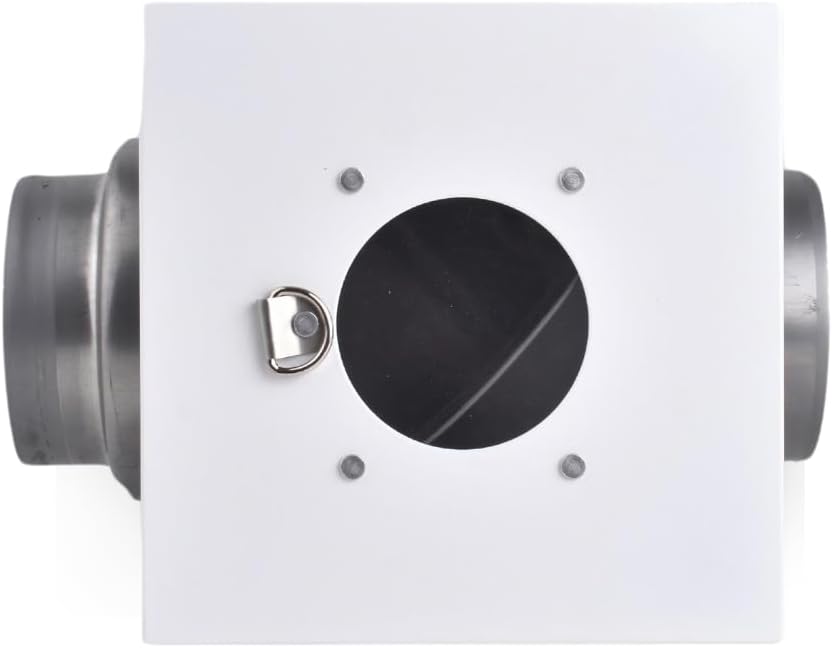
The 2025 Environmental Toxicology and Chemistry testing separated duct-mounted filters from indoor vent filters: the duct filter captured 44% of airborne microfibers by count, while the two indoor units captured 81% and 70%. Indoor units score higher because they sit at the very end of the run, but they are only an option for a ventless setup. For a normal vented dryer, an in-duct trap is the one that installs. Mesh lifts out through a spring-loaded access door, so cleaning needs no tools.
Pros
- The only measure here with large measured capture rates
- Galvanized steel stands up to dryer humidity
- No consumable to re-buy
- Also reduces lint build-up in the duct, a known fire risk
Cons
- Requires cutting into the duct run to install
- Needs cleaning or it restricts airflow and slows drying
- Only fits a 4-inch collar
The one product on this page with a measured capture rate behind it.
Check Today’s Price on Amazon →Amazon prices change daily — tap to see today’s price and any current discount.
- Free delivery for Prime members
- Fits standard 4-inch dryer ducting
 Best Fragrance-Free Reusable
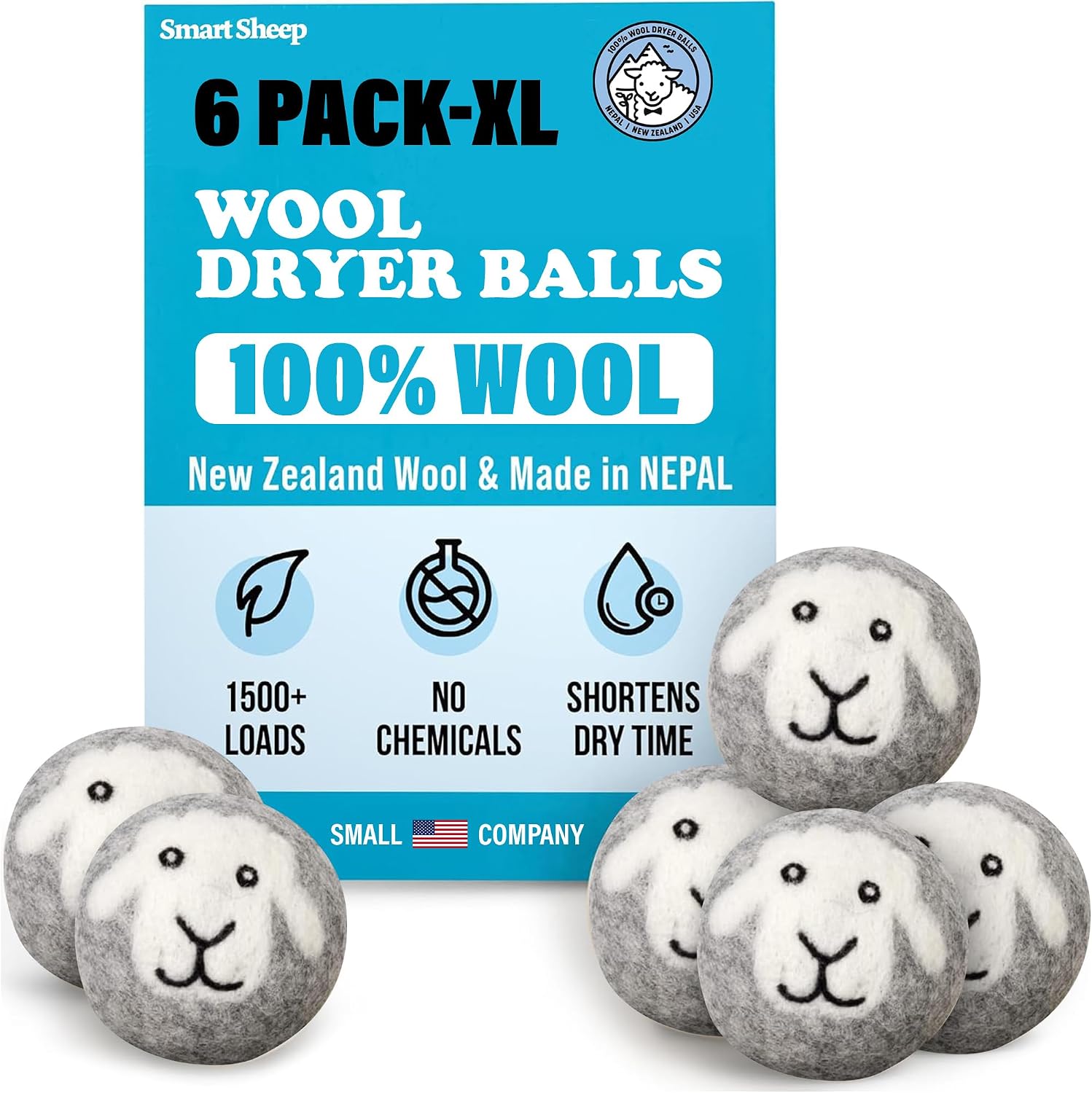
Smart Sheep’s own listing claims a thousand-plus loads per set and recommends three balls for a small or medium load and five to six for a large one. The wool is sourced from New Zealand and felted in Nepal. They shorten drying time by separating the load so hot air circulates, which is a real energy saving and also means less time under the mechanical stress that liberates fibers in the first place.
Pros
- No fragrance, dyes or softening coating of any kind
- Replaces a recurring disposable purchase
- Shortens drying time and cuts energy use
- No plastic in the product or, typically, the packaging
Cons
- No published evidence of any microfiber reduction
- Noisier than sheets on a hard-sided drum
- Animal fiber — not suitable for vegan or wool-allergic households
- Less effective on static than a coated sheet in very dry air
Gets fragrance and single-use waste out of the dryer for good.
Check Today’s Price on Amazon →Amazon prices change daily — tap to see today’s price and any current discount.
- Free delivery for Prime members
- Tens of thousands of verified reviews
 Best Fragrance-Free Sheet
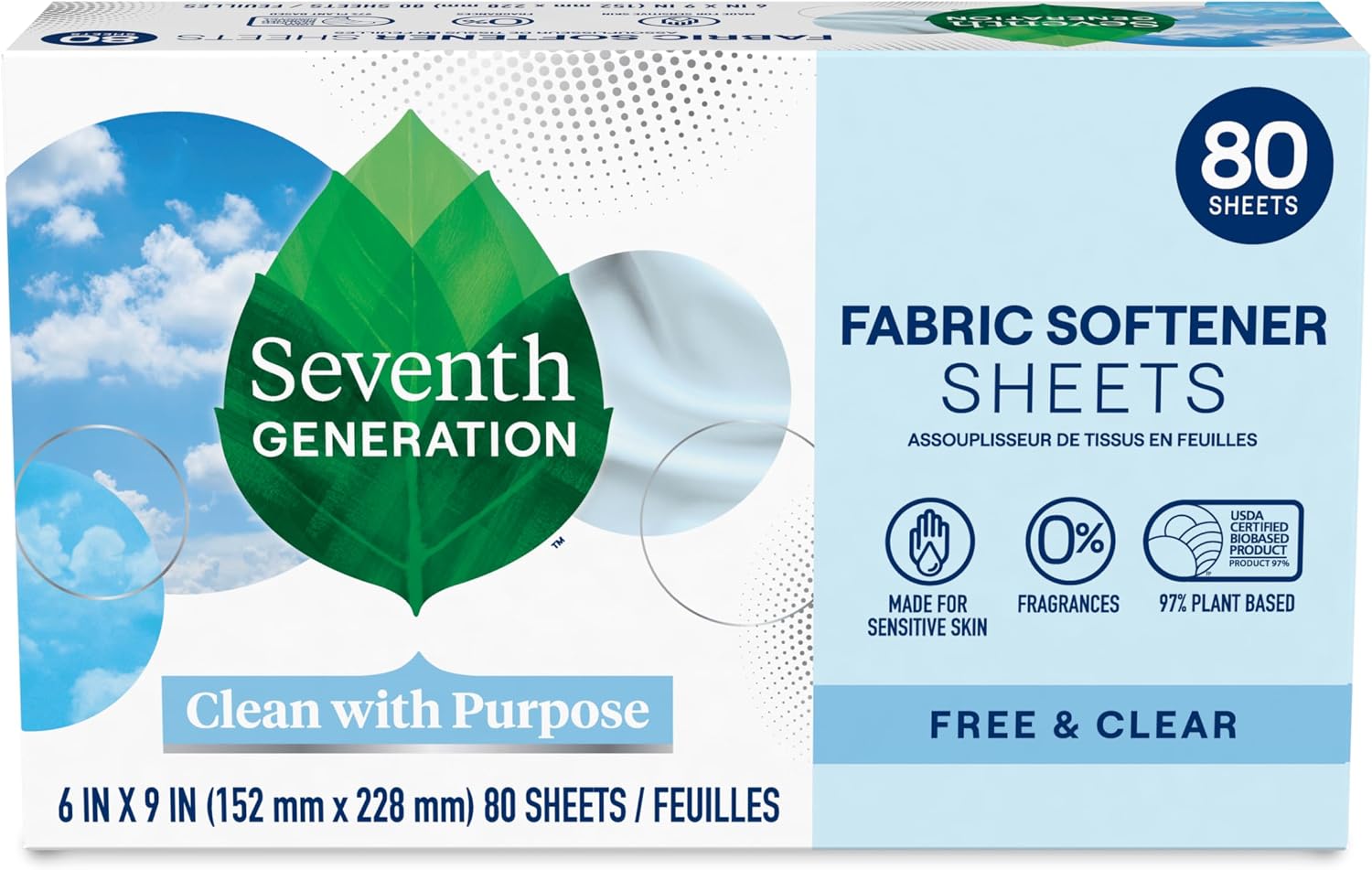
Seventh Generation lists these as hypoallergenic, dermatologist-tested, 97% plant-based and a USDA Certified Biobased Product at 97% biobased content. Two honest notes: the 2022 measurement was made with conventional sheets, not this one specifically, so the exact percentage for any given brand is unknown; and the sheet itself is a nonwoven that is thrown away after one load, which is the trade-off wool balls avoid.
Pros
- No added fragrance or dye — sidesteps the top allergen class
- Keeps the physical fiber-capture effect of a sheet
- Strong static control in dry winter air
- Widely stocked and inexpensive per load
Cons
- Single-use — a sheet per load, thrown away
- The 14.1–34.9% figure was measured on conventional sheets, not this product
- Still a coated nonwoven, not a bare-fiber product
The measured fiber-capture effect, without the fragrance problem.
Check Today’s Price on Amazon →Amazon prices change daily — tap to see today’s price and any current discount.
- Free delivery for Prime members
- Fragrance-free and dermatologist tested
For the washing-machine half of the same problem, see our plastic-free laundry guide and our breakdown of what is actually in laundry pods. If the dryer vent discharges near a window or into a garage, the fibers come back indoors — which is the subject of our piece on microplastics in indoor air.
Frequently Asked Questions
Do dryer sheets reduce microfibers?
Measurably, yes — in the one peer-reviewed test that looked. Lant, Defaye and Smith, publishing in PLOS ONE in 2022, found that tumble dryer sheets cut microfiber release from a vented dryer’s exhaust by 14.1 to 34.9 percent depending on dose and product, apparently because loose fibers stick to the sheet during the cycle. Paired with an anti-wrinkle liquid fabric conditioner the combined reduction reached 44.9 percent. Two caveats matter: the work was carried out by Procter & Gamble researchers at the company’s Newcastle Innovation Center, and the fibers are captured rather than prevented — they end up on the sheet and in the lint filter instead of in the air.
Do wool dryer balls reduce microfibers?
There is no published measurement showing that they do. Wool dryer balls are documented to shorten drying time and reduce static by separating the load, and they are reusable and fragrance-free, which is a real advantage. But no peer-reviewed study has measured microfiber release with and without wool balls, so any claim that they cut microplastic shedding is marketing rather than evidence. The fibers come off the clothes themselves, and a wool ball does nothing to catch them on the way out.
Is the lint from my dryer actually plastic?
Mostly not, in a mixed load. In the 2022 PLOS ONE testing of a load that was 48 percent cotton by mass, the fiber mass escaping the dryer exhaust was 93.0 to 99.8 percent cotton, because the lint filter catches the heavier polyester more efficiently than it catches fine cotton fluff. That is good news for the air outside your house and bad news for your lint filter, which concentrates the synthetic fraction. A 2019 Science of the Total Environment analysis of 70 lint samples from 19 households also found antimony throughout the synthetic, largely polyester, articles tested — a catalyst residue from polyester manufacture.
What is the fragrance problem with dryer sheets?
It is the best-documented downside of the category. A 2020 review in Dermatitis examined 65 top-selling laundry products and found fragrances and essential oils were the leading allergen class in 75 percent of the dryer sheets and 90 percent of the fabric softeners checked. In a nationally representative US survey published in Air Quality, Atmosphere & Health in 2018, 28.9 percent of asthmatics reported health problems from scented laundry products coming out of a dryer vent. Fragrance-free dryer sheets exist and sidestep most of this.
What actually cuts the microfibers my dryer vents outside?
Secondary filtration, and it is not expensive. A 2025 study in Environmental Toxicology and Chemistry by researchers at The 5 Gyres Institute, Ocean Wise and the Desert Research Institute tested three off-the-shelf filters: an in-duct filter captured 44 percent of airborne microfibers by count, and two indoor vent filters captured 81 percent and 70 percent. Lint filter design matters too — the 2022 PLOS ONE work found that tightening the filter screen from 0.2 mm² to 0.04 mm² pore size cut airborne release by 34.8 percent, and some installed filters have pores near 1 mm².
Sources
- Lant NJ, Defaye MMA, Smith AJ, Kechi-Okafor C, et al. “The impact of fabric conditioning products and lint filter pore size on airborne microfiber pollution arising from tumble drying.” PLOS ONE 2022; 17(4):e0265912. https://doi.org/10.1371/journal.pone.0265912
- Kapp KJ, Miller RZ. “Electric clothes dryers: An underestimated source of microfiber pollution.” PLOS ONE 2020; 15(10):e0239165. https://doi.org/10.1371/journal.pone.0239165
- Fulfer VM, Lo C, Wang S, Arienzo MM, et al. “Airborne microfiber capture: secondary filtration a solution to filter microfiber emissions from clothing dryers.” Environmental Toxicology and Chemistry 2025. https://doi.org/10.1093/etojnl/vgaf260
- Cummins AM, Malekpour AK, Smith AJ, et al. “Impact of vented and condenser tumble dryers on waterborne and airborne microfiber pollution.” PLOS ONE 2023. https://pubmed.ncbi.nlm.nih.gov/37224145/
- Bai H, Tam I, Yu J. “Contact Allergens in Top-Selling Textile-care Products.” Dermatitis 2020; 31(1):53–58. https://pubmed.ncbi.nlm.nih.gov/31905182/
- Steinemann A. “Fragranced consumer products: effects on asthmatics.” Air Quality, Atmosphere & Health 2018; 11(1):3–9. https://pmc.ncbi.nlm.nih.gov/articles/PMC5773647/
- Turner A. “Trace elements in laundry dryer lint: A proxy for household contamination and discharges to waste water.” Science of the Total Environment 2019; 665:568–573. https://doi.org/10.1016/j.scitotenv.2019.02.025
- Farnan J, Cicenia MC, Langknecht T, et al. “Plastic extraction from dryer lint (PEDL): a low-tech, mass-based approach to quantify plastic microfibers in complex dryer lint.” Environmental Science and Pollution Research 2026. https://pubmed.ncbi.nlm.nih.gov/42552510/