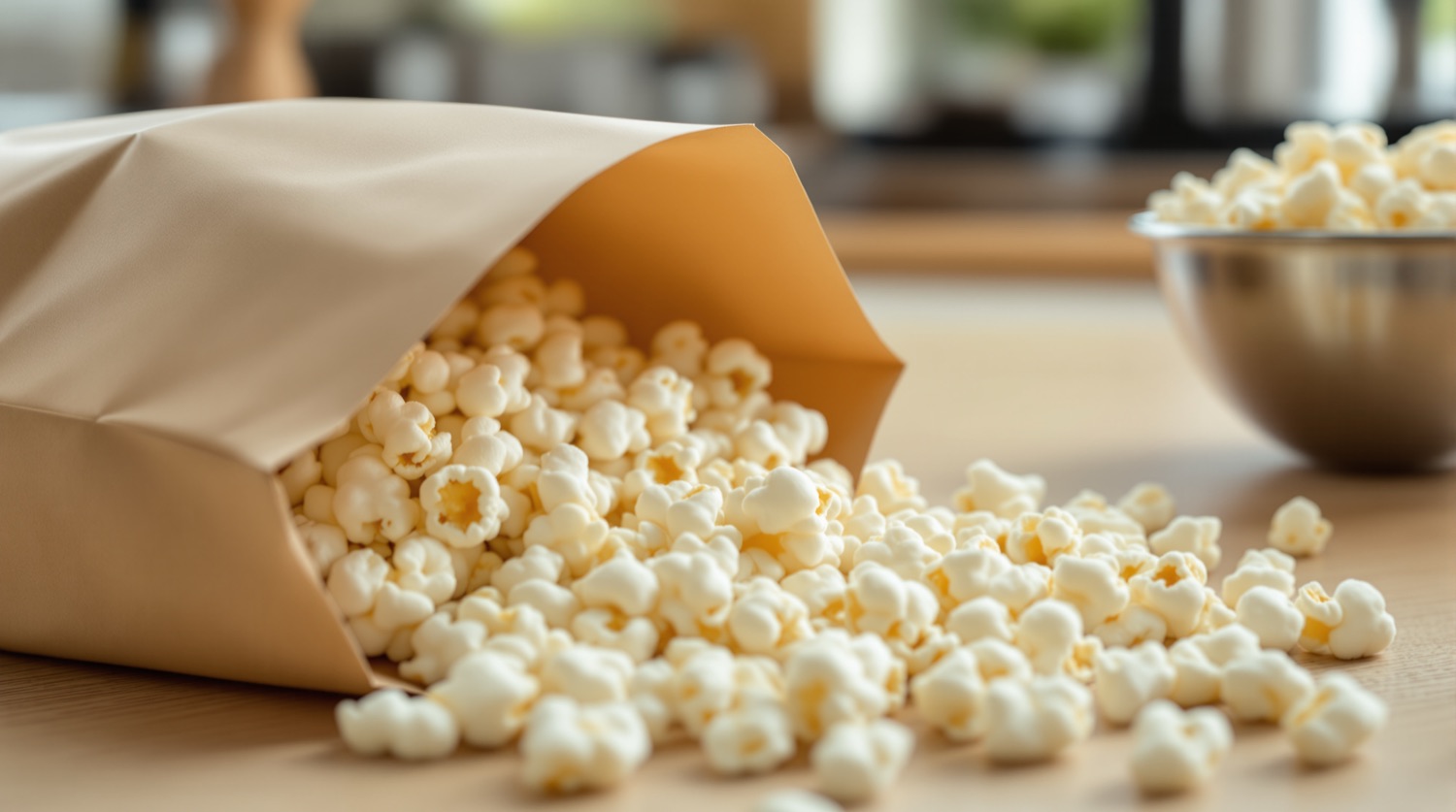
Grease-proofing PFAS — the coatings that stopped butter soaking through a popcorn bag — are no longer sold for food packaging in the United States. The FDA confirmed the voluntary phase-out was complete on 28 February 2024 and, in January 2025, declared 35 of those food-contact clearances abandoned. That removes the main source from newly made US bags. It does not make the question disappear: a 2025 study in Molecules still measured seven PFAS migrating out of five commercial popcorn bags at 5.2 to 274.0 nanograms per gram, an NHANES analysis of 10,106 Americans found daily popcorn eaters carried 63% more PFDA in their blood, and nothing in the phase-out touched the metallized plastic susceptor strip laminated inside every bag. Popping plain kernels in a lidded pot removes the coating, the susceptor and the argument.
PFAS — per- and polyfluoroalkyl substances, the “forever chemicals” — are a family of several thousand synthetic compounds built around a chain of carbon atoms bonded to fluorine. That bond is the strongest single bond in organic chemistry, which is exactly why they are useful and exactly why they are a problem. Nothing sticks to them, grease will not soak through them, and almost nothing breaks them down: not sunlight, not soil bacteria, not your liver. The EPA describes them as persistent in both the environment and the human body, which is why a chemical applied to a paper bag in 2015 can still be measured in blood a decade later.
Microwave popcorn became the textbook case for a reason. Three conditions drive a chemical out of packaging and into food: heat, fat, and time. A popcorn bag delivers all three at once, more intensely than almost anything else in a normal kitchen. So the question of whether the bag is clean is not academic, and the answer changed recently enough that most of what you will read online is out of date in one direction or the other.
The bottom line up front: a microwave popcorn bag manufactured for the US market after early 2024 should no longer carry a PFAS grease-proofing coating, and that is a genuine win. What the change did not cover is older stock, bags made for other markets, and the plastic susceptor film inside every bag. If you want the whole category of question off your counter, the fix is cheap and takes four minutes: plain kernels, a lidded pot, a spoonful of oil. For the related packaging questions, see PFAS in parchment paper, microplastics in food packaging and what lines a paper cup.
Does microwave popcorn have PFAS?
For bags made for the US market since early 2024, it should not — the grease-proofing coating that was the main source is no longer sold here. For any other bag, the honest answer is that nobody can tell you from the outside of the package, because fluorinated coatings are invisible, unlabeled, and not something a shopper can test for.
That split matters because the change is recent and narrow. The FDA's own page on authorized PFAS uses in food contact names the exact products the grease-proofers were applied to: “fast-food wrappers, microwave popcorn bags, take-out paperboard containers, and pet food bags.” The agency says those substances “are no longer being sold by manufacturers into the U.S. market,” and in January 2025 it published a Federal Register notice finding that 35 food contact notifications for them were “no longer effective based on the abandonment of these uses.”
Read carefully, that is a market withdrawal, not a prohibition. It covers the US supply chain, it was reached through voluntary agreements that began in 2020, and it does not reach back through stock already made or sideways into bags produced for other countries. Three PFAS food-contact uses also remain authorized in the US today: non-stick coatings on cookware, rubber gaskets and O-rings in processing equipment, and manufacturing aids used in other food-contact polymers. The FDA describes the migration from all three as negligible — though the first of those is its own long story, covered in our piece on whether non-stick pans shed particles.
What do the actual measurements show?
Four studies carry most of the weight here, and they measure four different things: what ends up in blood, what comes out of the bag, what the plastic strip inside contributes, and how common fluorinated packaging was across the shelf. Here they are side by side, with the numbers each one actually reported.
| Study | What it measured | The number that matters |
|---|---|---|
| Susmann et al., Environmental Health Perspectives, 2019 NHANES 2003–2014, 10,106 people aged 12+ |
Blood PFAS against self-reported diet | Daily popcorn over 12 months: PFDA +63% (95% CI 34–99), PFOA +43%, PFOS +44%, PFNA +39% |
| Hsu et al., Molecules, 2025 5 bags bought online in Taiwan |
Migration of 40 screened PFAS into food simulants, 70°C for 2 hours | 7 compounds detected; total migration 5.2 ± 0.4 to 274.0 ± 7.0 ng/g, PFOA dominant |
| Hsu et al., risk model, 2025 | Hazard ratio against reference doses | 0.01–0.8 using EFSA's four-PFAS limit; 0.3–142.3 using EPA reference doses, with 4 of 5 bags above 1.0 |
| Begley & Hollifield, Food Additives and Contaminants, 1990 FDA laboratory study |
PET oligomers migrating from the susceptor strip into microwaved food | <0.012 to ~7 µg/g in popcorn, fries, fish sticks, waffles and pizza |
| Consumer Reports, 2023 | Organic fluorine in 118 food packaging products from restaurant and grocery chains | PFAS indicators in more than half of products tested; detection floor 10 ppm |
| FDA, 2024–2025 | Grease-proofing PFAS in the US food-packaging supply | Phase-out confirmed complete 28 February 2024; 35 clearances declared abandoned January 2025 |
How much PFAS actually comes out of a popcorn bag?
The most detailed answer available comes from a 2025 paper in the journal Molecules by Jen-Yi Hsu and colleagues at National Cheng Kung University in Taiwan. They built a high-resolution mass spectrometry method capable of screening 40 different PFAS at once, then applied it to five microwave popcorn paper bags bought from online stores in Taiwan. Seven compounds actually migrated: PFHxA, PFHpA, PFOA, PFNA, PFDA, PFUnA and PFDoA. Total migration ran from 5.2 ± 0.4 nanograms per gram in the cleanest bag to 274.0 ± 7.0 nanograms per gram in the worst, with PFOA the dominant compound.
A nanogram per gram is a part per billion — 274 ng/g is 274 billionths of a gram of PFAS per gram of the liquid it migrated into. Whether that is a little or a lot depends entirely on which safety yardstick you use, and the paper is unusually candid about this. Measured against the European food authority's tolerable intake, which covers only four PFAS, the hazard ratios came out between 0.01 and 0.8 — all below the threshold of concern. Measured against EPA reference doses, which are far stricter and cover more compounds, the same bags produced hazard ratios of 0.3 to 142.3, with four of the five exceeding 1.0.
Two caveats are essential, and skipping them is how this study gets misreported. First, those were five bags bought in Taiwan, not a sample of what sits on a US shelf after the phase-out. Second, the test followed EU migration protocol — ethanol solutions held at 70°C for two hours — not actual popping. It is a measurement of what the coating can release, not a measurement of your Tuesday night snack. What it establishes is that the chemistry is still present on bags sold somewhere in the world in 2025, and that the yardstick you choose decides whether the result reads as reassuring or alarming.
Do popcorn eaters really have more PFAS in their blood?
In the largest US dataset anyone has looked at, yes — and the gap is not subtle. Herbert Susmann, Laurel Schaider, Kathryn Rodgers and Ruthann Rudel of the Silent Spring Institute pulled National Health and Nutrition Examination Survey data from 2003 to 2014, covering 10,106 people aged 12 and over, and matched measured blood PFAS against what those people said they ate. Their results appeared in Environmental Health Perspectives in 2019.
People who reported eating popcorn daily over the previous twelve months carried 63% more PFDA in their blood than those who did not (95% confidence interval 34 to 99), along with 43% more PFOA, 44% more PFOS and 39% more PFNA. Even the short-term measure moved: for every 100 calories of microwave popcorn eaten in the previous 24 hours, serum concentrations rose by roughly 3 to 5% depending on the compound. The authors attributed the pattern to migration from the bag's grease-proofing coating. In the same analysis, people who ate more meals prepared at home had lower PFAS levels — the mirror image of the same finding.
Be clear about what this does and does not prove. It is observational, it relies on people correctly recalling their own diet, and every sample predates the phase-out. It establishes a strong, consistent association in a period when the coatings were in wide use. It does not prove a bag eaten tomorrow will do the same thing, and it does not prove the PFAS in those people's blood caused them any particular illness.
Is there plastic inside a microwave popcorn bag?
There is, in every single one, and the PFAS phase-out did not touch it. Laminated inside the paper is a susceptor: a thin strip of metallized polyethylene terephthalate — the same PET used for water bottles — bonded to a layer of aluminum. Its job is to absorb microwave energy and convert it to heat, because microwaves alone cannot get kernels to the roughly 180°C they need to burst. The susceptor is the hottest piece of plastic most kitchens ever produce.
What that releases was measured by the FDA's own laboratory. Timothy Begley and Henry Hollifield published a study in Food Additives and Contaminants in 1990 that quantified PET cyclic oligomers — small ring-shaped fragments of the polymer — moving out of susceptor packaging into the food cooked against it. Across microwaved popcorn, fries, fish sticks, waffles and pizza, they found between less than 0.012 and about 7 micrograms of PET oligomers per gram of food.
Oligomers are not microplastic particles; they are chemical fragments, and the quantities are small. But the point stands structurally: the bag is not paper with a coating problem that has now been solved. It is a paper-and-plastic laminate that gets hotter than your pan does, every time you use it. That is the same reasoning behind our warnings about microwaving food in plastic containers — heat is what turns an inert-looking polymer into something that migrates.
Are the PFAS in popcorn bags dangerous?
Nobody has shown that microwave popcorn, by itself, makes anyone ill. What the evidence supports is narrower and still worth acting on: popcorn bags were a measurable contributor to the PFAS load in American blood during the years the coatings were in use, and PFAS as a class are associated in the broader literature with effects the EPA summarizes as including changes in cholesterol, immune response and some cancers. The relevant number is not one bag; it is cumulative exposure across water, packaging, cookware and dust over decades.
Which is the honest reason to care. You cannot do much about PFAS in rainwater. You can do something about the three sources you actually control: your drinking water filter, your cookware, and the packaging you deliberately heat your food inside. Popcorn is the easiest of the three to change, because the alternative is cheaper than the thing you are replacing.
What are the plastic-free ways to make popcorn?
Plain kernels cost a fraction of what bagged microwave popcorn does per serving, and every method below removes both the coating and the susceptor. Here is how the realistic options compare on the two things that matter: what touches the food, and what you still cannot rule out.
| Method | Grease-proof coating | What touches the hot food | What you still can't rule out |
|---|---|---|---|
| Microwave bag, US-made after Feb 2024 | Phased out | Coated paper + metallized PET susceptor | The susceptor film; whatever replaced the coating, which is not disclosed on pack |
| Microwave bag, older stock or imported | Possible | Coated paper + metallized PET susceptor | Everything above, plus the coating itself — unlabeled and untestable at home |
| Silicone microwave popper | None | Food-grade silicone at microwave temperature | Silicone is far more stable than PET but not inert; quality varies by maker |
| Lidded pot on the stove | None | Bare metal or ceramic-coated steel, plus oil | Nothing specific to popcorn; depends on the pan you already own |
| Hot-air popper | None | Usually a plastic chute and chamber at ~200°C | Hot moving air against plastic — cleaner than a bag, not plastic-free |
The stovetop method wins on every axis and needs no new equipment if you own a heavy pot with a lid. Put a tablespoon of a high-smoke-point oil in the pot over medium heat, add a third of a cup of kernels in a single layer, cover, and shake every few seconds once the first kernel pops. It takes about four minutes. Store the bulk kernels in a glass jar rather than the plastic sack they arrive in — see our guide to glass food storage for why that matters for anything you keep for months.
The gear that takes the bag out of the equation
None of this needs a special popcorn appliance. What it needs is a pot that holds heat evenly and has a lid, and somewhere to keep the kernels that is not plastic. These are the three pieces we already recommend elsewhere on the site, picked here for this job. Prices and availability change, so check current listings.
1. Lodge 10.25″ Cast Iron Skillet — Best Bare-Metal Pan
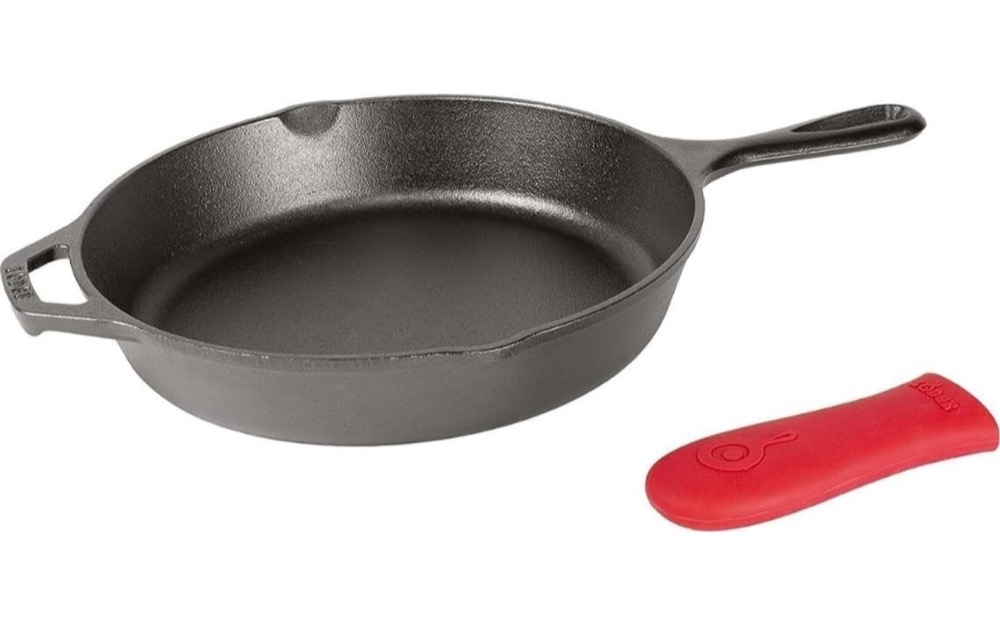 Best Bare Metal
Costs less than a few months of bagged microwave popcorn and lasts a lifetime — cast iron is the one pan that gets better with age rather than wearing out.
Why it's safe: There is no coating to degrade, so there is no fluoropolymer, no sol-gel layer and no grease-proofer between the oil and the food.
Check Today’s Price on Amazon →Amazon prices change daily — tap to see today's price and any active discount.
- Free delivery & returns for Prime members
- Sold & shipped by Amazon
- Thousands of verified reviews
Cast iron is the least complicated option on this page, because there is nothing between the food and the metal except the oil you put there. For the full field of pans and how ceramic, stainless and carbon steel compare, see our non-toxic cookware guide.
2. Caraway Ceramic Cookware Set — Best Lidded Pot if You Want Non-Stick
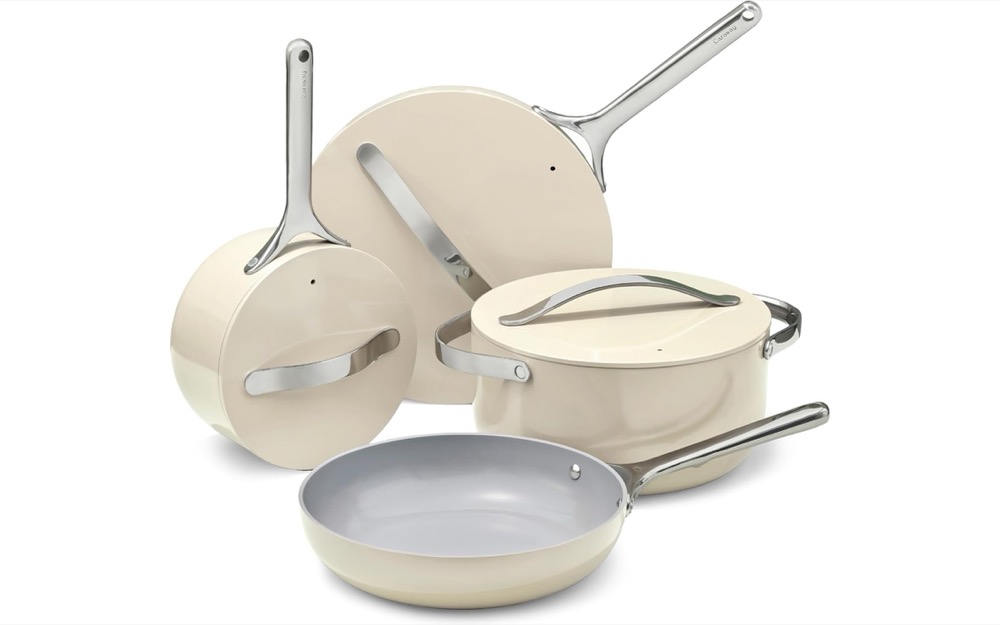 Best Lidded Set
A single set covers the pot-with-a-lid problem and replaces whatever non-stick pans you were already planning to retire.
Why it's safe: There is no PTFE layer to crack and shed fluoropolymer particles — the specific failure mode documented in worn non-stick pans.
Check Today’s Price on Amazon →Amazon prices change daily — tap to see today's price and any active discount.
- Free delivery & returns for Prime members
- Sold & shipped by Amazon
- Thousands of verified reviews
If you want the full comparison of how ceramic coatings hold up against traditional non-stick, we tested that question separately in ceramic vs non-stick cookware.
3. Glasslock Oven Safe Container Set — Best Place to Keep the Kernels
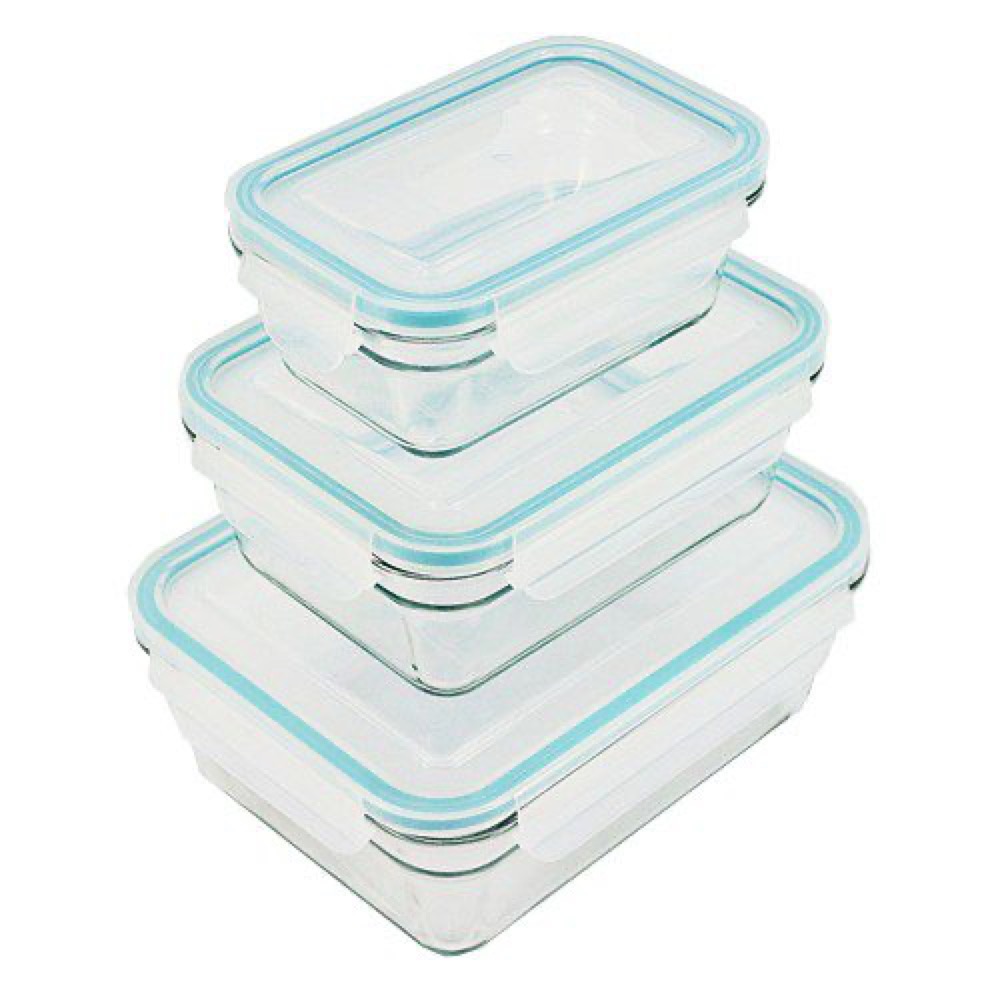 Best Storage
Glass does not absorb oil or odors the way a plastic tub does, so kernels and popped corn keep their taste through a whole bag.
Why it's safe: Tempered glass is inert — nothing leaches out of it into the food, hot or cold, which is the whole reason it beats a plastic container for anything stored long term.
Check Today’s Price on Amazon →Amazon prices change daily — tap to see today's price and any active discount.
- Free delivery & returns for Prime members
- Sold & shipped by Amazon
- Thousands of verified reviews
For the wider comparison of glass storage sets and where each one makes sense, see our ranking of the best glass food storage containers.
Want the Full Home Protection Guide?
Popcorn is one packaged food out of dozens. The Complete Plasticproof Guide covers every room — kitchen, bathroom, bedroom, living room — with 80+ product recommendations backed by 47+ studies.
The honest verdict
So, does microwave popcorn have PFAS? If the bag was made for the US market after early 2024, the grease-proofing coating that made popcorn a case study should be gone, and the FDA has the paperwork to say so. That is a real improvement won over four years, and it deserves to be reported as one rather than dismissed. But the phase-out answers a narrower question than the one most people are asking. It says nothing about bags produced elsewhere, nothing about what replaced the coating, and nothing at all about the metallized PET susceptor that still gets hotter than anything else in your kitchen.
What the evidence actually supports is this: during the years those coatings were in wide use, daily popcorn eaters carried measurably more PFAS in their blood — 63% more PFDA in the largest US sample ever analyzed for it. Migration testing published in 2025 shows the chemistry has not vanished from the world's shelves. And the single change that resolves all of it costs less than the product it replaces. Plain kernels, a lidded pot, a spoonful of oil, four minutes. No coating, no susceptor, no need to trust a label that was never going to tell you anyway.
Fix the bigger PFAS source first
Packaging is the visible one. For most households the larger and steadier PFAS exposure is drinking water — and unlike a popcorn bag, it is something you can filter.
Frequently Asked Questions
Bags made for the US market since 2024 should not. The FDA announced on 28 February 2024 that manufacturers had completed a voluntary phase-out of the grease-proofing PFAS used on microwave popcorn bags, fast-food wrappers, take-out paperboard and pet food bags, and in January 2025 it declared 35 of those food-contact clearances no longer effective. That removes the coating from newly made US bags. It does not cover bags made for other markets, and testing published in Molecules in 2025 still found seven PFAS migrating out of five commercial popcorn bags bought online in Taiwan, at 5.2 to 274.0 nanograms per gram.
Not in the sense of a prohibition with penalties. The FDA negotiated voluntary market phase-out agreements with the manufacturers of grease-proofing PFAS starting in 2020, announced in February 2024 that the sales had stopped, then issued a Federal Register notice in January 2025 declaring 35 food contact notifications no longer effective because the uses had been abandoned. Three PFAS food-contact uses remain authorized today: non-stick coatings on cookware, rubber O-rings and gaskets in processing equipment, and manufacturing aids in other food-contact polymers.
The most detailed measurement available is a 2025 study in Molecules by a team at National Cheng Kung University in Taiwan. They screened 40 PFAS against five microwave popcorn paper bags bought from online stores in Taiwan, held in 10% and 50% ethanol food simulants at 70°C for two hours under EU migration rules, and detected seven compounds: PFHxA, PFHpA, PFOA, PFNA, PFDA, PFUnA and PFDoA. Total migration ranged from 5.2 to 274.0 nanograms per gram, with PFOA dominant. Judged against EPA reference doses, four of the five bags produced a hazard ratio above 1.0; judged against the European limit, all five came in below the threshold of concern.
In the largest US dataset, yes. Susmann and colleagues at the Silent Spring Institute analyzed National Health and Nutrition Examination Survey data from 2003 to 2014 covering 10,106 people aged 12 and over, published in Environmental Health Perspectives in 2019. People who reported eating popcorn daily over the previous year had 63% more PFDA in their blood (95% confidence interval 34 to 99), 43% more PFOA, 44% more PFOS and 39% more PFNA. It is an association measured before the phase-out, from self-reported diet, so it shows a strong pattern rather than proving cause.
Yes, and the phase-out never touched it. Every microwave popcorn bag contains a susceptor: a strip of metallized polyethylene terephthalate film laminated inside the paper, which absorbs microwave energy and reaches the temperature kernels need to pop. An FDA laboratory study by Begley and Hollifield, published in Food Additives and Contaminants in 1990, measured PET cyclic oligomers transferring from susceptor packaging into microwaved popcorn, fries, fish sticks, waffles and pizza at less than 0.012 to about 7 micrograms per gram of food.
Buy plain kernels and pop them yourself. A heavy lidded pot with a tablespoon of a high smoke point oil over medium heat pops a full batch in about four minutes, with no coated paper, no susceptor film and no bag to throw away. A glass or stainless popper works the same way. Store the kernels in a glass jar rather than the plastic bag they came in, and skip the common shortcut of microwaving them in a plastic bowl under a plastic lid, which simply moves the heated plastic from the bag to the bowl.
Sources
- US Food and Drug Administration. "Authorized Uses of PFAS in Food Contact Applications." (Confirms the grease-proofing phase-out was complete as of 28 February 2024, the January 2025 Federal Register notice declaring 35 food contact notifications no longer effective, and the three PFAS food-contact uses that remain authorized.)
- Susmann HP, Schaider LA, Rodgers KM, Rudel RA. "Dietary Habits Related to Food Packaging and Population Exposure to PFASs." Environmental Health Perspectives, 2019;127(10):107003. (NHANES 2003–2014, 10,106 participants; daily popcorn consumption associated with 63% higher serum PFDA, 43% higher PFOA, 44% higher PFOS and 39% higher PFNA.)
- Hsu J-Y, Jiang H-J, Chang C-W, Chen Y-C, Liao P-C. "High-Resolution Mass Spectrometry for Identification, Quantification, and Risk Assessment of 40 PFAS Migrating from Microwave Popcorn Bags." Molecules, 2025;30(9):1989. (Seven PFAS detected migrating from five bags at 5.2–274.0 ng/g; hazard ratios 0.01–0.8 against the EFSA limit and 0.3–142.3 against EPA reference doses.)
- Begley TH, Hollifield HC. "Migration into food of polyethylene terephthalate (PET) cyclic oligomers from PET microwave susceptor packaging." Food Additives and Contaminants, 1990;7(3):339–346. (PET oligomers measured in microwaved popcorn, fries, fish sticks, waffles and pizza at less than 0.012 to about 7 µg/g.)
- Consumer Reports. "Dangerous PFAS Chemicals Are in Your Food Packaging." 2023. (118 food packaging products tested for organic fluorine across restaurant and grocery chains; PFAS indicators found in more than half, with a 10 ppm detection floor.)
- US Environmental Protection Agency. "PFAS Explained." (Background on what PFAS are, why they persist in the environment and the body, and the health effects associated with exposure.)