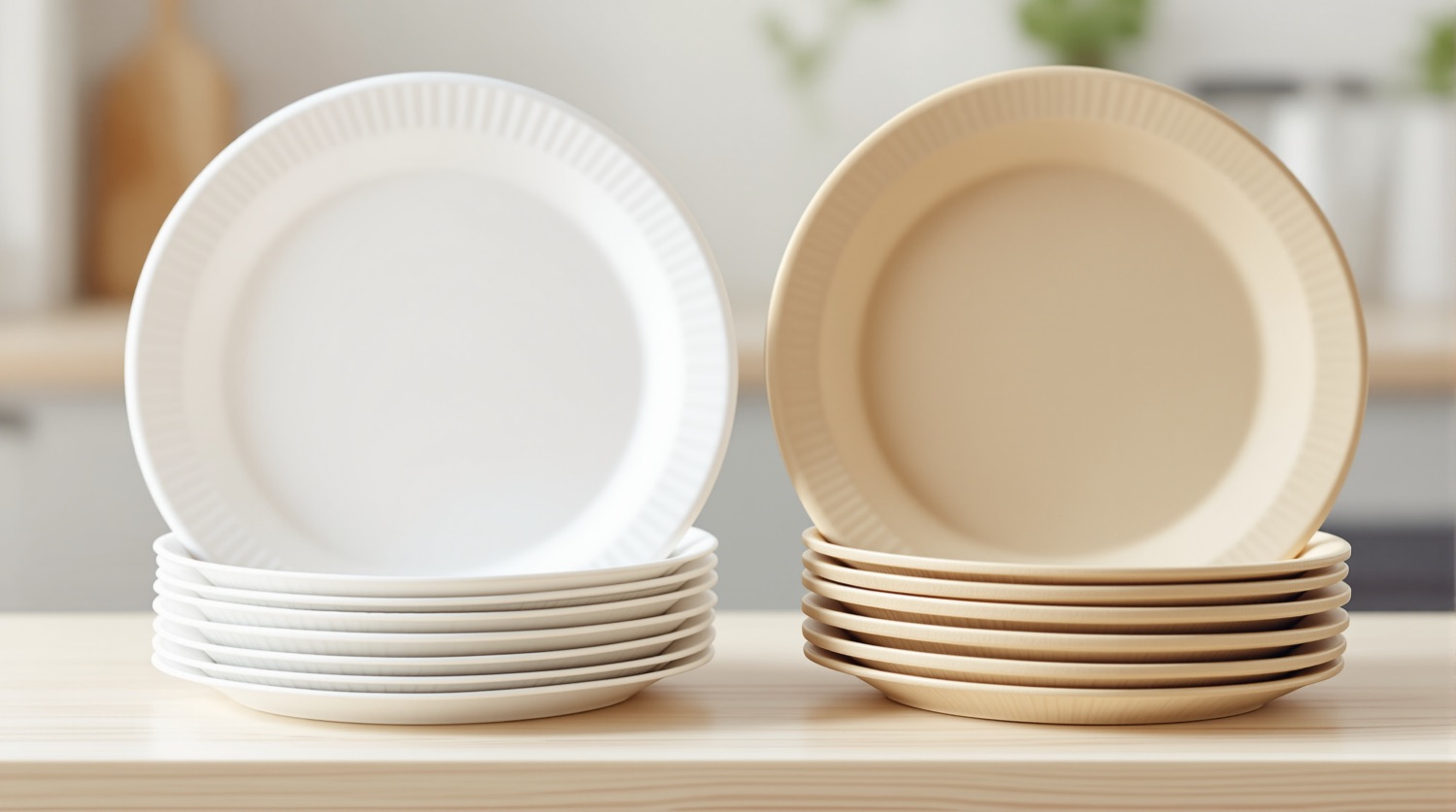
Do paper plates have PFAS?
PFAS — per- and polyfluoroalkyl substances, the "forever chemicals" — get added to paper food packaging for one reason: they stop grease and moisture from soaking through. A paper plate holding a slice of pizza or a buttered roll has exactly that job to do, which is why the question is worth asking at all.
The honest 2026 answer is "most do not, but some still do, and you cannot tell by looking." The most recent consumer-facing data comes from a round of testing published on January 27, 2026, in which 11 disposable paper plate products were sent to an EPA-certified laboratory and screened for total fluorine by oxygen flask combustion and ion-selective electrode, with free fluoride subtracted out to give an organic fluorine figure. Three products had detectable organic fluorine. Eight did not.
Organic fluorine is a proxy, not a fingerprint. Every PFAS compound is a carbon chain carrying fluorine, so finding organic fluorine in a plate is strong evidence that fluorinated chemistry was used somewhere in its manufacture — but it does not tell you which compound, or how much of it would ever reach your food. It is the same screening logic academic labs use, and it is why a result of 563 ppm next to a column of non-detects is a meaningful signal even without naming the molecule.
Why do "compostable" molded fiber plates test worst?
This is the counterintuitive part, and it is consistent across every dataset we could find.
In the 2023 study "Per- and Polyfluoroalkyl Substances in Canadian Fast Food Packaging" (Schwartz-Narbonne and colleagues, Environmental Science & Technology Letters, 2023, volume 10, pages 343–349), researchers from the University of Toronto, Indiana University, the University of Notre Dame and ETH Zürich measured 42 packaging items. Twenty-six percent of the set carried more than 10,800 micrograms of fluorine per square meter. The highest readings in the entire study — 1,010,000 to 1,300,000 micrograms of fluorine per square meter, roughly a hundred times the next tier — came from molded "compostable" bowls. Targeted analysis of the eight highest-fluorine samples found 4 to 15 individual PFAS in each one, dominated by 6:2 fluorotelomer methacrylate and 6:2 fluorotelomer alcohol. The authors' own conclusion is blunt: using PFAS in "compostable" packaging "represents a regrettable substitution of single-use plastic food packaging."
The reason is physical, not cynical. Bleached paperboard is dense and smooth. Molded plant fiber — bagasse from sugarcane, wheat straw, bamboo, miscanthus — is porous and thirsty, so it needs a far more aggressive barrier treatment to hold a wet, greasy meal without going soft. For years, fluorochemistry was the cheapest barrier that worked. The plate that was marketed as the environmental choice was, on this one measure, the dirtiest one on the table.
Didn't the FDA ban PFAS in food packaging in 2024?
Not a ban — and the distinction matters for what you can still buy in 2026.
On February 28, 2024 the FDA announced that substances containing PFAS "were no longer being sold into the U.S. market for use as grease-proofing agents on paper food packaging." The agency's market phase-out page lays out the sequence: the long-chain C8 compounds (including PFOA and PFOS) were gone by November 2016, the 6:2 fluorotelomer alcohol phase-out began in January 2021, and the remaining authorized grease-proofing PFAS stopped being sold by 2023.
Three things that announcement did not do:
- It was not a regulation. It records voluntary commitments by manufacturers to stop selling these substances, not a legal prohibition on using treated packaging.
- It did not clear the shelves. The FDA's own timeline anticipated existing treated stock being exhausted through June 2025. Packaging made before then was never recalled, and paper plates do not expire.
- It covers grease-proofing agents specifically — the coatings applied to fast-food wrappers, microwave popcorn bags, take-out paperboard and pet food bags. It is not a blanket statement that no fluorinated chemistry touches any food packaging sold in America, and it says nothing about imported goods that entered the market through other channels.
State law has moved faster and harder than the federal phase-out. Twelve states now restrict intentionally added PFAS in food packaging or foodservice ware, including California, New York, Washington, Minnesota, Colorado, Connecticut, Maine, Maryland, Oregon, Rhode Island, Vermont and Hawaii. That patchwork is the real reason "no PFAS added" has started appearing on packages: manufacturers that sell nationally have to meet the strictest state on the map.
What did the 2026 retail plate testing actually find?
Here are the measured organic fluorine results for all 11 products in that January 2026 round, highest first. "ND" means non-detect — below the laboratory's reporting threshold for that sample.
| Plate | Material | Organic fluorine |
|---|---|---|
| EcoSoul Tree Free Compostable 9" | Molded plant fiber | 563 ppm |
| Better Earth Farmer's Fiber 9" | Molded plant fiber | 16 ppm |
| Joyborn 100% Compostable 10" | Molded plant fiber | 14 ppm |
| Chinet Classic White 10 3/8" | Pressed recycled paper | ND |
| Dixie Ultra 10 1/16" | Coated paper | ND |
| Target up&up Heavy Duty 10" | Coated paper | ND |
| Target Everspring Sugarcane 10" | Bagasse fiber | ND |
| Matter Compostable Natural Fiber 9" | Molded plant fiber | ND |
| Natural Value Heavy Duty Recycled 9" | Recycled paper | ND |
| Repurpose Heavy Duty Compostable 9" | Molded plant fiber | ND |
| World Centric Compostable 9" | Unbleached plant fiber | ND |
Two honest caveats before you act on that table. This was advocacy-commissioned testing rather than a peer-reviewed study, and it tested one lot of each product. And "non-detect" is a statement about a threshold, not a permanent certificate — a different production run, a different supplier, a different year could read differently. What the table supports is a category judgment, not a lifetime guarantee about a brand.
The category judgment is the useful part anyway: molded plant-fiber plates occupied all three positive results and only four of the eight clean ones. Plain paper plates went 4 for 4.
Does PFAS actually move from the plate into your food?
Grease-proofing chemistry is applied precisely where food touches, so migration is the expected behavior rather than a surprising one. Researchers have measured transfer from treated packaging into food, and it increases with the three conditions a plate sees constantly: heat, fat, and time sitting on the surface. Hot pizza grease on a fiber plate for twenty minutes is close to a worst case.
The scale of the exposure route was established in 2017, when a team led by Laurel Schaider at the Silent Spring Institute collected about 400 packaging samples from fast-food restaurants across the United States and measured total fluorine by particle-induced gamma-ray emission spectroscopy. That study, "Fluorinated Compounds in U.S. Fast Food Packaging" (Environmental Science & Technology Letters, 2017, volume 4, pages 105–111), found detectable fluorine in 46% of food contact papers and 20% of paperboard samples, and concluded that the prevalence of fluorinated chemicals in food packaging demonstrates "their potentially significant contribution to dietary PFAS exposure."
That was a decade ago and the market has moved since. But it establishes the mechanism this whole question rests on: a treated paper surface is not an inert container. It is the same reason we take PFAS in parchment paper and the lining in paper cups seriously rather than waving them off as trivial.
Why does a fluorinated paper plate matter at all?
One meal on one plate is a small thing. PFAS are a concern because they do not break down and the doses add up across decades and across every route at once — water, dust, packaging, cookware, clothing.
The EPA's summary of current peer-reviewed research lists the health effects associated with PFAS exposure: "decreased fertility or increased high blood pressure in pregnant women"; developmental effects in children including "low birth weight, accelerated puberty, bone variations, or behavioral changes"; "increased risk of some cancers, including prostate, kidney, and testicular cancers"; "reduced ability of the body's immune system to fight infections, including reduced vaccine response"; interference with natural hormones; and increased cholesterol or risk of obesity. The EPA is also careful to say that specifying effects is difficult, because there are thousands of distinct PFAS and exposure routes vary.
So the proportionate response is not alarm about a birthday party. It is to take the free wins where they exist — and choosing the plate that tested non-detect over the one that tested at 563 ppm costs you nothing.
Which paper plates are safest to buy?
Every plate below returned non-detect for organic fluorine in that January 2026 round. Two are plain paper, two are plant fiber for people who want the compostable option — and both of those carry an explicit "no PFAS added" claim from the manufacturer, which is the thing to look for when a plate is made of molded fiber.
All four tested non-detect for organic fluorine in January 2026 lab screening. Prices change constantly, so we link the live listing rather than printing a number that goes stale.
| Plate | Material | Organic fluorine | |
|---|---|---|---|
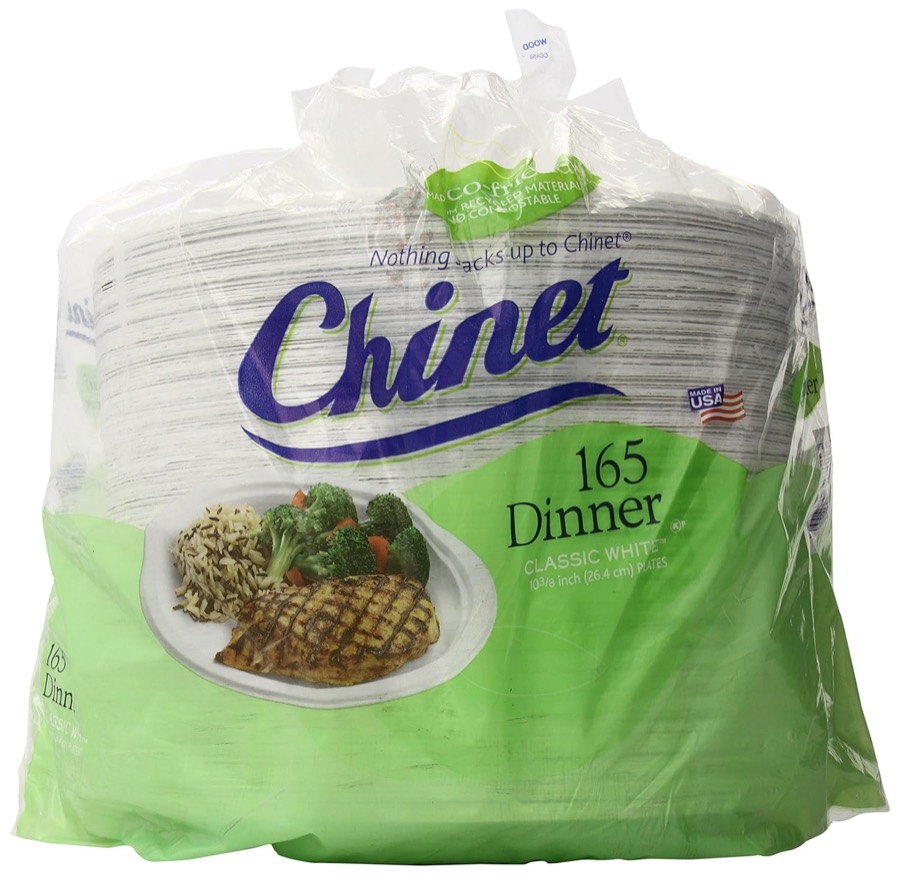
Best overallChinet Classic White Dinner Plates
|
Pressed recycled paper10 3/8 in |
Non-detect | Check price → |
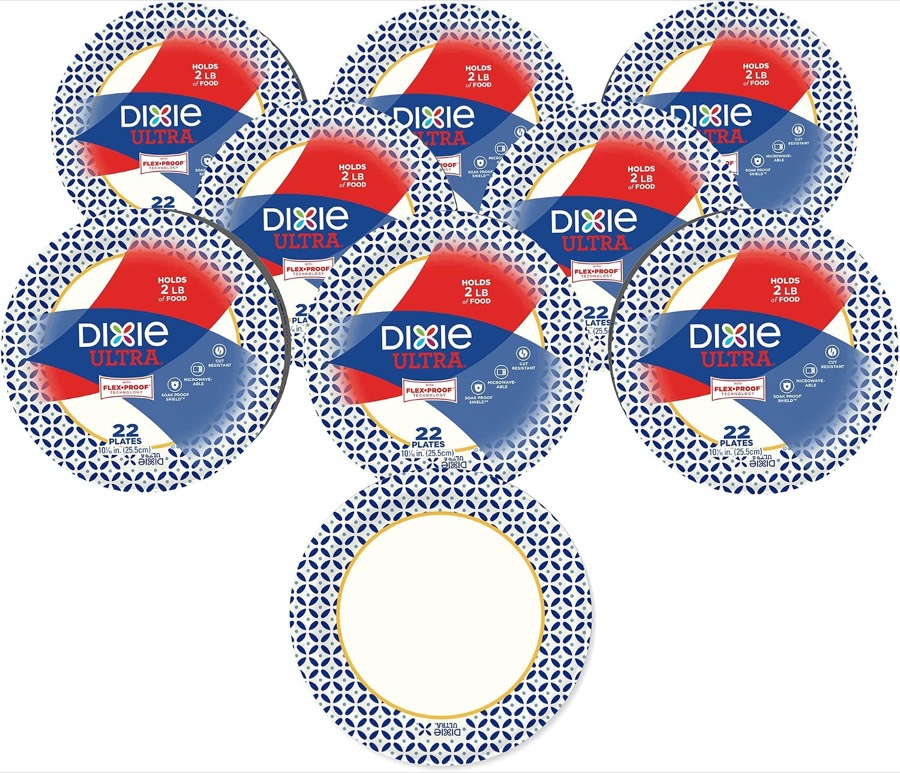
Best heavy dutyDixie Ultra Paper Plates
|
Coated paper10 1/16 in |
Non-detect | Check price → |
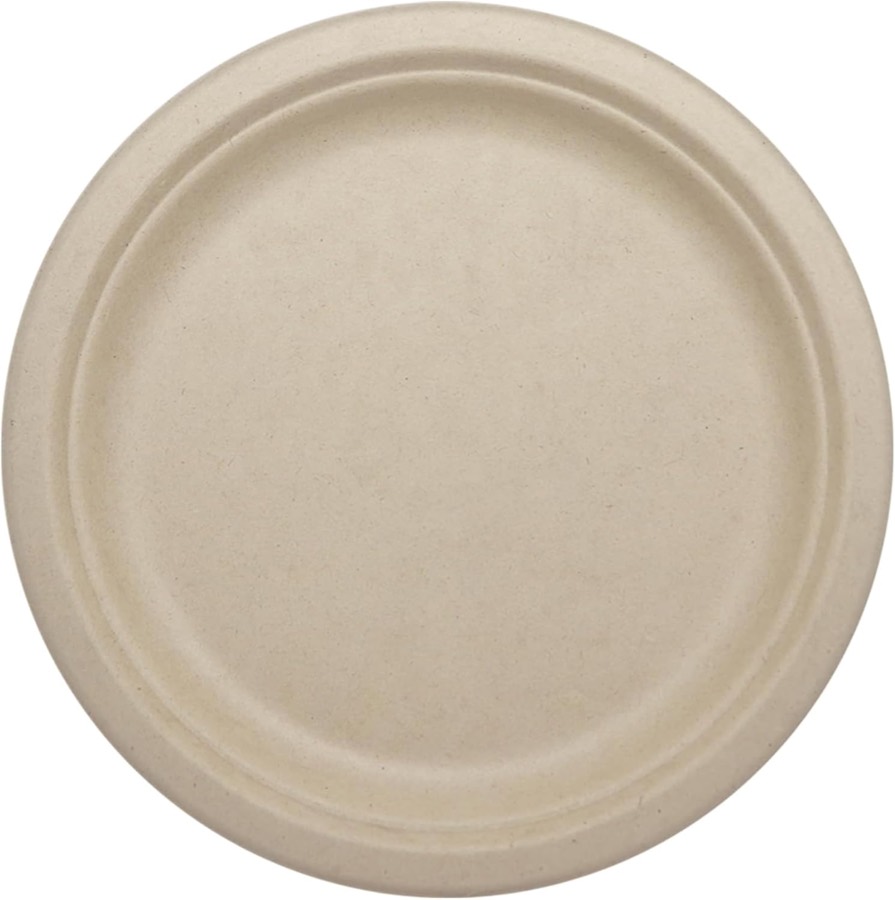
Best compostableWorld Centric Compostable Plates
|
Unbleached plant fiberNo PFAS added |
Non-detect | Check price → |
Best for a crowdRepurpose Heavy Duty Compostable Plates
|
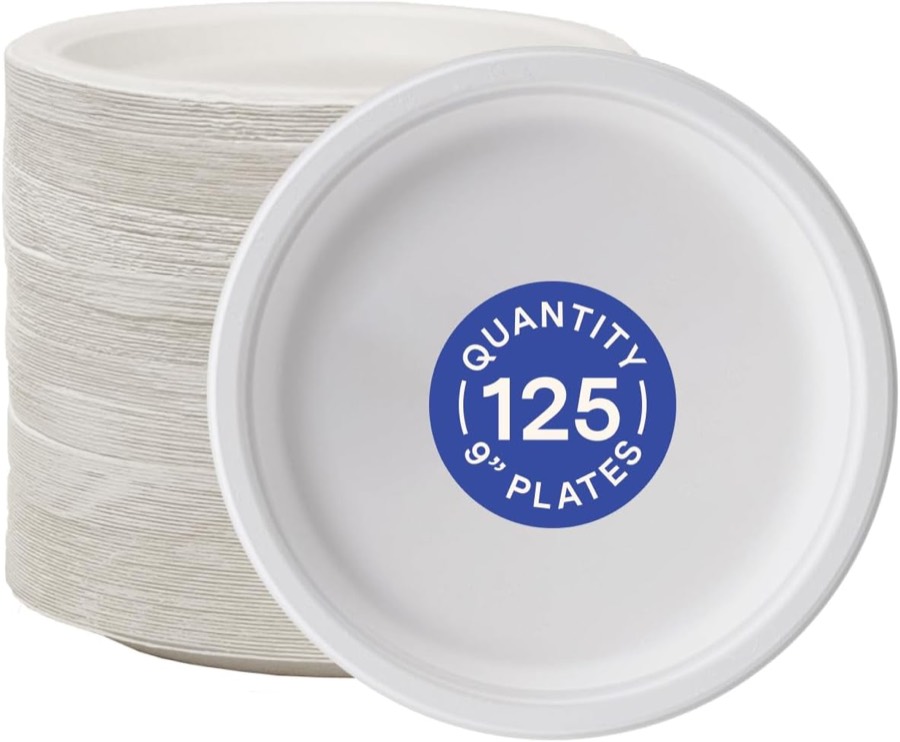
Molded plant fiberNo PFAS added125 count |
Non-detect | Check price → |
Chinet's Classic White is the least interesting plate on this list and that is the point: it is uncoated pressed fiber from recycled paper, it is rigid enough to hold a full dinner one-handed, and it has no grease-barrier film to be fluorinated in the first place. If you want a single default to buy and stop thinking about, this is it.
Check Price on Amazon →✓ Ships free with Prime · Free returns · Amazon A-to-z purchase guarantee (on eligible items)
Dixie Ultra is the useful counterexample to "coated means contaminated." It carries a grease barrier and still screened clean, which is exactly what you would expect from a large US manufacturer that has to satisfy California and New York packaging law. Choose it when the meal is heavy and wet enough that a bare pressed plate would give up.
Check Price on Amazon →✓ Ships free with Prime · Free returns · Amazon A-to-z purchase guarantee (on eligible items)
If you specifically want the compostable format, do not buy it blind: buy the one that states no added PFAS and that has been screened. World Centric is both. It is the plate to pick when the food scraps and the plate are going into the same commercial compost bin and you do not want fluorinated chemistry riding along into the soil.
Check Price on Amazon →✓ Ships free with Prime · Free returns · Amazon A-to-z purchase guarantee (on eligible items)
Repurpose is the one to reach for when you need a hundred plates and still want the screened, no-PFAS-added version rather than whatever unbranded "tree-free" bulk pack is cheapest that week. That unbranded pack is, on this evidence, exactly the category that tested at 563 ppm.
Check Price on Amazon →✓ Ships free with Prime · Free returns · Amazon A-to-z purchase guarantee (on eligible items)
How to read a paper plate package in ten seconds
Packaging carries no ingredient list, so there is nothing to scan the way you would scan a toothpaste tube. Three signals do most of the work:
- Look for an explicit claim. "No PFAS added," "PFAS-free," or a BPI certification issued after 2020 all mean somebody put their name on it. Silence is not reassurance.
- Default to plain paper over molded fiber. If the plate is white, pressed and uncoated, there is less reason for a fluorinated barrier to exist on it at all.
- Treat "tree-free," "bagasse" and "compostable" as prompts to check, not as answers. Those words describe the feedstock and the disposal route. They say nothing about the barrier chemistry, which is the part that matters here.
What if you skip disposable plates entirely?
The cleanest version of this problem is not buying a better disposable — it is using a plate you wash. A set of plain ceramic or glass dinnerware has no barrier coating, no migration question and no annual repurchase, and it is the single swap that removes this entire category from your kitchen. Our non-toxic dinnerware guide covers what to look for, and the kitchen plastic detox guide puts it in order against the other swaps that matter more.
Disposables still have their place — a hundred-person graduation party, a camping trip, a week with a broken dishwasher. For those, buy from the non-detect column and move on. And if you are working through the rest of the kitchen, the same logic applies to food wraps, storage containers and microwave popcorn bags, which were named directly in the FDA's grease-proofing phase-out.
Frequently Asked Questions
Sources
- Environmental Science & Technology Letters (2023), 10(4):343–349 — Per- and Polyfluoroalkyl Substances in Canadian Fast Food Packaging (Schwartz-Narbonne et al.)
- Environmental Science & Technology Letters (2017), 4(3):105–111 — Fluorinated Compounds in U.S. Fast Food Packaging (Schaider et al., Silent Spring Institute)
- US FDA — Market Phase-Out of Grease-Proofing Substances Containing PFAS
- US FDA (February 28, 2024) — PFAS Used in Grease-Proofing Agents for Food Packaging Are No Longer Being Sold in the US
- US EPA — Our Current Understanding of the Human Health and Environmental Risks of PFAS
- Mamavation (January 27, 2026) — Disposable paper plate testing, 11 products, EPA-certified laboratory