The difference is size. Microplastics are plastic fragments smaller than 5 millimeters; nanoplastics are a subset smaller than 1 micrometer — 1,000 nanometers, or thousands of times thinner than a human hair. Every nanoplastic is technically a microplastic, but the term "nanoplastic" is reserved for the very smallest particles — and that size gap matters enormously. Nanoplastics are small enough to cross the gut lining into your bloodstream, slip past the blood-brain barrier, reach the placenta, and enter individual cells — barriers that stop most larger microplastics. A 2024 PNAS study found bottled water carries about 240,000 particles per liter, roughly 90% of them nanoplastics that older methods never counted. Neither has been proven to cause disease at everyday levels, but the smaller size is exactly why researchers watch nanoplastics most closely — and the same swaps cut both. For the step-by-step version, see how to reduce microplastics in your body.
"Microplastics" and "nanoplastics" get used almost interchangeably in headlines, but scientifically they mark two different points on the same ruler. Both are pieces of plastic that broke off from something bigger — a bottle, a bag, a synthetic fabric, a road tire — or were manufactured small to begin with. What separates them is how far down the size scale they sit, and that single variable drives almost everything that follows: whether you can see them, whether a filter catches them, and whether they can get inside your body and your cells.
This guide draws the line clearly — the exact size cutoff scientists use, why nanoplastics went uncounted for so long, and why their tininess makes them the fraction researchers now worry about most. Then it gets practical: how each type is measured, what the human evidence does and doesn't show, and the filters and everyday swaps that lower your exposure to both. For the broader picture, see our overview of microplastics in the human body.
The bottom line up front: nanoplastics are just very small microplastics — under 1 micrometer — but that size lets them cross into blood, organs and cells in a way bigger particles can't, which is why they may matter more for health even though neither is proven to cause disease at everyday levels. You can't sort the two at home, and you don't need to: the fixes are identical. Filter your tap water (reverse osmosis catches the most nanoplastics), drink from glass or stainless steel instead of plastic bottles, and keep food off heated plastic. For context, see why tap water is a top source, what's measured in water bottles, and what's known about microplastics in blood.
What's the difference between nanoplastics and microplastics?
The whole distinction comes down to one number: size. Microplastics are any plastic particle smaller than 5 millimeters — roughly the width of a pencil eraser at the top end, down to about 1 micrometer at the bottom. That's a huge range, spanning everything from a visible fleck shed by a synthetic fleece to a speck you'd need a microscope to see. Nanoplastics are the very bottom slice of that range: particles smaller than 1 micrometer, which is 1,000 nanometers. Because they sit inside the microplastic size band, every nanoplastic is, strictly speaking, also a microplastic — but scientists reserve the word "nanoplastic" for the tiniest fragments, because at that scale the particles start behaving in a fundamentally different way.
Regulators and researchers draw the line the same way. NOAA and most environmental agencies define microplastics as fragments under 5 mm, and split them into "large" (5 mm–1 mm) and "small" (1 mm–1 µm) microplastics, with nanoplastics as everything below 1 µm. Some studies use a stricter nanoplastic cutoff of 100 nanometers, but the 1-micrometer threshold is the one you'll see most often. The takeaway is simple: it's one continuum of plastic fragments, and "nanoplastic" is just the name for the smallest, most mobile end of it. The table below lays out how the two compare on the things that actually matter.
| Microplastics | Nanoplastics | |
|---|---|---|
| Size | Smaller than 5 mm, down to 1 µm | Smaller than 1 µm (1,000 nm) |
| Can you see them? | The largest are visible; smaller ones need a microscope | No — invisible even to many standard microscopes |
| Cross into the bloodstream? | Rarely — mostly too big to leave the gut | Yes — small enough to cross the gut and lung linings |
| Enter cells / cross the blood-brain barrier? | Largely no | Yes, in lab and animal studies |
| Removed by a carbon/hollow-fiber filter? | Mostly yes | Only partly — needs reverse osmosis for most |
How small are nanoplastics, really?
Small enough that the numbers stop meaning much without a comparison. A single human hair is roughly 80,000 nanometers wide. A nanoplastic can be 100 nanometers — so about 800 of them could line up across the width of one hair. Even at the 1-micrometer (1,000-nanometer) upper edge of the nano range, you're looking at a particle far too small to see with the naked eye and often too small for the ordinary light microscopes that researchers use to count microplastics. A "small" microplastic at the other end of the scale, near 1 mm, is about a million nanometers — ten thousand times bigger across.
That invisibility is not a trivia point; it's the reason nanoplastics stayed off the radar for so long. For years, studies counted the microplastics they could actually detect and reported those totals, while the smaller, more numerous nano fraction slipped through uncounted. When newer techniques finally caught up, the numbers jumped — not because there was suddenly more plastic, but because we could finally see the smallest pieces that had been there all along.
Why do nanoplastics matter more than microplastics?
Because size determines access. A larger microplastic that you swallow mostly stays in your gut and leaves in your stool — it's too big to cross the intestinal wall. A nanoplastic is not. At that scale, particles can slip across the gut lining and the lungs into your bloodstream, where microplastics have already been measured directly. From the blood, the smallest particles can reach places larger ones can't: laboratory and animal studies show nanoplastics crossing the blood-brain barrier and the placenta, and even entering individual cells. A 2025 study in Nature Medicine reported plastic accumulating in human brain tissue, largely at the nano scale.
Getting inside is what turns a particle from a passenger into a potential problem. Once a nanoplastic is in a tissue or a cell, it can carry hitchhiking chemicals with it — the plasticizers, flame retardants and other additives bound to plastic — and its sheer surface area relative to its size makes it chemically reactive. In cell and animal studies, nanoplastics provoke inflammation and oxidative stress more readily than larger fragments. None of this proves harm in people at everyday exposure, and it's important not to overstate it. But it's exactly why researchers treat the nano fraction as the part worth watching, and why "it's just a smaller microplastic" undersells the difference.
"The danger of nanoplastics isn't that there's more plastic — it's that the plastic is small enough to go where microplastics can't: into your blood, your organs, and your cells."

How are nanoplastics and microplastics measured?
Differently — and that's a big part of why the two get separated in the research. Microplastics down to a few micrometers can be counted with light microscopy and identified with techniques like Raman microspectroscopy and micro-FTIR, which read a particle's chemical fingerprint. Nanoplastics are too small for those methods to catch reliably, so detecting them took new tools: a 2024 study in PNAS used a technique called stimulated Raman scattering microscopy, which can spot and identify particles down to about 100 nanometers, one at a time and automatically.
The result reset expectations. Analyzing three common brands of bottled water, that team found roughly 240,000 plastic particles per liter — about 10 to 100 times more than earlier microplastic counts — and around 90% of them were nanoplastics, the fraction older methods had missed entirely. It was a vivid demonstration that when you can finally see the smallest pieces, the picture of how much plastic is in everyday water changes completely.
Where do you take in the most nanoplastics and microplastics?
The sources overlap heavily, because nanoplastics are mostly just microplastics that have broken down further. The largest, most controllable input for most people is drinking water — bottled water especially, which sheds nano-sized particles from the plastic bottle and cap and carries far more than tap. Food contributes too: particles migrate from plastic packaging, wrap and containers, and heating food in plastic sharply increases what sheds into it. You also inhale particles from indoor air and household dust, where synthetic fibers from clothing and carpets collect. The table below shows where the biggest, most fixable share comes from.
| Source | Why it matters | How controllable |
|---|---|---|
| Bottled water | The most concentrated source of nanoplastics measured — ~240,000 particles/L, ~90% nano — shed from the bottle and cap | High — switch to filtered tap in glass/steel |
| Tap water | Lower than bottled, but a steady daily dose that a good filter removes | High — the main lever |
| Food & plastic packaging | Particles migrate from wrap, containers and processing; heat makes it worse | High — use glass, skip microwaving plastic |
| Indoor air & dust | Synthetic fibers shed by textiles and carpets are inhaled and swallowed | Moderate — ventilate, vacuum, fewer synthetics |
Are nanoplastics or microplastics proven to harm your health?
Neither is proven to cause a specific disease at everyday exposure — and that honesty matters. What exists so far is detection plus plausible mechanism: microplastics and nanoplastics have been found in human blood, lungs, placenta and brain tissue, and laboratory studies show they can trigger inflammation and oxidative stress. One 2024 study in the New England Journal of Medicine found that people with micro- and nanoplastics in the plaque of their carotid arteries had a higher rate of heart attack, stroke and death — a striking association, but an association, not proof that the particles caused those events.
The reasonable posture is neither panic nor dismissal. Nanoplastics are the more biologically plausible hazard because they can actually get inside cells and organs, so if any plastic-particle health effect is eventually confirmed, the nano fraction is the likeliest culprit. But "plausible and worth reducing" is not the same as "proven to make you sick." That's why the sensible response isn't a scare — it's lowering avoidable exposure with cheap, permanent swaps while the science catches up. For the fuller picture, see our overview of microplastics in the human body and what's known about microplastics and cancer.
No supplement, tea, cleanse, or gadget has been shown to remove microplastics or nanoplastics from your body, and some “detox” products arrive in plastic that adds exposure. The only intervention with evidence behind it is reducing what you take in day to day. Put your money into a certified water filter and glass or steel containers, not a detox.
How do you reduce your exposure to both?
You can't sort nanoplastics from microplastics at home, and you don't need to — the fixes are the same for both, and the highest-leverage one is water. Filter your tap water. A quality carbon-block or hollow-fiber pitcher removes most microplastics; for the tightest control of nano-sized particles, a reverse-osmosis system forces water through a membrane fine enough to catch the large majority of them. Drink it from glass or stainless steel rather than plastic bottles, since bottled water is the most concentrated nanoplastic source measured. Keep food off heated plastic — store and reheat in glass, never microwave a plastic container, and cut down on plastic-wrapped and heavily packaged food.
Then close the smaller doors. Favor glass food storage and food-grade silicone over cling film and plastic tubs, swap plastic-lined disposables like takeout cups and plastic teabags for plastic-free versions, and reduce indoor dust with regular vacuuming and ventilation so fewer fibers get inhaled and swallowed. None of this is dramatic, and that's the point: small, permanent swaps compound. The picks below are the simplest, longest-lasting ways to put them in place, starting with the water behind everything you drink.
Start where the exposure actually is
Filtering your drinking water and getting off plastic bottles cuts the single biggest, most controllable source of the particles you take in — nano and micro alike. Everything else builds on that first swap.
The gear that cuts the most nanoplastics and microplastics before they reach you
There is nothing you can buy to remove particles that are already inside you — the real lever is lowering how much gets in, and that means the water you drink and the plastic your food and drinks touch. So instead of a “detox” that doesn't work, here are the real, currently-sold tools that address the sources you actually control: certified water filters for the single biggest input, plus glass bottles, glass storage and food-grade silicone to keep what you consume off plastic. Prices and availability change, so check current listings.
1. Epic Pure Water Filter Pitcher — Best Overall for Microplastics
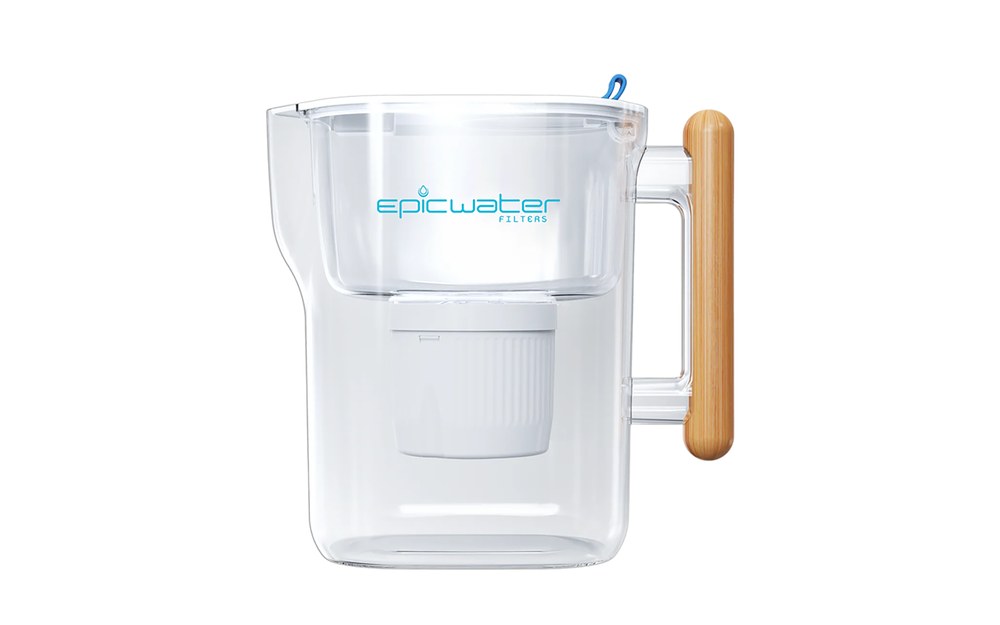 Best Overall
Reviewers point to published independent lab data and a filter rated around 150 gallons, far longer than a Brita, as the reasons they trust it, and several describe the slow, deliberate drip as reassuring rather than annoying. The honest downsides: owners report the filtration is genuinely slow and not the pick if you want a glass of water in a hurry, and third-party complaints mention cracked plastic, flip-top lids that stick, and water that spills or leaks from the lid when you pour a full pitcher.
The clearest evidence on this list: Epic posts its independent lab results publicly, so you can see the 99.9% microplastic-removal data instead of trusting a slogan on the box.
Why it's safe: The hollow fiber membrane physically blocks microplastic particles down to ~1 micron, while the carbon stage handles chlorine, lead, and PFAS — all in a BPA-free Tritan body.
Check Today’s Price on Amazon →Amazon prices change daily — tap to see today's price and any active discount.
- Free delivery & returns for Prime members
- Sold & shipped by Amazon
- Thousands of verified reviews
Drinking water is the single most controllable source of the microplastics you swallow, so filtering it is the highest-leverage swap on this list. The Epic Pure is the clearest choice: its dual-stage design uses a hollow fiber membrane as the primary microplastic barrier, and Epic publishes the independent lab results to back the 99.9% removal claim — transparency most competitors don't match. For the full field, see our ranking of the best water filter pitchers for microplastics.
2. Waterdrop Chubby 10-Cup Pitcher — Best Filter Life
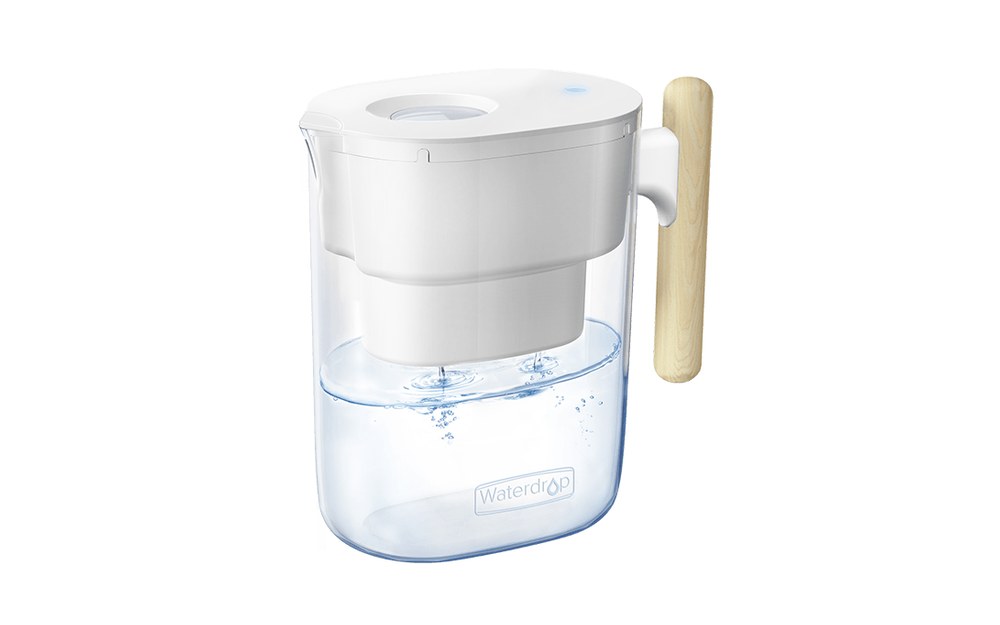 Best Filter Life
Owners like the look and the long 200-gallon filter life, and roughly 80 percent of reviews land positive, with the common praise being clean-tasting water at a low cost per gallon. The honest gripes: several owners warn the handle can feel loose or strain under a full pitcher, so they lift with two hands; some report the pour spills if you tip too fast; and the change-filter indicator light draws complaints for not lighting or not staying lit.
A membrane blocks particles by pore size rather than by claim list, and its 200-gallon filter runs about 4 to 5 months — the lowest ongoing cost on the list.
Why it's safe: A hollow fiber membrane is a physical barrier to particles, while the carbon composite handles chlorine, heavy metals, and PFAS — all in a BPA/BPS-free body.
Check Today’s Price on Amazon →Amazon prices change daily — tap to see today's price and any active discount.
- Free delivery & returns for Prime members
- Sold & shipped by Amazon
- Thousands of verified reviews
If you're filtering all your drinking water — which is the point — you'll run a lot through the cartridge, so filter life matters, and the Waterdrop Chubby leads on it: a hollow fiber membrane on Waterdrop's own published lab data, plus 200 gallons per filter (about 4–5 months for most households). The "filter while you pour" design works just like a familiar counter pitcher, but with a membrane that's actually tested for microplastics.
3. Aquagear Water Filter Pitcher — Best Value
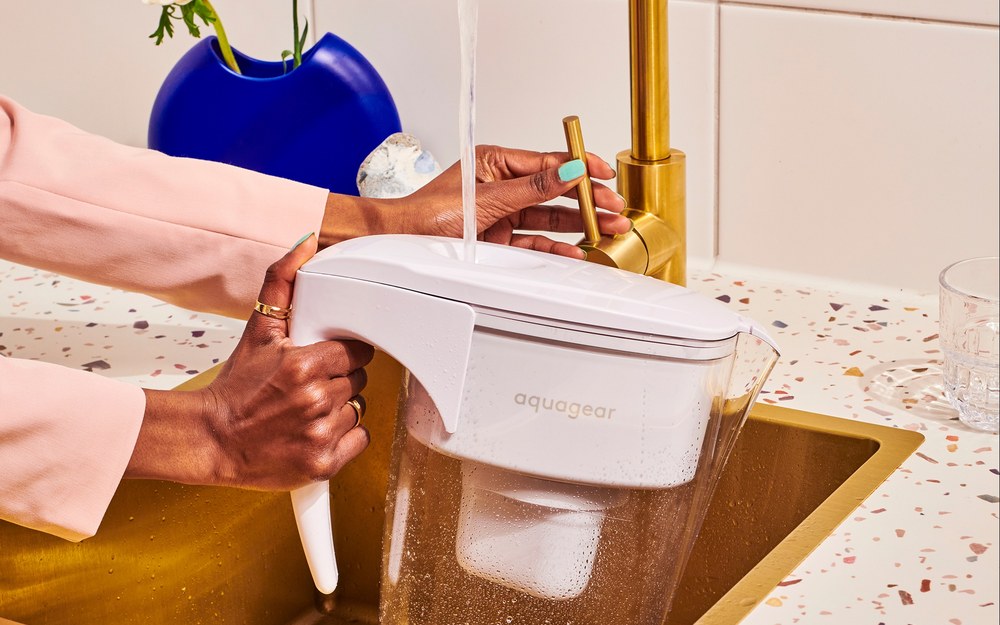 Best Value
Owners choose it for broad contaminant removal and clean taste, and some lab testing found it did not clog. The honest downsides: the most repeated complaint is slow filtration, described by one reviewer as a mixed bag between people waiting minutes and people waiting hours, and it can worsen as the filter ages; and the design draws gripes, with the pour-spout cover popping out and spraying water and a lid that fits poorly and can pop off mid-pour.
Change the filter half as often as most pitchers — 150 gallons per cartridge means fewer replacements, lower annual cost, and less to remember.
Why it's safe: A 5-stage filter with a sub-micron membrane stage captures microplastics, lead, fluoride, and chlorine, in a BPA-free body with USA-made filter media.
Check Today’s Price on Amazon →Amazon prices change daily — tap to see today's price and any active discount.
- Free delivery & returns for Prime members
- Sold & shipped by Amazon
- Thousands of verified reviews
The Aquagear costs more upfront but its 150-gallon filter life means lower annual replacement costs than most competitors, and the pitcher body is guaranteed for life. It uses a 5-stage filter with a sub-micron membrane stage that targets microplastics, heavy metals, and fluoride — a good fit if you'd rather set up clean water once and not think about cartridges every month.
4. Lifefactory Glass Bottle 22oz — Best Glass Bottle
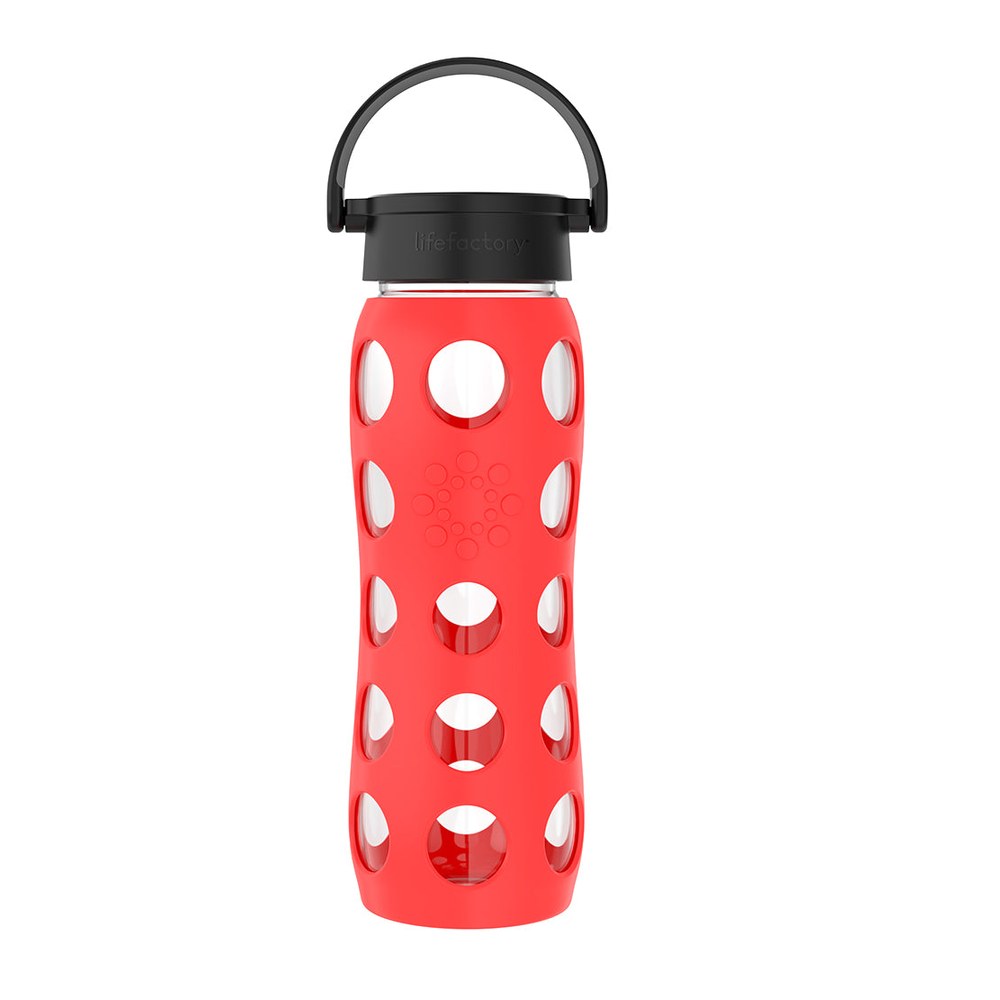 Best Glass Bottle
Bottled water is one of the most concentrated microplastic sources measured, so the highest-impact drinking swap is to carry your own filtered water in glass — and this is the bottle for it. It’s made from borosilicate glass, the same material used in laboratory glassware, which is thermally stable, chemically inert, and completely free of BPA, BPS, and any polymer contact with the drink. It imparts no taste, so water tastes like water. The protective silicone sleeve adds grip and guards against shattering.
The screw cap contains a small polypropylene component — the only plastic in the system, and it sits at the exterior closure rather than the drink surface. Rinse it like any cap and it stays a non-issue. Dishwasher-safe, and sturdy enough for daily desk-and-bag use.
Owners love that water tastes clean with no plastic aftertaste and that the silicone sleeve makes the glass easy to grip and survive the occasional drop. The honest downsides: it’s heavier than a plastic or steel bottle, the glass can still break if dropped on a hard edge, and some reviewers find the flip-cap spout narrow or report the cap can leak if not fully closed.
Carry the filtered water you made at home instead of buying bottled — no plastic contact, no leaching, and it cleans up in the dishwasher.
Why it's safe: Borosilicate glass is completely inert — it never leaches, never sheds microplastics, and imparts no taste. The only plastic is a small cap component at the exterior closure, not the drink surface.
Check Today’s Price on Amazon →Amazon prices change daily — tap to see today's price and any active discount.
- Free delivery & returns for Prime members
- Sold & shipped by Amazon
- Thousands of verified reviews
Carrying filtered water in a reusable glass or stainless steel bottle — or a dedicated filtered water bottle — means the water you reach for all day is already clean, with no PET shedding or plastic aftertaste. It's the simplest way to make “not bottled water” your default when you're away from home, which is where most people quietly rack up their plastic intake.
5. Glasslock Oven Safe Container Set (3-Pack) — Best Glass Storage
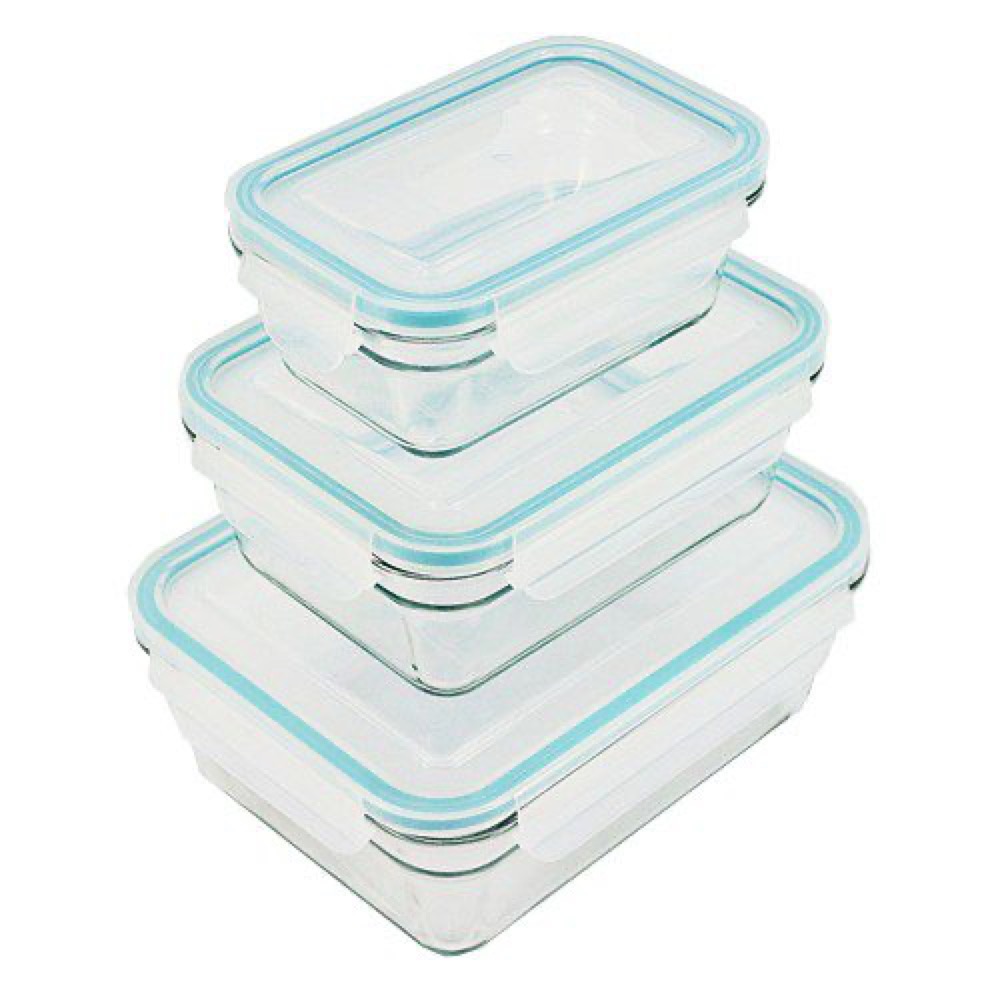 Best Glass Storage
Longtime owners like that the glass bodies are oven-, microwave-, and freezer-safe and that the snap-lock lids seal tight. The honest downsides run through the lids, not the glass: reviewers report cracked lids, snapped locking tabs, and mold building up in the rubber gaskets if they are not dried well. Some buyers also received sets with a locking piece missing, and several flag slow, hard-to-reach customer service when they needed a replacement part.
Three stackable glass containers in one box — enough to store a week of leftovers and prepped ingredients without a single plastic tub.
Why it's safe: Your food sits on inert tempered glass, not plastic — so warm, acidic, watery foods can’t leach or pick up shed particles. The BPA-free lids seal with a food-grade silicone gasket that only touches the rim.
Check Today's Price on Amazon →Amazon prices change daily — tap to see today's price and any active discount.
- Free delivery & returns for Prime members
- Sold & shipped by Amazon
- Thousands of verified reviews
Glass storage is the direct fix for food-borne exposure: keep leftovers and prepped meals in inert glass instead of plastic tubs, and warm them with the lid off — in the container, never in a plastic one in the microwave — so your food never sits against hot plastic. Warm, acidic and oily foods are exactly the ones that pull the most from plastic, and this is the cheapest way to move a week of meals off it in one purchase. For the full lineup, see our guide to the best glass food storage containers.
6. Stasher Reusable Silicone Bag Starter Kit — Best Silicone Bag
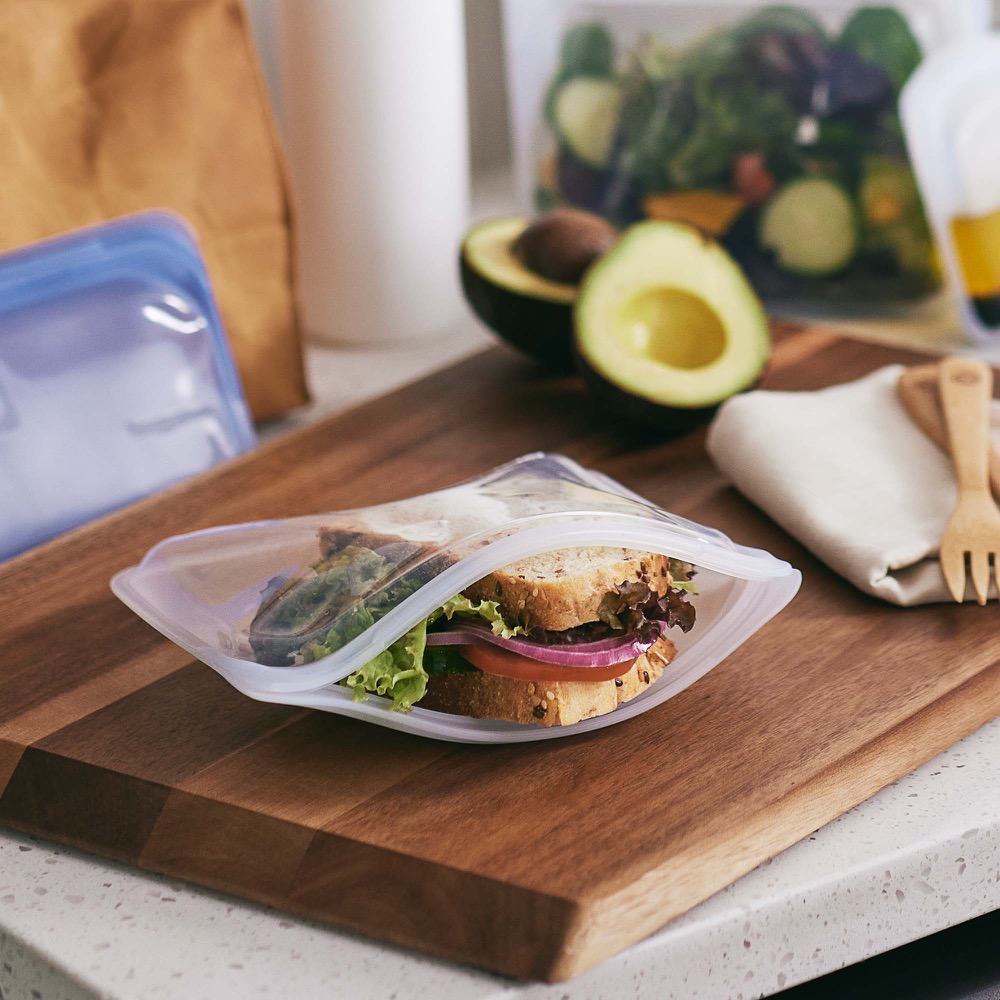 Best Silicone Bag
For freezing food in portions, stashing leftovers you won't finish in time, or anything you’d reach for a plastic bag — Stasher’s platinum-cured silicone is the upgrade: sturdier than any disposable bag and free of the chemicals that migrate from plastic. The patented Pinch-Loc seal is genuinely airtight and leakproof, so it keeps food from drying out.
It’s freezer safe to -70°F and goes straight to the microwave or a 425°F oven. The starter kit covers the everyday sizes — sandwich, snack, and stand-up half-gallon — so you can retire a whole box of single-use bags in one purchase.
Owners like that the platinum silicone bags go from freezer to microwave and replace throwaway plastic for years. The honest gripes: smell and stain retention come up often, with reviewers noting garlic and strong odors linger even after washing; the pinch-lock seal can be fiddly to open and close; and the seams are slow to dry, which can invite mildew if you do not air them out.
Store prepped produce, snacks, and batch-cooked food in airtight silicone instead of plastic film — then thaw and reheat in the same bag, no transfer needed.
Why it's safe: Platinum-cured silicone — the highest-purity, chemically inert grade — with no plastic, PVC, BPA, lead, latex, phthalates, or PFAS.
Check Today's Price on Amazon →Amazon prices change daily — tap to see today's price and any active discount.
- Free delivery & returns for Prime members
- Sold & shipped by Amazon
- Tens of thousands of verified reviews
Freezing and storing food in flimsy plastic bags is one of the easiest habits to upgrade. Food-grade platinum silicone does the same job without the shedding of a thin disposable bag: freeze a batch flat, thaw a portion at a time, and it seals airtight from freezer to microwave. Retiring single-use plastic bags removes a small but steady contact point between your food and plastic. For the full lineup, see our guide to the best silicone food storage bags.
Want the Full Home Protection Guide?
Your water is the biggest lever, but it's one of dozens of daily plastic touchpoints that add up in what you swallow. The Complete Plasticproof Guide covers every room — kitchen, bathroom, bedroom, living room — with 80+ product recommendations backed by 47+ studies.
The honest verdict
So what's the real difference between nanoplastics and microplastics? Size — and everything size unlocks. Microplastics are plastic fragments under 5 mm; nanoplastics are the sliver of that range under 1 micrometer, small enough to cross into your blood, organs and cells in a way larger particles can't. That's why they matter more: not because there's suddenly more plastic, but because the smallest pieces can go the farthest inside you, and because they vastly outnumber the microplastics we can easily see — roughly 90% of the particles in bottled water, in the study that finally counted them. Neither has been proven to cause disease at everyday exposure, so the accurate takeaway is neither “harmless” nor “poisoned.” It's that the nano fraction is the part worth watching, and your intake is largely in your hands.
The practical response is easy, because the fixes are identical for both and they're the inputs you touch every day. Filter your drinking water — reverse osmosis if you want the tightest control of nanoplastics — get off plastic bottles, keep food off heated plastic, and cut down on packaged and disposable plastic. Ignore anything sold as a microplastic “detox”: nothing removes particles already inside you, so the whole game is lowering what goes in. You don't need a plastic scare to act on this, and you can't fix it in a weekend. A certified water filter and a switch to glass, kept up over time, quietly do most of the work.
Cut the intake that actually adds up
The biggest wins are filtered water, glass or steel instead of plastic bottles, and keeping food off heated plastic. A certified filter and glass storage make that your easy default.
Frequently Asked Questions
Size. Microplastics are plastic fragments smaller than 5 millimeters — anywhere from the size of a sesame seed down to about 1 micrometer. Nanoplastics are a subset that is smaller still: below 1 micrometer, which is 1,000 nanometers. Because nanoplastics are defined as a slice at the very bottom of the microplastic range, every nanoplastic is technically also a microplastic, but the term nanoplastic is reserved for the tiniest particles. That size difference is not just semantics: nanoplastics are small enough to cross biological barriers — the gut lining, the blood-brain barrier, the placenta, even individual cell membranes — that stop most larger microplastics.
Researchers suspect so, but it is not proven in people. The concern is mechanical: because nanoplastics are far smaller, they can slip out of the gut into the bloodstream, penetrate tissues and enter cells, giving them access to organs that larger microplastics rarely reach. Laboratory and animal studies show nanoplastics can trigger inflammation, oxidative stress and cell damage more readily than bigger particles. But no human study has shown that everyday nanoplastic exposure causes a specific disease. The honest read is that the smaller size makes nanoplastics more biologically plausible as a hazard, which is exactly why lowering exposure is sensible while the science matures.
Nanoplastics are smaller than 1 micrometer, or 1,000 nanometers. For scale, a single human hair is roughly 80,000 nanometers wide, so a 100-nanometer nanoplastic is hundreds of times thinner than a hair and completely invisible to the naked eye — and even to standard microscopes. That is why they went uncounted for so long: it took new techniques such as stimulated Raman scattering microscopy to detect particles that small, which is how a 2024 study revealed bottled water contained far more particles than anyone had measured before.
The evidence points that way. Microplastics have already been measured directly in human blood, and because nanoplastics are far smaller, they cross the gut and lung linings into the bloodstream more easily. A 2025 study in Nature Medicine reported plastic particles — mostly at the nano scale — accumulating in human brain tissue, and laboratory work shows nanoplastics can cross the blood-brain barrier and the placenta in animal models. Detection confirms the particles reach these places; it does not by itself prove they cause harm there, but it is the reason scientists are watching the nano fraction most closely.
The best ones remove most of them. Larger microplastics are caught by ordinary carbon-block and hollow-fiber filters, but nanoplastics are so small that only tight membranes reliably capture them — reverse osmosis, which forces water through a membrane with pores around 0.0001 micrometers, is the most effective home option and removes the large majority of nano-sized particles. A quality pitcher or faucet filter still cuts your total plastic load meaningfully, and pairing filtered water with glass or stainless steel bottles avoids the nanoplastics that shed from plastic bottles in the first place.
Target the biggest, most controllable source first: drinking water. Filter your tap water — reverse osmosis for the tightest control of nanoplastics — and drink it from glass or stainless steel rather than plastic bottles, since bottled water is the most concentrated source of nanoplastics measured. Then keep food off heated plastic (store and reheat in glass, never microwave a plastic container), cut down on plastic-wrapped and heavily packaged food, and reduce indoor dust. No supplement or cleanse removes particles already inside you, so the whole game is lowering how much gets in.
Sources
- Qian N, Gao X, Lang X, et al. "Rapid single-particle chemical imaging of nanoplastics by SRS microscopy." Proceedings of the National Academy of Sciences (PNAS), 2024;121(3):e2300582121. (Using stimulated Raman scattering microscopy, found roughly 240,000 plastic particles per liter of bottled water — about 90% of them nanoplastics that earlier methods had not counted.)
- NOAA Marine Debris Program. "Microplastics." (Defines microplastics as plastic pieces smaller than 5 mm; the size classification under which nanoplastics fall below 1 micrometer.)
- Leslie HA, van Velzen MJM, Brandsma SH, et al. "Discovery and quantification of plastic particle pollution in human blood." Environment International, 2022;163:107199. (First measurement of plastic particles circulating in human blood — evidence that the smallest particles cross into the bloodstream.)
- Nihart AJ, Garcia MA, El Hayek E, et al. "Bioaccumulation of microplastics in decedent human brains." Nature Medicine, 2025. (Reported plastic particles — largely at the nanometer scale — accumulating in human brain, liver and kidney tissue, with higher levels in more recent samples.)
- Marfella R, Prattichizzo F, Sardu C, et al. "Microplastics and Nanoplastics in Atheromas and Cardiovascular Events." New England Journal of Medicine, 2024;390:900–910. (Patients with micro- and nanoplastics detected in carotid-artery plaque had a higher rate of heart attack, stroke and death — an association, not proof of causation.)