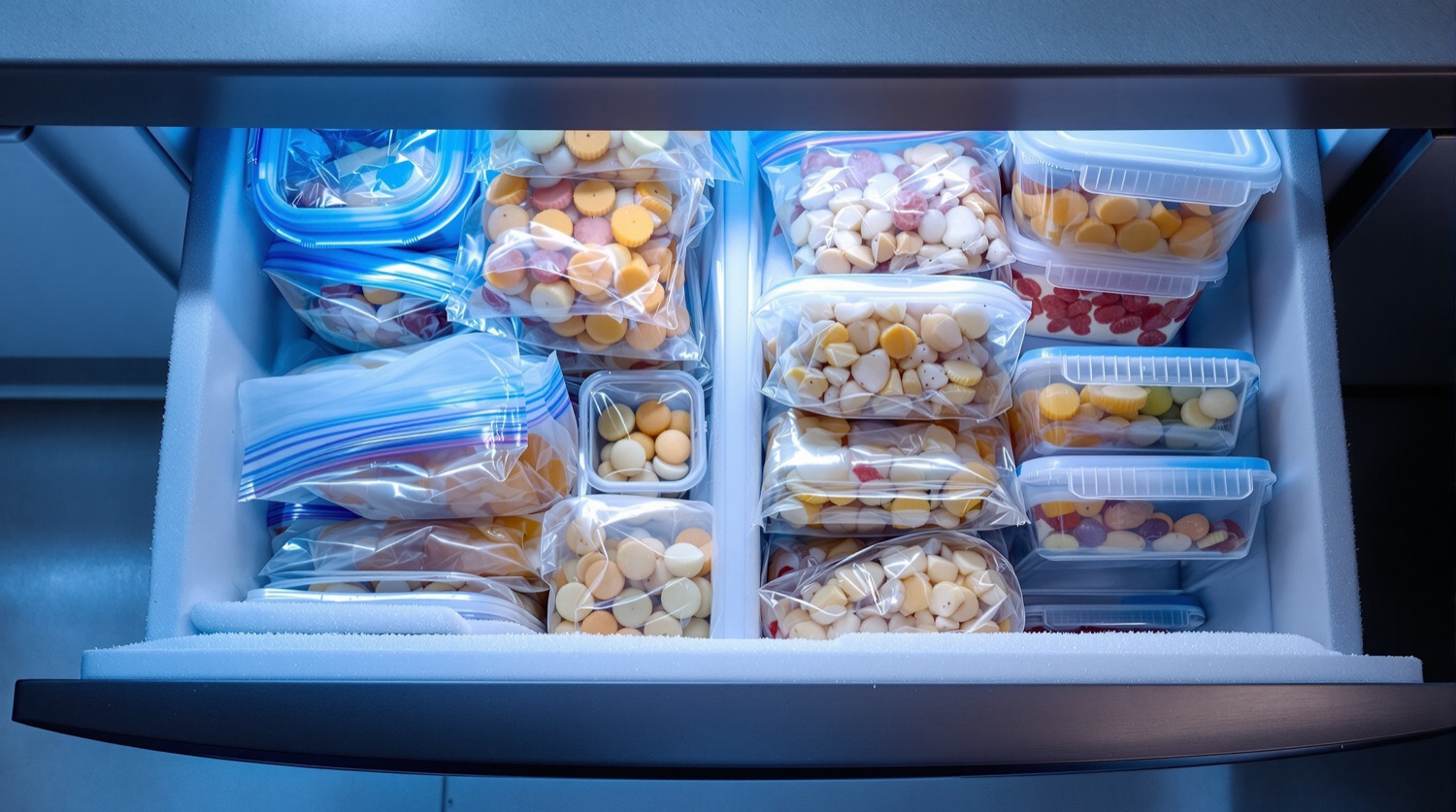
Almost every piece of advice about plastic and food is about heat — do not microwave it, do not put hot soup in it, do not leave the water bottle in the car. Freezing gets a free pass, on the unstated assumption that nothing much happens to a material at −18 °C. Until recently nobody had actually checked over a realistic timescale.
Two studies now let you answer the question with numbers rather than instinct. One tracked packaged meat through six months of storage at both normal fridge and normal freezer temperatures. The other measured what plastic containers release under refrigeration, room-temperature storage and microwaving, side by side. Read together, they produce an answer that is more useful than yes or no.
Bottom line: Freezing is the gentlest of the storage conditions anyone has measured — roughly half the particle count of refrigeration over 180 days in the one study that compared them directly. But “less” is not “none”: the frozen samples still gained particles with every week on the shelf, and microwave reheating in the same container released particles in a completely different league. If you freeze in plastic, freeze for weeks rather than months, and never reheat in the container you froze in.
Is It Safe to Freeze Food in Plastic?
Safer than refrigerating it in plastic, and far safer than heating it in plastic — but not inert. In the 2026 Scientific Reports study, chicken sausages that had been through packaging carried 10.45 microplastic particles per 5 grams on day one. After 180 days in a domestic freezer at −18 °C that figure was 15.44. After the same 180 days in a refrigerator at 4 °C it was 33.66. Same product, same packaging, same six months — the only variable was temperature, and the colder samples finished with less than half the particles.
The direction is intuitive once you see it. Polymer chains move, relax and abrade more readily as temperature rises; the colder the material, the more locked in place its surface is. What is less intuitive is that the freezer count went up at all. Cold slows the process. It does not switch it off.
Measured Microplastic Counts in Packaged Sausage Over 180 Days
Particles per 5 grams, measured by optical microscopy after digestion in 10% KOH and filtration at 0.6 µm. Day 14 and day 1 are omitted here for width; day 1 was identical to the before-packaging count in every sample. Source: Asadi Qajarloo et al., Scientific Reports, 2026 (Table 2).
| Sample | Before packaging | Day 7 | Day 21 | Day 28 | Day 180 |
|---|---|---|---|---|---|
| 70% meat — freezer (−18 °C) | 10.45 ± 0.31 | 11.61 | 11.66 | 12.66 | |
| 70% meat — fridge (4 °C) | 10.45 ± 0.31 | 12.66 | 26.51 | 27.45 | |
| 55% meat — freezer (−18 °C) | 18.66 ± 0.52 | 20.54 | 21.66 | 25.54 | |
| 55% meat — fridge (4 °C) | 18.66 ± 0.52 | 21.63 | 29.63 | 30.66 |
Two other things in that table are worth sitting with. First, nothing changed at all between “before packaging” and day one — the particles that were already there came from the production line, not the package. Second, the cheaper formulation started dirtier and stayed dirtier: the 55% meat sausages began at 18.66 particles per 5 grams against 10.45 for the 70% version, which the authors attribute to the non-meat fillers, binders and extenders that make up the difference.
What Did the 180-Day Study Actually Measure?
Chicken sausages in two commercial formulations — 70% meat and 55% meat — sampled before packaging and then at days 1, 7, 14, 21, 28 and 180, held at both −18 °C and 4 °C. Five-gram sub-samples were cut aseptically into solvent-rinsed glass jars, digested in 10% potassium hydroxide at 50 °C and filtered at 0.6 micrometers. Particles were counted and sized under an optical microscope, then identified by confocal Raman spectroscopy and scanning electron microscopy with energy-dispersive X-ray analysis — two independent techniques, one for the polymer, one for the elemental composition.
What came out was overwhelmingly fibrous, ranging from 50 to 1,500 micrometers long, and mostly transparent. The polymers identified were polypropylene, polycarbonate and polyamide — polyamide being the coating used on the sausage casing itself. The authors note that the heat sterilization applied to packed sausages can loosen the chains in that polyamide coating, which is a plausible route for the fibers to end up inside the food.
They also found something that has nothing to do with packaging: six transparent polypropylene fibers, 300 to 800 micrometers long, in just 5 grams of the seasoning additives — the salt and spices mixed in before anything was wrapped. Plastic is entering processed food at more than one point in the line.
Does Refrigerating Food in Plastic Release More Than Freezing?
Yes, and a second research group found the same ordering with a completely different method. At the University of Nebraska–Lincoln, Hussain and colleagues filled plastic containers and reusable food pouches with water and with 3% acetic acid as an acidic-food stand-in, then measured particle release under three ordinary usage scenarios. Their finding, published in Environmental Science & Technology in 2023: refrigeration and room-temperature storage for over six months released millions to billions of micro- and nanoplastic particles — real, measurable, and still the mildest two conditions they tested.
They also found the material matters. The polyethylene-based food pouch released more particles than the polypropylene-based rigid containers. That is worth knowing because the flexible pouch is exactly what most people reach for when freezing: the zip-top bag.
What Is Worse Than Freezing Food in Plastic? Reheating It
By a margin that makes the storage question look small. In the same Nebraska experiment, three minutes of microwave heating released as many as 4.22 million microplastic and 2.11 billion nanoplastic particles from a single square centimeter of plastic surface. Not per container — per square centimeter. The authors' exposure modeling put the highest estimated daily intakes at 20.3 ng/kg per day for infants drinking microwaved water and 22.1 ng/kg per day for toddlers eating microwaved dairy from polypropylene containers.
That is the number that should change behavior. Freezing a portion of chili in a plastic container for three weeks is a minor exposure. Taking that same container out and microwaving it is a different event entirely. If you take one habit from this page, make it the transfer: frozen food goes into glass or ceramic before it goes into the microwave. The same logic runs through our guide to microwaving Tupperware and whether Ziploc bags are microwave-safe.
Does Freezing Make Plastic Brittle Enough to Shed?
This is the mechanism people usually worry about, and the 180-day data gives it a careful answer rather than a confident one. The frozen samples did gain particles — 10.45 to 15.44 for the 70% sausages, a 48% increase over six months — so something is happening at freezer temperature. But the study measured particles in the food, not the mechanism in the polymer, and it did not test freeze-thaw cycling, which is the condition most likely to stress a container: freezing, partial thawing in a door shelf, refreezing. Nobody has published a measurement of that cycle in a domestic freezer, and we are not going to invent one. The honest summary is that cold storage is the slowest-shedding condition measured so far, and that time on the shelf still counts.
How Should You Actually Freeze Food?
Ranked by how much difference each change makes, based on what the two studies measured:
- Never reheat in the container you froze in. This is the whole ballgame — millions of particles per square centimeter in three minutes versus a slow drift over months. Transfer to glass or ceramic first, every time.
- Freeze rather than refrigerate anything you are keeping more than a few days. Less than half the particle count over 180 days, at no cost and no effort.
- Treat the freezer as weeks, not months. The count climbed steadily at both temperatures. Label things and actually eat them.
- Move the long-term items into glass or stainless. The batch-cooked portions that live in the freezer for a season are where a non-plastic container earns its price.
- Favor rigid containers over flexible pouches if you are staying with plastic — the polyethylene pouch out-shed the polypropylene containers in the Nebraska trial.
- Buy the better formulation of processed foods. The 70% meat sausages carried roughly half the particles of the 55% version before a single day of storage. More filler, more fiber.
For the wider picture on what to store food in, our ranked guides to the best glass food storage containers and the best non-toxic food storage containers cover the full field, and glass vs plastic food storage works through the trade-offs directly.
The Three Containers That Solve This
Glass for the freezer-to-oven portions, silicone for the bag-shaped jobs, stainless for everything you carry. None of them is a plastic container, and none of them needs you to think about storage time at all.
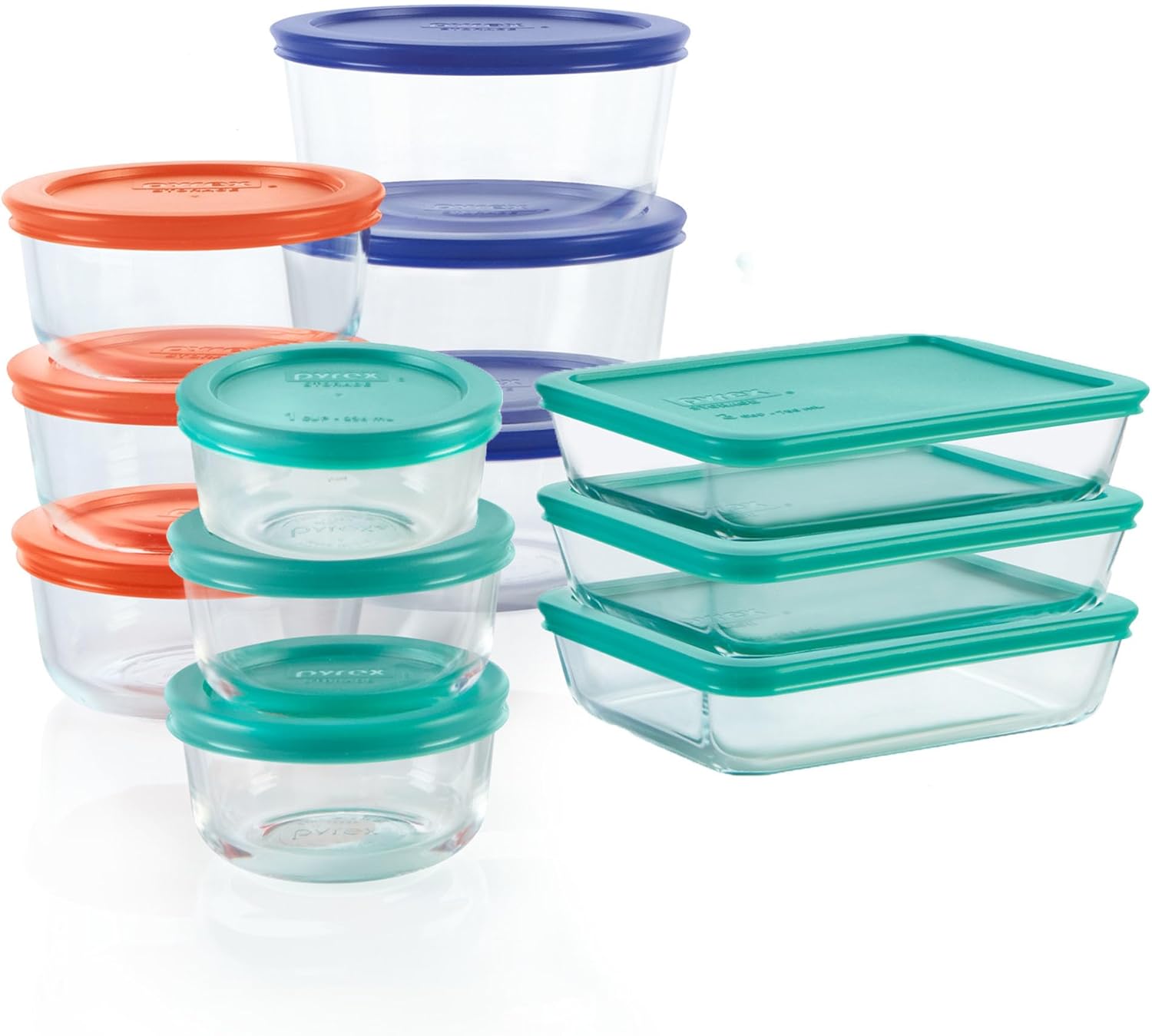 Best for Freezer Portions
Pros
- Nothing to shed at the food contact surface
- Goes freezer to microwave without a transfer
- Storage time stops being something to track
- Glass does not stain or hold odors
Cons
- The lids are still plastic — keep them off in the microwave
- Heavy, and breakable if dropped
- Leave headroom or freezing liquid can crack the glass
The one swap that removes the microwave problem entirely.
Why it matters: every particle count on this page comes from a plastic surface touching food. Glass does not have one.
Check Today’s Price on Amazon →Amazon prices change daily — tap to see today’s price and any current discount.
- Free delivery for Prime members
- Hundreds of thousands of reviews
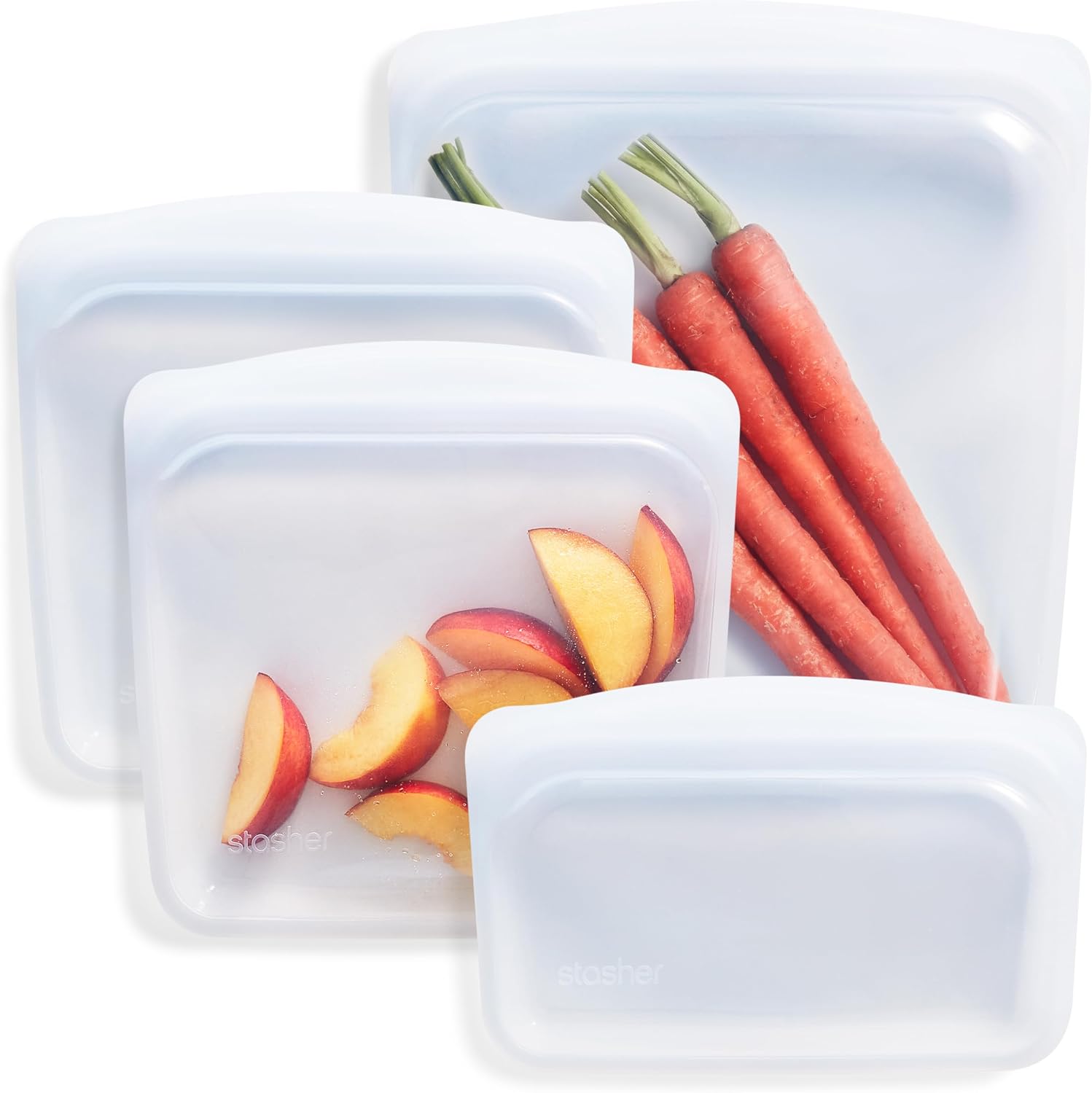 Best Bag Replacement
Pros
- Freezes flat and stacks like a disposable bag
- Replaces a recurring purchase outright
- Will not crack in the freezer the way glass can
Cons
- Silicone is still a polymer, not an inert mineral
- Costs far more up front than a box of zip bags
- Needs drying inside out after washing
Keep the convenience of the freezer bag; drop the single-use film.
Why it matters: the pouch format was the higher-shedding one in the 2023 container study. If you want the format, change the material.
Check Today’s Price on Amazon →Amazon prices change daily — tap to see today’s price and any current discount.
- Free delivery for Prime members
- Dishwasher safe
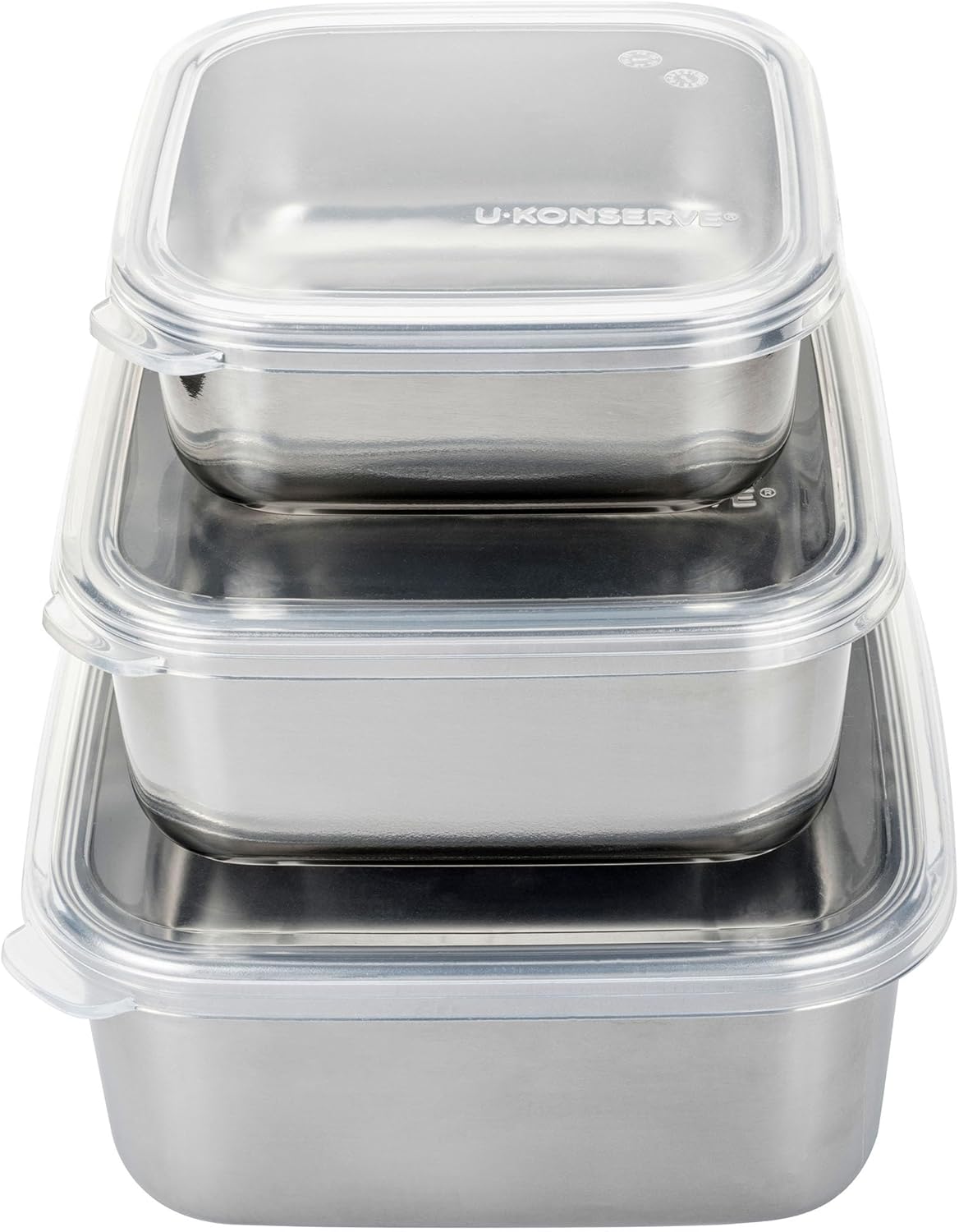 Best Unbreakable Option
Pros
- No polymer on the walls or base — just steel
- Will not break in a bag or a freezer drawer
- Nests to save cupboard space
Cons
- Not microwave safe — it is metal
- Opaque, so you cannot see what is inside
- The lids are silicone, not steel
The container you can hand to a child or throw in a backpack.
Why it matters: the steel body has no polymer surface to shed, at any temperature and over any storage time. The lids are silicone, so keep them clear of the food where you can.
Check Today’s Price on Amazon →Amazon prices change daily — tap to see today’s price and any current discount.
- Free delivery for Prime members
- Three sizes in one box
What We Are Not Claiming
The 180-day study measured chicken sausage in its commercial casing, not a home container, and it was conducted in Iran on products sold there. The particle counts are specific to that product and that packaging; your frozen chili in a deli tub is a different system. What transfers is the comparison — same food, same package, two temperatures — and that comparison was clean and statistically significant.
We are also not claiming a health outcome. Neither study measured one. The Nebraska group did run a cell-viability test, reporting that extracted particles killed 76.70% and 77.18% of human embryonic kidney cells at 1,000 µg/mL after 48 and 72 hours — but that is a petri dish at a concentration no kitchen produces, and it belongs in the “reason to keep researching” column, not the “this will happen to you” column. What we can say is that the exposure is real, it is measurable, and it is easy to lower.
Frequently Asked Questions
Is it safe to freeze food in plastic containers?
It is the mildest storage condition anyone has measured, but it is not zero. In a 2026 Scientific Reports study, packaged chicken sausages stored 180 days at −18 °C ended at 15.44 microplastic particles per 5 grams, against 33.66 for identical sausages at 4 °C — less than half. Both started at 10.45, so even the frozen samples gained particles over six months. Freezing in plastic is defensible for short periods; glass or stainless steel is the upgrade for anything stored long.
Does the fridge release more microplastics than the freezer?
Yes, in the one study that compared them directly on the same food. Over 180 days the refrigerated sausages more than tripled their particle count (10.45 to 33.66 per 5 grams) while the frozen ones rose 48% (10.45 to 15.44). A separate 2023 Environmental Science & Technology study found that refrigeration and room-temperature storage for over six months both released millions to billions of micro- and nanoplastic particles from plastic containers.
What is worse — freezing food in plastic or microwaving it?
Microwaving, by an enormous margin. The 2023 University of Nebraska study measured as many as 4.22 million microplastic and 2.11 billion nanoplastic particles released from a single square centimeter of plastic in three minutes of microwave heating — the highest release of any scenario they tested. Storage, cold or otherwise, was the mild end of their range. Transfer frozen food to glass or ceramic before reheating.
Does freezing make plastic brittle and shed particles?
Particle counts did rise in frozen samples — 48% over six months in the 2026 study — so something is happening, but that study counted particles in food rather than examining the polymer, and it did not test freeze-thaw cycling. Repeated freezing and thawing is the condition most likely to stress a container, and no published measurement of it in a domestic freezer exists yet. Cold storage is the slowest-shedding condition measured so far; it is not inert.
Are freezer bags worse than rigid plastic containers?
The flexible format performed worse in the one head-to-head test. In the 2023 Nebraska study the polyethylene-based reusable food pouch released more micro- and nanoplastic particles than the polypropylene-based rigid containers across the usage scenarios tested. If you are staying with plastic for the freezer, a rigid container is the better of the two; silicone, glass or stainless steel takes the polyethylene film out of the picture entirely.
Does the food itself matter, or only the packaging?
Both, and the food matters more than most people expect. In the 2026 study the sausages made with 55% meat carried 18.66 particles per 5 grams before packaging, nearly double the 10.45 in the 70% version, which the authors attribute to the non-meat fillers and binders. The researchers also found six polypropylene fibers in just 5 grams of the salt and spice additives. Plastic enters processed food at several points before it is ever wrapped.
Sources
- Asadi Qajarloo Z, Arfaeinia H, Jahanara M, Safaei A, Jafari M, Dehghani-tafti A, Khalili Sadrabad E. “Influence of temperature and storage time on microplastic release from packaged sausages.” Scientific Reports 2026; 16(1):23503. https://doi.org/10.1038/s41598-026-53153-8 (PubMed PMID 42173963). All particle counts in the table above are from Table 2 of this paper.
- Hussain KA, Romanova S, Okur I, Zhang D, Kuebler J, Huang X, Wang B, Fernandez-Ballester L, Lu Y, Schubert M, Li Y. “Assessing the Release of Microplastics and Nanoplastics from Plastic Containers and Reusable Food Pouches: Implications for Human Health.” Environmental Science & Technology 2023; 57(26):9782–9792. https://doi.org/10.1021/acs.est.3c01942 (PubMed PMID 37343248). Source of the microwave, refrigeration and room-temperature release figures and the polyethylene-versus-polypropylene comparison.
- Luo Y, Gibson CT, Chuah C, Tang Y, Naidu R, Fang C. “Raman imaging for the identification of Teflon microplastics and nanoplastics released from non-stick cookware.” Science of the Total Environment 2022; 851:158293. https://doi.org/10.1016/j.scitotenv.2022.158293. Background on damaged plastic surfaces as a measured source of particles in food.