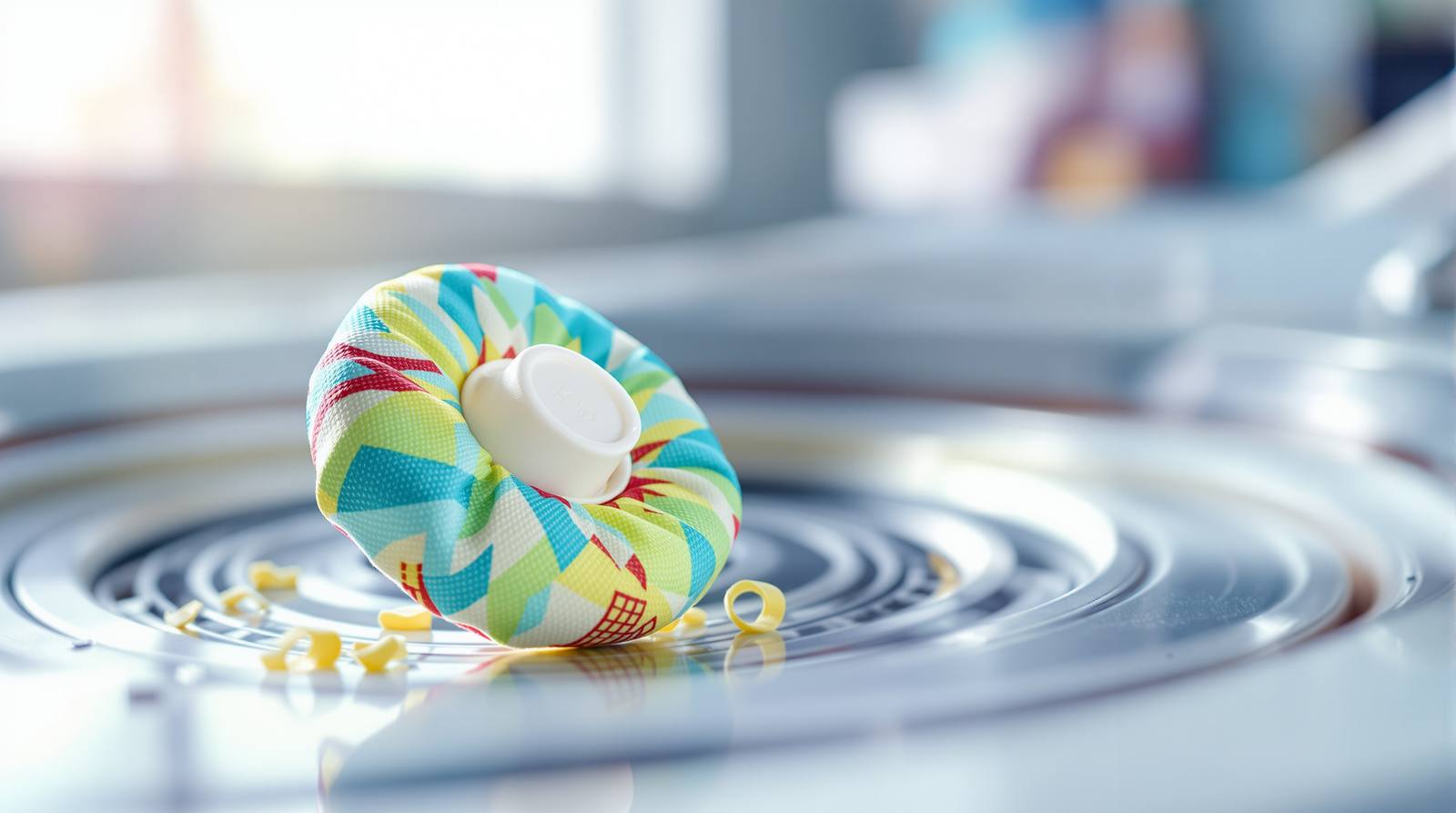
The pod film itself is plastic. The dissolving wrapper is polyvinyl alcohol (PVA or PVOH), a petroleum-derived synthetic polymer. A 2021 peer-reviewed Arizona State University study estimated that roughly 8,000 metric tons of PVA from US laundry and dishwasher pods reaches the environment every year without breaking down — not as woven microplastic fibers, but as a persistent synthetic material that has been shown to bind and carry heavy metals and other pollutants through waterways. The clean swap is any format that never involves a plastic film in the first place: powder in a cardboard box, a paper detergent sheet, or a concentrate tablet in a returnable steel tin.
Nobody looks at a laundry pod and thinks "plastic." That is essentially the point of the design — a soft, colorful, single-serving lozenge that dissolves in a whoosh of suds and is gone. And that reassurance is repeated on the box. The wrapper is water-soluble. It goes away. Move on with your day.
What the marketing does not say is what the wrapper is made of. In 2021, a team at Arizona State University's Rolsky Lab looked at the specific polymer — polyvinyl alcohol — and did the arithmetic on what happens to it after the wash. Their peer-reviewed paper in the International Journal of Environmental Research and Public Health concluded that most of the film survives the treatment plant, and that around 8,000 metric tons of it enters US waterways every year from laundry and dishwasher pods alone. This guide walks through what the study actually measured, whether it matters to your household, and the formats that skip the film entirely without asking you to change how you do laundry.
The bottom line up front: switch away from pods to a powder, sheet, or refill-tablet detergent that never involves a plastic wrapper — the room-by-room plastic-free laundry guide covers detergent, softener, dryer sheets, and the washer drum, and the parallel evidence in the chewing gum study shows how "food-safe" and "biodegradable" polymers actually behave.
Do laundry pods have microplastics?
The specific answer depends on which kind of plastic you mean. Laundry pods do not release fibrous microplastic fragments the way a polyester shirt — or a polyester sheet set — sheds through the wash cycle (one reason to choose natural fibers like organic cotton sheets). What they do contain is a soluble plastic film — polyvinyl alcohol, or PVA — that wraps the detergent dose. When the pod hits the wash water the film dissolves, and every gram of it becomes dissolved synthetic polymer in the effluent that leaves your washing machine.
That is not a small volume. Roughly 20 billion PVA pods are used in US households each year across laundry and dishwasher applications, and the film accounts for a meaningful fraction of each pod's weight. The 2021 Rolsky and Kelkar paper in IJERPH modelled national usage against measured biodegradation rates and estimated that around 17,300 metric tons of PVA enters US wastewater treatment plants every year from pods, of which roughly 8,000 metric tons is released into the environment via effluent and biosolid land application. That is the specific claim the study makes, in a peer-reviewed public health journal, with the data laid out for anyone to check.
What is the film on a laundry pod actually made of?
The pod wrapper is nearly always PVA, sometimes labeled PVOH. It is a synthetic polymer manufactured from ethylene — a petroleum feedstock — via vinyl acetate, hydrolyzed to make the finished vinyl alcohol chain. The resulting material is unusual among plastics because it is genuinely water-soluble, which is what lets a pod disappear on contact with wash water instead of clogging the drum. Every other consumer plastic you can think of, from grocery bags to yogurt tubs, is hydrophobic and holds its shape in water.
That solubility is real, and it is the reason PVA got adopted for pods in the first place. What the pod industry conflates — and what the 2021 study cleanly separates — is dissolving versus biodegrading. Dissolving means the polymer chain leaves the solid form and enters the water as a mixture of long molecules. Biodegrading means microbes eventually eat those molecules and reduce them to carbon dioxide, water, and biomass. The first is a physical change and it happens in seconds. The second is a biological process that requires the right microbes, the right conditions, and enough time — and in a real municipal treatment plant, most of the polymer moves through before that biology completes.
"Water-soluble is not the same as biodegraded. The pod disappears from view; the polymer is still in the water."
| Detergent Format | Plastic in Contact With the Wash | Packaging |
|---|---|---|
| PVA pod (laundry or dishwasher) | PVA film dissolves into wash water each cycle | Plastic tub or bag; some brands use paperboard tubs |
| Liquid detergent | None released to the wash by packaging | Plastic jug (roughly a pound of packaging you throw out per bottle) |
| Powder in cardboard | None | Cardboard box, sometimes with a paper inner liner |
| Paper detergent sheet | None | Compostable paper sleeve or paperboard envelope |
| Refill tablet (e.g. Blueland) | None (naked tablet, no wrapper) | Reusable steel tin plus a compostable refill pouch |
Does PVA really biodegrade in wastewater treatment?
Only in part, and only in the right lab. This is where the industry marketing and the peer-reviewed evidence diverge sharply. Pod brands generally cite the OECD 301B test, a 28-day laboratory biodegradation protocol in which PVA can and does break down. That result is real, but the test uses acclimated microbes at high concentrations under continuously aerated ideal conditions. A US wastewater treatment plant is not that environment. Sludge retention times are shorter, microbial populations vary by season, and the polymer often reaches the plant already diluted across thousands of gallons of household wastewater.
Rolsky and Kelkar pulled together the biodegradation literature and modelled how much PVA a typical activated-sludge plant actually removes. Their central estimate was around 39 percent removed and 61 percent passed through untreated into effluent and biosolids. Multiplied against the roughly 17,300 metric tons of PVA that enters US treatment annually from pods, that yields the 8,000-metric-ton escaped figure. Some of the polymer that leaves in biosolids is then land-applied as fertilizer, which puts it directly into agricultural soil rather than a river — a different fate, but not degradation.
Is PVA harmful to people or the environment?
Two different questions with two different answers. On direct human health, PVA is FDA-cleared as an inert ingredient for uses like film-coating tablets and capsules; there is no established consumer safety issue from using a pod in a normal home laundry load. That is a legitimate reason not to panic if you have a stash of pods under the sink. The environmental question is where the concern actually sits, and it is not really about acute toxicity. It is about the persistence and behavior of 8,000 tons per year of synthetic polymer distributed across US surface water and farmland.
Once PVA is loose in the environment, published research has shown it can act as a carrier for heavy metals and hydrophobic organic contaminants, effectively concentrating pollutants that would otherwise be dispersed and delivering them into aquatic organisms. The National Institute of Environmental Health Sciences and the Environmental Protection Agency both flag the broader problem that persistent synthetic polymers — including soluble ones — are turning up in wastewater, sludge, farmland, and increasingly the food supply, and that the long-term implications for human exposure are still being characterized. Rolsky and Kelkar's earlier 2019 Water Research paper made a related point: microplastic behavior during wastewater chlorination is complex and can shift depending on treatment conditions, meaning we should not assume any plastic input to the wastewater stream is inert.
PVA is not the villain of the microplastic story. Your bloodstream is not full of pod polymer. The point is that the marketing has been telling you the pods disappear cleanly, and the 2021 peer-reviewed data says roughly 61 percent of the polymer moves through the treatment plant untreated. The rational response is to stop buying the format — the alternatives are cheaper and work fine.
What laundry detergents do not contain plastic pods?
Any format that never wraps the detergent in a plastic film in the first place. There are more of these than there used to be, and they cover the full range of budget, scent, and cleaning power that a household actually cares about. The point is not to enroll in a virtuous minimalist ritual — it is to buy the same amount of detergent for the same weekly laundry in a container that is not plastic film. Here are the three formats to prefer, with real named products linked below.
1. Powder detergent in a cardboard box
The oldest format and still the cleanest. A box of Molly’s Suds Original Laundry Powder is a plant- and mineral-based powder in a paperboard tub. It runs roughly $25 and lasts about 120 loads for around 20 cents per wash — on par with a mainstream jug and well under the cost per load of a pod. Scoop, throw it in the drum before the clothes (not the dispenser drawer — drawers are designed for liquid and can clog with powder), and run the cycle. It works in high-efficiency machines and in cold water.
Check Molly's Suds on Amazon →
✓ Ships free with Prime · Free returns · Amazon A-to-z purchase guarantee (on eligible items)
2. Concentrated tablets in a returnable steel tin
The pod-alternative most people miss. Blueland Laundry Detergent Tablets are naked concentrate tablets — no PVA film, no plastic wrapper. You buy the starter with a reusable steel tin, then refills arrive as loose tablets in a compostable paperboard pouch. One tablet per load; drop it in with the clothes. Cleaning power is comparable to a mainstream detergent for typical household soil, and the per-load cost lands roughly where the average pod does. This is the closest 1-for-1 swap if you liked the convenience of pods but want the plastic film gone.
Check Blueland Tablets on Amazon →
✓ Ships free with Prime · Free returns · Amazon A-to-z purchase guarantee (on eligible items)
3. Paper detergent sheets
The lightest-weight option. Earth Breeze Laundry Detergent Sheets are pre-dosed strips of concentrated detergent wrapped only in a paperboard envelope. Tear one in half for a small load, use a whole sheet for a normal load, put it on top of the clothes and run the wash. Compact enough that a two-month supply fits in a drawer, and no plastic anywhere in the packaging. Cleaning power is best on light-to-medium soil; for heavily soiled workwear, a powder or the Blueland tablet is a stronger pick.
Check Earth Breeze on Amazon →
✓ Ships free with Prime · Free returns · Amazon A-to-z purchase guarantee (on eligible items)
How do I switch away from pods without ruining my clothes?
Almost every real switching problem comes from one of two easy-to-fix issues. First, dispenser drawers are designed for liquid detergent, and powder or a sheet dumped into the drawer instead of the drum can clog. Toss powders and sheets straight into the drum before you load the clothes, and the machine handles them the same as a pod. Second, if a load smells musty during the transition, that is not the new detergent — it is the pod residue that has coated the inside of your drum and hoses. Run one empty hot cycle with a cup of white vinegar (nothing else, no bleach), and the smell resolves. From there, use the new detergent on your normal cycles at your normal temperatures. Nothing else changes. While you are rethinking the plastic in your laundry routine, the hamper is worth a look too — a plastic-free laundry basket in cotton, bamboo, or seagrass replaces the flimsy plastic hamper that cracks and sheds in a warm, humid laundry room.
Skip the PVA film in one order
Pick a format that never involves a plastic wrapper — walk through detergent, fabric softener, dryer sheets, and the washer drum itself.
The honest verdict
Do laundry pods contain microplastics? The pods do not shed woven microplastic fibers the way synthetic clothing does, but they are wrapped in a plastic film — polyvinyl alcohol — that has been peer-reviewed as escaping US wastewater treatment plants at a rate of roughly 8,000 metric tons per year. That number is not a headline scare; it is the number the 2021 IJERPH paper landed on after modelling real US pod usage against measured biodegradation rates. And the reason to care is less about acute health harm and more about the persistence of that much synthetic polymer moving through waterways, soil, and the food chain each year.
The practical response is easy. Buy any detergent format that is not a plastic-wrapped pod. Powder in a cardboard box is cheapest and works in every machine. Refill tablets in a returnable steel tin get you the pod convenience without the film. Paper sheets are lightest to store. All three are the same price as a pod or cheaper per load. You do not have to prove PVA is harmful to your body to notice that a product marketed as clean is quietly adding thousands of tons of synthetic polymer to the environment, and to pick a version that doesn’t.
Fix the room where the plastic hides
Laundry is one of the highest-volume touchpoints for household plastic. The room-by-room guide walks through detergent, fabric softener, dryer sheets, and the washer drum itself.
Frequently Asked Questions
The pod film itself is plastic. The dissolving wrapper is polyvinyl alcohol (PVA or PVOH), a petroleum-derived synthetic polymer. A 2021 peer-reviewed study from Arizona State University estimated that roughly 8,000 metric tons of PVA leaves US wastewater treatment plants unmineralised every year, mostly from laundry and dishwasher pods. It is a soluble plastic film, not a microplastic fiber, but it is 8,000 tons of new plastic feedstock hitting waterways annually from a product marketed as clean and modern.
Polyvinyl alcohol, usually printed on the box as PVA or PVOH. It is a synthetic polymer manufactured from petroleum-derived vinyl acetate. It is water-soluble, which is why the pod appears to disappear in the wash, but water-soluble is not the same as biodegraded. The polymer dissolves into the wastewater, then has to be broken down by microbes at the treatment plant. The 2021 Rolsky and Kelkar study measured how much actually does.
Only partially. Rolsky and Kelkar reviewed the biodegradation literature and modelled a typical US treatment plant. They concluded that around 61 percent of PVA passes through untreated. Applied to national laundry and dishwasher pod usage, that works out to roughly 17,200 metric tons entering US wastewater each year, of which about 8,000 metric tons is released into the environment via treated effluent, biosolid land application, and other pathways. The industry-standard OECD 301B biodegradation test that PVA is often marketed under is a lab-controlled 28-day acclimated-microbe test that does not reflect a typical municipal plant.
The direct health risk to a person doing laundry has not been established, and PVA is FDA-cleared as an inert ingredient for uses like film-coating pills. The environmental story is more nuanced. Once PVA reaches waterways it can act as a carrier for heavy metals, hydrophobic organic contaminants, and other pollutants, effectively concentrating them and delivering them into aquatic ecosystems. The public health concern is less about the polymer itself and more about the 8,000 metric tons per year of persistent synthetic material spread across the food chain.
The cleanest swaps are formats that never involve a plastic film in the first place. Powder in a cardboard box (Molly’s Suds, Charlie’s Soap), concentrated tablets in a returnable steel tin (Blueland), paper detergent sheets (Earth Breeze), or bulk liquid in a cardboard-based carton (Branch Basics) all skip the PVA wrapper. Liquid detergent in a plastic jug still uses plastic packaging, but it does not add PVA to the wash water, which is the specific concern this article is about.
Start with one load. Measure the powder or sheet the same way you would a detergent dose, add it to the drum before the clothes (not the dispenser drawer, which is designed for liquid), and run the wash on your normal cycle. Cold water works for almost everything. If a load smells musty, run the empty machine once on a hot cycle with a cup of white vinegar to strip the pod residue that has built up in the drum and hoses. That is usually the only transition step required.
Sources
- Rolsky, C.; Kelkar, V. "Degradation of Polyvinyl Alcohol in US Wastewater Treatment Plants and Subsequent Nationwide Emission Estimate." International Journal of Environmental Research and Public Health, 2021, 18(11), 6027. MDPI open access · PubMed 34199691.
- Kelkar, V.P.; Rolsky, C.B.; Pant, A.; Green, M.D.; Tongay, S.; Halden, R.U. "Chemical and physical changes of microplastics during sterilization by chlorination." Water Research, 2019, 163, 114871. DOI: 10.1016/j.watres.2019.114871.
- US National Institute of Environmental Health Sciences (NIEHS). Plastics and human health — overview. niehs.nih.gov.
- US Environmental Protection Agency (EPA). Microplastics Research. epa.gov.
- US Food and Drug Administration. "Inactive Ingredient Search — Polyvinyl Alcohol." fda.gov, accessed 2026.
- Organisation for Economic Co-operation and Development. "OECD Test No. 301: Ready Biodegradability." OECD Guidelines for the Testing of Chemicals.