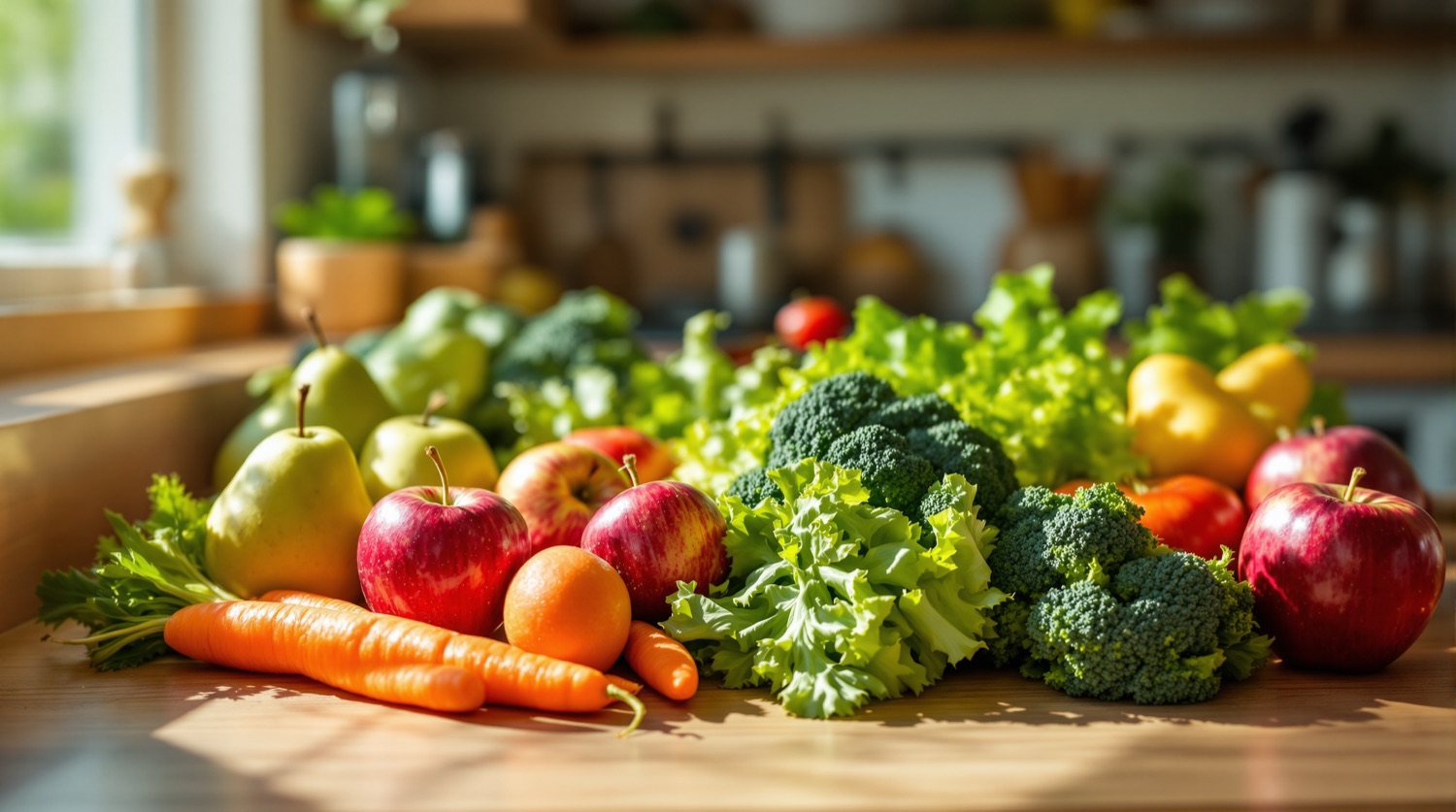
Fruits and vegetables do contain microplastics. The clearest evidence is a 2020 study in Environmental Research by Oliveri Conti et al. at the University of Catania: using scanning electron microscopy and micro-Raman spectroscopy, the team detected micro- and nano-plastic particles inside every apple, pear, carrot, lettuce, potato, and broccoli sample tested. Apples had the highest average load at about 195,500 particles per gram, followed by pears at about 189,500, then broccoli, potatoes, carrots, and lettuce. A separate 2020 Nature Sustainability paper by Li et al. then showed why washing can't fix it: submicron plastics enter through crack-entry sites at the roots and travel up into edible tissue. Do not stop eating produce — the well-documented health gains dwarf the theoretical risk. What you can do is skip the plastic-wrapped clamshells, rinse well, and store your cut produce in glass.
Whole fruit is the food people trust most. It doesn't come out of a factory line, it isn't in a can, and it doesn't have an ingredient list you need a chemistry degree to read. That's exactly why the 2020 Catania paper is jarring: when scientists ran an apple, a pear, a carrot, a leaf of lettuce, a broccoli floret, and a potato through an electron microscope, every one carried tiny plastic particles — and not just on the skin. The same broad finding has now appeared for foods and drinks nobody suspects, from honey to salt to beer to the yolks of supermarket eggs to the rice in your pantry, and now the produce aisle joins the list.
Over the last five years, teams in Italy, China, the Netherlands, and beyond have measured plastics inside plant tissue and traced how it gets there. This guide walks through exactly what the Catania numbers were, how the plastic enters the plant (it's both outside and inside), which fruits and vegetables carried the most, whether washing helps (only partially, and here's why), and the handful of changes that actually cut what you eat.
The bottom line up front: keep eating fruits and vegetables — the health benefit is real and the theoretical microplastic risk is not established. What is worth changing is the plastic around the produce: skip plastic clamshells and bagged pre-cut fruit when you can, rinse and brush before eating, store cut produce in glass instead of plastic, and filter the tap water you use to rinse. For the bigger picture, see our ranking of which foods have the most microplastics and the room-by-room kitchen plastic detox guide.
Do fruits and vegetables have microplastics?
The honest answer is yes. The clearest evidence came in 2020, when a team led by Gea Oliveri Conti at the University of Catania in Italy analyzed six common fresh foods — apples, pears, potatoes, carrots, lettuce, and broccoli — using scanning electron microscopy (SEM) paired with micro-Raman spectroscopy. They published the results in the peer-reviewed journal Environmental Research. Every sample carried micro- and nano-plastic particles, with a median particle size in the low micrometre range. The paper is titled "Micro- and nano-plastics in edible fruit and vegetables. The first diet risks assessment for the general population," and it remains the most-cited direct measurement of plastic in fresh produce.
What made the finding land harder than earlier salt or honey papers is what the plastic was doing there. The particles were smaller than any pesticide residue you'd rinse off, and they weren't only sitting on the skin. A parallel line of research showed the second half of the story: plants can pull submicron plastics up through their roots. In a 2020 Nature Sustainability paper, Li et al. exposed lettuce and wheat to fluorescent polystyrene nanoplastics and watched them enter through the lateral-root emergence sites — the natural cracks where new side roots break out — and travel up into the shoot. Some of the plastic your produce carries came in through the water and soil the plant grew in, which is why washing helps only so much.
How do microplastics get into fruits and vegetables?
Two ways: from outside and from inside. From outside, particles settle on the skin from airborne dust and from atmospheric fallout that now reaches even remote farmland. Many commercial crops are grown on beds covered in plastic mulch film that breaks down into fragments through a season in the sun. And the moment a piece of produce leaves the farm, it usually enters a plastic clamshell, a plastic bag, or a stretch-wrapped tray on the way to the store — more contact points, more shed particles. A waxy skin (apples, pears, cucumbers) traps whatever lands on it.
From inside, the 2020 Nature Sustainability crack-entry paper by Li et al. is the mechanism to know. The researchers showed that submicron plastic beads slip into lettuce and wheat through the natural cracks where lateral roots push out of the main root, then move up through the xylem — the plant's water-transport plumbing — into the leaves and stems. Later work in Environmental Pollution and Chemosphere reproduced the effect in tomatoes, radishes, and cress. This is the part washing can't reach, and it's why the plastic ends up inside every part of the plant, not just on its surface.
| Source | What Happens | Contribution |
|---|---|---|
| Root uptake from soil & irrigation water | Submicron plastics enter at lateral-root cracks and travel up through the xylem into edible tissue (Li et al., 2020) | Major — the part washing cannot remove |
| Atmospheric fallout | Airborne fibers and fragments settle on leaves and skins from the air itself | Moderate — higher on waxy skins that trap particles |
| Plastic mulch film on the farm | Farm-grade polyethylene film degrades under sun over a season, leaving fragments in the soil | Major on affected fields; varies by farm |
| Packaging & produce bags | Clamshells, plastic bags, and stretch-wrap add contact time on the way to the store | Moderate — and it is the one you actually choose |
| Waxes & coatings | Coatings sprayed on apples, pears, and cucumbers hold surface particles in place | Moderate on the affected fruits |
Which fruits and vegetables have the most microplastics?
In the 2020 Catania dataset, apples topped the list, and fruits ranked higher than vegetables on average. The researchers' hypothesis for why: fruit-bearing trees have larger, more established root systems and live longer in the same soil, giving more time and root surface for particles to accumulate; the waxy skins of apples and pears also trap what lands from the air. Leafy vegetables like lettuce, which grow lower to the ground and are harvested young, showed the lowest counts.
| Food | Category | Average particles per gram |
|---|---|---|
| Apples | Fruit | ~195,500 |
| Pears | Fruit | ~189,500 |
| Broccoli | Vegetable | ~126,150 |
| Potatoes | Vegetable | ~117,150 |
| Carrots | Vegetable | ~101,950 |
| Lettuce | Vegetable (leafy) | ~50,550 |
Two honest caveats. First, the counts sound huge because the particles are tiny — the median was around 1–3 micrometres, so a hundred thousand of them together are still invisible. By mass, the plastic is a very small fraction of the food. Second, the paper is one of the first of its kind for produce, and other independent labs are still working on standardized methods to reproduce these numbers on other apple varieties and other farms. Treat the ranking as directional, not as a nutrition label — but not as a reason to dismiss the finding, either. The pattern (fruits above vegetables, waxy skins above leafy) has held up in follow-up work.
"The plastic isn't only sitting on the skin — it goes in through the roots. Washing helps, but the real leverage is what the produce grew in and what it was packaged in."
Does washing produce actually help?
Partly, and it's still worth doing. A firm rinse under running water and a scrub with a produce brush knock off surface dust, atmospheric particles, and the wax coating that holds them in place, and they take some pesticide residue with them. Peeling waxed skins (apples, pears, cucumbers, potatoes) removes more than rinsing alone. What none of that can touch is the plastic already inside the plant, taken up through the roots as Li et al. documented — that particle stays with the produce all the way to the plate.
So washing is a real, cheap fix for the outside layer, and it's a good habit for other reasons. But it is not a full answer, and any product that promises to "remove microplastics from produce" is overselling. The most effective habits are further up the chain: skip the plastic clamshell and buy loose produce in your own cloth bag when you can, buy from local growers whose fields you can ask about, and rinse with tap water that itself has been filtered — because if your rinse water carries particles, you're re-depositing them onto the skin you just cleaned.
Are the microplastics in produce dangerous?
Here's where honesty matters. The counts in the Catania paper are real, and the Li et al. crack-entry mechanism is real. But both studies were designed to measure how much plastic is present and how it enters the plant — not to test what those particles do once they're inside a person. The dose-response research in humans is still very early, and no one should read a health verdict into these measurements that the data cannot support yet.
What we do know is broader: microplastics are now being detected throughout the human body — in blood, in placentas, in lungs, in the liver, and even in the brain — and researchers are still working out what, if anything, that means. Produce is one exposure route next to drinking water, food packaging, and hot liquid in plastic. The reasonable stance is neither panic nor dismissal: you do not have to prove the particles are harmful to decide that trimming the avoidable exposure is worth doing.
This is the most important sentence in the article. The measured health gains from eating produce — lower cardiovascular disease, lower cancer risk, lower all-cause mortality — are well-established, and they easily dwarf the theoretical risk from the tiny plastic load inside them. The correct response is eat more produce, and cut the plastic you can actually choose: the clamshell, the bag, the plastic tub you store the leftovers in.
How do you reduce the microplastics you eat with your produce?
You can't buy plastic-free apples and you can't scrub the plastic out of a leaf, so the leverage is what's around the produce and what you do with it at home. Four moves do most of the work: buy loose produce in cloth or paper instead of a plastic clamshell whenever you can; rinse well under running water with a brush; store cut produce in glass instead of plastic tubs; and filter the tap water you use to rinse and to store cut fruit in the fridge — because rinse water is a real exposure route, and it's the one input in the chain you can actually clean.
Start with the water, because it's the highest-volume input in the room and it doubles as the rinse water for everything you eat raw. A pitcher that carries a specific microplastics claim — certified under NSF/ANSI 401, or a rated hollow-fiber pore size — measurably cuts particle counts; see our guide to the best water filter pitchers for microplastics. Then get your cut fruit and prepped vegetables off plastic: store them in glass containers, wrap half-cut produce in beeswax wraps instead of cling film, and freeze extras in platinum-cured silicone bags instead of a disposable plastic freezer bag. The picks below are the simplest, longest-lasting ways to do all of that.
Fix the sources that actually matter
The plastic inside the apple you can't change. The plastic around it, on top of it, and stored with it — you can. Start with the rinse water, then move the fridge onto glass.
The swaps that cut the most plastic you eat with your produce
You cannot buy a microplastic-free apple, and no home appliance filters plastic out of a piece of fruit. What you can buy is a shorter path between the plant and your plate — less plastic touching the produce, cleaner water rinsing it, and glass instead of plastic storing it. These are the four real, currently-sold tools that do the most work. Prices and availability change, so check current listings.
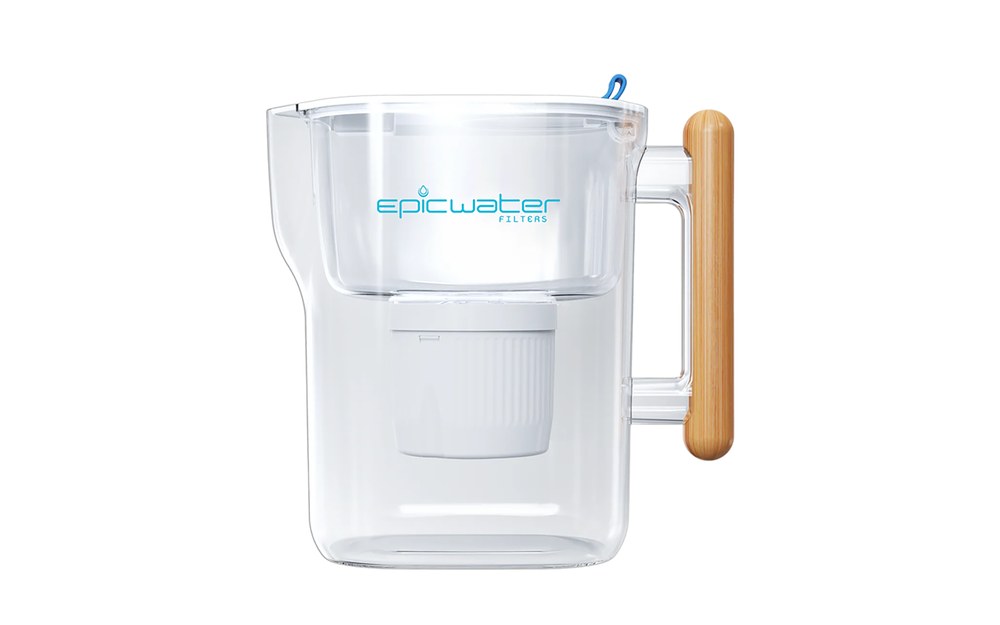
1. Epic Pure Water Filter Pitcher — Best Overall for Microplastics
 Best Overall
Reviewers point to published independent lab data and a filter rated around 150 gallons, far longer than a Brita, as the reasons they trust it, and several describe the slow, deliberate drip as reassuring rather than annoying. The honest downsides: owners report the filtration is genuinely slow and not the pick if you want a glass of water in a hurry, and third-party complaints mention cracked plastic, flip-top lids that stick, and water that spills or leaks from the lid when you pour a full pitcher.
The clearest evidence on this list: Epic posts its independent lab results publicly, so you can see the 99.9% microplastic-removal data instead of trusting a slogan on the box.
Why it's safe: The hollow fiber membrane physically blocks microplastic particles down to ~1 micron, while the carbon stage handles chlorine, lead, and PFAS — all in a BPA-free Tritan body.
Check Today’s Price on Amazon →Amazon prices change daily — tap to see today's price and any active discount.
- Free delivery & returns for Prime members
- Sold & shipped by Amazon
- Thousands of verified reviews
The tap water you use to rinse fruit and to store cut fruit in the fridge is a real produce-adjacent input, and it's the one you can actually clean. The Epic Pure is the clearest choice: its dual-stage design uses a hollow fiber membrane as the primary microplastic barrier, and Epic publishes the independent lab results to back the 99.9% removal claim — transparency most competitors don't match.
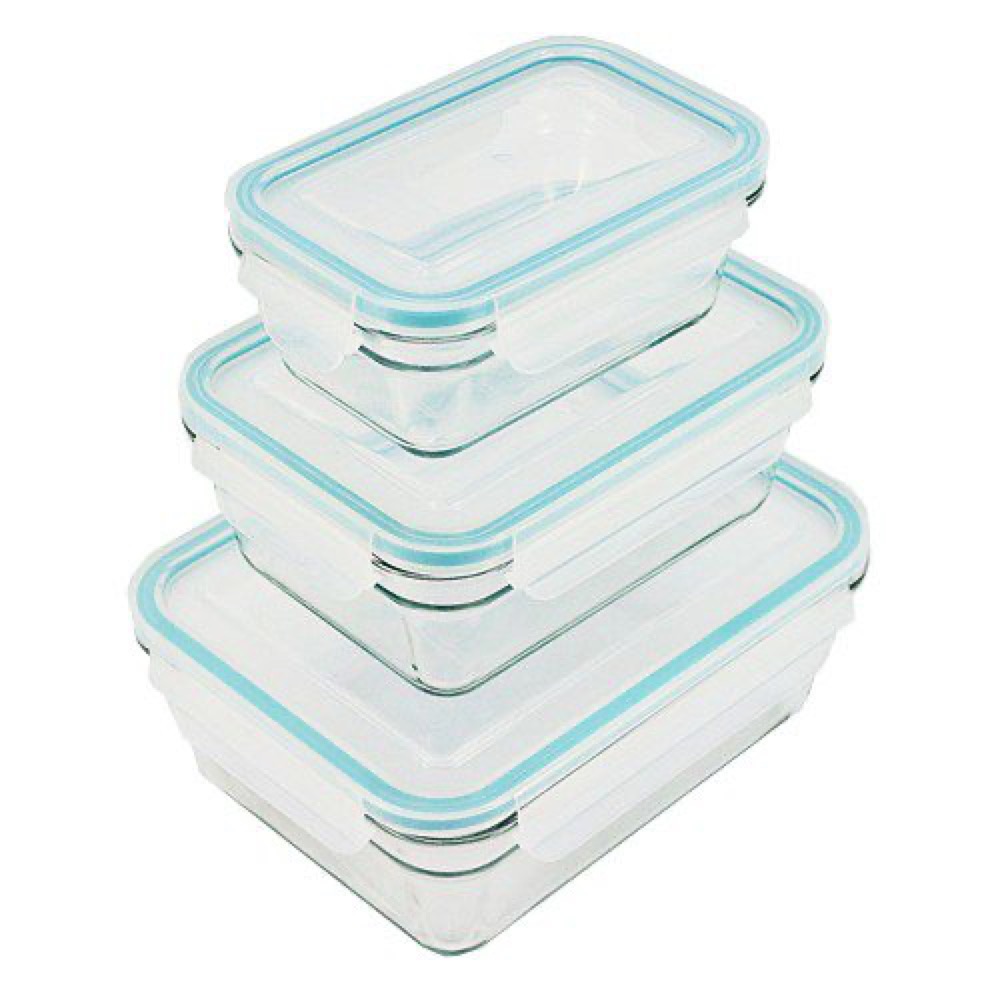
2. Glasslock Oven Safe Container Set (3-Pack) — Best for Cut Produce
 Best for Cut Produce
Longtime owners like that the glass bodies are oven-, microwave-, and freezer-safe and that the snap-lock lids seal tight enough to hold salad-dressing-slick greens. The honest downsides run through the lids, not the glass: reviewers report cracked lids, snapped locking tabs, and mold building up in the rubber gaskets if they are not dried well. Some buyers also received sets with a locking piece missing, and several flag slow, hard-to-reach customer service when they needed a replacement part.
Three stackable glass containers in one box — enough to store a week of prepped fruit and vegetables without a single plastic tub.
Why it's safe: Your cut fruit and prepped vegetables sit on inert tempered glass, not plastic — so watery, acidic, cold-stored foods can’t leach or pick up shed particles. The BPA-free lids seal with a food-grade silicone gasket that only touches the rim.
Check Today's Price on Amazon →Amazon prices change daily — tap to see today's price and any active discount.
- Free delivery & returns for Prime members
- Sold & shipped by Amazon
- Thousands of verified reviews
Once you've sliced an apple, halved a cucumber, or washed a bag of greens, the container it sits in for the next three days matters more than the packaging you bought it in. Glass eliminates the shed-particle path entirely, and the 3-pack is the cheapest way to retire a fridge full of plastic tubs in one purchase.
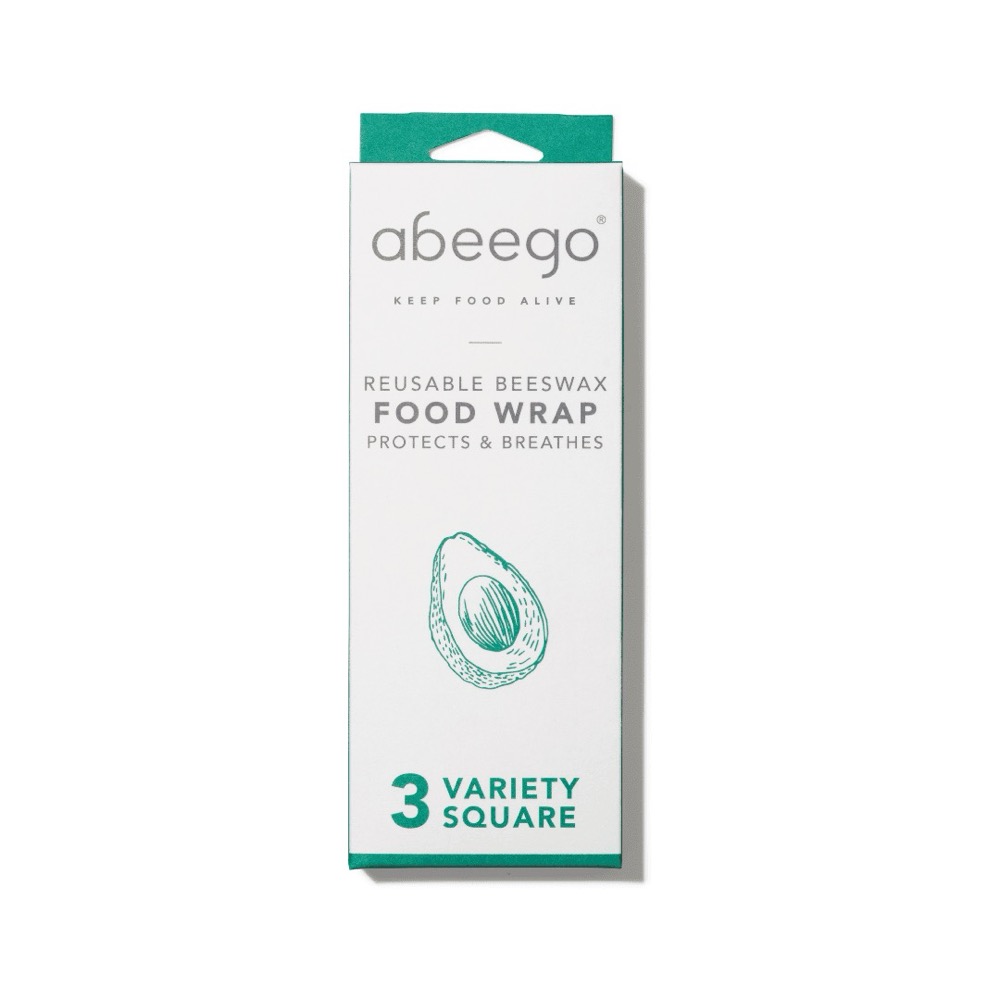
3. Abeego Beeswax Food Wrap — Best for Half-Cut Produce
 Best for Half-Cut Produce
Wrap the half-eaten cantaloupe, the cut side of a lemon, or a wedge of watermelon in something that keeps it fresh without touching cling film to the fruit itself.
Why it's safe: A breathable hemp-and-organic-cotton blend coated only in beeswax, pine resin, and jojoba oil — no PVC, no PFAS, and none of the DEHA plasticizers that leach from cling film.
Check Today's Price on Amazon →Amazon prices change daily — tap to see today's price and any active discount.
- Free delivery & returns for Prime members
- Sold & shipped by Amazon
- Hundreds of verified reviews
Cling film is the piece of kitchen plastic that touches the most produce, because we reach for it every time we half-eat a lemon, avocado, or melon and drop it back in the fridge. Abeego's beeswax wrap does the same job with none of the shed particles or the DEHA plasticizers, and the breathable weave actually extends fresh-produce shelf life. The variety pack covers small, medium, and large so it replaces the whole roll in one go.
4. Stasher Reusable Silicone Bag Starter Kit — Best for Freezing Extras
 Best for Freezing Extras
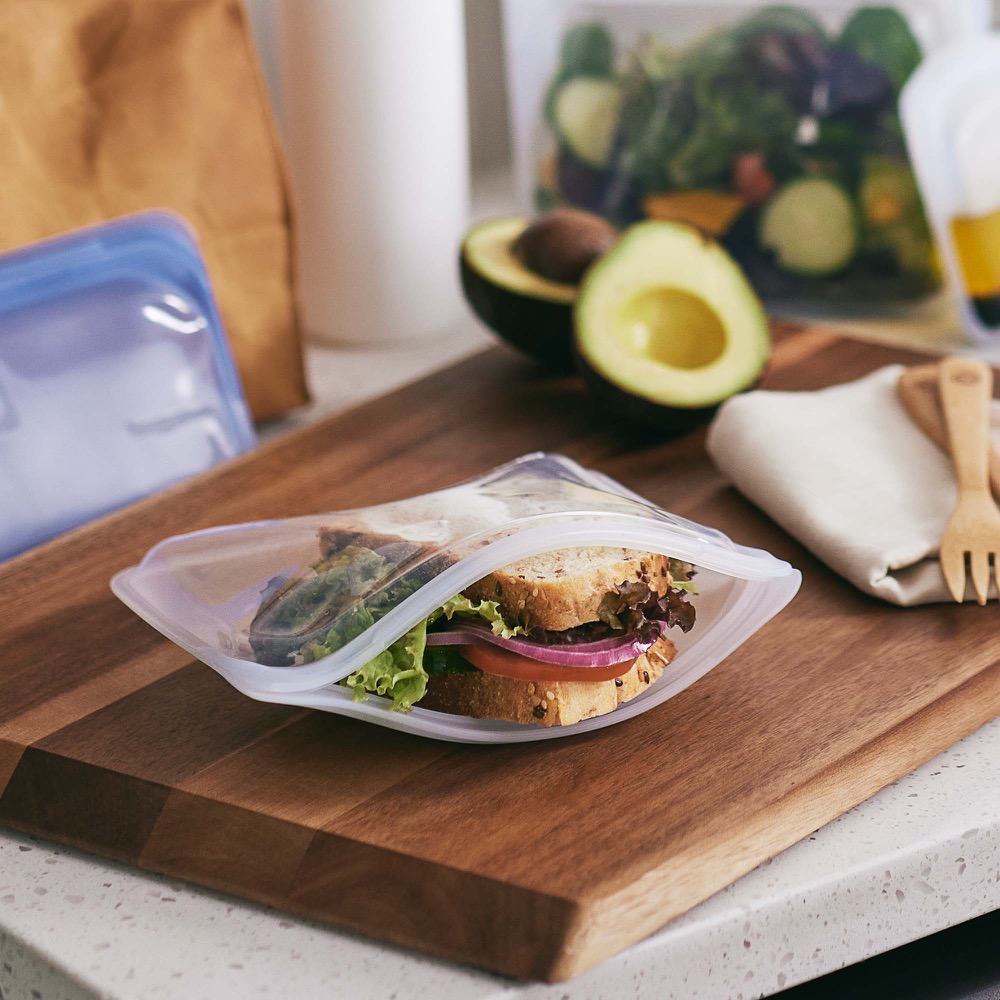
For freezing berries or peppers, marinating vegetables, or anything you'd reach for a plastic freezer bag, Stasher's platinum-cured silicone is the upgrade — sturdier than any disposable bag and free of the chemicals that migrate from thin plastic film. The patented Pinch-Loc seal is genuinely airtight and leakproof, so it holds thawing juice without freezer drips.
It's freezer safe to -70°F and goes straight to the microwave or a 425°F oven. The starter kit covers the everyday sizes — sandwich, snack, and stand-up half-gallon — so a whole box of single-use bags can retire in one purchase.
Owners like that the platinum silicone bags go from freezer to microwave and replace throwaway plastic for years. The honest gripes: smell and stain retention come up often, with reviewers noting garlic and strong odors linger even after washing; the pinch-lock seal can be fiddly to open and close; and the seams are slow to dry, which can invite mildew if you do not air them out.
Freeze berries, chopped vegetables, and cut fruit in airtight silicone instead of a leak-prone plastic freezer bag — then thaw in the same bag, no transfer needed.
Why it's safe: Platinum-cured silicone — the highest-purity, chemically inert grade — with no plastic, PVC, BPA, lead, latex, phthalates, or PFAS.
Check Today's Price on Amazon →Amazon prices change daily — tap to see today's price and any active discount.
- Free delivery & returns for Prime members
- Sold & shipped by Amazon
- Tens of thousands of verified reviews
Got berries you can't finish, a pepper you halved, or a bag of chopped vegetables you're prepping for the week? Freeze them in platinum-cured silicone instead of a plastic freezer bag — Stasher's Pinch-Loc seal holds thawing juice without dripping, and it never sheds the thin plastic film a disposable bag does.
Want the Full Home Protection Guide?
A basket of apples is one plastic touchpoint among dozens in a typical day. The Complete Plasticproof Guide covers every room — kitchen, nursery, bathroom, bedroom — with 80+ product recommendations backed by 47+ studies.
The honest verdict
Do fruits and vegetables have microplastics? Yes — the 2020 Oliveri Conti study in Environmental Research detected them inside every apple, pear, carrot, lettuce, potato, and broccoli sample tested, with apples averaging about 195,500 particles per gram, and the 2020 Li et al. paper in Nature Sustainability showed why washing can't fix it: plants can pull submicron plastics up through their roots. Those studies measured how much plastic is present and how it enters the plant, not what it does to the body. So the accurate takeaway is proportion, not alarm.
The practical response is easy, because the plastic around your produce is the plastic you can actually change. Skip the plastic clamshell and buy loose produce in your own cloth bag whenever your store lets you. Rinse well under running water with a produce brush. Store cut fruit and prepped vegetables in glass instead of plastic tubs. And filter the tap water you rinse with. None of that removes the plastic already inside the plant — but every one of those changes cuts the exposure you're actually adding. And the most important sentence in the whole article: keep eating fruits and vegetables.
Cut the plastic that actually adds up
The apple itself you can't change. The clamshell, the produce bag, and the plastic tub the leftovers sit in — you can.
Frequently Asked Questions
The peer-reviewed evidence is that they do. A 2020 study in Environmental Research from the University of Catania (Oliveri Conti et al.) analyzed apples, pears, carrots, lettuce, potatoes, and broccoli using scanning electron microscopy and micro-Raman spectroscopy and detected micro- and nano-plastic particles in every sample. Apples averaged the highest count at about 195,500 particles per gram; pears about 189,500; broccoli about 126,150; carrots about 101,950; potatoes about 117,150; and lettuce the lowest at about 50,550. A separate 2020 Nature Sustainability paper showed lettuce and wheat roots can pull submicron plastics up into the edible plant tissue through crack-entry sites, which is why the plastic isn't only sitting on the skin.
Two ways: from outside and from inside. From outside, particles land on the skin from airborne dust, from mulched plastic film used on many farms, and from plastic packaging and produce bags, and any wax coating traps them there. From inside, the 2020 Nature Sustainability crack-entry study by Li et al. showed submicron plastics enter through the lateral-root emergence sites and travel up into the shoot, so the plant itself carries some of the plastic — which is why washing, while worth doing, cannot clean it all off.
In the Catania 2020 dataset, apples had the highest average particle count (about 195,500 per gram), followed by pears (189,500), broccoli (126,150), potatoes (117,150), carrots (101,950), and lettuce (50,550). The pattern the researchers saw was that fruits carried a higher microplastic load than vegetables on average — likely because they spend longer above ground and often wear a waxy coating that traps atmospheric particles.
Only some. A firm rinse with a produce brush knocks off surface dust, wax, and the airborne particles clinging to the skin — that's still worth doing, and it removes some pesticide residue too. What it cannot touch is the plastic already inside the plant, taken up through the roots as the 2020 Nature Sustainability paper showed. Peeling waxed skins (apples, pears, cucumbers) removes more than washing alone, but you also lose the fiber. The realistic goal is reduction, not elimination.
There isn't good direct evidence yet. Organic farming avoids some plastic-derived inputs but still uses plastic mulch, plastic irrigation, plastic bins, and plastic packaging on the way to the store. Because the biggest exposure pathways are atmospheric fallout and root uptake from soils that all farms accumulate over time, organic is unlikely to be dramatically cleaner. The bigger swap is skipping the plastic bag and clamshell your produce is packaged in and rinsing well at home.
The health risk isn't established. The Catania and Nature Sustainability papers measured how much plastic is present and how it enters the plant, not what those particles do inside the human body. That said, microplastics are increasingly detected in human blood, organs, and even the brain, and produce is one exposure route among many next to drinking water, food packaging, and hot liquid in plastic. Do not stop eating fruits and vegetables — the well-documented benefits of eating them dwarf the theoretical risk. Trim the avoidable exposure (skip plastic-wrapped produce, wash well, store in glass) and eat more of them, not less.
Sources
- Oliveri Conti G, Ferrante M, Banni M, Favara C, Nicolosi I, Cristaldi A, Fiore M, Zuccarello P. "Micro- and nano-plastics in edible fruit and vegetables. The first diet risks assessment for the general population." Environmental Research, 2020;187:109677. (First direct measurement of micro- and nano-plastics in apples, pears, potatoes, carrots, lettuce, and broccoli by SEM + micro-Raman; apples highest at ~195,500 particles/g.)
- Li L, Luo Y, Li R, Zhou Q, Peijnenburg WJGM, Yin N, Yang J, Tu C, Zhang Y. "Effective uptake of submicrometre plastics by crop plants via a crack-entry mode." Nature Sustainability, 2020;3:929–937. (Demonstrated that lettuce and wheat roots take submicron plastics up into edible tissue through lateral-root emergence sites.)
- "Micro- and nano-plastics in edible fruit and vegetables" — DOI record for the Oliveri Conti et al. paper (Elsevier).
- World Health Organization. "Dietary and inhalation exposure to nano- and microplastic particles and potential implications for human health." WHO Report, 2022. (Reviews current evidence on ingestion of microplastics through food and the state of human-health research.)
- Leslie HA, van Velzen MJM, Brandsma SH, et al. "Discovery and quantification of plastic particle pollution in human blood." Environment International, 2022;163:107199.