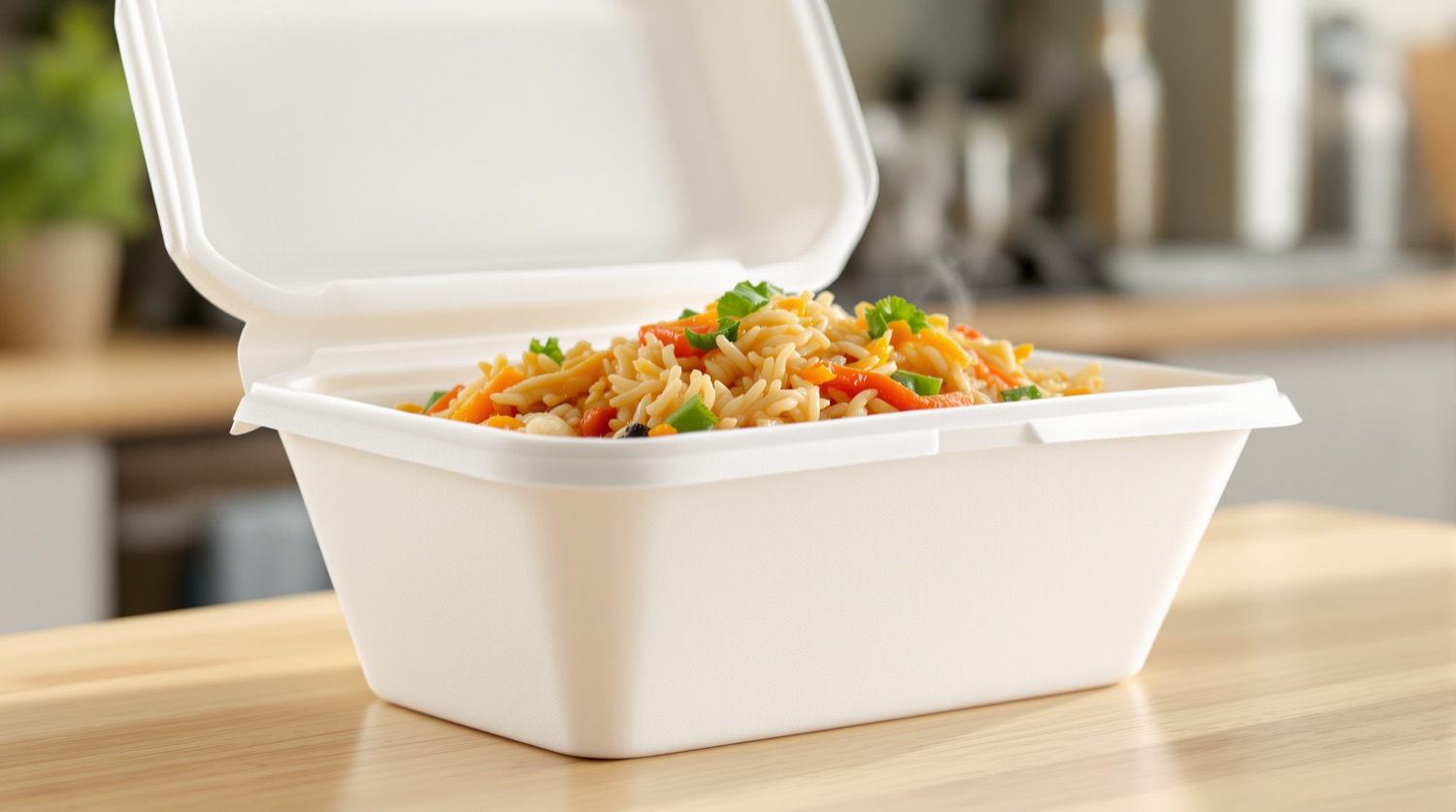
The chemical question and the particle question have different answers, and almost everything written about foam takeout containers blurs them together. On the chemical: the EFSA food-contact panel re-examined styrene in 2025 and concluded there was “no evidence that styrene is genotoxic following oral exposure”, and the US FDA clears polystyrene for food contact at no more than 1% residual styrene monomer. On the particles, nobody regulates anything: when Hu and colleagues poured hot water into expanded polystyrene takeout boxes and counted what came off, they measured 2.82 million microplastic particles per liter — 148 times more than polypropylene boxes tested the same way, with more than 96% of the particles under 10 micrometers. Foam is the worst common takeout material for shedding, and heat is what triggers it.
Expanded polystyrene is the white foam that hot soup, fried rice and a half-rack of ribs arrive in. It is made by blowing steam through small beads of polystyrene until they swell and fuse, which is why it is mostly trapped air: light, cheap, and an excellent insulator. That last property is the reason restaurants like it. It is also the reason it meets your food at the exact moment the food is hottest.
Worth clearing up first, because it changes what you are actually searching for: Styrofoam is a registered trademark, and it does not belong to the box. DuPont holds it for extruded polystyrene building insulation, and the company states plainly that “there isn't a cup, food container, cooler or packaging material in the world made from Styrofoam™ Brand material.” What your takeout comes in is expanded polystyrene, or EPS — a different, cheaper foam. Everything below is about EPS, which is what everyone means.
The bottom line up front: a foam container is not a chemical emergency, and the regulators who have actually run the numbers say so. What it is, measurably, is the leakiest common food container for plastic particles once hot food goes in — by a factor of over a hundred against the polypropylene box the restaurant next door uses. The practical move is not panic, it is transfer: tip hot food out of foam and onto a plate or into glass within a few minutes, and never reheat in it. Related reading: what lines a paper cup, microwaving plastic containers, and microplastics in food packaging.
Are Styrofoam containers safe?
For the chemical that worries people most — styrene — the honest answer is that the exposure from eating out of a foam box is small and has been measured repeatedly. For the plastic particles the foam sheds into hot food, the honest answer is that it is the worst performer of any common container material tested, and no agency anywhere has set a limit on it.
Both halves are true at once, and that is why the internet argues about this. A page that only reports the styrene numbers will tell you foam is fine. A page that only reports the particle numbers will tell you it is a disaster. The evidence supports neither headline on its own.
How many microplastics does a foam container release into hot food?
The cleanest measurement comes from a 2023 study in Food Additives & Contaminants: Part A by J.-L. Hu and colleagues at Jinan University and the Guangzhou Customs Technology Center. They took three kinds of real take-out containers — polypropylene, polyethylene and expanded polystyrene — ran hot water through them, and identified what came off using micro-Raman spectroscopy, which fingerprints each particle's polymer rather than just counting specks.
| Container material | Particles released per liter of hot water | Compared with polypropylene |
|---|---|---|
| Expanded polystyrene (the white foam box) | 2,820,000 | 148× more |
| Polyethylene (soft, flexible tubs and bags) | 101,000 | 5.3× more |
| Polypropylene (the rigid clear or black box, marked 5) | 19,000 | baseline |
Particle sizes ran from 0.8 to 38 micrometers, and over 96% of them were smaller than 10 micrometers — far below what an eye can see, and small enough that the research literature treats them as biologically available rather than simply passing through. The authors tied the gap to the material itself: foam is a loose, porous structure with a rough internal surface, so warmth and slight mechanical force flake it apart in a way a solid molded wall does not.
A second team reached the same ranking from a different direction. T. Jin and colleagues at Nankai University, publishing in the Journal of Hazardous Materials in 2024 with a co-author at the University of Massachusetts Amherst, measured release per square centimeter of container surface rather than per liter of liquid. Hot water pulled between 285,700 and 681,500 particles per square centimeter, and the order they reported was polystyrene first, then polypropylene, then PET, then compostable polylactic acid. Microwaving released less than hot water did, between 171,900 and 301,600 per square centimeter — a result worth noting, because it says the long warm soak matters more than the short blast.
That team went one step further than counting. They isolated the particles and the dissolved organic substances that actually came out of the containers and put them on human intestinal cells (Caco-2, the standard line for gut-lining work). Cell viability dropped, and the leachate interfered with the cells' energy metabolism. That is a laboratory result at laboratory doses, on cells in a dish, not a finding about people — but it is the first time anyone tested what real containers released rather than lab-made reference plastic.
Is the styrene in a foam container dangerous?
Styrene is the building block polystyrene is made from, and a little of it always stays behind unreacted in the finished plastic. It is also a chemical with a genuinely alarming-sounding classification history, which is where most of the fear comes from.
| Body | What it concluded | What exposure it was judging |
|---|---|---|
| IARC, Monograph Vol. 121, 2019 | Styrene is Group 2A, probably carcinogenic to humans — upgraded from Group 2B in 2002 | Mainly occupational inhalation in plastics manufacturing |
| US National Toxicology Program, Report on Carcinogens | Reasonably anticipated to be a human carcinogen, first listed 2011 | Limited human evidence, sufficient animal evidence; workplace exposure |
| EFSA food-contact panel, 2025 | “No evidence that styrene is genotoxic following oral exposure”; a 40 µg/kg migration limit is “not of safety concern” | Styrene swallowed in food from packaging |
| EFSA, 2020 | Migration below 10 µg/kg for most foods, up to 230 µg/kg in the worst case; dietary exposure around 0.1 µg per kg of body weight per day | Measured migration from styrenic packaging across the food supply |
| US FDA, 21 CFR 177.1640 | Polystyrene cleared for food contact at ≤1% residual styrene, tightened to ≤0.5% for fatty foods | The finished plastic, before any food touches it |
Read the right-hand column and the apparent contradiction dissolves. The cancer classifications rest overwhelmingly on breathing styrene vapor at industrial concentrations for a working lifetime, which is a different exposure from the roughly 0.1 micrograms per kilogram of body weight per day EFSA estimates people swallow from packaging. For a 70-kilogram adult that is about seven millionths of a gram a day, and EFSA notes it sits in the same range as the styrene naturally present in foods such as cinnamon and strawberries.
The 2025 re-assessment is the most recent word and the most directly relevant, because it was commissioned specifically to answer what the 2019 cancer upgrade meant for food packaging. The EFSA panel found no genotoxic hazard by mouth and judged the proposed migration limit protective. That is the honest state of the chemical question, and it deserves to be reported as the reassurance it is — which is exactly why the particle question needs reporting separately rather than being folded into it.
Does what you put in the container change the answer?
Substantially, and in a predictable direction. Three things drive anything out of a plastic and into food: heat, fat, and time. A foam box delivers all three when it holds a hot greasy meal that sits in a car for twenty minutes.
Jiae Wang and colleagues mapped exactly that in Heliyon in 2023, varying temperature, acidity and contact time on polystyrene containers. Release peaked at the harshest combination — alkaline conditions, 100°C, six hours — at 36 microplastic items per container and 2.58 micrograms per liter of styrene monomer, roughly double what the same containers gave up under acidic conditions. Their summary of the drivers was blunt: high temperature and long duration, above all else.
The fat half shows up in the regulation itself. The FDA sets a tighter residual-styrene ceiling for polystyrene used with fatty foods — 0.5% rather than 1% — precisely because oil pulls styrene out of the plastic more readily than water does. EFSA saw the same pattern in real migration data: the highest numbers came from fatty foods and from containers with a lot of surface touching a little food, which describes a shallow foam clamshell holding fries almost perfectly.
How much does a takeout habit actually add up to?
F. Du and colleagues at East China Normal University answered this the direct way. They bought take-out containers in five cities, rinsed them, and counted what was already sitting in them before any food arrived. Every single container had microplastics in it, from 3 to 29 pieces each, and polystyrene boxes with a rough surface held the most. Their estimate for someone ordering take-out four to seven times a week was 12 to 203 particles swallowed per week from the containers alone.
Two things make that number more useful than it first looks. It is for particles already loose in a dry container — it does not include anything hot food shakes loose, which the hot-water studies show is a far larger quantity. And the researchers found the particles came from two places: the atmosphere settling into open containers during packing, and flakes off the container's own inner surface. Only the second is something the material choice can fix.
Are foam containers being banned?
In a growing number of places, yes — though on litter and recycling grounds rather than food-safety ones. New York State adopted one of the broadest, and the Department of Environmental Conservation has barred food service providers and stores from selling or distributing disposable foam food containers statewide since 1 January 2022, along with polystyrene loose fill packing peanuts. The law was amended in 2024 to extend to foam cold-storage containers such as coolers from 1 January 2026.
What that means for you day to day is simply that the alternative already exists wherever the rule applies: restaurants in those states switched to molded fiber, paperboard or rigid polypropylene without the sky falling. If foam still shows up in your takeout bag, it is a choice your restaurant made, and one you can often change by asking.
What should you use instead?
You cannot control what the restaurant packs your food in. You can control two things that matter more than the material: how long hot food stays in it, and whether it ever gets reheated in it.
| What the food is in | Particle shedding into hot food | Safe to reheat in? | The practical rule |
|---|---|---|---|
| Expanded polystyrene foam | Highest measured — 2.82 million particles/L in hot water | No | Transfer within a few minutes; never microwave |
| Polypropylene (rigid, marked 5) | Lowest of the plastics tested — 19,000 particles/L | Only if the maker says so, and ideally not | The best plastic to be handed; still tip it out to reheat |
| Molded fiber / paperboard | Not a polystyrene source; grease-resistant coatings vary and are not disclosed | No | Better than foam for particles, but the coating is an open question |
| Glass | None — it is inert | Yes, lid off | What to transfer leftovers into the moment you get home |
| Stainless steel | None | Oven and stove, not microwave | What to carry food out in when you get the choice |
The single highest-value habit is the transfer. Hot food in foam is a timed exposure — the Heliyon work shows release rising with every hour of contact — so moving dinner onto a plate when you sit down and the leftovers into glass before they go in the fridge removes most of the contact time for free. Reheating in the container is the one thing to never do, and it is also the most common: the box is right there, and it is the single worst way to use it.
What to use instead of the foam box
None of this needs an appliance. It needs something to carry hot food in when you have the choice, and something inert to move leftovers into when you don't. These are three we already recommend elsewhere on the site, picked here for this job. Prices and availability change, so check current listings.
1. LunchBots Thermal Insulated Container — Best for Carrying Hot Food Out
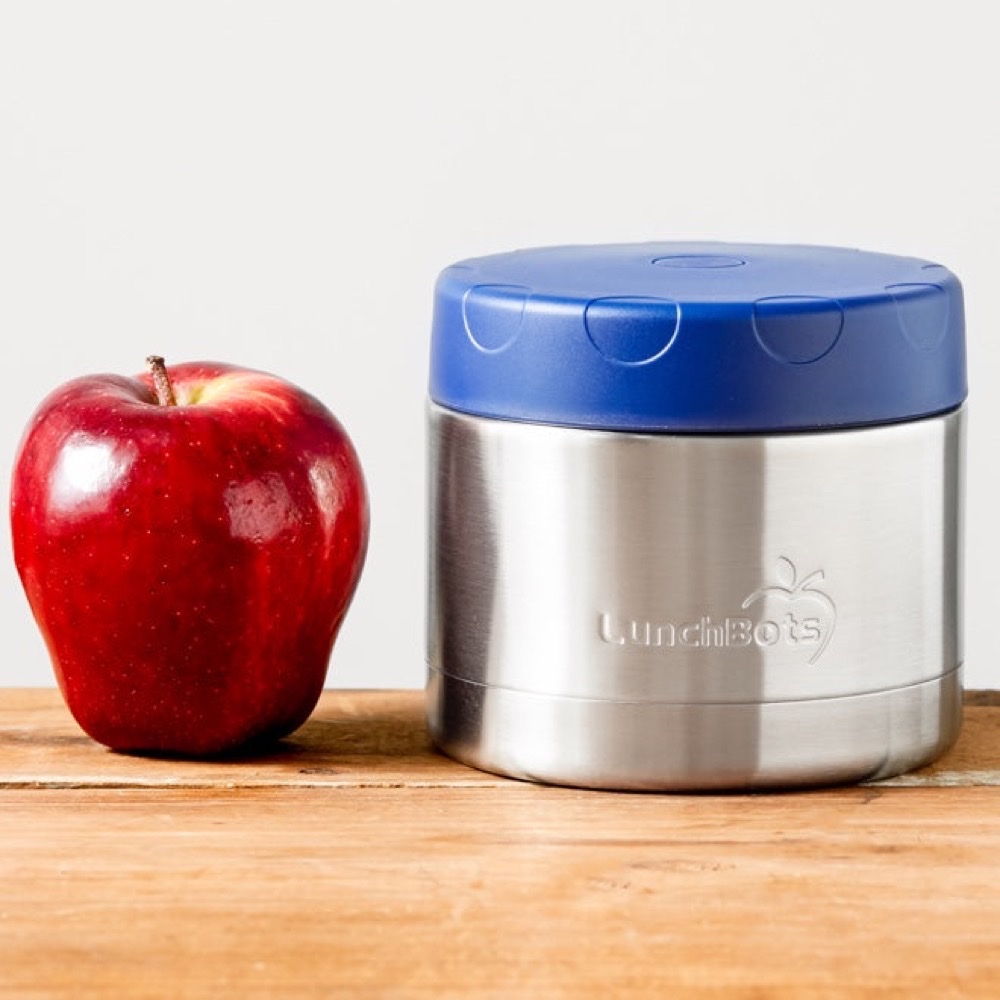 Best for Hot Food
Hand it over at a counter that offers to pack your food, or fill it at home — either way the hot food never meets a foam wall.
Why it's safe: Both the interior and the lid are stainless steel and silicone, so there is no polystyrene, no polypropylene and no coating between the heat and the food.
Check Today’s Price on Amazon →Amazon prices change daily — tap to see today's price and any active discount.
- Free delivery & returns for Prime members
- Sold & shipped by Amazon
- Thousands of verified reviews
2. Glasslock Oven Safe Container Set — Best to Transfer Leftovers Into
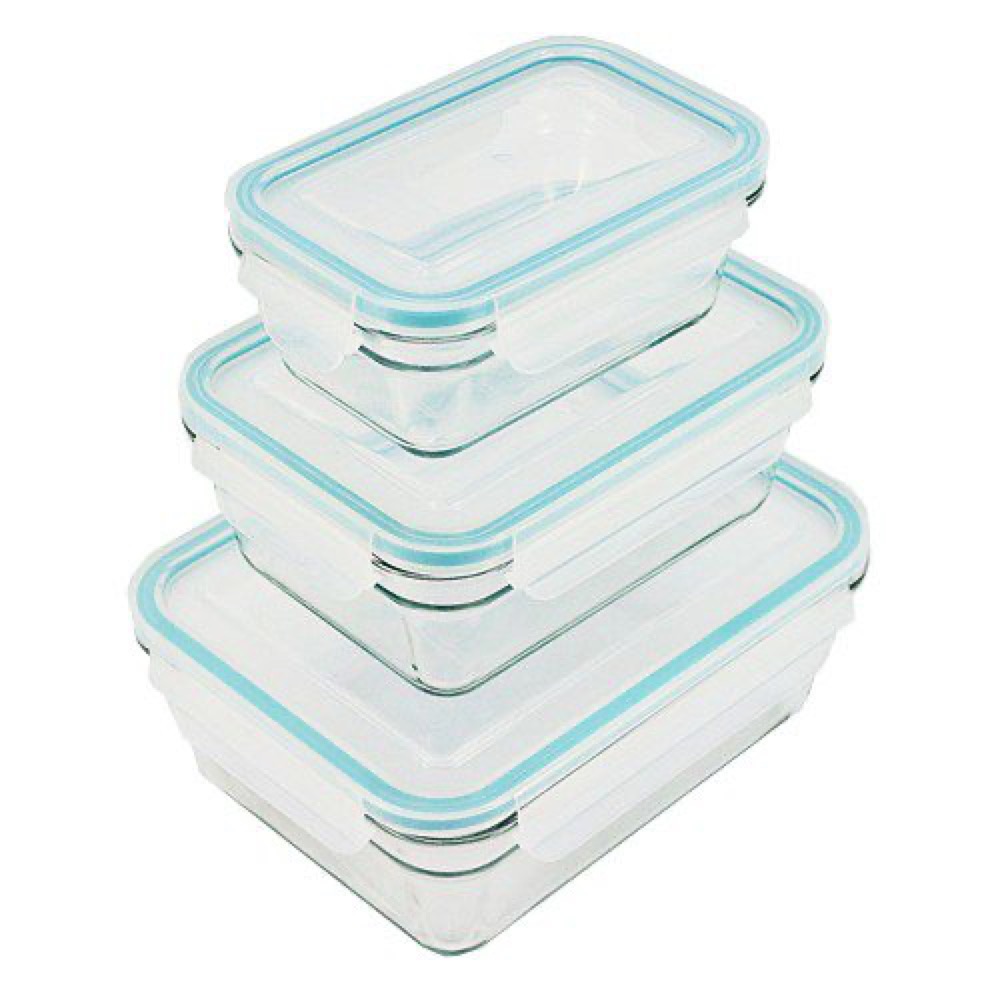 Best Transfer Container
Glass does not take on the smell or the grease of last week's curry, which plastic tubs and foam both do.
Why it's safe: Tempered glass is inert — there is no polymer surface for heat or oil to pull particles or monomer out of, hot or cold.
Check Today’s Price on Amazon →Amazon prices change daily — tap to see today's price and any active discount.
- Free delivery & returns for Prime members
- Sold & shipped by Amazon
- Thousands of verified reviews
For the full field of glass storage sets and where each one makes sense, see our ranking of the best glass food storage containers, and the head-to-head on glass versus plastic storage.
3. ECOlunchbox Three-in-One Stainless Bento — Best to Hand Over at the Counter
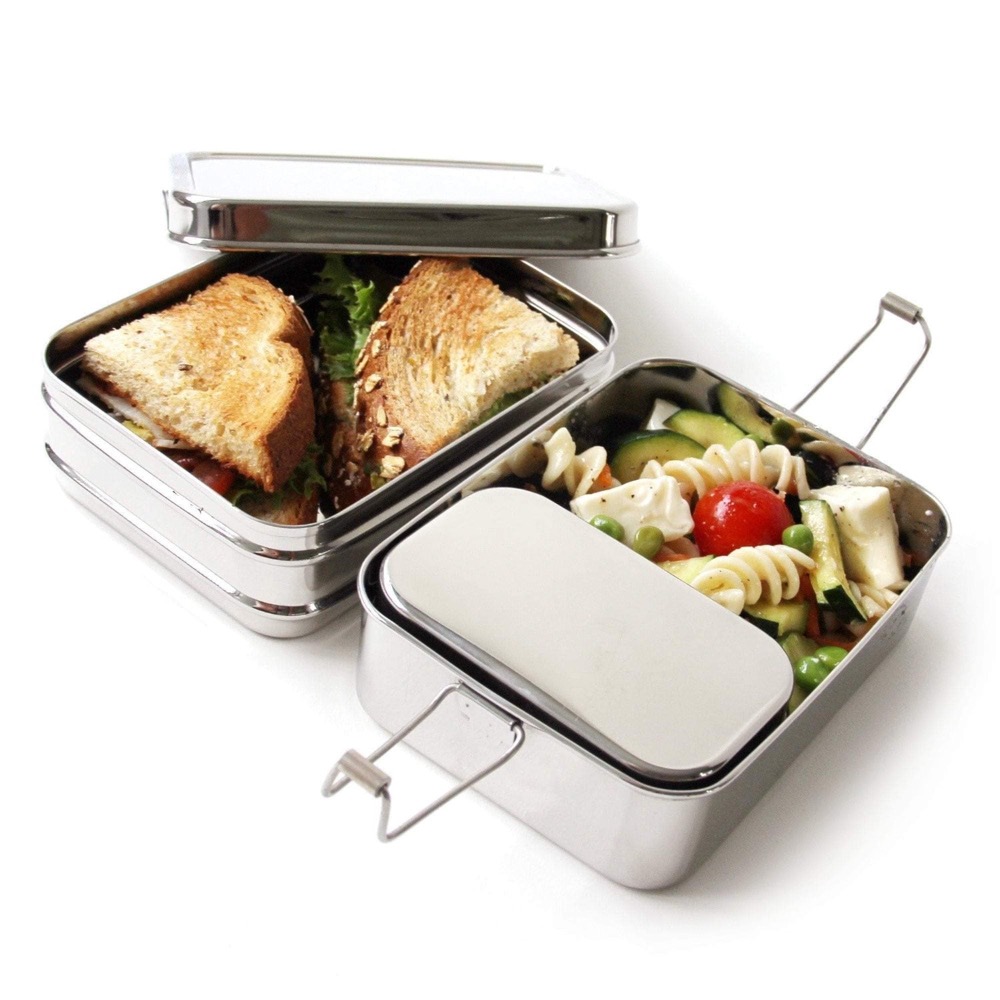 Best Plastic-Free
Nesting bodies mean the whole set collapses into one oval, so it travels in a bag rather than taking over it.
Why it's safe: There is no plastic component at all — no silicone seal, no plastic latch, no interior coating — so there is nothing for heat or grease to act on.
Check Today’s Price on Amazon →Amazon prices change daily — tap to see today's price and any active discount.
- Free delivery & returns for Prime members
- Sold & shipped by Amazon
- Thousands of verified reviews
If you want the wider comparison of plastic-free containers for carrying meals, see our guide to the best non-toxic lunch containers.
Want the Full Home Protection Guide?
Takeout is one source out of dozens. The Complete Plasticproof Guide covers every room — kitchen, bathroom, bedroom, living room — with 80+ product recommendations backed by 47+ studies.
The honest verdict
So, are Styrofoam containers safe? On the chemistry, the answer is better than the internet suggests. The styrene that migrates into food from polystyrene packaging has been measured across the food supply, it comes to roughly 0.1 micrograms per kilogram of body weight per day, and the European food authority's 2025 re-examination found no genotoxic hazard from swallowing it. The frightening cancer classifications are real, and they describe factory air, not dinner.
On the particles, the answer is worse than the internet suggests, mostly because almost nobody reports it. Expanded polystyrene shed 2.82 million microplastic particles into a liter of hot water in the only study that tested the three common takeout materials side by side — 148 times what polypropylene gave up, with 96% of the particles under 10 micrometers. A second team, measuring differently, put polystyrene at the top of the same ranking and then showed the leachate damaged human gut cells in a dish. Nobody regulates any of that, because no regulator has a limit to apply.
Which leaves a simple, free, non-dramatic rule. Foam is a transport container, not a plate and not a dish. Tip the food out when you sit down, move the leftovers into glass before the fridge, and never put the box in the microwave. That removes nearly all the contact time the research says drives the release — and it costs nothing but the thirty seconds you were going to spend finding a fork anyway.
Fix the bigger source first
Takeout is the visible one. For most households the larger and steadier microplastic source is drinking water — and unlike a foam box, it is something you can filter.
Frequently Asked Questions
They are the leakiest common takeout material for plastic particles, and heat is the trigger. Hu and colleagues, publishing in Food Additives & Contaminants: Part A in 2023, poured hot water through real take-out containers and measured 2,820,000 microplastic particles per liter from expanded polystyrene, against 101,000 from polyethylene and 19,000 from polypropylene. Over 96% of the particles were under 10 micrometers. The chemical side is more reassuring: EFSA concluded in 2025 that styrene shows no genotoxic hazard by mouth at food-packaging exposures.
Do not. A foam takeout box is not made or cleared for microwave use, and heat is the specific condition every study here identifies as driving release. Jin and colleagues measured 171,900 to 301,600 microplastic particles per square centimeter from microwaved plastic containers in the Journal of Hazardous Materials in 2024, with polystyrene the highest-releasing material of the four tested. Tip the food onto a plate or into a glass dish and heat it there.
The classifications that say “probably carcinogenic” are about breathing styrene vapor at industrial concentrations, not eating out of a box. IARC placed styrene in Group 2A in 2019 and the US National Toxicology Program has listed it as reasonably anticipated to be a human carcinogen since 2011, both resting largely on occupational inhalation. For the oral route, EFSA's 2025 re-assessment found no evidence of genotoxicity and judged a 40 microgram per kilogram migration limit not to be of safety concern. Estimated dietary exposure from styrenic packaging is about 0.1 micrograms per kilogram of body weight per day.
Du and colleagues at East China Normal University, publishing in the Journal of Hazardous Materials in 2020, found microplastics in every take-out container they collected across five cities, at 3 to 29 pieces per container, with rough-surfaced polystyrene boxes holding the most. They estimated that someone ordering take-out four to seven times a week swallows 12 to 203 particles per week from the containers alone — before counting anything hot food shakes loose, which the hot-water studies show is far more.
Not quite, and the distinction is a trademark one. STYROFOAM is DuPont's registered brand for extruded polystyrene building insulation, and the company states that no cup, food container, cooler or packaging material in the world is made from it. Takeout foam is expanded polystyrene, or EPS — polystyrene beads blown up with steam until they fuse into a mostly-air foam. Both are polystyrene; only one is the trademark, and it is not the one your dinner arrives in.
Of the plastics actually tested side by side, rigid polypropylene — the clear or black box marked 5 — released the fewest particles into hot water, 19,000 per liter against expanded polystyrene's 2,820,000. Glass and stainless steel release none, because neither is a polymer. Since you rarely choose what the restaurant uses, the change that matters more is what you do in the first ten minutes: tip hot food out of whatever it came in, and move leftovers into glass before they go in the fridge.
Sources
- Hu JL, Duan Y, Zhong HN, Lin QB, Zhang T, Zhao CC, et al. “Analysis of microplastics released from plastic take-out food containers based on thermal properties and morphology study.” Food Additives & Contaminants: Part A, 2023;40(2):305–318. (Hot-water treatment of real take-out containers: 2.82 × 10&sup6; particles/L from expanded polystyrene, 1.01 × 10⁵ from polyethylene, 1.90 × 10⁴ from polypropylene; particle size 0.8–38 µm with over 96% below 10 µm.)
- Jin T, Liu Y, Lyu H, He Y, Sun H, Tang J, Xing B. “Plastic takeaway food containers may cause human intestinal damage in routine life usage: microplastics formation and cytotoxic effect.” Journal of Hazardous Materials, 2024;475:134866. (285,700–681,500 particles/cm² released into hot water, polystyrene highest of four materials; 171,900–301,600 particles/cm² under microwave treatment; reduced Caco-2 cell viability from the isolated leachate.)
- Du F, Cai H, Zhang Q, Chen Q, Shi H. “Microplastics in take-out food containers.” Journal of Hazardous Materials, 2020;399:122969. (Microplastics found in every container sampled across five cities, 3–29 items per container, highest in rough-surfaced polystyrene; estimated 12–203 particles per week for people ordering take-out 4–7 times weekly.)
- Wang J, Lee J, Kwon EE, Jeong S. “Quantitative analysis of polystyrene microplastic and styrene monomer released from plastic food containers.” Heliyon, 2023;9(5):e15787. (Release peaked at 36 items per container and 2.58 µg/L styrene monomer at pH 9, 100°C and six hours; temperature and contact duration identified as the primary drivers.)
- EFSA Panel on Food Contact Materials. “Re-assessment of the risks to public health related to the genotoxicity of styrene present in plastic food contact materials.” EFSA Journal, 2025. (Concluded there was no evidence that styrene is genotoxic following oral exposure, and that use respecting a specific migration limit of 40 µg/kg food is not of safety concern.)
- EFSA Panel on Food Contact Materials, Enzymes and Processing Aids. “Assessment of the impact of the IARC Monograph Vol. 121 on the safety of the substance styrene (FCM No 193) for its use in plastic food contact materials.” EFSA Journal, 2020;18(10):6247. (Migration below 10 µg/kg for most foods and up to 230 µg/kg in the worst case; estimated dietary exposure around 0.1 µg per kg body weight per day, highest for fatty foods and high surface-to-volume packaging.)
- IARC Working Group. “Styrene, Styrene-7,8-oxide, and Quinoline.” IARC Monographs on the Identification of Carcinogenic Hazards to Humans, Volume 121, 2019. (Styrene classified Group 2A, probably carcinogenic to humans, on limited human evidence and sufficient animal evidence, upgraded from Group 2B.)
- National Research Council review of the National Toxicology Program styrene assessment. “Review of the Styrene Profile in the National Toxicology Program 12th Report on Carcinogens.” 2014. (Documents the 2011 listing of styrene as reasonably anticipated to be a human carcinogen, based on limited human evidence, sufficient animal evidence and mechanistic data, drawn predominantly from occupational exposure.)
- US Food and Drug Administration. “21 CFR 177.1640 — Polystyrene and rubber-modified polystyrene.” (Polystyrene cleared as a food-contact component at no more than 1 weight percent total residual styrene monomer, tightened to 0.5 weight percent for the listed fatty food types.)
- New York State Department of Environmental Conservation. “Expanded Polystyrene Foam Container and Polystyrene Loose Fill Packaging Ban.” (Statewide ban on distributing disposable foam food service containers and polystyrene loose fill in effect since 1 January 2022; extended to foam cold-storage containers from 1 January 2026.)