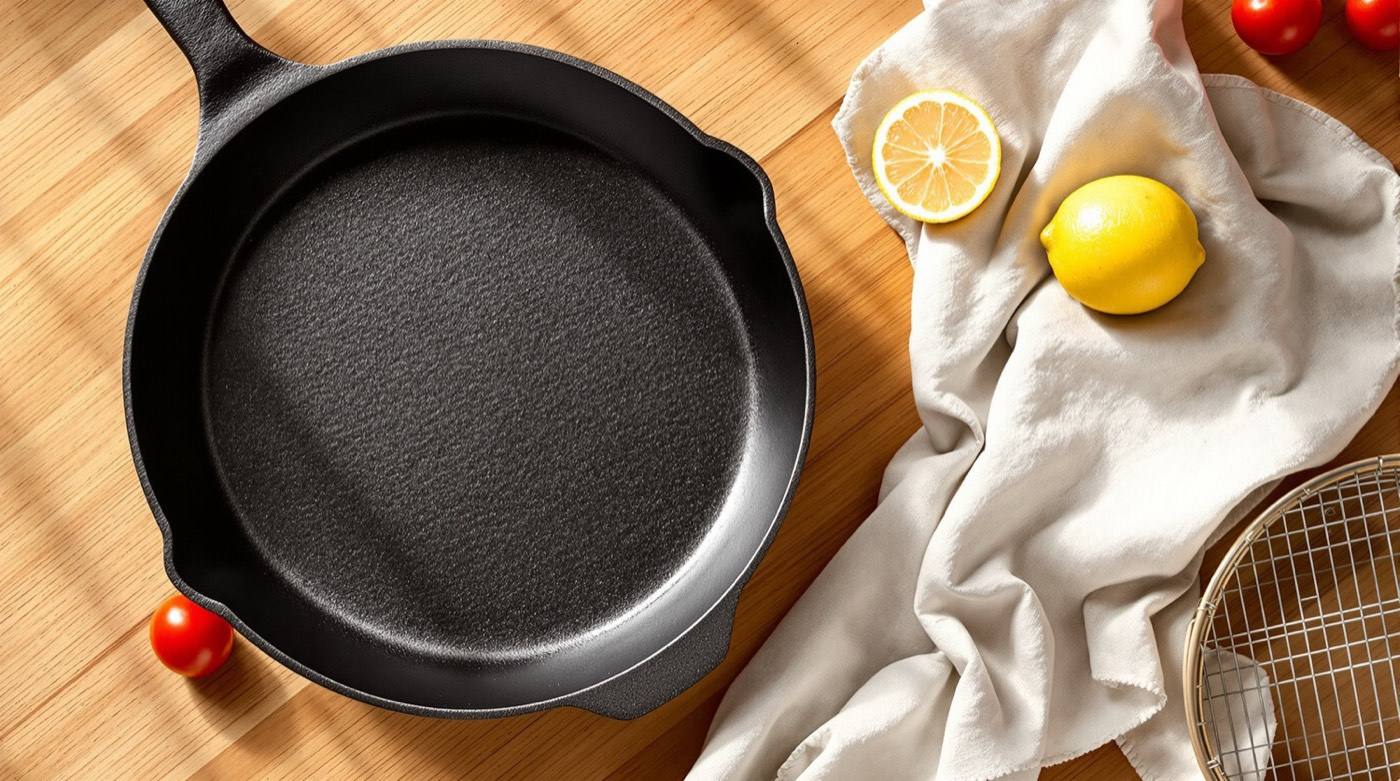
Bare cast iron is the only mainstream pan with nothing on its cooking surface but iron and baked-on oil — so the problem that dominates nonstick, where Raman imaging estimated that a single scratch in a Teflon coating releases about 9,100 micro- and nanoplastic particles (Luo et al., 2022), does not arise here at all. What cast iron transfers instead is iron itself. A 2021 systematic review in the Nepal Journal of Epidemiology pooled 13 studies and reported applesauce rising from 0.18 mg to 6.26 mg of iron per 100 g when cooked in iron rather than a non-iron pot, and spaghetti sauce from 0.44 mg to 2.10 mg (Sharma et al., 2021). For most households that is a free nutrient. For the roughly 1 in 200 to 1 in 400 people of northern European descent with hereditary hemochromatosis, it is the reason to cook acidic food in something else.
Almost every pan question on this site ends in a list of things that can come off a surface and into dinner: fluoropolymer flakes from a scratched nonstick, nickel and chromium from a long tomato simmer in stainless, aluminum from a thin uncoated pot. Cast iron is the odd one out. Strip it back and the pan is iron, a little carbon, and a layer of cooking oil that heat has turned into a hard film. There is no third material in the stack to worry about.
That does not make the question empty. It moves it. The honest version of “is cast iron safe” is not “does something synthetic come off it” — nothing synthetic is on it — but “how much iron ends up in the food, does that matter, and who does it matter to.” Researchers have been measuring exactly that since 1986, and the numbers are unusually clear. If you want the wider room first, our kitchen plastic detox guide works through it in order of impact.
The bottom line up front: keep the cast iron, and use it for the jobs it is good at. Sear, roast, bake and fry in it. Move the four-hour tomato sauce, the lemon braise and the vinegar reduction to enameled cast iron, oven-safe glass or solid ceramic — acid and long cooking times are what drive iron transfer, and they strip the seasoning too. If you have hemochromatosis or any other iron-overload diagnosis, treat a bare cast iron pan as an iron source and make that switch for all wet, acidic cooking, not just the long stuff.
Is cast iron safe?
It is, and the strongest argument is comparative. Every cooking surface gives up something under heat and acid; the question is what, and how much. Below is what has actually been measured across the materials a normal kitchen contains, with the study behind each figure. The cast iron row is the only one where the thing being transferred is also something people take as a supplement.
| Pan surface | What can migrate | A measured figure | Source |
|---|---|---|---|
| Bare cast iron | Iron, nothing else | Applesauce: 0.18 → 6.26 mg per 100 g | Sharma et al., 2021 |
| Nonstick (PTFE) | Fluoropolymer micro- and nanoplastics | ~9,100 particles per scratch; ~2.3 million from a broken coating | Luo et al., 2022 |
| Stainless steel | Iron, nickel, chromium | Into 4% acetic acid at 1 hour: 21.28 mg/L iron, 2.03 mg/L nickel | Sultan et al., 2023 |
| Non-anodized aluminum | Aluminum, lead | Into 4% acetic acid at 1 hour: 1,553 mg/L aluminum, 3.22 mg/L lead | Sultan et al., 2023 |
| Enameled cast iron | Nothing, while the glaze is intact and lead-free | FDA violation level for large hollowware: 1 µg/mL lead | FDA CPG 545.450 |
Two things are worth pulling out of that table. The first is that when the Food and Drug Administration actually wrote to retailers about cookware leaching lead — in a letter dated December 12, 2024 — the products it named were imported pots made from aluminum, brass and the aluminum alloys sold as Hindalium or Indalium (FDA, Lead in Food and Foodwares). Cast iron was not on that list. The second is that the only number in the table measured in millions belongs to the pan most people think of as the convenient, modern, safe one.
What actually comes off a cast iron pan?
Iron, and how much depends on three variables that researchers keep landing on independently. In 1986, Brittin and Nossaman cooked twenty foods in iron and non-iron utensils for the Journal of the American Dietetic Association, analyzed every sample by atomic absorption spectrophotometry, and reported that 90% of the foods contained significantly more iron when cooked in iron. Their conclusion named the drivers precisely: “acidity, moisture content, and cooking time of food significantly affected the iron content of food cooked in iron utensils” (PMID 3722654). They also noticed that two different skillets gave different results, which they attributed to differing amounts of previous use — an early hint that a well-built-up seasoning layer transfers less.
Thirty-five years later a systematic review pooled the numbers. Sharma, Khandelwal, Yadav, Ramaswamy and Vohra gathered 13 studies — nine randomized controlled trials in humans and four laboratory studies — and tabulated how far the iron content of real dishes moved (full text, PMC8266402). These are the figures worth knowing.
| Food | Cooked in non-iron | Cooked in iron | Change |
|---|---|---|---|
| Applesauce | 0.18 mg / 100 g | 6.26 mg / 100 g | about 35x |
| Spaghetti sauce | 0.44 mg / 100 g | 2.10 mg / 100 g | about 4.8x |
| Pea paste (vs a clay pot) | — | 21.4 ± 1.0 mg | 3.3x the clay pot |
| Meat and vegetables | — | — | roughly doubled |
| Legumes | — | — | about 1.5x |
Where a cell reads “—” the original study reported a ratio rather than an absolute value, and we are not going to invent one. The applesauce and spaghetti sauce rows come from Cheng and Brittin's 1991 measurements; the pea paste row from a 2017 Chinese study; the meat, vegetable and legume rows from a 1999 Ethiopian trial. All three sit inside the Sharma review.
The pattern is the useful part. Applesauce is wet, acidic and cooked slowly, and it moved by a factor of thirty-five. Spaghetti sauce is acidic but normally cooked for less time, and moved by less than five. A dry, fast sear — a steak, a pan of brussels sprouts, cornbread — sits at the far end of all three variables and transfers very little. The pan is not a constant; the dish is.
How much iron is 6.26 milligrams, really?
This is where most cast iron writing stops, and it is the part that decides the answer. The National Institutes of Health sets the recommended dietary allowance for iron at 8 mg a day for men aged 19 to 50, 18 mg a day for women in the same bracket and 27 mg during pregnancy, with a tolerable upper intake level of 45 mg a day for adults, set on the basis of gastrointestinal distress (NIH Office of Dietary Supplements).
Run that forward and the picture is not alarming for a person with normal iron regulation. You would need several acidic, slow-cooked, cast-iron dishes in one day to approach the upper limit, and the body's own absorption control turns down iron uptake as stores fill. Which is why the clinical literature does not treat cast iron as a hazard at all — it treats it as a public-health intervention. The Sharma review found hemoglobin gains of up to 1.7 g/dL in an Ethiopian trial and 1.18 g/dL in a Cambodian one, the latter alongside a 46% reduction in the prevalence of iron-deficiency anemia.
The honest counterweight came in 2019. Alves, Saleh and Alaofé published a systematic review in PLOS ONE covering 11 studies of iron-containing cookware in low- and middle-income countries and found statistically significant improvements in only 50% (4 of 8) of the pot studies, with hemoglobin differences spanning −0.4 to +1.20 g/dL, and in just 28.6% of the studies in women of reproductive age (Alves et al., 2019). Compliance was part of it: daily use of the pots ranged from 26.7% to 71.4%. The effect is real, measurable and inconsistent — which is exactly what you would expect from something that depends on what you cook rather than on owning the pan.
Who should not cook in cast iron?
People whose bodies cannot turn iron absorption down. Hereditary hemochromatosis is an autosomal recessive condition affecting between 1 in 200 and 1 in 400 people of northern European descent, and it causes unregulated absorption of dietary iron. The upper intake level above explicitly does not apply to them. Humans have no mechanism for excreting surplus iron once it has been absorbed, so what accumulates, stays.
For a diagnosed iron-overload condition — hereditary hemochromatosis, transfusional iron overload, or any doctor's instruction to restrict iron — a bare cast iron skillet is not a neutral piece of equipment. It is a variable iron source whose dose depends on what you cook in it. The practical move is not to throw it out but to stop using it for wet, acidic, slow dishes entirely and keep it for dry, fast cooking, or to switch to enameled cast iron, glass or solid ceramic across the board. This is a conversation to have with the clinician managing the condition, not a decision to make from a blog post.
For everyone else, the direction of the effect runs the other way. Iron deficiency remains the most common nutritional deficiency in the world, and menstruating women, pregnant women, frequent blood donors and endurance athletes sit at the end of the distribution where a few extra milligrams from a pan is a quiet benefit rather than a cost.
Does cast iron shed microplastics or PFAS?
No, and the reason is worth being precise about, because “seasoning” sounds like a coating and people reasonably wonder whether it behaves like one. Seasoning is cooking oil that heat has polymerized: the fat molecules cross-link into a hard, water-resistant film bonded to the iron. It is a fat, chemically unrelated to polytetrafluoroethylene. There is no fluorine in it, no per- or polyfluoroalkyl substance, and nothing that can shed a plastic particle, because there is no plastic present to shed.
The contrast is the whole reason cast iron keeps appearing in non-toxic kitchen guides. Using Raman imaging, researchers at Flinders University and the University of South Australia estimated that one scratch in a Teflon-coated pan could release around 9,100 micro- and nanoplastic particles, and that a coating broken across its surface could release roughly 2.3 million (Luo et al., Science of the Total Environment, 2022). We go through that study in detail in do nonstick pans shed microplastics, and what else comes off a damaged coating in is nonstick cookware safe. A cast iron pan has no equivalent failure mode. The worst thing that happens to neglected cast iron is that it rusts, which is visible, reversible with steel wool and oil, and not a plastic.
Is enameled cast iron safer than bare cast iron?
It is a different trade, not a straight upgrade. Enamel is a fused glass layer over the iron, so no iron moves into the food and acid cannot strip a seasoning that is not there. That makes enameled cast iron the correct pot for precisely the dish bare cast iron handles worst: the long, wet, acidic braise.
The question just moves to the glaze. The FDA's Compliance Policy Guide 545.450 sets the levels at which ceramic foodware is considered in violation for lead, measured by soaking the article in 4% acetic acid: 3 µg/mL of leaching solution for flatware, 2 for small hollowware, 1 for large hollowware, and 0.5 for cups, mugs and pitchers. The agency is also clear that no regulation authorizes lead as a component of foodware in the first place — these are enforcement thresholds, not a health target. Two practical rules follow: buy from a manufacturer that tests its glaze and will say so, and retire any enameled piece where the glaze has chipped through to the iron inside the cooking surface. The same logic governs our picks in non-toxic dinnerware.
What should you actually change?
Four things, in order of how much difference they make.
- Move the long acidic cooking out of the bare pan. This is the single change that matters, and it follows directly from the data: acidity, moisture and cooking time were the three significant variables in 1986 and they are still the three in the 2021 review. A four-hour tomato sauce, a lemon braise, a vinegar reduction or a long chili belongs in enameled cast iron, oven-safe glass or solid ceramic. A 20-minute pan sauce does not.
- Do not store food in the pan. Leftovers left in a skillet overnight are a twelve-hour acidic soak at exactly the condition that mobilizes the most iron, and they take the seasoning with them. Decant into glass storage containers once the food has cooled.
- Keep the seasoning built up. Brittin and Nossaman saw different iron transfer from two different skillets and attributed it to how much they had been used. A pan with a thick, intact seasoning layer puts a film of polymerized fat between the acid and the iron. Cook fatty, dry foods in it often, dry it on the heat, and wipe a thin film of oil on afterwards.
- Buy a pan whose maker names the material. Cast iron is one of the few categories where this is simple — iron and carbon, nothing proprietary — but it is also a category full of unmarked imports. A manufacturer that states what the pan is and what it is seasoned with is giving you the only specification that matters here.
Cast iron worth owning
Three pans that cover the full range of what this page has argued: a bare skillet for everyday heat, a lighter machined version for anyone who finds standard cast iron punishing, and the enameled pot for the acidic dishes bare iron should not be doing. Carbon steel vs cast iron compares the two nickel-free materials in detail, and cast iron vs stainless steel vs ceramic sets all of it against the pan already on your stove.
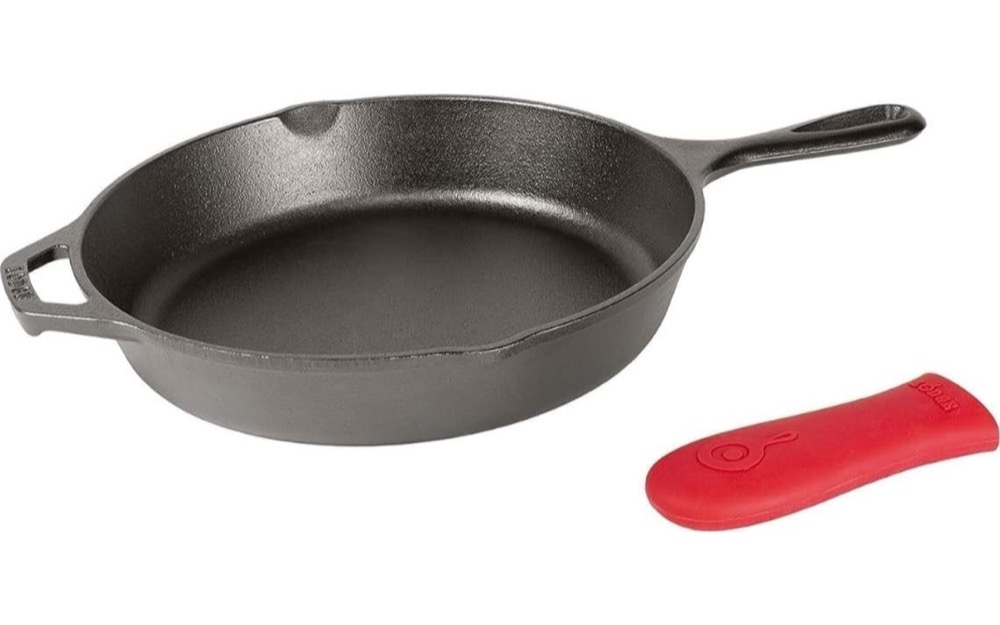 Best Everyday Skillet
1. Lodge 10.25-Inch Cast Iron Skillet — the default, and it is hard to beat
A coating-free cooking surface for less than the cost of one mid-range nonstick pan that you will replace in three years.
Why it’s the safer pick: No PTFE, no PFOA, no coating of any kind — nothing on the surface that can scratch, flake or shed a particle.
Check Today’s Price on Amazon →Amazon prices change daily — tap to see today’s price and any active discount.
- Free delivery & returns for Prime members
- Oven safe, induction compatible
 Best Lightweight Cast Iron
2. Field Company No.10 Cast Iron Skillet — for anyone who finds cast iron too heavy
Cast iron that behaves like a modern skillet — without adding a coating back to get there.
Why it’s the safer pick: Field states its pans carry no synthetic coatings, no PFOA and no PTFE — just iron and baked-on oil.
Check Today’s Price on Amazon →Amazon prices change daily — tap to see today’s price and any active discount.
- Machine-polished cooking surface
- Made in the USA, induction compatible
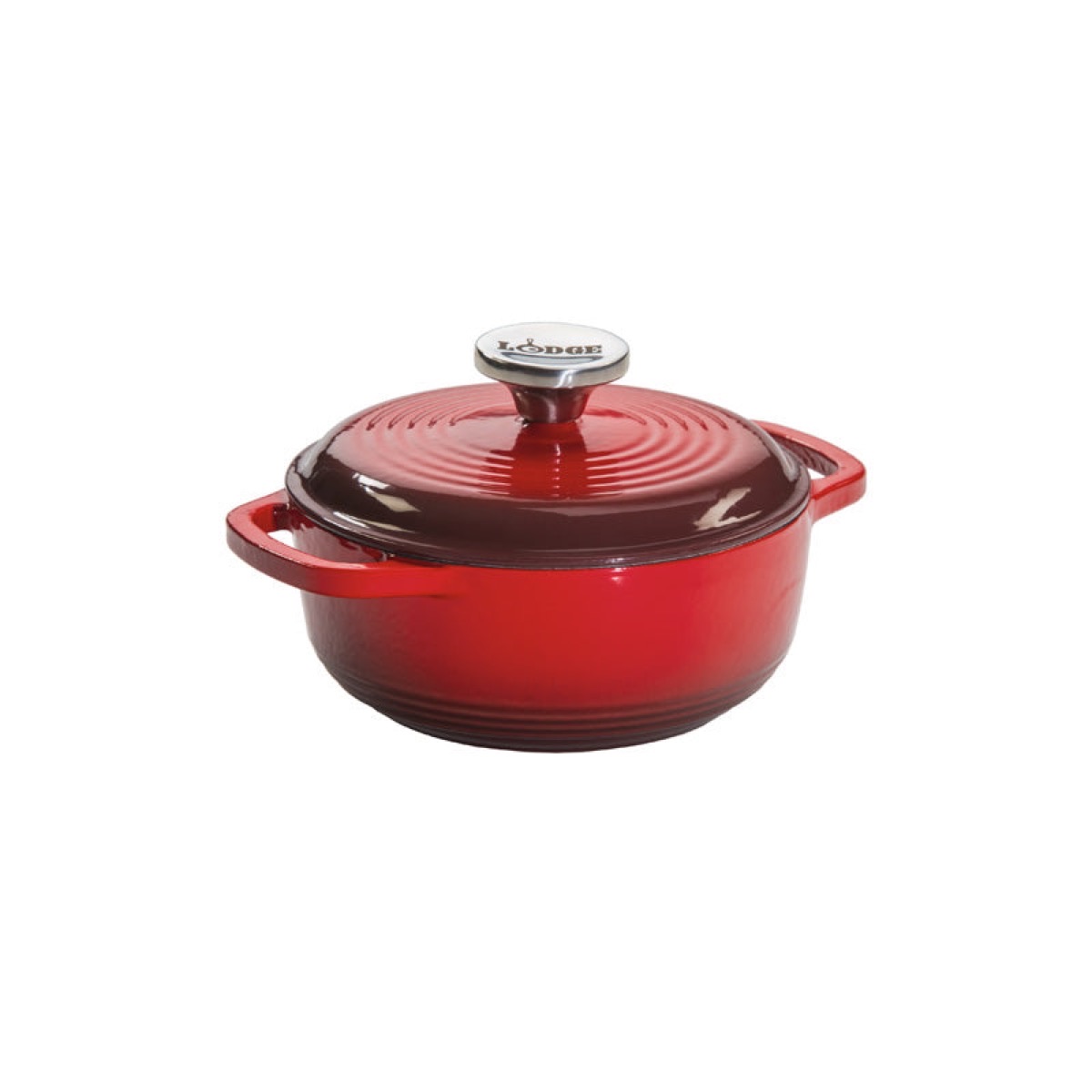 Best for Acidic Cooking
3. Lodge Essential Enameled Cast Iron Dutch Oven — the pot for tomato sauce
Cook the acidic dishes properly, without the iron transfer or the ruined seasoning.
Why it’s the safer pick: A glass enamel surface, not a polymer coating — there is no fluoropolymer anywhere on it, and the iron underneath never touches the food.
Check Today’s Price on Amazon →Amazon prices change daily — tap to see today’s price and any active discount.
- Free delivery & returns for Prime members
- Oven safe, no seasoning required
If the pan you are actually replacing is a scratched nonstick, start with PFAS-free cookware and best non-toxic cookware 2026; if it is a stainless pot, is stainless steel cookware safe runs the same analysis on the metal most non-toxic guides send you to.
Frequently asked questions
For almost everyone, yes, and for an unusual reason: bare cast iron is iron and carbon with baked-on oil, so there is no coating on it to scratch, flake or shed. The one thing it does transfer is iron. A 2021 systematic review in the Nepal Journal of Epidemiology pooled 13 studies and reported applesauce rising from 0.18 mg to 6.26 mg of iron per 100 g when cooked in iron rather than a non-iron pot, and spaghetti sauce from 0.44 mg to 2.10 mg. For most people that is a nutrient. For someone with hereditary hemochromatosis it is a reason to cook acidic food in enamel or glass instead.
No. There is no fluoropolymer and no synthetic coating anywhere on a bare cast iron pan. Seasoning is cooking oil that has been polymerized by heat into a hard layer of cross-linked fat, chemically unrelated to PTFE. That matters because the measured risk on the other side is large: researchers using Raman imaging estimated that a single scratch in a Teflon coating can release roughly 9,100 micro- and nanoplastic particles, and a badly broken coating around 2.3 million.
It depends almost entirely on acidity, moisture and cooking time. In pooled study data, applesauce measured 6.26 mg of iron per 100 g from an iron pot against 0.18 mg from a non-iron one, roughly a 35-fold difference, while spaghetti sauce went from 0.44 mg to 2.10 mg. A 1986 study in the Journal of the American Dietetic Association cooked 20 foods in iron and non-iron utensils and found 90% of them contained significantly more iron from the iron pan, with acidity, moisture content and cooking time all significantly affecting the result. A dry, quick sear transfers very little.
People who cannot regulate how much iron they absorb. Hereditary hemochromatosis affects between 1 in 200 and 1 in 400 people of northern European descent, and the body has no route for excreting surplus iron once it is absorbed. Anyone with that diagnosis, another iron-overload condition, or a doctor’s instruction to limit iron should treat a bare cast iron pan as an iron source and move long, wet, acidic cooking to enameled cast iron, glass or solid ceramic. For everyone else the direction of the effect is usually helpful.
It is a different trade rather than a strictly safer one. Enamel is a fused glass layer, so no iron moves into the food and acid cannot strip the seasoning, which makes enameled cast iron the right pot for a four-hour tomato sauce. The question simply moves to the glaze. FDA Compliance Policy Guide 545.450 sets the levels at which ceramic foodware is considered in violation for lead: 3 micrograms per milliliter of leaching solution for flatware, 2 for small hollowware, 1 for large hollowware and 0.5 for cups, mugs and pitchers, measured in 4% acetic acid. Buy from a maker that tests and publishes, and retire any piece whose enamel has chipped through.
A quick 20-minute pan sauce in a well-seasoned skillet is fine. An all-afternoon simmer is the exact scenario the research describes, because acidity, moisture and cooking time are the three variables that drive iron transfer, and a long acidic cook also strips the seasoning you spent months building. Move that dish to enameled cast iron, oven-safe glass or solid ceramic, and keep the bare skillet for searing, roasting, cornbread and eggs.
Sources
- Sharma S, Khandelwal R, Yadav K, Ramaswamy G, Vohra K. “Effect of cooking food in iron-containing cookware on increase in blood hemoglobin level and iron content of the food: A systematic review.” Nepal Journal of Epidemiology, 2021;11(2):994–1005. pmc.ncbi.nlm.nih.gov (full text) · PMID 34290890
- Brittin HC, Nossaman CE. “Iron content of food cooked in iron utensils.” Journal of the American Dietetic Association, 1986;86(7):897–901. PMID 3722654
- Alves C, Saleh A, Alaofé H. “Iron-containing cookware for the reduction of iron deficiency anemia among children and females of reproductive age in low- and middle-income countries: A systematic review.” PLOS ONE, 2019;14(9):e0221094. doi.org/10.1371/journal.pone.0221094
- Luo Y, Gibson CT, Chuah C, Tang Y, Naidu R, Fang C. “Raman imaging for the identification of Teflon microplastics and nanoplastics released from non-stick cookware.” Science of the Total Environment, 2022;851:158293. doi.org/10.1016/j.scitotenv.2022.158293
- Sultan SA, Khan FA, Wahab A, et al. “Assessing Leaching of Potentially Hazardous Elements from Cookware during Cooking: A Serious Public Health Concern.” Toxics, 2023;11(7):640. doi.org/10.3390/toxics11070640
- National Institutes of Health, Office of Dietary Supplements. “Iron — Health Professional Fact Sheet.” ods.od.nih.gov
- U.S. Food and Drug Administration. “Lead in Food and Foodwares” (includes the December 12, 2024 letter to retailers on imported aluminum, brass and Hindalium cookware) and Compliance Policy Guide Sec. 545.450, “Pottery (Ceramics); Import and Domestic — Lead Contamination.” fda.gov