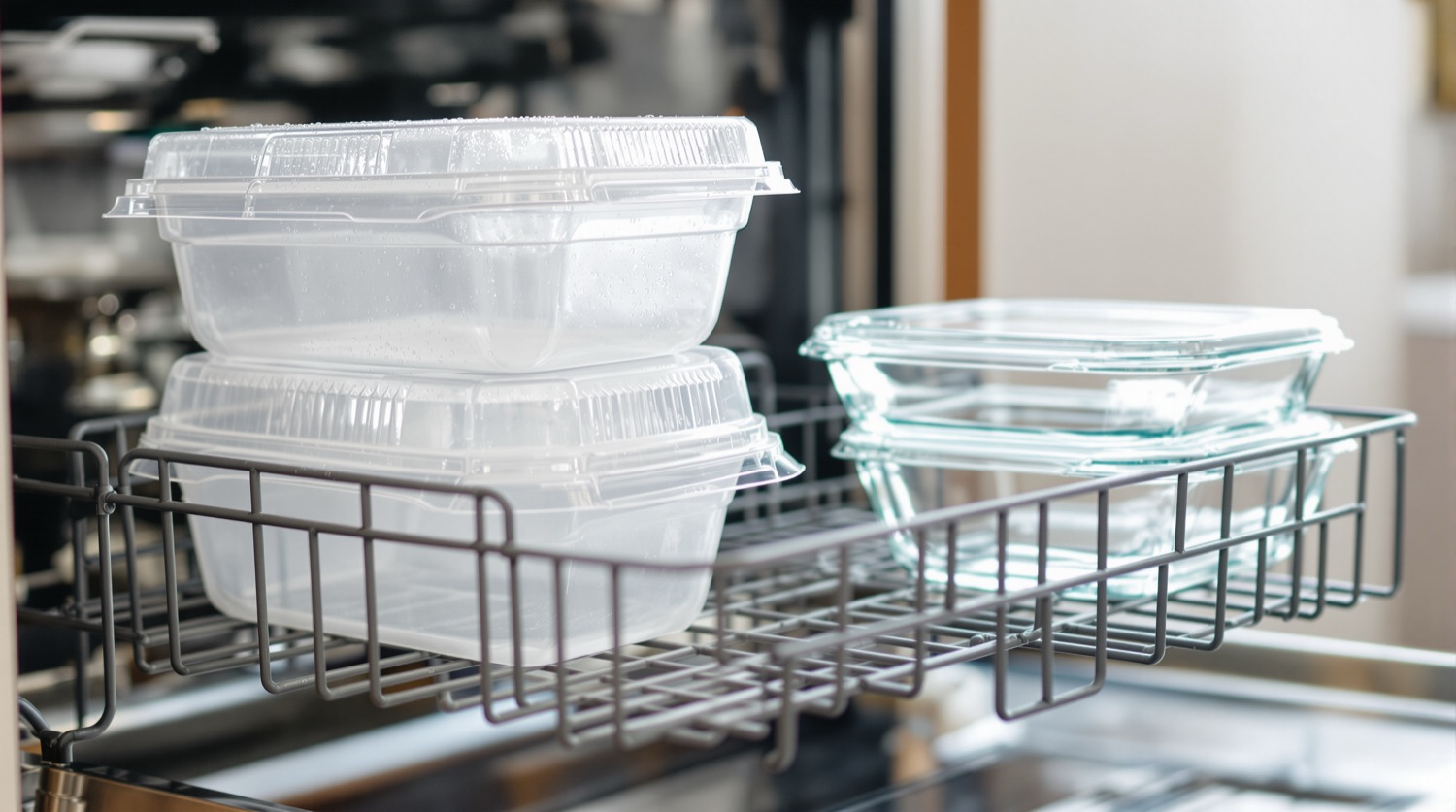
A single full load of plastic dishes sheds about 920,000 micro- and nanosized plastic particles into the wash water — and every item tested carried a “dishwasher safe” label. That figure comes from Elvis Okoffo, Benjamin Tscharke and Kevin Thomas of the University of Queensland, published in May 2025 in ACS ES&T Water (Okoffo, Tscharke & Thomas, 2025). Scaled to normal use it works out to roughly 33 million particles per household per year. The honest counterweight: the total mass is about 6 milligrams of plastic per person per year, around a quarter the weight of a grain of rice (University of Queensland). Polypropylene — takeout-container plastic — shed the most. What nobody has measured is how much of it stays on the plate.
Microplastics research has a pattern by now: somebody measures an everyday object, the particle count comes back in the millions, and the headline writes itself. The dishwasher study is a better one than most, because the researchers reported two numbers that pull in opposite directions — an enormous particle count and a tiny mass — and the useful answer lives in the gap between them.
Below is exactly what was washed, what came off, why 70°C turns out to be the temperature that matters, how the dishwasher compares with the appliance that is genuinely worse, and the short list of changes that are actually worth making. If you want the wider picture of where plastic meets heat in a kitchen, our kitchen plastic detox guide works through the room in order of impact.
The bottom line up front: the dishwasher is a real, measurable source of plastic particles, but it is overwhelmingly an environmental story — the particles leave with the waste water. The appliance that puts plastic into your food is the microwave, by a factor of millions. Fix that first, then stop running thin takeout tubs through the dishwasher, then replace what you wash most often with glass.
Does the dishwasher release microplastics?
It does, and the measurement is recent and specific. The study, Release of Micro- and Nanosized Particles from Plastic Articles during Mechanical Dishwashing, was carried out by Dr Elvis Okoffo with Benjamin Tscharke and Professor Kevin Thomas at the Queensland Alliance for Environmental Health Sciences, University of Queensland, and published on 19 May 2025 in the American Chemical Society journal ACS ES&T Water (doi.org/10.1021/acsestwater.4c00768).
The design was deliberately ordinary. The team took common household plastic articles — containers, tubs and utensils made from polypropylene, polyethylene, polystyrene, polyethylene terephthalate and nylon-6 — and ran them through a domestic dishwasher using normal detergent and normal cycles, with wash water reaching up to 70°C. Every item was one a shopper would consider safe to put in there: all of them carried a dishwasher-safe label. Then they measured what had come off into the water.
| What was measured | The result |
|---|---|
| One full load of plastic articles | About 920,000 micro- and nanosized plastic particles released into the wash water |
| One household, one year | About 33 million particles |
| Total plastic mass | About 6 milligrams per person per year — roughly a quarter the weight of a grain of rice |
| Worst-performing plastic | Polypropylene — released more micro- and nanoplastics than any other polymer tested |
| Plastics tested | Polypropylene, polyethylene, polystyrene, polyethylene terephthalate, nylon-6 — all labeled dishwasher safe |
| Wash temperature | Up to 70°C (158°F) |
Okoffo's own summary is the part worth holding on to: “Despite the high number of particles released, the total mass released from plastic containers is low and is minor compared to other known sources of plastic pollution.” That is a researcher refusing to oversell his own finding, and it is why this page is not going to tell you to stop using your dishwasher.
Why does a dishwasher shed plastic at all?
Because a dishwasher is three attacks on a polymer surface running at once, for an hour or two, over and over for years.
- Heat. Wash water reaching 70°C sits right at the temperature where common food-grade plastics begin softening at the surface and giving particles up. This is the single biggest factor, and the next section shows exactly why that number matters.
- Chemistry. Dishwasher detergent is strongly alkaline and usually enzymatic — it is formulated to break down and lift organic films. Polymer surfaces are not immune to the environment that does that.
- Abrasion. High-pressure jets drive hot, detergent-loaded water against the same surfaces repeatedly. Hand-washing simply does not deliver that mechanical energy.
None of this contradicts the label. “Dishwasher safe” is a claim about the article — that it will not warp, crack, melt or lose its shape in the machine. It has never been a claim that the surface emerges chemically or physically unchanged. The Queensland result is the gap between those two things, measured for the first time with real numbers.
Which plastics shed the most in a dishwasher?
Polypropylene, by a clear margin, and that is the inconvenient part. Polypropylene — recycling code 5, often stamped PP — is the default plastic for takeout containers, yogurt and sour cream tubs, deli boxes, reusable “microwave safe” storage sets and most plastic food containers sold as heat-tolerant. It is in almost every kitchen, usually as the thinnest, most-reused plastic in the house.
That is also the plastic people are most likely to wash repeatedly. A takeout container gets emptied, rinsed, stacked in the dishwasher and reused for months. Each cycle is another round of 70°C water, alkaline detergent and jet abrasion against a container that was engineered to survive one trip across town, not a hundred wash cycles. If you want one rule out of this entire page, it is the one in the box below.
They are the thinnest polypropylene in your kitchen, polypropylene shed the most particles in testing, and they were designed as single-use packaging. Reusing them is a sensible instinct — running them through a dishwasher is where the instinct backfires. Hand-wash them in warm water if you are going to reuse them, and retire them as soon as they go cloudy or chalky. Our breakdown of microplastics in takeout food covers what those containers do before they ever reach your sink.
Is 70°C really hot enough to damage plastic?
This is where the dishwasher finding stops being surprising, because 70°C has already been measured on exactly this plastic — in a completely different context, with a far larger result.
In October 2020, Dunzhu Li, Yunhong Shi, Luming Yang and colleagues at Trinity College Dublin published a study in Nature Food on polypropylene infant feeding bottles during ordinary formula preparation (Li et al., 2020, Nature Food 1, 746–754). Sterilizing the bottle and mixing formula with water at the World Health Organization's recommended 70°C released around 6 million microplastic particles per liter. Pushing the water to 95°C raised it to 55 million per liter, with peak measurements as high as 16.2 million particles per liter across the bottles tested.
| Polypropylene, same plastic, different heat | Microplastic particles released | Source |
|---|---|---|
| Water at 70°C (WHO formula-prep temperature) | About 6 million per liter | Li et al., 2020 |
| Water at 95°C | About 55 million per liter | Li et al., 2020 |
| Highest measured release across bottles tested | Up to 16.2 million per liter | Li et al., 2020 |
| Estimated infant intake, first 12 months | 14,600 to 4,550,000 particles per day, by region | Li et al., 2020 |
Read those two studies side by side and the dishwasher result looks less like a surprise and more like a confirmation. Seventy degrees is simply the temperature at which polypropylene starts handing over its surface, and a dishwasher is a machine that holds plastic at that temperature in moving, detergent-laden water. If the baby-bottle numbers are new to you, we cover the same research in detail in does baby formula have microplastics.
Do dishwasher microplastics end up on your dishes?
Nobody has measured it. That sentence is the most important one on this page, and it is the one every headline about this study left out.
The Queensland work quantified particles released into the wash water, which then leaves with the waste water — the study is framed, correctly, as a question about what households send into sewers and what treatment plants can and cannot capture. It did not test what remains on a plate, a fork or a container after the final rinse and drain cycle. No published study has.
So the honest position has three parts. Particles are definitely being produced: that is measured. Most of them are definitely leaving down the drain: that is what the study was designed to track. Whether a residue stays on the dishes you then eat from is unknown, and a page that tells you otherwise is guessing. What is not speculative is the other side of the same coin — every cycle takes a little material off the plastic article itself, which is why a container that has gone cloudy, chalky or finely scratched has visibly given up surface, and is the one to retire first.
Is 6 milligrams a year worth worrying about?
Not on its own, and the comparison that proves it is sitting in the same kitchen.
In 2023, Kazi Albab Hussain and colleagues at the University of Nebraska–Lincoln published a study in Environmental Science & Technology that microwaved polypropylene baby food containers and a polyethylene reusable pouch — all FDA-approved food-contact materials — for three minutes at full power in a 1,000-watt microwave, with deionized water and with 3% acetic acid standing in for dairy, fruit and vegetables (Hussain et al., 2023, University of Nebraska–Lincoln). The release reached 4.22 million microplastic particles and 2.11 billion nanoplastic particles per square centimeter of container — into the liquid, which a person then drinks or eats. In follow-up cell work, 75% of cultured human embryonic kidney cells died after two days of exposure at concentrations the authors modeled for infants and toddlers.
| Appliance | What it does to plastic | Where the particles go |
|---|---|---|
| Dishwasher | About 920,000 particles per full load; about 6 mg of plastic per person per year | Into the waste water — an environmental load, not a measured food exposure |
| Microwave | Up to 4.22 million micro- and 2.11 billion nanoplastic particles per cm² in three minutes | Into the food — a direct, measured route to the person eating it |
| Hot water in a PP bottle | About 6 million particles per liter at 70°C, 55 million at 95°C | Into the drink — the single highest per-serving figure in this comparison |
Put plainly: the dishwasher is a plastic-pollution story and the microwave is a plastic-exposure story. If you are going to change one habit this week, change the one that ends with the particles in your mouth rather than in a sewer. We cover that in is it safe to microwave Tupperware and in the wider look at whether Tupperware is safe.
How do you cut the microplastics your dishwasher makes?
Six changes, ordered by how much they are supported by what was actually measured. The first two follow directly from the study results; the middle three follow from the mechanism the study describes rather than from a measured reduction, and we are labeling them that way on purpose.
- 1. Stop putting takeout containers in the machine. Directly supported: polypropylene shed the most, and takeout tubs are the thinnest, most-reused polypropylene in a normal kitchen. Hand-wash or retire them.
- 2. Replace what you wash most with glass or stainless steel. Directly supported: neither material is a polymer and neither can shed one. This is the only change on the list that removes the source rather than slowing it down.
- 3. Use the eco or lower-temperature cycle for plastic loads. Mechanism-based: the 70°C ceiling is what drives polypropylene release in both the dishwashing and the baby-bottle data. Nobody has published a measured particle reduction at a lower setting.
- 4. Keep remaining plastic on the top rack. Mechanism-based: the top rack sits furthest from the heating element and takes less direct jet pressure. The same reasoning, no measured figure.
- 5. Skip heated dry for plastic. Mechanism-based: heated dry holds plastic at elevated temperature after the wash, for no cleaning benefit.
- 6. Retire plastic once it goes cloudy, chalky or scratched. Visible surface degradation is the thing these studies are counting. A container that looks worn has already given material up, and will keep doing it faster.
Two things that are not on this list, because the evidence does not put them there: stopping using your dishwasher, which would trade 6 milligrams of plastic a year for a large increase in water and energy use, and buying a filter for the drain line, for which there is no consumer product with published particle-capture data. The useful lever is which containers go in, not whether the machine runs.
Take the plastic out of the load entirely
Glass for leftovers, stainless for lunch, and nothing in the rack that can shed a polymer — two swaps cover almost everything you wash on repeat.
What should you replace plastic containers with?
One honest caveat before the picks, because almost nobody states it: a glass food storage container is not a plastic-free object. The body is glass and will not shed, but the lid is almost always polypropylene — and the lid is the part that goes in the rack, takes the jets and gets replaced when it cracks. Glass removes the plastic from the part that holds hot food. Only all-metal containers remove it from the wash entirely. Here is the real trade-off between the three, with prices and availability that change daily, so check the current listing.
1. Glasslock Oven Safe Container Set (3-Pack) — Best Everyday Glass
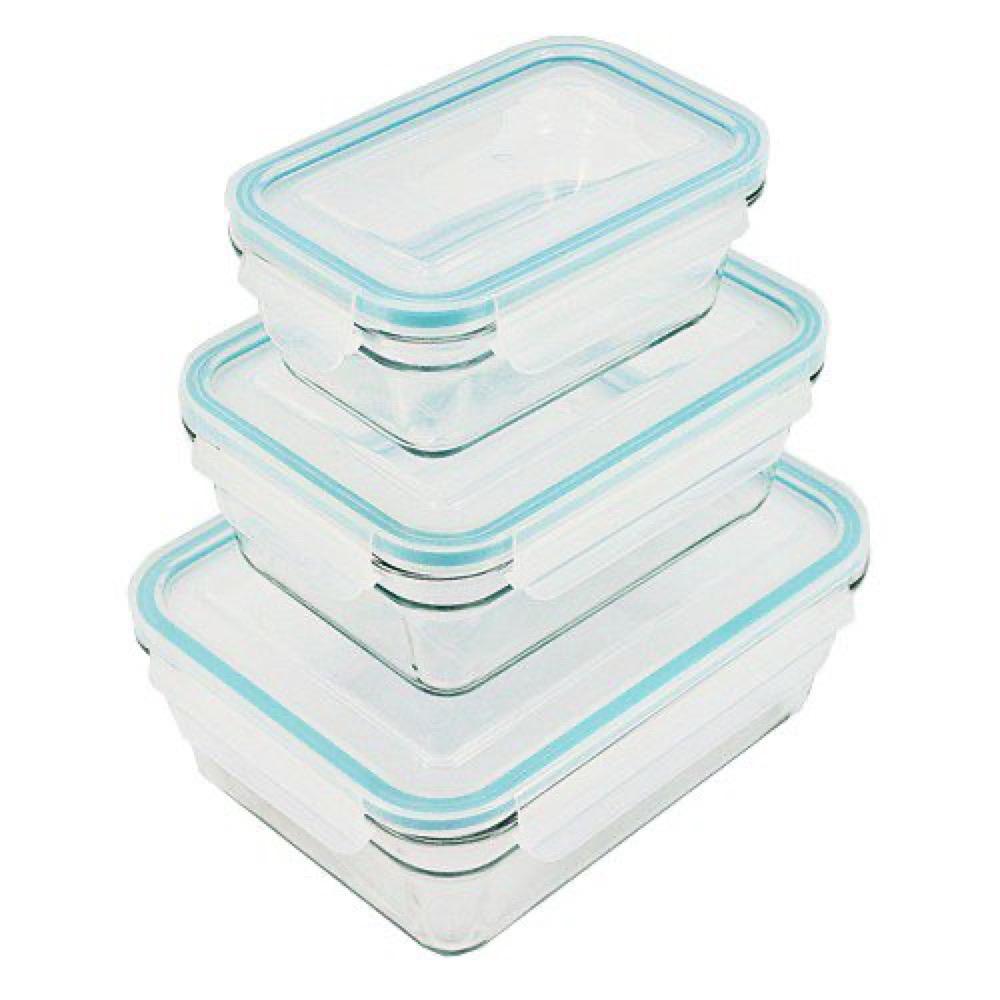 Best Everyday Glass
Store, reheat and wash leftovers in one container, with no polypropylene anywhere near the hot food.
Why it's the safer pick: The body is tempered glass — inert, non-shedding, and unaffected by the 70°C wash water that drove particle release in the Queensland testing.
Check Today’s Price on Amazon →Amazon prices change daily — tap to see today's price and any active discount.
- Free delivery & returns for Prime members
- Sold & shipped by Amazon
2. Pyrex Simply Store — Best Value Glass
 Best Value Glass
A full set of glass in one box, with individual pieces easy to replace when a lid eventually gives out.
Why it's the safer pick: Glass does not soften, leach or shed at dishwasher or cooking temperatures, so the surface touching your food is unchanged after a hundred washes.
Check Today’s Price on Amazon →Amazon prices change daily — tap to see today's price and any active discount.
- Free delivery & returns for Prime members
- Sold & shipped by Amazon
3. ECOlunchbox Three-in-One Stainless Steel Bento — Best Fully Plastic-Free
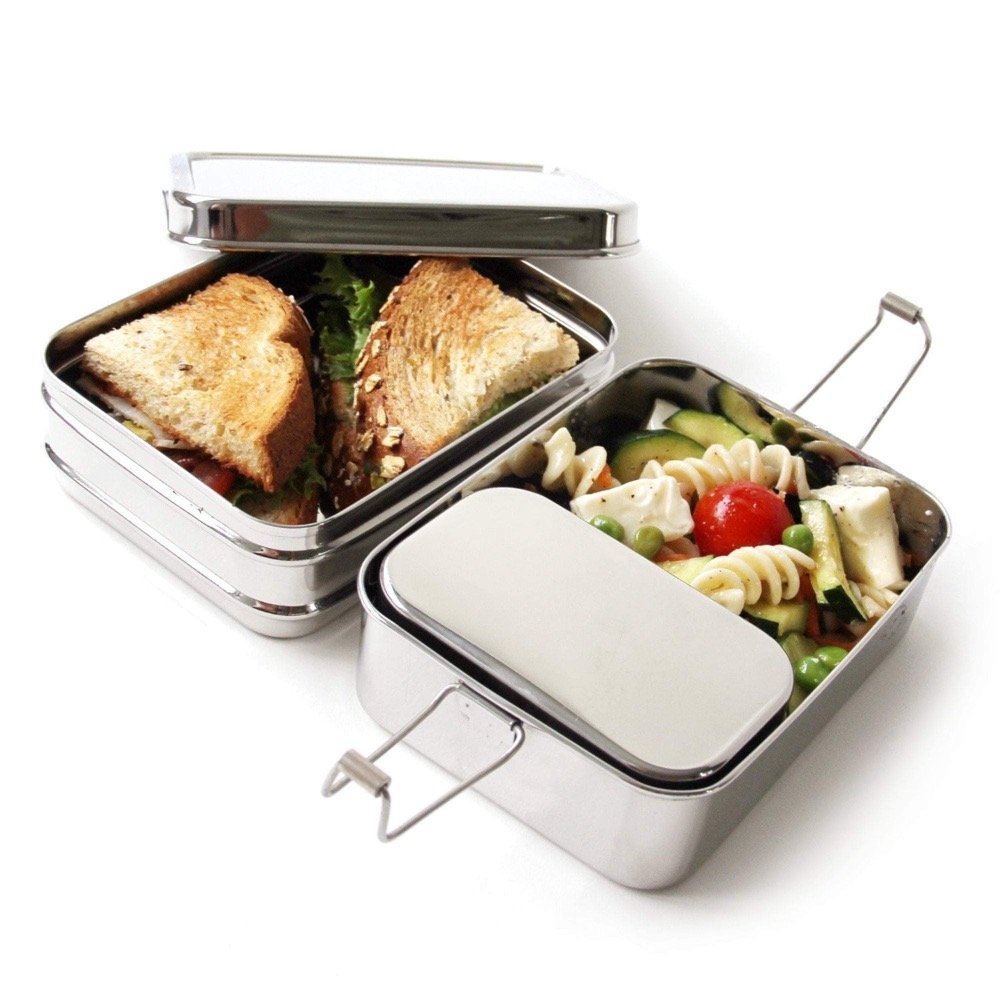 Fully Plastic-Free
Pack lunch in a container with no plastic part at all, and put the whole thing in the dishwasher without adding a single particle.
Why it's the safer pick: Stainless steel is not a polymer — heat, alkaline detergent and jet abrasion cannot produce microplastics from it, because there are none in the material.
Check Today’s Price on Amazon →Amazon prices change daily — tap to see today's price and any active discount.
- Free delivery & returns for Prime members
- Plastic-free construction throughout
If you want the longer comparison of materials rather than three picks, silicone vs plastic food containers and the best silicone food storage bags cover the bag-and-pouch half of the same problem, and non-toxic dinnerware covers the plates and bowls that make up most of a real load.
Frequently asked questions
A single full load of plastic articles releases roughly 920,000 micro- and nanosized plastic particles into the wash water, according to a 2025 study by Okoffo, Tscharke and Thomas of the University of Queensland published in ACS ES&T Water. Scaled to normal use that is about 33 million particles per household per year, though the total mass is small: roughly 6 milligrams of plastic per person per year, about a quarter the weight of a grain of rice. Every item tested carried a dishwasher-safe label.
Polypropylene released more micro- and nanoplastic particles than any other plastic the University of Queensland team tested. Polypropylene, recycling code 5, is the plastic used for most takeout containers, yogurt tubs and microwave-safe storage boxes. The study also tested polyethylene, polystyrene, polyethylene terephthalate and nylon-6, all in articles labeled dishwasher safe.
No study has measured that. The University of Queensland research quantified what the wash releases into wastewater, not what remains on a plate after the final rinse and drain. That gap is the honest limit of the evidence. What the measurements do establish is that the plastic article itself is losing surface material every cycle, which is why older, cloudier, more scratched containers are the ones to retire first.
The microwave is far worse for personal exposure. A 2023 University of Nebraska–Lincoln study in Environmental Science & Technology found that three minutes in a 1,000-watt microwave released up to 4.22 million microplastic and 2.11 billion nanoplastic particles per square centimeter of container, directly into the food. The dishwasher sends its particles down the drain. Treat the dishwasher as an environmental problem and the microwave as the one that reaches your plate.
Keep thin polypropylene takeout containers out of the machine entirely, since that plastic shed the most in testing and those tubs were never built for repeated 70°C washing. Replace the plastics you wash most often with glass or stainless steel, run a lower-temperature or eco cycle, keep any remaining plastic on the top rack away from the heating element, and retire containers once they go cloudy, chalky or deeply scratched.
Sources
- Okoffo ED, Tscharke BJ, Thomas KV. "Release of Micro- and Nanosized Particles from Plastic Articles during Mechanical Dishwashing." ACS ES&T Water, published 19 May 2025. doi.org/10.1021/acsestwater.4c00768
- University of Queensland. "Dishwashing a source of microplastic pollution." Queensland Alliance for Environmental Health Sciences, 20 May 2025. news.uq.edu.au
- Li D, Shi Y, Yang L, et al. "Microplastic release from the degradation of polypropylene feeding bottles during infant formula preparation." Nature Food, 2020, 1, 746–754. nature.com/articles/s43016-020-00171-y
- Hussain KA, Romanova S, Okur I, et al. "Assessing the Release of Microplastics and Nanoplastics from Plastic Containers and Reusable Food Pouches: Implications for Human Health." Environmental Science & Technology, 2023. doi.org/10.1021/acs.est.3c01942
- University of Nebraska–Lincoln College of Engineering. "Nebraska engineers find billions of plastic particles released when microwaving containers," 21 July 2023. engineering.unl.edu