
The best non-toxic dishwasher detergent in 2026 is Blueland’s Free & Clear Dishwasher Detergent Tablet — a pressed tablet with no film around it, sold in a compostable paper pouch, and listed on the EPA’s Safer Choice certified-product database as fragrance-free. The number behind the whole category: a 2021 analysis in the International Journal of Environmental Research and Public Health estimated that US laundry and dish pods put about 17,200 metric tons of polyvinyl alcohol — the clear pod film — into drains each year, with roughly 77 percent of it leaving wastewater treatment intact. Procter & Gamble’s own laboratory measured the opposite and found 97 percent removal. Below we rank six real products on whether any polymer enters the machine at all, so you do not have to pick a side in an unresolved argument.
Dishwasher detergent is the one cleaning product most people never think about twice. You buy the bag of pods, you drop one in, the dishes come out clean. It is also, quietly, one of the few places in a kitchen where a piece of plastic is designed to be dissolved and flushed on purpose, every single day, by almost every household in the country.
That is not a scare line, it is arithmetic. In the survey underpinning the most-cited paper on the subject, US households reported getting through roughly 12 billion dish detergent pods and 15 billion laundry pods a year. Each one of those is wrapped in a thin film of polyvinyl alcohol. Whether that matters is genuinely contested — we get into exactly who says what below, including which side is funded by whom — but you do not have to resolve the science to shop well. You can simply buy a detergent that has no film in it, and several of the best ones do not.
Are dishwasher pods made of plastic?
The film is. The question is only ever about the film, and the answer is not in dispute at the chemistry level: the clear skin around a dissolving pod is polyvinyl alcohol, written PVA or PVOH, a synthetic water-soluble polymer. Dropps, to its credit, does not dance around it — the brand’s published ingredient list for its dishwasher pods names “polyvinyl alcohol (synthetic water soluble film)” in plain language, alongside its enzymes and oxygen bleach.
What is in dispute is what happens after it dissolves. “Dissolved” is not the same as “gone.” Sugar dissolves in tea and is still sugar. The real question is whether microbes in a wastewater treatment plant then break the polymer chain down into carbon dioxide and water, or whether it survives the plant and travels on into sludge, farm fields and rivers. Two pieces of evidence point in opposite directions, and knowing both of them is the only honest way to read this category.
What the research actually found — both halves of it
The paper that started the public argument is Rolsky and Kelkar, “Degradation of Polyvinyl Alcohol in US Wastewater Treatment Plants and Subsequent Nationwide Emission Estimate,” published in the International Journal of Environmental Research and Public Health, volume 18, issue 11, article 6027 (2021), doi 10.3390/ijerph18116027. It is open access on PubMed Central. Working from a household-use survey across 126 million US households and a review of the biodegradation literature, the authors modeled the national flow of pod film.
| What Rolsky & Kelkar (2021) estimated | Figure |
|---|---|
| Dish detergent pods used in the US per year | ~12 billion |
| Laundry detergent pods used in the US per year | ~15 billion |
| PVA entering US drains from both, per year | 17,200 ± 5,000 metric tons |
| PVA reaching wastewater treatment plants | 10,500 ± 3,000 metric tons |
| PVA still intact after treatment | 8,100 ± 2,400 metric tons |
| Share leaving via sewage sludge | ~61% |
| Share leaving via treated water | ~15.7% |
Those two percentages are where the widely-quoted “about 75 percent of pod film survives” line comes from. And here is the part the headlines leave out: this is a model, not a measurement. The authors did not sample a treatment plant. They combined a usage survey with published degradation rates and projected a national figure, and that method is only as good as the inputs chosen. An independent expert panel convened to review the paper concluded it had serious methodological problems. That criticism is worth taking seriously, even though the panel review was itself commissioned by an industry-aligned process.
The strongest evidence on the other side is McDonough and colleagues, “Application of standardized methods to evaluate the environmental safety of polyvinyl alcohol disposed of down the drain,” Integrated Environmental Assessment and Management, volume 20, issue 5, page 1693 (2024), doi 10.1002/ieam.4929. This one is a measurement. The team ran detergent-grade PVOH 18-88 through an OECD 303A wastewater treatment plant simulation and tracked dissolved organic carbon, and during the plateau phase they recorded removal by biodegradation averaging 97.4 ± 7.1 percent, with a range of 88 to 116 percent. They also ran acute toxicity tests on algae, invertebrates and fish embryos.
And its catch, stated plainly because you deserve it: the work was carried out at The Procter & Gamble Company in Mason, Ohio. Procter & Gamble makes Cascade and Tide. That does not make a laboratory result wrong — a correctly run OECD 303A simulation is a correctly run OECD 303A simulation — but it does mean the two best studies in this field are a disputed model on one side and the world’s largest pod manufacturer on the other. Nobody neutral has settled it.
So our position, which we would rather state than hide behind: we are not going to tell you pod film is poisoning your family, because the evidence does not support that. What we will say is that if a product can do the same job with no polymer in it at all, the argument becomes irrelevant to you, and that is a reasonable thing to buy. If you want the longer version of this same chemistry on the laundry side, we covered it in do laundry pods have microplastics.
Compare all 6 picks
Every pick side by side — tap a name to jump to the full review, or check today’s price.
| Pick | PVA film? | Packaging & certification | |
|---|---|---|---|
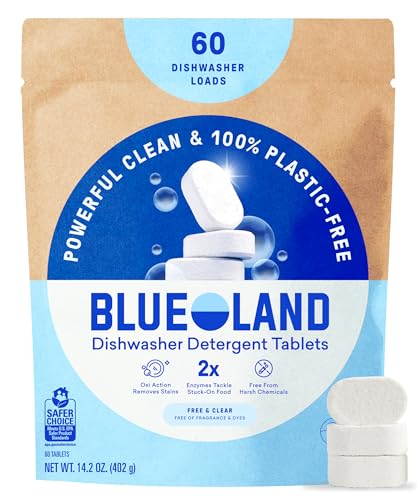 Best OverallBlueland Tablets |
None | Compostable paper pouchOn EPA Safer Choice list |
Check price → |
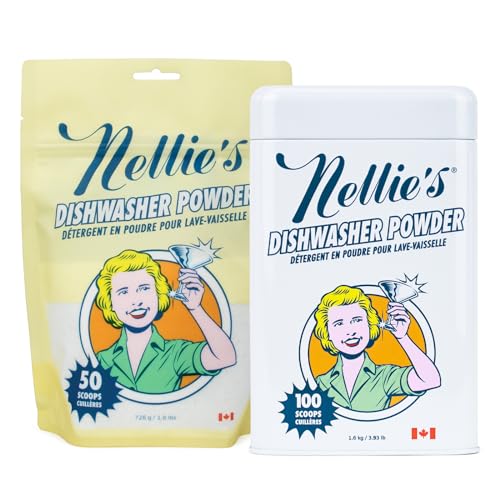 Best Refillable ContainerNellie’s Powder Tin |
None | Refillable steel tin, cork sealNot on EPA Safer Choice list |
Check price → |
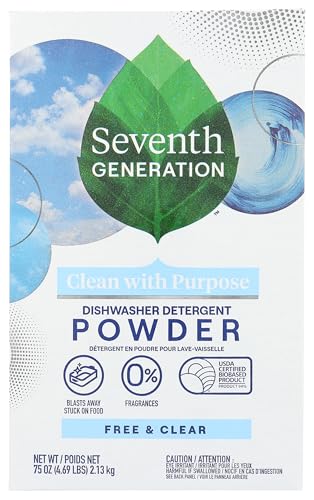 Most Loads per DollarSeventh Generation Powder |
None | 75 oz cardboard cartonPowder not listed; packs are |
Check price → |
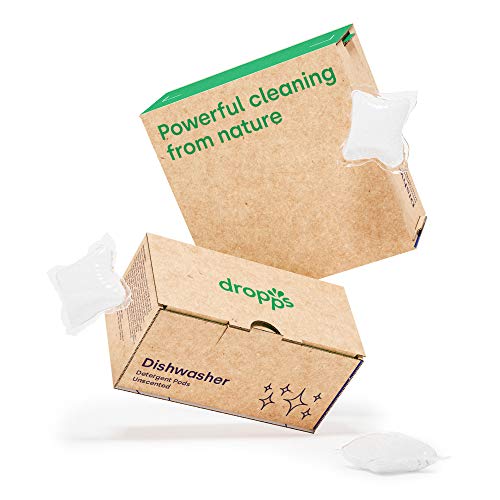 Best Pod, If You Want a PodDropps UltraWash |
Yes — declared | Cardboard carton, no plasticOn EPA Safer Choice list |
Check price → |
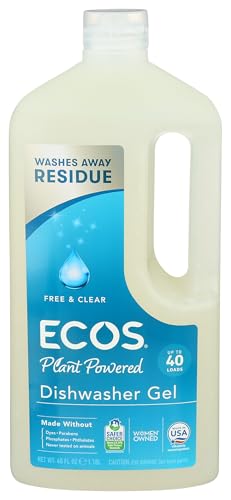 Best for Hard Water DosingECOS Dishwasher Gel |
None | Plastic bottleOn EPA Safer Choice list |
Check price → |
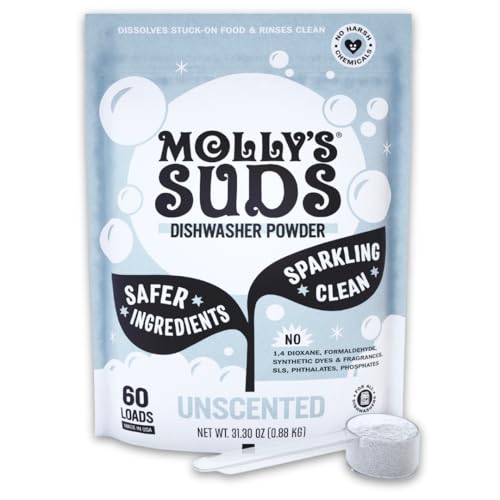 Strictest Ingredient PolicyMolly’s Suds Powder |
None | Stand-up pouchNot on EPA Safer Choice list |
Check price → |
What makes a dishwasher detergent “non-toxic,” exactly?
Four things, in descending order of how much they actually matter. The film comes first, because it is the only component deliberately designed to dissolve and leave the house every cycle. The surfactant system is second: 1,4-dioxane is a probable human carcinogen that forms as a byproduct of ethoxylation, so it never appears on a label — which is exactly why a brand that commits to non-ethoxylated surfactants is telling you something a front-of-pack claim cannot. Fragrance is third, and it is the single easiest win, because “fragrance” is a legally protected blanket term that can cover dozens of undisclosed compounds; every pick on this list is available fragrance-free. The container is fourth — it does not touch your dishes, but it is the plastic you can see.
What does not belong on that list: the word “natural,” which has no regulatory meaning on a cleaning product, and “plant-derived,” which describes a feedstock rather than a molecule. We walk through why that distinction trips people up in why BPA-free does not mean safe.
Does EPA Safer Choice certification mean it is plastic-free?
No — and this is the most common mix-up in the category, so it is worth being precise. Safer Choice is a US Environmental Protection Agency program that reviews every intentionally added ingredient in a product against the agency’s human-health and environmental criteria. It is a real, government-run certification, and it is far more meaningful than most seals on a cleaning bottle. But it evaluates the formula. It says nothing about packaging, and it does not exclude a PVA film: Dropps UltraWash Unscented carries the certification and uses one.
The second thing to know is that Safer Choice is granted product by product, not brand by brand. We did not take anyone’s word for which products are on the list — we downloaded EPA’s own certified-product dataset from EPA Safer Choice on October 24, 2026 and searched it. The results are the basis of the certification column above, and they are not what the marketing would lead you to assume. Blueland’s Free & Clear tablet, Dropps UltraWash Unscented, ECOS Auto Dishwasher Gel Free & Clear and Seventh Generation’s Free & Clear packs are all on it. Seventh Generation’s 75 ounce Free & Clear powder is not. Neither Nellie’s nor Molly’s Suds appears anywhere in the database.
Not being on the list is not an accusation — certification costs money and takes time, and small brands often skip it. It simply means nobody outside the company has audited the formula, and you should read that column as “independently checked” versus “taken on trust,” not as “safe” versus “unsafe.”
The 6 Best Non-Toxic Dishwasher Detergents in 2026
#1 — Blueland Dishwasher Detergent Tablets, Free & Clear — Best Overall
Best Overall
Nothing dissolves except the detergent itself. No film in the machine, no plastic tub in the cupboard, and a formula that a federal agency has reviewed line by line.
Why it’s best for plastic exposure: a pressed tablet has no water-soluble polymer wrapper at all, which is the single component this entire category argues about.
Check Today’s Price on Amazon →Amazon prices change daily — tap to see today's price and any active discount.
- Free delivery & returns for Prime members
- No pod film, no plastic packaging
- Verified on EPA’s Safer Choice database, Oct 24, 2026
The honest trade-offs. It is the most expensive option here per load by a clear margin, and that gap widens if you are coming from a warehouse-club tub of conventional pods. Tablets are also a fixed dose, so if you have very soft water you cannot dial the amount down the way you can with a powder or a gel. And a paper pouch is not weatherproof — store it somewhere dry, because a tablet that has absorbed humidity crumbles.
Best for: Anyone who wants the polyvinyl alcohol question removed from their kitchen entirely and is willing to pay a premium to stop thinking about it.
#2 — Nellie’s Dishwasher Powder, Tin and Refill — Best Refillable Container
Best Refillable Container
Buy the tin once, refill it indefinitely. No pod film, no new container every month, and a dose you set yourself.
Why it’s best for plastic exposure: loose powder needs no water-soluble wrapper, and the primary container is steel rather than molded plastic.
Check Today’s Price on Amazon →Amazon prices change daily — tap to see today's price and any active discount.
- Free delivery & returns for Prime members
- Steel tin, cork-sealed rim
- Nine published ingredients, no fragrance
The honest trade-offs. Nellie’s does not appear anywhere in EPA’s Safer Choice database, so the formula has not been independently reviewed in the way Blueland’s and Dropps’ have — you are trusting a published ingredient list rather than an audit. The refill pouch that comes in the bundle is a plastic-lined bag, so the system is not fully plastic-free, only far better than a tub a month. And sodium metasilicate is strongly alkaline, which is what makes the powder effective on baked-on food and also why it should be kept away from aluminum pans and out of reach of children.
Best for: The household that wants to stop buying a new container every month and would rather control the dose than hand it to a pod.
#3 — Seventh Generation Free & Clear Powder — Most Loads per Dollar
Most Loads per Dollar
The lowest-friction switch on this list: a familiar brand, a cardboard box, no pod film, and widely stocked.
Why it’s best for plastic exposure: no water-soluble wrapper and no plastic container — the whole package is a cardboard carton.
Check Today’s Price on Amazon →Amazon prices change daily — tap to see today's price and any active discount.
- Free delivery & returns for Prime members
- Cardboard carton, no plastic tub
- Fragrance-free and dye-free
The honest trade-offs, and one of them is a correction to a claim you will see made constantly. This powder is not on EPA’s Safer Choice list. Seventh Generation’s Free & Clear dishwasher packs and its Free & Clear gel both are, which is almost certainly why the powder gets described as certified all over the internet — but we searched EPA’s own dataset on October 24, 2026 and the 75 ounce powder is not in it. Separately, a big cardboard carton of loose powder is messier than a pod and absorbs humidity if the flap is left open, and the USDA Biobased mark measures renewable carbon content, not safety.
Best for: Anyone who wants off pods this week without changing their budget or their shopping route.
#4 — Dropps UltraWash Unscented Pods — Best Pod, If You Want a Pod
Best Pod, If You Want a Pod
A pre-dosed pod, zero plastic in the shipping box, a fully published formula, and a brand that names its film instead of calling it “dissolvable packaging.”
The honest catch: there is a polyvinyl alcohol film, and that is the exact thing the rest of this page is about. We rank it fourth for that reason, and we still recommend it over any conventional pod.
Check Today’s Price on Amazon →Amazon prices change daily — tap to see today's price and any active discount.
- Free delivery & returns for Prime members
- Cardboard carton, no plastic packaging
- Verified on EPA’s Safer Choice database, Oct 24, 2026
The honest trade-offs. The film is the whole trade-off, and we are not going to soften it: if avoiding polyvinyl alcohol is your reason for reading this page, buy a tablet or a powder instead. Beyond that, pods are a fixed dose, so soft-water households routinely overdose and get etched glassware, and buying 120 at a time is a real commitment if your machine turns out not to like them.
Best for: The reader who has decided the biodegradation evidence is good enough and wants the best-documented pod rather than no pod.
#5 — ECOS Free & Clear Automatic Dishwasher Gel — Best for Hard Water Dosing
Best for Hard Water Dosing
Pour exactly as much as your water needs. Nothing dissolves but the gel, and the formula has been through EPA’s ingredient review.
The honest catch: it is the only pick here in a plastic bottle. Nothing plastic goes into the wash, but a container does come into the house.
Check Today’s Price on Amazon →Amazon prices change daily — tap to see today's price and any active discount.
- Free delivery & returns for Prime members
- Fully adjustable dose
- Verified on EPA’s Safer Choice database, Oct 24, 2026
The honest trade-offs. The bottle is plastic, and on a page about getting plastic out of a kitchen that has to count against it — it is the reason this sits fifth rather than second despite the certification. Gels are also generally weaker than powders on baked-on starch, so a heavily soiled load may need a pre-rinse. And “up to 40 loads” assumes a conservative pour; if you have hard water you will use more and get fewer.
Best for: Hard-water households, and anyone who has given up on cloudy glasses and wants to solve it by controlling the dose.
#6 — Molly’s Suds Dishwasher Powder — Strictest Ingredient Policy
Strictest Ingredient Policy
A loose powder with no film, a disclosed position on the surfactant chemistry that actually produces contaminants, and a scoop so the dose is yours.
Why it’s good for plastic exposure: powder needs no wrapper, and the brand is unusually specific in print about which of its products do contain PVA film.
Check Today’s Price on Amazon →Amazon prices change daily — tap to see today's price and any active discount.
- Free delivery & returns for Prime members
- Formulated without ethoxylated surfactants
- Unscented, no dyes
The honest trade-offs. Molly’s Suds does not appear in EPA’s Safer Choice database, so as with Nellie’s you are trusting the company’s own disclosure rather than an outside audit. The pouch is plastic — Molly’s Suds states its pouches use post-consumer recycled plastic, which is better than virgin material but is still a plastic bag, and it is why this sits below the tin and the carton. Third-party ingredient databases also list the powder slightly differently from the brand’s own glossary, so if polyvinyl alcohol is the single reason you are switching, the Blueland tablet or the Nellie’s tin leaves nothing open to interpretation.
Best for: Households focused on surfactant byproducts and undisclosed fragrance rather than on packaging.
What we left out, and why
Conventional supermarket pods. Cascade, Finish and the store brands all use the same polyvinyl alcohol film as Dropps, without the published ingredient list, usually with fragrance, and generally in a plastic tub. There is no version of this page where they make the top six.
“Dissolvable packaging” and “water-soluble wrapper.” These are the same material under a friendlier name. If a product will not say the words polyvinyl alcohol, assume it is using it, because a brand that had removed the film would be advertising that fact in 40-point type.
Homemade borax-and-washing-soda recipes. They cost almost nothing and they contain no film, which is genuinely appealing. We left them out because they lack the enzymes that do the actual work on protein and starch in a modern low-water dishwasher, and the usual result is a machine that slowly scales up. Our kitchen plastic detox guide covers the swaps that work without that penalty.
Rinse aids. A separate product and a separate decision — most of them are in plastic bottles and none would change the ranking above.
Is it worth switching off pods at all?
On the evidence, we think it is a reasonable change to make and a poor one to be frightened into. Nobody has demonstrated that the polyvinyl alcohol from a dishwasher pod harms the person running the dishwasher; the film dissolves in the wash and leaves with the wastewater. The real question is environmental, it is about sludge and surface water, and the two best studies disagree, with one being a model its critics have attacked and the other being run by the industry’s largest manufacturer.
What tips it, for us, is that the alternative costs you almost nothing. A tablet or a powder cleans just as well, is usually cheaper per load, and gives you dose control you did not have. When one option carries an unresolved question and the equivalent option carries none, taking the one with no question attached is not alarmism — it is just the cheaper bet. That is the same logic we apply to the rest of the room in how to avoid microplastics, and to the machine itself in does the dishwasher release microplastics.
Comparison Table: At a Glance
| Pick | Form | PVA film | Packaging | On EPA Safer Choice list |
|---|---|---|---|---|
| Blueland Free & Clear Tablets | Pressed tablet | None | Compostable paper pouch | Yes, fragrance-free |
| Nellie’s Dishwasher Powder | Loose powder | None | Refillable steel tin + pouch | No |
| Seventh Generation Free & Clear Powder | Loose powder | None | 75 oz cardboard carton | No (the packs and gel are) |
| Dropps UltraWash Unscented | Pod | Yes, declared on the label | Cardboard carton | Yes |
| ECOS Free & Clear Gel | Liquid gel | None | Plastic bottle | Yes, fragrance-free |
| Molly’s Suds Powder | Loose powder | None | Stand-up pouch | No |
Formats, packaging and ingredient lists are each manufacturer’s own published wording, read off their live listings on October 24, 2026. The certification column is not taken from any brand’s marketing — it is the result of searching the EPA’s own Safer Choice certified-product dataset, downloaded the same day. We are not printing prices, because Amazon changes them daily and a stale number is worse than none — tap any buy button for today’s figure.
Our Pick by Situation
- You want the polyvinyl alcohol question gone entirely: Blueland Free & Clear tablets.
- You want to stop buying a container every month: Nellie’s tin, refilled from the pouch.
- You want off pods without spending more: Seventh Generation Free & Clear powder.
- You are not giving up the convenience of a pod: Dropps UltraWash Unscented.
- Hard water, or cloudy glassware you want to fix: ECOS Free & Clear gel, dosed by eye.
- Your concern is 1,4-dioxane and hidden fragrance: Molly’s Suds unscented powder.
- You want the rest of the kitchen handled too: start with our plastic-free kitchen sponge guide.
How We Evaluated These Detergents
We did not run a wash-performance laboratory test and we are not going to imply we did. What we did is narrower and checkable. For every candidate we required a published ingredient list from the manufacturer; anything that would only say “plant-based” or “non-toxic” without naming ingredients was excluded rather than guessed at. We ranked on whether a water-soluble polymer enters the machine first, on the primary container second, and on independent review of the formula third — and for that third column we downloaded the EPA’s Safer Choice certified-product dataset from EPA Envirofacts on October 24, 2026 and searched it product by product, rather than repeating a certification claim from a brand page. That is how we found that Seventh Generation’s Free & Clear powder is not certified while its packs are, a distinction that is misreported almost everywhere. Every product photograph on this page is the manufacturer’s own listing image, and every specification was read off each product’s live listing on October 24, 2026. Where the published science disagrees with itself, as it does on polyvinyl alcohol degradation, we have cited both sides and named who funded each.
Frequently Asked Questions
The film is. Every dissolving pod on sale is wrapped in polyvinyl alcohol — PVA or PVOH — a synthetic water-soluble polymer. Dropps names it directly in its published ingredient list as “polyvinyl alcohol (synthetic water soluble film).” The argument is not about whether it is a plastic, because it is; the argument is about whether it breaks down after it dissolves. A pressed tablet with no film, such as Blueland’s, removes the question entirely.
The two best pieces of evidence disagree, and both carry a caveat. Rolsky and Kelkar, in the International Journal of Environmental Research and Public Health (2021), modeled US pod use at roughly 17,200 metric tons of PVA a year and estimated about 77 percent of it leaves wastewater treatment intact — but that is a literature-based model rather than a measurement, and an expert panel has disputed its methods. A 2024 paper in Integrated Environmental Assessment and Management ran an OECD 303A treatment-plant simulation and measured 97.4 percent removal by biodegradation — a real measurement, but the work was done at The Procter & Gamble Company, the largest maker of detergent pods in the world. Neither source is neutral enough to close the question.
Blueland’s Free & Clear Dishwasher Detergent Tablets. The tablet is pressed powder with no film around it, so no polymer goes into the machine at all, and the 60-count pack arrives in a compostable paper pouch rather than a plastic tub. It also appears on the EPA’s Safer Choice certified-product database as “Automatic Dish Washer Tablet Free & Clear” with the fragrance-free criterion met — which we confirmed by downloading EPA’s dataset rather than taking the brand’s word for it.
For plastic, yes, because there is no film. For cleaning, powder gives you something a pod cannot: dose control. Soft water needs less detergent than hard water, and a pod is a fixed dose either way — over-dosing in soft water is the most common cause of etched, cloudy glassware. Powder also tends to be the cheapest format per load. The trade is convenience, and the small amount of powder that ends up in the scoop and the carton.
No, and conflating the two is the most common mistake in this category. Safer Choice evaluates every intentionally added ingredient against EPA’s human-health and environmental criteria. It says nothing about packaging, and it does not exclude a polyvinyl alcohol film — Dropps UltraWash Unscented is on the list and uses one. Certification is also granted product by product, not brand by brand: Seventh Generation’s Free & Clear dishwasher packs and gel are on EPA’s list, while its 75 ounce Free & Clear powder box is not.
Not as an added ingredient. 1,4-dioxane is a byproduct that forms during ethoxylation, the process used to make many common surfactants, so it turns up as a trace contaminant rather than something printed on a label. That is why some brands — Molly’s Suds among them — state that they formulate without ethoxylated ingredients. If this is your concern, look for a published, complete ingredient list naming each surfactant, not a front-of-pack claim.
Protect Every Room in Your Home
From the kitchen to the nursery to the bathroom — the Complete Plasticproof Guide covers every swap that matters, backed by 47+ studies.