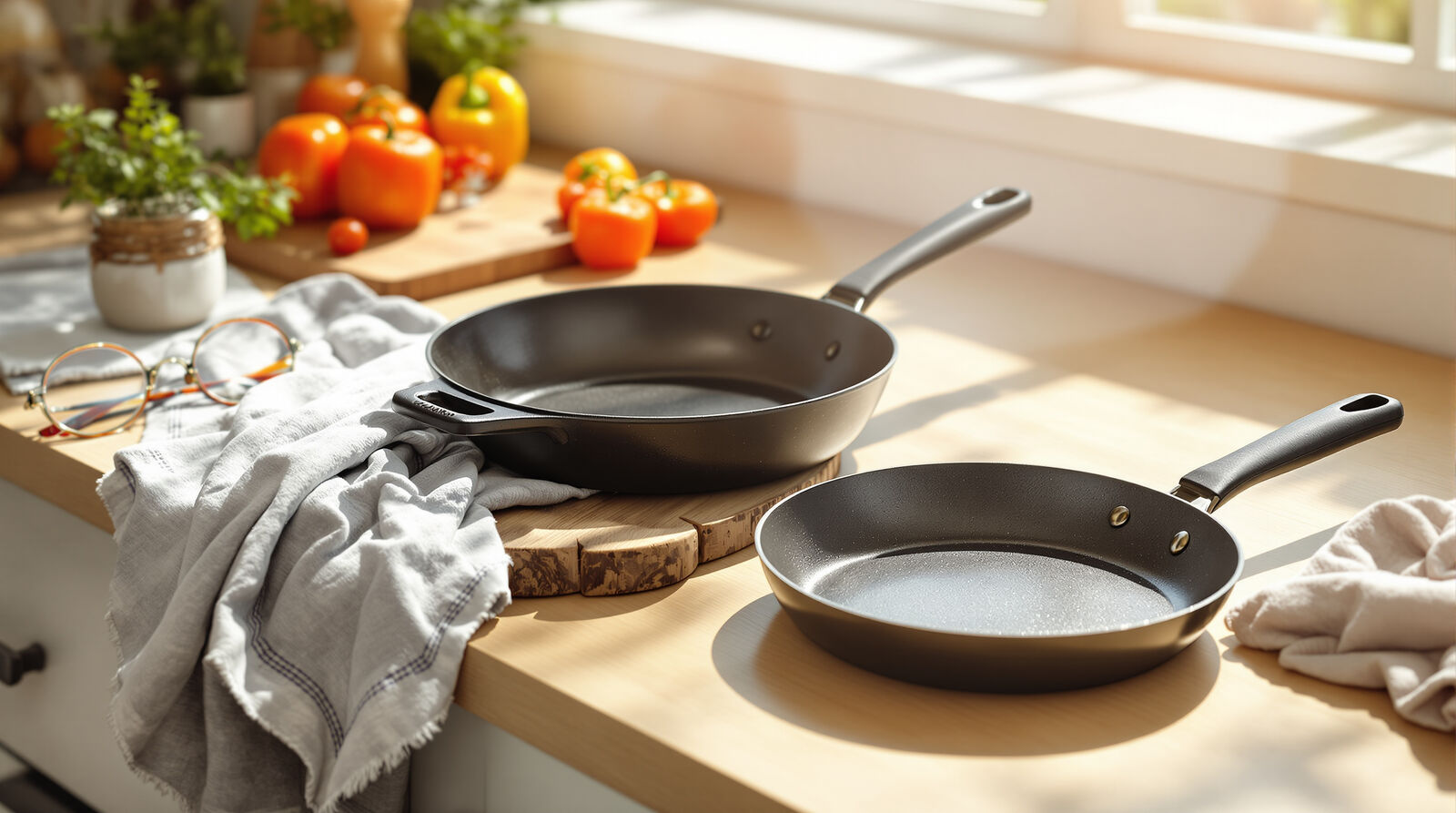
PFAS-free cookware is any pan whose cooking surface contains no fluorinated “forever chemicals” — no PTFE (Teflon), PFOA or GenX. In practice that means a short, reliable list: bare cast iron, carbon steel and stainless steel, which have no coating at all, plus true ceramic (sol-gel) coatings, which are silica-based rather than fluoropolymer. Anything sold simply as “nonstick” is almost always PTFE unless the maker clearly states otherwise. Our six picks below span all four PFAS-free surfaces — from a $30 cast iron skillet to a full ceramic set — so you can match the material to how you actually cook.
“PFAS-free” has become a headline claim on cookware boxes, but it is also one of the easiest to misread. PFAS — per- and polyfluoroalkyl substances — are a large family of fluorinated chemicals prized for being slick and heat-stable, which is exactly why the classic nonstick coating, PTFE, belongs to it. A pan is only genuinely PFAS-free when none of that chemistry is present on the cooking surface, and the word “ceramic” or “green” on a label is not, by itself, proof of that.
So this guide does two jobs. First it pins down what PFAS-free actually rules out, which cookware materials qualify, and how to avoid the pans that merely imply it. Then it ranks six specific, currently-sold pans and sets — across cast iron, carbon steel and true ceramic — with an honest note on what each one is good at and where it falls short.
The bottom line up front: the surest PFAS-free cookware is uncoated metal — cast iron, carbon steel and stainless steel — because there is no coating that could contain PFAS in the first place. A true ceramic coating (silica sol-gel, explicitly stated PTFE- and PFOA-free) is the PFAS-free way to keep an easy-release nonstick feel, with the trade-off that it wears out in a few years. Skip anything labelled only “nonstick” with no chemistry statement. For the wider picture, see our best non-toxic cookware guide, how ceramic compares to nonstick, and whether nonstick cookware is safe at all.
What does “PFAS-free” actually mean on a pan?
It means the cooking surface contains none of the per- and polyfluoroalkyl substances used to make cookware slick and heat-stable — above all PTFE, the fluoropolymer sold as Teflon, and its manufacturing relatives PFOA and GenX. No fluorinated coating, no PFAS. That is the whole test, and it is stricter than most labels imply.
PFAS is not one chemical but a sprawling family of thousands, bonded together by fluorine-carbon links so stable they barely break down in the environment — hence “forever chemicals.” Conventional nonstick cookware is the most direct kitchen source, because the coating that lets an egg slide is a PFAS compound. So a pan can be PFAS-free in only two honest ways: it carries no coating at all (bare metal), or it uses a non-fluorinated coating, which in cookware means a genuine silica-based ceramic. Everything else is either Teflon or an unverified claim.
Which cookware materials are PFAS-free?
Four materials clear the bar reliably, and two commonly sold surfaces do not. The uncoated metals are PFAS-free by design: there is simply no coating on them to contain fluorochemicals. True ceramic is PFAS-free when the maker states it carries no PTFE and no PFOA. Conventional nonstick is PFAS by definition, and a vague “ceramic” or “non-toxic” claim with no chemistry statement is a maybe, not a yes.
| Material | PFAS-free? | How it releases food | Best for |
|---|---|---|---|
| Cast iron | Yes — no coating | Seasoning (baked-on oil) | Searing, baking, high heat, buy-it-for-life value |
| Carbon steel | Yes — no coating | Seasoning (baked-on oil) | Eggs, sautéing, a lighter everyday skillet |
| Stainless steel | Yes — no coating | Heat control and technique | Sauces, deglazing, acidic foods, browning |
| True ceramic (sol-gel) | Yes — if stated PTFE/PFOA-free | Silica-based nonstick glaze | Easy release without fluoropolymer; replacing a whole set |
| PTFE / Teflon nonstick | No — the coating is PFAS | Fluoropolymer film | Nothing, if PFAS-free is the goal |
| “Ceramic” with no chemistry stated | Unverified — treat as no | Varies / undisclosed | Skip unless the maker spells out no PTFE, no PFOA |
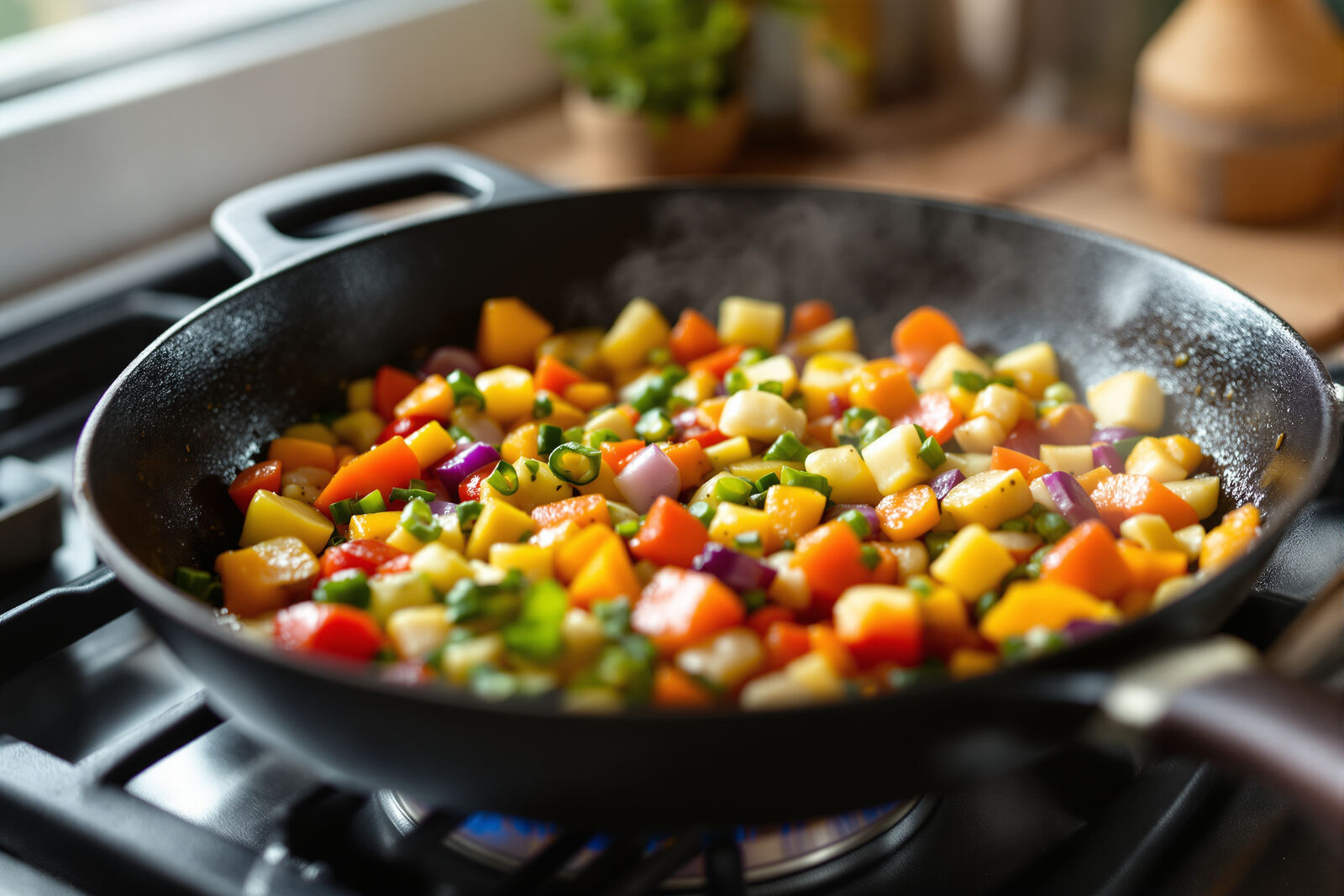
Notice what the uncoated metals share: their “nonstick” is a property of the surface or the cook, not a film laid on top. Cast iron and carbon steel build a slick, polymerized-oil seasoning that improves with use; stainless relies on preheating and a little fat. None of them can wear through to a PFAS layer, because there isn't one. That is why they anchor our ranking, with true ceramic as the PFAS-free option for anyone who still wants button-easy release.
What cookware should you avoid if you want PFAS-free?
Avoid anything sold simply as “nonstick” with no statement about its chemistry — by default that is a PTFE (Teflon) coating, which is PFAS. Also be wary of the word “ceramic” used on its own, since it has no legal definition and is sometimes slapped on coatings that still contain fluoropolymers. The claim you want in writing is explicit: “no PTFE, no PFOA.”
The reason PTFE is worth leaving behind is not just the chemistry on day one — it's the failure mode. A fluoropolymer coating is a soft film that scratches, dulls and eventually flakes, and a damaged one both sheds fluoropolymer particles into food and can release fumes when overheated, since PTFE starts breaking down above about 500°F (260°C). A 2022 study in Science of the Total Environment used Raman imaging to count the particles coming off non-stick pans and found a single crack could release thousands, a broken coating far more. That is the whole problem a PFAS-free pan sidesteps: no coating, nothing to break down. The same coating sits inside most nonstick air-fryer baskets, and the same abrasion logic drives other kitchen shedders like plastic cutting boards.
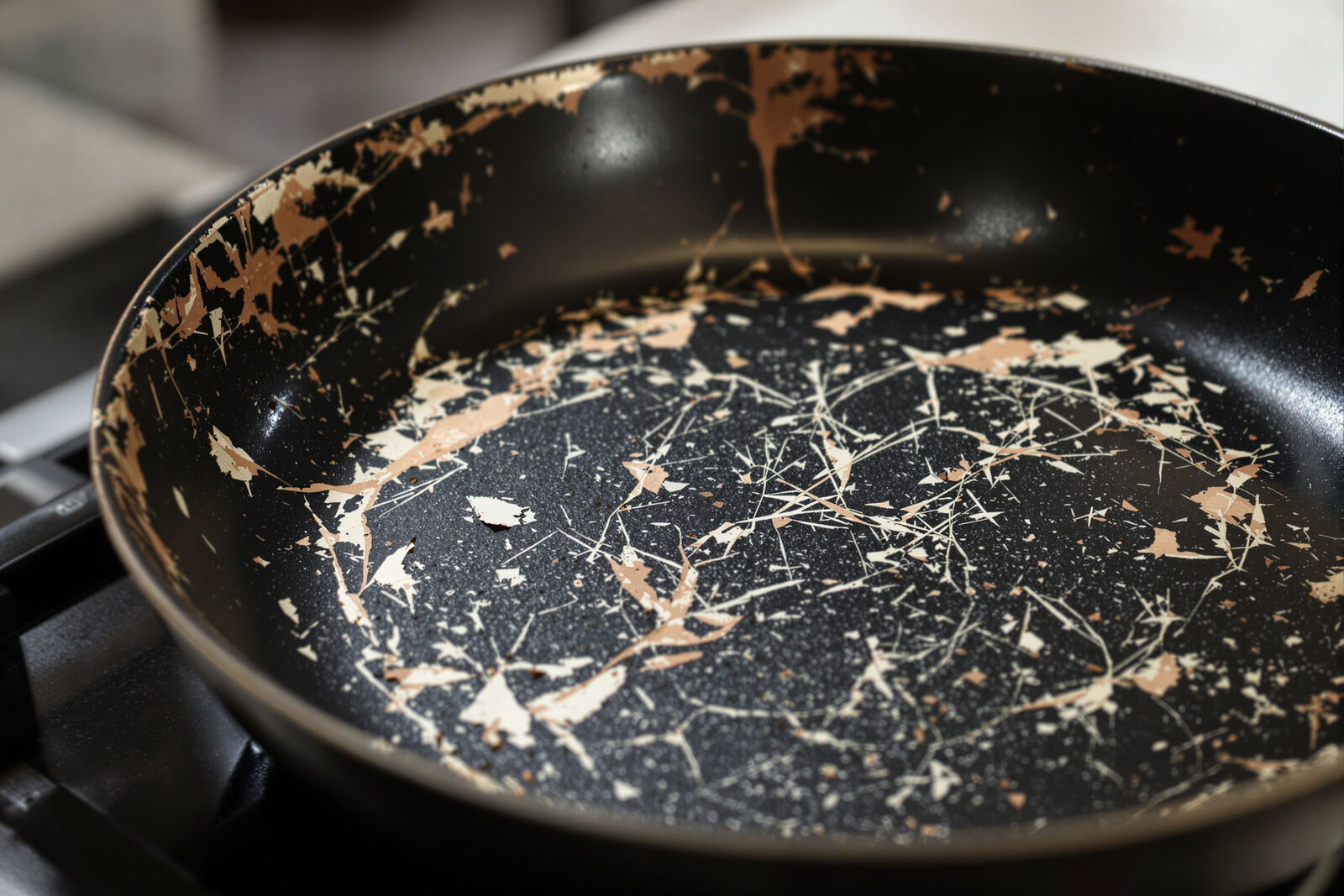
If you can see scratches, chips or bare metal showing through a nonstick coating, that pan is past its safe life — no repair restores it. It is the single easiest PFAS source to remove from a kitchen, and replacing it with a bare or true-ceramic pan closes the question for good. Our kitchen plastic detox guide walks the rest of the room, swap by swap.
"The surest PFAS-free pan isn't a better coating — it's no coating. Bare cast iron, carbon steel and stainless steel can't contain forever chemicals, because there's nothing on them to contain."
How we ranked these PFAS-free pans
We started from the materials that can be PFAS-free at all, then picked specific, currently-sold pans and sets within each one. The goal was a short list that covers how people actually cook — a cheap first skillet, a lighter everyday pan, a big family skillet, and a drop-in set for anyone replacing a whole scratched nonstick collection at once.
Three things decided the ranking: whether the maker explicitly states the surface is free of PTFE and PFOA (or carries no coating at all); how the pan performs for its intended job; and value over its lifetime, since an uncoated pan that lasts decades reads very differently from a coating that wears out in a few years. Prices and availability change, so treat the picks as the models we'd reach for and check current listings before buying.
Match the material to how you cook
Every pick below is PFAS-free — the choice is really about material and habit. See how the safe surfaces compare, then take the one that fits your kitchen.
The 6 best PFAS-free pans and sets
Every pick here is PFAS-free by material: four are bare metal with no coating at all, and two use a true silica-based ceramic their makers state is free of PTFE and PFOA. They run from a $30 cast iron skillet to a full ceramic set, so there's a PFAS-free option whether you're replacing one pan or an entire collection. Prices and availability change, so check current listings before buying.
1. Matfer Bourgeat Black Carbon Steel — Best Nonstick Replacement
 Best Nonstick Replacement
Matfer describes the pan as free of PTFE, PFOA and any other chemical coating, with a handle welded to the body rather than riveted, so there are no rivet heads inside the pan for food to collect around. It works on induction, gas, grills and in the oven. The trade-offs are the ones every carbon steel pan shares: it arrives with a protective coating to wash off, you season it yourself before first use, and Matfer says plainly not to cook acidic foods like lemon, vinegar or tomato sauce in it.
Replace the scratched nonstick pan with one that has no coating to scratch — at nearly the same weight and feel.
Why it's PFAS-free: Bare carbon steel has no PTFE layer and no other coating, so there is no fluorinated chemistry on the cooking surface at all — nothing to scratch through, flake or break down.
Check Today's Price on Amazon →Amazon prices change daily — tap to see today's price and any active discount.
- Made in France
- Induction compatible
- Easy 30-day returns
If you want the closest thing to the nonstick skillet you're retiring — light enough to flip an omelette, quick to heat — carbon steel is the natural swap, and Matfer's welded one-piece pan is the classic. Season it once and it develops its own slick, coating-free surface that only improves with use.
2. Lodge Cast Iron Skillet (10.25″) — Best Value Cast Iron
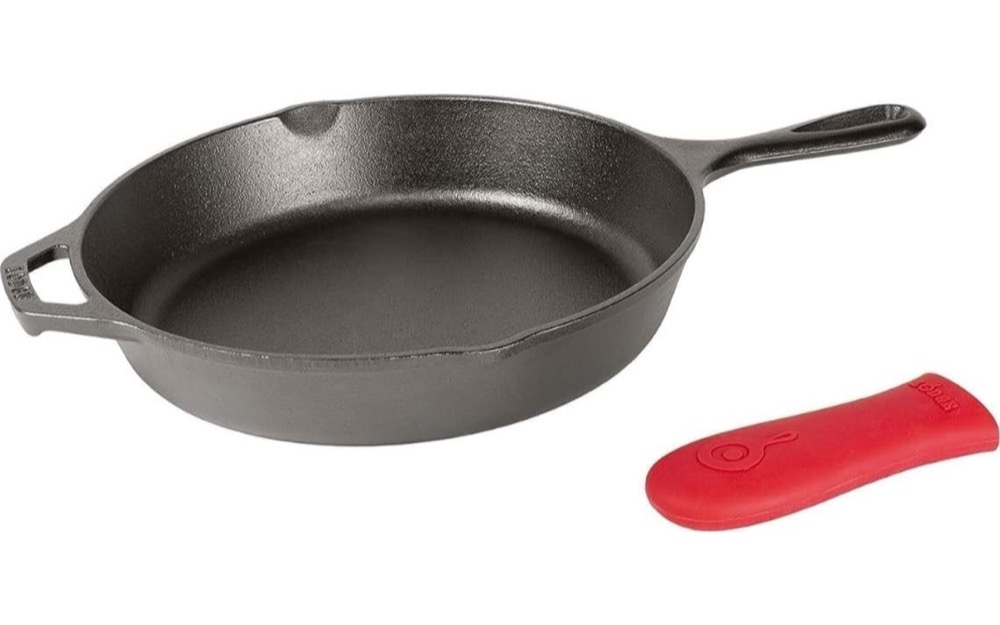 Best Value Cast Iron
Every rule that protects a coated pan — medium heat only, no metal, replace when scratched — exists because there is a coating to protect. Cast iron deletes the problem. Its seasoning is polymerized cooking oil that gets better with use, it shrugs off the high heat that degrades PTFE, and a scratch is something you fix with a paper towel and a drop of oil rather than a reason to bin the pan. Lodge ships it seasoned and ready to cook, and makes it in the USA.
One pan, no coating, no replacement cycle — for less than the cost of one mid-range nonstick.
Why it's PFAS-free: There is nothing on the cooking surface but iron and polymerized oil — no coating of any kind, so no PFAS, nothing to emit fumes, nothing to wear out.
Check Today's Price on Amazon →Amazon prices change daily — tap to see today's price and any active discount.
- Free delivery for Prime members
- Made in the USA since 1896
- Hundreds of thousands of reviews
If the nonstick pan you're replacing was the worst offender in your kitchen, cast iron is the highest-value swap on this list: it costs a fraction of a coated set, handles searing and baking that would ruin a nonstick, and never needs replacing. The 10.25-inch is the right first pan for most households.
3. de Buyer Mineral B Carbon Steel (12½″) — Best Large Carbon Steel
 Best Large Carbon Steel
The thickness is the point and the catch. At 2.5 to 3 mm, Mineral B holds its shape under high heat better than thin steel, but that same metal makes it heavy. The pan arrives coated in beeswax to stop rust in transit, which you wash off before seasoning. de Buyer says to avoid acidic foods and to keep oven use short, and it lists a lifetime warranty. It's the large, coating-free skillet for anyone who cooks for a household.
A big, coating-free skillet that seasons to a slick finish and lasts decades — no film to shed.
Why it's PFAS-free: de Buyer describes Mineral B as having no artificial coating — its nonstick comes from seasoning, not PTFE, so there is no PFAS on the pan.
Check Today's Price on Amazon →Amazon prices change daily — tap to see today's price and any active discount.
- Made in France
- Induction compatible
- Easy 30-day returns
When one skillet has to cook for the whole table, thin carbon steel can warp on a fierce burner — de Buyer's thicker Mineral B is built to resist that. It's the large, warp-resistant version of the Matfer above, for the same coating-free reason.
4. Field Company No.10 Cast Iron — Best Lightweight Cast Iron
 Best Lightweight Cast Iron
Field Company machine-polishes its skillets to recreate the smoother, lighter vintage American pans, and seasons each one with organic grapeseed oil before it ships. At about 6 lb for an 11⅝-inch pan it is noticeably lighter than a same-size Lodge, though still heavier than thin carbon steel. The price is the obstacle, but you get cast iron that behaves more like a modern skillet — with nothing synthetic on it.
Cast iron that behaves more like a modern nonstick skillet, with nothing synthetic on it to shed.
Why it's PFAS-free: Field states its pans carry no synthetic coatings, no PFOA and no PTFE — just iron and baked-on oil, with no fluorinated chemistry anywhere.
Check Today's Price on Amazon →Amazon prices change daily — tap to see today's price and any active discount.
- Made in the USA
- Induction compatible
- Easy 30-day returns
The usual complaints about cast iron — too heavy, too rough for eggs — are exactly what Field's machined, lighter skillet is built to answer, without adding a coating back. It's the premium pick for anyone who wants cast iron's permanence but a smoother, lighter feel.
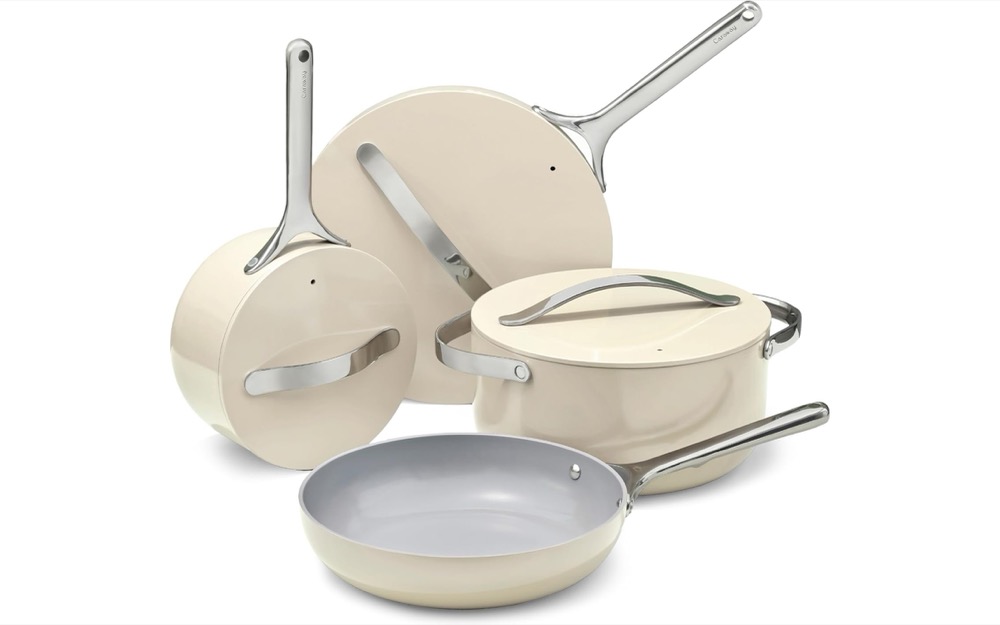
5. Caraway Ceramic Cookware Set — Best Ceramic Set
 Best Ceramic Set
Caraway's cooking surface is a sol-gel ceramic: no PTFE layer to crack and shed the particles the 2022 study documented in nonstick pans. When a ceramic coating wears, it stops being slick — it doesn't shed fluoropolymer into food. Treat it like any coated pan (wood or silicone utensils, medium heat) and expect to trade some longevity for the cleaner chemistry; it's the easy one-purchase way to retire a whole nonstick set at once.
Replace a scratched nonstick set in one move — with a cooking surface that has no fluoropolymer in it.
Why it's PFAS-free: The cooking surface is a silica-based sol-gel glaze that Caraway states is made without PTFE, PFOA, lead or cadmium — no fluoropolymer, so no PFAS.
Check Today's Price on Amazon →Amazon prices change daily — tap to see today's price and any active discount.
- Free delivery for Prime members
- Thousands of verified reviews
- Easy 30-day returns
If you'd rather keep the ease of a nonstick pan but drop the fluoropolymer, a true ceramic set is the middle path — and Caraway is the one that made it mainstream. It won't last like cast iron, but when it wears it simply loses slickness instead of shedding Teflon.
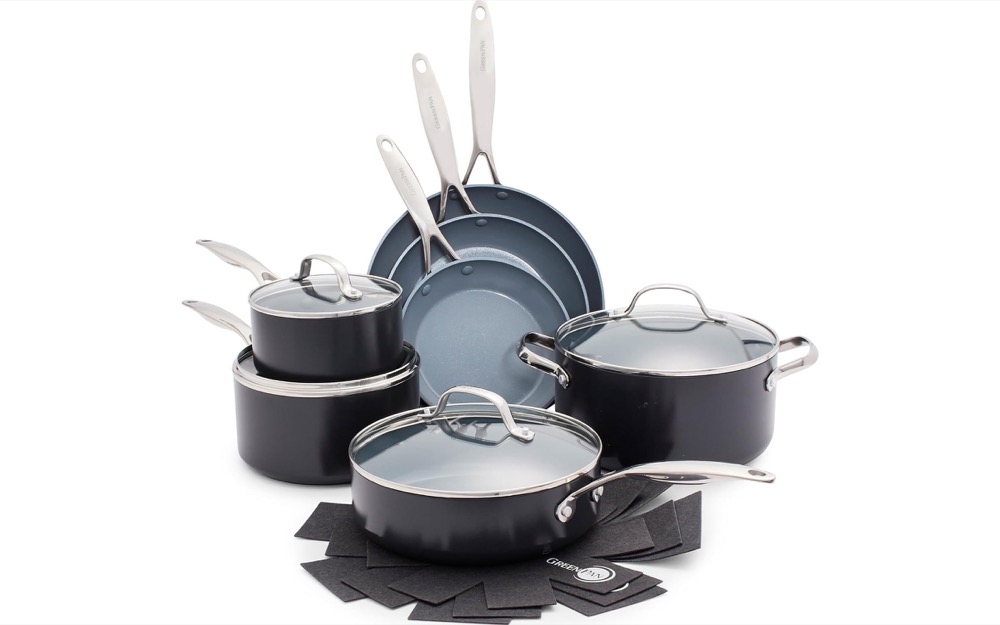
6. GreenPan Valencia Pro — Best Value Ceramic
 Best Value Ceramic
GreenPan created the ceramic nonstick category, and Valencia Pro is its proven mid-line: the silica-based Thermolon surface on a hard-anodized aluminum body with a magnetic base for induction stoves. The safety logic is identical to every true ceramic coating — no PTFE means the scratch-and-shed failure mode documented in nonstick pans simply isn't available. It's the budget way to get ceramic's clean chemistry.
Ceramic-coated cooking without the boutique markup — from the brand that invented the coating.
Why it's PFAS-free: Thermolon is a silica-based surface made without PTFE or PFOA (manufacturer-stated) — there is no fluoropolymer in the coating, so no PFAS.
Check Today's Price on Amazon →Amazon prices change daily — tap to see today's price and any active discount.
- Free delivery for Prime members
- Thousands of verified reviews
- Category-inventor track record
Ceramic doesn't have to be a premium buy — GreenPan's mid-line gives you the same no-fluoropolymer surface as the boutique sets for less. For the full comparison of coated and uncoated options, see our best non-toxic cookware guide and the deeper dive on ceramic vs nonstick.
Want the Full Home Protection Guide?
A worn nonstick pan is one plastic touchpoint among dozens in a typical kitchen. The Complete Plasticproof Guide covers every room — kitchen, nursery, bathroom, bedroom — with 80+ product recommendations backed by 47+ studies.
The honest verdict
PFAS-free cookware is one of the few non-toxic-kitchen upgrades with a genuinely clean answer: the surest options aren't a cleverer coating but no coating at all. Bare cast iron, carbon steel and stainless steel cannot contain forever chemicals because there is nothing on them to contain — and a true sol-gel ceramic, when the maker explicitly states no PTFE and no PFOA, is the PFAS-free way to keep an easy-release feel. The only pans to be wary of are the ones that lean on the word “nonstick” or “ceramic” without ever naming their chemistry.
So the practical path is short. If you want buy-it-for-life value and don't mind seasoning, start with cast iron or carbon steel. If you want a lighter everyday skillet, carbon steel is the closest in feel to the nonstick pan you're leaving. If you'd rather replace a whole scratched set in one move and keep button-easy release, a true ceramic set is the PFAS-free middle path — just expect to replace it in a few years as the coating wears. Any of the six above gets the forever chemicals out of the pan for good.
Match the pan to how you cook
Every pick here is PFAS-free — the real choice is material and habit. See how the safe surfaces compare, then take the one that fits your kitchen.
Frequently Asked Questions
PFAS-free cookware is any pan whose cooking surface contains no per- and polyfluoroalkyl substances — the family of fluorinated “forever chemicals” that includes PTFE (Teflon), PFOA and GenX. In practice the surest PFAS-free options are bare cast iron, carbon steel and stainless steel, which have no coating at all, plus true ceramic (sol-gel) coatings, which are silica-based rather than fluoropolymer.
A true ceramic coating is a silica-based sol-gel glaze, not a fluoropolymer, so when it is genuinely free of PTFE and PFOA it is PFAS-free — brands like Caraway and GreenPan state this on their own specs. The catch is that “ceramic” is a marketing word with no legal definition, so buy only from makers that explicitly state no PTFE and no PFOA. Ceramic coatings also wear out in a few years, at which point they lose slickness rather than shedding fluoropolymer.
Yes. Bare stainless steel, cast iron and carbon steel have no synthetic nonstick coating at all, so there is no PFAS on the cooking surface. Cast iron and carbon steel get their release from seasoning — a baked-on layer of polymerized oil — while stainless relies on heat control and technique. These uncoated metals are the only cookware that cannot contain PFAS by design, and they last for decades.
Assume any pan sold as “nonstick” uses a PTFE coating unless it clearly says otherwise. Look for explicit maker language such as “PTFE-free and PFOA-free” or “no forever chemicals”; a slick dark coating on aluminum with no such statement is almost always Teflon. Bare cast iron, carbon steel and stainless steel are unmistakably uncoated. The word “ceramic” alone is not proof — confirm the maker states no PTFE and no PFOA.
Not necessarily all at once. An intact, PFOA-free nonstick pan used at low-to-medium heat with wood or silicone utensils is reasonable to keep using in the short term. But any pan that is scratched, chipped or flaking should be retired, because a damaged PTFE coating sheds fluoropolymer particles and can emit fumes if overheated. Replacing it with an uncoated or true-ceramic pan removes the question for good.
Sources
- Luo Y, Gibson CT, Chuah C, Tang Y, Naidu R, Fang C. "Raman imaging for the identification of Teflon microplastics and nanoplastics released from non-stick cookware." Science of the Total Environment, 2022;851(Pt 2):158293. (Used Raman imaging with a purpose-built algorithm to detect and count Teflon particles from non-stick cookware; reported ~9,100 microplastic particles released from a single surface crack and up to ~2.3 million micro- and nanoplastics from a broken, deteriorated coating.)
- Luo Y, Gibson CT, Chuah C, Tang Y, Naidu R, Fang C. "Raman imaging for the identification of Teflon microplastics and nanoplastics released from non-stick cookware." PubMed record (PMID 36030853). (Indexed abstract of the 2022 Flinders University / University of Newcastle study, confirming the particle-release findings above.)
- Cox KD, Covernton GA, Davies HL, et al. "Human Consumption of Microplastics." Environmental Science & Technology, 2019;53(12):7068–7074. (Estimated tens of thousands of microplastic particles consumed per person per year from food and drink combined — the exposure context a shedding pan quietly adds to.)