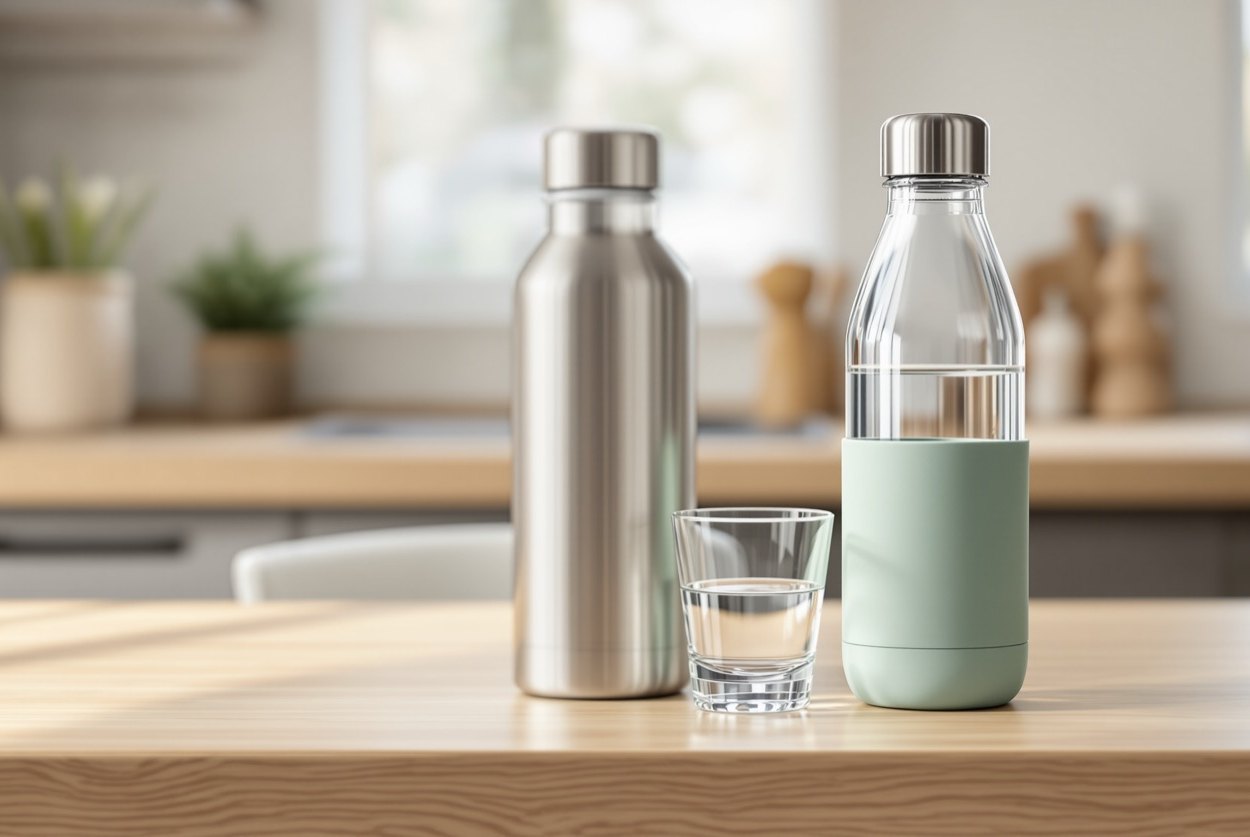
If you have already decided to get plastic out of your water bottle, the choice usually comes down to two materials: stainless steel and glass. Both get called “plastic-free,” both cost more than the plastic bottle they replace, and the internet argues about them mostly on feel — glass “tastes cleaner,” steel “is tougher.” The research lets us be more specific than that. Neither body sheds microplastics into water. What separates them is a smaller list of real trade-offs: what each material can put into your drink instead, and the one plastic part almost every bottle of both kinds still has.
That part is the cap. The studies that have actually counted plastic particles in bottled water keep tracing them to the place where the cap meets the neck, not to the walls of the bottle. So this comparison covers the bodies first, then the caps, then the specific bottles worth buying — each judged on what touches your water, not on what the box says.
Bottom line: For plain water, both materials are a large step down in plastic exposure from a disposable bottle, and the difference between them is small. Choose glass if you drink lemon water, juice or other acidic drinks from it all day, if you have a nickel allergy, or if taste is your top priority. Choose stainless steel if the bottle travels, gets dropped, or needs to keep water cold for hours. Then fix the part that matters most for microplastics in either one: pick a cap with no plastic in the water path, or at least stop squeezing and twisting a worn plastic cap.
Which Is Safer, a Stainless Steel or Glass Water Bottle?
For everyday water, both are safe and both are far better than plastic; glass is the more inert of the two. Glass puts nothing measurable into cold water, while food-grade stainless steel can release small amounts of nickel and chromium — but the study that measured that used hours of simmering acidic tomato sauce, a very different job from holding cold water.
The baseline both materials are replacing is worth stating with real numbers. In a 2024 study in the Proceedings of the National Academy of Sciences, Naixin Qian, Wei Min and colleagues at Columbia University used a new laser imaging method to count individual plastic particles in bottled water. They estimated about 240,000 micro- and nanoplastic particles per liter (2.4 ± 1.3 × 10⁵), and about 90 percent of them were nanoplastics — particles smaller than one micron, far below what earlier counting methods could see (PNAS, 2024). A steel or glass body removes the container from that equation entirely.
Head-to-Head: Stainless Steel vs Glass Water Bottle
What the research and the makers’ own specs say, side by side. A dash means no study has measured it.
| Feature | Stainless Steel (18/8) | Glass |
|---|---|---|
| Body sheds microplastics | No — contains no plastic | No — contains no plastic |
| What the body can release | Nickel and chromium; measured with acidic food cooked for hours (J Agric Food Chem, 2013) | Nothing measurable in plain water — chemically inert |
| Metal content | Grade 304: about 18–20% chromium, 8–12% nickel | None |
| Acidic drinks (lemon water, juice) | Short-term fine; avoid storing for days in a new bottle | Best choice |
| Keeps water cold | Double-wall vacuum models: up to 24 hours (Hydro Flask spec) | No — single-wall glass warms to room temperature |
| Drop resistance | Dents, rarely fails | Can shatter; a silicone sleeve helps but is not a guarantee |
| Hidden concern | Some vacuum bottles seal the base with a lead-containing pellet, covered by steel | Painted metal caps on store-bought drinks shed paint particles (ANSES, 2025) |
| Typical cap | Plastic, with all-steel options from some brands | Plastic, often with a silicone gasket |
| Taste | Neutral for most people; some notice a faint metallic note | Completely neutral |
| Best for | Commuting, hiking, kids, cold water all day | Desk, home, acidic drinks, nickel allergy |
Does Stainless Steel Leach Into Water?
It can release tiny amounts of nickel and chromium, but the only strong measurement comes from hot, acidic, long cooking — not cold water. New steel releases the most, and the amount drops sharply after the first several uses.
The study everyone cites is Kristin Kamerud, Kevin Hobbie and Kim Anderson’s 2013 paper from Oregon State University in the Journal of Agricultural and Food Chemistry (PubMed 23984718). They simmered four commercial tomato sauces with different grades of stainless steel. After six hours of cooking, nickel in the sauce rose up to 26-fold and chromium up to 7-fold, depending on the steel grade. Brand-new steel leached the most; leaching fell with each cooking cycle and leveled off after the sixth, though by the tenth cycle a 126-gram serving still picked up an average of 88 micrograms of nickel and 86 of chromium.
What that means for a water bottle: the conditions that drove those numbers were heat, acid and time together. Cold tap water is close to neutral and sits in the bottle for hours, not simmering. Nobody has published an equivalent measurement for water bottles, so the honest reading is “far lower, not zero.” Two groups should take the cooking result seriously anyway: people with a nickel allergy, which is the reason the Oregon State team ran the study, and anyone who fills a steel bottle with lemon water, juice or sports drinks and leaves it for a day or more. For both, glass removes the question entirely. Everyone else can lower the small remaining exposure by washing a new steel bottle several times before regular use and emptying acidic drinks the same day.
Is Glass Really Microplastic-Free?
The glass itself is; the cap may not be. A 2025 study from France’s food-safety agency found more microplastics in glass-bottled drinks than in plastic ones — and traced them to the paint on the metal caps, not the glass.
Iseline Chaïb and colleagues at ANSES published the work in the Journal of Food Composition and Analysis (2025, vol. 144). Glass bottles of soft drinks, lemonade, iced tea and beer averaged about 100 microplastic particles per liter, roughly 5 to 50 times more than the same drinks in plastic bottles or cans. The particles matched the color and polymer of the paint on the caps, and the caps were scratched from rubbing against each other in storage. In a follow-up test reported in the ANSES summary, water sealed under uncleaned caps held an average of 287 particles per liter; blowing air on the caps cut that to 106, and blowing plus rinsing cut it to 87. Plain water was low regardless of container — 4.5 particles per liter in glass bottles and 1.6 in plastic bottles and cartons.
A reusable glass water bottle does not use a painted crown cap, so that specific source does not apply to it. The lesson that does carry over is the same one the next section shows for plastic bottles: the closure is the weak point. We cover the full ANSES study in microplastics in glass bottles.
Do Water Bottle Caps Shed Microplastics?
Yes — and in disposable bottles, the cap is the main source. Twisting a plastic cap on and off grinds plastic off both the cap and the bottle neck, and those fragments land in the water.
In a 2021 study in the Journal of Water and Health, Tanvir Singh opened and closed disposable plastic water bottles repeatedly and dyed the particles to count them. Each open-and-close cycle added about 553 ± 202 microplastic particles per liter, enough on its own to explain the total particle count in the water. The paper concluded that abrasion between the cap and the bottleneck is the dominant mechanism behind microplastics in bottled water (doi:10.2166/wh.2021.025). A 2022 Water Research study by Anna Winkler and colleagues at the University of Milan and the European Commission’s Joint Research Centre found the polyethylene sealing of drinking-water bottles released particles from a few hundred nanometers up to about one micron, at a few tenths of a nanogram per opening and closing cycle (PubMed 35901554).
Those studies used disposable bottles with soft, cheap caps, and no one has run the same test on a reusable bottle’s cap. But the mechanism is the same — plastic threads rubbing against a neck — so it is the one place a steel or glass bottle can still add plastic. Three habits limit it: choose a cap where the part touching your water is steel or silicone rather than hard plastic, replace a plastic cap once its threads look scuffed or chalky, and do not let the cap ride around loosely half-threaded where every bump grinds it. If you drink through a built-in straw, check what the straw is made of too; many are plastic.
Do Insulated Steel Bottles Contain Lead?
Some do, in a sealing pellet hidden in the base — not in any surface your water touches. Stanley confirmed in 2024 that its vacuum-insulated cups use a sealing material that includes some lead, covered by a stainless steel layer.
Double-wall vacuum bottles are made by pulling the air out from between two steel walls and sealing the hole, and the industry-standard pellet used for that seal has historically contained lead. Stanley’s parent company said the sealed area is covered by durable stainless steel, so the lead is inaccessible unless the base is damaged (reported January 2024). The practical rule: if the bottom cap of an insulated bottle falls off or the base is cracked open, retire the bottle, and keep insulated bottles away from small children who chew on things. Single-wall steel bottles, like the Klean Kanteen Classic below, have no vacuum seal and no pellet. Glass bottles have neither issue.
Which One Should You Choose?
Match the material to the job. Most households end up with one of each.
Choose stainless steel for:
- Commuting, gym bags, hiking and kids’ backpacks
- Water that needs to stay cold for hours
- Anywhere a bottle might be dropped on concrete
- Plain water, refilled and emptied daily
Choose glass for:
- Lemon water, juice, kombucha and other acidic drinks
- Anyone with a nickel allergy
- A desk or bedside bottle that stays put
- The most neutral taste possible
Whichever you pick, the water going into it matters as much as the bottle. Tap water carries its own particles, which our guide to microplastics in tap water breaks down, and bottled water vs tap water compares the two sources directly. If you are still reusing disposable bottles, read are plastic water bottles safe to reuse first. The full ranked lists are in the best plastic-free water bottles and the best stainless steel water bottles.
The Three Worth Buying
One single-wall steel bottle, one insulated steel bottle and one glass bottle — each with nothing but steel or glass in contact with the water in the body.
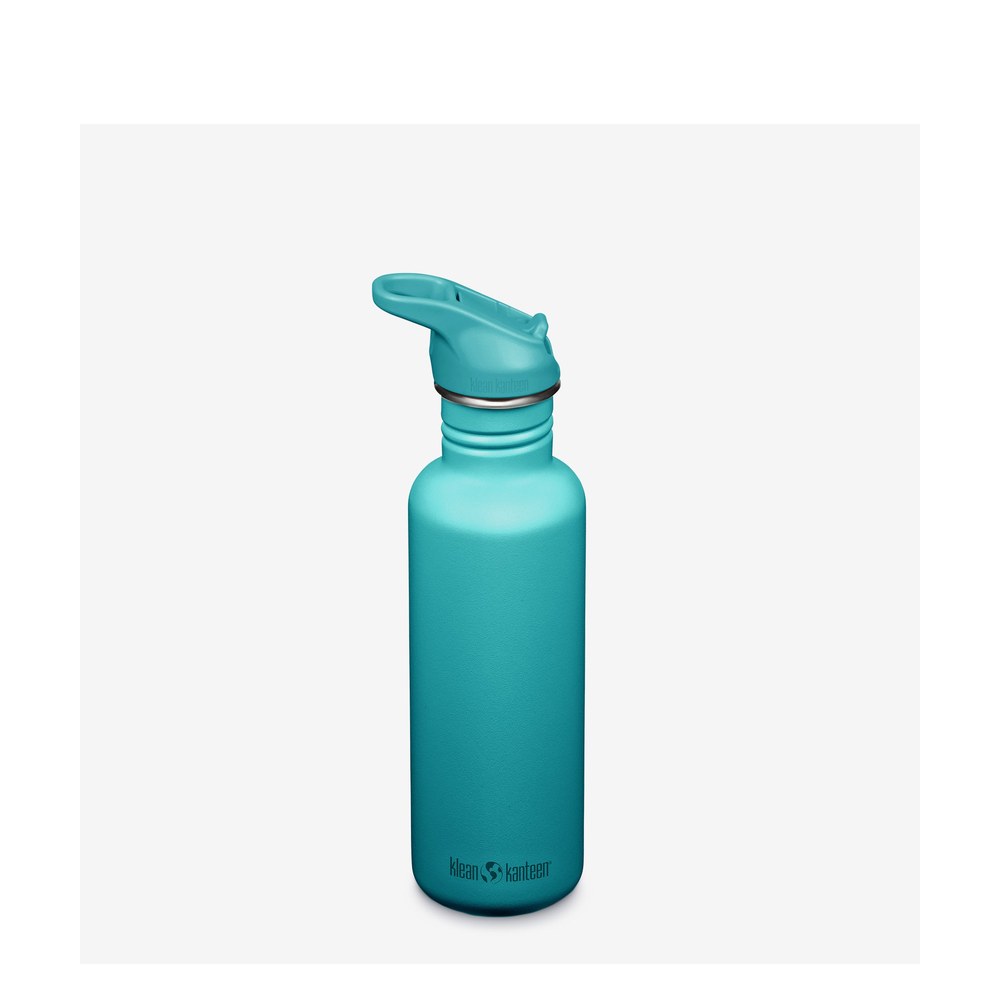 Best Stainless Steel
Klean Kanteen makes the Classic body from 90 percent post-consumer recycled 18/8 stainless steel, and the surface your water touches is bare steel. Because it is single-wall, there is no vacuum gap and no sealing pellet in the base — the lead question that hangs over insulated bottles does not apply. The standard Loop Cap is polypropylene plastic, so if you want nothing but steel near your water, Klean Kanteen also sells an all-steel cap that fits the Classic neck.
Pros
- Bare steel interior, no lining to wear
- No vacuum seal, so no sealing pellet
- Survives drops that would end a glass bottle
Cons
- Not insulated — water warms and the outside sweats
- Standard cap is plastic; the steel cap is a separate choice
- Not the pick for acidic drinks stored all day
The everyday steel bottle with nothing hidden inside it.
Why it is the safer choice: Bare 18/8 steel where the water sits, and single-wall construction with no lead-sealed vacuum base.
Check Today's Price on Amazon →Amazon prices change daily — tap to see today's price and any current discount.
- Free delivery for Prime members
- Recycled steel
- Easy 30-day returns
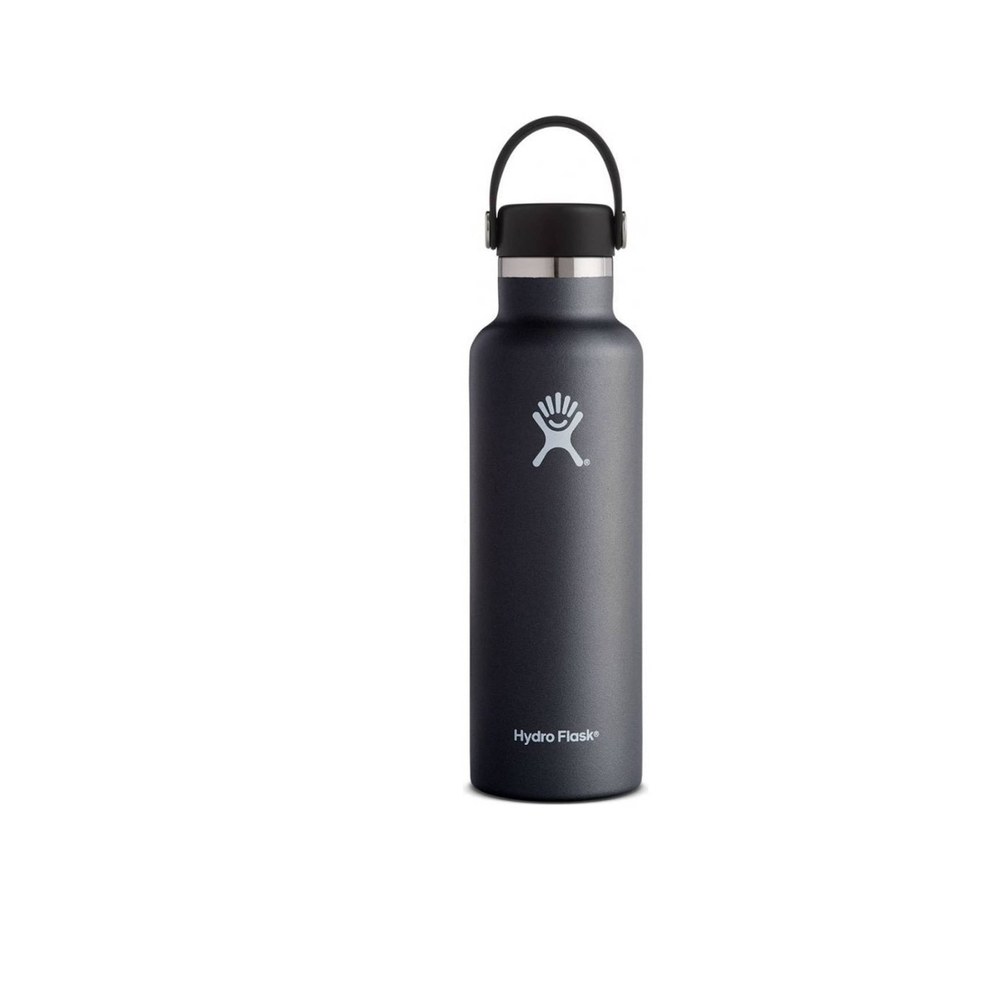 Best Insulated
Hydro Flask builds the Standard Mouth from what it calls 18/8 pro-grade stainless steel with its TempShield double-wall vacuum insulation, rated for up to 24 hours cold and up to 12 hours hot. The interior is unlined steel. The standard Flex Cap is plastic (Hydro Flask states it is BPA-free), and the company also sells this size with a stainless steel cap. As with any vacuum bottle, retire it if the base is ever cracked open, and check the cap threads for wear once a year.
Pros
- Keeps water cold through a full day
- No condensation on the outside
- Unlined steel interior
Cons
- Standard Flex Cap is plastic
- Heavier than a single-wall bottle
- Vacuum construction means a sealed base you cannot inspect
Cold water for a whole day, with steel touching the water.
Why it is the safer choice: An unlined 18/8 steel interior replaces the plastic bottle, which a 2024 PNAS study found held about 240,000 particles per liter.
Check Today's Price on Amazon →Amazon prices change daily — tap to see today's price and any current discount.
- Free delivery for Prime members
- Steel cap available
- Easy 30-day returns
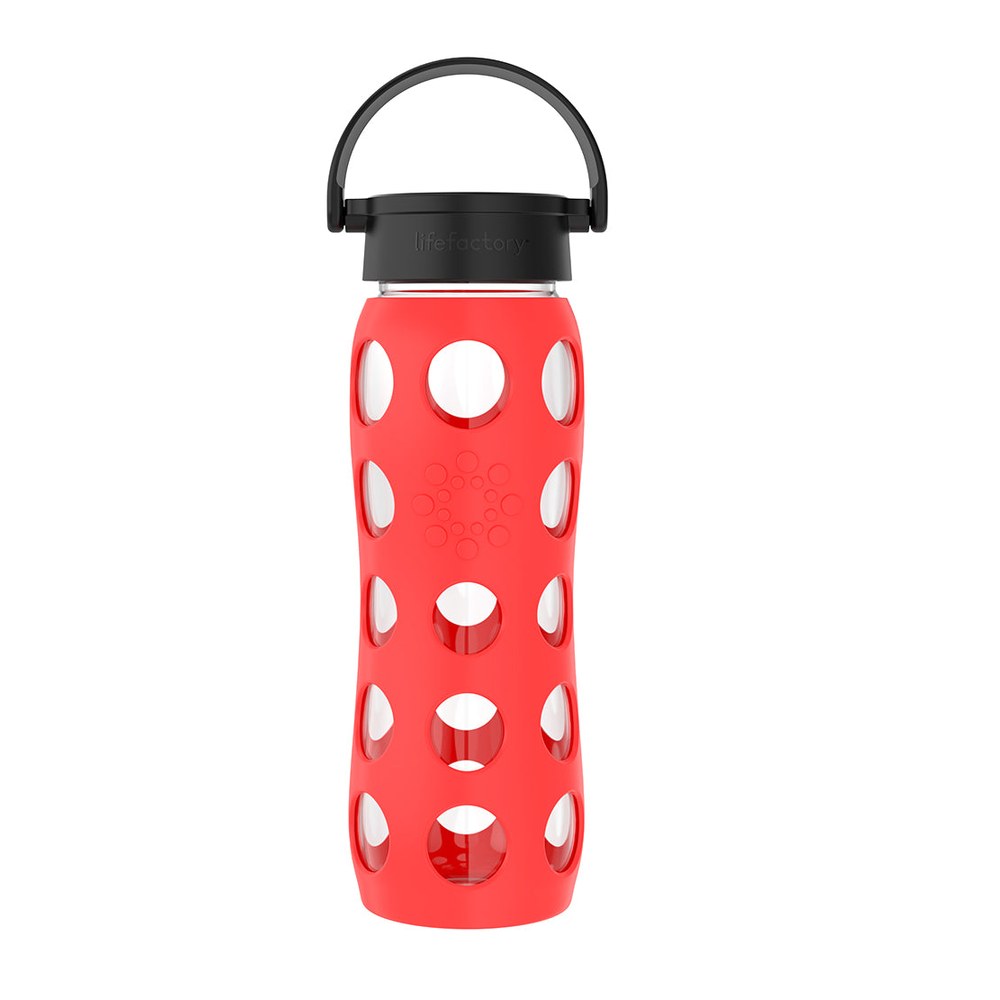 Best Glass
Glass is the one material here with nothing to give up to your drink, which is why it is our choice for lemon water, juice and iced tea that sit in the bottle all day. Lifefactory wraps the glass in a silicone sleeve that improves grip and softens bumps, and the whole bottle goes in the dishwasher, which makes it easy to keep the threads and cap clean. It is still glass: a hard drop onto tile or concrete can break it, so it lives best on a desk, in a kitchen or at a bedside.
Pros
- Inert glass — no metals, no plastic in the body
- Best choice for acidic drinks and nickel allergies
- Dishwasher safe, sleeve included
Cons
- Can break if dropped on a hard floor
- No insulation — water reaches room temperature
- Heavier than steel for the same volume
The most neutral bottle for water, lemon water and juice.
Why it is the safer choice: Glass releases nothing measurable into what it holds, so acidity and storage time stop mattering.
Check Today's Price on Amazon →Amazon prices change daily — tap to see today's price and any current discount.
- Free delivery for Prime members
- Dishwasher safe
- Easy 30-day returns
Frequently Asked Questions
Is a stainless steel or glass water bottle better?
For plain water, both are safe and far better than plastic, and the difference between them is small. Glass is fully inert, so it is the better choice for acidic drinks, nickel allergies and taste. Stainless steel is better for travel, drops and keeping water cold. A 2024 PNAS study estimated about 240,000 plastic particles per liter in bottled water; neither a steel nor a glass body adds to that.
Does stainless steel leach into water?
It can release small amounts of nickel and chromium. The main measurement comes from a 2013 Oregon State University study in the Journal of Agricultural and Food Chemistry, where tomato sauce cooked for six hours in stainless steel picked up up to 26 times more nickel and 7 times more chromium. New steel leached the most and leaching leveled off after six uses. Cold, near-neutral water is a far milder test, and no equivalent study of water bottles has been published.
Do glass water bottles have microplastics?
The glass does not shed any. A 2025 ANSES study in the Journal of Food Composition and Analysis found about 100 particles per liter in glass-bottled sodas, iced teas and beers, but traced them to the paint on the metal caps, not the glass. Plain water in glass averaged 4.5 particles per liter. Reusable glass water bottles do not use painted crown caps.
Do water bottle caps shed microplastics?
In disposable bottles, yes, and they are the main source. A 2021 Journal of Water and Health study measured about 553 particles per liter added with each open-and-close cycle, from the cap grinding against the bottleneck. Choosing a cap with steel or silicone in the water path, and replacing a worn plastic cap, limits it in a reusable bottle.
Do insulated stainless steel bottles contain lead?
Some vacuum-insulated bottles seal the base with a pellet that contains lead. Stanley confirmed this in 2024 and said the pellet is covered by stainless steel and is not in contact with the drink. Retire any insulated bottle whose base cover comes off or cracks. Single-wall steel bottles and glass bottles have no such seal.
Is glass or stainless steel better for lemon water?
Glass. Acid is what drove the metal leaching measured in the Oregon State stainless steel study, and glass releases nothing measurable regardless of acidity. If you use a steel bottle for lemon water, empty and wash it the same day rather than storing the drink overnight.
Sources
- Qian N, Gao X, Lang X, Deng H, Bratu TM, Chen Q, Stapleton P, Yan B, Min W. Rapid single-particle chemical imaging of nanoplastics by SRS microscopy. Proceedings of the National Academy of Sciences. 2024;121(3):e2300582121. doi:10.1073/pnas.2300582121 · PubMed PMID 38190543
- Singh T. Generation of microplastics from the opening and closing of disposable plastic water bottles. Journal of Water and Health. 2021;19(3):488–498. doi:10.2166/wh.2021.025 · PubMed PMID 34152301
- Winkler A, Fumagalli F, Cella C, Gilliland D, Tremolada P, Valsesia A. Detection and formation mechanisms of secondary nanoplastic released from drinking water bottles. Water Research. 2022;222:118848. doi:10.1016/j.watres.2022.118848 · PubMed PMID 35901554
- Chaïb I, Doyen P, Merveillie P, Dehaut A, Duflos G. Microplastic contaminations in a set of beverages sold in France. Journal of Food Composition and Analysis. 2025;144:107719. doi:10.1016/j.jfca.2025.107719 · ANSES summary
- Kamerud KL, Hobbie KA, Anderson KA. Stainless steel leaches nickel and chromium into foods during cooking. Journal of Agricultural and Food Chemistry. 2013;61(39):9495–9501. doi:10.1021/jf402400v · PMC4284091
- FOX 9. Stanley products contain ‘some lead,’ company says. January 2024. fox9.com