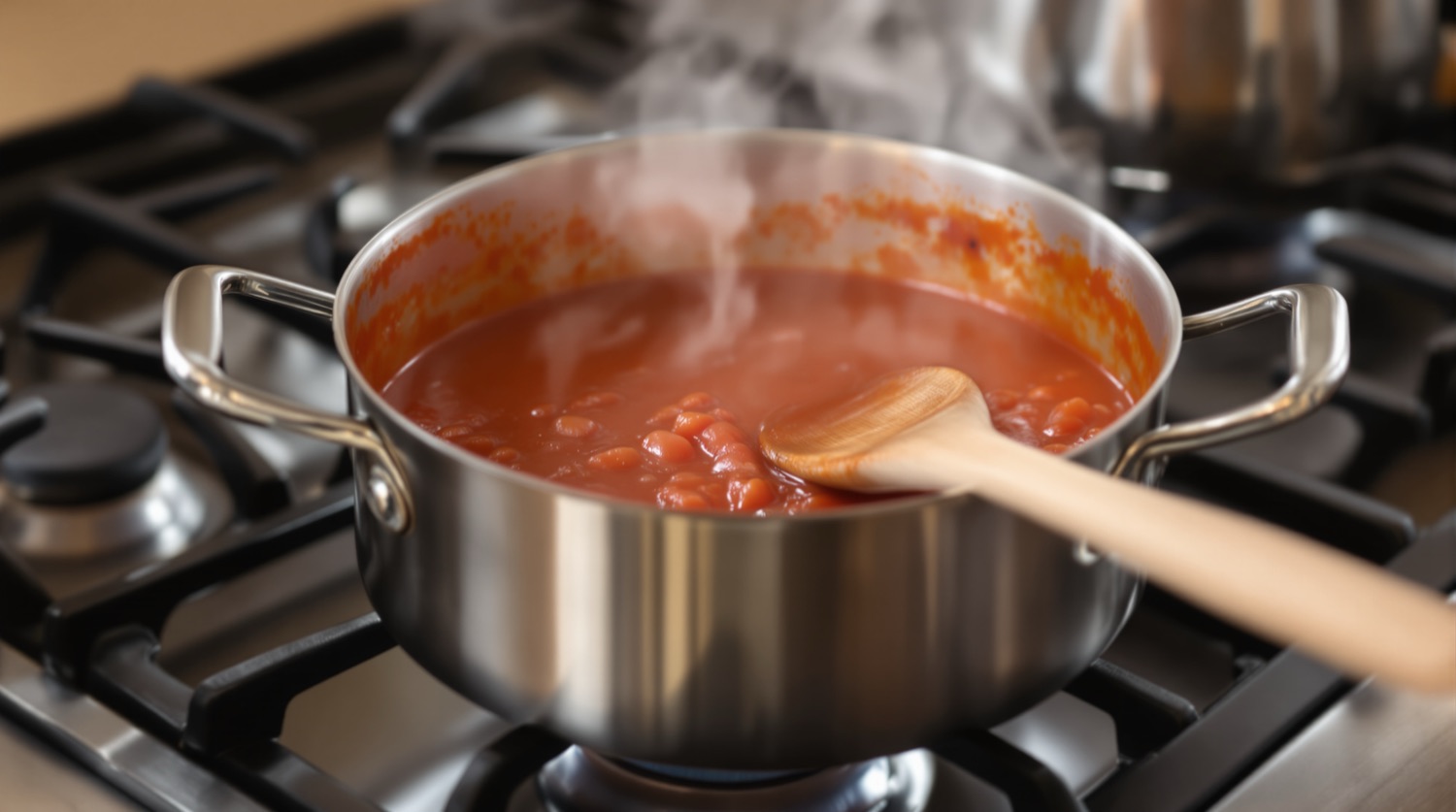
For everyday cooking, stainless steel is one of the cleanest materials you can put food in — and the evidence for that is a lot stronger than the evidence against it. A 2026 systematic review in Food and Chemical Toxicology pooled 2,053 migration measurements from 69 studies and found stainless steel exceeded regulatory limits in 11.0% of them, against 12.5% for plastics, 36.1% for bare metal cookware and 43.0% for paper and board; only glass did better, at 5.6% (Mahmoud et al., 2026). The real exception is acidic food cooked long and slow: Oregon State University researchers simmering commercial tomato sauce measured an average of 88 µg of nickel and 86 µg of chromium per 126 g serving (Kamerud, Hobbie & Anderson, 2013). For a 70 kg adult that is roughly a tenth of a day's tolerable nickel intake — worth knowing, not worth panicking over.
There is a particular kind of advice that deserves to be checked hardest: the advice you give yourself. Nearly every page on this site, when it finds plastic shedding into food, points at the same two replacements — glass and stainless steel. So the fair question is whether the replacement has a problem of its own, and the honest answer is that it has a small, well-measured, highly conditional one.
Stainless steel is not an inert material in the way glass is. It is an alloy, and the two metals that give it its corrosion resistance — chromium and nickel — are the two that can migrate into food. Below is what has actually been measured, in what conditions, how it compares to the alternatives, and the four changes that are genuinely worth making. For the wider room, our kitchen plastic detox guide works through it in order of impact.
The bottom line up front: keep your stainless pans. Break a new one in before you trust it with a long braise, do not let acidic leftovers sit in the pan overnight, and if you are among the roughly 17% of women who are nickel-allergic, move multi-hour tomato cooking to enameled cast iron, glass or solid ceramic. Everything else — searing, boiling, sauteing, a 20-minute pan sauce — is a non-issue.
Is stainless steel cookware safe?
It is, and the best evidence is comparative rather than absolute. In July 2026, Mahmoud, Ghuniem, Ali and Ramadan published a PRISMA-compliant systematic review in Food and Chemical Toxicology that gathered every experimental metal-migration study on food-contact materials published between 2015 and 2026 — 69 studies, 2,053 individual measurements, all using standard laboratory methods and food simulants (PMID 42472591). Across the whole dataset, 19.3% of measurements exceeded a regulatory limit. Broken out by material, the ranking is the useful part.
| Food-contact material | Measurements over a regulatory limit | What that means in a kitchen |
|---|---|---|
| Glass | 5.6% | The cleanest material tested. Nothing to break in, nothing to react. |
| Ceramics | 10.0% | A similar rate, but worse when it fails — lead and cadmium in decorative glazes. |
| Stainless steel | 11.0% | The exceedances cluster in acidic, long-duration conditions. |
| Plastics | 12.5% | Worse than stainless on metals alone, before microplastics enter the picture. |
| Metal cookware (aluminum, artisanal) | 36.1% | More than three times the stainless rate. Aluminum is the recurring problem. |
| Paper and board | 43.0% | The worst performer — and the material takeout arrives in. |
The review also ran a risk assessment on 38 element-and-material combinations and found 18 exceeding health-based thresholds at the 95th percentile. The highest hazard quotients were cadmium and lead in ceramics and aluminum in paper and board. Stainless steel was not among the headline concerns. That is the context missing from most of what is written about nickel in pans: the pan sits near the clean end of the range, and the container the food arrived in sits near the dirty end.
What actually leaches out of a stainless steel pan?
Nickel and chromium, and the definitive measurement is now more than a decade old and still the one everybody cites. Kristin Kamerud, Kevin Hobbie and Kim Anderson of the Department of Environmental and Molecular Toxicology at Oregon State University published Stainless Steel Leaches Nickel and Chromium into Foods During Cooking in the Journal of Agricultural and Food Chemistry in October 2013 (PMID 23984718).
They picked the hardest realistic case on purpose. Three types of stainless steel plus a stainless saucepan, four commercial tomato sauces, cooking times from 2 to 20 hours, and 10 consecutive cooking cycles, with everything analyzed afterwards by mass spectrometry. Tomato sauce is the stress test because it is acidic, and acid is what mobilizes metal from an alloy surface.
| What was measured | The result |
|---|---|
| After 6 hours of cooking | Nickel up 26-fold, chromium up 7-fold, depending on the grade of steel |
| At the longest cooking durations | Nickel up 34-fold and chromium up about 35-fold versus sauce cooked without stainless steel |
| Tenth cooking cycle, per 126 g serving | An average of 88 µg nickel and 86 µg chromium |
| New versus used pans | Cooking with new stainless steel produced the largest increases |
| Across repeat cycles | Leaching fell with each cycle and stabilized after the sixth |
Read those fold-increases carefully, because they are the numbers most often misquoted. A 26-fold increase sounds enormous, and it is — relative to tomato sauce that touched no steel at all, which contains very little nickel to begin with. Multiplying a small number by 26 still gives a small number. The figure that carries real meaning is the absolute one: 88 micrograms in a serving.
How much nickel is 88 micrograms, really?
In 2020 the European Food Safety Authority re-ran its risk assessment of nickel in food and drinking water and set a tolerable daily intake of 13 µg per kilogram of body weight per day, revised upward from the previous 2.8 µg/kg figure (EFSA, 2020). That is a daily allowance, not a danger line, and it already carries a 100-fold safety factor.
Putting the two published figures side by side is simple arithmetic:
- A 70 kg adult has a tolerable daily intake of about 910 µg of nickel. One 126 g serving of long-simmered sauce at 88 µg is roughly a tenth of that day's allowance.
- A 20 kg child has a tolerable daily intake of about 260 µg. The same serving is roughly a third of it — which is why body weight, not the pan, is what changes the answer.
- That allowance is also being spent by food itself. Oats, legumes, nuts, cocoa and leafy greens are all naturally nickel-rich, and for most people they contribute far more than cookware does.
Is stainless steel cookware safe if you are allergic to nickel?
This is the question that actually has a population behind it. Reviewing the epidemiology of metal allergy in Chemical Research in Toxicology, Thyssen and Menne estimated that up to 17% of women and 3% of men are allergic to nickel, with another 1–3% allergic to cobalt and chromium (PMID 19831422). For most of them the trigger is jewelry or a belt buckle against skin, but oral nickel can provoke a flare in sensitized people.
A team at the University of Messina tested exactly this, and published it in Contact Dermatitis in January 2017 (PMID 27804135). Guarneri and colleagues cooked tomato sauce and lemon marmalade for an hour in 18/10 stainless pots from several manufacturers, used and unused, and separately boiled solutions at pH 2.3, 7.7 and 9. Their findings line up with Oregon State's and add two things:
- Release rose with cooking time, with acidity, and with a brand-new pot — an independent replication of the new-pan effect.
- It varied noticeably between manufacturers, which is the strongest argument there is for buying pans from a maker that will tell you the alloy.
- In every experiment, the amounts released were below known allergy-triggering thresholds. The authors concluded that 18/10 pots are safe for the majority of nickel-allergic and chromium-allergic people.
They were careful about the limit of that conclusion, and so are we: nickel already present in the food plus nickel released from the pot may together cross the individual threshold of a highly sensitive patient. If you have a diagnosed nickel allergy and you react to high-nickel foods, the pan is a variable worth removing from long acidic cooking. If you do not, this study is the reassurance.
Which stainless steel grade should you buy?
The numbers stamped on a pan are a composition, not a score. They tell you how much chromium and how much nickel the alloy contains, and more nickel is what buys corrosion resistance and a finish that survives decades of dishwashing.
| Marking | Roughly what it contains | Where you find it |
|---|---|---|
| 18/10 | About 18% chromium, 10% nickel | The standard for quality pans and flatware. The most corrosion-resistant of the common three. |
| 18/8 (type 304) | About 18% chromium, 8% nickel | Extremely common in cookware and water bottles. Functionally very close to 18/10. |
| 18/0 (type 430) | About 18% chromium, essentially no nickel | Magnetic, cheaper, less corrosion-resistant. Mostly flatware and induction-compatible bases. |
| 316 | Chromium and nickel plus about 2% molybdenum | Marketed as surgical or marine grade. The molybdenum buys extra resistance to salt and acid. |
If you are nickel-sensitive, 18/0 is the grade that takes nickel out of the equation, but it is rarely sold as a cooking surface and it pits more readily. For everyone else, a well-made 18/10 or 18/8 tri-ply pan from a manufacturer that publishes its alloy is the sensible buy — and it is still the recommendation in our best non-toxic cookware guide. A reactive alloy that releases micrograms is a materially different proposition from a nonstick coating that sheds particles, and PFAS-free cookware covers why the coating question is the bigger one.
What should you actually change?
Four things, in order of how much difference they make.
- Break a new pan in. This is the highest-value change and it costs nothing. Leaching was highest from new steel in both studies and stabilized after about six cooking cycles. Use a new pan for water, searing and stir-frying first; give it a few weeks before it meets an all-afternoon tomato braise.
- Do not store acidic food in the pan. Cooking time was the strongest single driver. A sauce left in the pot overnight is a 12-hour exposure at the acidity that mobilizes the most metal. Decant leftovers into glass storage containers once they have cooled.
- Move the multi-hour acidic cooking. Long tomato sauces, chili, lemon braises and vinegar reductions belong in enameled cast iron, oven-safe glass or solid ceramic, none of which present a reactive metal surface to acid. A 20-minute pan sauce in stainless is not the scenario any of this data describes.
- Buy from a maker that names its alloy. The Messina team found release varied noticeably between manufacturers of nominally identical 18/10 pots. A brand that will state the grade is giving you the only specification that matters here.
They contain no nickel, which makes them a genuine option for a nickel-allergic cook — but they are the wrong tool for the exact job stainless does worst. Acid strips their seasoning and they give up iron into the food instead, which is a real consideration for anyone with hemochromatosis or another iron-overload condition. For a four-hour tomato sauce the honest picks are enameled cast iron, glass or solid ceramic. For searing, sauteing and everyday heat, the pans below are nickel-free and excellent.
Nickel-free pans for everyday cooking
These are for the roughly one in six women with a nickel allergy, or anyone who simply wants a cooking surface with no nickel in it. All three are bare iron or carbon steel — read the caution above before using any of them for long acidic dishes. Carbon steel vs cast iron compares the two materials in detail, and cast iron vs stainless steel vs ceramic sets all of it against the pan you already own.
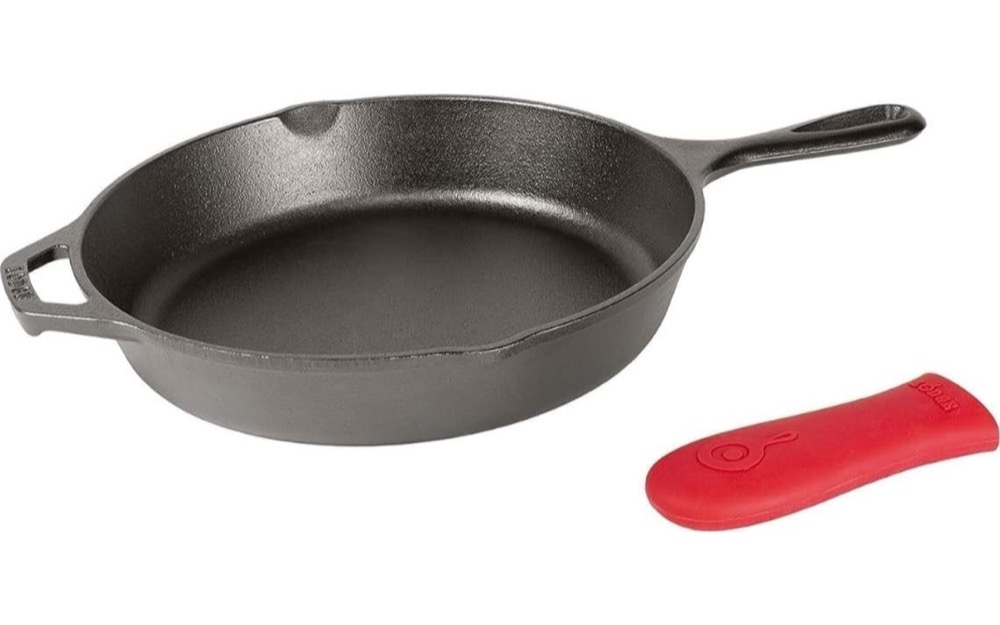
1. Lodge 10.25-Inch Cast Iron Skillet — the no-nickel default
Own a nickel-free cooking surface for less than the cost of a single tri-ply stainless pan.
Why it's the safer pick: No nickel and no chromium in the alloy, and no coating to wear off — the two migration questions on this page simply do not apply.
Check Today’s Price on Amazon →Amazon prices change daily — tap to see today's price and any active discount.
- Free delivery & returns for Prime members
- No nickel, no chromium, no coating

2. de Buyer Mineral B Carbon Steel Fry Pan — lighter, and it browns better
Get cast iron's nickel-free surface and searing power in a pan light enough to toss vegetables in.
Why it's the safer pick: Iron and carbon only — no nickel, no chromium, no synthetic coating to break down at searing heat.
Check Today’s Price on Amazon →Amazon prices change daily — tap to see today's price and any active discount.
- Free delivery & returns for Prime members
- Requires seasoning before first use

3. Matfer Bourgeat Black Carbon Steel Fry Pan — the restaurant-line version
A nickel-free pan with a smooth, rivet-free interior that will not trap residue for the next twenty years.
Why it's the safer pick: Carbon steel contains no nickel, and the welded handle removes the interior crevices where residue collects.
Check Today’s Price on Amazon →Amazon prices change daily — tap to see today's price and any active discount.
- Free delivery & returns for Prime members
- Welded handle, no rivets inside the pan
If the pan you are replacing is a scratched nonstick rather than a stainless one, that is a different and more urgent question — is nonstick cookware safe covers what comes off a damaged coating, and non-toxic kitchen utensils covers what you stir with.
Frequently asked questions
For everyday cooking it is among the safest materials you can own. A 2026 PRISMA systematic review in Food and Chemical Toxicology pooled 2,053 migration measurements from 69 studies and found stainless steel exceeded regulatory limits in 11.0% of them, below plastics at 12.5%, bare metal cookware at 36.1% and paper and board at 43.0%, and beaten only by glass at 5.6%. The qualifier is acidic food cooked long and slow, where measurable amounts of nickel and chromium do move into the food.
In the most-cited measurement, researchers at Oregon State University simmered commercial tomato sauce in stainless steel and found an average of 88 micrograms of nickel and 86 micrograms of chromium in a 126 gram serving by the tenth cooking cycle. After six hours of cooking, nickel concentrations rose up to 26-fold and chromium up to 7-fold depending on the grade of steel. For a 70 kilogram adult, 88 micrograms is roughly a tenth of the 13 micrograms per kilogram of body weight per day tolerable daily intake that EFSA set for nickel in 2020.
It does, and it is one of the clearest findings in the literature. The Oregon State team reported that cooking with new stainless steel produced the largest increases, that leaching fell with each successive cooking cycle, and that it stabilized after the sixth cycle. A 2017 University of Messina study found the same pattern independently: release was higher from unused pots than from used ones. A brand-new pan is the one worth breaking in before it meets a long tomato braise.
Mostly, with a real exception. A 2017 study in Contact Dermatitis cooked tomato sauce and lemon marmalade in 18/10 stainless pots and reported that in all experiments the amounts released were below known allergy-triggering thresholds, concluding the pots are safe for the majority of nickel-allergic and chromium-allergic people. The authors added the honest caveat: nickel already present in food plus nickel released from the pot may together exceed the individual threshold of a highly sensitive patient. Roughly 17% of women and 3% of men are nickel-allergic.
The numbers on the box are a composition, not a quality rating. 18/10 means about 18% chromium and 10% nickel, 18/8 is about 18% chromium and 8% nickel, and 18/0 contains essentially no nickel at all. Grade 316 adds molybdenum for extra corrosion resistance. More nickel buys corrosion resistance and the shine that lasts, which is why 18/10 is the normal choice. If you are nickel-sensitive, 18/0 is the stainless grade that removes the variable, though it is less corrosion-resistant and is mostly sold as flatware rather than pans.
Enameled cast iron, oven-safe glass or solid ceramic, because none of them present a reactive metal surface to acid for hours. Bare cast iron and carbon steel are nickel-free but are the wrong answer for this specific job: acid strips their seasoning and they give up iron instead. For a short 20-minute sauce in stainless the measured amounts are small; it is the multi-hour simmer in a brand-new pan that produced the largest numbers in testing.
Sources
- Kamerud KL, Hobbie KA, Anderson KA. "Stainless Steel Leaches Nickel and Chromium into Foods During Cooking." Journal of Agricultural and Food Chemistry, 2013;61(39):9495–9501. pmc.ncbi.nlm.nih.gov (full text) · PMID 23984718
- Mahmoud MAA, Ghuniem MM, Ali SA, Ramadan KMA. "A systematic assessment of metal and metalloid migration from food contact materials: Evidence from plastics, metal cookware, stainless steel, ceramics, glass, and paper-board." Food and Chemical Toxicology, 2026;216:116286. doi.org/10.1016/j.fct.2026.116286 · PMID 42472591
- Guarneri F, Costa C, Cannavo SP, Catania S, Bua GD, Fenga C, Dugo G. "Release of nickel and chromium in common foods during cooking in 18/10 (grade 316) stainless steel pots." Contact Dermatitis, 2017;76(1):40–48. PMID 27804135
- EFSA Panel on Contaminants in the Food Chain. "Update of the risk assessment of nickel in food and drinking water." EFSA Journal, 2020;18(11):6268. efsa.onlinelibrary.wiley.com
- Thyssen JP, Menne T. "Metal allergy — a review on exposures, penetration, genetics, prevalence, and clinical implications." Chemical Research in Toxicology, 2010;23(2):309–318. PMID 19831422