
Butter has microplastics — and at some of the highest concentrations found in any everyday dairy product, because the plastic packs into the fat. A 2025 study in npj Science of Food found microplastics in every dairy sample and showed they concentrate in the fat-rich curd rather than draining off with the watery whey, so the higher the fat, the higher the count. An analysis of high-fat dairy reported roughly 7,875 microplastic particles per kg in conventional butter, about 2,500 in organic butter and 5,600 in sour cream — against roughly 350 per kg in fluid milk. The particles are mostly PET, polyethylene and polypropylene, from processing equipment and packaging, not the cream. The studies measured how much plastic is present, not proven harm — and because you eat butter by the pat, your absolute intake stays modest.
Butter feels like it should be clean: it's just cream, churned until the fat comes together, with nothing added. But that same simplicity is why it concentrates plastic. Microplastics that ride into the dairy on equipment and packaging don't dissolve in water, so when milk is separated and the fat is worked into butter, the particles follow the fat instead of washing away in the buttermilk. The result is that a block of butter carries the plastic from many liters of milk, packed into a fraction of the volume — the same reason aged cheese out-measures milk, only more so, because butter is nearly pure fat.
This guide walks through exactly what the studies found — the ~7,875 particles per kg that make butter the densest common dairy, why organic tested lower, and where the plastic actually enters — whether the amounts are worth worrying about (the honest answer is calmer than the per-kilogram headline), and the handful of small changes that cut it.
The bottom line up front: butter's microplastics come from processing equipment and packaging, not the cream — and they concentrate because fat holds onto them. So the levers are choosing foil-wrapped butter over a plastic tub, storing it in a glass or ceramic butter dish, and never melting it in plastic. But keep it in proportion: you eat butter in pats, so the absolute intake is small, and the biggest source you control is the water you drink all day. For the bigger picture, see why tap water is a top source, our ranking of which foods have the most microplastics, and the room-by-room kitchen plastic detox guide.
Does butter have microplastics, and how much?
Yes — and by weight, more than almost any other everyday dairy. A 2025 study in npj Science of Food analyzed 28 dairy samples by micro-FTIR and found microplastics in every one, with the load climbing as the fat content climbed: fluid milk sat near 350 particles per kg, fresh cheese around 1,280 and aged cheese around 1,857. When researchers turned to high-fat dairy, butter went further still — roughly 7,875 particles per kg in conventional butter, about 2,500 in organic butter, and 5,600 in sour cream. The dominant polymers were PET, polyethylene and polypropylene, the plastics of dairy processing lines and packaging.
The explanation is where the plastic goes, not how much gets in. Microplastics do not dissolve in water, so when milk is separated and churned, the particles do not rinse away in the buttermilk — they stay with the fat and end up concentrated in the finished butter. It takes on the order of twenty liters of milk to make a kilogram of butter, and the plastic from all of it comes along. That is the same curd-versus-whey split the npj team identified to explain why cheese out-measures milk, taken to its extreme in a food that is roughly 80% fat. So the striking per-kilogram number is really a concentration story, not a sign that butter is uniquely dirty at the farm.
Why does butter have more microplastics than milk?
Because butter is fat, and the plastic sticks with the fat. When a dairy separates cream and churns it, most of the water leaves as buttermilk — but the microplastic particles are not water-soluble, so they partition into the fat-rich curd rather than washing out. Concentrate the fat and you concentrate the plastic with it. That is the mechanism the 2025 npj Science of Food study pointed to when it found cheese carried far more than milk, and butter simply pushes it to the limit as the most fat-dense dairy on the shelf.
Butter also touches more plastic on the way to you. Cream is pumped, churned, worked and portioned on stainless and plastic-lined equipment, filtration media and conveyor surfaces, and airborne synthetic fibers can settle onto open product — the same “it's the equipment and packaging, not the animal” pattern seen across milk and other dairy. Then comes the wrapper: a soft, fatty block pressed against foil-lined paper or sealed in a plastic tub for weeks. The table below sorts out where the plastic in a stick of butter actually originates.
| Source | What Happens | Contribution |
|---|---|---|
| Fat concentration | Particles follow the fat, not the whey, so churning milk into butter packs many liters' worth of plastic into one block | Major — why the count is so high |
| Processing equipment | Plastic-lined pipes, churns, conveyor surfaces and filtration media shed particles into the cream and butter | Major |
| Packaging (tub or wrapper) | A soft, fatty solid sits against a plastic tub or foil-lined paper; fat also draws plasticizer chemicals out of plastic | Moderate to major |
| Airborne fibers in the dairy | Synthetic fibers can settle onto open cream and butter during production | Minor to moderate |
| The cream & the cow | The milkfat itself is not the source; contamination is added downstream by equipment and packaging | Negligible |

Does organic butter have fewer microplastics?
In the one high-fat-dairy analysis that compared them, organic butter came in around 2,500 particles per kg against roughly 7,875 for conventional — a genuinely large gap, and a more hopeful result than dairy usually delivers. But read it cautiously. It is a single study with a small sample, and because the plastic enters through equipment and packaging rather than the pasture, the likely explanation is a shorter or simpler processing-and-packaging chain, not the organic farming itself. Yogurt studies, by contrast, found organic scored no better than conventional, so the edge is not a rule.
The practical read: treat organic as a possible advantage worth taking if it's on the shelf, but don't rely on it as a guarantee, and don't pay any price for it expecting a plastic-free product. What the numbers actually reward is the format and the handling — how the butter is wrapped and how you store it — far more than the label on the front. That is a recurring lesson on this site, and one of the more useful microplastics myths to retire: the reassuring word on the package rarely maps to the particle count inside.
"Butter doesn't get its microplastics from the cows — it gets them from the churns, the pipes and the wrapper, then concentrates them because the plastic rides with the fat."
Is butter still fine to eat?
On the microplastics alone, the honest answer is that the scary per-kilogram number needs a portion size next to it. You don't eat a kilogram of butter — you eat a pat: a tablespoon is about 14 grams, so even at 7,875 particles per kg it works out to roughly a hundred particles, and most people use far less in a day than the number implies. Butter's concentration is high, but your intake from it is modest next to the food and water you consume in bulk. Nothing in these studies is a reason to cut butter for fear of plastic.
The more actionable concern with a fatty food isn't the particle count at all — it's chemical migration. Fat is lipophilic, so it pulls fat-soluble plasticizers such as phthalates out of any plastic it sits against, which is exactly why heating or storing butter in plastic is the habit worth breaking. That parallels what studies found for olive oil and other fats, and it's the same reason we flag microwaving food in plastic generally. Keep butter on glass or foil, and you've handled the part that matters most.
Are the microplastics in butter dangerous?
Here's where honesty matters. The dairy studies were designed to measure how many particles are present and what polymers they are — not to test what those particles do once they're inside a person. On the narrow question of harm from the microplastics in butter, the research doesn't have a verdict, and no one should read one into it. Butter's per-kilogram count is high, but the amount you actually eat keeps its share of your total exposure modest.
A widely cited 2019 analysis in Environmental Science & Technology estimated the average person already swallows tens of thousands of microplastic particles a year from food and drink combined, with tap and bottled water a large driver; butter is a real but small slice of that. What we do know more broadly is that microplastics are increasingly detected throughout the human body — in blood, organs, and even the brain — and that the plasticizer chemicals fat draws out of packaging are linked in other research to hormone disruption. So trimming avoidable sources is sensible even while the particle-harm question stays open — and with butter, the fix is genuinely easy.
You don't need a plastic scare to act on this one. Butter's per-kilogram load is high, but you eat it by the pat; choose foil-wrapped butter over a plastic tub, keep it in a glass or ceramic dish, and never melt it in plastic, and you've handled most of it. Then spend the rest of your effort on the bigger, more constant sources in our kitchen plastic detox guide, starting with the water you drink all day.
How do you reduce the microplastics in butter?
Because you can't filter butter, the fixes are about packaging and handling. Choose butter wrapped in foil-lined paper over a plastic tub of spread, since the tub is a large plastic surface pressed against fat for weeks. Store it in a glass or ceramic butter dish at home instead of leaving it in the tub, never microwave or melt butter in a plastic container — use a glass bowl or a metal pan — and favor a shorter, simpler supply chain where you can, which is likely part of why organic tested lower. None of this costs much, and it handles the part of the problem you can actually control.
The highest-leverage move, though, isn't about butter at all — it's the source you consume all day. Filter the tap water you drink and cook with, because the water going through your body all day is a far bigger and more constant microplastic source than a pat of butter, and it's the one you can genuinely clean: a pitcher certified under NSF/ANSI 401 or built around a rated membrane pore size cuts particle counts sharply. See our guide to the best water filter pitchers for microplastics and the broader water filter roundup — or, if you’d rather filter at the tap, the best faucet water filters. Keep leftovers and dairy in glass instead of plastic, and you've closed off the sources that actually add up. The picks below are the simplest, longest-lasting ways to do all of that.

Fix the sources that actually matter
A glass butter dish and foil over plastic handle most of the plastic around your butter — but the water you drink all day is the bigger, steadier source. Start where it counts: filter your tap water and keep your food in glass instead of plastic.
The swaps that cut the most plastic around butter
You can't filter butter, and there's no such thing as a “microplastic-free” stick to buy — the real lever is choosing foil over a plastic tub, keeping butter in glass, and cleaning up the bigger daily source, your water. So instead of padding this out with products that don't exist, here are the real, currently-sold tools that address the sources you actually control: certified water filters for the bigger daily source, plus glass and platinum-silicone storage to keep your dairy and leftovers off plastic. Prices and availability change, so check current listings.
1. Epic Pure Water Filter Pitcher — Best Overall for Microplastics
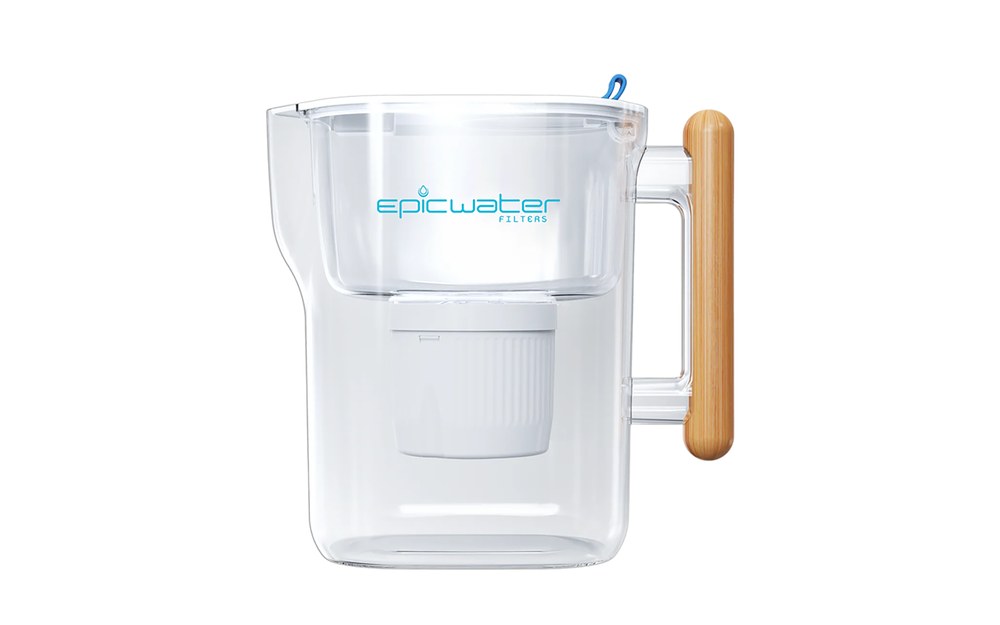 Best Overall
Reviewers point to published independent lab data and a filter rated around 150 gallons, far longer than a Brita, as the reasons they trust it, and several describe the slow, deliberate drip as reassuring rather than annoying. The honest downsides: owners report the filtration is genuinely slow and not the pick if you want a glass of water in a hurry, and third-party complaints mention cracked plastic, flip-top lids that stick, and water that spills or leaks from the lid when you pour a full pitcher.
The clearest evidence on this list: Epic posts its independent lab results publicly, so you can see the 99.9% microplastic-removal data instead of trusting a slogan on the box.
Why it's safe: The hollow fiber membrane physically blocks microplastic particles down to ~1 micron, while the carbon stage handles chlorine, lead, and PFAS — all in a BPA-free Tritan body.
Check Today’s Price on Amazon →Amazon prices change daily — tap to see today's price and any active discount.
- Free delivery & returns for Prime members
- Sold & shipped by Amazon
- Thousands of verified reviews
The water you drink and cook with all day — the glass you fill at the tap, the pot you boil, everything behind your daily hydration — is usually a bigger and steadier microplastic source than a pat of butter, and it's the input you control most tightly, which makes a good filter the highest-leverage swap on this list. The Epic Pure is the clearest choice: its dual-stage design uses a hollow fiber membrane as the primary microplastic barrier, and Epic publishes the independent lab results to back the 99.9% removal claim — transparency most competitors don't match.
2. Waterdrop Chubby 10-Cup Pitcher — Best Filter Life
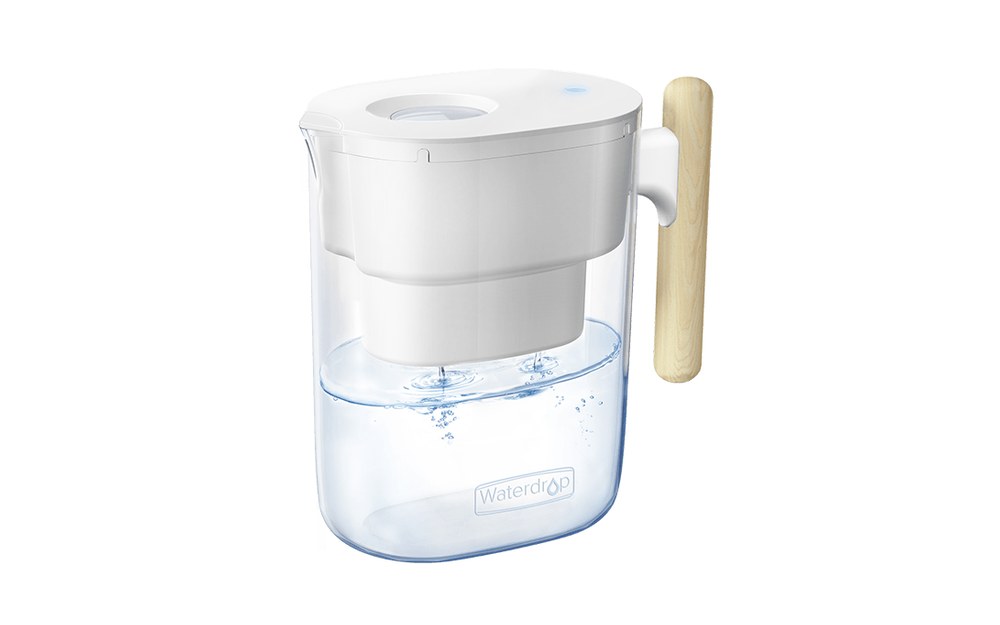 Best Filter Life
Owners like the look and the long 200-gallon filter life, and roughly 80 percent of reviews land positive, with the common praise being clean-tasting water at a low cost per gallon. The honest gripes: several owners warn the handle can feel loose or strain under a full pitcher, so they lift with two hands; some report the pour spills if you tip too fast; and the change-filter indicator light draws complaints for not lighting or not staying lit.
A membrane blocks particles by pore size rather than by claim list, and its 200-gallon filter runs about 4 to 5 months — the lowest ongoing cost on the list.
Why it's safe: A hollow fiber membrane is a physical barrier to particles, while the carbon composite handles chlorine, heavy metals, and PFAS — all in a BPA/BPS-free body.
Check Today’s Price on Amazon →Amazon prices change daily — tap to see today's price and any active discount.
- Free delivery & returns for Prime members
- Sold & shipped by Amazon
- Thousands of verified reviews
If you're filtering the water you drink and cook with all day, you'll run water through a filter constantly — so filter life matters, and the Waterdrop Chubby leads on it: a hollow fiber membrane on Waterdrop's own published lab data, plus 200 gallons per filter (about 4–5 months for most households). The "filter while you pour" design works just like a familiar counter pitcher, but with a membrane that's actually tested for microplastics.
3. Aquagear Water Filter Pitcher — Best Value
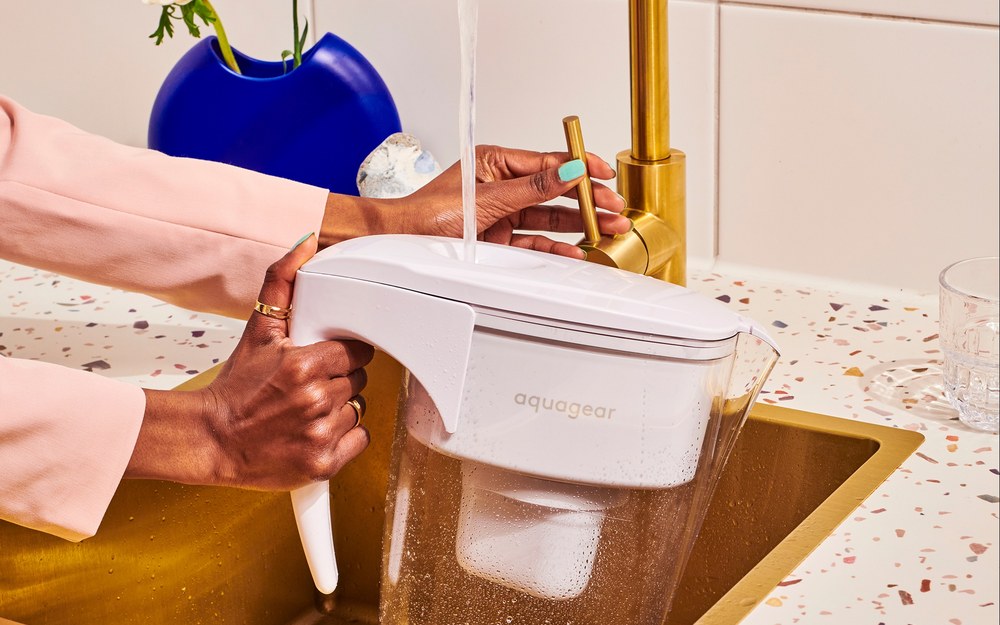 Best Value
Owners choose it for broad contaminant removal and clean taste, and some lab testing found it did not clog. The honest downsides: the most repeated complaint is slow filtration, described by one reviewer as a mixed bag between people waiting minutes and people waiting hours, and it can worsen as the filter ages; and the design draws gripes, with the pour-spout cover popping out and spraying water and a lid that fits poorly and can pop off mid-pour.
Change the filter half as often as most pitchers — 150 gallons per cartridge means fewer replacements, lower annual cost, and less to remember.
Why it's safe: A 5-stage filter with a sub-micron membrane stage captures microplastics, lead, fluoride, and chlorine, in a BPA-free body with USA-made filter media.
Check Today’s Price on Amazon →Amazon prices change daily — tap to see today's price and any active discount.
- Free delivery & returns for Prime members
- Sold & shipped by Amazon
- Thousands of verified reviews
The Aquagear costs more upfront but its 150-gallon filter life means lower annual replacement costs than most competitors, and the pitcher body is guaranteed for life. It uses a 5-stage filter with a sub-micron membrane stage that targets microplastics, heavy metals, and fluoride — a good fit for households that don't want to track filter changes constantly.
4. Lifefactory Glass Bottle 22oz — Best Glass Bottle
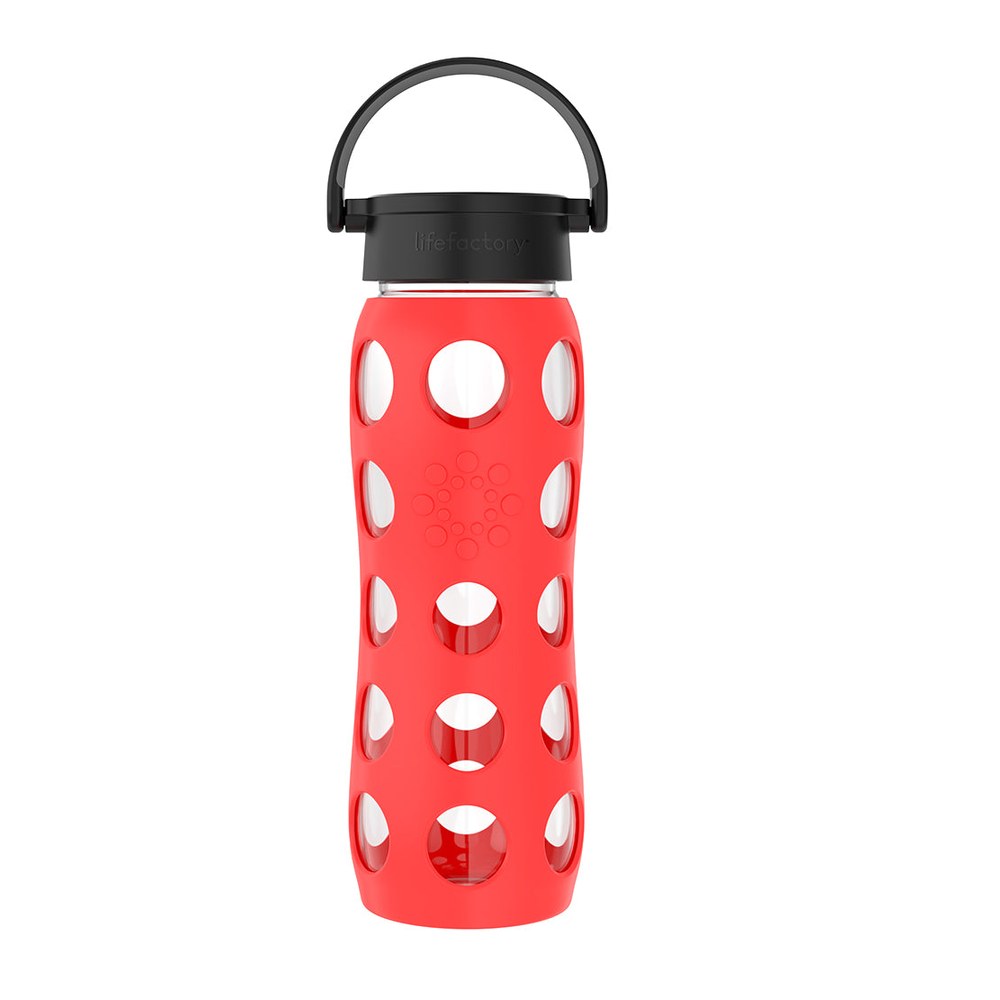 Best Glass Bottle
Butter is a small, occasional source; the water you drink all day is the steady one — and this is how you carry the clean version. It’s made from borosilicate glass, the same material used in laboratory glassware, which is thermally stable, chemically inert, and completely free of BPA, BPS, and any polymer contact with your drink. It imparts no taste, so water tastes like water. The protective silicone sleeve adds grip and guards against shattering.
The screw cap contains a small polypropylene component — the only plastic in the system, and it sits at the exterior closure rather than the drink surface. Rinse it like any cap and it stays a non-issue. Dishwasher-safe, and sturdy enough for daily desk-and-bag use.
Owners love that water tastes clean with no plastic aftertaste and that the silicone sleeve makes the glass easy to grip and survive the occasional drop. The honest downsides: it’s heavier than a plastic or steel bottle, the glass can still break if dropped on a hard edge, and some reviewers find the flip-cap spout narrow or report the cap can leak if not fully closed.
Carry the filtered water you made at home instead of buying bottled — no plastic contact, no leaching, and it cleans up in the dishwasher.
Why it's safe: Borosilicate glass is completely inert — it never leaches, never sheds microplastics, and imparts no taste. The only plastic is a small cap component at the exterior closure, not the drink surface.
Check Today’s Price on Amazon →Amazon prices change daily — tap to see today's price and any active discount.
- Free delivery & returns for Prime members
- Sold & shipped by Amazon
- Thousands of verified reviews
Butter is worth managing, but water is the source you consume most. Carrying filtered water in a reusable glass or stainless steel bottle — or a dedicated filtered water bottle — gives you grab-and-go hydration without the PET — no shedding, no leaching, no plastic aftertaste — so the packaged bottle stops being the default.
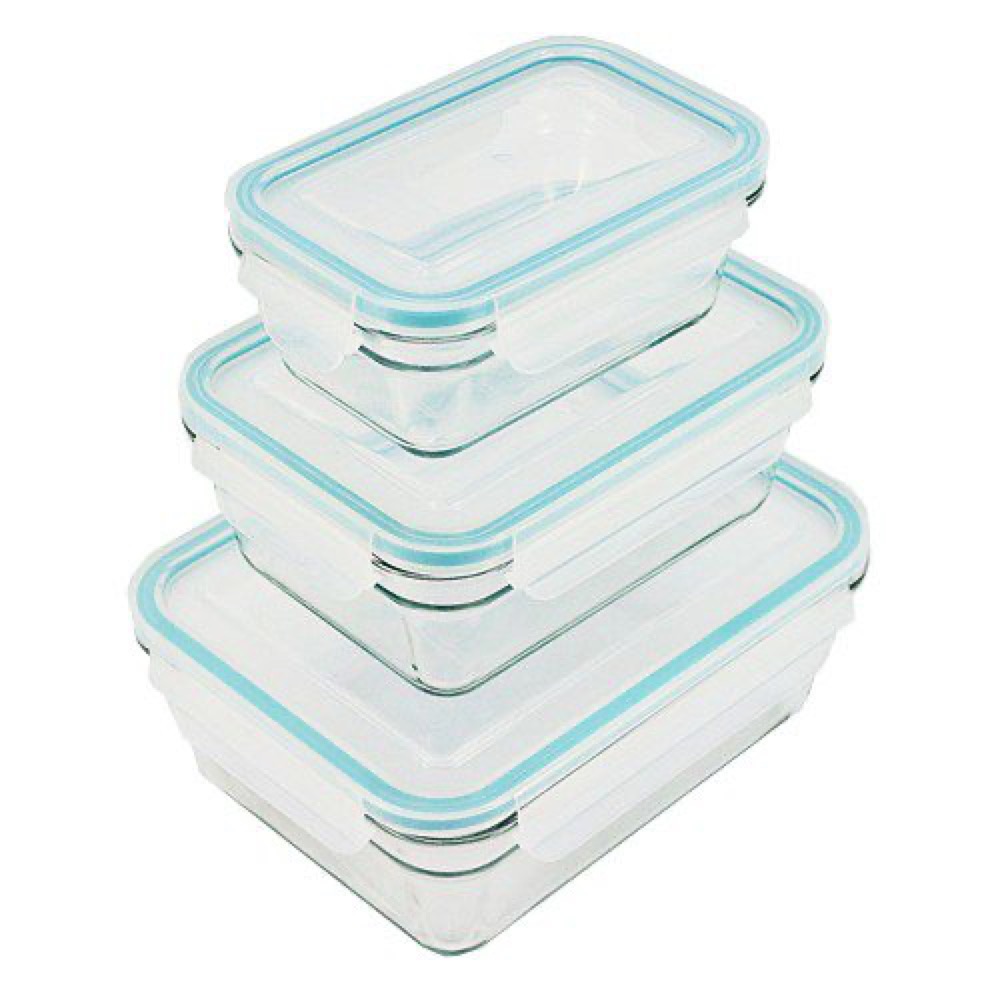
5. Glasslock Oven Safe Container Set (3-Pack) — Best Glass Storage
 Best Glass Storage
Longtime owners like that the glass bodies are oven-, microwave-, and freezer-safe and that the snap-lock lids seal tight. The honest downsides run through the lids, not the glass: reviewers report cracked lids, snapped locking tabs, and mold building up in the rubber gaskets if they are not dried well. Some buyers also received sets with a locking piece missing, and several flag slow, hard-to-reach customer service when they needed a replacement part.
Three stackable glass containers in one box — enough to store a week of leftovers and prepped ingredients without a single plastic tub.
Why it's safe: Your food sits on inert tempered glass, not plastic — so warm, acidic, watery foods can’t leach or pick up shed particles. The BPA-free lids seal with a food-grade silicone gasket that only touches the rim.
Check Today's Price on Amazon →Amazon prices change daily — tap to see today's price and any active discount.
- Free delivery & returns for Prime members
- Sold & shipped by Amazon
- Thousands of verified reviews
Glass storage is the direct fix for keeping your food and drinks off plastic: store leftovers, prepped ingredients and open pantry items in inert glass instead of plastic tubs or cling wrap, and reheat with the lids off so warm food never sits against plastic. At roughly ten dollars per container, it's also the cheapest way to retire your plastic food tubs in one purchase.
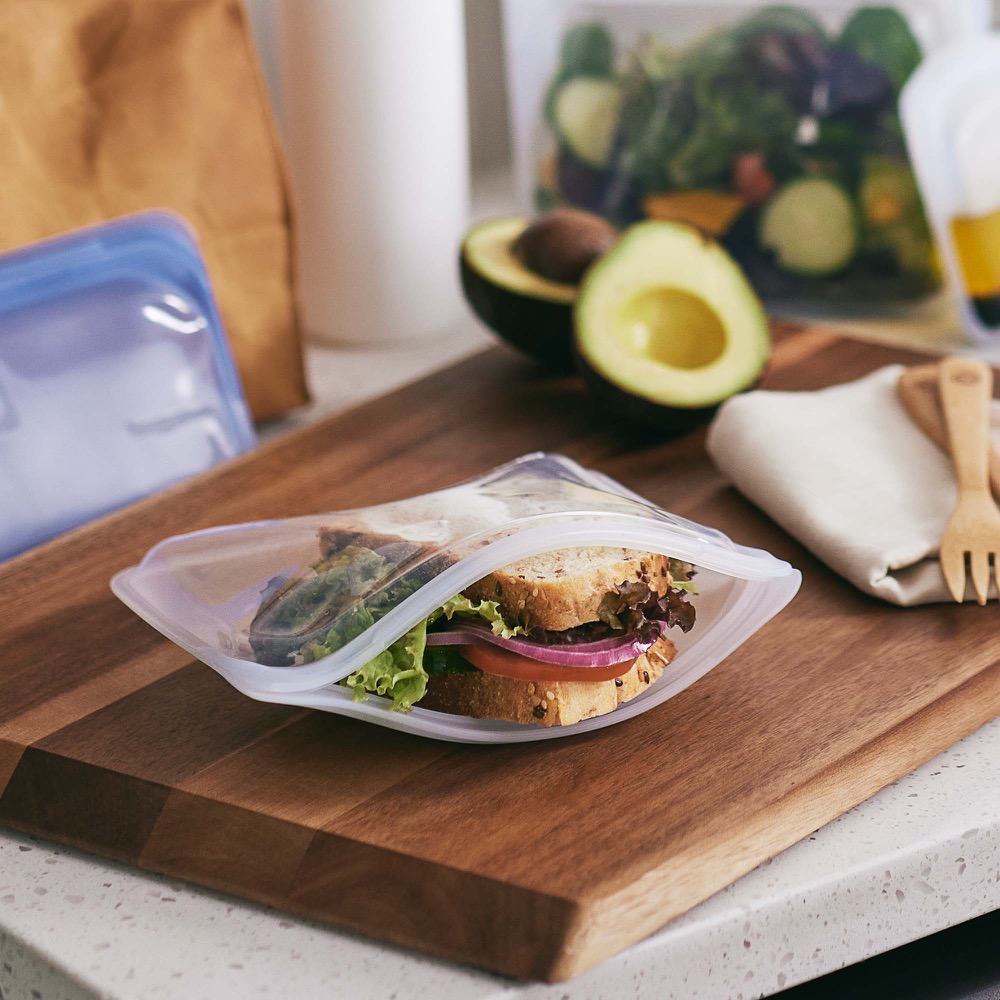
6. Stasher Reusable Silicone Bag Starter Kit — Best Silicone Bag
 Best Silicone Bag
For freezing food in portions, stashing leftovers you won't finish in time, or anything you’d reach for a plastic bag — Stasher’s platinum-cured silicone is the upgrade: sturdier than any disposable bag and free of the chemicals that migrate from plastic. The patented Pinch-Loc seal is genuinely airtight and leakproof, so it keeps food from drying out.
It’s freezer safe to -70°F and goes straight to the microwave or a 425°F oven. The starter kit covers the everyday sizes — sandwich, snack, and stand-up half-gallon — so you can retire a whole box of single-use bags in one purchase.
Owners like that the platinum silicone bags go from freezer to microwave and replace throwaway plastic for years. The honest gripes: smell and stain retention come up often, with reviewers noting garlic and strong odors linger even after washing; the pinch-lock seal can be fiddly to open and close; and the seams are slow to dry, which can invite mildew if you do not air them out.
Store prepped produce, snacks, and batch-cooked food in airtight silicone instead of plastic film — then thaw and reheat in the same bag, no transfer needed.
Why it's safe: Platinum-cured silicone — the highest-purity, chemically inert grade — with no plastic, PVC, BPA, lead, latex, phthalates, or PFAS.
Check Today's Price on Amazon →Amazon prices change daily — tap to see today's price and any active discount.
- Free delivery & returns for Prime members
- Sold & shipped by Amazon
- Tens of thousands of verified reviews
Prepped produce, snacks, and batch-cooked food are exactly the things people stash in flimsy plastic bags and cling film. A multi-size silicone kit replaces the whole box at once, seals airtight, and goes from freezer to microwave in the same bag. For the full lineup, see our guide to the best silicone food storage bags.
Want the Full Home Protection Guide?
A tub of butter is one plastic touchpoint among dozens in a typical kitchen. The Complete Plasticproof Guide covers every room — kitchen, nursery, bathroom, bedroom — with 80+ product recommendations backed by 47+ studies.
The honest verdict
Does butter have microplastics? Yes — and by weight it is the densest common dairy tested, roughly 7,875 particles per kg in conventional butter, next to about 2,500 in organic butter and just 350 in fluid milk. But the crucial detail is why. It isn't the cream or the cow — butter's plastic comes from processing equipment and packaging, and it concentrates because the particles ride with the fat instead of washing out in the buttermilk. The studies measured presence, not proven harm; and because you eat butter by the pat, your intake is a modest share of overall exposure despite the high per-kilogram number. So the accurate takeaway is proportion, not alarm — and the fact that the meaningful sources are ones you can actually control.
The practical response is easy, because the culprits are the packaging and the handling. Choose butter wrapped in foil-lined paper over a plastic tub, keep it in a glass or ceramic butter dish, never microwave or melt it in plastic, and take organic where it's on the shelf. With a fatty food the chemical-migration angle matters as much as the particle count, so keeping butter off plastic does double duty. And above all, filter the tap water you drink and cook with, since the water going through your body all day is the bigger, more constant source and the one you can genuinely make cleaner. You don't need a plastic scare to act on this one — a glass dish and foil over plastic handle most of it.
Cut the plastic that actually adds up
A pat of butter is small next to the water you drink all day. A certified filter and glass storage make clean water and plastic-free food your easy default.
Frequently Asked Questions
Yes, and at some of the highest levels found in dairy. A 2025 study in npj Science of Food found microplastics in every dairy sample tested and showed the particles concentrate in the fat-rich curd rather than the watery whey, so higher-fat products carry more. An analysis of high-fat dairy products reported roughly 7,875 microplastic particles per kg in conventional butter — versus about 2,500 in organic butter and 5,600 in sour cream — far above the roughly 350 per kg measured in fluid milk. The particles are mostly PET, polyethylene and polypropylene, the same plastics used in dairy processing lines and packaging.
Because plastic concentrates in the fat. When milk is separated and churned into butter, the microplastics do not leave with the watery whey — they partition into the fat-rich curd, so roughly ten liters of milk worth of particles end up packed into one block of butter. On top of that, butter is churned, worked and wrapped on more equipment than milk ever touches, and its wrapper sits in direct contact with a soft, fatty surface. The 2025 npj Science of Food study identified this curd-versus-whey split as the reason cheese and other high-fat dairy out-measure fluid milk.
In the one high-fat-dairy analysis that compared them, yes — organic butter came in around 2,500 particles per kg versus about 7,875 in conventional butter. But read that cautiously: it is a single study with a small sample, and the likely explanation is differences in processing and packaging, not the farming itself, since the plastic comes from equipment and wrappers rather than the cows. In yogurt studies, by contrast, organic tested no better than conventional. Treat organic as a possible edge, not a guarantee, and put more weight on the packaging and how you store it.
From processing equipment and packaging, not the cream. Butter is made and moved on plastic-lined pipes, churns, conveyor surfaces and filtration media, and airborne synthetic fibers can settle onto it during production. The wrapper is the last source: butter is a soft, fatty solid pressed against foil-lined paper or a plastic tub. Because fat is lipophilic, butter also pulls fat-soluble plasticizer chemicals such as phthalates out of any plastic it touches — a chemical-migration issue that sits on top of the particle count. The cream and the cow contribute essentially none of it.
You can't filter butter, so the levers are packaging and storage. Choose butter wrapped in foil-lined paper over a plastic tub, keep it in a glass or ceramic butter dish at home instead of the tub, never microwave or melt butter in a plastic container, and favor a shorter, simpler supply chain where you can. But keep it in proportion: you eat butter by the pat, not the liter, so absolute intake is modest. The biggest lever is the source you consume all day — filter the tap water you drink and cook with, since that is a far larger and steadier microplastic source than butter.
The studies measured how many particles are present, not what they do inside the body, so they don't establish harm. Butter's per-kilogram counts are high, but you eat small amounts, so the absolute intake is a modest share of overall exposure — which a 2019 analysis put at tens of thousands of particles a year from food, drink and air combined. Microplastics are increasingly detected throughout the human body, so cutting easy sources is sensible, and the more actionable concern with a fatty food is the plasticizer chemicals fat draws out of packaging. Filtered water and less plastic-packaged food matter more than swearing off butter.
Sources
- "Assessing microplastic contamination in milk and dairy products." npj Science of Food, 2025. (Analyzed 28 dairy samples by micro-FTIR; microplastics in every sample, with fluid milk near 350 particles/kg, fresh cheese ~1,280 and ripened cheese ~1,857 — PET the most common polymer, then PE and PP — and showed the particles concentrate in the fat-rich curd rather than the whey, so higher-fat dairy carries more.) Open-access mirror at PMC12246066.
- "Emerging Health Risks Associated with the Intake of Microplastics Found in Milk and Dairy Products." Microplastics (MDPI), 2025. (Reviews microplastic contamination across dairy and compiles an analysis of high-fat dairy products reporting the highest loads in butter — roughly 7,875 particles per kg in conventional butter, about 2,500 in organic butter and 5,600 in sour cream — attributed to processing equipment and packaging.)
- Kosuth M, Mason SA, Wattenberg EV. "Anthropogenic contamination of tap water, beer, and sea salt." PLOS ONE, 2018;13(4):e0194970. (Found microplastic fibers across foods, beverages and drinking water, establishing that everyday products routinely carry low levels of anthropogenic particles.)
- Cox KD, Covernton GA, Davies HL, et al. "Human Consumption of Microplastics." Environmental Science & Technology, 2019;53(12):7068–7074. (Estimated tens of thousands of microplastic particles consumed per person per year from food and drink combined.)