Toilet paper does carry PFAS — in trace amounts — but the study everyone quotes was measuring sewers, not skin. Researchers at the University of Florida tested toilet paper sold across four world regions alongside sewage sludge from eight Florida wastewater plants. One compound, 6:2 fluorotelomer phosphate diester (6:2 diPAP), was the most common PFAS in both, and normal toilet paper use was estimated to add 6.4 to 80 micrograms of it per person per year to wastewater (Thompson et al., 2023, Environmental Science & Technology Letters). Separate commissioned lab testing of 23 retail brands found the PFAS marker organic fluorine in 6 of them, at 6 to 35 parts per million. What no study has measured yet is how much of that reaches the person using the roll.
PFAS — per- and polyfluoroalkyl substances, the “forever chemicals” that resist water, grease and heat and barely break down once released — keep turning up in products nobody expected them in. In March 2023 toilet paper joined the list, and the headlines that followed were close to the worst possible version of the finding: your toilet paper is poisoning you.
That is not what the research said. The study was designed to answer a wastewater question, and it answered it well. The consumer question — does this matter for the person in the bathroom — is genuinely open, and the honest answer is more useful than either the panic or the dismissal. Below is what was actually measured, which brands came back with detections in independent retail testing, how the chemicals got into paper in the first place, and what is worth changing.
The bottom line up front: PFAS in toilet paper is real but small, and it is not the biggest plastic or fluorochemical exposure in your bathroom. If you want to spend effort where the measurements are strongest, start with your shower water and your drinking water filter, then work through the plastic-free bathroom guide. Changing toilet paper is cheap and harmless — just do not mistake it for the main event.
Does toilet paper have PFAS?
It does, at trace levels, and it has been detected on every continent the researchers sampled. The study was led by Jake T. Thompson with Boting Chen, John A. Bowden and Timothy G. Townsend of the University of Florida's environmental engineering department, and published on 1 March 2023 in Environmental Science & Technology Letters (volume 10, pages 234–239). The team ran two tracks of testing in parallel: 21 toilet paper rolls bought in North America, South and Central America, Western Europe and Africa, and sewage sludge collected from eight wastewater treatment plants in Florida.
In both the paper and the sludge, the same compound dominated: 6:2 diPAP, a fluorotelomer phosphate used in paper manufacturing. Five other PFAS compounds were detected alongside it. From the concentrations in the paper and average per-person consumption, the authors estimated that toilet paper alone contributes 6.4 to 80 micrograms of 6:2 diPAP per person per year into wastewater systems — enough, they concluded, that toilet paper “should be considered as a potentially major source of PFAS entering wastewater treatment systems.”
| What was tested | Where it came from | What the study found |
|---|---|---|
| Toilet paper | 21 rolls from North America, South and Central America, Western Europe, Africa | 6:2 diPAP the most prevalent PFAS; five other PFAS compounds also detected |
| Sewage sludge | 8 wastewater treatment plants, Florida, USA | 6:2 diPAP again the most prevalent PFAS detected |
| Estimated load | Modeled from paper concentrations and per-person use | 6.4–80 µg of 6:2 diPAP per person per year into wastewater |
| Share of sewage 6:2 diPAP | Compared against published wastewater data by country | About 4% in the USA and Canada, 35% in Sweden, up to 89% in France |
That last row is the one most often misread. The 89% figure for France does not mean French toilet paper is unusually contaminated. It means the other sources of 6:2 diPAP entering French sewage are comparatively small, so toilet paper accounts for a bigger slice of a smaller pie. In the United States and Canada, where industrial and consumer sources of fluorochemicals are far larger, toilet paper is roughly 4% of the total.
How did PFAS end up in toilet paper?
Not because anyone wanted it in there. Nothing about toilet paper benefits from being waterproof. Fluorochemicals enter the product along two routes, and neither is about the finished roll.
The first is the mill. PFAS compounds are used in paper manufacturing as wetting and processing agents — they control how pulp behaves on fast-moving machinery and stop fiber mats sticking. Residue stays behind in the fiber. This is not a recent discovery: a 2009 paper in Environmental Science & Technology by D'eon and colleagues reported polyfluoroalkyl phosphoric acid diesters in paper fibers, wastewater treatment plant sludge, and in human blood serum, all in the same study (D'eon et al., 2009, volume 43, pages 4589–4594). The chemistry has been in the paper supply for well over a decade.
The second route is recycling, and it is the counterintuitive one. Recycled paper pulp is made from paper that was previously something else — including grease-resistant food packaging, which is deliberately treated with PFAS. Those fluorochemicals ride through the recycling stream into the new product. It is the same mechanism behind PFAS turning up in other treated paper goods, which is why parchment paper and lined paper cups have their own problems. A roll marketed on its recycled content is not automatically the cleaner choice.
Which toilet paper brands tested positive for PFAS?
The University of Florida study did not name the brands it bought. For brand-level data the best available source is independent retail screening commissioned by the consumer group Mamavation, which sent toilet paper to an EPA-certified laboratory and ran the standard PFAS screen: determination of total fluorine by oxygen flask combustion and ion-selective electrode, with a detection limit of 10 parts per million. Across 23 brands, 6 came back with detectable organic fluorine.
| Brand | Paper type | Organic fluorine detected |
|---|---|---|
| Seventh Generation 100% Recycled Bath Tissue | Recycled | 35 ppm — highest in the screen |
| Charmin Ultra Soft | Conventional wood pulp | 13 ppm |
| Who Gives A Crap Bamboo | Bamboo | 11 ppm |
| Tushy Bamboo | Bamboo | 10 ppm |
| DeBella Bamboo Septic Safe | Bamboo | 10 ppm |
| Purafide 100% Tree Free Bamboo | Bamboo | 6 ppm |
| 17 other brands — including Reel Bamboo, Caboo, Bim Bam Boo, Cheeky Panda, Grove Co., Public Goods, Repurpose, Natural Value, Green Forest, Sprouts and Open Nature | Bamboo, recycled, tree-free | Non-detect at the screening limit |
Two things in that table are worth sitting with. The highest result belonged to a recycled brand, which fits the contamination route described above exactly. And four of the six detections were bamboo — the category most shoppers assume is the safe one. “Bamboo” and “tree-free” describe where the fiber came from. They say nothing about what the mill used to process it.
This matters for reading any “PFAS-free” claim. The screen above measures total organic fluorine, which indicates fluorinated chemistry is present but does not identify or quantify individual PFAS compounds. A result of 13 ppm organic fluorine is not 13 ppm of PFAS. Equally, “non-detect” at a 10 ppm screening limit means below 10 ppm — not zero. Any brand telling you its product is verifiably PFAS-free should be able to show you a test result with a stated detection limit; most cannot.
Does the PFAS in toilet paper get into your body?
Nobody has measured it. This is the part the headlines skipped, and it is the single most important sentence on this page. The University of Florida study quantified what goes down the drain — it did not measure skin transfer, absorption, or blood levels in people, and it never claimed to. No published research has established how much 6:2 diPAP moves from a sheet of toilet paper into a human being.
What is established is the surrounding picture, and it is not reassuring enough to dismiss the question either. DiPAPs are detectable in human blood: the 2009 study above found them in human sera at the same time it found them in paper fibers. And they do not stay as diPAPs once inside. A 2026 study in ChemBioChem incubated 6:2 diPAP with human gut microbial communities and found that every cohort transformed it — within minutes into 6:2 fluorotelomer alcohol, then onward into perfluorohexanoic acid (PFHxA), perfluoropentanoic acid (PFPeA) and other persistent acids, with the exact mix depending on which bacteria a person carries.
So the chain is: the compound is in the paper, the compound is in people, and in people it converts into forever chemicals that stay. The missing link is whether toilet paper is a meaningful contributor to that body burden compared with food packaging, drinking water, household dust and the dozens of other routes. On current evidence it looks like a small one. “Small” is not the same as “zero”, and it is also not the same as “dangerous”.
Is 6:2 diPAP actually harmful?
Less is known about 6:2 diPAP than about the PFAS compounds that made the news first. The EPA's position on the family is that exposure to certain PFAS has been linked to health effects including changes in liver enzymes, increased cholesterol, reduced vaccine response in children, and increased risk of some cancers, while noting the science is still developing for most individual compounds (US EPA, current understanding of PFAS risks).
6:2 diPAP specifically is best understood as a precursor — a compound whose own toxicity is less studied than what it becomes. That is the reason the gut-microbiome work matters: a chemical that converts into PFHxA and PFPeA contributes to a person's lifetime PFAS load even if the parent compound clears quickly. It is also why regulators increasingly treat precursors as part of the problem rather than a separate question. For the wider picture of what these compounds do once they are inside, see our pages on plastics and hormones and microplastics measured in human blood.
How do you choose a toilet paper with less PFAS?
There is no certification to look for, so this comes down to a short list of things that genuinely narrow the odds:
- Treat “PFAS-free” on a package as marketing until proven otherwise. Ask the brand for a lab result with a stated detection limit. A brand that has tested will tell you; a brand that has not will talk about bamboo.
- Do not assume bamboo is clean. Four of the six detections in the retail screen were bamboo rolls. The fiber source is not the contamination source — the mill is.
- Be cautious with recycled content. It is the better environmental choice and the one documented route for food-packaging fluorochemicals to re-enter paper. The highest result in the screen was a recycled brand.
- Prefer unbleached, undyed, unscented. This does not address PFAS, but it removes chlorine-bleaching byproducts, dyes and fragrance chemistry from a product that sits against skin.
- Skip the plastic wrap. Rolls wrapped in paper rather than polyethylene remove one more plastic source from the house — the same logic behind the rest of the plastic-free bathroom swaps.
On the brand-level evidence that exists, the rolls that came back non-detect in the independent screen are the defensible choice. Reel's bamboo tissue was one of them, it ships with no plastic packaging, and it is widely available — which is why it is the one we point people to. Read the claim precisely, though: non-detect at a 10 ppm screening limit means below the limit, not certified free of PFAS.
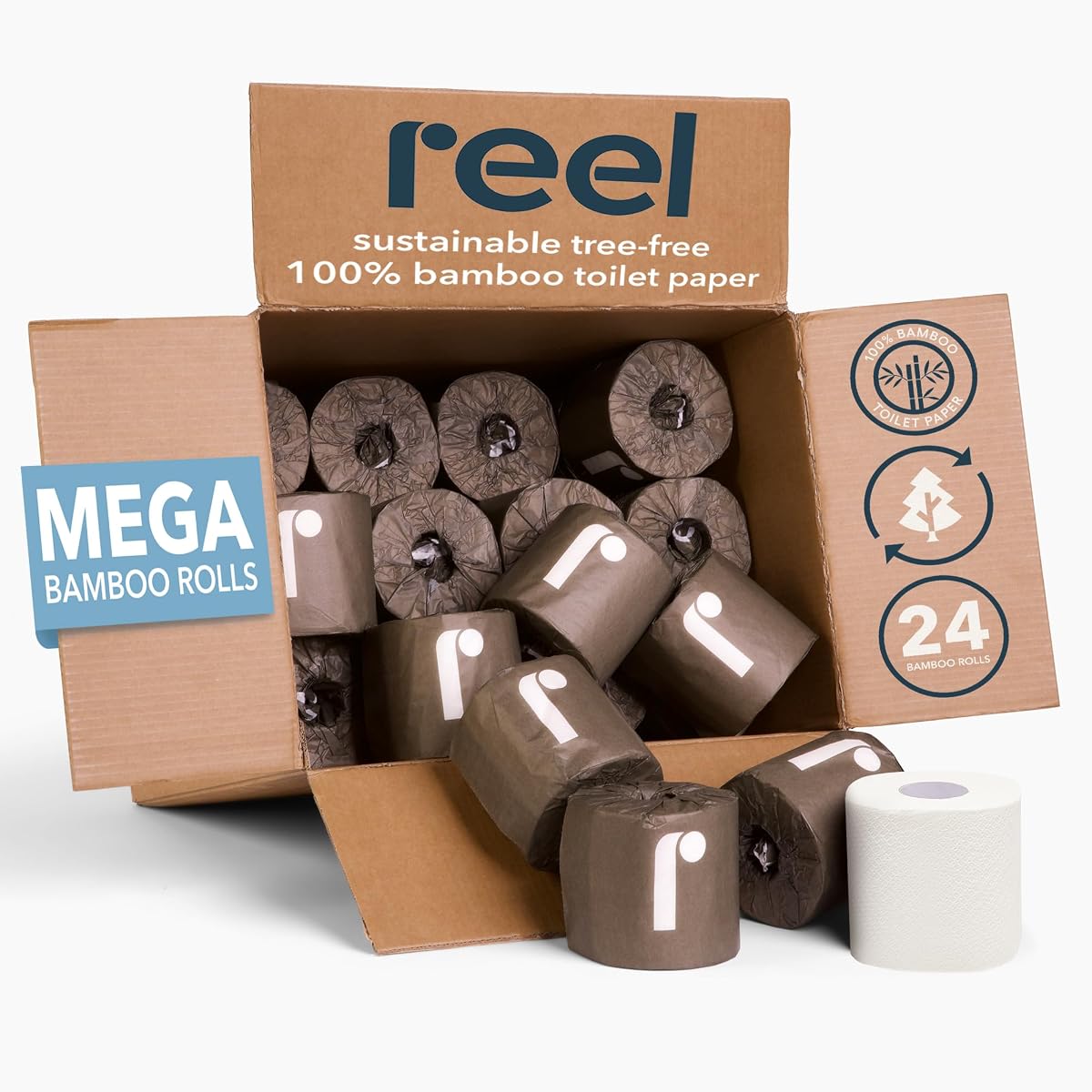 Tested Non-Detect
Non-detect in the only independent brand-level screen we could find, with paper-wrapped rolls and no plastic film in the box.
Why it's the safer pick: It is one of the 17 brands that returned no detectable organic fluorine at the laboratory's 10 ppm screening limit — while four bamboo competitors in the same screen did not.
Check Today’s Price on Amazon →✓ Ships free with Prime · Free returns · Amazon A-to-z purchase guarantee (on eligible items)
- Free delivery & returns for Prime members
- Plastic-free packaging throughout
- Thousands of verified reviews
What in your bathroom matters more than toilet paper?
Proportion is the whole point of this page. Toilet paper contributes micrograms a year to a sewer. Several other things in the same room are measured in far larger numbers and are easier to fix for good.
- Shower and tap water. This is the best-measured exposure route in the house and the one with real filtration options — start with a shower filter or compare whole-house options in shower filter vs whole house filter.
- Household dust. Indoor dust carries synthetic fibers and flame retardants, and you breathe it all day — see microplastics in household dust.
- Personal care products. Fluorinated ingredients turn up in cosmetics far more deliberately than in paper — see PFAS in makeup.
- Everything else plastic in the room. Curtain liners, bottles, razors and toothbrushes add up; the plastic-free bathroom guide works through them in order of impact.
Change your toilet paper if you want to — it costs almost nothing and the better brands are pleasant to use. Just do it with the real numbers in hand, and spend the larger share of your attention on water.
Frequently asked questions
It does, at trace levels. A 2023 University of Florida study published in Environmental Science & Technology Letters tested toilet paper sold in four world regions and found 6:2 fluorotelomer phosphate diester (6:2 diPAP) to be the most prevalent PFAS present, estimating that ordinary use contributes 6.4 to 80 micrograms per person per year into wastewater. Separate retail lab screening found the PFAS marker organic fluorine in 6 of 23 brands, at 6 to 35 parts per million.
In the 23-brand retail screen, six returned detectable organic fluorine: Seventh Generation 100% Recycled at 35 ppm, Charmin Ultra Soft at 13 ppm, Who Gives A Crap Bamboo at 11 ppm, Tushy Bamboo at 10 ppm, DeBella Bamboo at 10 ppm and Purafide Bamboo at 6 ppm. Seventeen others, including Reel, Caboo, Bim Bam Boo and Cheeky Panda, were non-detect at the 10 ppm screening limit. Note that organic fluorine indicates fluorinated chemistry is present; it is not a count of individual PFAS compounds.
Not automatically. Four of the six brands with detectable organic fluorine in the retail screen were bamboo. The fiber source is not where the contamination comes from — fluorochemicals are introduced during pulping and papermaking, so a bamboo roll from a mill that uses them will carry residue just as a wood-pulp roll does. Several bamboo brands did come back non-detect, so the category is not the problem either; the individual mill is.
No study has measured it, and that is the honest state of the evidence. The University of Florida research quantified what toilet paper sends into wastewater, not what it transfers to a person. What is known is that diPAPs have been detected in human blood serum, and that human gut microbes convert 6:2 diPAP into persistent acids such as PFHxA within minutes in laboratory work. Whether toilet paper is a meaningful contributor compared with food packaging, water and dust has not been established.
Only if it is easy. The measured amounts are micrograms per person per year, and in the United States and Canada toilet paper accounts for roughly 4% of the 6:2 diPAP reaching sewage. Switching to a brand that tested non-detect costs little and does no harm, but it is a much smaller lever than filtering your drinking and shower water, which are better measured and carry larger exposures. Do the cheap thing, then spend the real effort on water.
Sources
- Thompson JT, Chen B, Bowden JA, Townsend TG. "Per- and Polyfluoroalkyl Substances in Toilet Paper and the Impact on Wastewater Systems." Environmental Science & Technology Letters, 2023, 10(3), 234–239. doi.org/10.1021/acs.estlett.3c00094
- D'eon JC, Crozier PW, Furdui VI, Reiner EJ, Libelo EL, Mabury SA. "Observation of a Commercial Fluorinated Material, the Polyfluoroalkyl Phosphoric Acid Diesters, in Human Sera, Wastewater Treatment Plant Sludge, and Paper Fibers." Environmental Science & Technology, 2009, 43(12), 4589–4594. doi.org/10.1021/es900100d
- Peskett ST, Grégoire DS, Rand AA. "Human Intestinal Microbiota Composition Shapes Model Polyfluoroalkyl Substance Biotransformation." ChemBioChem, 2026. pmc.ncbi.nlm.nih.gov/articles/PMC12968591
- US Environmental Protection Agency. "Our Current Understanding of the Human Health and Environmental Risks of PFAS." epa.gov/pfas
- Mamavation. "Indications of Toxic PFAS 'Forever Chemicals' Found in Toilet Paper" — EPA-certified laboratory screening of 23 retail brands for total organic fluorine. mamavation.com