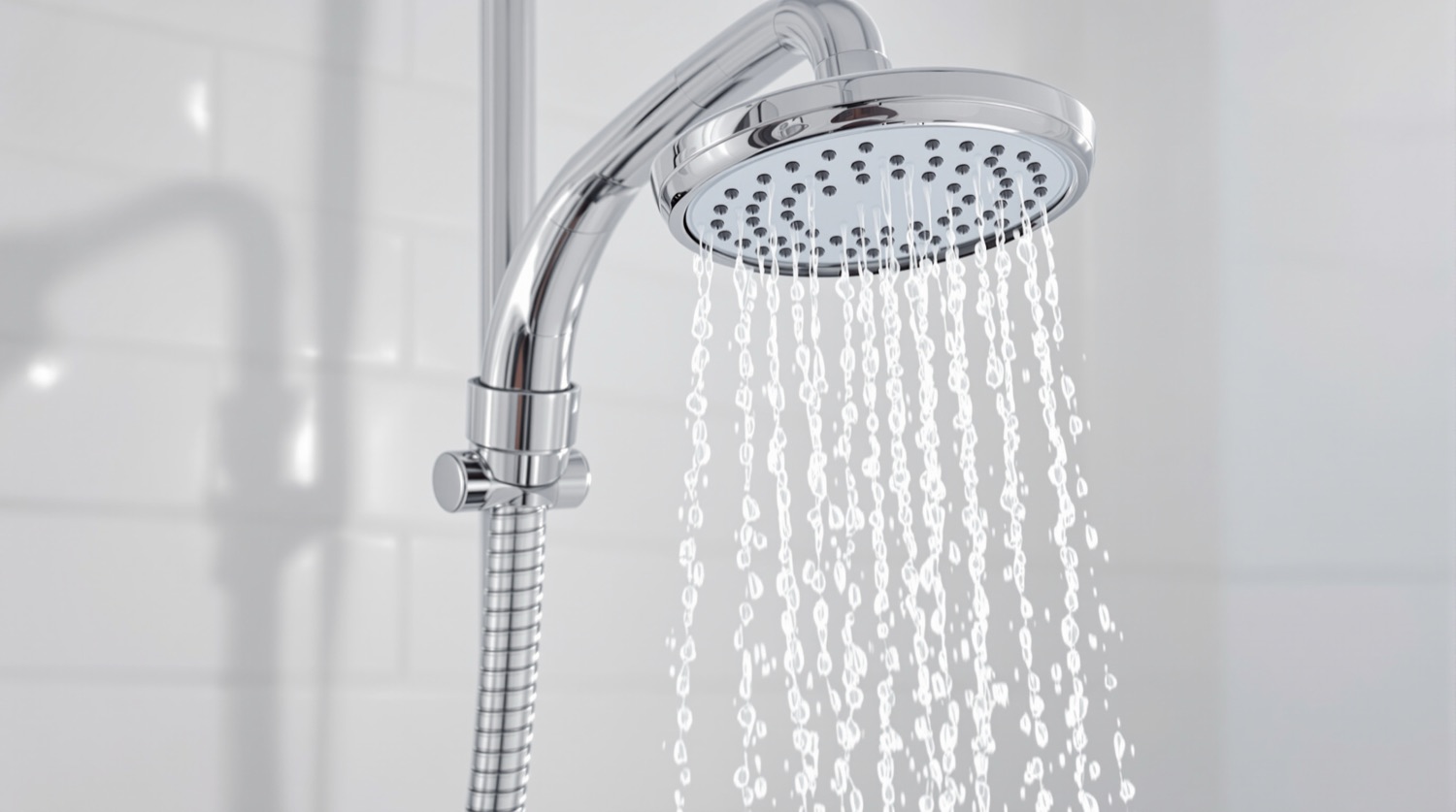
What does a shower filter actually get tested for?
One contaminant. NSF/ANSI 177 is the only third-party standard written specifically for shower filtration systems, and its scope is narrow on purpose: material safety (the housing must not leach anything into the water), structural integrity (it must not burst), minimum flow rate, free available chlorine reduction, and the accuracy of the product literature. To earn the chlorine claim, a unit has to reduce an influent challenge of 2.0 mg/L chlorine by 50% — not when new, but across the full capacity the maker rates it for.
Two lines inside that standard are the ones nobody prints on the box. The first: it is not a health-effects standard, so a certified filter is making no claim at all about skin, hair, lungs or long-term risk. The second: certified literature must carry the statement that the system has not been evaluated for free available chlorine reduction performance in the presence of chloramines, and that it is not intended as a drinking water treatment system. Everything below follows from those two sentences.
Shower filter claims vs what the testing proves
Here is every common claim side by side with the evidence actually behind it. A dash means no standard tests the claim at all.
| Claim on the box | Independently tested? | What the data actually shows |
|---|---|---|
| Reduces chlorine | Yes — NSF/ANSI 177 | Minimum bar is a 50% cut of a 2.0 mg/L challenge, held to the cartridge's rated capacity. Certified models publish their own figures above that floor. |
| Removes chloramine | No — explicitly excluded | Certified literature must say the unit was not evaluated against chloramines. EPA: more than one in five Americans is on chloraminated water. |
| Softens hard water | — | No shower filter removes calcium or magnesium. Hardness is handled by ion exchange in a plumbed softener, not by a cartridge on the arm. |
| Stops hair loss / fixes eczema | — | 177 is not a health-effects standard. The hard-water-and-eczema literature is split: a clear cross-sectional signal, no overall longitudinal effect except in children with filaggrin mutations. |
| Filters microplastics, lead, fluoride | — | None of these appear in the standard, and certified literature must state the unit is not a drinking water treatment system. |
| Pointless — you don't drink it | Measured, and false | Showering raised household air trihalomethanes from 8 to 384 µg/m³ and blood levels five- to fifteen-fold in an Environmental Health Perspectives study. |
Myth 1: “NSF certified” means it filters everything
Certification is a claim-by-claim thing, not a quality badge. A filter certified to NSF/ANSI 177 has proven one performance claim — free available chlorine — plus that its housing is safe and does not throttle flow. It has proven nothing about anything else, because nothing else is in the standard.
The 50% floor is worth sitting with too. A product can be fully certified and still be removing only half the chlorine arriving at your showerhead. The better manufacturers publish their own tested figure above that floor, and those numbers vary enormously: Weddell lists a minimum reduction of 93% or better for the Duo across its rated 10,000 gallons, while Jolie publishes roughly 70% over the same 10,000 gallons against the 50% benchmark. Both are certified. One removes a third more chlorine than the other. The mark tells you a claim was verified; the published number tells you how good it is.
What a stage count does not tell you is anything. A “15-stage” cartridge is a description of what is inside the housing, not a measured outcome. Stages are not tested; chlorine reduction is.
Myth 2: the certification applies to your water
Only if your utility uses free chlorine. Roughly speaking, American water systems finish their treatment one of two ways: free chlorine, or chloramine — chlorine combined with ammonia. EPA explains that chloramines “provide longer-lasting disinfection as the water moves through pipes to consumers,” which is why utilities switched to them to meet disinfection byproduct rules, and that “more than one in five Americans uses drinking water treated with chloramines.”
Chloramine is the harder molecule to break down, and a shower filter has the worst possible conditions for the job: a few seconds of contact time, at full flow, in hot water. That is precisely why the standard refuses to make any claim about it and forces certified products to print the disclaimer. If you are on chloraminated water, the NSF/ANSI 177 mark on the box is describing a test that does not resemble your tap.
You can find out which you have in about two minutes, for free. Every US community water system publishes an annual Consumer Confidence Report listing its disinfectant; search your utility's name plus “water quality report.” Do that before you buy — it is the single piece of information that decides whether a shower filter is a sensible purchase or a decorative one. If you are on chloramine and want it genuinely addressed, that is a job for a longer contact-time system upstream, which is the argument laid out in our shower filter vs whole-house filter comparison.
Myth 3: a shower filter softens hard water
It does not, and no shower filter claims to under any certification. Hardness is dissolved calcium and magnesium. Removing it requires ion exchange — a resin bed that swaps those minerals for sodium or potassium, regenerated with salt, installed on your main line. A cartridge screwed onto the shower arm has neither the resin volume nor the contact time to do that, and nothing in NSF/ANSI 177 tests hardness reduction.
What changes is how the water feels. Removing chlorine genuinely alters the sensation on skin and the way shampoo behaves, and people reliably report that as “softer.” The mineral content leaving the showerhead, though, is identical to the mineral content entering it. If you have scale on the glass and a chalky film on the tiles, a shower filter will not touch either.
Myth 4: a shower filter will fix your skin and hair
This is the claim doing most of the selling, and it is the one with the least support. Start with the certification: NSF/ANSI 177 is explicitly not a health-effects standard, so no certified product is making a tested skin claim.
The underlying science is genuinely interesting and genuinely unsettled. In 2016, Perkin and colleagues published a study of 1,303 three-month-old infants in the Journal of Allergy and Clinical Immunology (PubMed 27241890). Infants in homes with high water calcium carbonate and low chlorine had an adjusted odds ratio of 1.87 (95% confidence interval 1.25–2.80) for visible atopic dermatitis compared with low-mineral, low-chlorine homes. Hardness, not chlorine, carried the strongest signal.
Then the same cohort was followed to 36 months and published in the British Journal of Dermatology in 2020 (PubMed 31599965). Across all 1,303 children there was no overall association between harder water (above 257 mg/L calcium carbonate) and eczema — an adjusted hazard ratio of 1.07, confidence interval 0.92 to 1.24, which is statistically indistinguishable from no effect. The exception was striking: in infants carrying filaggrin gene mutations, which weaken the skin barrier, hard water carried an adjusted hazard ratio of 2.72 (2.03–3.66).
Read honestly, that is a real effect in a genetically susceptible subgroup and no detectable effect in everyone else — and in any case it is an argument about water hardness, which a shower filter does not change. If your skin improves after installing one, the plausible mechanism is less chlorine, not softer water. That is worth something; it is not the transformation the marketing promises.
Myth 5: it also filters microplastics, lead and fluoride
None of those are in the standard, and certified literature has to state that the unit is not intended as a drinking water treatment system. Some filters capture larger particles as a side effect of their media bed, but “captures some sediment” is not a tested contaminant-reduction claim, and no shower filter carries one for microplastics, lead or fluoride.
If those are your real concerns, they belong at the tap or on the main line, where contact time and certification both exist. A reverse-osmosis system or a certified carbon block handles drinking water — see our guide to removing microplastics from water, the best water filters for lead and the best filters for fluoride. For particles reaching every fixture in the house, that is a whole-house filter, not a showerhead.
So is a shower filter worth buying?
For chlorinated city water, yes — on the narrow grounds it can actually defend. The common dismissal, that shower water does not matter because you do not drink it, is the one claim here that the data flatly contradicts.
In a 2005 Environmental Health Perspectives study, Nuckols and colleagues monitored households and measured what a shower does to the air and to the people in it (PMC1257647). At the higher-trihalomethane site, median airborne total trihalomethanes rose from a baseline of 8 µg/m³ to 384 µg/m³ during showering, roughly a 48-fold jump; at the lower site, from 5 to 95 µg/m³. Blood concentrations followed, rising about 5- to 15-fold at the high site and roughly 5-fold at the low site.
Earlier work explains why skin matters as much as breathing. Jo, Weisel and Lioy, writing in Risk Analysis in 1990 (PubMed 2287784), compared exhaled chloroform after a normal shower against an inhalation-only exposure and concluded that “the mean internal dose due to dermal exposure was found to be approximately equal to that due to the inhalation exposure.” A hot shower is a warm, high-surface-area, high-humidity delivery system for whatever volatile compounds are in the water.
So the defensible case for a shower filter is this: the exposure is real and measurable, the fix is cheap, and the certification proves the fix works for one specific thing. That is a reasonable purchase. It is just a much smaller promise than the one on the box.
Which shower filters are actually certified?
These three publish NSF/ANSI 177 certification for chlorine reduction, which puts them in a small minority of the shower filters sold. We have listed what each maker states, and nothing more — where a figure is the manufacturer's own published lab result rather than an independent one, it says so. For the full ranked lineup including hard-water and hair-focused picks, see our best shower filter guide.

Sprite's own description is refreshingly plain about scope: it removes “free chlorine, dirt, and odors from water,” and says nothing about chloramine, hardness or skin. That is the whole thesis of this article in one product listing. If you are on free-chlorine city water and want one cartridge swap a year, this is the least fussy certified option.
✓ Ships free with Prime · Free returns · Amazon A-to-z purchase guarantee (on eligible items)
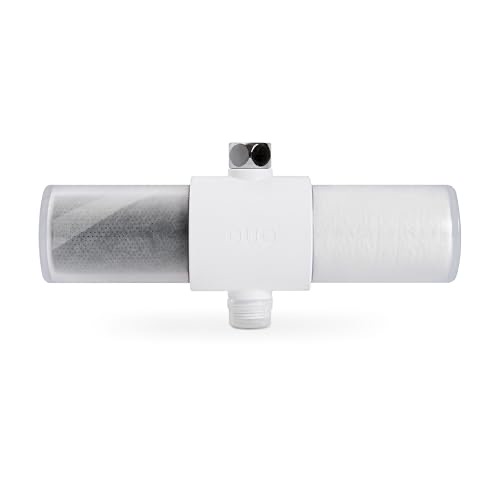
An activated-carbon dual cartridge rated to 10,000 gallons at 2.8 gallons per minute, so it does not strangle the flow the way some inline filters do. Weddell also advertises particulate and PFAS reduction from its own third-party testing; those are company-published claims outside the 177 scope, so treat them as the manufacturer's data rather than certified performance. The certified chlorine number is the one to buy on, and it is the best of the three.
✓ Ships free with Prime · Free returns · Amazon A-to-z purchase guarantee (on eligible items)
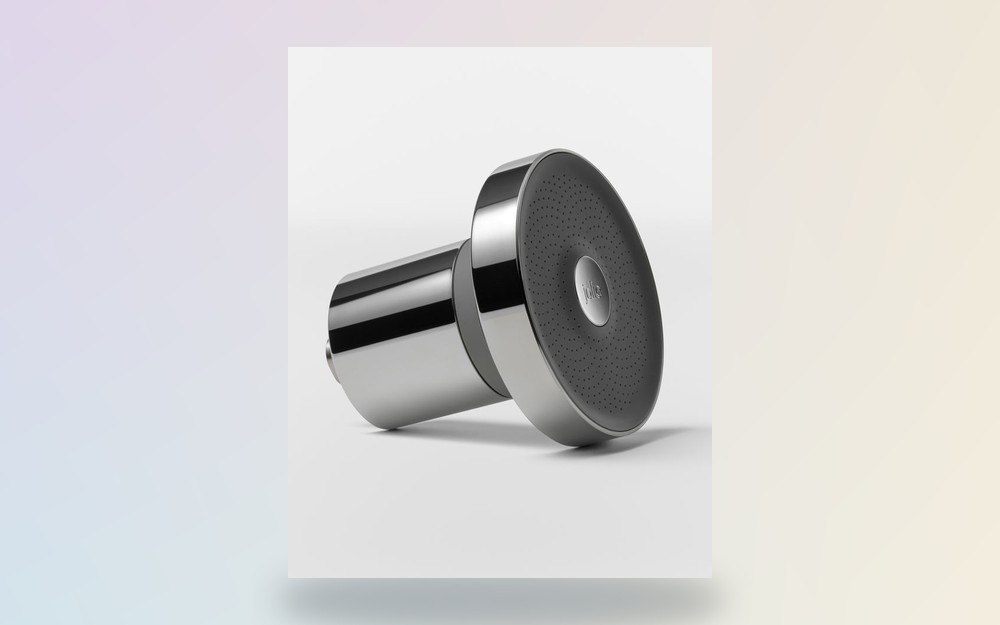
The appeal is that you replace the showerhead rather than adding a housing between the arm and the head, which keeps the installation tidy and the pressure high. Jolie also promotes skin and hair results from company-commissioned studies; those are self-reported outcome studies, not certified performance claims, and they sit outside what NSF/ANSI 177 measures. Buy it for the design and the verified chlorine claim.
✓ Ships free with Prime · Free returns · Amazon A-to-z purchase guarantee (on eligible items)
How to buy one without being sold a myth
Four checks, in order, and the first one is free:
- Read your Consumer Confidence Report first. If your utility uses chloramine, no shower filter has a certified claim that applies to your water. That one fact should decide the purchase.
- Insist on the NSF/ANSI 177 mark, then look past it. Ask for the maker's published reduction percentage and the rated capacity in gallons. Certified at 50% and certified at 93% are both “certified.”
- Ignore stage counts and mineral-ball marketing. Vitamin C, tourmaline and ceramic beads are not tested components. If a feature has no number attached, treat it as decoration.
- Diarize the cartridge change. Certification holds to the rated capacity and no further; a filter left in past its gallons is a plain showerhead with extra plumbing. The rated life ranges from a few months to a year across these products, which matters more to running cost than the sticker price does.
And keep the job in the right place. A shower filter is for chlorine at one fixture. Drinking water, microplastics and lead are a different purchase — our best water filter guide covers that side, and the plastic-free bathroom guide covers the rest of the room.
Frequently Asked Questions
Sources & further reading
- US EPA — Chloramines in Drinking Water
- US EPA — Basic Information about Chloramines and Drinking Water Disinfection
- Nuckols et al., Environmental Health Perspectives (2005) — Influence of Tap Water Quality and Household Water Use Activities on Indoor Air and Internal Dose Levels of Trihalomethanes
- Jo, Weisel & Lioy, Risk Analysis 10(4):575–80 (1990) — Routes of chloroform exposure and body burden from showering with chlorinated tap water
- Perkin et al., Journal of Allergy and Clinical Immunology 138(2):509–16 (2016) — Association between domestic water hardness, chlorine, and atopic dermatitis risk in early life
- Jabbar-Lopez et al., British Journal of Dermatology 183(2):285–93 (2020) — Longitudinal analysis of the effect of water hardness on atopic eczema
- NSF — NSF/ANSI 177, Shower Filtration Systems — Aesthetic Effects