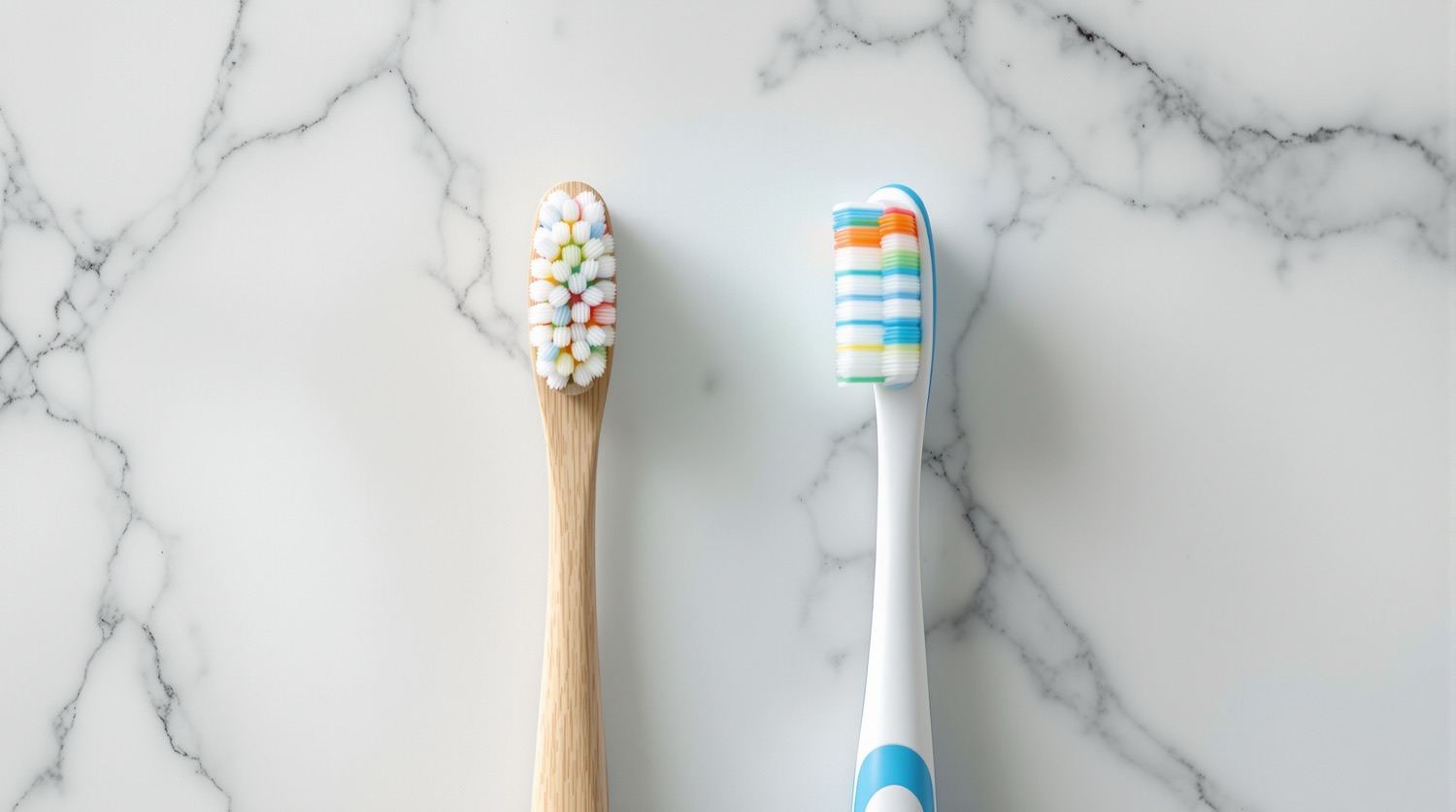
The toothbrush is the most-replaced plastic object in an average bathroom. The American Dental Association advises swapping it every three to four months, which makes it a purchase you repeat roughly four times a year for your whole life, and that repetition is the entire reason the material matters. One brush is trivial. Two hundred and forty of them are not.
Bamboo brushes arrived as the answer, and most of what is written about them is written by the companies selling them. There is a better source. In 2020 a team at the Eastman Dental Hospital in London and the Dublin Dental University Hospital ran a full life-cycle assessment of four toothbrush types over a five-year period — plastic manual, bamboo manual, plastic manual with replaceable heads, and electric — and published it in the British Dental Journal. It is still the only quantitative comparison of its kind, and it answers the plastic question precisely. A second paper, published in 2025, answers a question that study did not ask: what the bristles release into your mouth.
Bottom line: switch the handle and you remove 97% of the plastic. You do not remove the bristles, which are nylon on almost every bamboo brush sold, and which are the only part of the brush that goes in your mouth and sheds particles while you use it. Buy bamboo — it is clearly the better object — but buy it understanding which problem it solves.
Four Toothbrushes, Five Years, Measured Side by Side
Figures from Lyne et al., British Dental Journal 2020. The study modeled brushing twice daily for two minutes, with the brush or head replaced every three months, over a five-year period.
| Toothbrush type | Plastic used over 5 years | Climate impact (kg CO2 eq) | Lowest impact in | Biggest contributor | Price tier |
|---|---|---|---|---|---|
| Bamboo manual | 11 g (97% less) | 0.0422 | 5 of 16 categories | Tap water used while brushing | $ |
| Plastic manual, replaceable head | — | — | 11 of 16 categories | Polypropylene handle (33%) | $$ |
| Plastic manual | Baseline | 0.256 | None | Polypropylene handle (37%) | $ |
| Electric (rechargeable) | — | 0.479 | None — worst in 15 of 16 | Transport (47%), materials (46%) | $$$ |
Two honest notes on that table before anything else. The dashes are values the paper did not publish as a single figure for that product, and we have left them blank rather than estimating them — the plastic-mass comparison was published as the bamboo brush’s 11 g and its 97% reduction against the plastic manual, not as a mass for every product. And the replaceable-head plastic brush, which is the result nobody quotes, was lowest in more categories than bamboo: eleven against five. Bamboo is the most visible plastic saving, not the sweep that the marketing implies.
Does a Bamboo Toothbrush Really Use Less Plastic?
It does, and 11 grams over five years is the number to hold onto. That is the entire plastic content of a bamboo brush replaced twenty times — roughly half a gram of nylon bristle per brush, plus the metal staples that anchor it. The study put that at 97% less plastic than the traditional plastic manual toothbrush, which was the lowest plastic figure of all four products.
What that saving actually consists of is the handle. In the plastic manual brush, the polypropylene handle was the single biggest contributor to its whole environmental footprint — 37% of it — and in the replaceable-head version, 33%. Bamboo deletes that component outright. The authors confirmed that no glue is used in the bamboo brush’s manufacture; the handle is shaped and heat-treated to sterilize it.
The paper also ran the arithmetic out to a human lifetime. At a UK life expectancy of 80 years, one person brushing with plastic manual toothbrushes gets through roughly 6.3 kg of plastic. That is the pile a bamboo handle is removing from one bathroom — not a tonnage that changes the ocean, but a real and permanent object that will exist long after the person who brushed with it.
What Are Bamboo Toothbrush Bristles Made Of?
Nylon, on almost every brush sold. This is the sentence that the category tends to skip, and the British Dental Journal authors stated it plainly: all four products in the study used plastic to make the toothbrush bristles, specifically nylon, and all except the bamboo product also used plastic for the handle and the packaging.
The better brands publish it rather than hide it. The Humble Co. lists its bristles as BPA-free nylon-6. Greenzla’s bamboo brushes use BPA-free nylon bristles infused with charcoal. Neither is being deceptive; the bristle is simply the part of a toothbrush that no plant fiber has yet matched for durability, end-rounding and resistance to bacteria.
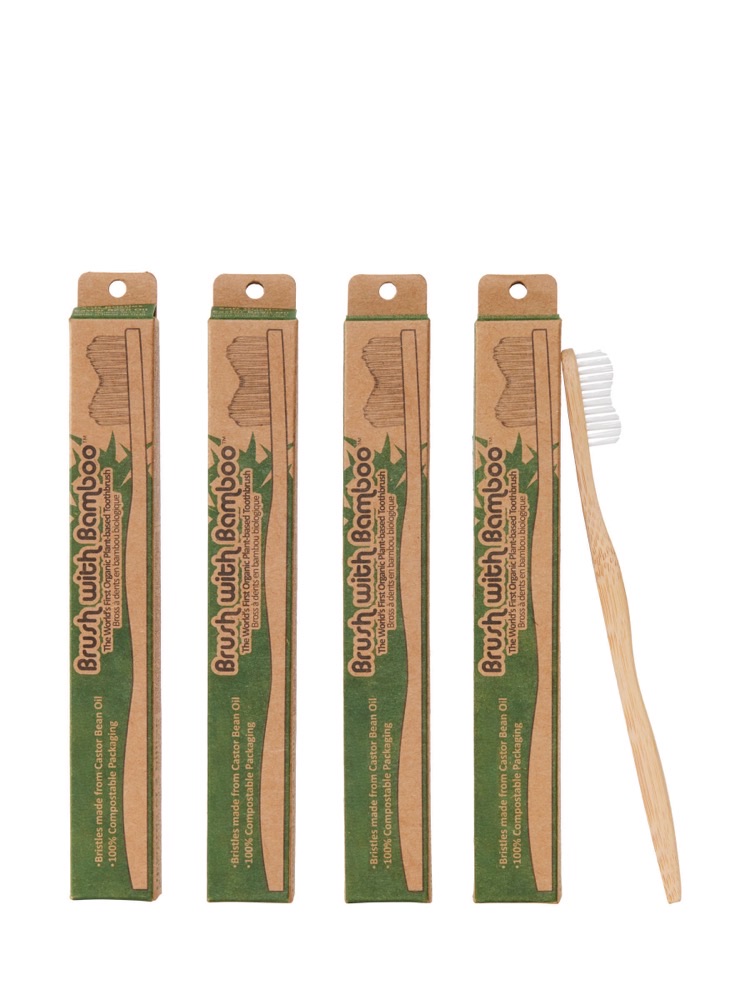
One real exception exists. Brush with Bamboo states that its bristles are made from 100% castor bean oil and are USDA Certified 100% Biobased, with “0% fossil fuel and 0% petroleum.” That is a genuine difference in feedstock — the carbon in the filament came out of a plant rather than a well. It is not a claim that the filament is not a polymer, and the company is unusually straight about the consequence: it says the bristles are biodegradable but cannot legally be called compostable, because compostable products have to break down as fast as food, and these do not. Their timeline, in the company’s words, “would depend on soil activity.”
Bristle Materials, Measured in a Lab
Nylon against a polyester filament (Curen), tested in vitro by Prakash et al., Cureus, December 2024.
| Property measured | Nylon filament | Curen polyester filament |
|---|---|---|
| Enamel abrasion | Higher | 72.84% less abrasive |
| Change in enamel surface roughness | ||
| Bristle splaying over use | Greater | 30% less |
| Usable life | About 3 months | About 6 months |
| Water absorption | Absorbs, losing stiffness when wet | Absorbs almost none |
The useful takeaway from that table is not that one plastic beats another. It is that bristle material changes how long a brush lasts, and a filament that stays usable for six months instead of three halves the number of brushes a person throws away. That is a bigger lever on total plastic than the handle material, and nobody markets it.
Do Toothbrush Bristles Shed Microplastics Into Your Mouth?
They do, and as of 2025 the quantity has been measured rather than assumed. A team publishing in the Microchemical Journal built a 3D-modeled zirconium dental arch, ran commercial toothbrushes against it twice daily for seven days under realistic brushing conditions, then collected, counted and identified what came off using microscopy, Fourier-transform infrared spectroscopy and micro-Raman spectroscopy.
Every toothbrush released microplastics, regardless of brand. The least expensive brand released the most, at an average of 39 particles per day. The particles were not all one shape — the researchers recovered fragments, fibers, films and pellets — and they spanned a very wide size range, from 8 to 1,995 micrometers. The polymers the authors flagged as the primary risk concern were nylon and polybutylene terephthalate, which are the two materials toothbrush bristles are made from. Bristle shape and material both influenced how much fragmented.
What that means at your sink: 39 particles a day is roughly 14,000 a year from one cheap brush, released directly into the mouth rather than into a river. It is a small number next to the particle counts measured in bottled water, and it is not a reason to stop brushing — the oral-health case for brushing is not in question. It is a reason to care which bristle you are buying, and a reason not to buy the cheapest multipack on the shelf purely because it is bamboo.
Is an Electric Toothbrush Worse Than a Plastic Manual One?
On this evidence, yes, and not marginally. The electric toothbrush had the greatest environmental impact in 15 of the 16 categories the study assessed — the only exception being water scarcity. Its five-year climate change potential was 0.479 kg CO2 equivalent, against 0.0422 for the bamboo brush: eleven times higher. Its land use impact, which the authors tie to biodiversity and habitat loss, was more than 36 times the bamboo brush’s.
The interesting part is where that footprint comes from, because it is not where most people assume. Charging the handle accounted for 0.69% of the electric brush’s total impact and disposal for 0.16%. The weight is the problem: at 1.42 kg it was the heaviest product in the study, and transport (47%) plus materials (46%) accounted for almost all of its footprint. Using it more efficiently changes essentially nothing; the damage was done before it reached the bathroom.
Against that sits the clinical evidence, which deserves to be stated fairly. The Cochrane review the authors cite — Yaacob and colleagues, 2014 — found moderate-quality evidence that powered brushes achieve a statistically significant reduction in plaque and in gingivitis compared with manual ones, in both the short and long term. The British Dental Journal authors’ own reading of that same evidence, stated in their paper, is that there is no evidence any type of toothbrush is more clinically effective for the prevention of dental caries and periodontal disease. If an electric brush is what gets a particular person to brush properly for two minutes, that is a real clinical benefit and it outranks a carbon figure. If it is sitting on the counter because it looked nice, the figures above are what it costs. Our guide to non-toxic electric toothbrushes covers the models worth it if you need one.
The Three Bamboo Brushes Worth Buying
Ranked by how much of the problem each one actually solves — which means the bristle, not just the handle.
 Best Overall
The handle is wild-harvested Giant Moso bamboo, FSC certified. The company removed the plastic wrapper from its packaging in March 2019 and ships in a paper box only, which closes the third plastic component the British Dental Journal study identified — the polyethylene packaging that every non-bamboo brush in the study also carried. On disposal, the honest instruction is the same as for any bamboo brush: the head comes off and goes in the bin, the bare handle composts.
Pros
- Bristles are plant-derived, not petroleum nylon
- USDA Certified 100% Biobased — a verified claim, not a slogan
- FSC-certified bamboo handle, no glue in manufacture
- Paper-only packaging since 2019
Cons
- Costs more per brush than a bamboo multipack
- Biobased is not compostable — the company says so
- Bristles still need removing before the handle composts
- Four brushes per pack, so you cannot buy just one
The one bamboo brush that also deals with the part that goes in your mouth.
Why it matters: the 2025 release study named nylon and polybutylene terephthalate as the polymers of primary concern. This is the only pick here whose filament is neither of them.
Check Today’s Price on Amazon →Amazon prices change daily — tap to see today’s price and any current discount.
- Free delivery for Prime members
- USDA BioPreferred certified
 Best Everyday Pick
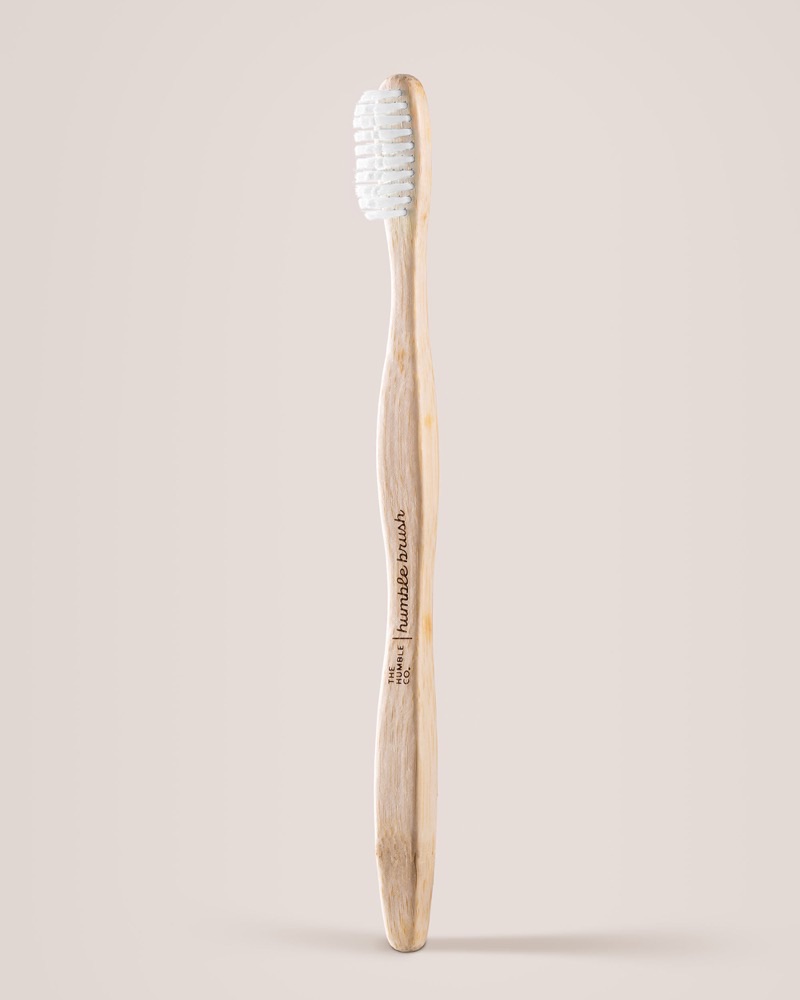
The bristles are nylon-6, and there is no point pretending otherwise: this brush solves the handle problem and leaves the bristle problem exactly where it found it. What it does well is remove every excuse not to switch. A five-pack covers more than a year at the dental association’s three-to-four-month replacement interval, the handle is unvarnished bamboo, and the brand is explicit that the product is free from BPA, PFAS and PTFE.
Pros
- Publishes its bristle material openly (nylon-6)
- Stated free from BPA, PFAS and PTFE
- Five-pack covers over a year of replacements
- Widely stocked, so resupply is never a problem
Cons
- Bristles are petroleum nylon, not plant-derived
- Does nothing about bristle shedding
- Handle needs drying between uses to avoid swelling
- More expensive per brush than budget multipacks
The whole handle saving, from a brand that tells you what the bristle is.
Check Today’s Price on Amazon →Amazon prices change daily — tap to see today’s price and any current discount.
- Free delivery for Prime members
- Thousands of verified reviews
 Best Value
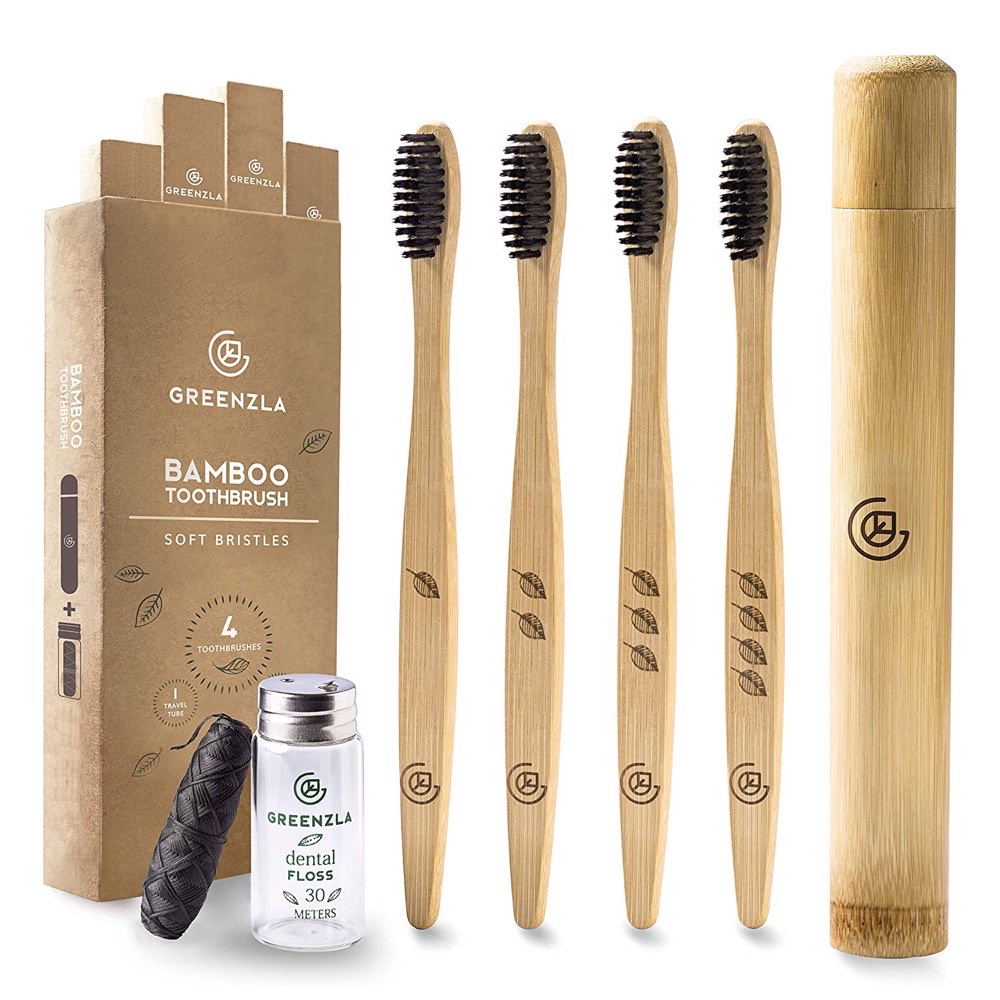
One caution worth naming, because the 2025 release study found it directly: the cheapest brush in that trial shed the most microplastic, at 39 particles a day, and bristle material and shape were both factors in how much fragmented. We are not claiming that result transfers to this specific product, which was not in the study. We are saying that budget bristle is a real variable, and that the honest reason to buy a value multipack is cost, not performance.
Pros
- Lowest cost per brush of the three picks
- Four brushes covers a full year of replacements
- Bamboo travel case and charcoal floss included
- Soft bristles suit sensitive gums
Cons
- Bristles are nylon, same as a plastic brush
- Budget bristle is the variable the 2025 study flagged
- Charcoal infusion is cosmetic, not a cleaning benefit
- Handles vary slightly in finish between units
A year of bamboo brushing, at the price point that actually gets switched.
Check Today’s Price on Amazon →Amazon prices change daily — tap to see today’s price and any current discount.
- Free delivery for Prime members
- Travel case and floss included
For the wider field, including kids’ brushes and the charcoal options we do not recommend, see our plastic-free toothbrush guide. The rest of the counter is covered in the plastic-free bathroom guide, and the two products most likely to be sitting beside the brush are handled in our non-toxic toothpaste and plastic-free dental floss picks.
Can You Actually Compost a Bamboo Toothbrush?
The handle, yes. The brush, no — and this is where the category’s marketing is at its loosest. The bristles are a polymer and they are held in place by metal staples, so both have to come out before anything goes near a compost heap. The study authors did exactly this as part of building their inventory, pulling the bristles and staples from a bamboo brush with tweezers, and recorded how long it took: almost 30 minutes per brush. They concluded it was unrealistic to expect consumers to do it.
The realistic version is simpler and still worth doing. Snap or cut the head off the handle, put the head in the bin, and compost, chip or burn the bare bamboo. You keep most of the benefit and you do not spend half an hour with tweezers. A brush whose instructions quietly assume you will is a brush making a claim it has not earned — the same pattern as a “BPA-free” label on a plastic that swapped BPA for BPS.
What the Handle Switch Does Not Fix
Three things, and they are worth knowing before you count the problem solved.
The bristles. They are the only part of the brush that enters your mouth, the only part that sheds while you use it, and the part that bamboo leaves untouched on all but a handful of brands. Everything the 2025 Microchemical Journal paper measured came off the bristle, not the handle.
The replacement interval. The three-month cycle is what turns a 20-gram object into a 6.3-kilogram lifetime pile. A filament that genuinely lasts six months halves that, which is why bristle longevity is a larger lever than handle material and why the Cureus finding above matters more than it looks.
Everything else in the bathroom. A toothbrush is about 20 grams. The razor, the shampoo bottle, the shower curtain liner and the toothpaste tube are all heavier, and the particles you actually ingest in the largest numbers come from food and water rather than from brushing — see what has been measured in the human body for the scale.
So Which Should You Buy?
Buy a bamboo brush if:
- You want the largest single plastic cut available in this category
- You are happy to bin the head and compost the handle
- You brush manually already, or would
- You will pay a little more to get a plant-derived bristle
Stay with plastic if:
- You use a replaceable-head manual brush — it beat bamboo in 11 of 16 categories
- A specific brush is the only one your dentist will approve for your mouth
- An electric brush is genuinely what keeps you brushing for two minutes
- You would otherwise buy a bamboo brush and keep the plastic one too
The quiet answer in the data is the one nobody sells: a manual brush with a replaceable head was the best performer overall, and bamboo was the best performer on plastic specifically. If plastic is the thing you are trying to remove from your house, bamboo is the right buy. Just buy it knowing that the bristles came with it.
Frequently Asked Questions
Does a bamboo toothbrush really use less plastic than a plastic one?
By a large and measured margin. In the British Dental Journal life-cycle assessment, the bamboo manual brush used 11 grams of plastic across five years of twice-daily brushing — 97% less than the plastic manual brush tested alongside it. The 11 grams that remain are the bristles and the staples holding them, because a bamboo brush replaces the handle, not the head.
What are bamboo toothbrush bristles made of?
Almost always nylon. The study noted that all four brushes it assessed, bamboo included, used nylon bristles. The Humble Co. publishes its spec as BPA-free nylon-6. The main exception is Brush with Bamboo, which states its bristles are 100% castor bean oil and USDA Certified 100% Biobased — a plant-derived polymer rather than a petroleum one, which the company says is biodegradable but legally cannot be called compostable.
Do toothbrush bristles shed microplastics into your mouth?
Yes, and it has been measured. A 2025 Microchemical Journal study ran commercial brushes against a 3D-modeled zirconium dental arch twice daily for seven days. Every brush released microplastics; the cheapest brand averaged 39 particles per day. Particles ranged from 8 to 1,995 micrometers and included fragments, fibers, films and pellets, with nylon and polybutylene terephthalate flagged as the polymers of primary concern.
Is an electric toothbrush worse for the environment than a plastic one?
Considerably, on 15 of 16 measures. Its five-year climate impact was 0.479 kg CO2 equivalent against 0.0422 for bamboo — eleven times higher — and its land use impact was over 36 times bamboo’s. Charging it accounted for only 0.69% of that; the footprint is in the 1.42 kg of material and the transport of it.
Can you compost a bamboo toothbrush?
The handle only. The bristles are a polymer anchored with metal staples and have to come out first. The study authors timed that job at almost 30 minutes per brush with tweezers and judged it unrealistic for consumers. Snapping the head off and binning it, then composting the bare handle, keeps most of the benefit.
Which toothbrush is best if you care about plastic?
A manual brush with either a bamboo handle or a replaceable head — those two tied as the lowest-impact options, with bamboo lowest in five categories and the replaceable-head plastic brush lowest in eleven. Among bamboo brushes, the one that also changes the bristle is the one worth paying for. And because the American Dental Association advises replacing a brush every three to four months, whatever you choose gets multiplied by four every year.
Sources
- Lyne A, Ashley P, Saget S, Porto Costa M, Underwood B, Duane B. “Combining evidence-based healthcare with environmental sustainability: using the toothbrush as a model.” British Dental Journal 2020; 229(5):303–309. https://doi.org/10.1038/s41415-020-1981-0
- Akbaridana P et al. “Preliminary results on microplastic release from commercial toothbrushes during simulated brushing.” Microchemical Journal 2025; 216:114680. https://doi.org/10.1016/j.microc.2025.114680
- Prakash A et al. “Physicochemical Properties of Curen® Filaments Versus Nylon Filaments in Toothbrush Bristles: An In Vitro Study.” Cureus 2024; 16(12):e75767. https://pmc.ncbi.nlm.nih.gov/articles/PMC11733252/
- Yaacob M, Worthington HV, Deacon SA, Deery C, Walmsley AD, Robinson PG, Glenny AM. “Powered versus manual toothbrushing for oral health.” Cochrane Database of Systematic Reviews 2014; Issue 6:CD002281. DOI 10.1002/14651858.CD002281.pub3. https://pubmed.ncbi.nlm.nih.gov/24934383/
- Brush with Bamboo. Bristle composition, certification and disposal statements. https://www.brushwithbamboo.com/faq/
- American Dental Association. Toothbrush care, cleaning, storage and replacement. https://www.ada.org/resources/ada-library/oral-health-topics/toothbrushes