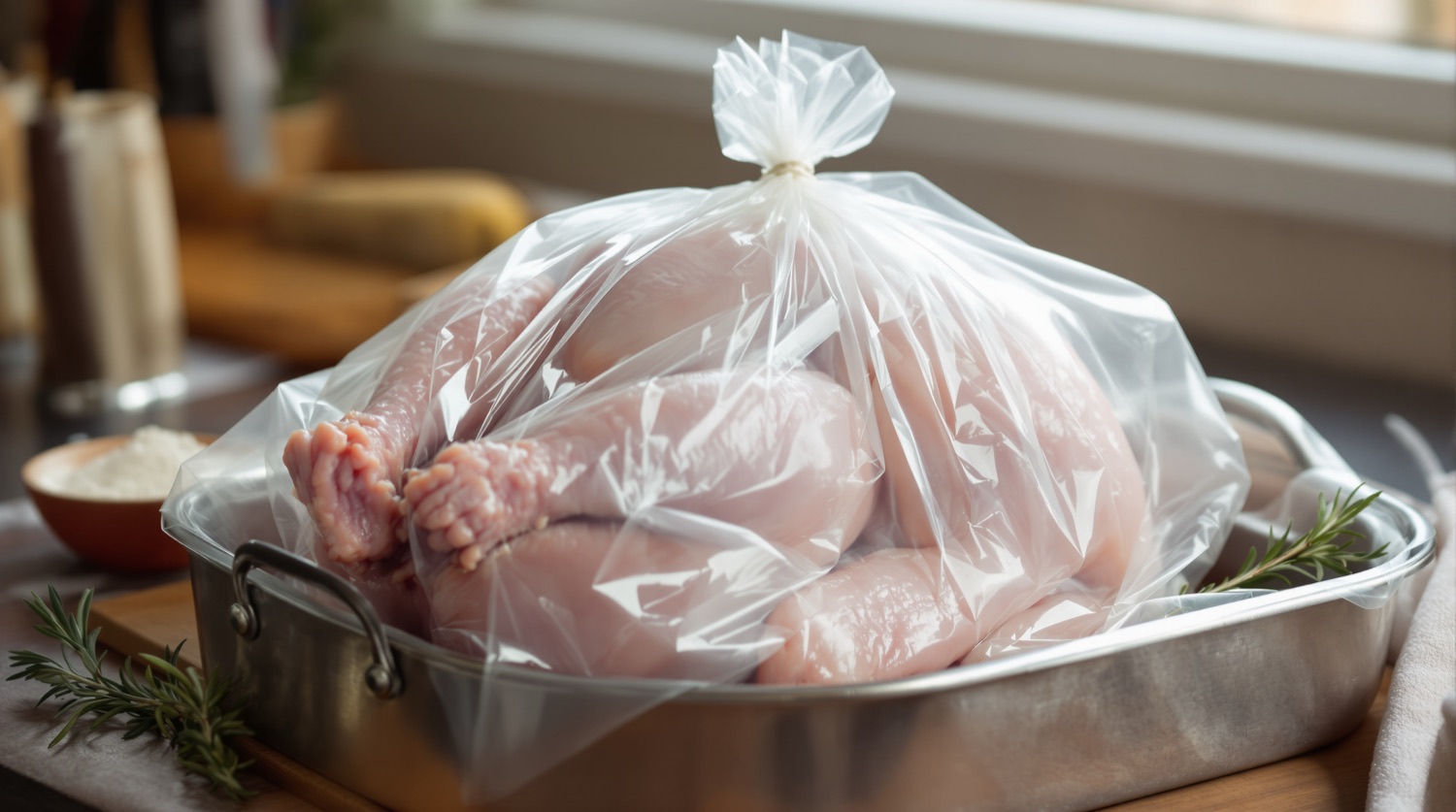
Oven bags are made of heat-resistant nylon that is FDA-compliant up to 400°F, so used as directed they will not melt, but heat does move nylon compounds into food. In a study in Food Additives & Contaminants (Gramshaw and Soto-Valdez, 1998), chicken roasted in a nylon bag at 200°C (392°F) for two hours picked up 8.26 mg of nylon monomers and oligomers per bag, and a 2026 Lund University study in Chemosphere found nylon oven bags release toxic leachates only once they are heated. A lidded roasting pan gives the same moist turkey with no plastic touching the meat.
An oven bag does two jobs. It traps steam around the meat so the outside does not dry out before the inside is cooked, and it keeps the drippings off your pan. Reynolds, the brand most people buy, says its bags are BPA-free, meet FDA regulations, and are safe to 400°F. All of that is true, and none of it answers the question most people are actually asking: does anything from the bag end up in the food?
That question has been tested directly, more than once. Below are the studies, with links, in the order a cook would want them: what the bag is made of, what migrates out of it, whether it sheds particles, what the newest toxicity research found, and what to do this Thanksgiving.
Oven bag safety at a glance
| Question | What was tested | Measured result | Source |
|---|---|---|---|
| Does nylon migrate into roast meat? | Chicken roasted in nylon 6,6 / nylon 6 bags, 200°C for 2 hours | 7.48 µg per gram of chicken; 8.26 mg per bag | Gramshaw & Soto-Valdez, 1998 |
| Does fat pull out more? | Same type of bag, olive oil at 175°C for 1 hour | 19.2 mg per bag; 41.8% of the compounds measured in the bag | Soto-Valdez et al., 1997 |
| Does food-grade nylon shed nanoplastics? | Single-use food-grade nylon in hot water | More than 1 trillion particles per liter, 30–80 nm, 7 times more than LDPE-lined cups | Zangmeister et al. (NIST), 2022 |
| Is what comes out toxic? | Nylon and PET oven bags; leachates tested on water fleas | No effect at room temperature; significant toxicity from material released at cooking temperatures. PET bags released far less, with no detectable toxicity | Ekvall et al., Chemosphere, 2026 |
| Is the main migrant well studied? | Cyclic nylon oligomers from kitchen items | Found in every migration test; regulators call for “urgent” toxicology data | Kappenstein et al. (BfR), 2018 |
What are oven bags made of?
Standard oven bags are nylon, also called polyamide. Reynolds describes its bags as “FDA-compliant, heat-resistant nylon” that is safe for oven roasting and microwave use up to 400°F (200°C), and tells you to shake one tablespoon of flour inside before cooking so fat and juices blend instead of bursting the bag. Its cooking guide rules out broilers, toaster ovens, countertop roasters, grills, stovetops, boiling and sous vide.
Nylon is chosen because it survives oven heat that would melt the polyethylene in a zipper bag or plastic wrap. That heat tolerance is real, but “does not melt” and “releases nothing” are different claims. Nylon is built from small ring-shaped and chain-shaped molecules, and a finished film always holds some that never joined the chain. Those leftovers are what migrate. “BPA-free” is accurate and beside the point here: nylon was never made with BPA, so the label tells you nothing about what nylon itself releases. Our BPA-free explainer covers why that label is so often a distraction.
Does nylon leach into food when you roast in a bag?
Measurable amounts do. The cleanest test is still a pair of studies from the University of Leeds food science department. First, Soto-Valdez, Gramshaw and Vandenburg took nylon “microwave and roasting bags” apart chemically and published what was in them in Food Additives & Contaminants in 1997. Then Gramshaw and Soto-Valdez roasted whole chickens in those bags at 200°C (392°F) for two hours and measured what ended up in the meat, skin and juices, published in the same journal in 1998.
| Measurement | Result | Conditions |
|---|---|---|
| Caprolactam (nylon 6 building block) in the bag | 5.0–35.5 mg per bag | Released as vapor at 200°C |
| Cyclopentanone in the bag | 31.7 mg per bag | Released as vapor at 200°C |
| Non-volatile compounds extractable from the bag | 46.0 mg per bag | Methanol extraction |
| Migration into olive oil | 19.2 mg per bag (0.916 mg/dm²), 41.8% of what was measured in the bag | 175°C for 1 hour |
| Migration into roast chicken | 7.48 µg/g of chicken; 8.26 mg per bag; 16% of the bag’s non-volatile compounds | 200°C for 2 hours |
| 2-cyclopentyl cyclopentanone into roast chicken | 14.0 µg per bag (±4.36) | 200°C for 2 hours |
What migrated into the chicken was mostly seven cyclic monomers and oligomers of nylon 6 and nylon 6,6, the small rings of the polymer’s own building blocks. The 1998 authors concluded that, in general, the transfer “can be considered not to present a hazard.” That was a reasonable call against the toxicology available at the time, and it is the honest starting point: no study has shown that eating a bag-roasted turkey harms people.
Two details matter for a home cook, though. First, fat pulls far more out of nylon than lean meat does: olive oil extracted 41.8% of the measured compounds in one hour, against 16% for chicken in two. Turkey drippings are mostly fat and juice that sat against the bag for hours, which is exactly the part most people turn into gravy. Second, the chicken test ran at 392°F, just under the bag’s 400°F maximum. Most turkey recipes run at 325–350°F, which is a gentler exposure than the one measured.
Are nylon oligomers harmful?
Nobody knows yet, and that gap is the real issue. Cyclic oligomers are the main substances that migrate from nylon food-contact materials, according to a 2012 TU Dresden study by Heimrich and colleagues, which measured 13.4 and 19.5 grams of them per kilogram in two nylon 6 raw materials from different manufacturers. In other words, the amount available to migrate depends on who made the plastic, and the box does not tell you.
Germany’s Federal Institute for Risk Assessment (BfR) then built a method to measure eight nylon 6 and four nylon 6,6 cyclic oligomers moving from kitchen items into food simulants, tap water and tea. In its 2018 paper, Kappenstein and colleagues found the oligomers above the quantification limit in every migration solution they tested, ran a preliminary computer-based risk assessment, and concluded that the results “demonstrate the urgent need for toxicological data” to judge the health risk. That is the current state of knowledge: the migration is measured and consistent, and the health effect is untested.
Do oven bags release microplastics or nanoplastics?
Food-grade nylon does shed nanoplastics in hot water, in very large numbers. Scientists at the U.S. National Institute of Standards and Technology tested single-use food-grade nylon bags and LDPE-lined hot beverage cups and reported in Environmental Science & Technology in 2022 that both released plastic particles at more than a trillion per liter. The particles averaged 30 to 80 nanometers, and the nylon released 7 times more than the cups. The number rose with water temperature.
The NIST summary describes the nylon as bags “such as baking liners,” so this is the same material family as a roasting bag rather than a test of a turkey bag itself. It also puts the count in context: the nylon lost about one tenth of a percent of its mass, well under the FDA’s allowance for food-grade nylon of up to 1% under high-temperature conditions. Lead author Christopher Zangmeister said plainly that particles this small could get inside a cell, but that no one has determined they cause harm. Our nanoplastics vs microplastics explainer covers why particle size matters.
What did the 2026 oven bag study find?
It found that the harm, in a standard toxicity screen, comes from what heated nylon releases, not from the particles. Mikael Ekvall, Kevin Boo, Martin Lundqvist and Tommy Cedervall at Lund University tested nylon and PET oven bags and published the results in Chemosphere in 2026. They exposed the freshwater zooplankton Daphnia magna, a standard organism for screening chemical toxicity, to what came out of each bag.
- Room temperature: leachates from nylon bags had no significant effect.
- Cooking temperatures: material released from heated nylon bags caused significant immobilization of the animals.
- Particles vs molecules: splitting the leachate by size showed the toxicity came mainly from small dissolved molecules, not larger particles.
- PET bags: released substantially less material and showed no detectable toxicity under the conditions tested.
Kevin Boo’s 2025 master’s thesis from the same group, which the paper builds on, reported that bags cooked at higher temperatures caused more toxicity. Keep the limits in view: water fleas are an early warning system, not a stand-in for people, and the study did not measure a dose a person would eat. What it adds to the 1990s chemistry is direction. Heat is the switch, and the nylon bag, not the PET one, is the one that flips it.
The PET bags in the Lund study came out cleanly. In the U.S., the turkey-size bags on most grocery shelves are nylon, and Reynolds says so on its own site. If you buy a different brand and want to keep using a bag, check the box for the material.
Is it safe to cook a turkey in an oven bag?
Used exactly as directed, an oven bag is a legal, FDA-compliant way to roast a turkey, and no study has shown it makes people sick. It is also a guaranteed source of nylon compounds in your food, in amounts that rise with heat, fat and time, from a substance regulators say still needs toxicology data. For a once-a-year bird, that is a small exposure. It is also an entirely avoidable one, because a covered roasting pan does the same job.
If you are going to use one this year, these habits keep the exposure at the low end of what the studies measured:
- Roast at 325–350°F, not 400°F. The Leeds chicken test ran at 392°F, and the Lund work found toxicity rises with temperature. Never go above the box’s 400°F limit.
- Keep the bag off the oven walls and racks. Reynolds warns that loose ends touching hot metal can burn or melt. Trim the tie ends and let the bag sit inside the pan.
- Never use it under a broiler, in a toaster oven, in a countertop roaster, or for boiling or sous vide. All are on the manufacturer’s own do-not list.
- Think twice about bag-drippings gravy. Fat pulled the most out of nylon in the 1997 tests. Making gravy from a separately roasted set of wings and necks avoids it. This is our inference from the olive-oil data, not a tested limit.
- One bag, one use. Nylon bags are single-use; do not wash and reuse one.
- Use a thermometer, not the clock. Bags speed up cooking, and a turkey left in longer than it needs to be is more time at temperature for the bag and dry meat for you. Pull it at 165°F in the thickest part of the breast and thigh.
How do you get a juicy turkey without an oven bag?
Trap the steam with a lid instead of a bag. A covered roaster holds moisture around the bird the same way a bag does, and the food only touches steel or enamel. Take the lid off for the last 30 to 45 minutes to brown the skin. If you have an open pan, an aluminum foil tent over the breast for the first two-thirds of cooking does a similar job; our aluminum foil guide covers when foil is and is not a good idea, mainly with acidic foods. For lining a pan under vegetables, unbleached parchment is the other plastic-free option, and our parchment paper PFAS test roundup lists which brands are clean.
The three picks below are the plastic-free swaps for an oven bag, from the closest stand-in to the most versatile. Each has a real product photo and a tracked link; we earn a commission if you buy, at no cost to you.
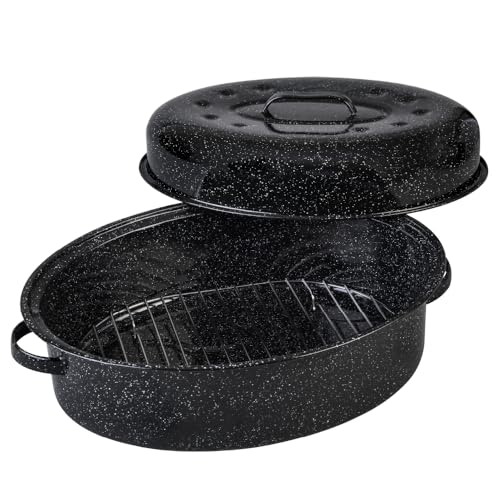
Closest Swap for a Bag: Granite Ware 19" Oval Roaster with Lid
 Closest Swap
Get the moist, easy turkey you bought oven bags for, with no plastic in the oven, ever.
Why it’s safe: The turkey touches porcelain enamel and a metal rack, not nylon. There is no coating to wear off and no plastic to heat.
Check Today's Price on Amazon →Amazon prices change daily — tap to see today's price and any active discount.
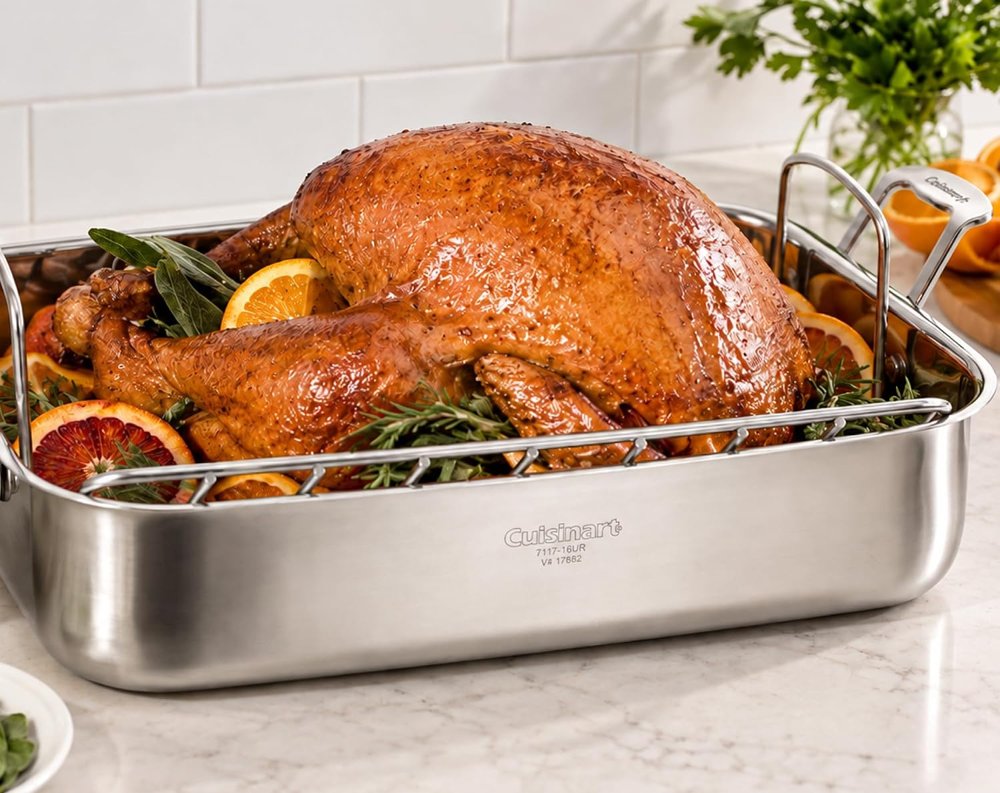
Best Open Roaster: Cuisinart 16" Stainless Steel Roasting Pan with Rack
 Best Open Roaster
A pan you will use for every roast, chicken and tray of vegetables, not just one Thursday a year.
Why it’s safe: Stainless steel pan and rack, with no nonstick coating and no plastic. Our stainless steel safety guide covers the details.
Check Today's Price on Amazon →Amazon prices change daily — tap to see today's price and any active discount.
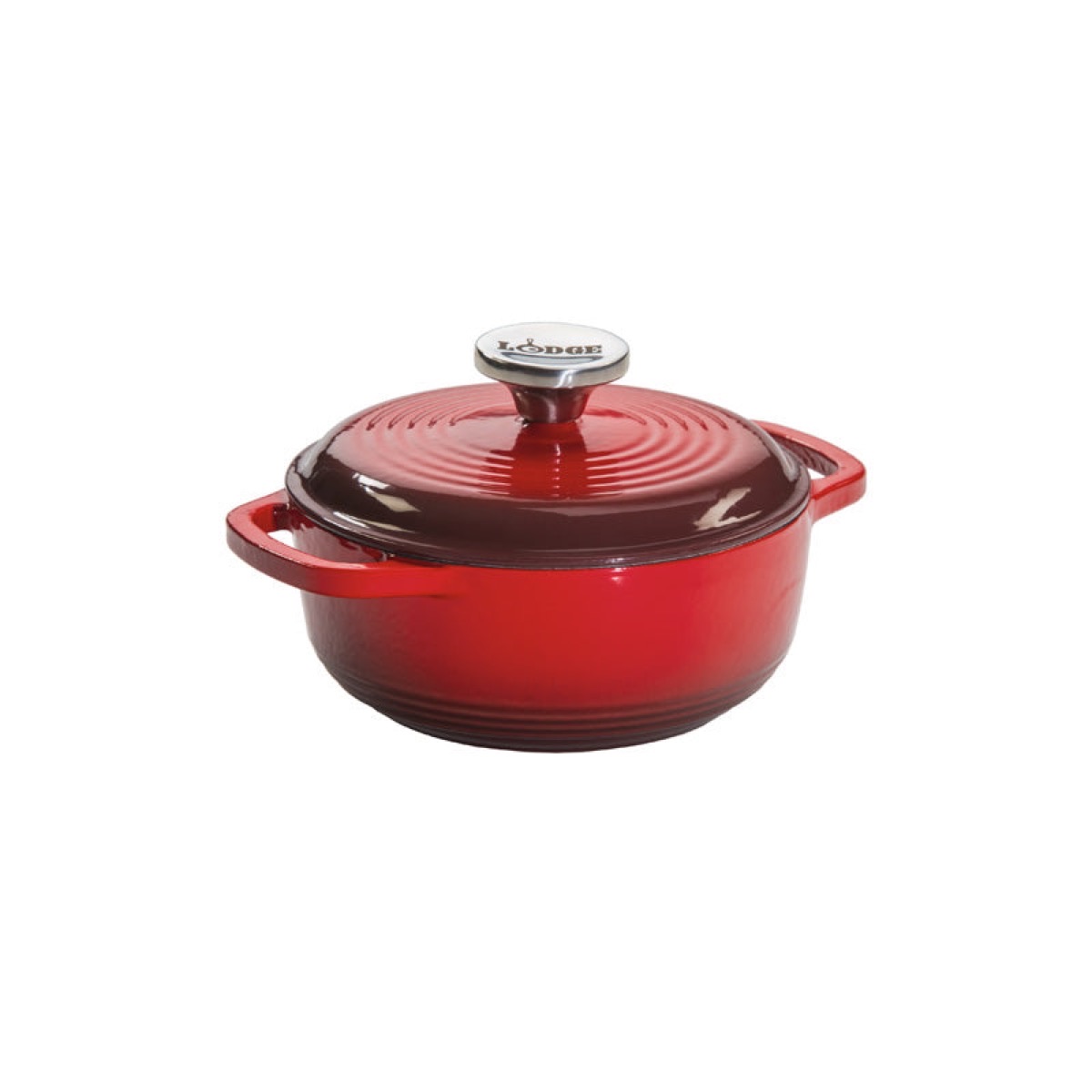
Best for a Turkey Breast or Chicken: Lodge Essential Enameled Cast Iron Dutch Oven
 Small Roasts
One pot that replaces oven bags for small roasts and handles soups, braises and bread all year.
Why it’s safe: Food touches glass-like enamel over cast iron, with no plastic and no nonstick coating.
Check Today's Price on Amazon →Amazon prices change daily — tap to see today's price and any active discount.
Rounding out a plastic-free holiday kitchen? The best non-toxic cookware guide ranks pots and pans by material, and our baking sheet picks cover the sides.
The bottom line: are oven bags safe?
Oven bags are safe in the narrow sense the label means: they are FDA-compliant nylon, they will not melt below 400°F, and no study has shown that eating a bag-roasted turkey makes anyone sick. They are not inert. Measured migration into roast chicken was 8.26 mg of nylon compounds per bag at 392°F, food-grade nylon sheds more than a trillion nanoparticles per liter of hot water, and the newest toxicity work from Lund University found that what nylon bags release becomes toxic in a standard screen only once it is heated. The health effect in people is unknown, and German regulators have called the missing toxicology data urgent.
So the practical answer is simple. If you already have a bag and Thanksgiving is next week, roast at 325–350°F, keep the bag off the oven walls, use a thermometer, and make gravy from separately roasted parts. If you are buying anything, buy a lidded roaster instead: it does the same job for every holiday that follows, with nothing plastic in the oven. The kitchen plastic detox guide ranks the rest of the swaps by impact, and our plastic wrap guide covers the leftovers.
Frequently Asked Questions
Most oven bags sold in the U.S., including Reynolds, are heat-resistant nylon (polyamide). Reynolds says its bags are FDA-compliant, BPA-free and safe to 400°F. Some bags sold elsewhere are PET, the plastic used in soda bottles; in a 2026 Chemosphere study, PET oven bags released far less material than nylon ones and showed no detectable toxicity.
Measurable amounts of nylon compounds do migrate. A 1998 Food Additives & Contaminants study found chicken roasted in a nylon bag at 200°C for two hours absorbed 7.48 micrograms per gram, or 8.26 mg per bag, mostly cyclic nylon oligomers. The authors judged this not to be a hazard; a 2018 German BfR study later said these oligomers urgently need toxicology data.
Food-grade nylon sheds plastic nanoparticles in hot water. A 2022 NIST study in Environmental Science & Technology measured more than a trillion particles per liter from single-use food-grade nylon, 7 times more than from LDPE-lined coffee cups, with most particles 30 to 80 nanometers across. That study tested nylon baking liners rather than turkey bags specifically.
Reynolds says never exceed 400°F (200°C), and never use a bag under a broiler, in a toaster oven or countertop roaster, or for boiling or sous vide. Lower is better: research from Lund University found heated nylon bags release more toxic material at higher temperatures, so 325–350°F is the gentler choice.
A lidded roaster, such as an enamel-on-steel oval roaster, traps steam around the bird the same way a bag does; take the lid off for the last 30 to 45 minutes to brown the skin. An open stainless roasting pan with the breast tented in foil also works. Both keep plastic out of the oven entirely.
Sources
- Gramshaw JW, Soto-Valdez H. “Migration from polyamide ‘microwave and roasting bags’ into roast chicken.” Food Additives & Contaminants, 1998;15(3):329–335, doi.org/10.1080/02652039809374648 (PubMed 9666892).
- Soto-Valdez H, Gramshaw JW, Vandenburg HJ. “Determination of potential migrants present in Nylon ‘microwave and roasting bags’ and migration into olive oil.” Food Additives & Contaminants, 1997;14(3):309–318, PubMed 9135729.
- Ekvall MT, Boo K, Lundqvist M, Cedervall T. “Temperature dependent leaching of substances from polyamide oven bags is toxic to zooplankton Daphnia magna.” Chemosphere, 2026;410:145032, doi.org/10.1016/j.chemosphere.2026.145032 (PubMed 42480496).
- Zangmeister CD, Radney JG, Benkstein KD, Kalanyan B. “Common Single-Use Consumer Plastic Products Release Trillions of Sub-100 nm Nanoparticles per Liter into Water during Normal Use.” Environmental Science & Technology, 2022;56(9):5448–5455, doi.org/10.1021/acs.est.1c06768 (PubMed 35441513). Summary: NIST, April 2022.
- Kappenstein O, Ebner I, Förster C, et al. “Validation and application of an LC-MS/MS method for the determination of cyclic oligomers originating from polyamide 6 and polyamide 66 in food simulant.” Food Additives & Contaminants: Part A, 2018;35(7):1410–1420, PubMed 29510082.
- Heimrich M, Bönsch M, Nickl H, Simat TJ. “Cyclic oligomers in polyamide for food contact material: quantification by HPLC-CLND and single-substance calibration.” Food Additives & Contaminants: Part A, 2012;29(5):846–860, PubMed 22329416.
- Reynolds Kitchens. “How Cooking in an Oven Bag Makes Delicious and Easy Meals,” reynoldsbrands.com. Manufacturer statements on material, 400°F maximum, flour and prohibited uses.
Get the rest of the plastic out of your kitchen
The oven bag is one swap. The Complete Plasticproof Guide covers every one that matters, room by room, with the research behind each.