In the lab, microplastics clearly can cause inflammation: cell and animal studies show particles trigger oxidative stress and switch on inflammatory pathways such as the NLRP3 inflammasome, which releases pro-inflammatory signals. In people, the evidence is newer and associational rather than proven. A 2024 study found that patients with microplastics in their artery plaque had higher inflammatory markers and more heart attacks and strokes, and people with inflammatory bowel disease carry more microplastics in their stool. What that adds up to in 2026 is a credible, actively studied link — not proof that everyday plastic exposure is causing chronic inflammatory disease in a given person. None of it is a reason to panic, but it does make a few focused swaps worthwhile: filtered water, no heating food in plastic, and less ultra-processed packaged food cut most of your controllable exposure.
"Microplastics and inflammation" is a fast-rising search, and for a fair reason: inflammation sits underneath so many modern health problems — heart disease, gut disorders, metabolic illness — that a brand-new, universal exposure feeding into it is a genuinely important question. It is also one of the easiest topics to over-read, because "can trigger inflammation in a dish" quietly becomes "is inflaming your body right now" as the claim travels across the internet.
This guide lays out what the science actually shows, and — just as importantly — what it does not. The goal is to separate the established findings (particles can set off oxidative stress and immune signalling in lab and animal models) from the still-emerging leap (that everyday plastic exposure is driving chronic inflammatory disease in people). It is the same evidence-first approach we take in microplastics and the immune system and microplastics and gut health, applied to inflammation itself.
The bottom line up front: the lab and animal evidence that microplastic particles can trigger inflammation is real and consistent, and the first human studies tying particles to inflammatory conditions are now appearing — but "microplastics are inflaming your body and making you sick" is not an established human fact. Because exposure is concentrated in a few predictable places — drinking water, heated or stored food in plastic, and processed packaged food — you can cut most of it with a short list of swaps, which we lay out below and in how to avoid microplastics.
Can microplastics cause inflammation?
In the lab, the answer is a fairly clear yes; in people, it is a careful "the evidence is building." Cell and animal studies repeatedly show that microplastic particles can set off oxidative stress and switch on the body's inflammatory machinery. The harder question — whether the particles most people carry are actually driving meaningful, chronic inflammation and disease — is exactly where the research is active and not yet settled.
That split matters, because inflammation is not one thing. A brief, local immune response to a splinter is healthy and self-limiting; the kind that worries people is low-grade, chronic inflammation, the slow background burn linked to heart disease, metabolic illness and gut disorders. Showing that a particle can provoke an immune reaction in a dish is real and important, but it is a different claim from showing that everyday exposure keeps a person's whole body inflamed for years. We take the same evidence-first view in microplastics and the immune system.
How would a plastic particle trigger inflammation?
The mechanism is actually well understood, because the body treats a microplastic particle the way it treats other foreign, insoluble particles like asbestos fibres or silica dust. Immune cells called macrophages try to engulf and clear it. Because a plastic particle cannot be broken down, that frustrated effort generates reactive oxygen species — oxidative stress — and triggers an internal alarm called the NLRP3 inflammasome, which releases pro-inflammatory cytokines such as IL-1β.
A 2023 review in Frontiers in Immunology lays out this pathway in detail, describing the NLRP3 inflammasome as a plausible sensor of micro- and nanoplastic immunotoxicity while noting that the studies pinning it down are still relatively few (Busch et al., Frontiers in Immunology, 2023). The World Health Organization reaches a similar, cautious conclusion: in its 2022 report it says the health effects of ingested particles are assumed, by analogy with other insoluble particles, to include oxidative stress and an inflammatory response — an assumption grounded in particle biology, not yet a demonstrated finding for plastics specifically (WHO, Dietary and inhalation exposure to nano- and microplastic particles, 2022).

What does the human evidence actually show?
This is where the story stopped being purely theoretical. Two lines of human research now connect microplastics to inflammation in real patients, and both are striking — but both are associations, which means they show a link without proving which way it runs.
The headline study came from the heart. Researchers examined the fatty plaque surgically removed from the carotid arteries of 257 patients and found microplastics and nanoplastics in a majority of them. Over the next 34 months, patients with particles in their plaque were far more likely to have a heart attack or stroke or to die — a hazard ratio of about 4.5 — and they also had higher levels of inflammatory markers in the plaque tissue (Marfella et al., New England Journal of Medicine, 2024). The gut tells a parallel story: a 2022 analysis found that people with inflammatory bowel disease had roughly 1.5 times more microplastics in their stool than healthy people, and those with more severe disease carried more particles (Yan et al., Environmental Science & Technology, 2022). You can read more on that in microplastics and gut health.
The honest caveat is the same for both. More particles could be inflaming the tissue — or already-inflamed, already-diseased tissue could simply trap and accumulate more particles. Observational studies like these cannot separate the two, which is why the researchers themselves call for the cause-and-effect work that has not yet been done.
Is microplastic inflammation a myth, or real?
Both, depending on exactly what is being claimed — and this is the distinction that most online coverage blurs. The myth is the confident, sweeping version: that microplastics are a proven, silent cause of the inflammation behind your fatigue, your aches or your diagnosis, and that your body is quietly on fire because of plastic. Nothing in the current science supports a claim that specific and that personal.
The real part is more measured and more interesting: particles demonstrably can trigger inflammatory pathways in the lab, the biological mechanism is plausible and well mapped, and the first human studies are finding particles exactly where chronic inflammatory disease lives — in artery plaque and in the inflamed gut. Holding both halves at once is the accurate position. The mechanism is credible; the proof that ordinary, real-world exposure causes chronic disease in humans is not yet in hand. Treat anyone selling certainty in either direction — "it's definitely poisoning you" or "it's completely harmless" — with the same skepticism. For the broader picture, see how dangerous are microplastics.
Be wary of products or posts that promise to "remove microplastics from your body," "reverse plastic-driven inflammation," or measure your "microplastic inflammation level." There is no validated test for that and no proven detox. The only evidence-based move is to lower your ongoing exposure — which costs little and carries no downside.
Who should pay the most attention?
If you already live with an inflammatory condition — inflammatory bowel disease, cardiovascular disease, an autoimmune disorder — or you are pregnant, the case for reducing exposure as a precaution is strongest. Not because the particles are proven to worsen your condition, but because the early human signals cluster in exactly these areas, and cutting a plausible trigger is a low-cost, low-risk addition on top of — never instead of — your medical care. (If you are pregnant, see microplastics during pregnancy.)
For everyone else, the takeaway is calmer: the same swaps that cut microplastics also push you toward an anti-inflammatory, whole-food way of living that is well supported on its own merits. The biggest difference between two similar people is usually habit, not luck — someone drinking bottled water, microwaving meals in plastic, and living on packaged food takes in far more than someone who has made a few swaps.
How to reduce your microplastic exposure
You cannot reach zero, and you do not need to. The aim is to remove the big, controllable exposures with changes that fit real life. Target your water, the way you heat and store food, and how processed your diet is — in that order — and you have covered most of what matters.
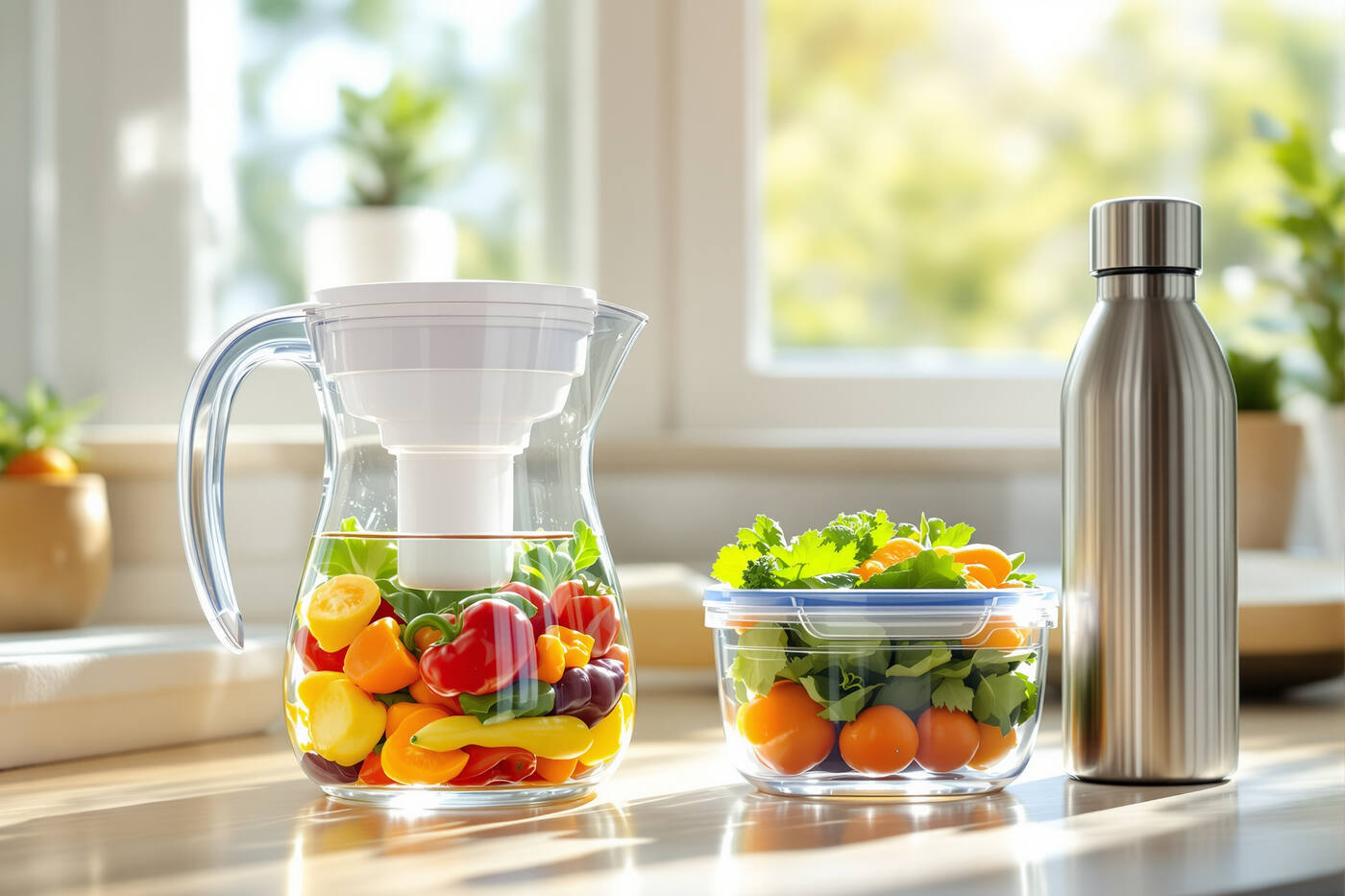
- Filter your tap water. A good filter beats bottled water, which carries its own particle load; start with the best water filters for microplastics and check whether your tap water is safe to drink.
- Never heat food in plastic. No microwaving plastic containers and no pouring boiling liquid into plastic — heat is what drives the most particle shedding and chemical leaching.
- Store food in glass, drink from steel or glass. Move leftovers into glass containers and switch to stainless steel bottles.
- Cut heavily processed, plastic-packaged food. Ultra-processed and plastic-wrapped foods are a leading dietary source of plastic particles and additives; see which foods have the most microplastics.
- Mind cans and "BPA-free" labels. Many can linings and receipts still carry bisphenols, and "BPA-free" often means BPS, which is not proven safer — and swap scratched nonstick for PFAS-free cookware.
The honest verdict
Microplastics and inflammation are genuinely connected in the science — and the two halves of that link stand on different footing. The lab and animal evidence that particles can trigger oxidative stress and inflammatory signalling is real and consistent; the human evidence is early, resting on associations between particles and inflammatory conditions that cannot yet prove cause. That combination argues for prudent, low-cost prevention now, not panic and not dismissal.
If you do just a few things, make them the highest-payoff ones: filtered water, no heating food in plastic, and glass or steel instead of plastic. They cut the exposure that actually reaches your body — and because they pull you toward cleaner, less-processed living, they are worth doing whether or not the inflammation link is ever proven to drive disease. For the full plan, see microplastics in the human body.
Cut the exposure you can actually control
You can't reach zero, but you can remove most of your everyday exposure. These guides show the swaps that matter most — starting with your water and your food storage.
Frequently Asked Questions
In the lab, yes: cell and animal studies consistently show that microplastic particles can trigger oxidative stress and switch on inflammatory pathways such as the NLRP3 inflammasome, prompting immune cells to release pro-inflammatory signals. In people, the evidence is newer. A 2024 study found that patients with microplastics and nanoplastics in their artery plaque had higher inflammatory markers and more heart attacks and strokes, and people with inflammatory bowel disease carry more microplastics in their stool. As of 2026 this shows a credible, actively studied link, not proof that everyday plastic exposure causes chronic inflammatory disease in a given person.
The body treats a microplastic particle the way it treats other foreign insoluble particles. Immune cells called macrophages try to engulf it, and because the particle cannot be broken down, that effort generates reactive oxygen species (oxidative stress) and activates the NLRP3 inflammasome, a sensor that releases pro-inflammatory cytokines such as IL-1 beta. The World Health Organization notes that the health effects of ingested particles are assumed, by analogy with other insoluble particles, to include this kind of oxidative and inflammatory response.
No, but it is often overstated. The myth is the claim that microplastics are proven to be silently inflaming everyone's body and causing specific diseases. The evidence is that particles can trigger inflammation in lab and animal models, and that early human studies show associations between particles and inflammatory conditions. Both halves are true at once: the biological plausibility is real, and the proof that everyday exposure causes chronic disease in humans is not yet established.
The research raises the question but does not answer it. People with inflammatory bowel disease were found to have about 1.5 times more microplastics in their stool than healthy people, and those with more severe symptoms had more particles, but this is an association that could run in either direction. In a 2024 study, people with microplastics in their artery plaque had a higher risk of heart attack, stroke or death. These findings justify reducing exposure as a precaution, especially if you already have an inflammatory condition, but they do not prove the particles cause the disease.
There is no human trial showing that cutting microplastic exposure measurably lowers inflammation, so no one can promise that result. What is reasonable is that lowering a plausible inflammatory trigger is a low-risk precaution, and the swaps that cut microplastics — filtered water instead of bottled, no heating food in plastic, glass and steel instead of plastic, less ultra-processed packaged food — also push you toward an anti-inflammatory, whole-food way of eating that is well supported on its own.
Focus on the biggest routes: filter your tap water instead of drinking bottled water, never microwave or store hot food in plastic, switch food storage to glass and drink from stainless steel or glass, and cut heavily processed, plastic-packaged foods. These few changes remove most of a person's controllable exposure without a plastic-free home.
Sources
- World Health Organization. "Dietary and inhalation exposure to nano- and microplastic particles and potential implications for human health," 2022, who.int. Concludes that nano- and microplastics are widespread in food, water and air, and that the health effects of ingested particles are assumed, by analogy with other insoluble particles, to include reactive-oxygen-species generation and an inflammatory response — while noting the available data are of limited use for a full risk assessment.
- Busch M, et al. "NLRP3 inflammasome as a sensor of micro- and nanoplastics immunotoxicity." Frontiers in Immunology, 2023, ncbi.nlm.nih.gov/pmc/articles/PMC10151538. Reviews how micro- and nanoplastic particles can activate the NLRP3 inflammasome and drive pro-inflammatory cytokine release, while noting that studies directly delineating this pathway remain relatively rare.
- Marfella R, et al. "Microplastics and Nanoplastics in Atheromas and Cardiovascular Events." New England Journal of Medicine, 2024;390:900–910, doi.org/10.1056/NEJMoa2309822. In 257 patients, those with microplastics and nanoplastics in carotid-artery plaque had about 4.5 times the risk of myocardial infarction, stroke or death over 34 months, along with higher inflammatory markers in plaque tissue — an association, not proof of causation.
- Yan Z, et al. "Analysis of Microplastics in Human Feces Reveals a Correlation between Fecal Microplastics and Inflammatory Bowel Disease Status." Environmental Science & Technology, 2022;56(1):414–421, doi.org/10.1021/acs.est.1c03924. People with inflammatory bowel disease had roughly 1.5 times more fecal microplastics than healthy people, with higher levels in those with more severe disease; the authors do not claim causation.
- Hirt N, Body-Malapel M. "Immunotoxicity and intestinal effects of nano- and microplastics: a review of the literature." Particle and Fibre Toxicology, 2020;17:57, ncbi.nlm.nih.gov/pmc/articles/PMC7661204. Reviews animal studies showing nano- and microplastics can impair the gut's oxidative and inflammatory balance, disrupt epithelial permeability and alter the microbiota, while noting that human-relevant evidence is still scarce.