
Microplastics are inhaled and have been found deep in human lung tissue, and occupational and animal studies link them to airway inflammation — but there is no proof that everyday household exposure causes asthma. The strongest human evidence comes from synthetic-textile workers, who have long been known to develop airway inflammation and reduced lung function at high exposure. Animal studies show microplastics can worsen allergic airway inflammation, and decades of air-pollution research show inhaled particles aggravate asthma in general. What that adds up to in 2026 is a credible, actively studied link — not proof that plastic particles are triggering asthma in a given person. None of it is a reason to panic, but it does make a few focused changes worthwhile: a true-HEPA air purifier in the bedroom, fewer synthetic textiles, and regular vacuuming cut most of your controllable airborne exposure.
"Microplastics and asthma" is a fast-rising search, and for a fair reason: asthma affects hundreds of millions of people, it is driven in part by what we breathe, and a brand-new, near-universal airborne exposure feeding into it is a genuinely important question. It is also one of the easiest topics to over-read, because "worsens airway inflammation in mice" quietly becomes "microplastics are giving you asthma" as the claim travels across the internet.
This guide lays out what the science actually shows, and — just as importantly — what it does not. The goal is to separate the established findings (particles are inhaled, reach the lungs, and harm the airways at high occupational doses) from the still-emerging leap (that ordinary household exposure causes or worsens asthma in the general population). It is the same evidence-first approach we take in microplastics in the lungs and microplastics and the immune system, applied to asthma itself.
The bottom line up front: the evidence that microplastics are inhaled and reach the lungs is solid, the occupational evidence that high-dose fibre exposure harms the airways is real, and animal studies that particles worsen asthma-like inflammation are consistent — but "microplastics are causing your asthma" is not an established human fact. Because most inhaled particles come from indoor air, you can cut a lot of your exposure with a short list of changes, which we lay out below and in how to avoid microplastics.
Can microplastics cause or worsen asthma?
There is no proof that everyday microplastic exposure causes asthma, and anyone who tells you otherwise is ahead of the science. What the evidence does support is narrower and still worth taking seriously: the particles are inhaled, they reach and lodge in the lungs, high-dose exposure in certain workplaces clearly harms the airways, and in animals microplastics can make asthma-like inflammation worse. That is a plausible, actively studied link — not a demonstrated cause of the asthma people develop at home.
The distinction matters, because "asthma" and "airway irritation" are not the same claim. Showing that a particle inflames an animal's airways, or that factory workers breathing clouds of synthetic fibre develop lung disease, is real and important — but it is a different thing from showing that the much lower levels in an ordinary living room cause or trigger asthma in the general population. We take the same evidence-first view in microplastics in the lungs.
How do microplastics get into your lungs?
You breathe them in. Synthetic clothing, carpets, upholstery and even the dust on your shelves constantly shed tiny plastic fibres, and those fibres become airborne. Indoor air generally carries more of them than outdoor air, because a home is an enclosed box full of plastic textiles — which is exactly where most people spend most of their time. Air sampled at the breathing zone, right where you actually draw breath, confirms the particles are in the air you take in (Vianello et al., Environment International, 2019).
Those inhaled particles do not just pass through. In 2021, researchers recovered microplastics from human lung tissue taken during surgery (Amato-Lourenço et al., Journal of Hazardous Materials, 2021), and in 2022 a UK team found microplastics in 11 of 13 lung-tissue samples, including in the deep lower regions of the lung where the airways are smallest and most delicate (Jenner et al., Science of the Total Environment, 2022). That is the pivotal point for asthma: the particles are not a theoretical exposure — they physically reach the parts of the lung where asthma lives. For more on where that household air load comes from, see microplastics in indoor air and microplastics in household dust.

What does the research actually show about airways?
Three strands of evidence point the same direction without closing the case. The first and strongest is occupational. Long before "microplastics" was a household word, doctors documented that workers in synthetic-textile and flocking plants — breathing high concentrations of nylon, polyester and acrylic fibre — developed coughing, breathlessness, reduced lung function and airway inflammation. A 2018 review of airborne microplastics pulled this history together, concluding that inhaled plastic fibres can provoke airway and interstitial inflammatory responses, and that susceptible individuals may be most at risk (Prata, Environmental Pollution, 2018).
The second strand is mechanistic. The World Health Organization's 2022 review concluded that the health effects of inhaled particles are assumed, by analogy with other insoluble particles, to include oxidative stress and an inflammatory response in the airways — biologically plausible, but not yet demonstrated for plastics at real-world doses (WHO, 2022). The third strand is animal work: controlled studies find that polystyrene and fibrous microplastics can intensify allergic airway inflammation, mucus production and airway hyperresponsiveness in mice — the hallmarks of asthma — with the effect strongest for smaller particles and when combined with a known allergen. Those are deliberately high exposures in a dish or a mouse, not proof for a person, but they are consistent and they move in one direction.
Does air pollution context make the asthma concern credible?
It does, and this is the most grounded way to think about it. We already know, from decades of air-quality research, that inhaling fine particulate matter aggravates asthma: the US Environmental Protection Agency lists worsened asthma, more attacks and reduced lung function among the documented effects of breathing airborne particles (US EPA, Particulate Matter Pollution). Microplastics are simply another kind of inhalable particle — often fibrous, sometimes carrying chemical additives — added on top of that established burden.
That framing keeps the claim honest in both directions. It is credible that airborne microplastics contribute to the particle load the airways have to cope with, because that is exactly what particles do. It is not established that microplastics specifically are a major, independent driver of asthma, because no study has isolated them from everything else in the air and measured their effect in people. The right conclusion is neither "plastic is giving everyone asthma" nor "it's irrelevant" — it is that reducing airborne particles is sensible, and microplastics are part of what you reduce.
Be wary of products or posts that promise to "detox microplastics from your lungs," "reverse plastic-driven asthma," or measure your personal "lung microplastic level." There is no validated test for that and no proven detox. If you have asthma, your inhaler, your action plan and your doctor come first — cutting airborne exposure is a low-cost addition on top of real treatment, never a replacement for it.
Who should pay the most attention?
If you already have asthma, COPD or another chronic airway condition — or you are caring for a child with asthma — the case for lowering airborne exposure is strongest. Not because the particles are proven to worsen your condition, but because the early signals cluster in exactly the airways you are already protecting, and reducing a plausible irritant is a low-cost, low-risk addition to your care. Children matter especially: they breathe faster, spend more time close to the floor where dust settles, and have developing airways, which is why the broader picture in microplastics and the immune system is worth reading too.
People with heavy indoor exposure — a home full of synthetic carpet and upholstery, a lot of drying synthetic laundry, or a dusty workspace — also have more to gain from a few changes. The biggest difference between two otherwise similar homes is usually ventilation and textiles, not luck: a well-aired home with a running air purifier and mostly natural fibres carries a far lighter airborne particle load than a sealed, synthetic, rarely-vacuumed one.
How can you reduce airborne microplastic exposure at home?
You cannot reach zero, and you do not need to. The aim is to cut the big, controllable part of what you breathe, with changes that fit real life. Because most inhaled particles come from indoor air, start there — then handle the particles you swallow as a second front.
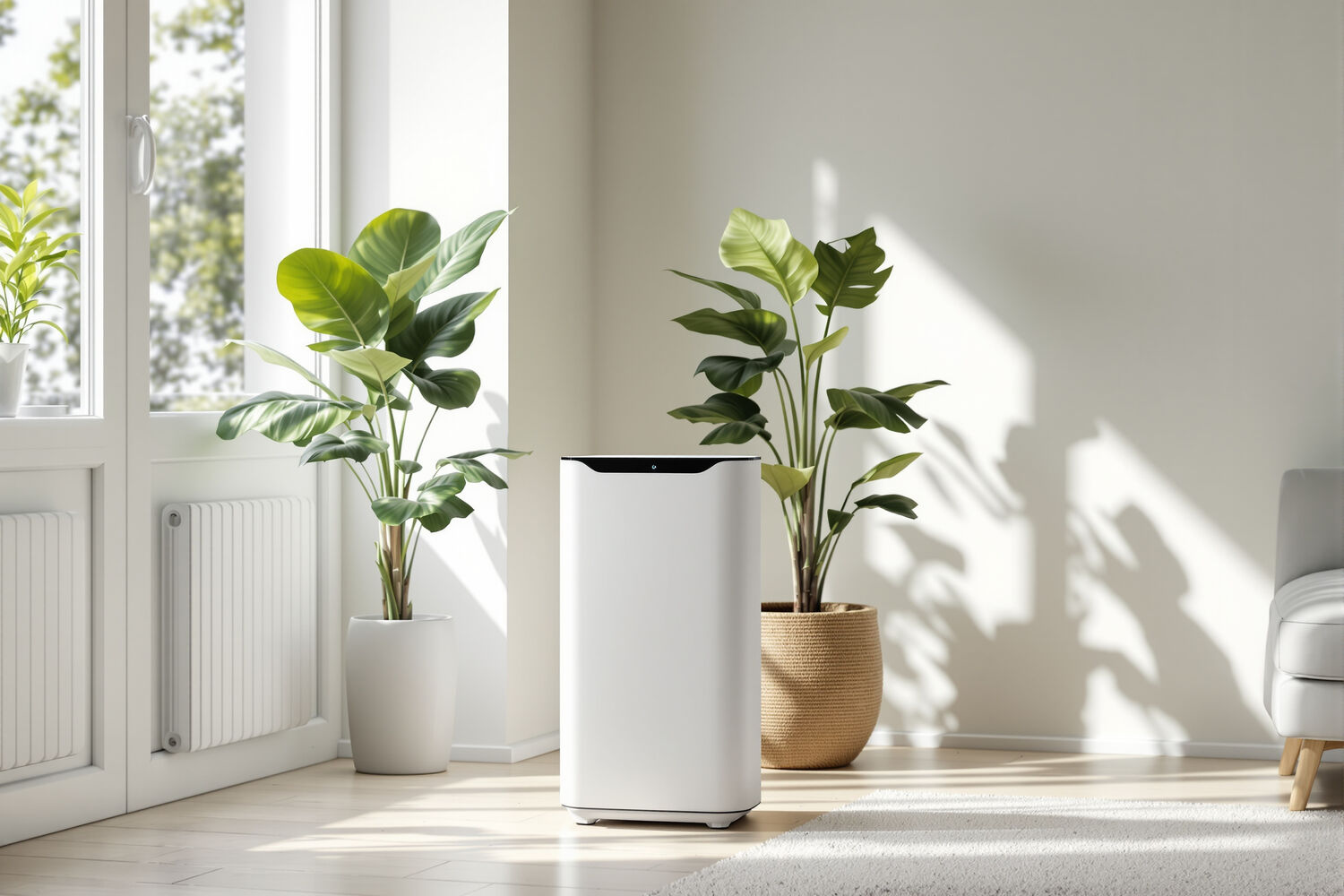
- Run a true-HEPA air purifier where you sleep. Airborne microplastic fibres sit in the size range HEPA is built to capture, and the same filter removes the pollen, dust and dander that trigger asthma; see the best air purifiers for allergies and for dust.
- Vacuum and damp-dust regularly. Use a vacuum with a HEPA filter and wipe surfaces with a damp cloth rather than dry-dusting, which just launches particles back into the air — the mechanics are covered in microplastics in household dust.
- Favour natural fibres over synthetics. Cotton, wool and linen clothing, bedding and rugs shed far less plastic fibre than polyester and acrylic; see microplastics in clothing and the best organic alternatives.
- Ventilate, especially when it is dusty. Open windows when you vacuum, cook or dry laundry indoors; fresh air dilutes the particle load the fastest and costs nothing.
- Handle the particles you swallow too. Filter your tap water with one of the best water filters for microplastics, don't heat food in plastic, and store food in glass — the full plan is in how to avoid microplastics.
The honest verdict
Microplastics and asthma are genuinely connected in the science — and the pieces of that link stand on different footing. That the particles are inhaled and reach deep lung tissue is well established; that high-dose occupational fibre exposure harms the airways is well documented; that microplastics worsen asthma-like inflammation in animals is consistent. What is not established is that ordinary household exposure causes or meaningfully worsens asthma in the general population. That combination argues for prudent, low-cost prevention now, not panic and not dismissal.
If you do just a few things, make them the highest-payoff ones: a true-HEPA purifier in the bedroom, fewer synthetic textiles, and regular vacuuming and ventilation. They cut the airborne particles that actually reach your lungs — and because they also remove ordinary asthma triggers like pollen, dust and dander, they are worth doing whether or not the microplastic link is ever proven to drive disease. For the full picture, see microplastics in the human body.
Clear the air you actually breathe
You can't reach zero, but you can remove most of your indoor airborne exposure. These guides show the devices and swaps that matter most — starting with your bedroom air and your textiles.
Frequently Asked Questions
There is no proof that everyday microplastic exposure causes asthma in the general population. What the evidence does show is biologically plausible and worth taking seriously: airborne microplastics are inhaled, they have been found deep in human lung tissue, and the strongest human signal comes from workers in synthetic-textile factories, who have long been known to develop airway inflammation and reduced lung function. Animal studies show microplastics can worsen allergic airway inflammation. As of 2026 that adds up to a credible, actively studied link, not established proof that plastic particles trigger asthma in a given person.
You inhale them. Microplastics shed from synthetic clothing, carpets, upholstery and dust become airborne, and indoor air generally carries more of these fibres than outdoor air because homes are enclosed and full of plastic textiles. Measurements taken at the breathing zone confirm the particles are present in the air we actually take in, and researchers have since recovered microplastics from human lung tissue, including from the deep lower lung, showing that inhaled particles reach and lodge in the airways.
Possibly, and this is where the concern is most reasonable. Decades of air-pollution research show that inhaled particulate matter aggravates asthma, and microplastics are a type of inhalable particle. Animal studies find that polystyrene and fibrous microplastics can intensify allergic airway inflammation, mucus production and airway hyperresponsiveness, especially with smaller particles or alongside other allergens. These are animal doses, not proof for humans, but they justify reducing exposure as a precaution if you already have asthma.
Both, depending on the claim. The hype is that microplastics are a proven, hidden cause of modern asthma. Nothing in the current science supports a claim that specific. The real part is that particles are inhaled and reach the lungs, the mechanism for airway inflammation is plausible, occupational studies show high-dose exposure harms the airways, and animal work shows worsening of asthma-like inflammation. The mechanism is credible; proof that ordinary household exposure causes or worsens asthma in people is not yet established.
A true-HEPA air purifier is the single most useful device, because airborne microplastic fibres fall in the particle-size range a HEPA filter is built to capture, and the same filtration also removes the pollen, dust and dander that trigger asthma. Pair it with simple habits: vacuum with a HEPA vacuum, cut synthetic textiles and soft furnishings where you can, ventilate when cooking, and keep humidity moderate. None of this needs to be extreme to meaningfully lower the particle load in the room you spend the most time in.
Focus on indoor air, where most inhaled particles come from: run a true-HEPA air purifier in your bedroom, vacuum and damp-dust regularly, choose natural-fibre clothing and bedding over synthetics, and ventilate the home. Because you also swallow microplastics, filter your tap water, avoid heating food in plastic, and store food in glass. These few changes remove most of a person's controllable exposure without a plastic-free home.
Sources
- World Health Organization. "Dietary and inhalation exposure to nano- and microplastic particles and potential implications for human health," 2022, who.int. Concludes that nano- and microplastics are widespread in air, water and food, and that the health effects of inhaled particles are assumed, by analogy with other insoluble particles, to include oxidative stress and an inflammatory response in the airways — while noting the available data are of limited use for a full risk assessment.
- Prata JC. "Airborne microplastics: Consequences to human health?" Environmental Pollution, 2018;234:115–126, pubmed.ncbi.nlm.nih.gov/29172041. Reviews the respiratory evidence, noting that workers exposed to high levels of airborne synthetic fibres developed dyspnoea from airway and interstitial inflammatory responses, and that susceptible individuals may be most at risk even at lower environmental concentrations.
- Jenner LC, et al. "Detection of microplastics in human lung tissue using μFTIR spectroscopy." Science of the Total Environment, 2022;831:154907, doi.org/10.1016/j.scitotenv.2022.154907. Found microplastics in 11 of 13 human lung-tissue samples, including polypropylene and PET fibres in the lower regions of the lung, confirming that inhaled particles reach deep lung tissue.
- Amato-Lourenço LF, et al. "Presence of airborne microplastics in human lung tissue." Journal of Hazardous Materials, 2021;416:126124, pubmed.ncbi.nlm.nih.gov/34492918. Detected microplastic particles and fibres in human lung-tissue samples obtained during surgery, demonstrating that inhaled microplastics lodge in the respiratory tract.
- Vianello A, et al. "Simulating human exposure to indoor airborne microplastics using a Breathing Thermal Manikin." Environment International, 2019;130:104883, doi.org/10.1016/j.envint.2019.105314. Measured microplastics in the breathing zone of indoor air, showing that people inhale airborne microplastic particles in ordinary indoor settings.
- US Environmental Protection Agency. "Health and Environmental Effects of Particulate Matter (PM)," epa.gov. Documents that inhaling fine particulate matter aggravates asthma, triggers attacks and reduces lung function — the established air-pollution context into which airborne microplastics add another inhalable particle.