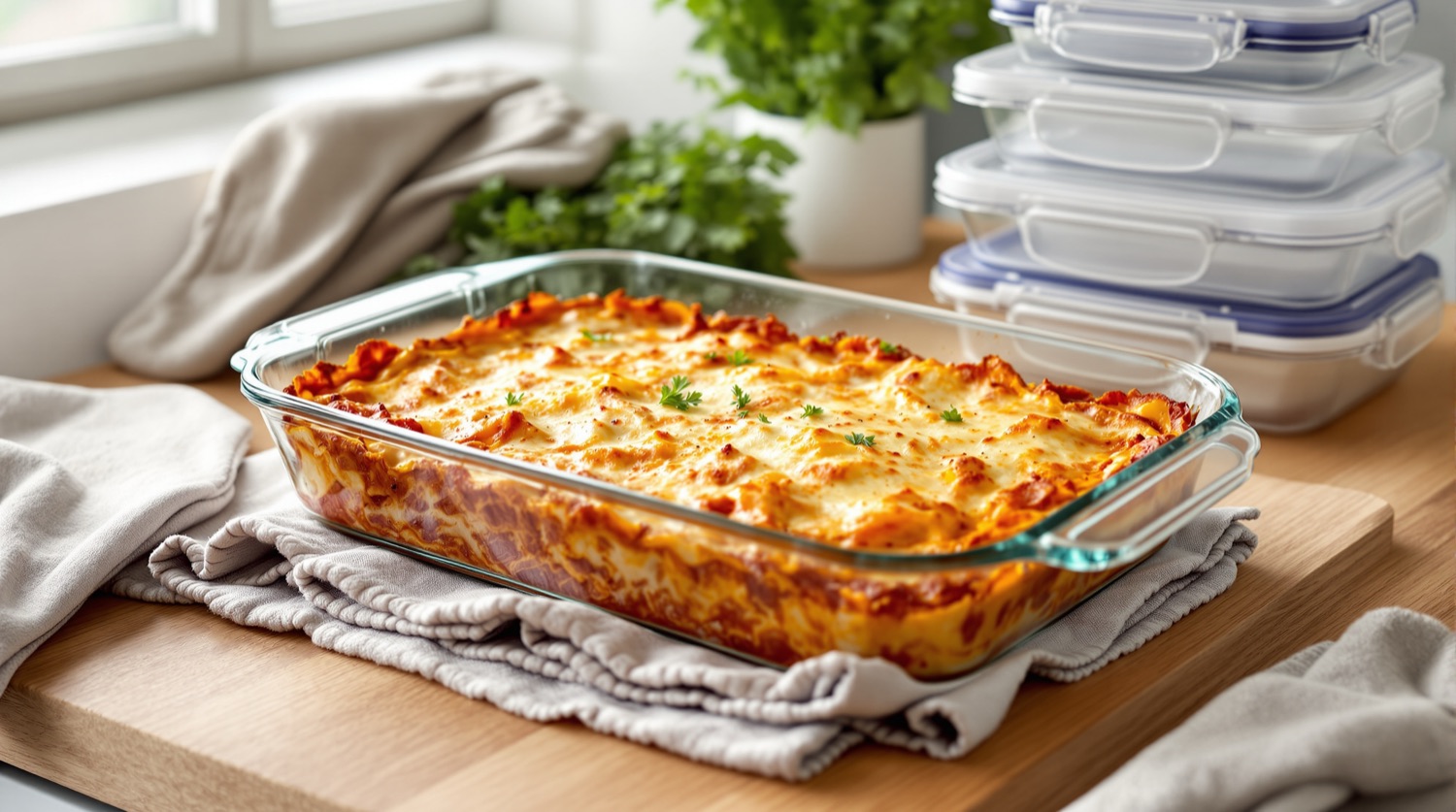
Pyrex glass is food-safe: glass is inert, contains no BPA or plastic, and sheds no microplastics into food. The real risks are physical and plastic. U.S. Pyrex bakeware is tempered soda-lime glass, which a 2012 American Ceramic Society Bulletin analysis (Bradt and Martens) found can handle a sudden temperature swing of only about 55°C (99°F), versus about 183°C (330°F) for borosilicate glass, so it can shatter if you move it hot onto a wet or cold surface. And the plastic storage lids should stay away from heat: a 2023 Environmental Science & Technology study measured more than 4 million microplastic and 2 billion nanoplastic particles per square centimeter released when plastic containers were microwaved for three minutes.
If you have been swapping plastic containers for glass, Pyrex is probably already in your cupboard. It is cheap, it is everywhere, and it is the brand most people mean when they say “glass dish.” Then you hear that Pyrex “explodes,” that the lids are plastic anyway, or that old patterned Pyrex has lead in the paint, and it is hard to tell which of those worries are real.
This guide sorts them out with the actual sources: Consumer Reports’ shatter tests, the materials-science paper that explains why they happened, Pyrex’s own use-and-care rules, the University of Nebraska study on heated plastic containers, and a peer-reviewed study on lead in decorated glassware. Each section starts with a short answer, then the evidence, then what to do about it.
Pyrex safety at a glance
| Part | Material | The concern | What the evidence shows | What to do |
|---|---|---|---|---|
| Clear glass dish or container | Tempered soda-lime glass (U.S. Pyrex) | Chemicals or plastic leaching | Glass is inert; no plastic, no BPA, nothing to shed | Use freely for storing, reheating and baking |
| Same glass, under heat | Tempered soda-lime glass | Shattering from a sudden temperature change | Tolerates a swing of about 55°C (99°F) vs about 183°C (330°F) for borosilicate (Bradt & Martens, 2012) | Preheat the oven, set hot dishes on a dry towel or rack, never on a wet or cold surface |
| Storage lids | BPA-free plastic (resin not named by Pyrex) | Micro- and nanoplastics when heated | Plastic containers microwaved 3 minutes released 4M+ micro and 2B+ nanoplastic particles per cm² (Hussain et al., 2023) | Take the lid off to heat; cool food before lidding |
| Painted vintage pieces | Enamel decoration on the outside | Lead and cadmium in the paint | 52 of 72 decorated glass products tested positive for lead (Turner, 2018); Pyrex not tested specifically | Keep decorated vintage pieces for display or dry goods |
Is Pyrex glass toxic?
The glass is not toxic. Glass is chemically inert at kitchen temperatures: it does not contain plastic, it has no BPA or phthalates to migrate, and it does not shed particles into food when you heat it, scrub it or run it through the dishwasher. That is exactly why glass is the standard swap we recommend in our guide to microwaving Tupperware and in the glass vs plastic food storage comparison.
The concern people have about plastic containers — that heat, fat and acid pull particles and additives into food — simply does not apply to the glass part of a Pyrex dish. Storing tomato sauce, reheating leftovers or baking a casserole in clear Pyrex glass puts nothing from the dish into your food. Every real risk with Pyrex comes from somewhere else: the way the glass breaks, the lid, or paint on old decorated pieces.
Why does Pyrex shatter?
U.S. Pyrex bakeware is made of tempered soda-lime glass, and soda-lime glass tolerates sudden temperature changes far less well than the borosilicate glass Pyrex was originally known for. Consumer Reports reported that Pyrex and Anchor Hocking bakeware sold in the United States had moved to soda-lime glass, which is cheaper to produce, while the European-made glass it tested was borosilicate. It also noted that it is not clear exactly when the switch happened.
In tests published in December 2010, Consumer Reports filled glass baking dishes with dry sand, heated them in the oven, then set each hot dish on a wet granite countertop. Ten out of ten times, the soda-lime glass broke after baking at 450 degrees. The borosilicate dishes did not break at 450, though most did after baking at 500. Consumer Reports also reviewed 163 reports of glass bakeware shattering, 152 of them from Consumer Product Safety Commission files, including 42 reports of injuries ranging from minor burns and cuts to surgery.
That test was deliberately harsh — sand gets hotter than food, and a wet stone counter is the worst place to set hot glass — and Consumer Reports said so. The U.S. makers’ reply was that soda-lime glass has its own advantage: it is less likely to break when it is dropped or bumped.
A 2012 paper explains the physics. In “Shattering Glass Cookware,” published in the Bulletin of the American Ceramic Society, materials scientists R.C. Bradt and R.L. Martens calculated how big a sudden temperature difference each glass can take before it cracks. As summarized by the American Ceramic Society, tempered soda-lime glass resists fracture only for temperature differences of less than about 55°C (99°F), while borosilicate glass holds up to about 183°C (330°F) — a three-fold difference. None of their calculations suggested soda-lime cookware would likely survive rapid exposure to boiling water, and they described its margin of safety against thermal-stress failure as “borderline.”
| Measure | Tempered soda-lime glass (U.S. Pyrex) | Borosilicate glass | Source |
|---|---|---|---|
| Sudden temperature change it can take | About 55°C (99°F) | About 183°C (330°F) | Bradt & Martens, 2012 |
| Baked at 450°, set on wet granite | Broke 10 out of 10 times | Did not break | Consumer Reports, 2010 |
| Baked at 500°, set on wet granite | — | Most broke | Consumer Reports, 2010 |
| Resistance to drops and bumps | Better, per the U.S. makers | — | Manufacturer statement reported by Consumer Reports |
None of this makes the glass toxic. Shattering is a burn-and-cut risk, not a chemical one, and it is almost entirely about how the dish is handled. The rules in the safe-use section below are the ones Pyrex itself prints.
Taking a hot dish out of the oven and setting it on a wet counter, a cold stone surface, a metal sink or a stovetop burner. Put it on a dry cloth, a cooling rack or a wooden board instead, and never pour cold liquid into hot glass.
Are Pyrex plastic lids safe?
The lids are safe for cold storage, but they are the one part of a Pyrex storage set that is plastic, so they should not be heated with your food. Pyrex describes its storage lids as BPA-free plastic but does not name the resin. Its safety and usage page says plastic lids must never go in a conventional or convection oven, and that in the microwave they should be removed or vented at least a quarter inch.
BPA-free is not the same as particle-free. In a 2023 study in Environmental Science & Technology, University of Nebraska–Lincoln engineers led by Kazi Albab Hussain microwaved two polypropylene baby-food containers and a polyethylene reusable pouch at full power for three minutes in a 1,000-watt microwave. They measured more than 2 billion nanoplastics and 4 million microplastics for every square centimeter of container. When the team exposed cultured embryonic kidney cells to those particles at the highest concentrations, about three-quarters of the cells had died after two days.
That is a lab study of different containers, and it does not tell us what happens to people. The researchers said as much. But it is the clearest measurement we have of what heat does to food-contact plastic, and there is no reason to put a plastic lid through it when the glass underneath does not need it. Our own rule is stricter than the label: take the lid off to heat, and cover the dish with a plate or a paper towel instead. The BPA-free explainer covers why the label alone is not reassuring.
Does vintage Pyrex have lead?
Clear vintage Pyrex is plain glass, but the painted, patterned pieces collectors love are decorated with enamel on the outside, and enamel decorations on glassware are where lead and cadmium have been found. No peer-reviewed study we could find has tested vintage Pyrex specifically, so the honest answer is that painted pieces are unknown, not proven contaminated.
The closest real evidence is a study of decorated drinking glasses by Andrew Turner at the University of Plymouth, published in Science of the Total Environment in 2018. Across 197 tests on 72 new and second-hand decorated glass products, lead turned up in 52 of the 72 and cadmium in 51. Lead concentrations ran from about 40 to 400,000 parts per million, sometimes more than 1,000 times the limit level, and paint flaked off in tests that simulated sustained use.
The painted surface on a casserole dish is on the outside, away from the food, so the main exposure route is worn paint flaking onto hands, counters or food over years of use. If you own patterned vintage Pyrex, the cautious move is simple: use it for display or dry goods, and use plain clear glass for cooking and leftovers.
How do you use Pyrex safely?
Almost every Pyrex problem is preventable with a handful of habits, most of them straight from Pyrex’s own instructions and Consumer Reports’ safety tips.
- Avoid sudden temperature changes. Pyrex’s first rule. Do not move a dish straight from the freezer to the oven, and do not add cold liquid to hot glass.
- Preheat the oven first. Pyrex says to preheat before putting glassware in, so the dish never sits through the element’s initial blast of heat.
- Never use it on direct heat. No stovetop, broiler, grill or toaster oven, and no countertop appliances such as multi-cookers, per Pyrex.
- Set hot glass on a dry surface. A dry towel, cooling rack or wooden board — never a wet counter, cold stone or metal sink.
- Cover the bottom with liquid when roasting meat or vegetables, as Consumer Reports advises, so the glass is not heated empty.
- Take the plastic lid off to heat. Pyrex allows a vented lid in the microwave; we recommend no plastic lid at all, and never in the oven.
- Retire chipped, cracked or deeply scratched dishes. Damage concentrates stress and makes a break more likely.
- Keep painted vintage pieces off food duty. Display them or use them for dry storage.
What should you store and reheat food in?
Clear glass is still the best everyday choice; the picks below differ mainly in their lids. All three have real product photos and tracked links, and we earn a commission if you buy, at no cost to you.
Best Everyday Glass: Pyrex Simply Store Glass Containers
 Best Everyday Glass
Swap a cupboard of plastic tubs for glass in one order, at the lowest price of any brand-name glass set.
Why it’s safe: Food touches glass, not plastic. Heat it with the lid off and nothing sheds into your food.
Check Today's Price on Amazon →Amazon prices change daily — tap to see today's price and any active discount.
Best Leak-Proof Seal: Glasslock Oven Safe Container Set (3-Pack)
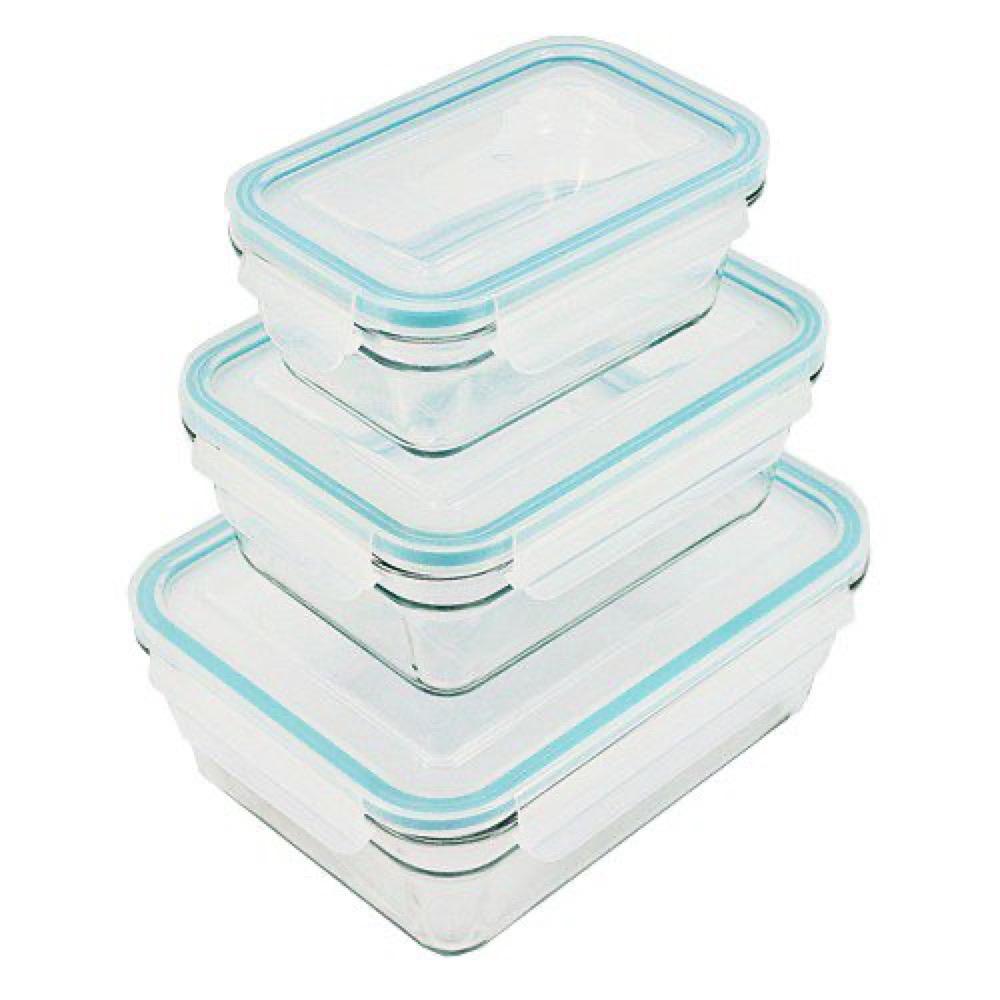 Best Leak-Proof Seal
Lunches and soups that do not leak in a bag, on glass instead of plastic.
Why it’s safe: The food-contact body is tempered glass; the gasket only seals the rim.
Check Today's Price on Amazon →Amazon prices change daily — tap to see today's price and any active discount.
Zero Plastic Anywhere: Weck 742 Mold Jars (Set of 6)
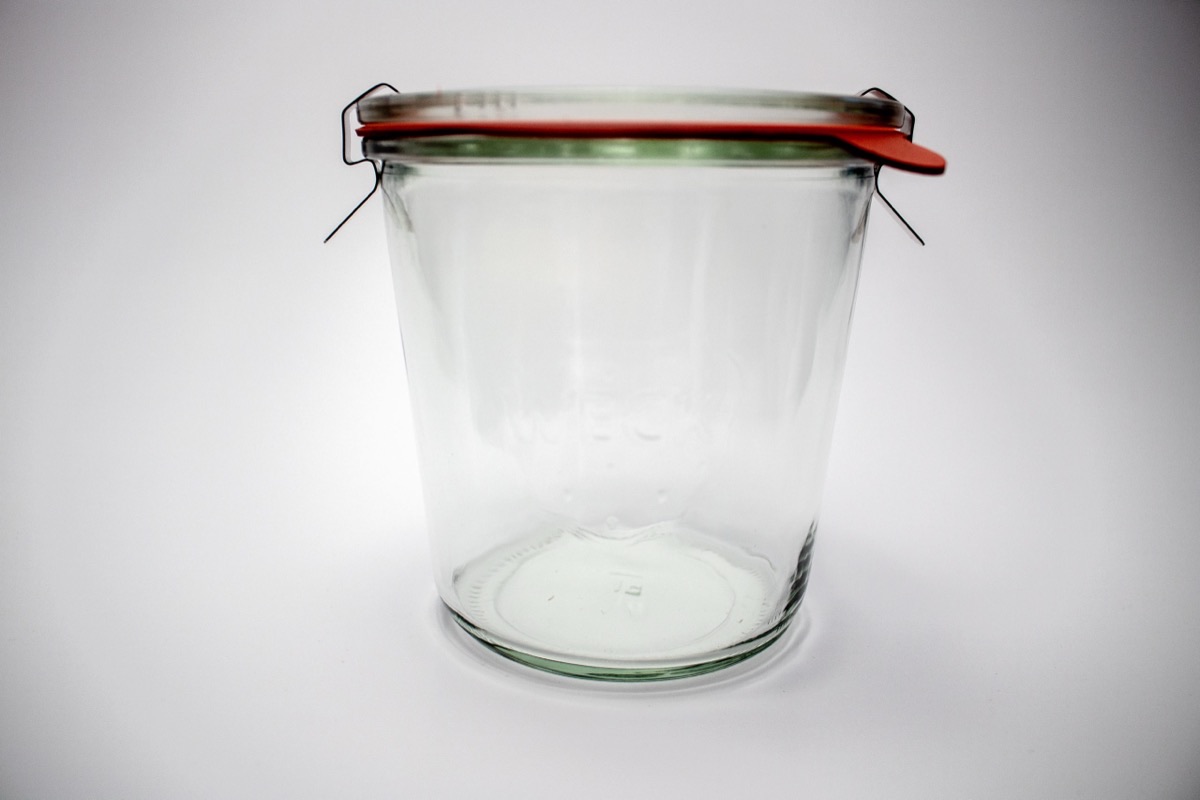 Zero Plastic
Store and reheat with no plastic anywhere in the container — not even the lid.
Why it’s safe: Glass on glass, with a replaceable rubber ring as the only other material touching the rim.
Check Today's Price on Amazon →Amazon prices change daily — tap to see today's price and any active discount.
For a full ranking of glass storage sets, including borosilicate options, see our best glass food storage containers guide, and for every material compared side by side, the best non-toxic food storage containers roundup.
The bottom line: is Pyrex safe?
Yes for your food, with two habits attached. The glass in a Pyrex dish is inert and puts nothing into what you eat, which makes it one of the safest ways to store, reheat and bake. U.S. Pyrex is tempered soda-lime glass, so it tolerates sudden temperature swings far less well than borosilicate — about 55°C versus 183°C by Bradt and Martens’ numbers — and the fix is to preheat, avoid direct heat and set hot glass on something dry. The plastic lids are fine in the fridge and should stay out of the oven and, by our standard, out of the microwave. Painted vintage pieces are best kept for display.
If you are working through the rest of the kitchen, the kitchen plastic detox guide ranks the swaps by impact, and our silicone safety guide covers the other material most glass sets are sealed with.
Frequently Asked Questions
The glass is microwave-safe and releases nothing into food. Pyrex says its plastic lids can be used in the microwave if vented at least a quarter inch, but a 2023 Environmental Science & Technology study found that microwaved plastic containers released billions of nanoplastic particles per square centimeter, so we recommend taking the lid off and covering the dish with a plate or paper towel. Pyrex also warns against heating empty glassware.
Pyrex bakeware sold in the United States is tempered soda-lime glass, according to Consumer Reports, which also found the European-made glass it tested was borosilicate. Consumer Reports said it is not clear exactly when the U.S. switch happened. If you want borosilicate, check that the product listing says borosilicate rather than assuming from the brand name.
Pyrex’s own instructions say to avoid sudden temperature changes and to preheat the oven before putting glassware in. A 2012 analysis by Bradt and Martens found tempered soda-lime glass resists fracture only for sudden temperature differences under about 55°C (99°F). The safe habit is to let a cold dish sit on the counter for a while and always put it into a fully preheated oven, never straight from the freezer.
Clear Pyrex glass is not a known source of lead. The concern is painted or patterned vintage pieces, because enamel decorations on glassware have been found to contain lead: a 2018 Science of the Total Environment study found lead in 52 of 72 decorated glass products. That study did not test Pyrex specifically, so keep decorated vintage pieces for display or dry goods to be safe.
Almost always a sudden temperature change, such as setting a hot dish on a wet counter, adding cold liquid to hot glass, or using it on a stovetop or under a broiler. In Consumer Reports tests, soda-lime glass baked at 450 degrees and set on a wet granite counter broke ten out of ten times. Chips and deep scratches make a break more likely, so retire damaged dishes.
Sources
- Consumer Reports. “Hot glassware can shatter unexpectedly,” press release, December 7, 2010, consumerreports.org. Sand-filled dishes baked and set on wet granite; soda-lime glass broke 10 of 10 times at 450 degrees; 163 incident reports reviewed, 42 involving injuries.
- Bradt RC, Martens RL. “Shattering Glass Cookware.” Bulletin of the American Ceramic Society, September 2012. Summary: phys.org / American Ceramic Society. Soda-lime glass resists thermal-stress fracture for temperature differences under about 55°C (99°F); borosilicate about 183°C (330°F).
- Hussain KA, Romanova S, Okur I, Zhang D, et al. “Assessing the Release of Microplastics and Nanoplastics from Plastic Containers and Reusable Food Pouches: Implications for Human Health.” Environmental Science & Technology, 2023, doi.org/10.1021/acs.est.3c01942 (PubMed 37343248).
- Turner A. “High levels of migratable lead and cadmium on decorated drinking glassware.” Science of the Total Environment, 2018, doi.org/10.1016/j.scitotenv.2017.10.164 (PubMed 29070454).
- Pyrex. “Product warranties, safety and usage,” pyrexhome.com. Manufacturer instructions on temperature changes, preheating, direct heat and plastic lids.
Get the rest of the plastic out of your kitchen
Glass dishes are one swap. The Complete Plasticproof Guide covers every one that matters, room by room, with the research behind each.