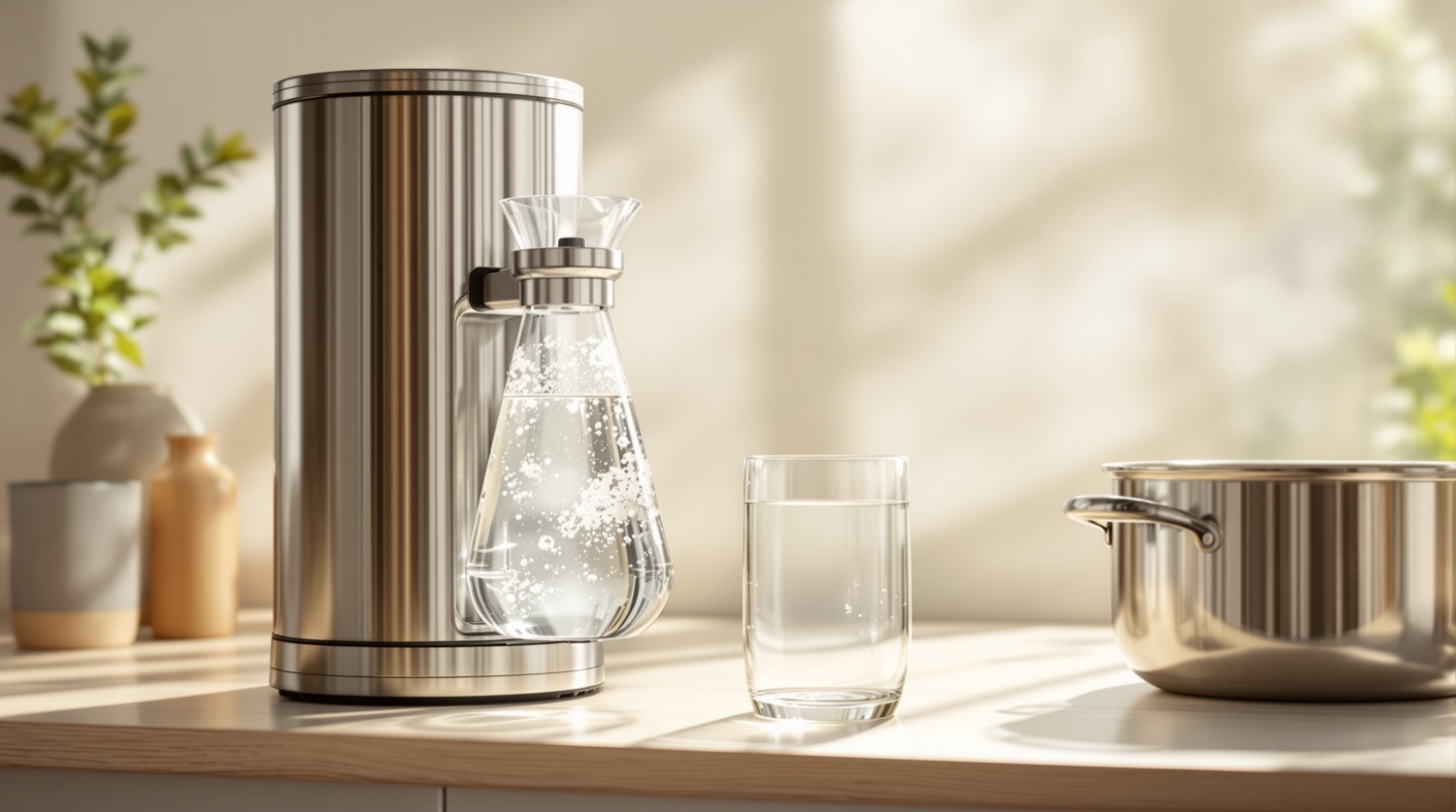
Distilled water is free of almost every contaminant — distillation removes up to 99.5% of impurities, according to University of Nebraska–Lincoln Extension — so it is safe to drink, but it is not a complete drinking water. A World Health Organization review by Frantisek Kozisek (Nutrients in Drinking Water, 2005) found that water this low in minerals raised urine output by almost 20% in volunteers and pulled sodium, potassium, calcium and magnesium out with it, and recommended drinking water carry at least 10 mg/L of magnesium and 20 mg/L of calcium. Distilled water carries close to none. Drink it alongside a mineral-rich diet, store it in glass or stainless steel rather than a plastic jug, and don’t boil vegetables in it.
“Is distilled water safe to drink?” gets two confident, opposite answers online. One camp calls it the purest water you can buy. The other says it “leaches minerals from your bones.” Both are pointing at something real, and neither tells you what to actually do. The honest answer sits in the data: distillation is one of the most thorough ways to strip contaminants — including the plastic particles that turn up in tap and bottled water — and the WHO’s own review of low-mineral water explains exactly where the trade-off lies.
This guide walks through what distillation removes and what it misses, what the WHO review measured in people and animals drinking demineralized water, why cooking in it is a bigger issue than drinking it, why the plastic jug store-bought distilled water comes in undercuts the whole point, and when distilled water is the right choice. If you are deciding between technologies, our water distiller vs reverse osmosis comparison covers the head-to-head.
The short version: distilled water is clean, not complete. It is safe to drink as part of a normal diet. The three real catches are missing minerals, mineral loss when you cook with it, and the plastic it is usually sold in. All three are easy to fix.
What does distillation actually remove from water?
Distillation boils water, collects the steam, and condenses it back into liquid, leaving dissolved solids behind in the boiling chamber. University of Nebraska–Lincoln Extension’s guide Drinking Water Treatment: Distillation (G1493) says the collected water “can have up to 99.5 percent of impurities removed,” including sodium, calcium and magnesium, iron, manganese, fluoride, nitrate, lead, chlorine, chloramines and radionuclides, and that boiling inactivates bacteria, viruses and protozoan cysts.
There is one important gap. The same guide warns that volatile organic compounds such as benzene and toluene, plus some pesticides and solvents that boil at or below water’s boiling point, “will vaporize along with the water” and can carry over into the finished water. Good distillers handle this with a gas vent, a fractional column, or an activated-carbon post-filter. The guide also notes that discarding the first pint (about half a liter) of each batch removes some VOCs.
What about microplastics? Plastic particles are non-volatile solids, the same category of impurity the Nebraska guide says is “not vaporized and left behind in the boiling chamber.” By that principle a distiller should hold back plastic particles along with minerals. We could not find a peer-reviewed test that counted microplastics in the output of a home distiller, so treat that as sound physics rather than a measured result. Where plastic can get back in is after distillation, in the container. That is covered below.
Is it safe to drink distilled water every day?
For a healthy adult eating a normal diet, drinking distilled water is not dangerous. But the WHO evidence says it is not ideal as your only water over years. The concern is not something distilled water adds. It is what it lacks. The WHO chapter defines demineralized water as water with total dissolved solids (TDS) “as low as 1 mg/L.” Typical drinking water carries hundreds of milligrams per liter.
The chapter, written by Frantisek Kozisek of the Czech National Institute of Public Health, reviews research going back to a 1980 WHO-commissioned report from Moscow’s A.N. Sysin Institute. That report concluded that “not only does completely demineralised water (distillate) have unsatisfactory organoleptic properities, but it also has a definite adverse influence on the animal and human organism.” In human volunteers, water low in dissolved solids (under about 100 mg/L) increased urine output “almost by 20%, on average,” lowered blood potassium, and “increased the elimination of sodium, potassium, chloride, calcium and magnesium ions from the body.”
That is the real basis for the “distilled water leaches minerals” claim. It is not that distilled water dissolves your bones. It is that the body has to supply electrolytes to water that arrives with none, and then excretes them. The German Society for Nutrition, cited in the chapter, warned the public against drinking distilled water for this reason. It listed tiredness, weakness and headache as early signs and muscle cramps and an irregular heart rate as more severe ones.
Keep the evidence in proportion. Much of it comes from older Soviet-era animal and volunteer studies and from ecological comparisons of whole towns, which can show an association but not prove cause. The chapter also stresses that food, not water, supplies most of our minerals. What it argues is that the extra minerals in water still matter, because diets are often short on calcium and especially magnesium.
How much calcium and magnesium should drinking water have?
The WHO chapter collects the recommended minimum and optimal levels from researchers and national standards. Distilled water falls below every one of them. That is not a toxicity problem. It is a supply problem, and you can close it with food or by remineralizing.
| Measure | Distilled | Minimum | Optimal |
|---|---|---|---|
| Dissolved solids (TDS) | As low as 1 mg/L | 100 mg/L (1980 WHO report) | 200–400 mg/L (chloride-sulfate waters); 250–500 mg/L (bicarbonate waters) |
| Magnesium | Near zero | 10 mg/L | About 20–30 mg/L |
| Calcium | Near zero | 20 mg/L (30 mg/L in the 1980 report) | About 50 (40–80) mg/L |
| Hardness (Ca + Mg) | Near zero | — | 2–4 mmol/L |
| Bicarbonate | Near zero | 30 mg/L (1980 WHO report) | — |
Source: Kozisek F., “Health risks from drinking demineralised water,” in Nutrients in Drinking Water, WHO, 2005. “Near zero” follows University of Nebraska–Lincoln Extension G1493, which lists “hardness compounds such as calcium and magnesium” and “other dissolved solids” among what distillation removes. — means the source gives no figure.
The chapter also summarizes a large Russian cohort study (Lutai, in the Ust-Ilim region) that followed 7,658 adults, 562 children and 1,582 pregnant women and their newborns in two areas with different water. The authors reported that eating habits, air quality and social conditions did not differ between the areas. The lower-mineral area had higher rates of goiter, hypertension, ischemic heart disease and stomach ulcers.
| Mean level | Lower-mineral town | Higher-mineral town |
|---|---|---|
| Total dissolved solids | 134 mg/L | 385 mg/L |
| Calcium | 18.7 mg/L | 29.5 mg/L |
| Magnesium | 4.9 mg/L | 8.3 mg/L |
| Bicarbonates | 86.4 mg/L | 243.7 mg/L |
Source: Lutai study as summarized in the WHO chapter. Note that even the lower-mineral town’s water held about 134 times more dissolved solids than distilled water can.
Is it safe to cook with distilled water?
Cooking is the bigger problem, and most articles skip it. When you boil vegetables, grains or meat, minerals move out of the food and into the water. The WHO chapter reports that cooking in soft, low-mineral water caused losses of “up to 60 % for magnesium and calcium or even more for some other microelements (e.g., copper 66 %, manganese 70 %, cobalt 86 %).” In hard water those losses were much lower, and some foods even gained calcium.
That matters more than the drinking glass, because most of your minerals come from food. Pour off the pasta water or the vegetable water and those minerals go down the drain. If you distill at home, use the distilled water for drinking, coffee and tea, and cook with ordinary tap water or filtered tap water.
Does store-bought distilled water have microplastics?
The water inside may start out very clean, but nearly all store-bought distilled water is sold in a plastic gallon jug. Bottled drinking water has been tested heavily, and the results are not reassuring. In a 2018 study in Frontiers in Chemistry, Sherri Mason’s team at the State University of New York at Fredonia tested 259 bottles from 11 brands bought in nine countries. They found microplastic contamination in 93% of them, an average of 325 particles per liter including particles down to 6.5 micrometers, and polypropylene (a common bottle-cap plastic) made up 54% of the identified particles.
A 2024 study in PNAS from Columbia University (Qian et al.) used a laser imaging method that can see particles smaller than a micrometer. It estimated about 240,000 plastic particles per liter of bottled water, about 90% of them nanoplastics. That is far more than earlier studies could detect. Neither study tested distilled water jugs specifically, and we found no published test that did. But the plastic contact is the same kind, and our breakdown of microplastics in bottled water covers how shelf time and heat drive shedding.
Distilled water has one more problem. The WHO chapter warns that low-mineral water “is unstable and therefore, highly aggressive to materials with which it comes into contact” and “more readily dissolves metals and some organic substances from pipes, coatings, storage tanks and containers.” The Nebraska Extension guide is blunt about the fix: “Storage containers should be glass or stainless steel.”
Distillation leaves plastic particles behind in the boiling chamber. Then most store-bought distilled water goes into a plastic jug and sits on a warehouse shelf. If you want distilled water for its purity, either make it at home into a glass carafe or move store-bought water into glass or stainless steel as soon as you open it.
When should you use distilled water?
Distilled water does have places where it is the right choice, and two of them have clear federal guidance:
- Neti pots and sinus rinsing. The CDC says to “use store-bought water that is labeled ‘distilled’ or ‘sterile,’” or tap water brought to a rolling boil for 1 minute (3 minutes above 6,500 feet) and then cooled. The goal is to keep waterborne germs out of the nasal passages.
- Infant formula. Distilled water is not required. The CDC says that “most of the time, it’s safe to prepare powdered infant formula by mixing it with tap water,” filtered or unfiltered, and that for babies under 2 months, born before 37 weeks, or with weakened immune systems you should boil the water and wait about 5 minutes before mixing. Separately, the WHO chapter records severe cases (brain swelling, convulsions) in infants whose drinks were prepared with distilled or low-mineral bottled water. That is a good reason not to give a baby plain distilled water as a drink, and to ask your pediatrician before switching. For formula water specifically, see our water filters for baby formula guide.
- Appliances. Humidifiers, steam irons, CPAP humidifier chambers and car batteries benefit from water with no minerals to scale up. Follow each manufacturer’s instructions.
- Drinking, when your tap water is the problem. If your water has nitrate, lead, arsenic or high dissolved solids, distillation is one of the few home methods that handles all of them. Get the water tested first. Our arsenic removal guide explains why.
Is a home water distiller worth it?
A home distiller is worth it if you want water with almost nothing in it, collected straight into glass, and you accept the running cost. The Nebraska Extension guide says operating cost “can be among the highest of available home drinking water treatment systems.” Its worked example is an 1,100-watt unit taking 3 hours per gallon at $0.10/kWh, which costs about $0.33 per gallon in electricity. Countertop batch units typically produce 3 to 10 gallons a day, and a well-maintained distiller lasts 10 to 15 years. Descaling with a 50% vinegar solution keeps it efficient.
The feature that matters most for plastic exposure is the collection container. Pick a unit that drips into a glass carafe, not a plastic jug, and that has a carbon post-filter for VOCs. These are the two glass-carafe units at the top of our full best water distiller ranking:
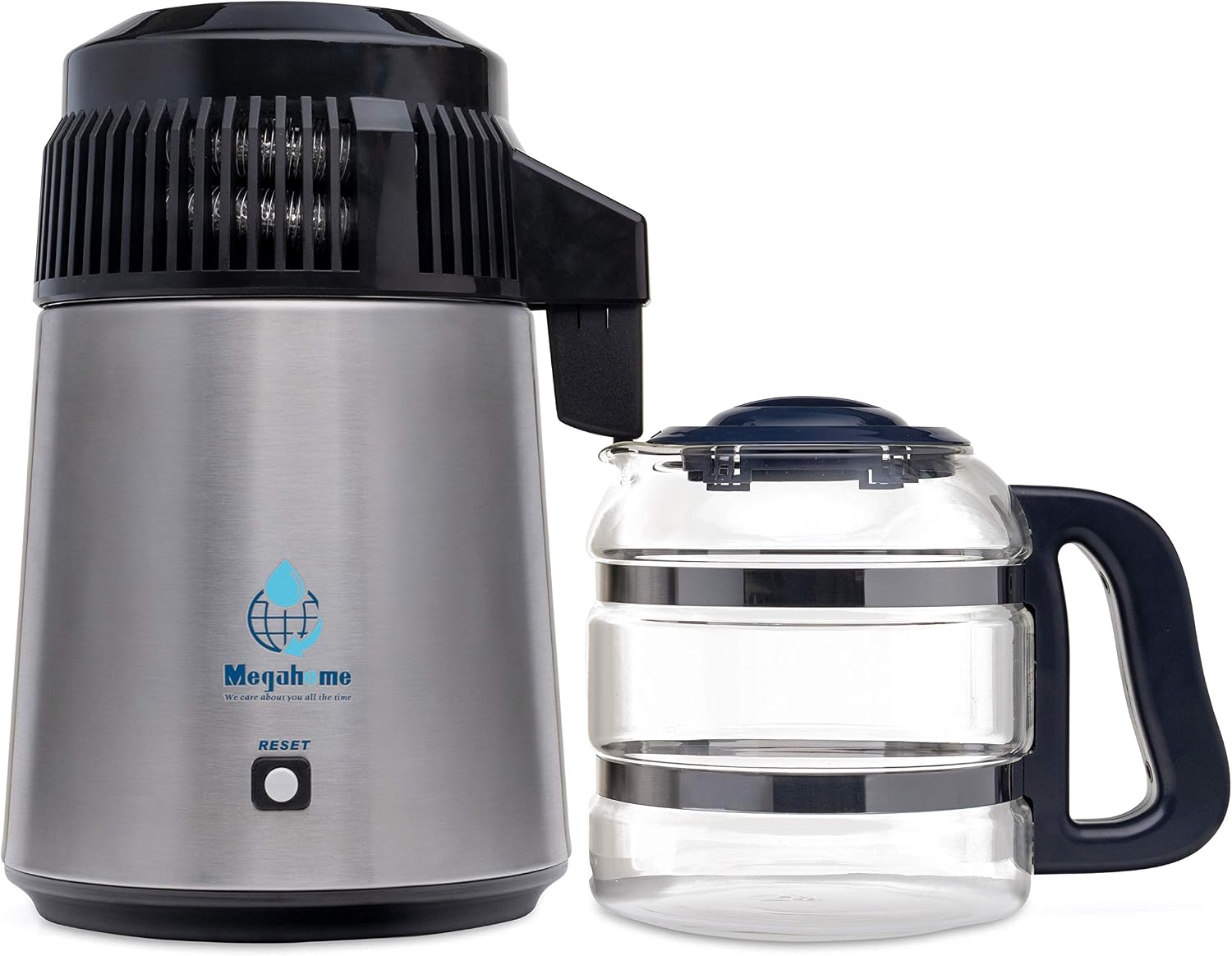 Our Top Distiller
The default pick for making distilled water at home without a plastic jug at the end of the line.
Check Today’s Price on Amazon →Amazon prices change daily — tap to see today’s price.
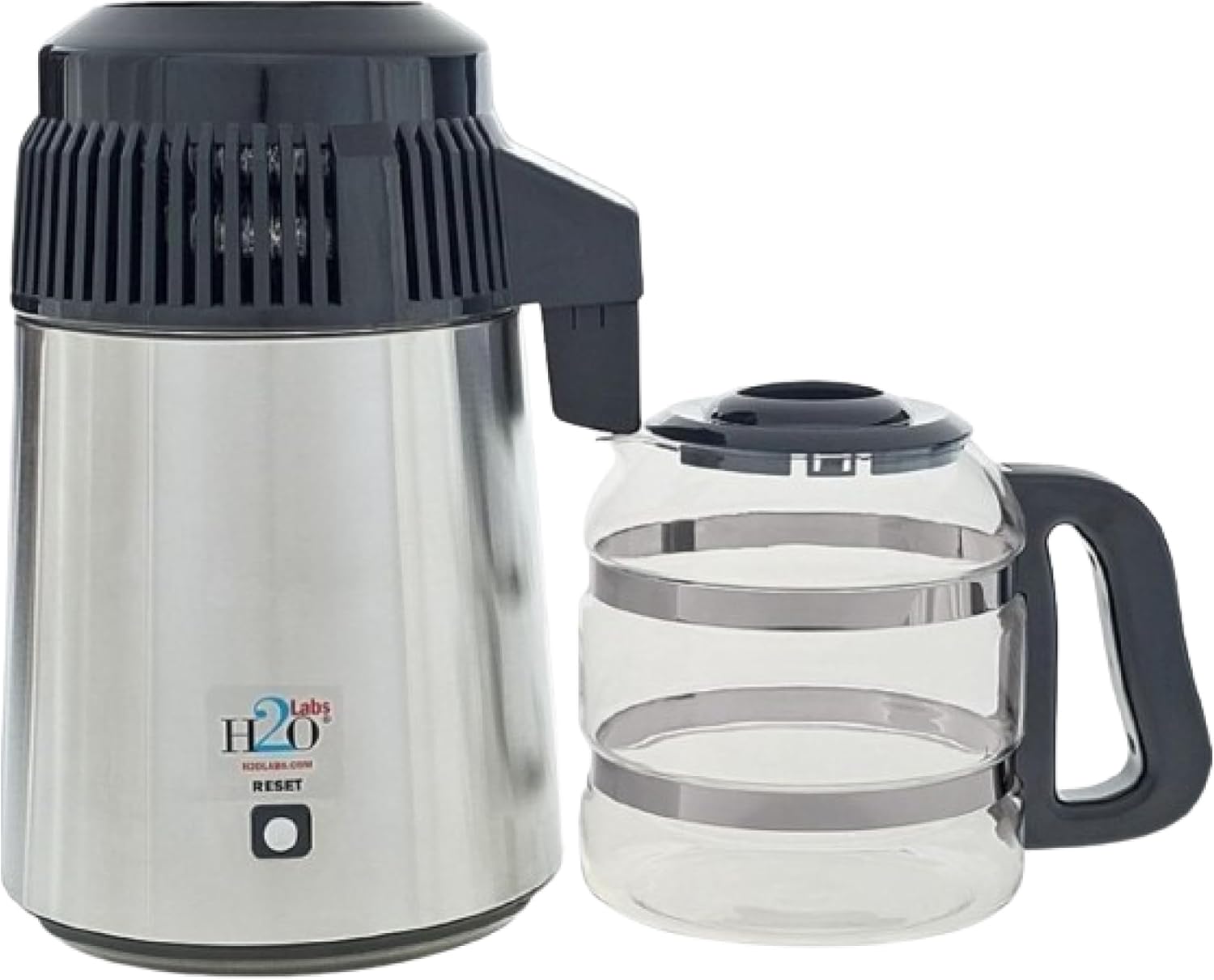 All-Stainless Upgrade
The step-up pick if you use distilled water for a CPAP or want the strictest materials.
Check Today’s Price on Amazon →Amazon prices change daily — tap to see today’s price.
Plasticproof earns a commission on qualifying Amazon purchases through these links, at no cost to you. It never changes what we recommend.
How do you make distilled water healthier to drink?
The fixes follow directly from the evidence above, roughly in order of impact:
- Get your minerals from food. Leafy greens, nuts, seeds, beans, whole grains and dairy cover calcium and magnesium far better than any water. The WHO concern is sharpest for people whose diets are already low in them.
- Drink it, don’t cook with it. Boiling food in low-mineral water can strip up to 60% of its magnesium and calcium. Cook with tap or filtered water.
- Consider remineralizing. The WHO chapter notes that adding calcium and magnesium carbonates to demineralized water is “a common water stabilization practice and is relatively inexpensive.” Mineral drops or a remineralizing cartridge do the same thing at home. Check that the product lists real calcium and magnesium amounts.
- Store it in glass or stainless steel. Distilled water is aggressive toward containers, and plastic jugs are a known microplastic source. A glass carafe or a stainless steel bottle fixes both.
- Handle the VOC gap. Use a distiller with a carbon post-filter or vent, and pour off the first pint of each batch if your source water has solvents or fuel-type contamination.
- Don’t overdo it after hard exercise. The WHO chapter records hyponatremia (dangerously low blood sodium) after intense exertion followed by drinking several liters of low-mineral water. After a long sweaty effort, replace electrolytes too.
The bottom line on drinking distilled water
Is distilled water safe to drink? It is one of the cleanest waters you can make. Distillation removes up to 99.5% of impurities and leaves plastic particles behind with the minerals. The catches are real but manageable. It carries none of the calcium and magnesium the WHO review recommends. It strips minerals out of food you cook in it. And the plastic jug it is usually sold in can add back the plastic you were trying to avoid.
Drink it with a good diet, cook with something else, and keep it in glass or steel. If you are choosing a system, compare reverse osmosis water, which raises similar mineral questions, and our countertop distiller picks.
Make it clean and keep it clean
Distillation does the hard part. Your container decides whether plastic gets back in. Collect into glass, store in steel, and cook with ordinary water.
Frequently Asked Questions
Distilled water is safe for a healthy adult to drink as part of a normal diet. Distillation removes up to 99.5% of impurities, including lead, nitrate and microbes. Its drawback is what it lacks: a WHO review found water this low in minerals increased urine output by almost 20% and electrolyte loss in volunteers, and recommended drinking water carry at least 10 mg/L magnesium and 20 mg/L calcium. Distilled water carries close to none, so eat a mineral-rich diet or remineralize it.
Not from your bones directly, but it does increase mineral loss. In volunteer studies reviewed for the WHO, low-mineral water (under about 100 mg/L dissolved solids) raised urine output by almost 20% and increased the elimination of sodium, potassium, chloride, calcium and magnesium. The body supplies electrolytes to water that arrives without any. A normal diet covers most of this, which is why food matters more than the water.
You can, but it is not a good idea for boiling food. The WHO chapter reports that cooking in low-mineral water caused losses of up to 60% of the magnesium and calcium in vegetables, cereals and meat, and 66% of copper, 70% of manganese and 86% of cobalt. Use distilled water for drinking, coffee and tea, and cook with ordinary or filtered tap water.
Distillation should leave plastic particles behind in the boiling chamber, because they are non-volatile solids, though we found no published test of home distiller output. The bigger risk is the container: store-bought distilled water is usually sold in plastic jugs, and bottled water studies have found an average of 325 microplastic particles per liter (Frontiers in Chemistry, 2018) and about 240,000 particles per liter including nanoplastics (PNAS, 2024). Store distilled water in glass or stainless steel.
For a neti pot, yes: the CDC recommends distilled or sterile water, or tap water boiled for 1 minute and cooled. For powdered infant formula, distilled water is not required. The CDC says tap water is usually safe, and for babies under 2 months, preterm or immunocompromised, you should boil the water and wait about 5 minutes before mixing. Do not give a baby plain distilled water as a drink. Ask your pediatrician first.
Sources
- Kozisek F. “Health risks from drinking demineralised water.” Chapter 12 in Nutrients in Drinking Water. World Health Organization, Geneva, 2005, iris.who.int/handle/10665/43403. Defines demineralized water (TDS as low as 1 mg/L); reports almost 20% higher urine output and higher electrolyte loss on low-mineral water; recommends at least 10 mg/L magnesium and 20 mg/L calcium; reports cooking losses up to 60% for magnesium and calcium; summarizes the 1980 WHO report (minimum TDS 100 mg/L) and the Lutai Ust-Ilim cohort.
- Dvorak BI, Skipton SO. Drinking Water Treatment: Distillation (G1493, revised December 2013). University of Nebraska–Lincoln Extension, extensionpubs.unl.edu/publication/g1493. Up to 99.5% of impurities removed; VOC carryover and fixes; storage in glass or stainless steel; $0.33/gallon worked cost example; 3–10 gallons/day; 10–15 year lifespan.
- Centers for Disease Control and Prevention. “Sinus Rinsing and Naegleria fowleri,” 2025, cdc.gov/naegleria/prevention/sinus-rinsing.html. Use distilled or sterile water, or tap water boiled for 1 minute (3 minutes above 6,500 feet) and cooled.
- Centers for Disease Control and Prevention. “Infant Formula Preparation and Storage,” 2026, cdc.gov/infant-toddler-nutrition/formula-feeding/preparation-and-storage.html. Tap water, filtered or unfiltered, is usually safe for powdered formula; boil and wait about 5 minutes for babies under 2 months, preterm, or immunocompromised.
- Mason SA, Welch VG, Neratko J. “Synthetic Polymer Contamination in Bottled Water.” Frontiers in Chemistry, 2018;6:407, doi.org/10.3389/fchem.2018.00407 (PubMed 30255015). 259 bottles, 11 brands, 9 countries; 93% contaminated; average 325 particles per liter; polypropylene 54% of identified particles.
- Qian N, Gao X, Lang X, et al. “Rapid single-particle chemical imaging of nanoplastics by SRS microscopy.” Proceedings of the National Academy of Sciences, 2024;121(3):e2300582121, doi.org/10.1073/pnas.2300582121 (PubMed 38190543). About 2.4 × 10⁵ plastic particles per liter of bottled water, about 90% nanoplastics.